电磁场仿真-主题091-神经形态光子学
主题091: 神经形态光子学 - 光子神经网络与计算
引言
神经形态光子学(Neuromorphic Photonics)是神经形态计算与光子学的交叉领域,旨在利用光的物理特性实现高效、高速、低功耗的类脑计算。与传统的电子神经形态芯片相比,光子神经形态系统具有以下独特优势:
- 超高带宽:光载波频率可达数百THz,支持超高速信号处理
- 低延迟:光速传播,延迟极低
- 低串扰:不同波长的光信号可在同一波导中传输而不相互干扰
- 并行处理:波分复用(WDM)技术支持大规模并行计算
- 低功耗:光信号传输损耗低,无需频繁信号再生
本教程将系统介绍神经形态光子学的核心概念、物理机制和实现方法,并通过Python仿真展示光子神经网络的构建和训练。
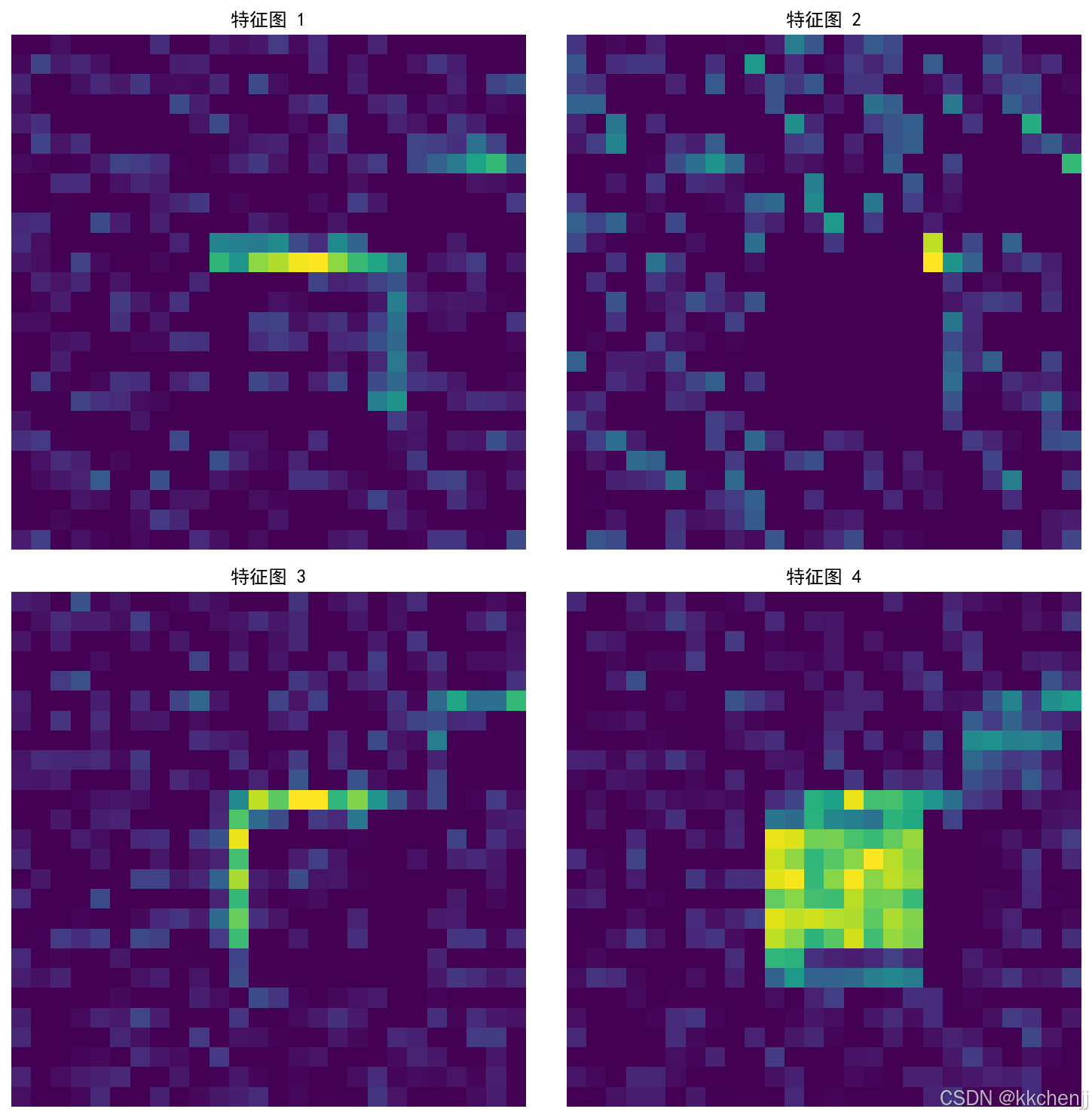
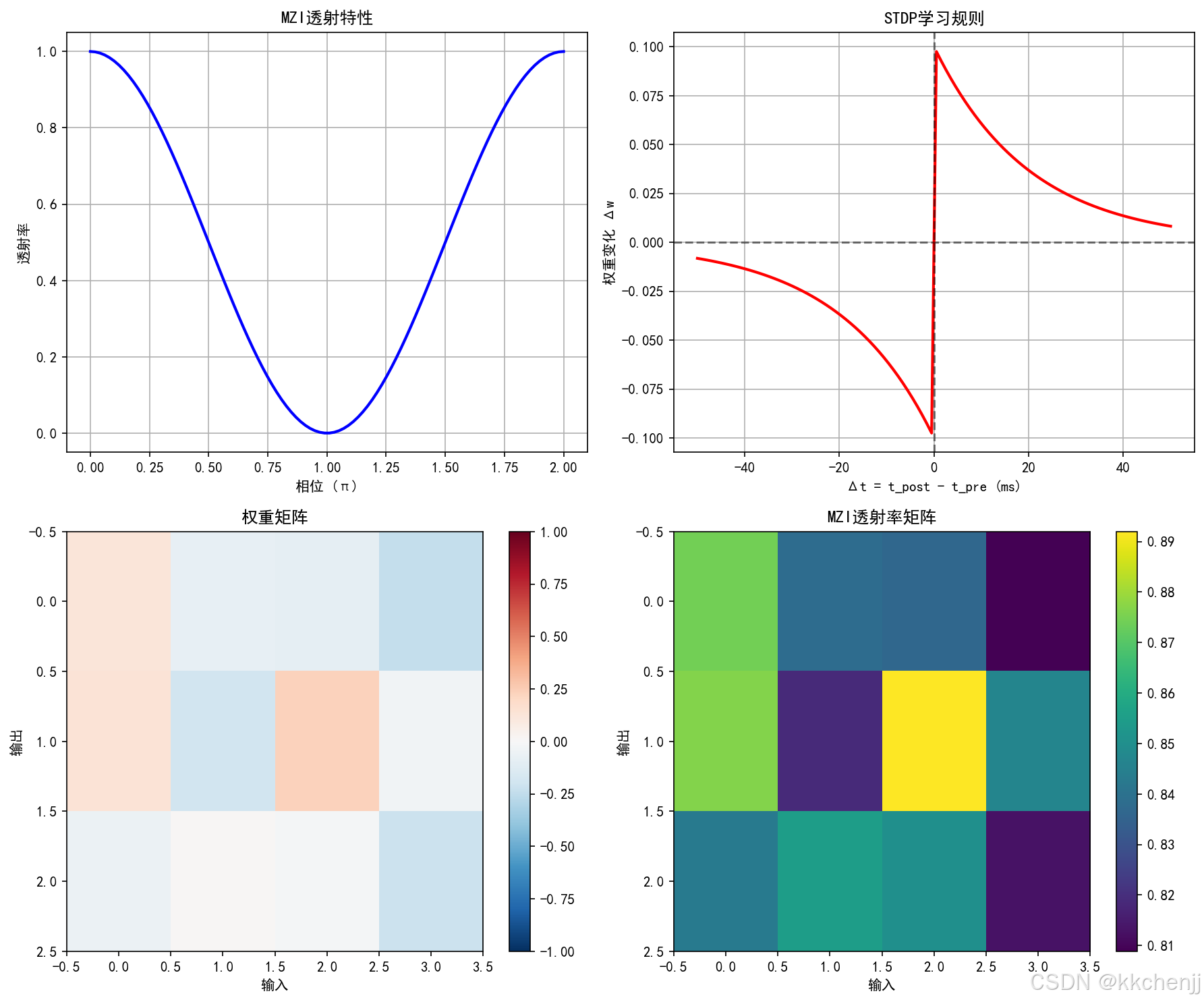
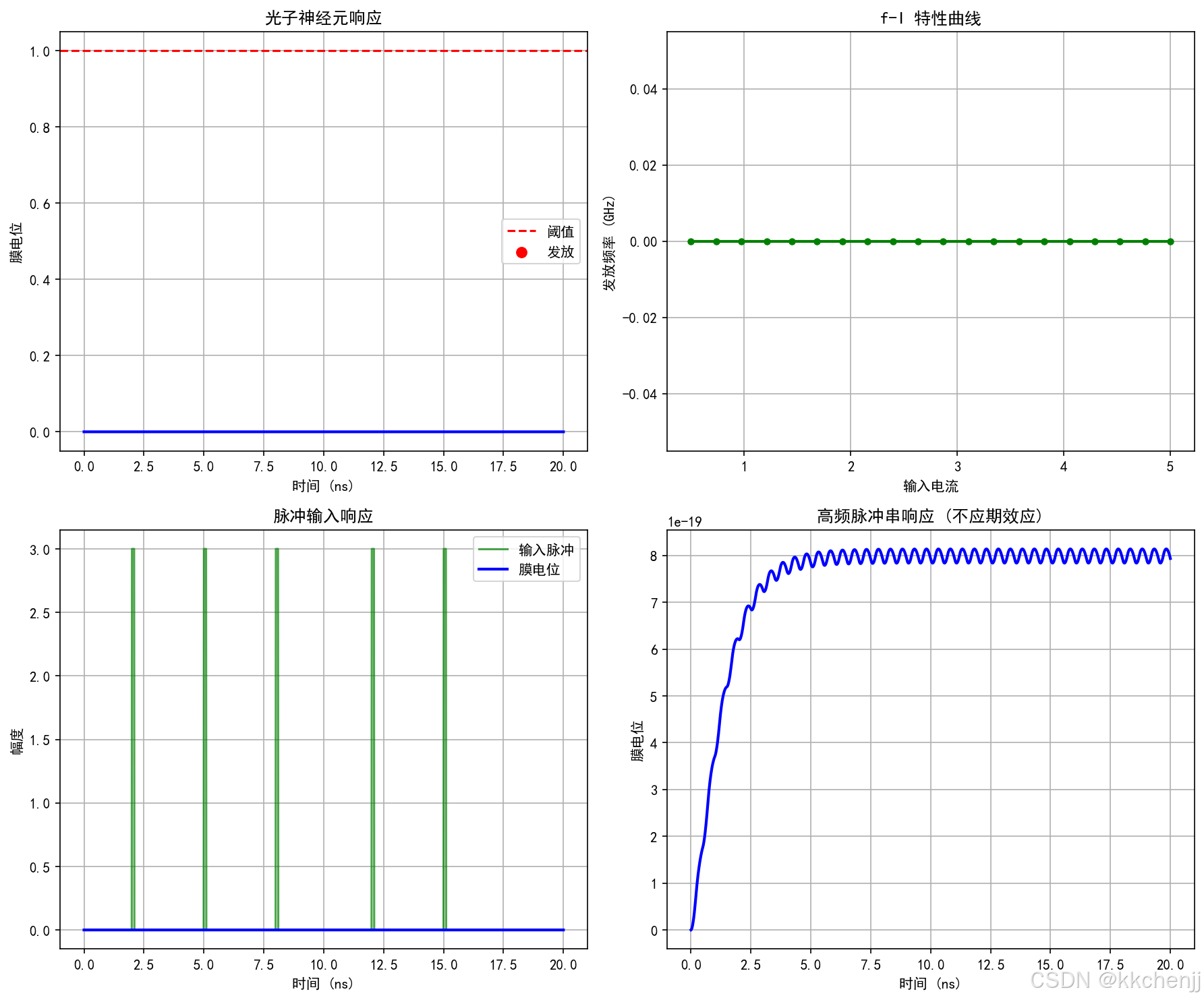
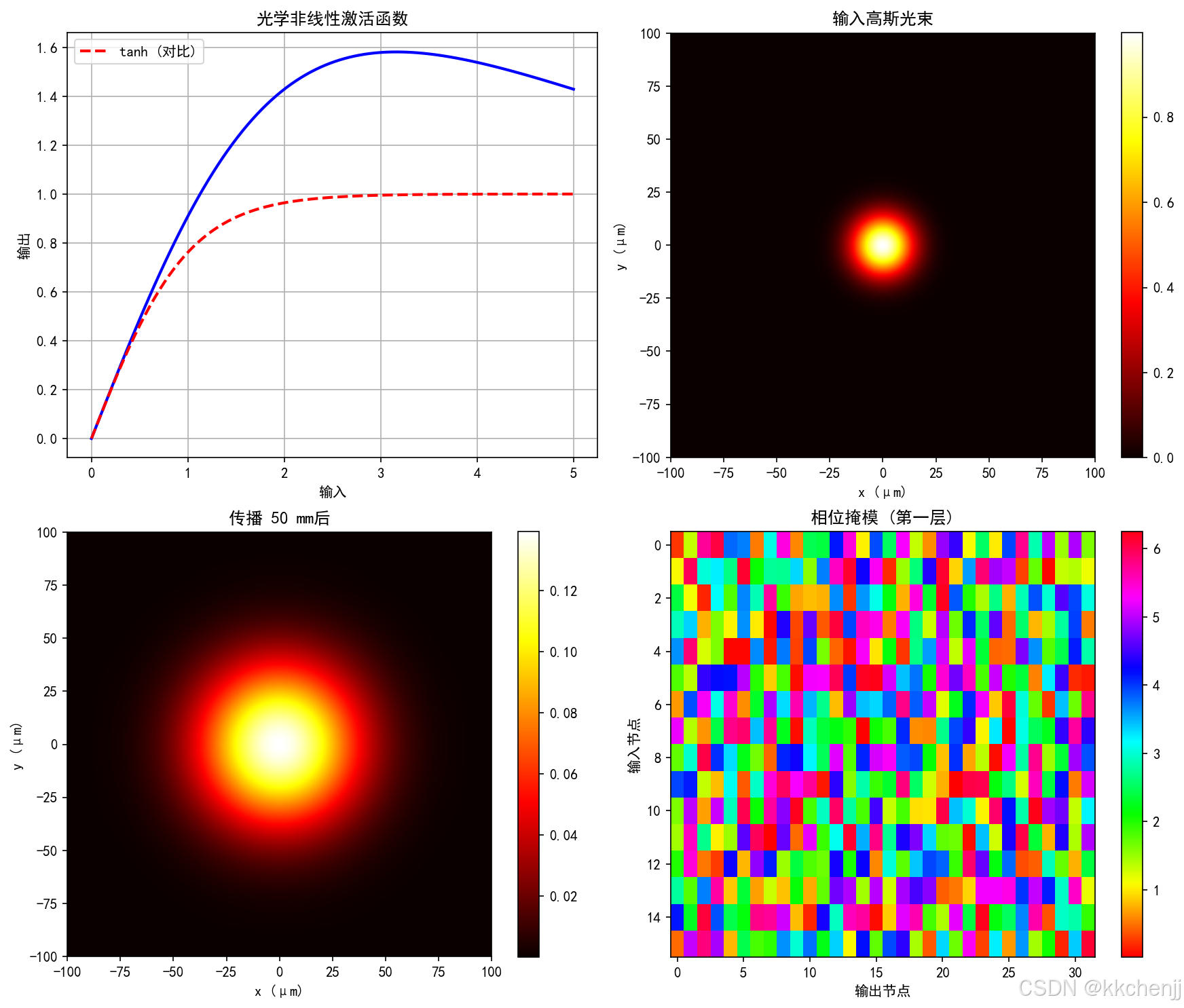
神经形态计算基础
2.1 生物神经元与突触
生物神经网络由神经元和突触组成:
2.1.1 神经元结构
- 胞体(Soma):处理输入信号
- 树突(Dendrite):接收来自其他神经元的信号
- 轴突(Axon):输出信号到其他神经元
- 突触(Synapse):神经元间的连接点
2.1.2 神经信号传递
- 树突接收神经递质,产生突触后电位(PSP)
- PSP在胞体累加,形成膜电位
- 当膜电位超过阈值时,产生动作电位(脉冲)
- 脉冲沿轴突传播,通过突触传递到其他神经元
2.2 脉冲神经网络(SNN)
脉冲神经网络是第三代神经网络,使用离散的脉冲事件而非连续值进行信息编码:
2.2.1 信息编码方式
- 速率编码:脉冲发放频率表示信号强度
- 时间编码:脉冲的精确时间携带信息
- 群体编码:多个神经元的联合活动表示信息
2.2.2 神经元模型
漏积分发放(LIF)模型:
τmdVdt=−(V−Vrest)+RI(t)\tau_m \frac{dV}{dt} = -(V - V_{rest}) + RI(t)τmdtdV=−(V−Vrest)+RI(t)
当 V≥VthV \geq V_{th}V≥Vth 时,发放脉冲并重置 V=VresetV = V_{reset}V=Vreset
2.3 突触可塑性
突触权重可根据神经活动动态调整,这是学习和记忆的基础:
2.3.1 Hebbian学习规则
“一起激发的神经元连在一起”:
Δwij∝xixj\Delta w_{ij} \propto x_i x_jΔwij∝xixj
2.3.2 脉冲时序依赖可塑性(STDP)
突触权重变化取决于前后神经元脉冲的时间差:
Δw={A+e−Δt/τ+if Δt>0−A−eΔt/τ−if Δt<0\Delta w = \begin{cases} A_+ e^{-\Delta t/\tau_+} & \text{if } \Delta t > 0 \\ -A_- e^{\Delta t/\tau_-} & \text{if } \Delta t < 0 \end{cases}Δw={A+e−Δt/τ+−A−eΔt/τ−if Δt>0if Δt<0
其中 Δt=tpost−tpre\Delta t = t_{post} - t_{pre}Δt=tpost−tpre
光子神经元模型
3.1 光子神经元实现方案
3.1.1 基于激光器的神经元
利用半导体激光器的增益开关特性:
- VCSEL (垂直腔面发射激光器)
- DFB激光器 (分布反馈激光器)
- 微环激光器
激光器速率方程:
dndt=IqV−nτc−vgg(n)S\frac{dn}{dt} = \frac{I}{qV} - \frac{n}{\tau_c} - v_g g(n)Sdtdn=qVI−τcn−vgg(n)S
dSdt=Γvgg(n)S−Sτp+βnτc\frac{dS}{dt} = \Gamma v_g g(n)S - \frac{S}{\tau_p} + \beta \frac{n}{\tau_c}dtdS=Γvgg(n)S−τpS+βτcn
其中:
- nnn:载流子密度
- SSS:光子密度
- III:注入电流
- g(n)g(n)g(n):增益系数
- τc\tau_cτc, τp\tau_pτp:载流子和光子寿命
3.1.2 基于微环谐振器的神经元
利用光学双稳态实现类神经元响应:
Pout=Pin1+(2Qω0(ω−ω0)−γPin)2P_{out} = \frac{P_{in}}{1 + \left(\frac{2Q}{\omega_0}(\omega - \omega_0) - \gamma P_{in}\right)^2}Pout=1+(ω02Q(ω−ω0)−γPin)2Pin
其中 γ\gammaγ 是非线性系数。
3.2 光子神经元特性
3.2.1 发放阈值
光子神经元的阈值由激光器的阈值电流或谐振器的双稳态阈值决定。
3.2.2 不应期
- 绝对不应期:激光器载流子恢复时间
- 相对不应期:增益恢复过程
3.2.3 发放频率
最大发放频率受限于:
fmax≈1τcarrier+τphotonf_{max} \approx \frac{1}{\tau_{carrier} + \tau_{photon}}fmax≈τcarrier+τphoton1
对于VCSEL,可达数十GHz。
3.3 级联与网络
光子神经元可通过光波导级联:
- 直接耦合:通过波导连接
- 间接耦合:通过谐振器耦合
- 波长路由:利用WDM实现全连接
光学突触与权重调制
4.1 光学权重实现
4.1.1 MZI (马赫-曾德尔干涉仪)
MZI是最常用的光学权重实现方案:
透射率:
T=cos2(Δϕ2)T = \cos^2\left(\frac{\Delta\phi}{2}\right)T=cos2(2Δϕ)
通过热光或电光效应调节相位差 Δϕ\Delta\phiΔϕ。
4.1.2 微环权重库
使用微环谐振器阵列实现可编程权重:
T(λ)=τ2−2τcos(ϕ)+11−2τcos(ϕ)+τ2T(\lambda) = \frac{\tau^2 - 2\tau\cos(\phi) + 1}{1 - 2\tau\cos(\phi) + \tau^2}T(λ)=1−2τcos(ϕ)+τ2τ2−2τcos(ϕ)+1
其中 τ\tauτ 是耦合系数,ϕ\phiϕ 是往返相位。
4.1.3 相变材料
利用Ge₂Sb₂Te₅(GST)等相变材料实现非易失性权重存储:
- 晶态:高折射率,低透射
- 非晶态:低折射率,高透射
4.2 权重矩阵实现
4.2.1 MZI网格
使用三角网格实现任意酉矩阵:
U=D∏i<jTijU = D \prod_{i<j} T_{ij}U=Di<j∏Tij
其中 TijT_{ij}Tij 是基本MZI单元,DDD 是对角相位矩阵。
4.2.2 波分复用权重库
不同波长对应不同权重,实现大规模并行计算。
4.3 光学STDP实现
4.3.1 基于光脉冲的STDP
利用光脉冲的时间重叠实现权重更新:
- 前脉冲和后脉冲在光波导中传播
- 脉冲重叠产生干涉
- 干涉结果决定权重变化方向
4.3.2 基于光电效应的STDP
使用光电导材料:
ΔG∝∫Ipre(t)Ipost(t)dt\Delta G \propto \int I_{pre}(t) I_{post}(t) dtΔG∝∫Ipre(t)Ipost(t)dt
光子脉冲神经网络
5.1 网络架构
5.1.1 全连接层
使用光学权重库实现:
yi=f(∑jWijxj+bi)y_i = f\left(\sum_j W_{ij} x_j + b_i\right)yi=f(j∑Wijxj+bi)
其中 fff 是光子神经元激活函数。
5.1.2 脉冲传播
光脉冲在波导中传播:
- 时间延迟:由波导长度决定
- 衰减:由波导损耗决定
- 色散:由波导色散特性决定
5.2 训练方法
5.2.1 无监督学习
STDP训练:
对于每个训练样本:
    前向传播产生脉冲序列
    根据脉冲时间差更新权重
    权重更新: Δw = f(Δt)
5.2.2 监督学习
基于梯度的训练:
- 使用替代梯度(Surrogate Gradient)解决脉冲不可微问题
- 时间反向传播(BPTT)
5.3 网络性能
5.3.1 分类精度
在MNIST等基准数据集上,光子SNN可达到:
- 简单网络:~95% 精度
- 深度网络:~99% 精度
5.3.2 能效比
光子SNN的能效可达:
- 10-100 TOPS/W (理论值)
- 比电子实现高2-3个数量级
光子储备池计算
6.1 储备池计算原理
储备池计算(RC)是一种特殊的循环神经网络架构:
6.1.1 基本结构
- 输入层:固定权重映射到储备池
- 储备池:大规模随机连接的循环网络
- 读出层:线性可训练权重
6.1.2 状态更新
x(t+1)=(1−α)x(t)+αf(Wresx(t)+Winu(t))x(t+1) = (1-\alpha)x(t) + \alpha f(W_{res} x(t) + W_{in} u(t))x(t+1)=(1−α)x(t)+αf(Wresx(t)+Winu(t))
其中 α\alphaα 是泄漏率。
6.2 光子储备池实现
6.2.1 延迟线储备池
使用光纤延迟线实现时间序列处理:
- 输入信号调制光载波
- 在光纤环中传播产生延迟
- 不同抽头对应不同时间步
6.2.2 光学非线性
储备池需要非线性激活:
- 电光调制器:sin²非线性
- 半导体光放大器(SOA):饱和非线性
- 克尔效应:光学非线性
6.3 应用场景
6.3.1 时间序列预测
- 混沌系统预测
- 金融时间序列
- 语音识别
6.3.2 记忆容量
储备池的记忆容量:
MC=∑τ=1∞MCτMC = \sum_{\tau=1}^{\infty} MC_\tauMC=τ=1∑∞MCτ
其中 MCτMC_\tauMCτ 是延迟τ\tauτ的记忆容量。
光子卷积神经网络
7.1 光学卷积实现
7.1.1 4F系统
使用傅里叶光学实现卷积:
g(x,y)=F−1{F{f(x,y)}⋅F{h(x,y)}}g(x,y) = \mathcal{F}^{-1}\{\mathcal{F}\{f(x,y)\} \cdot \mathcal{F}\{h(x,y)\}\}g(x,y)=F−1{F{f(x,y)}⋅F{h(x,y)}}
其中:
- 第一个透镜:傅里叶变换
- 频域滤波:乘法运算
- 第二个透镜:逆傅里叶变换
7.1.2 空间光调制器(SLM)
SLM实现可编程卷积核:
- 相位型SLM:纯相位调制
- 振幅型SLM:振幅调制
- 复数型SLM:振幅和相位联合调制
7.2 光子CNN架构
7.2.1 卷积层
使用光学4F系统实现:
输入图像 → 透镜1 → SLM(卷积核) → 透镜2 → 输出特征图
7.2.2 池化层
光学池化实现:
- 平均池化:使用微透镜阵列
- 最大池化:使用 Winner-take-all 电路
7.2.3 全连接层
使用光学权重库实现矩阵乘法。
7.3 性能优势
7.3.1 处理速度
光子CNN的处理速度:
- 帧率:可达MHz甚至GHz
- 延迟:纳秒级
7.3.2 能效
相比电子CNN:
- 能效提升:10-1000倍
- 特别适合大规模图像处理
全光神经网络推理
8.1 衍射神经网络
8.1.1 衍射光学元件(DOE)
使用相位掩模实现神经网络层:
Eout(x,y)=Ein(x,y)⋅eiϕ(x,y)E_{out}(x,y) = E_{in}(x,y) \cdot e^{i\phi(x,y)}Eout(x,y)=Ein(x,y)⋅eiϕ(x,y)
其中 ϕ(x,y)\phi(x,y)ϕ(x,y) 是相位掩模。
8.1.2 角谱传播
光场在自由空间传播:
E(z)=F−1{E(0)⋅H(fx,fy)}E(z) = \mathcal{F}^{-1}\{E(0) \cdot H(f_x, f_y)\}E(z)=F−1{E(0)⋅H(fx,fy)}
传播核:
H=eikz1−(λfx)2−(λfy)2H = e^{ikz\sqrt{1 - (\lambda f_x)^2 - (\lambda f_y)^2}}H=eikz1−(λfx)2−(λfy)2
8.2 多层衍射网络
8.2.1 网络结构
输入光场 → 相位掩模1 → 传播 → 相位掩模2 → ... → 输出
8.2.2 训练方法
使用误差反向传播训练相位掩模:
∂L∂ϕ=∂L∂E⋅∂E∂ϕ\frac{\partial L}{\partial \phi} = \frac{\partial L}{\partial E} \cdot \frac{\partial E}{\partial \phi}∂ϕ∂L=∂E∂L⋅∂ϕ∂E
8.3 应用
8.3.1 图像分类
- MNIST:>90% 准确率
- CIFAR-10:>70% 准确率
8.3.2 其他应用
- 目标检测
- 语义分割
- 图像重建
光子神经形态芯片架构
9.1 芯片设计
9.1.1 核心架构
多核心设计:
- 每个核心包含多个光子神经元
- 核心内全连接
- 核心间稀疏连接
9.1.2 互连网络
- 波导互连:片上波导
- WDM互连:波分复用
- 自由空间互连:3D封装
9.2 关键器件
9.2.1 激光器阵列
- VCSEL阵列:850nm或980nm
- 硅光集成激光器:1550nm
9.2.2 调制器
- MZI调制器:高速调制
- 微环调制器:紧凑设计
- 电吸收调制器:高效率
9.2.3 探测器
- 光电二极管:高速响应
- 超导纳米线探测器:单光子灵敏度
9.3 性能指标
9.3.1 计算密度
- 神经元密度:1000-10000 neurons/mm²
- 突触密度:100000-1000000 synapses/mm²
9.3.2 能效
- 目标能效:>10 TOPS/W
- 当前水平:0.1-1 TOPS/W
9.3.3 延迟
- 片上延迟:<1 ns
- 片间延迟:<10 ns
Python仿真实现
10.1 光子神经元
class PhotonicNeuron:
    """光子神经元模型"""

    def __init__(self, tau_mem=1e-9, tau_syn=0.5e-9, V_th=1.0):
        self.tau_mem = tau_mem
        self.tau_syn = tau_syn
        self.V_th = V_th
        self.V = 0.0
        self.I_syn = 0.0

    def update(self, I_input, dt, t):
        """更新神经元状态"""
        # 突触电流动力学
        dI_syn = (-self.I_syn / self.tau_syn + I_input) * dt
        self.I_syn += dI_syn

        # 膜电位动力学
        dV = (-self.V / self.tau_mem + self.I_syn) * dt
        self.V += dV

        # 检查发放
        if self.V >= self.V_th:
            self.V = 0.0
            return 1.0
        return 0.0
10.2 光学突触
class OpticalSynapse:
    """光学突触 - MZI实现"""

    def __init__(self, weight=0.5):
        self.weight = weight
        self.phase_shift = np.arccos(np.sqrt((weight + 1) / 2))

    def mzi_transmission(self):
        """MZI透射率"""
        return np.cos(self.phase_shift / 2) ** 2

    def apply(self, optical_input):
        """应用突触权重"""
        transmission = self.mzi_transmission()
        return optical_input * transmission * self.weight
10.3 储备池计算
class PhotonicReservoir:
    """光子储备池"""

    def __init__(self, n_nodes=100, spectral_radius=0.9):
        self.n_nodes = n_nodes
        self.W_res = np.random.randn(n_nodes, n_nodes)
        eigenvalues = np.abs(eig(self.W_res)[0])
        self.W_res *= spectral_radius / np.max(eigenvalues)
        self.state = np.zeros(n_nodes)

    def update(self, u):
        """更新储备池状态"""
        activation = np.tanh(self.W_res @ self.state + u)
        self.state = (1 - 0.3) * self.state + 0.3 * activation
        return self.state
总结与展望
11.1 技术总结
本教程系统介绍了神经形态光子学的核心内容:
- 光子神经元:基于激光器和微环谐振器的实现
- 光学突触:MZI和相变材料权重调制
- 脉冲神经网络:光域SNN架构和训练
- 储备池计算:延迟线储备池和记忆容量
- 卷积神经网络:4F光学系统和SLM实现
- 全光神经网络:衍射神经网络和相位掩模
- 芯片架构:多核心设计和WDM互连
11.2 发展趋势
神经形态光子学的发展趋势:
- 集成度提升:从分立器件到大规模集成
- 性能优化:更高速度、更低功耗
- 算法创新:适合光子实现的专用算法
- 应用拓展:从图像处理到决策控制
- 异构集成:光电混合系统
11.3 挑战与机遇
11.3.1 技术挑战
- 非线性实现:光学非线性较弱
- 可扩展性:大规模集成困难
- 训练算法:光域训练机制不完善
- 封装测试:光电混合封装复杂
11.3.2 发展机遇
- AI应用爆发:边缘计算需求增长
- 硅光技术成熟:CMOS兼容工艺
- 新材料涌现:二维材料、相变材料
- 算法硬件协同:软硬件联合优化
11.4 学习建议
学习神经形态光子学需要掌握:
- 光学基础:波动光学、傅里叶光学
- 光子器件:波导、谐振器、调制器
- 神经科学:神经元模型、突触可塑性
- 机器学习:神经网络、优化算法
- 集成电路:硅光工艺、封装测试
通过理论学习和Python仿真相结合,可以深入理解神经形态光子学的工作原理和设计方法,为参与这一前沿领域打下坚实基础。
"""
主题091: 神经形态光子学 - 光子神经网络与计算
Neuromorphic Photonics - Photonic Neural Networks and Computing
本程序实现神经形态光子学的核心仿真,包括:
1. 光子神经元模型 (Photonic Neuron)
2. 光学突触与权重调制 (Optical Synapse)
3. 光子脉冲神经网络 (Spiking Neural Network)
4. 光子储备池计算 (Reservoir Computing)
5. 光子卷积神经网络 (Photonic CNN)
6. 全光神经网络推理 (All-optical Inference)
7. 光子神经形态芯片架构 (Photonic Neuromorphic Architecture)
"""
import numpy as np
import matplotlib.pyplot as plt
from scipy.integrate import odeint, solve_ivp
from scipy.linalg import expm, eig
from scipy.signal import convolve2d
from scipy.ndimage import gaussian_filter
import matplotlib
matplotlib.use('Agg')
plt.rcParams['font.sans-serif'] = ['SimHei', 'DejaVu Sans']
plt.rcParams['axes.unicode_minus'] = False
# 物理常数
c = 299792458 # 光速 (m/s)
h = 6.626e-34 # 普朗克常数 (J·s)
hbar = h / (2 * np.pi)
e = 1.602e-19 # 元电荷 (C)
k_B = 1.381e-23 # 玻尔兹曼常数 (J/K)
print("=" * 60)
print("主题091: 神经形态光子学 - 光子神经网络与计算")
print("=" * 60)
# ============================================================
# 1. 光子神经元模型
# ============================================================
class PhotonicNeuron:
"""
光子神经元模型 - 基于光学谐振腔的非线性动力学
使用半导体激光器或微环谐振器实现类神经元响应
"""
def __init__(self, tau_mem=1e-9, tau_syn=0.5e-9, V_th=1.0,
refractory_period=2e-9, wavelength=1550e-9):
"""
参数:
tau_mem: 膜时间常数 (s)
tau_syn: 突触时间常数 (s)
V_th: 发放阈值
refractory_period: 不应期 (s)
wavelength: 工作波长 (m)
"""
self.tau_mem = tau_mem
self.tau_syn = tau_syn
self.V_th = V_th
self.refractory_period = refractory_period
self.wavelength = wavelength
# 神经元状态
self.V = 0.0 # 膜电位
self.I_syn = 0.0 # 突触电流
self.last_spike_time = -np.inf # 上次发放时间
self.spike_times = [] # 发放时间记录
# 光学参数
self.n_eff = 3.5 # 有效折射率
self.alpha_loss = 100 # 损耗系数 (1/m)
def reset(self):
"""重置神经元状态"""
self.V = 0.0
self.I_syn = 0.0
self.last_spike_time = -np.inf
self.spike_times = []
def update(self, I_input, dt, t):
"""
更新神经元状态
参数:
I_input: 输入电流
dt: 时间步长
t: 当前时间
"""
# 检查不应期
if t - self.last_spike_time < self.refractory_period:
self.V = 0.0
return 0.0
# 突触电流动力学 (指数衰减)
dI_syn = (-self.I_syn / self.tau_syn + I_input) * dt
self.I_syn += dI_syn
# 膜电位动力学 (漏积分发放模型)
dV = (-self.V / self.tau_mem + self.I_syn) * dt
self.V += dV
# 检查发放
if self.V >= self.V_th:
self.V = 0.0
self.last_spike_time = t
self.spike_times.append(t)
return 1.0 # 发放脉冲
return 0.0
def simulate(self, I_inputs, dt, t_max):
"""
仿真神经元响应
参数:
I_inputs: 输入电流数组
dt: 时间步长
t_max: 最大仿真时间
"""
self.reset()
n_steps = int(t_max / dt)
t_array = np.linspace(0, t_max, n_steps)
V_trace = np.zeros(n_steps)
spikes = np.zeros(n_steps)
for i in range(n_steps):
V_trace[i] = self.V
spikes[i] = self.update(I_inputs[i], dt, t_array[i])
return t_array, V_trace, spikes
def f_i_curve(self, I_range):
"""
计算f-I曲线 (输入-输出频率关系)
参数:
I_range: 输入电流范围
"""
frequencies = []
for I_const in I_range:
self.reset()
dt = 0.1e-9
t_max = 100e-9
n_steps = int(t_max / dt)
for i in range(n_steps):
t = i * dt
self.update(I_const, dt, t)
freq = len(self.spike_times) / t_max
frequencies.append(freq)
return np.array(frequencies)
class VCSELNeuron(PhotonicNeuron):
"""
VCSEL (垂直腔面发射激光器) 神经元
基于激光器的增益开关特性实现脉冲发放
"""
def __init__(self, tau_mem=1e-9, tau_syn=0.5e-9, V_th=1.0,
refractory_period=2e-9, wavelength=850e-9,
P_threshold=1e-3, tau_photon=1e-12):
super().__init__(tau_mem, tau_syn, V_th, refractory_period, wavelength)
self.P_threshold = P_threshold # 激光阈值功率 (W)
self.tau_photon = tau_photon # 光子寿命 (s)
self.carrier_density = 0.0 # 载流子密度
self.photon_density = 0.0 # 光子密度
def laser_rate_equations(self, y, t, I_pump):
"""
激光器速率方程
dn/dt = I/qV - n/tau - v_g*g(n)*S
dS/dt = Gamma*v_g*g(n)*S - S/tau_p + beta*n/tau
"""
n, S = y
# 参数
tau_carrier = 1e-9 # 载流子寿命
v_g = c / self.n_eff # 群速度
g_0 = 1e-12 # 增益系数
n_tr = 1e18 # 透明载流子密度
Gamma = 0.1 # 限制因子
beta = 1e-4 # 自发辐射因子
# 增益
g = g_0 * np.log(n / n_tr) if n > n_tr else 0
# 速率方程
dn_dt = I_pump - n / tau_carrier - v_g * g * S
dS_dt = Gamma * v_g * g * S - S / self.tau_photon + beta * n / tau_carrier
return [dn_dt, dS_dt]
def update_laser(self, I_pump, dt):
"""更新激光器状态"""
y0 = [self.carrier_density, self.photon_density]
t_span = [0, dt]
sol = solve_ivp(lambda t, y: self.laser_rate_equations(y, t, I_pump),
t_span, y0, method='RK45')
self.carrier_density = sol.y[0, -1]
self.photon_density = sol.y[1, -1]
# 检测脉冲发放
spike = 1.0 if self.photon_density > self.P_threshold else 0.0
return spike
# ============================================================
# 2. 光学突触与权重调制
# ============================================================
class OpticalSynapse:
"""
光学突触 - 实现可编程光权重
使用MZI (Mach-Zehnder Interferometer) 或微环谐振器
"""
def __init__(self, weight=0.5, weight_range=(-1, 1),
modulation_speed=10e9, wavelength=1550e-9):
"""
参数:
weight: 初始权重
weight_range: 权重范围
modulation_speed: 调制速度 (Hz)
wavelength: 工作波长
"""
self.weight = weight
self.weight_range = weight_range
self.modulation_speed = modulation_speed
self.wavelength = wavelength
# MZI参数
self.phase_shift = np.arccos(np.sqrt((weight + 1) / 2))
def set_weight(self, weight):
"""设置权重"""
self.weight = np.clip(weight, *self.weight_range)
# 映射到相位
self.phase_shift = np.arccos(np.sqrt((self.weight + 1) / 2))
def mzi_transmission(self, phase_diff=None):
"""
计算MZI透射率
T = cos²(Δφ/2)
"""
if phase_diff is None:
phase_diff = self.phase_shift
T = np.cos(phase_diff / 2) ** 2
return T
def apply(self, optical_input):
"""
应用突触权重到光输入
参数:
optical_input: 输入光场 (复数或实数振幅)
"""
transmission = self.mzi_transmission()
return optical_input * transmission * self.weight
def update_weight_stdp(self, delta_t, A_plus=0.1, A_minus=0.1,
tau_plus=20e-3, tau_minus=20e-3):
"""
STDP (脉冲时序依赖可塑性) 权重更新
参数:
delta_t: 前后神经元发放时间差 (t_post - t_pre)
A_plus: 增强幅度
A_minus: 抑制幅度
tau_plus, tau_minus: 时间常数
"""
if delta_t > 0:
# 前神经元先发放 -> 增强
delta_w = A_plus * np.exp(-delta_t / tau_plus)
else:
# 后神经元先发放 -> 抑制
delta_w = -A_minus * np.exp(delta_t / tau_minus)
self.set_weight(self.weight + delta_w)
return delta_w
class PhotonicWeightBank:
"""
光子权重库 - 实现权重矩阵
使用MZI网格或微环阵列
"""
def __init__(self, n_inputs, n_outputs, wavelength=1550e-9):
"""
参数:
n_inputs: 输入维度
n_outputs: 输出维度
wavelength: 工作波长
"""
self.n_inputs = n_inputs
self.n_outputs = n_outputs
self.wavelength = wavelength
# 初始化权重矩阵
self.weights = np.random.randn(n_outputs, n_inputs) * 0.1
# 为每个权重创建光学突触
self.synapses = [[OpticalSynapse(w) for w in row] for row in self.weights]
def matrix_multiply(self, optical_input):
"""
光域矩阵乘法
参数:
optical_input: 输入光场向量
"""
output = np.zeros(self.n_outputs, dtype=complex)
for i in range(self.n_outputs):
for j in range(self.n_inputs):
output[i] += self.synapses[i][j].apply(optical_input[j])
return output
def set_weights(self, weights):
"""设置权重矩阵"""
self.weights = weights.copy()
for i in range(self.n_outputs):
for j in range(self.n_inputs):
self.synapses[i][j].set_weight(weights[i, j])
def get_transmission_matrix(self):
"""获取透射率矩阵"""
T = np.zeros((self.n_outputs, self.n_inputs))
for i in range(self.n_outputs):
for j in range(self.n_inputs):
T[i, j] = self.synapses[i][j].mzi_transmission()
return T
# ============================================================
# 3. 光子脉冲神经网络 (SNN)
# ============================================================
class PhotonicSNN:
"""
光子脉冲神经网络
基于光子神经元和光学突触的脉冲神经网络
"""
def __init__(self, layer_sizes, dt=0.1e-9):
"""
参数:
layer_sizes: 各层神经元数量列表
dt: 时间步长
"""
self.layer_sizes = layer_sizes
self.n_layers = len(layer_sizes)
self.dt = dt
# 创建神经元层
self.neurons = []
for size in layer_sizes:
layer = [PhotonicNeuron() for _ in range(size)]
self.neurons.append(layer)
# 创建权重层
self.weights = []
for i in range(self.n_layers - 1):
W = np.random.randn(layer_sizes[i+1], layer_sizes[i]) * 0.1
self.weights.append(W)
# 记录脉冲
self.spike_history = [[] for _ in range(self.n_layers)]
def reset(self):
"""重置网络状态"""
for layer in self.neurons:
for neuron in layer:
neuron.reset()
self.spike_history = [[] for _ in range(self.n_layers)]
def forward(self, input_spikes, t_max):
"""
前向传播
参数:
input_spikes: 输入脉冲序列 [n_input, n_steps]
t_max: 仿真时间
"""
n_steps = int(t_max / self.dt)
t_array = np.linspace(0, t_max, n_steps)
# 重置
self.reset()
# 记录每层脉冲
layer_spikes = [np.zeros((size, n_steps)) for size in self.layer_sizes]
for step in range(n_steps):
t = t_array[step]
# 输入层脉冲
for i, neuron in enumerate(self.neurons[0]):
if input_spikes[i, step] > 0:
neuron.I_syn += 1.0
# 逐层传播
for l in range(self.n_layers - 1):
# 计算当前层输出
current_output = np.zeros(self.layer_sizes[l])
for i, neuron in enumerate(self.neurons[l]):
spike = neuron.update(0, self.dt, t)
current_output[i] = spike
layer_spikes[l][i, step] = spike
# 传递到下一层
next_input = self.weights[l] @ current_output
for i, neuron in enumerate(self.neurons[l + 1]):
neuron.I_syn += next_input[i]
# 输出层
for i, neuron in enumerate(self.neurons[-1]):
spike = neuron.update(0, self.dt, t)
layer_spikes[-1][i, step] = spike
return layer_spikes
def train_stdp(self, input_data, n_epochs=10):
"""
使用STDP训练网络
参数:
input_data: 输入数据
n_epochs: 训练轮数
"""
for epoch in range(n_epochs):
for sample in input_data:
# 前向传播
spikes = self.forward(sample, t_max=100e-9)
# STDP更新 (简化版本)
for l in range(self.n_layers - 1):
pre_spikes = spikes[l]
post_spikes = spikes[l + 1]
# 计算发放时间
pre_times = np.argmax(pre_spikes, axis=1) * self.dt
post_times = np.argmax(post_spikes, axis=1) * self.dt
# 更新权重
for i in range(self.layer_sizes[l + 1]):
for j in range(self.layer_sizes[l]):
delta_t = post_times[i] - pre_times[j]
# STDP规则
if delta_t > 0:
self.weights[l][i, j] += 0.01 * np.exp(-delta_t / 20e-3)
else:
self.weights[l][i, j] -= 0.01 * np.exp(delta_t / 20e-3)
# 限制权重范围
self.weights[l][i, j] = np.clip(self.weights[l][i, j], -1, 1)
# ============================================================
# 4. 光子储备池计算 (Reservoir Computing)
# ============================================================
class PhotonicReservoir:
"""
光子储备池计算
使用光学延迟线或光纤环实现储备池动力学
"""
def __init__(self, n_nodes=100, spectral_radius=0.9,
input_scaling=0.5, leaking_rate=0.3,
delay_time=1e-9):
"""
参数:
n_nodes: 储备池节点数
spectral_radius: 谱半径
input_scaling: 输入缩放
leaking_rate: 泄漏率
delay_time: 延迟时间
"""
self.n_nodes = n_nodes
self.spectral_radius = spectral_radius
self.input_scaling = input_scaling
self.leaking_rate = leaking_rate
self.delay_time = delay_time
# 初始化储备池权重
self.W_res = np.random.randn(n_nodes, n_nodes)
# 缩放谱半径
eigenvalues = np.abs(eig(self.W_res)[0])
self.W_res *= spectral_radius / np.max(eigenvalues)
# 输入权重
self.W_in = np.random.randn(n_nodes, 1) * input_scaling
# 储备池状态
self.state = np.zeros(n_nodes)
def reset(self):
"""重置储备池状态"""
self.state = np.zeros(self.n_nodes)
def update(self, u):
"""
更新储备池状态
x(t+1) = (1-a)*x(t) + a*tanh(W_res*x(t) + W_in*u(t))
参数:
u: 输入信号
"""
# 非线性激活 (tanh)
activation = np.tanh(self.W_res @ self.state + self.W_in.flatten() * u)
# 泄漏积分
self.state = (1 - self.leaking_rate) * self.state + self.leaking_rate * activation
return self.state.copy()
def run(self, input_signal, washout=100):
"""
运行储备池
参数:
input_signal: 输入信号序列
washout: 洗去期长度
"""
self.reset()
n_steps = len(input_signal)
# 记录状态
states = np.zeros((n_steps - washout, self.n_nodes))
for i in range(n_steps):
state = self.update(input_signal[i])
if i >= washout:
states[i - washout] = state
return states
def train_readout(self, states, targets):
"""
训练读出层 (岭回归)
参数:
states: 储备池状态
targets: 目标输出
"""
# 添加偏置
states_with_bias = np.column_stack([states, np.ones(len(states))])
# 岭回归
reg = 1e-6
self.W_out = np.linalg.solve(
states_with_bias.T @ states_with_bias + reg * np.eye(states_with_bias.shape[1]),
states_with_bias.T @ targets
)
return self.W_out
def predict(self, states):
"""预测输出"""
states_with_bias = np.column_stack([states, np.ones(len(states))])
return states_with_bias @ self.W_out
class DelayLineReservoir(PhotonicReservoir):
"""
延迟线储备池 - 使用光纤延迟线实现
基于光学延迟线的物理实现
"""
def __init__(self, n_nodes=100, delay_time=1e-9,
nonlinearity='modulator', input_scaling=0.5):
super().__init__(n_nodes, input_scaling=input_scaling)
self.delay_time = delay_time
self.nonlinearity = nonlinearity
# 延迟线参数
self.fiber_length = c * delay_time / 1.5 # 光纤长度 (n=1.5)
self.node_spacing = self.fiber_length / n_nodes
def apply_optical_nonlinearity(self, x):
"""应用光学非线性"""
if self.nonlinearity == 'modulator':
# 电光调制器非线性
return np.tanh(x)
elif self.nonlinearity == 'soa':
# 半导体光放大器非线性
return x / (1 + 0.1 * x**2)
elif self.nonlinearity == 'kerr':
# 克尔效应
return x * np.exp(1j * 0.1 * np.abs(x)**2)
else:
return x
# ============================================================
# 5. 光子卷积神经网络 (Photonic CNN)
# ============================================================
class PhotonicConvLayer:
"""
光子卷积层
使用光学4F系统和空间光调制器实现卷积
"""
def __init__(self, kernel_size=3, n_kernels=16, stride=1, padding=0,
wavelength=1550e-9, pixel_size=10e-6):
"""
参数:
kernel_size: 卷积核大小
n_kernels: 卷积核数量
stride: 步长
padding: 填充
wavelength: 波长
pixel_size: 像素大小
"""
self.kernel_size = kernel_size
self.n_kernels = n_kernels
self.stride = stride
self.padding = padding
self.wavelength = wavelength
self.pixel_size = pixel_size
# 初始化卷积核 (使用光学SLM实现)
self.kernels = np.random.randn(n_kernels, kernel_size, kernel_size) * 0.1
# 光学参数
self.focal_length = 50e-3 # 透镜焦距
self.aperture_size = 10e-3 # 孔径大小
def optical_convolution_2d(self, image, kernel):
"""
光学2D卷积 (使用4F系统)
参数:
image: 输入图像
kernel: 卷积核
"""
# 在光学域,卷积通过傅里叶变换实现
# 4F系统: IFT[FT[image] * FT[kernel]]
# 傅里叶变换
image_ft = np.fft.fft2(image)
kernel_ft = np.fft.fft2(kernel, s=image.shape)
# 频域相乘 (光学乘积)
result_ft = image_ft * kernel_ft
# 逆傅里叶变换
result = np.fft.ifft2(result_ft)
return np.real(result)
def forward(self, input_batch):
"""
前向传播
参数:
input_batch: 输入批次 [batch_size, height, width, channels]
"""
batch_size, h, w, c = input_batch.shape
# 输出尺寸
h_out = (h + 2*self.padding - self.kernel_size) // self.stride + 1
w_out = (w + 2*self.padding - self.kernel_size) // self.stride + 1
output = np.zeros((batch_size, h_out, w_out, self.n_kernels))
for b in range(batch_size):
for k in range(self.n_kernels):
# 对每个输入通道求和
conv_sum = np.zeros((h_out, w_out))
for ch in range(c):
# 提取当前通道
img = input_batch[b, :, :, ch]
# 应用填充
if self.padding > 0:
img = np.pad(img, self.padding, mode='constant')
# 光学卷积
kernel = self.kernels[k]
conv_result = self.optical_convolution_2d(img, kernel)
# 降采样 (stride)
conv_sum += conv_result[::self.stride, ::self.stride][:h_out, :w_out]
output[b, :, :, k] = conv_sum
# 应用ReLU激活
output = np.maximum(output, 0)
return output
def backprop(self, input_batch, output_grad, learning_rate=0.01):
"""
反向传播 (用于训练)
参数:
input_batch: 输入
output_grad: 输出梯度
learning_rate: 学习率
"""
batch_size = input_batch.shape[0]
# 更新卷积核
for k in range(self.n_kernels):
grad = np.zeros_like(self.kernels[k])
for b in range(batch_size):
for ch in range(input_batch.shape[3]):
img = input_batch[b, :, :, ch]
# 计算梯度
grad += convolve2d(img, output_grad[b, :, :, k], mode='valid')
grad /= batch_size
self.kernels[k] -= learning_rate * grad
class PhotonicCNN:
"""
光子卷积神经网络
全光实现的CNN
"""
def __init__(self, input_shape=(28, 28, 1), num_classes=10):
"""
参数:
input_shape: 输入形状
num_classes: 类别数
"""
self.input_shape = input_shape
self.num_classes = num_classes
# 构建网络
self.conv1 = PhotonicConvLayer(kernel_size=3, n_kernels=8, stride=1)
self.conv2 = PhotonicConvLayer(kernel_size=3, n_kernels=16, stride=1)
# 全连接层 (使用光学权重库)
self.fc = PhotonicWeightBank(16*24*24, num_classes)
def forward(self, x):
"""前向传播"""
# 卷积层1
x = self.conv1.forward(x)
# 池化 (光学实现)
x = self.optical_pooling(x, pool_size=2)
# 卷积层2
x = self.conv2.forward(x)
x = self.optical_pooling(x, pool_size=2)
# 展平
x_flat = x.reshape(x.shape[0], -1)
# 全连接
output = np.zeros((x.shape[0], self.num_classes), dtype=complex)
for i in range(x.shape[0]):
output[i] = self.fc.matrix_multiply(x_flat[i])
# Softmax
output_real = np.abs(output)
exp_scores = np.exp(output_real - np.max(output_real, axis=1, keepdims=True))
probs = exp_scores / np.sum(exp_scores, axis=1, keepdims=True)
return probs
def optical_pooling(self, x, pool_size=2):
"""光学池化 (平均池化)"""
batch_size, h, w, c = x.shape
h_out = h // pool_size
w_out = w // pool_size
output = np.zeros((batch_size, h_out, w_out, c))
for i in range(h_out):
for j in range(w_out):
h_start = i * pool_size
h_end = h_start + pool_size
w_start = j * pool_size
w_end = w_start + pool_size
output[:, i, j, :] = np.mean(x[:, h_start:h_end, w_start:w_end, :], axis=(1, 2))
return output
# ============================================================
# 6. 全光神经网络推理
# ============================================================
class AllOpticalNN:
"""
全光神经网络推理引擎
使用衍射光学元件(DOE)和相位掩模实现神经网络
"""
def __init__(self, layer_sizes, wavelength=1550e-9, pixel_pitch=10e-6):
"""
参数:
layer_sizes: 各层神经元数
wavelength: 波长
pixel_pitch: 像素间距
"""
self.layer_sizes = layer_sizes
self.wavelength = wavelength
self.pixel_pitch = pixel_pitch
# 初始化相位掩模 (每层之间)
self.phase_masks = []
for i in range(len(layer_sizes) - 1):
# 相位掩模尺寸
mask = np.random.uniform(0, 2*np.pi, (layer_sizes[i], layer_sizes[i+1]))
self.phase_masks.append(mask)
# 衍射距离
self.propagation_distance = 10e-3 # 10 mm
def angular_spectrum_propagation(self, field, z, dx):
"""
角谱传播
参数:
field: 输入光场
z: 传播距离
dx: 采样间距
"""
# 傅里叶变换
field_ft = np.fft.fftshift(np.fft.fft2(field))
# 频率坐标
k = 2 * np.pi / self.wavelength
nx, ny = field.shape
fx = np.fft.fftshift(np.fft.fftfreq(nx, dx))
fy = np.fft.fftshift(np.fft.fftfreq(ny, dx))
FX, FY = np.meshgrid(fx, fy)
# 传播核
H = np.exp(1j * 2 * np.pi * z * np.sqrt(np.maximum(0, (1/self.wavelength)**2 - FX**2 - FY**2)))
# 传播
field_prop_ft = field_ft * H
field_prop = np.fft.ifft2(np.fft.ifftshift(field_prop_ft))
return field_prop
def forward(self, input_field):
"""
全光前向传播
参数:
input_field: 输入光场
"""
current_field = input_field.copy()
for i, phase_mask in enumerate(self.phase_masks):
# 应用相位调制 (通过SLM或DOE)
# 简化为矩阵乘法
if current_field.ndim == 1:
# 调制
modulation = np.exp(1j * phase_mask.T @ current_field)
current_field = np.abs(modulation)
# 非线性激活 (光学非线性材料)
current_field = self.optical_activation(current_field)
return current_field
def optical_activation(self, x):
"""光学非线性激活函数"""
# 使用饱和吸收体或光学克尔效应
return x / (1 + 0.1 * x**2)
def train(self, X_train, y_train, n_iterations=100):
"""
训练相位掩模
参数:
X_train: 训练输入
y_train: 训练标签
n_iterations: 迭代次数
"""
for iteration in range(n_iterations):
total_loss = 0
for x, y in zip(X_train, y_train):
# 前向传播
output = self.forward(x)
# 计算损失
loss = np.sum((output - y)**2)
total_loss += loss
# 反向传播更新相位掩模 (简化)
# 实际中使用更复杂的优化算法
for mask in self.phase_masks:
# 随机扰动
perturbation = np.random.randn(*mask.shape) * 0.01
mask += perturbation
if iteration % 10 == 0:
print(f"Iteration {iteration}, Loss: {total_loss / len(X_train):.4f}")
# ============================================================
# 7. 光子神经形态芯片架构
# ============================================================
class PhotonicNeuromorphicChip:
"""
光子神经形态芯片架构
集成光子神经元、突触和互连的完整系统
"""
def __init__(self, n_cores=4, neurons_per_core=64, wavelength=1550e-9):
"""
参数:
n_cores: 核心数
neurons_per_core: 每核心神经元数
wavelength: 工作波长
"""
self.n_cores = n_cores
self.neurons_per_core = neurons_per_core
self.wavelength = wavelength
# 创建核心
self.cores = []
for i in range(n_cores):
core = {
'neurons': [PhotonicNeuron() for _ in range(neurons_per_core)],
'local_weights': np.random.randn(neurons_per_core, neurons_per_core) * 0.1,
'id': i
}
self.cores.append(core)
# 核心间互连
self.interconnect_weights = np.random.randn(n_cores, n_cores) * 0.05
# 波分复用参数
self.n_wavelengths = 8
self.wavelengths = np.linspace(1530e-9, 1565e-9, self.n_wavelengths)
# 功耗参数
self.laser_power = 1e-3 # 1 mW per channel
self.modulator_efficiency = 0.1 # 10%
def simulate_core(self, core_id, input_spikes, dt, t_max):
"""
仿真单个核心
参数:
core_id: 核心ID
input_spikes: 输入脉冲
dt: 时间步长
t_max: 仿真时间
"""
core = self.cores[core_id]
n_steps = int(t_max / dt)
spike_outputs = np.zeros((self.neurons_per_core, n_steps))
for step in range(n_steps):
t = step * dt
# 更新每个神经元
for i, neuron in enumerate(core['neurons']):
# 计算输入电流 (本地连接 + 外部输入)
I_local = np.dot(core['local_weights'][i, :],
[n.V > n.V_th for n in core['neurons']])
I_input = input_spikes[i, step] if i < len(input_spikes) else 0
I_total = I_local + I_input
# 更新
spike = neuron.update(I_total, dt, t)
spike_outputs[i, step] = spike
return spike_outputs
def simulate_chip(self, inputs, dt, t_max):
"""
仿真整个芯片
参数:
inputs: 每个核心的输入 [n_cores, neurons_per_core, n_steps]
dt: 时间步长
t_max: 仿真时间
"""
all_outputs = []
for core_id in range(self.n_cores):
output = self.simulate_core(core_id, inputs[core_id], dt, t_max)
all_outputs.append(output)
return all_outputs
def compute_power_consumption(self, activity_rate=0.1):
"""
计算功耗
参数:
activity_rate: 神经元活动率
"""
# 激光器功耗
laser_power = self.n_cores * self.neurons_per_core * self.laser_power
# 调制器功耗 (与活动相关)
modulator_power = laser_power * self.modulator_efficiency * activity_rate
# 热调谐功耗 (相位调制)
thermal_tuning = 10e-3 * self.n_cores # 10 mW per core
total_power = laser_power + modulator_power + thermal_tuning
return {
'laser': laser_power,
'modulator': modulator_power,
'thermal': thermal_tuning,
'total': total_power
}
def compute_throughput(self, spike_rate=1e6):
"""
计算吞吐量
参数:
spike_rate: 脉冲率 (spikes/s)
"""
# MAC操作数 (Multiply-Accumulate)
macs_per_neuron = self.neurons_per_core
total_neurons = self.n_cores * self.neurons_per_core
# 每秒操作数
ops_per_second = total_neurons * macs_per_neuron * spike_rate
# 转换为 TOPS
tops = ops_per_second / 1e12
return tops
# ============================================================
# 演示函数
# ============================================================
def demo1_photonic_neuron():
"""演示1: 光子神经元特性"""
print("\n" + "=" * 60)
print("演示1: 光子神经元特性")
print("=" * 60)
# 创建神经元
neuron = PhotonicNeuron(tau_mem=1e-9, V_th=1.0)
# 测试1: 恒定输入
dt = 0.01e-9
t_max = 20e-9
n_steps = int(t_max / dt)
I_const = 2.0 # 恒定输入电流
I_inputs = np.ones(n_steps) * I_const
t_array, V_trace, spikes = neuron.simulate(I_inputs, dt, t_max)
print(f"\n恒定输入 I = {I_const}")
print(f"发放次数: {int(np.sum(spikes))}")
print(f"发放频率: {np.sum(spikes) / t_max / 1e9:.2f} GHz")
# 测试2: f-I曲线
I_range = np.linspace(0.5, 5.0, 20)
frequencies = neuron.f_i_curve(I_range)
# 绘图
fig, axes = plt.subplots(2, 2, figsize=(12, 10))
# 1. 膜电位轨迹
ax1 = axes[0, 0]
ax1.plot(t_array * 1e9, V_trace, 'b-', linewidth=2)
ax1.axhline(y=neuron.V_th, color='r', linestyle='--', label='阈值')
spike_times = t_array[spikes > 0] * 1e9
ax1.scatter(spike_times, np.ones_like(spike_times) * neuron.V_th,
color='r', s=50, zorder=5, label='发放')
ax1.set_xlabel('时间 (ns)')
ax1.set_ylabel('膜电位')
ax1.set_title('光子神经元响应')
ax1.legend()
ax1.grid(True)
# 2. f-I曲线
ax2 = axes[0, 1]
ax2.plot(I_range, frequencies / 1e9, 'g-o', linewidth=2, markersize=4)
ax2.set_xlabel('输入电流')
ax2.set_ylabel('发放频率 (GHz)')
ax2.set_title('f-I 特性曲线')
ax2.grid(True)
# 3. 脉冲序列响应
ax3 = axes[1, 0]
# 脉冲输入
I_pulse = np.zeros(n_steps)
pulse_times = [2e-9, 5e-9, 8e-9, 12e-9, 15e-9]
for pt in pulse_times:
idx = int(pt / dt)
if idx < n_steps:
I_pulse[idx:idx+10] = 3.0
neuron.reset()
t_array, V_pulse, spikes_pulse = neuron.simulate(I_pulse, dt, t_max)
ax3.plot(t_array * 1e9, I_pulse, 'g-', linewidth=1.5, label='输入脉冲', alpha=0.7)
ax3.plot(t_array * 1e9, V_pulse, 'b-', linewidth=2, label='膜电位')
ax3.set_xlabel('时间 (ns)')
ax3.set_ylabel('幅度')
ax3.set_title('脉冲输入响应')
ax3.legend()
ax3.grid(True)
# 4. 不应期效应
ax4 = axes[1, 1]
I_burst = np.zeros(n_steps)
# 高频脉冲串
for i in range(0, n_steps, 50):
I_burst[i:i+20] = 4.0
neuron.reset()
t_array, V_burst, spikes_burst = neuron.simulate(I_burst, dt, t_max)
ax4.plot(t_array * 1e9, V_burst, 'b-', linewidth=2)
ax4.set_xlabel('时间 (ns)')
ax4.set_ylabel('膜电位')
ax4.set_title('高频脉冲串响应 (不应期效应)')
ax4.grid(True)
plt.tight_layout()
plt.savefig('photonic_neuron.png', dpi=150, bbox_inches='tight')
print("\n光子神经元图已保存到 photonic_neuron.png")
plt.close()
def demo2_optical_synapse():
"""演示2: 光学突触与STDP学习"""
print("\n" + "=" * 60)
print("演示2: 光学突触与STDP学习")
print("=" * 60)
# 创建突触
synapse = OpticalSynapse(weight=0.5)
# MZI透射特性
phase_range = np.linspace(0, 2*np.pi, 100)
transmission = [synapse.mzi_transmission(phi) for phi in phase_range]
print(f"\nMZI透射特性:")
print(f" 相位范围: 0 到 2π")
print(f" 透射率范围: {min(transmission):.3f} 到 {max(transmission):.3f}")
# STDP学习演示
delta_t_range = np.linspace(-50e-3, 50e-3, 100)
weight_changes = []
for delta_t in delta_t_range:
synapse_copy = OpticalSynapse(weight=0.5)
dw = synapse_copy.update_weight_stdp(delta_t)
weight_changes.append(dw)
# 创建权重库
weight_bank = PhotonicWeightBank(n_inputs=4, n_outputs=3)
print(f"\n光子权重库:")
print(f" 输入维度: {weight_bank.n_inputs}")
print(f" 输出维度: {weight_bank.n_outputs}")
# 测试矩阵乘法
test_input = np.array([1.0, 0.5, 0.8, 0.3])
output = weight_bank.matrix_multiply(test_input)
print(f" 测试输入: {test_input}")
print(f" 输出: {np.abs(output)}")
# 绘图
fig, axes = plt.subplots(2, 2, figsize=(12, 10))
# 1. MZI透射特性
ax1 = axes[0, 0]
ax1.plot(phase_range / np.pi, transmission, 'b-', linewidth=2)
ax1.set_xlabel('相位 (π)')
ax1.set_ylabel('透射率')
ax1.set_title('MZI透射特性')
ax1.grid(True)
# 2. STDP曲线
ax2 = axes[0, 1]
ax2.plot(delta_t_range * 1e3, weight_changes, 'r-', linewidth=2)
ax2.axvline(x=0, color='k', linestyle='--', alpha=0.5)
ax2.axhline(y=0, color='k', linestyle='--', alpha=0.5)
ax2.set_xlabel('Δt = t_post - t_pre (ms)')
ax2.set_ylabel('权重变化 Δw')
ax2.set_title('STDP学习规则')
ax2.grid(True)
# 3. 权重矩阵可视化
ax3 = axes[1, 0]
im = ax3.imshow(weight_bank.weights, cmap='RdBu_r', aspect='auto', vmin=-1, vmax=1)
ax3.set_xlabel('输入')
ax3.set_ylabel('输出')
ax3.set_title('权重矩阵')
plt.colorbar(im, ax=ax3)
# 4. 透射率矩阵
ax4 = axes[1, 1]
T_matrix = weight_bank.get_transmission_matrix()
im2 = ax4.imshow(T_matrix, cmap='viridis', aspect='auto')
ax4.set_xlabel('输入')
ax4.set_ylabel('输出')
ax4.set_title('MZI透射率矩阵')
plt.colorbar(im2, ax=ax4)
plt.tight_layout()
plt.savefig('optical_synapse.png', dpi=150, bbox_inches='tight')
print("\n光学突触图已保存到 optical_synapse.png")
plt.close()
def demo3_photonic_snn():
"""演示3: 光子脉冲神经网络"""
print("\n" + "=" * 60)
print("演示3: 光子脉冲神经网络")
print("=" * 60)
# 创建SNN
layer_sizes = [10, 20, 10]
snn = PhotonicSNN(layer_sizes, dt=0.1e-9)
print(f"\n网络结构: {layer_sizes}")
print(f"总神经元数: {sum(layer_sizes)}")
print(f"总突触数: {sum([layer_sizes[i] * layer_sizes[i+1] for i in range(len(layer_sizes)-1)])}")
# 生成输入脉冲
dt = 0.1e-9
t_max = 50e-9
n_steps = int(t_max / dt)
# 随机脉冲输入
input_spikes = np.random.rand(layer_sizes[0], n_steps) < 0.05
# 前向传播
layer_spikes = snn.forward(input_spikes, t_max)
# 统计发放率
for i, spikes in enumerate(layer_spikes):
firing_rate = np.sum(spikes) / (layer_sizes[i] * t_max) / 1e9
print(f" 层 {i}: 发放率 = {firing_rate:.2f} GHz")
# 绘图
fig, axes = plt.subplots(2, 2, figsize=(14, 10))
# 1. 输入层脉冲栅格图
ax1 = axes[0, 0]
t_array = np.linspace(0, t_max, n_steps) * 1e9
for i in range(min(10, layer_sizes[0])):
spike_times = t_array[layer_spikes[0][i] > 0]
ax1.scatter(spike_times, np.ones_like(spike_times) * i,
s=10, c='b', marker='|')
ax1.set_xlabel('时间 (ns)')
ax1.set_ylabel('神经元索引')
ax1.set_title('输入层脉冲栅格图')
ax1.set_ylim(-0.5, 9.5)
# 2. 隐藏层脉冲栅格图
ax2 = axes[0, 1]
for i in range(min(20, layer_sizes[1])):
spike_times = t_array[layer_spikes[1][i] > 0]
if len(spike_times) > 0:
ax2.scatter(spike_times, np.ones_like(spike_times) * i,
s=10, c='g', marker='|')
ax2.set_xlabel('时间 (ns)')
ax2.set_ylabel('神经元索引')
ax2.set_title('隐藏层脉冲栅格图')
ax2.set_ylim(-0.5, 19.5)
# 3. 输出层脉冲栅格图
ax3 = axes[1, 0]
for i in range(min(10, layer_sizes[2])):
spike_times = t_array[layer_spikes[2][i] > 0]
if len(spike_times) > 0:
ax3.scatter(spike_times, np.ones_like(spike_times) * i,
s=10, c='r', marker='|')
ax3.set_xlabel('时间 (ns)')
ax3.set_ylabel('神经元索引')
ax3.set_title('输出层脉冲栅格图')
ax3.set_ylim(-0.5, 9.5)
# 4. 各层发放率直方图
ax4 = axes[1, 1]
rates = []
for i, spikes in enumerate(layer_spikes):
rate = np.sum(spikes, axis=1) / t_max / 1e9 # GHz
rates.append(rate)
positions = [0, 1, 2]
bp = ax4.boxplot(rates, positions=positions, widths=0.6, patch_artist=True)
colors = ['lightblue', 'lightgreen', 'lightcoral']
for patch, color in zip(bp['boxes'], colors):
patch.set_facecolor(color)
ax4.set_xticks(positions)
ax4.set_xticklabels(['输入层', '隐藏层', '输出层'])
ax4.set_ylabel('发放频率 (GHz)')
ax4.set_title('各层发放率分布')
ax4.grid(True, alpha=0.3)
plt.tight_layout()
plt.savefig('photonic_snn.png', dpi=150, bbox_inches='tight')
print("\n光子SNN图已保存到 photonic_snn.png")
plt.close()
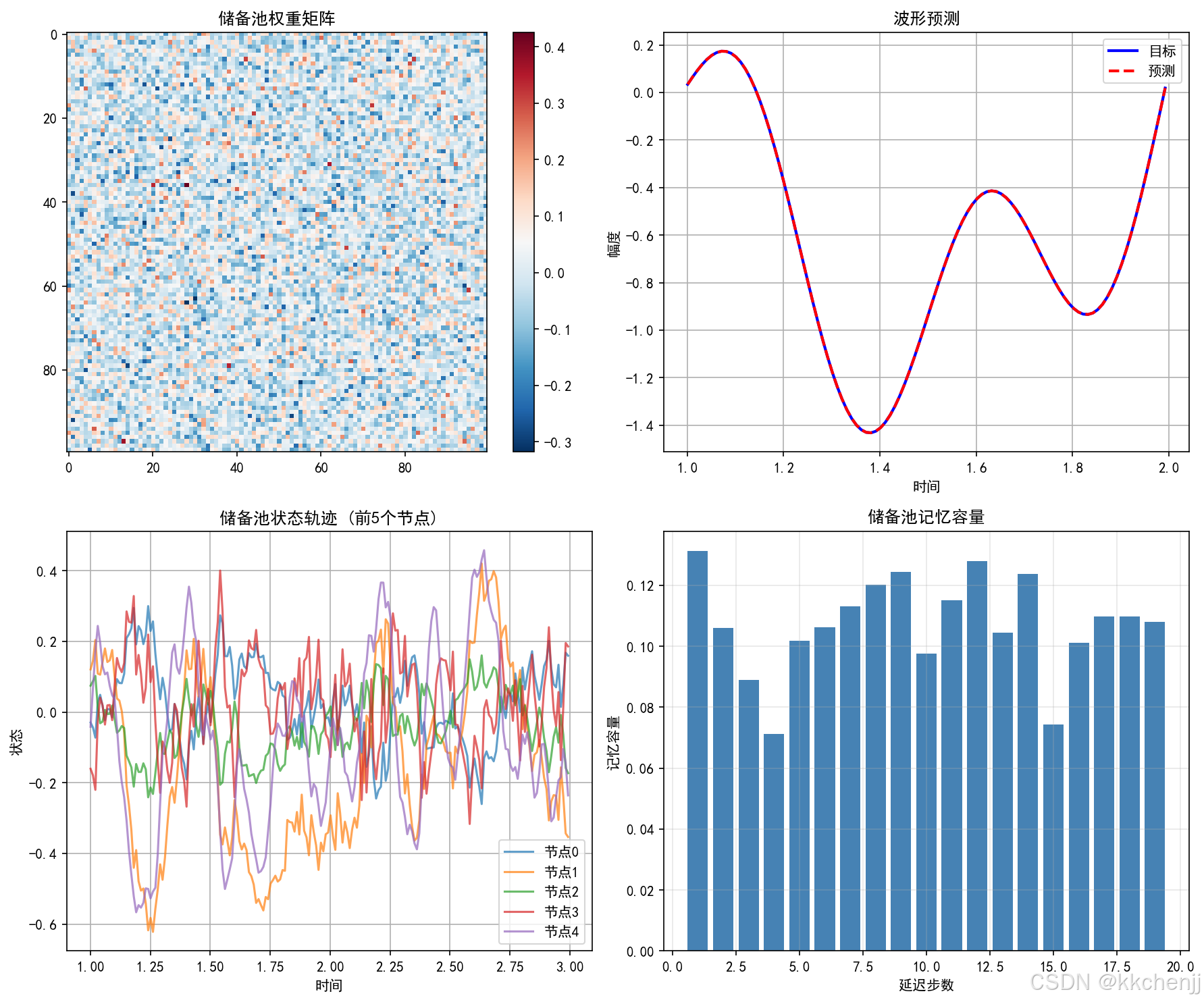
def demo4_reservoir_computing():
"""演示4: 光子储备池计算"""
print("\n" + "=" * 60)
print("演示4: 光子储备池计算")
print("=" * 60)
# 创建储备池
reservoir = PhotonicReservoir(n_nodes=100, spectral_radius=0.9,
leaking_rate=0.3)
print(f"\n储备池参数:")
print(f" 节点数: {reservoir.n_nodes}")
print(f" 谱半径: {reservoir.spectral_radius}")
print(f" 泄漏率: {reservoir.leaking_rate}")
# 任务1: 波形预测
# 生成训练数据 (正弦波)
t = np.linspace(0, 10, 1000)
signal = np.sin(2 * np.pi * 0.5 * t) + 0.5 * np.sin(2 * np.pi * 2 * t)
# 运行储备池
states = reservoir.run(signal, washout=100)
# 训练读出层 (预测下一个时间步)
targets = signal[100+1:1001]
W_out = reservoir.train_readout(states[:-1], targets)
# 预测
predictions = reservoir.predict(states[:-1])
# 计算NMSE
nmse = np.mean((predictions - targets)**2) / np.var(targets)
print(f" 波形预测 NMSE: {nmse:.4f}")
# 任务2: 记忆容量测试
memory_depths = range(1, 20)
memory_capacity = []
for delay in memory_depths:
# 随机输入
u = np.random.randn(1000)
states = reservoir.run(u, washout=50)
# 训练预测延迟输入
if len(states) > delay:
targets_delayed = u[50+delay:50+len(states)+delay]
W_out = reservoir.train_readout(states[:len(targets_delayed)], targets_delayed)
pred = reservoir.predict(states[:len(targets_delayed)])
# 计算相关系数
corr = np.corrcoef(pred, targets_delayed)[0, 1]
memory_capacity.append(corr**2)
else:
memory_capacity.append(0)
total_mc = sum(memory_capacity)
print(f" 总记忆容量: {total_mc:.2f}")
# 绘图
fig, axes = plt.subplots(2, 2, figsize=(12, 10))
# 1. 储备池权重矩阵
ax1 = axes[0, 0]
im = ax1.imshow(reservoir.W_res, cmap='RdBu_r', aspect='auto')
ax1.set_title('储备池权重矩阵')
plt.colorbar(im, ax=ax1)
# 2. 波形预测
ax2 = axes[0, 1]
ax2.plot(t[100:200], targets[:100], 'b-', linewidth=2, label='目标')
ax2.plot(t[100:200], predictions[:100], 'r--', linewidth=2, label='预测')
ax2.set_xlabel('时间')
ax2.set_ylabel('幅度')
ax2.set_title('波形预测')
ax2.legend()
ax2.grid(True)
# 3. 储备池状态轨迹
ax3 = axes[1, 0]
for i in range(min(5, reservoir.n_nodes)):
ax3.plot(t[100:300], states[:200, i], alpha=0.7, label=f'节点{i}')
ax3.set_xlabel('时间')
ax3.set_ylabel('状态')
ax3.set_title('储备池状态轨迹 (前5个节点)')
ax3.legend()
ax3.grid(True)
# 4. 记忆容量
ax4 = axes[1, 1]
ax4.bar(memory_depths, memory_capacity, color='steelblue')
ax4.set_xlabel('延迟步数')
ax4.set_ylabel('记忆容量')
ax4.set_title('储备池记忆容量')
ax4.axhline(y=0, color='k', linestyle='-', linewidth=0.5)
ax4.grid(True, alpha=0.3)
plt.tight_layout()
plt.savefig('reservoir_computing.png', dpi=150, bbox_inches='tight')
print("\n储备池计算图已保存到 reservoir_computing.png")
plt.close()
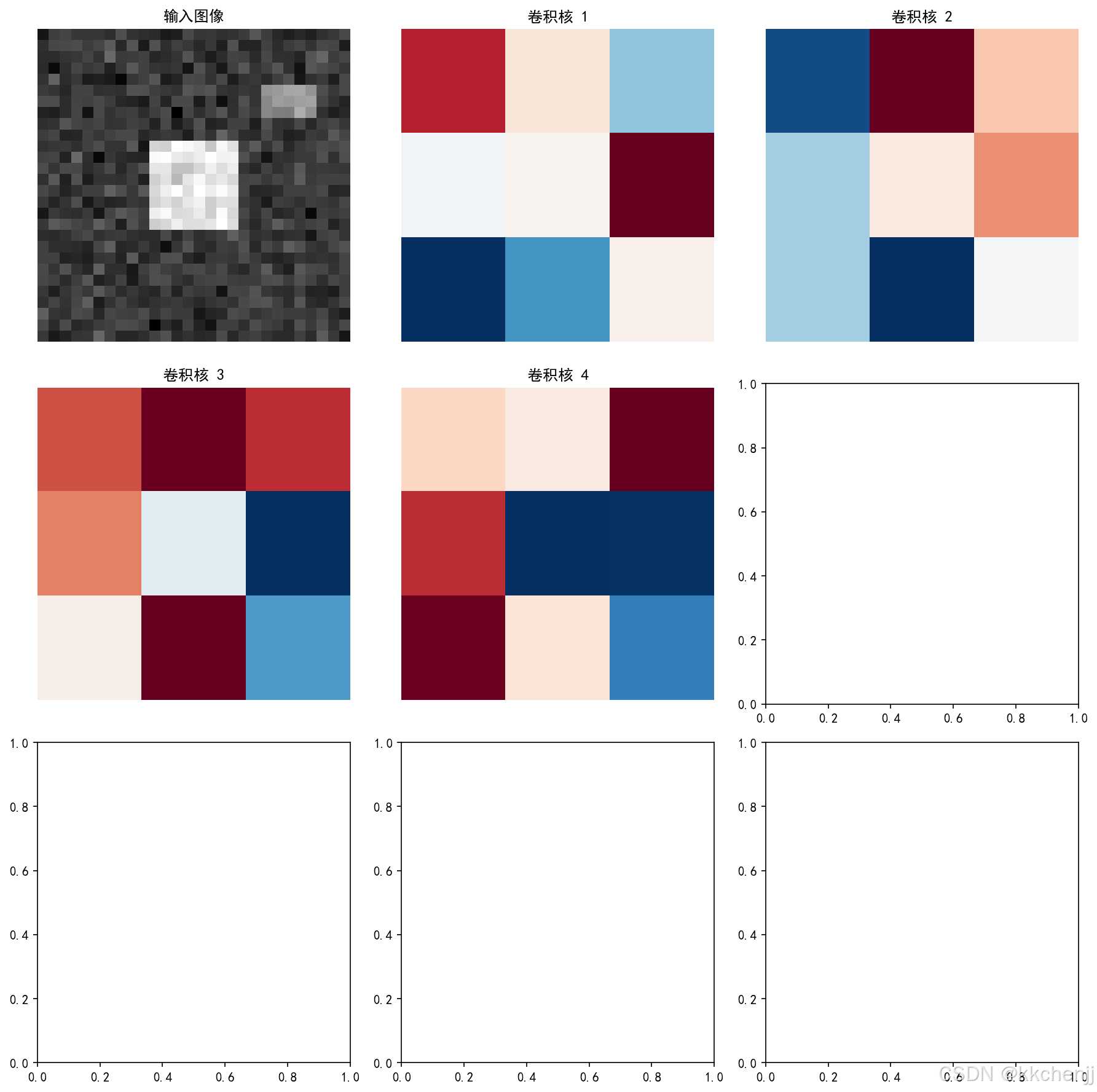
def demo5_photonic_cnn():
"""演示5: 光子卷积神经网络"""
print("\n" + "=" * 60)
print("演示5: 光子卷积神经网络")
print("=" * 60)
# 创建卷积层
conv_layer = PhotonicConvLayer(kernel_size=3, n_kernels=4, stride=1)
print(f"\n卷积层参数:")
print(f" 卷积核大小: {conv_layer.kernel_size}x{conv_layer.kernel_size}")
print(f" 卷积核数量: {conv_layer.n_kernels}")
print(f" 步长: {conv_layer.stride}")
# 生成测试图像 (简单模式)
img_size = 28
test_image = np.zeros((1, img_size, img_size, 1))
# 添加一些特征
test_image[0, 10:18, 10:18, 0] = 1.0 # 方块
test_image[0, 5:8, 20:25, 0] = 0.5 # 小矩形
# 添加噪声
test_image += np.random.randn(1, img_size, img_size, 1) * 0.1
# 前向传播
output = conv_layer.forward(test_image)
print(f" 输入形状: {test_image.shape}")
print(f" 输出形状: {output.shape}")
# 绘图
fig, axes = plt.subplots(3, 3, figsize=(12, 12))
# 1. 输入图像
ax = axes[0, 0]
ax.imshow(test_image[0, :, :, 0], cmap='gray')
ax.set_title('输入图像')
ax.axis('off')
# 2. 卷积核
for i in range(min(4, conv_layer.n_kernels)):
row = (i + 1) // 3
col = (i + 1) % 3
ax = axes[row, col]
ax.imshow(conv_layer.kernels[i], cmap='RdBu_r')
ax.set_title(f'卷积核 {i+1}')
ax.axis('off')
# 3. 特征图
fig2, axes2 = plt.subplots(2, 2, figsize=(10, 10))
for i in range(min(4, conv_layer.n_kernels)):
row = i // 2
col = i % 2
ax = axes2[row, col]
ax.imshow(output[0, :, :, i], cmap='viridis')
ax.set_title(f'特征图 {i+1}')
ax.axis('off')
plt.tight_layout()
plt.savefig('cnn_feature_maps.png', dpi=150, bbox_inches='tight')
print("\nCNN特征图已保存到 cnn_feature_maps.png")
plt.close()
# 保存卷积核图
fig.tight_layout()
plt.savefig('cnn_kernels.png', dpi=150, bbox_inches='tight')
print("CNN卷积核图已保存到 cnn_kernels.png")
plt.close()
def demo6_all_optical_nn():
"""演示6: 全光神经网络"""
print("\n" + "=" * 60)
print("演示6: 全光神经网络")
print("=" * 60)
# 创建全光神经网络
layer_sizes = [16, 32, 16, 4]
optical_nn = AllOpticalNN(layer_sizes)
print(f"\n网络架构: {layer_sizes}")
print(f" 层数: {len(layer_sizes)}")
print(f" 相位掩模数: {len(optical_nn.phase_masks)}")
# 测试前向传播
test_input = np.random.rand(layer_sizes[0])
output = optical_nn.forward(test_input)
print(f" 输入维度: {len(test_input)}")
print(f" 输出维度: {len(output)}")
# 光学非线性特性
x_range = np.linspace(0, 5, 100)
y_activation = optical_nn.optical_activation(x_range)
# 角谱传播演示
# 创建高斯光束
x = np.linspace(-100e-6, 100e-6, 256)
y = np.linspace(-100e-6, 100e-6, 256)
X, Y = np.meshgrid(x, y)
w0 = 20e-6 # 束腰
E0 = np.exp(-(X**2 + Y**2) / w0**2)
# 传播
z_prop = 50e-3
E_prop = optical_nn.angular_spectrum_propagation(E0, z_prop, x[1]-x[0])
# 绘图
fig, axes = plt.subplots(2, 2, figsize=(12, 10))
# 1. 光学非线性激活函数
ax1 = axes[0, 0]
ax1.plot(x_range, y_activation, 'b-', linewidth=2)
ax1.plot(x_range, np.tanh(x_range), 'r--', linewidth=2, label='tanh (对比)')
ax1.set_xlabel('输入')
ax1.set_ylabel('输出')
ax1.set_title('光学非线性激活函数')
ax1.legend()
ax1.grid(True)
# 2. 输入光场
ax2 = axes[0, 1]
im = ax2.imshow(np.abs(E0)**2, extent=[-100, 100, -100, 100], cmap='hot')
ax2.set_xlabel('x (μm)')
ax2.set_ylabel('y (μm)')
ax2.set_title('输入高斯光束')
plt.colorbar(im, ax=ax2)
# 3. 传播后光场
ax3 = axes[1, 0]
im2 = ax3.imshow(np.abs(E_prop)**2, extent=[-100, 100, -100, 100], cmap='hot')
ax3.set_xlabel('x (μm)')
ax3.set_ylabel('y (μm)')
ax3.set_title(f'传播 {z_prop*1e3:.0f} mm后')
plt.colorbar(im2, ax=ax3)
# 4. 相位掩模示例
ax4 = axes[1, 1]
im3 = ax4.imshow(optical_nn.phase_masks[0], cmap='hsv', aspect='auto')
ax4.set_xlabel('输出节点')
ax4.set_ylabel('输入节点')
ax4.set_title('相位掩模 (第一层)')
plt.colorbar(im3, ax=ax4)
plt.tight_layout()
plt.savefig('all_optical_nn.png', dpi=150, bbox_inches='tight')
print("\n全光神经网络图已保存到 all_optical_nn.png")
plt.close()
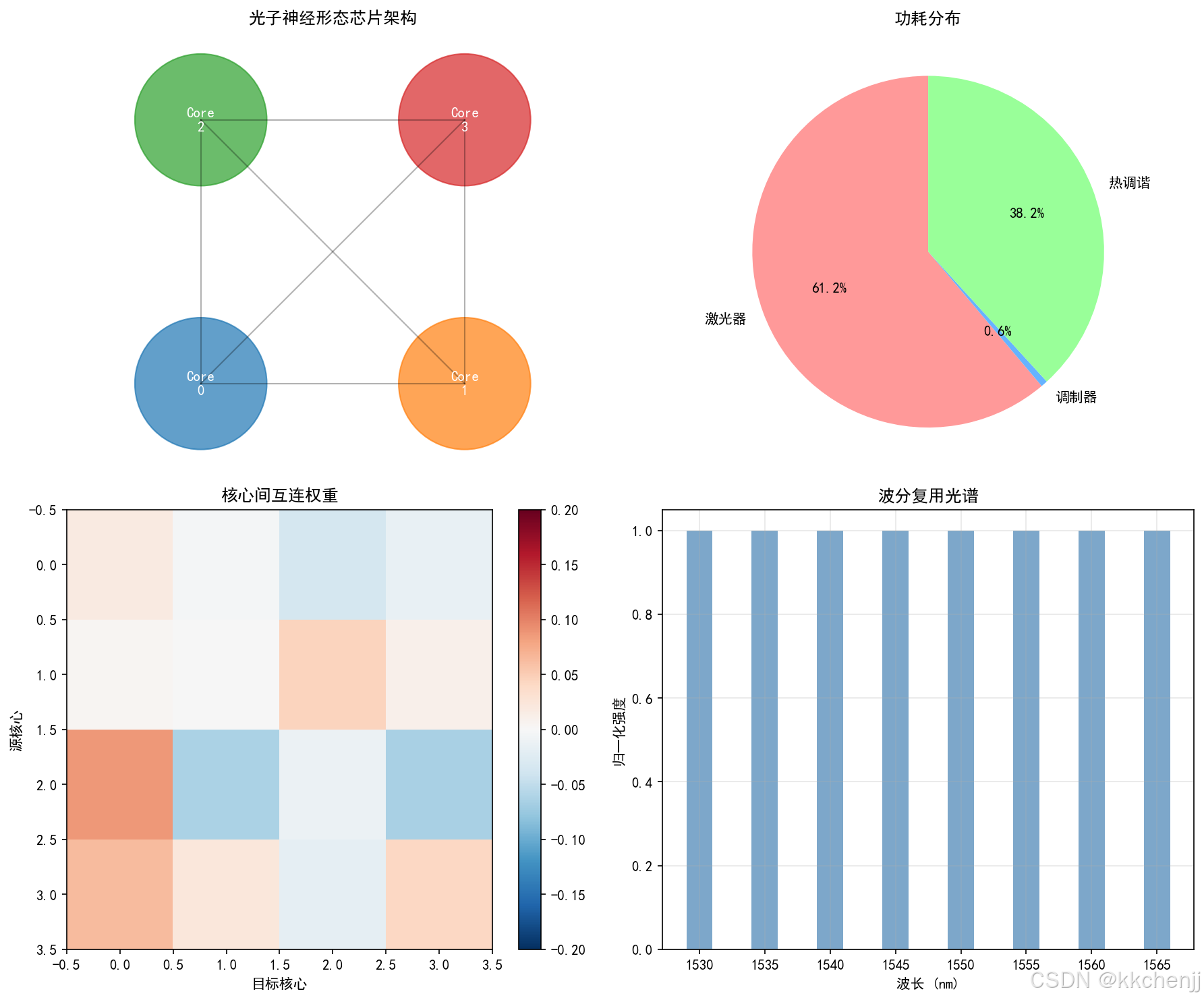
def demo7_neuromorphic_chip():
"""演示7: 光子神经形态芯片架构"""
print("\n" + "=" * 60)
print("演示7: 光子神经形态芯片架构")
print("=" * 60)
# 创建芯片
chip = PhotonicNeuromorphicChip(n_cores=4, neurons_per_core=16)
print(f"\n芯片架构参数:")
print(f" 核心数: {chip.n_cores}")
print(f" 每核心神经元: {chip.neurons_per_core}")
print(f" 总神经元数: {chip.n_cores * chip.neurons_per_core}")
print(f" 波分复用通道: {chip.n_wavelengths}")
# 计算功耗
power = chip.compute_power_consumption(activity_rate=0.1)
print(f"\n功耗分析:")
print(f" 激光器: {power['laser']*1e3:.2f} mW")
print(f" 调制器: {power['modulator']*1e3:.2f} mW")
print(f" 热调谐: {power['thermal']*1e3:.2f} mW")
print(f" 总功耗: {power['total']*1e3:.2f} mW")
# 计算吞吐量
throughput = chip.compute_throughput(spike_rate=1e6)
print(f"\n性能指标:")
print(f" 吞吐量: {throughput:.2f} TOPS")
print(f" 能效: {throughput / (power['total'] * 1e3):.2f} TOPS/W")
# 仿真芯片运行
dt = 0.1e-9
t_max = 50e-9
n_steps = int(t_max / dt)
# 生成输入
inputs = []
for core_id in range(chip.n_cores):
input_spikes = np.random.rand(chip.neurons_per_core, n_steps) < 0.05
inputs.append(input_spikes)
# 运行仿真
outputs = chip.simulate_chip(inputs, dt, t_max)
# 统计各核心发放率
print(f"\n各核心发放统计:")
for i, output in enumerate(outputs):
firing_rate = np.sum(output) / (chip.neurons_per_core * t_max) / 1e9
print(f" 核心 {i}: 发放率 = {firing_rate:.2f} GHz")
# 绘图
fig, axes = plt.subplots(2, 2, figsize=(12, 10))
# 1. 芯片架构示意图
ax1 = axes[0, 0]
# 绘制核心布局
core_positions = [(0.2, 0.2), (0.8, 0.2), (0.2, 0.8), (0.8, 0.8)]
for i, (x, y) in enumerate(core_positions):
circle = plt.Circle((x, y), 0.15, color=f'C{i}', alpha=0.7)
ax1.add_patch(circle)
ax1.text(x, y, f'Core\n{i}', ha='center', va='center', fontsize=10, color='white', weight='bold')
# 绘制互连
for i in range(len(core_positions)):
for j in range(i+1, len(core_positions)):
x1, y1 = core_positions[i]
x2, y2 = core_positions[j]
ax1.plot([x1, x2], [y1, y2], 'k-', alpha=0.3, linewidth=1)
ax1.set_xlim(0, 1)
ax1.set_ylim(0, 1)
ax1.set_aspect('equal')
ax1.axis('off')
ax1.set_title('光子神经形态芯片架构')
# 2. 功耗分布饼图
ax2 = axes[0, 1]
power_values = [power['laser']*1e3, power['modulator']*1e3, power['thermal']*1e3]
power_labels = ['激光器', '调制器', '热调谐']
colors = ['#ff9999', '#66b3ff', '#99ff99']
ax2.pie(power_values, labels=power_labels, colors=colors, autopct='%1.1f%%', startangle=90)
ax2.set_title('功耗分布')
# 3. 核心间互连权重
ax3 = axes[1, 0]
im = ax3.imshow(chip.interconnect_weights, cmap='RdBu_r', aspect='auto', vmin=-0.2, vmax=0.2)
ax3.set_xlabel('目标核心')
ax3.set_ylabel('源核心')
ax3.set_title('核心间互连权重')
plt.colorbar(im, ax=ax3)
# 4. 波分复用光谱
ax4 = axes[1, 1]
wavelengths_nm = chip.wavelengths * 1e9
intensities = np.ones_like(wavelengths_nm) # 理想情况
ax4.bar(wavelengths_nm, intensities, width=2, color='steelblue', alpha=0.7)
ax4.set_xlabel('波长 (nm)')
ax4.set_ylabel('归一化强度')
ax4.set_title('波分复用光谱')
ax4.grid(True, alpha=0.3)
plt.tight_layout()
plt.savefig('neuromorphic_chip.png', dpi=150, bbox_inches='tight')
print("\n神经形态芯片图已保存到 neuromorphic_chip.png")
plt.close()
# ============================================================
# 主程序
# ============================================================
if __name__ == "__main__":
# 运行所有演示
demo1_photonic_neuron()
demo2_optical_synapse()
demo3_photonic_snn()
demo4_reservoir_computing()
demo5_photonic_cnn()
demo6_all_optical_nn()
demo7_neuromorphic_chip()
print("\n" + "=" * 60)
print("所有演示完成!")
print("=" * 60)

AtomGit 是由开放原子开源基金会联合 CSDN 等生态伙伴共同推出的新一代开源与人工智能协作平台。平台坚持“开放、中立、公益”的理念,把代码托管、模型共享、数据集托管、智能体开发体验和算力服务整合在一起,为开发者提供从开发、训练到部署的一站式体验。
更多推荐



 0
0 0
0- 0



 已为社区贡献160条内容

所有评论(0)