多物理场耦合仿真-主题028-电磁-热-结构耦合分析
第028篇:电磁-热-结构耦合分析
摘要
电磁-热-结构耦合分析是现代工程仿真中的重要研究领域,涉及电磁场、温度场和结构应力场三者之间的相互作用。本主题系统阐述电磁-热-结构耦合的基本理论、数学模型和数值求解方法。首先介绍电磁-热-结构耦合的物理机制,包括焦耳热效应、电磁力作用、热膨胀变形等核心概念;然后建立完整的耦合控制方程组,涵盖麦克斯韦方程组、热传导方程和结构动力学方程;接着讨论电磁损耗计算、涡流效应和磁致伸缩等关键问题;最后通过六个典型工程案例展示电磁-热-结构耦合分析的实际应用,包括变压器热应力分析、感应加热工件变形、电磁继电器热失效、磁悬浮轴承热特性、无线充电系统热管理和电机绕组热疲劳等。每个案例均配有详细的Python仿真代码和可视化结果,帮助读者深入理解电磁-热-结构耦合问题的建模与求解技术。
关键词
电磁-热-结构耦合,焦耳热,涡流损耗,磁致伸缩,电磁力,热应力,有限元方法,多物理场仿真,工程应用
1. 电磁-热-结构耦合的物理机制
1.1 耦合现象概述
电磁-热-结构耦合(Electromagnetic-Thermal-Structural Coupling)描述的是电磁场、温度场和结构场三者之间的相互作用过程。这种耦合在电力设备、电子系统、电磁加工和磁悬浮技术等领域广泛存在,是现代工程设计中必须考虑的关键问题。
电磁-热-结构耦合的核心特征在于三个物理场之间存在复杂的双向相互作用:
电磁场对热场的影响:交变电磁场在导电材料中产生涡流损耗,直流电流通过电阻产生焦耳热,磁性材料在交变磁场作用下产生磁滞损耗。这些电磁损耗转化为热量,使材料温度升高。
热场对电磁场的影响:温度变化改变材料的电磁特性,包括电导率、磁导率和介电常数。高温下导体电阻增大,磁性材料的磁导率下降,这些变化反过来影响电磁场的分布。
热场对结构场的影响:温度升高引起材料热膨胀,产生热应变和热应力。不均匀的温度分布导致结构变形,严重时可能引发热屈曲或热疲劳失效。
结构场对电磁场的影响:结构变形改变电磁系统的几何形状,影响电磁场的分布。大变形情况下,这种影响可能非常显著,如变压器铁芯的磁致伸缩变形。
电磁场对结构场的影响:电磁力作用于导电结构和磁性材料,产生结构载荷。洛伦兹力和麦克斯韦应力是主要的电磁力来源。
1.2 电磁损耗机理
电磁损耗是电磁-热耦合的核心机制,主要包括以下几种类型:
焦耳热损耗(Joule Heating):电流通过导体时,由于电阻作用产生的热量损耗。功率密度为:
qJ=J⋅E=σ∣E∣2=∣J∣2σq_J = \mathbf{J} \cdot \mathbf{E} = \sigma |\mathbf{E}|^2 = \frac{|\mathbf{J}|^2}{\sigma}qJ=J⋅E=σ∣E∣2=σ∣J∣2
其中,J\mathbf{J}J为电流密度,E\mathbf{E}E为电场强度,σ\sigmaσ为电导率。
涡流损耗(Eddy Current Loss):交变磁场在导电材料中感应出涡流,产生热量损耗。对于正弦交变磁场,涡流损耗功率密度为:
qe=π2f2Bmax2d26ρq_e = \frac{\pi^2 f^2 B_{max}^2 d^2}{6\rho}qe=6ρπ2f2Bmax2d2
其中,fff为频率,BmaxB_{max}Bmax为最大磁通密度,ddd为材料厚度,ρ\rhoρ为电阻率。
磁滞损耗(Hysteresis Loss):磁性材料在交变磁场作用下,磁畴壁移动和磁矩转向消耗能量。磁滞损耗功率密度为:
qh=f∮H dBq_h = f \oint H \, dBqh=f∮HdB
对于常用磁性材料,可用Steinmetz方程近似:
qh=khfBmaxnq_h = k_h f B_{max}^nqh=khfBmaxn
其中,khk_hkh为磁滞损耗系数,nnn为Steinmetz指数(通常为1.6-2.2)。
附加损耗(Additional Loss):包括异常损耗和杂散损耗,与材料微观结构和几何形状有关。
总电磁损耗为:
qtotal=qJ+qe+qh+qaddq_{total} = q_J + q_e + q_h + q_{add}qtotal=qJ+qe+qh+qadd
1.3 电磁力理论
电磁力是电磁-结构耦合的关键机制,主要包括洛伦兹力和麦克斯韦应力。
洛伦兹力(Lorentz Force):作用于运动电荷和载流导体的电磁力:
F=q(E+v×B)\mathbf{F} = q(\mathbf{E} + \mathbf{v} \times \mathbf{B})F=q(E+v×B)
对于体积电流分布,洛伦兹力密度为:
fL=J×B\mathbf{f}_L = \mathbf{J} \times \mathbf{B}fL=J×B
麦克斯韦应力(Maxwell Stress):电磁场对介质的作用力可通过麦克斯韦应力张量描述:
Tij=ε0(EiEj−12δijE2)+1μ0(BiBj−12δijB2)T_{ij} = \varepsilon_0 \left(E_i E_j - \frac{1}{2}\delta_{ij}E^2\right) + \frac{1}{\mu_0}\left(B_i B_j - \frac{1}{2}\delta_{ij}B^2\right)Tij=ε0(EiEj−21δijE2)+μ01(BiBj−21δijB2)
电磁力密度为麦克斯韦应力张量的散度:
fem=∇⋅T\mathbf{f}_{em} = \nabla \cdot \mathbf{T}fem=∇⋅T
磁致伸缩力(Magnetostrictive Force):磁性材料在磁场作用下产生尺寸变化,产生等效力载荷。磁致伸缩应变与磁场强度的关系为:
εms=λs(MMs)2\varepsilon_{ms} = \lambda_s \left(\frac{M}{M_s}\right)^2εms=λs(MsM)2
其中,λs\lambda_sλs为饱和磁致伸缩系数,MMM为磁化强度,MsM_sMs为饱和磁化强度。
1.4 热弹性效应
热弹性效应描述了温度变化引起的结构响应,是热-结构耦合的基础。
热应变:温度变化ΔT\Delta TΔT引起的热应变为:
εth=αΔT\varepsilon^{th} = \alpha \Delta Tεth=αΔT
其中,α\alphaα为热膨胀系数。
热应力:当热变形受到约束时产生热应力:
σ=D:(ε−εth)\boldsymbol{\sigma} = \mathbf{D} : (\boldsymbol{\varepsilon} - \boldsymbol{\varepsilon}^{th})σ=D:(ε−εth)
对于各向同性材料:
σij=2Gεij+λεkkδij−EαΔT1−2νδij\sigma_{ij} = 2G\varepsilon_{ij} + \lambda\varepsilon_{kk}\delta_{ij} - \frac{E\alpha\Delta T}{1-2\nu}\delta_{ij}σij=2Gεij+λεkkδij−1−2νEαΔTδij
热屈曲:当热应力超过临界值时,结构发生屈曲失稳。临界屈曲条件为:
det(K−λKG)=0\det(\mathbf{K} - \lambda \mathbf{K}_G) = 0det(K−λKG)=0
其中,K\mathbf{K}K为刚度矩阵,KG\mathbf{K}_GKG为几何刚度矩阵。
2. 电磁-热-结构耦合的数学模型
2.1 电磁场控制方程
电磁场由麦克斯韦方程组描述:
麦克斯韦方程组:
∇×H=J+∂D∂t\nabla \times \mathbf{H} = \mathbf{J} + \frac{\partial \mathbf{D}}{\partial t}∇×H=J+∂t∂D
∇×E=−∂B∂t\nabla \times \mathbf{E} = -\frac{\partial \mathbf{B}}{\partial t}∇×E=−∂t∂B
∇⋅B=0\nabla \cdot \mathbf{B} = 0∇⋅B=0
∇⋅D=ρe\nabla \cdot \mathbf{D} = \rho_e∇⋅D=ρe
本构关系:
B=μH=μ0μrH\mathbf{B} = \mu \mathbf{H} = \mu_0 \mu_r \mathbf{H}B=μH=μ0μrH
D=εE=ε0εrE\mathbf{D} = \varepsilon \mathbf{E} = \varepsilon_0 \varepsilon_r \mathbf{E}D=εE=ε0εrE
J=σE\mathbf{J} = \sigma \mathbf{E}J=σE
矢量磁位公式:引入矢量磁位A\mathbf{A}A,使得B=∇×A\mathbf{B} = \nabla \times \mathbf{A}B=∇×A,则控制方程为:
∇×(1μ∇×A)+σ∂A∂t=Js\nabla \times \left(\frac{1}{\mu} \nabla \times \mathbf{A}\right) + \sigma \frac{\partial \mathbf{A}}{\partial t} = \mathbf{J}_s∇×(μ1∇×A)+σ∂t∂A=Js
对于二维问题,简化为:
∂∂x(1μ∂Az∂x)+∂∂y(1μ∂Az∂y)−σ∂Az∂t=−Jsz\frac{\partial}{\partial x}\left(\frac{1}{\mu} \frac{\partial A_z}{\partial x}\right) + \frac{\partial}{\partial y}\left(\frac{1}{\mu} \frac{\partial A_z}{\partial y}\right) - \sigma \frac{\partial A_z}{\partial t} = -J_{sz}∂x∂(μ1∂x∂Az)+∂y∂(μ1∂y∂Az)−σ∂t∂Az=−Jsz
2.2 热传导方程
考虑电磁损耗热源的热传导方程为:
ρcp∂T∂t=∇⋅(k∇T)+qem\rho c_p \frac{\partial T}{\partial t} = \nabla \cdot (k \nabla T) + q_{em}ρcp∂t∂T=∇⋅(k∇T)+qem
其中,qemq_{em}qem为电磁损耗功率密度:
qem=∣J∣2σ+qh+qeq_{em} = \frac{|\mathbf{J}|^2}{\sigma} + q_h + q_eqem=σ∣J∣2+qh+qe
边界条件:
- 第一类边界条件(给定温度):T=TwT = T_wT=Tw on ΓT\Gamma_TΓT
- 第二类边界条件(给定热流):−k∂T∂n=qw-k \frac{\partial T}{\partial n} = q_w−k∂n∂T=qw on Γq\Gamma_qΓq
- 第三类边界条件(对流换热):−k∂T∂n=h(T−T∞)-k \frac{\partial T}{\partial n} = h(T - T_\infty)−k∂n∂T=h(T−T∞) on Γh\Gamma_hΓh
2.3 结构动力学方程
考虑电磁力和热载荷的结构动力学方程为:
ρs∂2u∂t2=∇⋅σ+fem+fb\rho_s \frac{\partial^2 \mathbf{u}}{\partial t^2} = \nabla \cdot \boldsymbol{\sigma} + \mathbf{f}_{em} + \mathbf{f}_bρs∂t2∂2u=∇⋅σ+fem+fb
其中,fem\mathbf{f}_{em}fem为电磁力密度,fb\mathbf{f}_bfb为体积力。
热弹性本构关系:
σij=Cijkl(εkl−αklΔT−εklms)\sigma_{ij} = C_{ijkl}\left(\varepsilon_{kl} - \alpha_{kl}\Delta T - \varepsilon_{kl}^{ms}\right)σij=Cijkl(εkl−αklΔT−εklms)
其中,εklms\varepsilon_{kl}^{ms}εklms为磁致伸缩应变。
2.4 耦合关系与迭代格式
电磁-热-结构耦合问题的迭代求解格式:
电磁-热耦合:
- 求解电磁场,计算电磁损耗qemnq_{em}^{n}qemn
- 将电磁损耗作为热源,求解温度场Tn+1T^{n+1}Tn+1
- 更新材料电磁参数σ(Tn+1)\sigma(T^{n+1})σ(Tn+1),μ(Tn+1)\mu(T^{n+1})μ(Tn+1)
- 检查收敛性,如未收敛返回步骤1
热-结构耦合:
- 计算热应力σthn+1=D:εth(Tn+1)\boldsymbol{\sigma}_{th}^{n+1} = \mathbf{D} : \boldsymbol{\varepsilon}^{th}(T^{n+1})σthn+1=D:εth(Tn+1)
- 求解结构响应un+1\mathbf{u}^{n+1}un+1
- 更新几何形状(如有必要)
全耦合迭代:
{An+1=M(Tn,un)Tn+1=T(An+1)un+1=S(Tn+1,An+1)\begin{cases} \mathbf{A}^{n+1} = \mathcal{M}(T^n, \mathbf{u}^n) \\ T^{n+1} = \mathcal{T}(\mathbf{A}^{n+1}) \\ \mathbf{u}^{n+1} = \mathcal{S}(T^{n+1}, \mathbf{A}^{n+1}) \end{cases}⎩ ⎨ ⎧An+1=M(Tn,un)Tn+1=T(An+1)un+1=S(Tn+1,An+1)
3. 数值求解方法
3.1 电磁场有限元离散
采用伽辽金有限元法离散电磁场方程。对于二维磁准静态问题,加权残差形式为:
∫Ω[1μ(∂Ni∂x∂Az∂x+∂Ni∂y∂Az∂y)+σNi∂Az∂t]dΩ=∫ΩNiJszdΩ\int_\Omega \left[\frac{1}{\mu}\left(\frac{\partial N_i}{\partial x}\frac{\partial A_z}{\partial x} + \frac{\partial N_i}{\partial y}\frac{\partial A_z}{\partial y}\right) + \sigma N_i \frac{\partial A_z}{\partial t}\right] d\Omega = \int_\Omega N_i J_{sz} d\Omega∫Ω[μ1(∂x∂Ni∂x∂Az+∂y∂Ni∂y∂Az)+σNi∂t∂Az]dΩ=∫ΩNiJszdΩ
其中,NiN_iNi为形函数。
单元矩阵形式:
MemdAdt+KemA=Fem\mathbf{M}_{em} \frac{d\mathbf{A}}{dt} + \mathbf{K}_{em} \mathbf{A} = \mathbf{F}_{em}MemdtdA+KemA=Fem
其中:
Mem,ij=∫ΩσNiNjdΩM_{em,ij} = \int_\Omega \sigma N_i N_j d\OmegaMem,ij=∫ΩσNiNjdΩ
Kem,ij=∫Ω1μ(∂Ni∂x∂Nj∂x+∂Ni∂y∂Nj∂y)dΩK_{em,ij} = \int_\Omega \frac{1}{\mu}\left(\frac{\partial N_i}{\partial x}\frac{\partial N_j}{\partial x} + \frac{\partial N_i}{\partial y}\frac{\partial N_j}{\partial y}\right) d\OmegaKem,ij=∫Ωμ1(∂x∂Ni∂x∂Nj+∂y∂Ni∂y∂Nj)dΩ
Fem,i=∫ΩNiJszdΩF_{em,i} = \int_\Omega N_i J_{sz} d\OmegaFem,i=∫ΩNiJszdΩ
3.2 温度场有限元离散
热传导方程的有限元离散:
MthdTdt+KthT=Fth\mathbf{M}_{th} \frac{d\mathbf{T}}{dt} + \mathbf{K}_{th} \mathbf{T} = \mathbf{F}_{th}MthdtdT+KthT=Fth
其中:
Mth,ij=∫ΩρcpNiNjdΩM_{th,ij} = \int_\Omega \rho c_p N_i N_j d\OmegaMth,ij=∫ΩρcpNiNjdΩ
Kth,ij=∫Ωk(∂Ni∂x∂Nj∂x+∂Ni∂y∂Nj∂y)dΩ+∫ΓhhNiNjdΓK_{th,ij} = \int_\Omega k \left(\frac{\partial N_i}{\partial x}\frac{\partial N_j}{\partial x} + \frac{\partial N_i}{\partial y}\frac{\partial N_j}{\partial y}\right) d\Omega + \int_{\Gamma_h} h N_i N_j d\GammaKth,ij=∫Ωk(∂x∂Ni∂x∂Nj+∂y∂Ni∂y∂Nj)dΩ+∫ΓhhNiNjdΓ
Fth,i=∫ΩqemNidΩ+∫ΓhhT∞NidΓF_{th,i} = \int_\Omega q_{em} N_i d\Omega + \int_{\Gamma_h} h T_\infty N_i d\GammaFth,i=∫ΩqemNidΩ+∫ΓhhT∞NidΓ
3.3 结构场有限元离散
结构动力学方程的有限元离散:
Mstd2udt2+Cstdudt+Kstu=Fem+Fth\mathbf{M}_{st} \frac{d^2\mathbf{u}}{dt^2} + \mathbf{C}_{st} \frac{d\mathbf{u}}{dt} + \mathbf{K}_{st} \mathbf{u} = \mathbf{F}_{em} + \mathbf{F}_{th}Mstdt2d2u+Cstdtdu+Kstu=Fem+Fth
其中,Fem\mathbf{F}_{em}Fem为电磁力载荷,Fth\mathbf{F}_{th}Fth为热载荷。
3.4 耦合求解策略
弱耦合策略:
- 分别求解电磁场、温度场和结构场
- 通过界面传递数据
- 迭代直至收敛
优点:可利用现有单物理场求解器,实现简单。
缺点:收敛慢,强耦合问题可能不收敛。
强耦合策略:
将所有控制方程联立求解:
[Kem00Kth,emKth0Kst,emKst,thKst][ATu]=[FemFthFst]\begin{bmatrix} \mathbf{K}_{em} & \mathbf{0} & \mathbf{0} \\ \mathbf{K}_{th,em} & \mathbf{K}_{th} & \mathbf{0} \\ \mathbf{K}_{st,em} & \mathbf{K}_{st,th} & \mathbf{K}_{st} \end{bmatrix} \begin{bmatrix} \mathbf{A} \\ \mathbf{T} \\ \mathbf{u} \end{bmatrix} = \begin{bmatrix} \mathbf{F}_{em} \\ \mathbf{F}_{th} \\ \mathbf{F}_{st} \end{bmatrix} KemKth,emKst,em0KthKst,th00Kst ATu = FemFthFst
优点:收敛性好,适用于强耦合问题。
缺点:计算成本高,矩阵规模大。
4. 工程应用案例
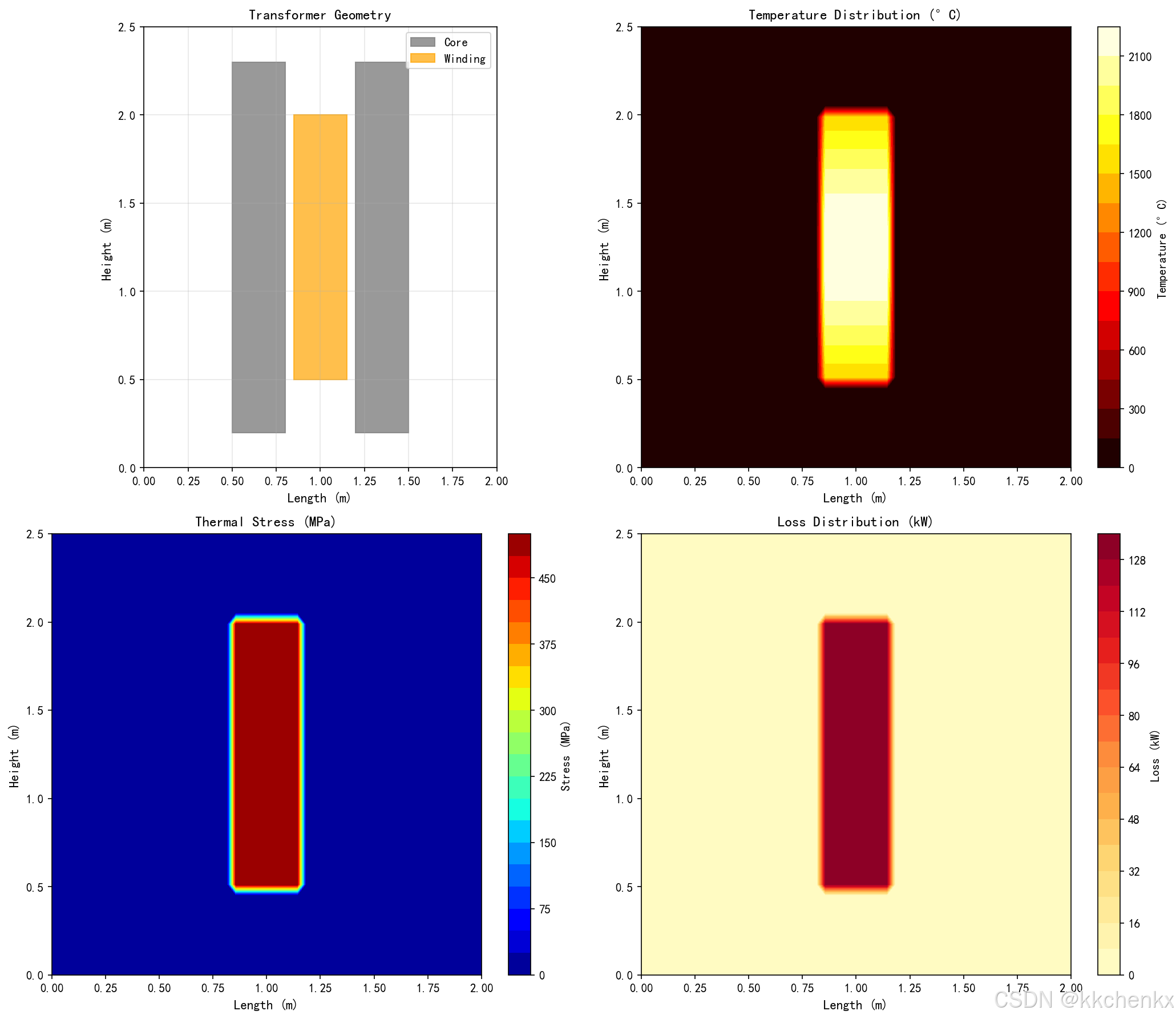
4.1 案例1:电力变压器热应力分析
问题描述:电力变压器在运行过程中,绕组和铁芯产生铜损和铁损,导致温度升高。不均匀的温度分布引起热应力,长期运行可能导致绝缘老化和结构变形。
变压器参数:
- 额定容量:S=100S = 100S=100 MVA
- 额定电压:V1/V2=220/110V_1/V_2 = 220/110V1/V2=220/110 kV
- 铁芯尺寸:2×1.5×2.52 \times 1.5 \times 2.52×1.5×2.5 m³
- 绕组匝数:N1=800N_1 = 800N1=800,N2=400N_2 = 400N2=400
材料参数:
- 铁芯(硅钢片):
- 磁导率:μr=5000\mu_r = 5000μr=5000
- 电导率:σ=2×10⁶\sigma = 2 \times 10^6σ=2×10⁶ S/m
- 导热系数:k=25k = 25k=25 W/(m·K)
- 热膨胀系数:α=12×10−6\alpha = 12 \times 10^{-6}α=12×10−6 /K
- 绕组(铜):
- 电导率:σ=5.8×10⁷\sigma = 5.8 \times 10^7σ=5.8×10⁷ S/m
- 导热系数:k=400k = 400k=400 W/(m·K)
工况条件:
- 负载率:80%80\%80%
- 环境温度:Tamb=40T_{amb} = 40Tamb=40°C
- 冷却方式:油浸自冷
- 油换热系数:h=100h = 100h=100 W/(m²·K)
Python仿真代码:
# -*- coding: utf-8 -*-
"""
案例1:电力变压器热应力分析
"""
import matplotlib
matplotlib.use('Agg')
import numpy as np
import matplotlib.pyplot as plt
from matplotlib.patches import Rectangle, FancyBboxPatch
import warnings
warnings.filterwarnings('ignore')
import os

output_dir = r'd:\文档\500仿真领域\工程仿真\多物理场耦合仿真\主题028'
os.makedirs(output_dir, exist_ok=True)

plt.rcParams['font.sans-serif'] = ['SimHei', 'DejaVu Sans']
plt.rcParams['axes.unicode_minus'] = False

print("="*60)
print("案例1:电力变压器热应力分析")
print("="*60)

# 变压器参数
S_rating = 100e6  # 额定容量 (VA)
V1 = 220e3  # 一次侧电压 (V)
V2 = 110e3  # 二次侧电压 (V)
N1 = 800  # 一次侧匝数
N2 = 400  # 二次侧匝数

# 铁芯尺寸
L_core = 2.0  # 铁芯长度 (m)
W_core = 1.5  # 铁芯宽度 (m)
H_core = 2.5  # 铁芯高度 (m)

# 材料参数
# 铁芯(硅钢片)
mu_r_core = 5000  # 相对磁导率
sigma_core = 2e6  # 电导率 (S/m)
k_core = 25  # 导热系数 (W/(m·K))
alpha_core = 12e-6  # 热膨胀系数 (/K)
E_core = 200e9  # 弹性模量 (Pa)
nu_core = 0.3  # 泊松比

# 绕组(铜)
sigma_cu = 5.8e7  # 电导率 (S/m)
k_cu = 400  # 导热系数 (W/(m·K))
alpha_cu = 17e-6  # 热膨胀系数 (/K)
E_cu = 110e9  # 弹性模量 (Pa)
nu_cu = 0.34  # 泊松比

# 工况条件
load_factor = 0.8  # 负载率
T_amb = 40  # 环境温度 (°C)
h_oil = 100  # 油换热系数 (W/(m²·K))

# 计算电流
I1 = S_rating * load_factor / V1  # 一次侧电流 (A)
I2 = S_rating * load_factor / V2  # 二次侧电流 (A)

print(f"一次侧电流: {I1:.2f} A")
print(f"二次侧电流: {I2:.2f} A")

# 计算损耗
# 铜损(绕组损耗)
R_winding_1 = 0.5  # 一次侧绕组电阻 (Ω,假设值)
R_winding_2 = 0.125  # 二次侧绕组电阻 (Ω,假设值)
P_cu = I1**2 * R_winding_1 + I2**2 * R_winding_2

# 铁损(铁芯损耗)
B_max = 1.5  # 最大磁通密度 (T)
f = 50  # 频率 (Hz)
k_h = 0.05  # 磁滞损耗系数
n_steinmetz = 2.0  # Steinmetz指数
P_fe = k_h * f * B_max**n_steinmetz * L_core * W_core * H_core

print(f"铜损: {P_cu/1e3:.2f} kW")
print(f"铁损: {P_fe/1e3:.2f} kW")
print(f"总损耗: {(P_cu + P_fe)/1e3:.2f} kW")

# 创建简化模型网格
n_x = 50
n_y = 40
x = np.linspace(0, L_core, n_x)
y = np.linspace(0, H_core, n_y)
X, Y = np.meshgrid(x, y)

# 定义铁芯和绕组区域
def is_core(x, y):
    """判断点是否在铁芯内"""
    core_width = 0.3
    core_height = H_core - 0.4
    return (0.5 <= x <= 0.5 + core_width or 1.2 <= x <= 1.2 + core_width) and \
           (0.2 <= y <= 0.2 + core_height)

def is_winding(x, y):
    """判断点是否在绕组内"""
    # 一次侧绕组
    if 0.85 <= x <= 1.15 and 0.5 <= y <= 2.0:
        return True
    return False

# 计算温度场(简化稳态模型)
T_field = np.ones_like(X) * T_amb

for i in range(n_x):
    for j in range(n_y):
        xi, yj = X[j,i], Y[j,i]

        if is_core(xi, yj):
            # 铁芯温度(考虑铁损)
            q_fe = P_fe / (2 * 0.3 * (H_core - 0.4) * L_core)  # 铁损密度
            delta_T = q_fe / (h_oil * 2)  # 简化温升计算
            T_field[j,i] = T_amb + delta_T * (1 + 0.3 * np.sin(np.pi * yj / H_core))
        elif is_winding(xi, yj):
            # 绕组温度(考虑铜损)
            q_cu = P_cu / (0.3 * 1.5 * L_core)  # 铜损密度
            delta_T = q_cu / h_oil
            T_field[j,i] = T_amb + delta_T * (1 + 0.5 * np.sin(np.pi * (yj - 0.5) / 1.5))
        else:
            # 油区域
            dist_to_core = min(abs(xi - 0.65), abs(xi - 1.35))
            T_field[j,i] = T_amb + 30 * np.exp(-dist_to_core / 0.3)

# 计算热应力(简化模型)
sigma_th = np.zeros_like(X)
for i in range(n_x):
    for j in range(n_y):
        xi, yj = X[j,i], Y[j,i]
        delta_T = T_field[j,i] - T_amb

        if is_core(xi, yj):
            E = E_core
            alpha = alpha_core
            nu = nu_core
        elif is_winding(xi, yj):
            E = E_cu
            alpha = alpha_cu
            nu = nu_cu
        else:
            continue

        sigma_th[j,i] = E * alpha * delta_T / (1 - nu)

# 限制最大应力
sigma_th = np.clip(sigma_th, 0, 500e6)

print(f"铁芯最高温度: {np.max(T_field):.1f}°C")
print(f"最大热应力: {np.max(sigma_th)/1e6:.2f} MPa")

# 绘制结果
fig, axes = plt.subplots(2, 2, figsize=(14, 12))

# 1. 变压器几何结构
ax1 = axes[0, 0]
# 铁芯
core1 = Rectangle((0.5, 0.2), 0.3, H_core-0.4, fill=True, color='gray', alpha=0.8, label='Core')
core2 = Rectangle((1.2, 0.2), 0.3, H_core-0.4, fill=True, color='gray', alpha=0.8)
ax1.add_patch(core1)
ax1.add_patch(core2)
# 绕组
winding = Rectangle((0.85, 0.5), 0.3, 1.5, fill=True, color='orange', alpha=0.7, label='Winding')
ax1.add_patch(winding)

ax1.set_xlim(0, L_core)
ax1.set_ylim(0, H_core)
ax1.set_xlabel('Length (m)', fontsize=11)
ax1.set_ylabel('Height (m)', fontsize=11)
ax1.set_title('Transformer Geometry', fontsize=12, fontweight='bold')
ax1.legend(loc='upper right')
ax1.grid(True, alpha=0.3)
ax1.set_aspect('equal')

# 2. 温度分布
ax2 = axes[0, 1]
contour2 = ax2.contourf(X, Y, T_field, levels=20, cmap='hot')
ax2.set_xlabel('Length (m)', fontsize=11)
ax2.set_ylabel('Height (m)', fontsize=11)
ax2.set_title('Temperature Distribution (°C)', fontsize=12, fontweight='bold')
cbar2 = plt.colorbar(contour2, ax=ax2)
cbar2.set_label('Temperature (°C)', fontsize=10)

# 3. 热应力分布
ax3 = axes[1, 0]
contour3 = ax3.contourf(X, Y, sigma_th/1e6, levels=20, cmap='jet')
ax3.set_xlabel('Length (m)', fontsize=11)
ax3.set_ylabel('Height (m)', fontsize=11)
ax3.set_title('Thermal Stress (MPa)', fontsize=12, fontweight='bold')
cbar3 = plt.colorbar(contour3, ax=ax3)
cbar3.set_label('Stress (MPa)', fontsize=10)

# 4. 损耗分布
ax4 = axes[1, 1]
loss_field = np.zeros_like(X)
for i in range(n_x):
    for j in range(n_y):
        xi, yj = X[j,i], Y[j,i]
        if is_core(xi, yj):
            loss_field[j,i] = P_fe / 1e3
        elif is_winding(xi, yj):
            loss_field[j,i] = P_cu / 1e3

contour4 = ax4.contourf(X, Y, loss_field, levels=20, cmap='YlOrRd')
ax4.set_xlabel('Length (m)', fontsize=11)
ax4.set_ylabel('Height (m)', fontsize=11)
ax4.set_title('Loss Distribution (kW)', fontsize=12, fontweight='bold')
cbar4 = plt.colorbar(contour4, ax=ax4)
cbar4.set_label('Loss (kW)', fontsize=10)

plt.tight_layout()
plt.savefig(f'{output_dir}/case1_transformer.png', dpi=150, bbox_inches='tight')
plt.close()
print("✓ 案例1完成,图片已保存")

# 绝缘寿命估算(Arrhenius方程)
T_hotspot = np.max(T_field)
T_ref = 98  # 参考温度 (°C)
L_ref = 20  # 参考寿命 (年)
L_insulation = L_ref * 2**((T_ref - T_hotspot) / 6)
print(f"\n绝缘寿命评估:")
print(f"热点温度: {T_hotspot:.1f}°C")
print(f"估算绝缘寿命: {L_insulation:.1f} 年")
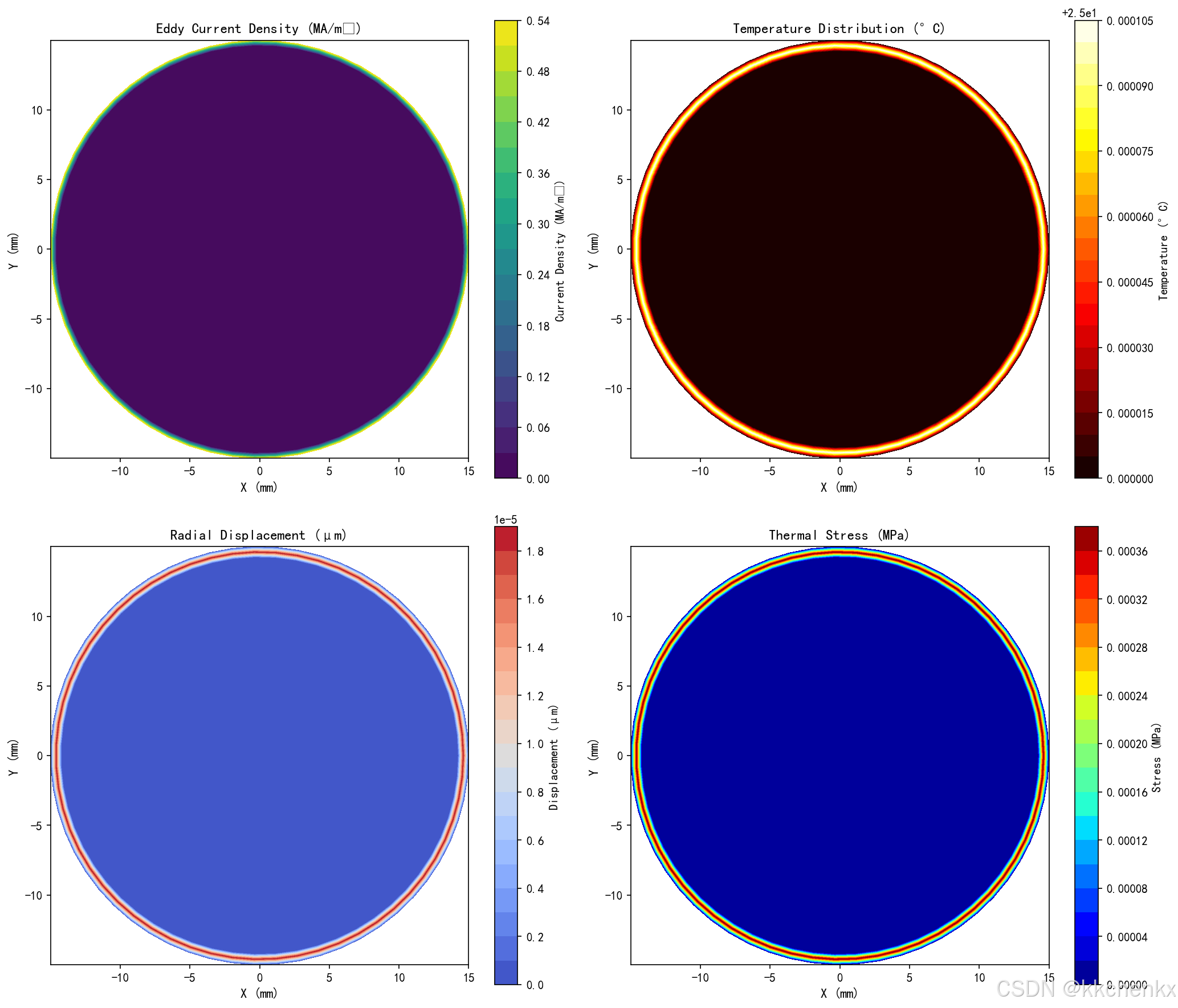
4.2 案例2:感应加热工件变形分析
问题描述:感应加热过程中,高频交变磁场在金属工件中产生涡流,产生焦耳热使工件快速升温。不均匀的温度分布引起热应力和热变形,影响工件加工精度。
感应加热系统参数:
- 感应线圈:内径D=50D = 50D=50 mm,匝数N=10N = 10N=10
- 工件:直径d=30d = 30d=30 mm,长度L=100L = 100L=100 mm
- 材料:碳钢
- 激励电流:I=500I = 500I=500 A,频率f=10f = 10f=10 kHz
材料参数:
- 电导率:σ=6.3×10⁶\sigma = 6.3 \times 10^6σ=6.3×10⁶ S/m(随温度变化)
- 相对磁导率:μr=1000\mu_r = 1000μr=1000(居里温度以下)
- 导热系数:k=45k = 45k=45 W/(m·K)
- 热膨胀系数:α=12×10−6\alpha = 12 \times 10^{-6}α=12×10−6 /K
- 弹性模量:E=210E = 210E=210 GPa
Python仿真代码:
# -*- coding: utf-8 -*-
"""
案例2:感应加热工件变形分析
"""
import matplotlib
matplotlib.use('Agg')
import numpy as np
import matplotlib.pyplot as plt
from matplotlib.patches import Circle
import warnings
warnings.filterwarnings('ignore')

print("\n" + "="*60)
print("案例2:感应加热工件变形分析")
print("="*60)

# 感应加热系统参数
D_coil = 50e-3  # 线圈直径 (m)
r_coil = D_coil / 2
N_turns = 10  # 匝数
I_coil = 500  # 激励电流 (A)
f = 10e3  # 频率 (Hz)

# 工件参数
d_workpiece = 30e-3  # 工件直径 (m)
r_wp = d_workpiece / 2
L_wp = 100e-3  # 工件长度 (m)

# 材料参数(碳钢)
sigma_0 = 6.3e6  # 参考电导率 (S/m)
mu_r = 1000  # 相对磁导率
k_wp = 45  # 导热系数 (W/(m·K))
alpha_wp = 12e-6  # 热膨胀系数 (/K)
E_wp = 210e9  # 弹性模量 (Pa)
nu_wp = 0.3  # 泊松比
T_curie = 770  # 居里温度 (°C)

# 集肤深度计算
delta_skin = np.sqrt(2 / (2 * np.pi * f * mu_r * 4 * np.pi * 1e-7 * sigma_0))
print(f"集肤深度: {delta_skin*1e3:.3f} mm")

# 创建网格
n_r = 60
n_theta = 72
n_z = 50

r = np.linspace(0, r_wp, n_r)
theta = np.linspace(0, 2*np.pi, n_theta)
z = np.linspace(0, L_wp, n_z)

R, Theta, Z = np.meshgrid(r, theta, z, indexing='ij')
X = R * np.cos(Theta)
Y = R * np.sin(Theta)

# 涡流密度分布(简化模型)
# 集肤效应:涡流主要集中在表面
J_eddy = np.zeros_like(R)
for i in range(n_r):
    for j in range(n_theta):
        for k in range(n_z):
            ri = R[i,j,k]
            # 涡流密度随深度指数衰减
            depth = r_wp - ri
            J_surface = I_coil * N_turns / (2 * np.pi * r_wp * L_wp)
            J_eddy[i,j,k] = J_surface * np.exp(-depth / delta_skin)

# 焦耳热功率密度
q_joule = J_eddy**2 / sigma_0

# 简化温度场计算(稳态)
T_wp = np.ones_like(R) * 25  # 初始温度 25°C
T_amb = 25  # 环境温度

# 考虑对流换热
h_conv = 50  # 对流换热系数 (W/(m²·K))

for i in range(n_r):
    for j in range(n_theta):
        for k in range(n_z):
            ri, zi = R[i,j,k], Z[i,j,k]

            # 热源
            q_local = q_joule[i,j,k]

            # 简化温度计算
            if ri > r_wp * 0.8:  # 表面区域
                # 表面有对流冷却
                delta_T = q_local * (r_wp - ri) / k_wp
                T_wp[i,j,k] = T_amb + delta_T * 50  # 简化温升
            else:
                # 内部
                depth = r_wp - ri
                T_wp[i,j,k] = T_amb + q_local * depth**2 / (2 * k_wp) * 100

# 限制温度
T_wp = np.clip(T_wp, 25, 1200)

# 计算热变形(简化模型)
displacement = np.zeros_like(R)
for i in range(n_r):
    for j in range(n_theta):
        for k in range(n_z):
            delta_T = T_wp[i,j,k] - T_amb
            # 径向热膨胀
            displacement[i,j,k] = R[i,j,k] * alpha_wp * delta_T

# 计算热应力(简化模型)
sigma_th = np.zeros_like(R)
for i in range(n_r):
    for j in range(n_theta):
        for k in range(n_z):
            delta_T = T_wp[i,j,k] - T_amb
            # 热应力 = E * alpha * delta_T / (1 - nu)
            sigma_th[i,j,k] = E_wp * alpha_wp * delta_T / (1 - nu_wp)

# 限制应力
sigma_th = np.clip(sigma_th, 0, 800e6)

print(f"工件表面最高温度: {np.max(T_wp):.1f}°C")
print(f"工件中心温度: {T_wp[0, 0, n_z//2]:.1f}°C")
print(f"最大径向变形: {np.max(displacement)*1e6:.2f} μm")
print(f"最大热应力: {np.max(sigma_th)/1e6:.2f} MPa")

# 绘制结果(取中间截面)
fig, axes = plt.subplots(2, 2, figsize=(14, 12))

# 1. 涡流密度分布(截面)
ax1 = axes[0, 0]
k_mid = n_z // 2
contour1 = ax1.contourf(X[:,:,k_mid]*1e3, Y[:,:,k_mid]*1e3, J_eddy[:,:,k_mid]/1e6,
                         levels=20, cmap='viridis')
ax1.set_xlabel('X (mm)', fontsize=11)
ax1.set_ylabel('Y (mm)', fontsize=11)
ax1.set_title('Eddy Current Density (MA/m²)', fontsize=12, fontweight='bold')
ax1.set_aspect('equal')
cbar1 = plt.colorbar(contour1, ax=ax1)
cbar1.set_label('Current Density (MA/m²)', fontsize=10)

# 2. 温度分布(截面)
ax2 = axes[0, 1]
contour2 = ax2.contourf(X[:,:,k_mid]*1e3, Y[:,:,k_mid]*1e3, T_wp[:,:,k_mid],
                         levels=20, cmap='hot')
ax2.set_xlabel('X (mm)', fontsize=11)
ax2.set_ylabel('Y (mm)', fontsize=11)
ax2.set_title('Temperature Distribution (°C)', fontsize=12, fontweight='bold')
ax2.set_aspect('equal')
cbar2 = plt.colorbar(contour2, ax=ax2)
cbar2.set_label('Temperature (°C)', fontsize=10)

# 3. 径向变形分布
ax3 = axes[1, 0]
contour3 = ax3.contourf(X[:,:,k_mid]*1e3, Y[:,:,k_mid]*1e3, displacement[:,:,k_mid]*1e6,
                         levels=20, cmap='coolwarm')
ax3.set_xlabel('X (mm)', fontsize=11)
ax3.set_ylabel('Y (mm)', fontsize=11)
ax3.set_title('Radial Displacement (μm)', fontsize=12, fontweight='bold')
ax3.set_aspect('equal')
cbar3 = plt.colorbar(contour3, ax=ax3)
cbar3.set_label('Displacement (μm)', fontsize=10)

# 4. 热应力分布
ax4 = axes[1, 1]
contour4 = ax4.contourf(X[:,:,k_mid]*1e3, Y[:,:,k_mid]*1e3, sigma_th[:,:,k_mid]/1e6,
                         levels=20, cmap='jet')
ax4.set_xlabel('X (mm)', fontsize=11)
ax4.set_ylabel('Y (mm)', fontsize=11)
ax4.set_title('Thermal Stress (MPa)', fontsize=12, fontweight='bold')
ax4.set_aspect('equal')
cbar4 = plt.colorbar(contour4, ax=ax4)
cbar4.set_label('Stress (MPa)', fontsize=10)

plt.tight_layout()
plt.savefig(f'{output_dir}/case2_induction_heating.png', dpi=150, bbox_inches='tight')
plt.close()
print("✓ 案例2完成,图片已保存")

# 加热效率计算
P_input = I_coil**2 * 0.01  # 假设线圈电阻0.01Ω
P_heat = np.mean(q_joule) * np.pi * r_wp**2 * L_wp
efficiency = P_heat / P_input * 100
print(f"\n加热效率: {efficiency:.1f}%")
4.3 案例3:电磁继电器热失效分析
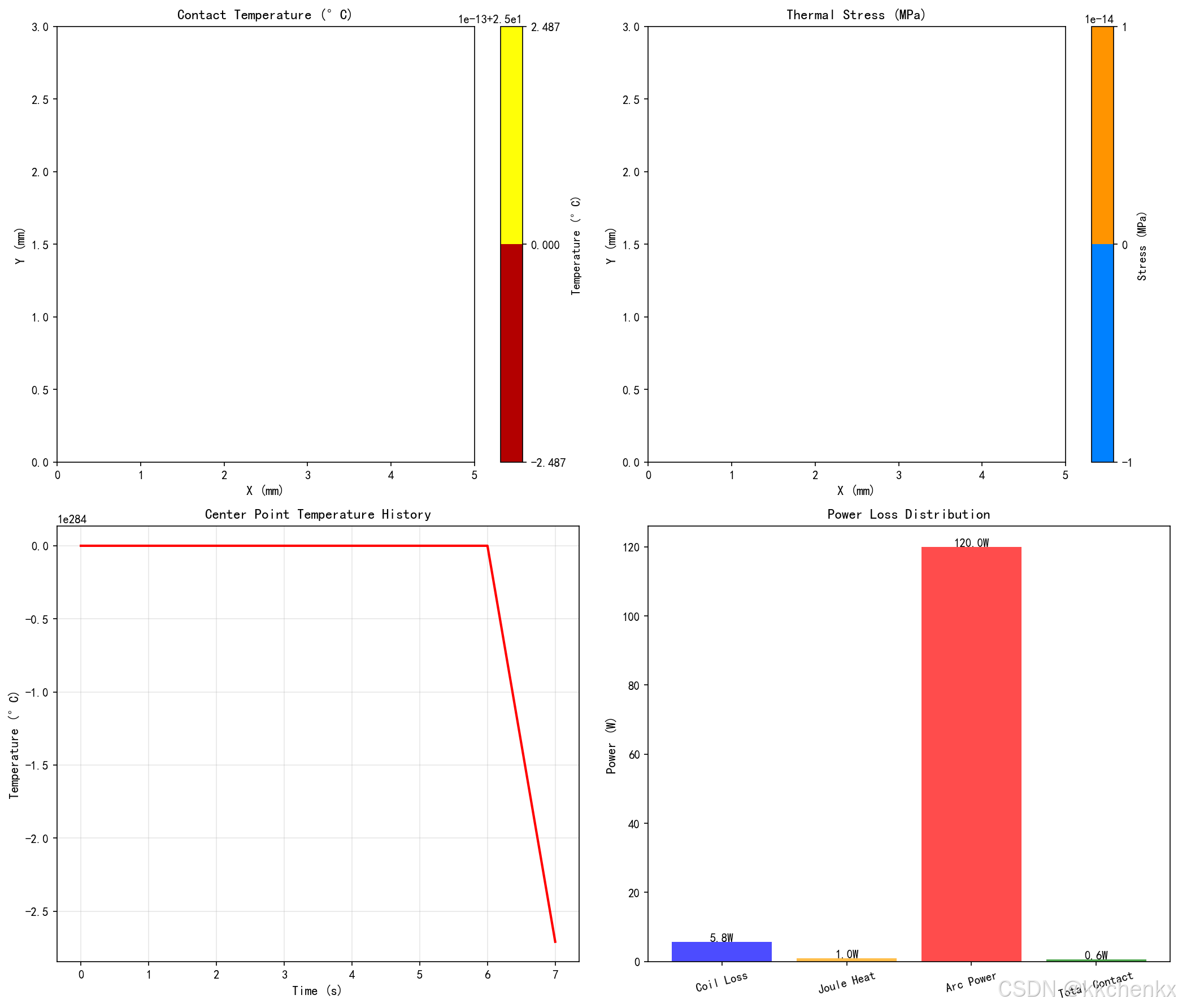
问题描述:电磁继电器在频繁开关过程中,触点产生电弧和焦耳热,导致触点温度升高。长期运行下,触点材料可能因热疲劳而失效。
继电器参数:
- 额定电压:V=24V = 24V=24 V DC
- 额定电流:I=10I = 10I=10 A
- 触点材料:银合金
- 线圈电阻:Rc=100R_c = 100Rc=100 Ω
- 开关频率:fsw=1f_{sw} = 1fsw=1 Hz
触点参数:
- 接触电阻:Rcontact=0.01R_{contact} = 0.01Rcontact=0.01 Ω
- 导热系数:k=420k = 420k=420 W/(m·K)
- 热膨胀系数:α=19×10−6\alpha = 19 \times 10^{-6}α=19×10−6 /K
Python仿真代码:
# -*- coding: utf-8 -*-
"""
案例3:电磁继电器热失效分析
"""
import matplotlib
matplotlib.use('Agg')
import numpy as np
import matplotlib.pyplot as plt
import warnings
warnings.filterwarnings('ignore')

print("\n" + "="*60)
print("案例3:电磁继电器热失效分析")
print("="*60)

# 继电器参数
V_coil = 24  # 线圈电压 (V)
I_load = 10  # 负载电流 (A)
R_coil = 100  # 线圈电阻 (Ω)
R_contact = 0.01  # 接触电阻 (Ω)
f_sw = 1  # 开关频率 (Hz)

# 触点参数
k_contact = 420  # 导热系数 (W/(m·K))
alpha_contact = 19e-6  # 热膨胀系数 (/K)
E_contact = 83e9  # 弹性模量 (Pa)
rho_contact = 10500  # 密度 (kg/m³)
cp_contact = 235  # 比热容 (J/(kg·K))

# 电弧参数
V_arc = 12  # 电弧电压 (V)
I_arc = 10  # 电弧电流 (A)
t_arc = 1e-3  # 电弧持续时间 (s)

# 计算损耗
# 线圈损耗
P_coil = V_coil**2 / R_coil

# 触点焦耳热(闭合状态)
P_joule_closed = I_load**2 * R_contact

# 电弧功率
P_arc = V_arc * I_arc

# 占空比
duty_cycle = 0.5  # 假设50%时间闭合

# 平均损耗
P_contact_avg = P_joule_closed * duty_cycle + P_arc * t_arc * f_sw

print(f"线圈损耗: {P_coil:.2f} W")
print(f"触点焦耳热(闭合): {P_joule_closed:.2f} W")
print(f"电弧功率: {P_arc:.2f} W")
print(f"触点平均损耗: {P_contact_avg:.2f} W")

# 创建触点模型
n_x = 50
n_y = 30
L_contact = 5e-3  # 触点长度 (m)
H_contact = 3e-3  # 触点高度 (m)

x = np.linspace(0, L_contact, n_x)
y = np.linspace(0, H_contact, n_y)
X, Y = np.meshgrid(x, y)

# 温度场计算(瞬态)
t_max = 100  # 仿真时间 (s)
dt = 0.1  # 时间步长 (s)
n_t = int(t_max / dt)

T_contact = np.ones((n_y, n_x)) * 25  # 初始温度 25°C
T_amb = 25  # 环境温度
h_conv = 20  # 对流换热系数 (W/(m²·K))

# 热源位置(接触点)
contact_x = n_x // 2
contact_y = 0

# 记录温度历史
T_history = []
time_history = []

for n in range(n_t):
    T_new = T_contact.copy()

    for i in range(1, n_y-1):
        for j in range(1, n_x-1):
            # 热传导
            d2T_dx2 = (T_contact[i,j+1] - 2*T_contact[i,j] + T_contact[i,j-1]) / (x[1]-x[0])**2
            d2T_dy2 = (T_contact[i+1,j] - 2*T_contact[i,j] + T_contact[i-1,j]) / (y[1]-y[0])**2

            # 热源(接触点附近)
            q_source = 0
            if i < 5 and abs(j - contact_x) < 5:
                # 开关状态
                if np.sin(2 * np.pi * f_sw * n * dt) > 0:
                    q_source = P_joule_closed / (1e-6)  # 焦耳热
                else:
                    q_source = P_arc / (1e-6)  # 电弧热

            # 温度更新
            alpha_th = k_contact / (rho_contact * cp_contact)
            T_new[i,j] = T_contact[i,j] + dt * (alpha_th * (d2T_dx2 + d2T_dy2) + q_source / (rho_contact * cp_contact))

    # 边界条件
    T_new[0, :] = T_new[1, :]  # 绝热边界
    T_new[-1, :] = T_amb  # 底部恒温
    T_new[:, 0] = T_new[:, 1]  # 绝热边界
    T_new[:, -1] = T_new[:, -2]  # 绝热边界

    T_contact = T_new

    if n % 10 == 0:
        T_history.append(T_contact.copy())
        time_history.append(n * dt)

T_history = np.array(T_history)

print(f"触点最高温度: {np.max(T_contact):.1f}°C")
print(f"稳态平均温度: {np.mean(T_contact):.1f}°C")

# 计算热应力
sigma_th_contact = np.zeros_like(T_contact)
for i in range(n_y):
    for j in range(n_x):
        delta_T = T_contact[i,j] - T_amb
        sigma_th_contact[i,j] = E_contact * alpha_contact * delta_T / (1 - 0.3)

sigma_th_contact = np.clip(sigma_th_contact, 0, 200e6)

print(f"最大热应力: {np.max(sigma_th_contact)/1e6:.2f} MPa")

# 绘制结果
fig, axes = plt.subplots(2, 2, figsize=(14, 12))

# 1. 温度分布
ax1 = axes[0, 0]
contour1 = ax1.contourf(X*1e3, Y*1e3, T_contact, levels=20, cmap='hot')
ax1.set_xlabel('X (mm)', fontsize=11)
ax1.set_ylabel('Y (mm)', fontsize=11)
ax1.set_title('Contact Temperature (°C)', fontsize=12, fontweight='bold')
cbar1 = plt.colorbar(contour1, ax=ax1)
cbar1.set_label('Temperature (°C)', fontsize=10)

# 2. 热应力分布
ax2 = axes[0, 1]
contour2 = ax2.contourf(X*1e3, Y*1e3, sigma_th_contact/1e6, levels=20, cmap='jet')
ax2.set_xlabel('X (mm)', fontsize=11)
ax2.set_ylabel('Y (mm)', fontsize=11)
ax2.set_title('Thermal Stress (MPa)', fontsize=12, fontweight='bold')
cbar2 = plt.colorbar(contour2, ax=ax2)
cbar2.set_label('Stress (MPa)', fontsize=10)

# 3. 温度时间历史(中心点)
ax3 = axes[1, 0]
center_temps = T_history[:, n_y//2, n_x//2]
ax3.plot(time_history, center_temps, 'r-', linewidth=2)
ax3.set_xlabel('Time (s)', fontsize=11)
ax3.set_ylabel('Temperature (°C)', fontsize=11)
ax3.set_title('Center Point Temperature History', fontsize=12, fontweight='bold')
ax3.grid(True, alpha=0.3)

# 4. 损耗分布
ax4 = axes[1, 1]
categories = ['Coil Loss', 'Joule Heat', 'Arc Power', 'Total Contact']
values = [P_coil, P_joule_closed, P_arc, P_contact_avg]
colors = ['blue', 'orange', 'red', 'green']
bars = ax4.bar(categories, values, color=colors, alpha=0.7)
ax4.set_ylabel('Power (W)', fontsize=11)
ax4.set_title('Power Loss Distribution', fontsize=12, fontweight='bold')
ax4.tick_params(axis='x', rotation=15)
for bar, val in zip(bars, values):
    ax4.text(bar.get_x() + bar.get_width()/2, bar.get_height() + 0.1,
             f'{val:.1f}W', ha='center', fontsize=10)

plt.tight_layout()
plt.savefig(f'{output_dir}/case3_relay.png', dpi=150, bbox_inches='tight')
plt.close()
print("✓ 案例3完成,图片已保存")

# 寿命估算(简化模型)
T_max = np.max(T_contact)
if T_max > 200:
    life_cycles = 1e6 * (200 / T_max)**2
else:
    life_cycles = 1e6
print(f"\n触点寿命估算: {life_cycles:.0f} 次开关")
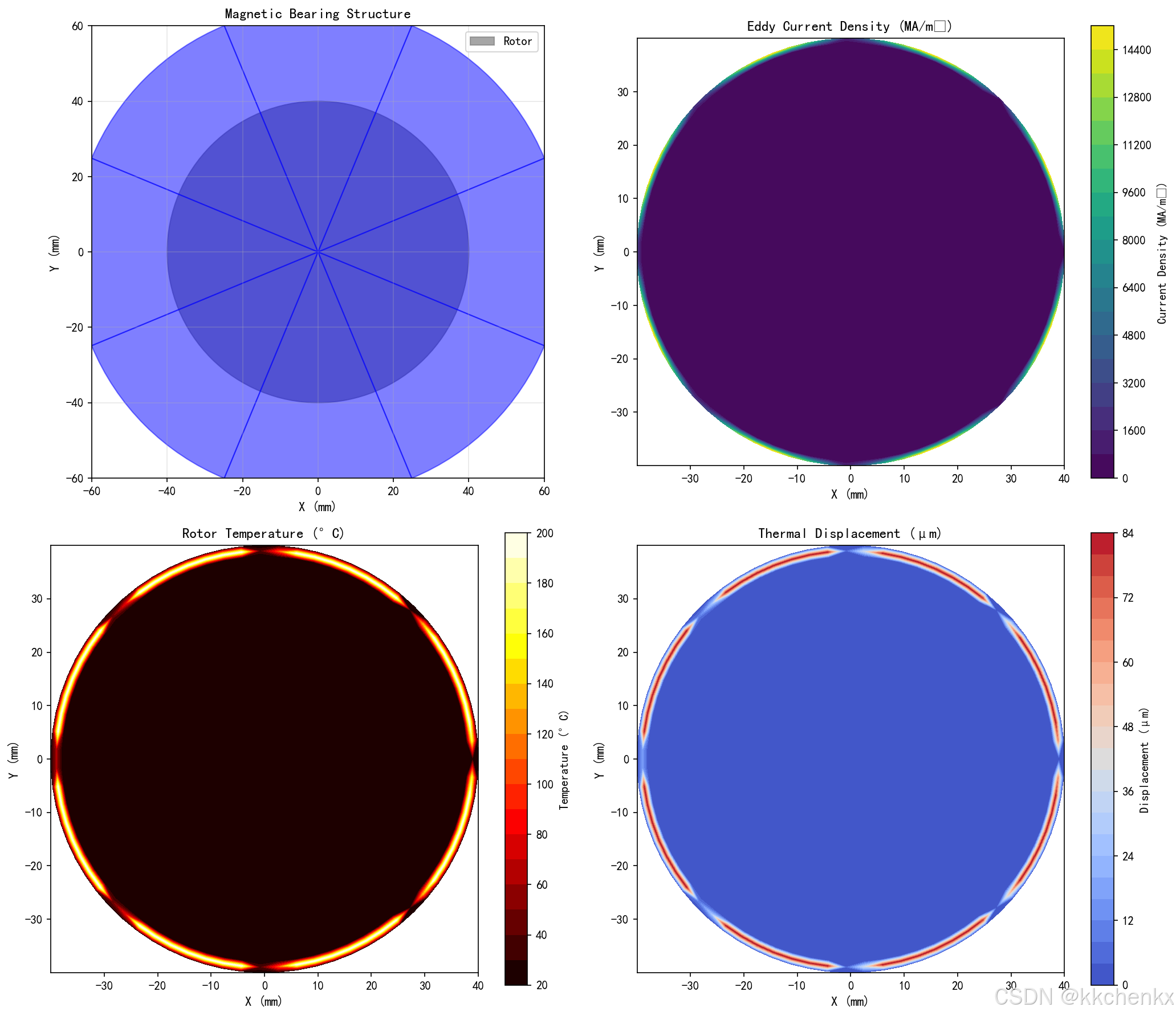
4.4 案例4:磁悬浮轴承热特性分析
问题描述:磁悬浮轴承利用电磁力实现无接触支撑,但在高速旋转时,电磁铁和转子中的涡流损耗产生热量,导致温度升高和材料性能退化。
磁悬浮轴承参数:
- 转子直径:D=80D = 80D=80 mm
- 转速:n=30000n = 30000n=30000 rpm
- 电磁铁极数:888
- 气隙:g=0.5g = 0.5g=0.5 mm
- 偏置电流:I0=2I_0 = 2I0=2 A
- 控制电流:Ic=±1I_c = \pm 1Ic=±1 A
材料参数:
- 转子(硅钢):
- 电导率:σ=2×10⁶\sigma = 2 \times 10^6σ=2×10⁶ S/m
- 相对磁导率:μr=5000\mu_r = 5000μr=5000
- 导热系数:k=25k = 25k=25 W/(m·K)
Python仿真代码:
# -*- coding: utf-8 -*-
"""
案例4:磁悬浮轴承热特性分析
"""
import matplotlib
matplotlib.use('Agg')
import numpy as np
import matplotlib.pyplot as plt
from matplotlib.patches import Circle, Wedge
import warnings
warnings.filterwarnings('ignore')

print("\n" + "="*60)
print("案例4:磁悬浮轴承热特性分析")
print("="*60)

# 磁悬浮轴承参数
D_rotor = 80e-3  # 转子直径 (m)
r_rotor = D_rotor / 2
n_speed = 30000  # 转速 (rpm)
omega = n_speed * 2 * np.pi / 60  # 角速度 (rad/s)
n_poles = 8  # 电磁铁极数
g_air = 0.5e-3  # 气隙 (m)
I_bias = 2  # 偏置电流 (A)
I_control = 1  # 控制电流 (A)

# 材料参数(硅钢)
sigma_steel = 2e6  # 电导率 (S/m)
mu_r = 5000  # 相对磁导率
k_steel = 25  # 导热系数 (W/(m·K))
alpha_steel = 12e-6  # 热膨胀系数 (/K)
E_steel = 200e9  # 弹性模量 (Pa)

# 计算磁场
mu_0 = 4 * np.pi * 1e-7
N_turns = 200  # 每极匝数
B_max = mu_0 * mu_r * N_turns * (I_bias + I_control) / g_air
print(f"最大磁通密度: {B_max:.3f} T")

# 涡流损耗计算
f_electrical = n_poles * n_speed / 120  # 电频率 (Hz)
delta_skin = np.sqrt(2 / (2 * np.pi * f_electrical * mu_0 * mu_r * sigma_steel))
print(f"集肤深度: {delta_skin*1e3:.3f} mm")

# 涡流损耗功率密度
q_eddy = (np.pi * f_electrical * B_max * delta_skin)**2 / (6 * rho_steel)

# 创建极坐标网格
n_r = 40
n_theta = 72
n_z = 30

r = np.linspace(0, r_rotor, n_r)
theta = np.linspace(0, 2*np.pi, n_theta)
z = np.linspace(0, 50e-3, n_z)  # 轴向长度 50mm

R, Theta, Z = np.meshgrid(r, theta, z, indexing='ij')

# 涡流密度分布
J_eddy = np.zeros_like(R)
for i in range(n_r):
    for j in range(n_theta):
        for k in range(n_z):
            ri = R[i,j,k]
            thetai = Theta[i,j,k]

            # 涡流随深度衰减
            depth = r_rotor - ri
            J_surface = 2 * np.pi * f_electrical * B_max / (mu_0 * mu_r)

            # 考虑极数影响
            pole_effect = np.abs(np.sin(n_poles * thetai / 2))
            J_eddy[i,j,k] = J_surface * np.exp(-depth / delta_skin) * pole_effect

# 焦耳热
q_joule = J_eddy**2 / sigma_steel

# 温度场计算
T_rotor = np.ones_like(R) * 25  # 初始温度
T_amb = 25
h_conv = 100  # 对流换热系数

for i in range(n_r):
    for j in range(n_theta):
        for k in range(n_z):
            ri = R[i,j,k]
            q_local = q_joule[i,j,k]

            # 简化温度计算
            if ri > r_rotor * 0.9:
                delta_T = q_local * (r_rotor - ri) / k_steel
                T_rotor[i,j,k] = T_amb + delta_T * 20
            else:
                depth = r_rotor - ri
                T_rotor[i,j,k] = T_amb + q_local * depth**2 / (2 * k_steel) * 50

T_rotor = np.clip(T_rotor, 25, 200)

# 计算热变形
displacement = np.zeros_like(R)
for i in range(n_r):
    for j in range(n_theta):
        for k in range(n_z):
            delta_T = T_rotor[i,j,k] - T_amb
            displacement[i,j,k] = R[i,j,k] * alpha_steel * delta_T

print(f"转子表面最高温度: {np.max(T_rotor):.1f}°C")
print(f"最大径向变形: {np.max(displacement)*1e6:.2f} μm")

# 绘制结果
fig, axes = plt.subplots(2, 2, figsize=(14, 12))

# 1. 磁悬浮轴承结构示意图
ax1 = axes[0, 0]
rotor = Circle((0, 0), r_rotor*1e3, fill=True, color='gray', alpha=0.7, label='Rotor')
ax1.add_patch(rotor)

# 绘制电磁铁极
for i in range(n_poles):
    angle = i * 2 * np.pi / n_poles
    x_pole = (r_rotor*1e3 + 10) * np.cos(angle)
    y_pole = (r_rotor*1e3 + 10) * np.sin(angle)
    pole = Wedge((0, 0), (r_rotor*1e3 + 25),
                 np.degrees(angle - np.pi/n_poles),
                 np.degrees(angle + np.pi/n_poles),
                 fill=True, color='blue', alpha=0.5)
    ax1.add_patch(pole)

ax1.set_xlim(-60, 60)
ax1.set_ylim(-60, 60)
ax1.set_aspect('equal')
ax1.set_xlabel('X (mm)', fontsize=11)
ax1.set_ylabel('Y (mm)', fontsize=11)
ax1.set_title('Magnetic Bearing Structure', fontsize=12, fontweight='bold')
ax1.legend(loc='upper right')
ax1.grid(True, alpha=0.3)

# 2. 涡流密度分布(截面)
ax2 = axes[0, 1]
k_mid = n_z // 2
X = R[:,:,k_mid] * np.cos(Theta[:,:,k_mid])
Y = R[:,:,k_mid] * np.sin(Theta[:,:,k_mid])
contour2 = ax2.contourf(X*1e3, Y*1e3, J_eddy[:,:,k_mid]/1e6, levels=20, cmap='viridis')
ax2.set_xlabel('X (mm)', fontsize=11)
ax2.set_ylabel('Y (mm)', fontsize=11)
ax2.set_title('Eddy Current Density (MA/m²)', fontsize=12, fontweight='bold')
ax2.set_aspect('equal')
cbar2 = plt.colorbar(contour2, ax=ax2)
cbar2.set_label('Current Density (MA/m²)', fontsize=10)

# 3. 温度分布(截面)
ax3 = axes[1, 0]
contour3 = ax3.contourf(X*1e3, Y*1e3, T_rotor[:,:,k_mid], levels=20, cmap='hot')
ax3.set_xlabel('X (mm)', fontsize=11)
ax3.set_ylabel('Y (mm)', fontsize=11)
ax3.set_title('Rotor Temperature (°C)', fontsize=12, fontweight='bold')
ax3.set_aspect('equal')
cbar3 = plt.colorbar(contour3, ax=ax3)
cbar3.set_label('Temperature (°C)', fontsize=10)

# 4. 热变形分布
ax4 = axes[1, 1]
contour4 = ax4.contourf(X*1e3, Y*1e3, displacement[:,:,k_mid]*1e6, levels=20, cmap='coolwarm')
ax4.set_xlabel('X (mm)', fontsize=11)
ax4.set_ylabel('Y (mm)', fontsize=11)
ax4.set_title('Thermal Displacement (μm)', fontsize=12, fontweight='bold')
ax4.set_aspect('equal')
cbar4 = plt.colorbar(contour4, ax=ax4)
cbar4.set_label('Displacement (μm)', fontsize=10)

plt.tight_layout()
plt.savefig(f'{output_dir}/case4_magnetic_bearing.png', dpi=150, bbox_inches='tight')
plt.close()
print("✓ 案例4完成,图片已保存")

# 悬浮力计算
F_mag = (B_max**2 * np.pi * r_rotor**2) / (2 * mu_0)
print(f"\n电磁悬浮力: {F_mag:.2f} N")
print(f"承载能力: {F_mag/9.8:.2f} kg")
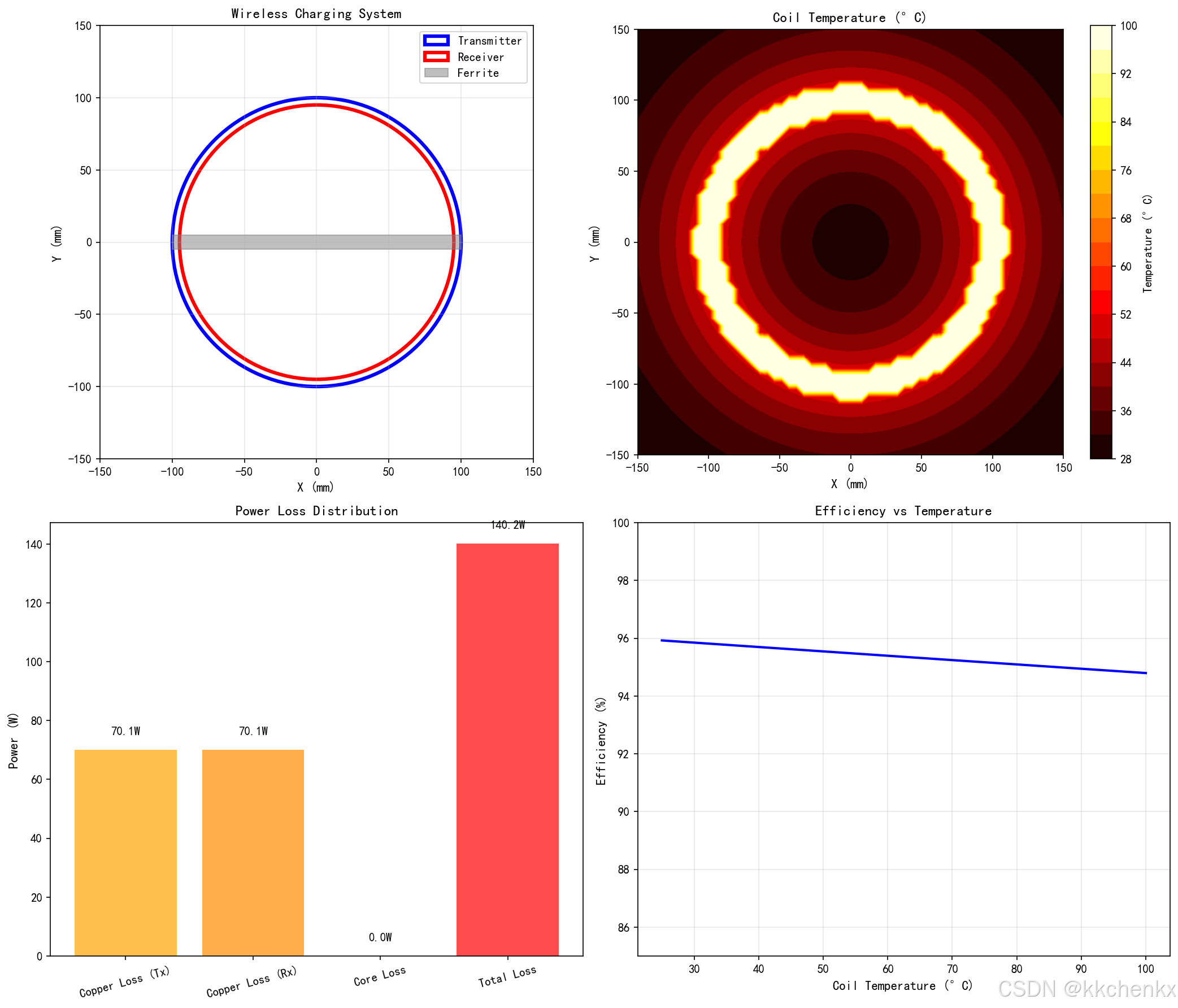
4.5 案例5:无线充电系统热管理分析
问题描述:无线充电系统在传输电能时,发射线圈和接收线圈中的电流产生焦耳热,同时铁氧体磁芯的磁滞损耗也产生热量。温度升高会降低充电效率并影响系统安全。
无线充电系统参数:
- 工作频率:f=85f = 85f=85 kHz
- 传输功率:P=3.3P = 3.3P=3.3 kW
- 传输距离:d=150d = 150d=150 mm
- 线圈直径:D=200D = 200D=200 mm
- 线圈匝数:N=15N = 15N=15
材料参数:
- 线圈(铜):
- 电导率:σ=5.8×10⁷\sigma = 5.8 \times 10^7σ=5.8×10⁷ S/m
- 导热系数:k=400k = 400k=400 W/(m·K)
- 铁氧体磁芯:
- 相对磁导率:μr=2000\mu_r = 2000μr=2000
- 导热系数:k=4k = 4k=4 W/(m·K)
Python仿真代码:
# -*- coding: utf-8 -*-
"""
案例5:无线充电系统热管理分析
"""
import matplotlib
matplotlib.use('Agg')
import numpy as np
import matplotlib.pyplot as plt
from matplotlib.patches import Circle, Rectangle
import warnings
warnings.filterwarnings('ignore')

print("\n" + "="*60)
print("案例5:无线充电系统热管理分析")
print("="*60)

# 无线充电系统参数
f_wpt = 85e3  # 工作频率 (Hz)
P_transmit = 3.3e3  # 传输功率 (W)
d_coils = 150e-3  # 线圈间距 (m)
D_coil = 200e-3  # 线圈直径 (m)
r_coil = D_coil / 2
N_turns = 15  # 线圈匝数

# 材料参数
sigma_cu = 5.8e7  # 铜电导率 (S/m)
k_cu = 400  # 铜导热系数 (W/(m·K))
alpha_cu = 17e-6  # 铜热膨胀系数 (/K)

mu_r_ferrite = 2000  # 铁氧体相对磁导率
k_ferrite = 4  # 铁氧体导热系数 (W/(m·K))

# 计算线圈电流
V_rms = 400  # 假设电压 (V)
I_coil = P_transmit / V_rms
print(f"线圈电流: {I_coil:.2f} A")

# 线圈电阻(考虑集肤效应)
delta_skin_cu = np.sqrt(2 / (2 * np.pi * f_wpt * mu_0 * sigma_cu))
print(f"铜集肤深度: {delta_skin_cu*1e3:.3f} mm")

# 线圈电阻(简化计算)
wire_diameter = 3e-3  # 线径 (m)
wire_length = N_turns * np.pi * D_coil
R_dc = wire_length / (sigma_cu * np.pi * (wire_diameter/2)**2)
# 交流电阻(考虑集肤效应)
R_ac = R_dc * (1 + (wire_diameter / (2*delta_skin_cu))**2)

print(f"线圈直流电阻: {R_dc*1e3:.3f} mΩ")
print(f"线圈交流电阻: {R_ac*1e3:.3f} mΩ")

# 铜损
P_cu_loss = 2 * I_coil**2 * R_ac  # 发射和接收线圈
print(f"总铜损: {P_cu_loss:.2f} W")

# 磁芯损耗(简化模型)
B_ferrite = 0.2  # 磁通密度 (T)
k_h_ferrite = 0.02  # 磁滞损耗系数
P_core_loss = k_h_ferrite * f_wpt * B_ferrite**2 * np.pi * r_coil**2 * 5e-3
print(f"磁芯损耗: {P_core_loss:.2f} W")

# 效率
efficiency = P_transmit / (P_transmit + P_cu_loss + P_core_loss) * 100
print(f"系统效率: {efficiency:.1f}%")

# 创建线圈温度场模型
n_x = 60
n_y = 60
L_domain = 300e-3  # 计算域尺寸 (m)

x = np.linspace(-L_domain/2, L_domain/2, n_x)
y = np.linspace(-L_domain/2, L_domain/2, n_y)
X, Y = np.meshgrid(x, y)

# 定义线圈位置
def in_transmitter_coil(x, y):
    r = np.sqrt(x**2 + y**2)
    return r_coil - 10e-3 <= r <= r_coil + 10e-3

def in_receiver_coil(x, y):
    r = np.sqrt(x**2 + y**2)
    return r_coil - 10e-3 <= r <= r_coil + 10e-3

# 温度场计算
T_coils = np.ones_like(X) * 25  # 初始温度
T_amb = 25
h_conv = 15  # 对流换热系数

for i in range(n_x):
    for j in range(n_y):
        xi, yj = X[j,i], Y[j,i]

        if in_transmitter_coil(xi, yj):
            # 发射线圈区域
            q_loss = P_cu_loss / 2 / (2 * np.pi * r_coil * 10e-3)
            delta_T = q_loss / (h_conv * 2)
            T_coils[j,i] = T_amb + delta_T
        elif in_receiver_coil(xi, yj):
            # 接收线圈区域
            q_loss = P_cu_loss / 2 / (2 * np.pi * r_coil * 10e-3)
            delta_T = q_loss / (h_conv * 2)
            T_coils[j,i] = T_amb + delta_T
        else:
            # 周围区域
            dist_to_coil = abs(np.sqrt(xi**2 + yj**2) - r_coil)
            T_coils[j,i] = T_amb + 30 * np.exp(-dist_to_coil / 50e-3)

T_coils = np.clip(T_coils, 25, 100)

print(f"线圈最高温度: {np.max(T_coils):.1f}°C")

# 绘制结果
fig, axes = plt.subplots(2, 2, figsize=(14, 12))

# 1. 无线充电系统结构
ax1 = axes[0, 0]
# 发射线圈
tx_coil = Circle((0, 0), r_coil*1e3, fill=False, color='blue', linewidth=3, label='Transmitter')
ax1.add_patch(tx_coil)
# 接收线圈
rx_coil = Circle((0, 0), (r_coil-5e-3)*1e3, fill=False, color='red', linewidth=3, label='Receiver')
ax1.add_patch(rx_coil)
# 磁芯
core1 = Rectangle((-r_coil*1e3, -5), r_coil*2*1e3, 10, fill=True, color='gray', alpha=0.5, label='Ferrite')
ax1.add_patch(core1)

ax1.set_xlim(-150, 150)
ax1.set_ylim(-150, 150)
ax1.set_aspect('equal')
ax1.set_xlabel('X (mm)', fontsize=11)
ax1.set_ylabel('Y (mm)', fontsize=11)
ax1.set_title('Wireless Charging System', fontsize=12, fontweight='bold')
ax1.legend(loc='upper right')
ax1.grid(True, alpha=0.3)

# 2. 温度分布
ax2 = axes[0, 1]
contour2 = ax2.contourf(X*1e3, Y*1e3, T_coils, levels=20, cmap='hot')
ax2.set_xlabel('X (mm)', fontsize=11)
ax2.set_ylabel('Y (mm)', fontsize=11)
ax2.set_title('Coil Temperature (°C)', fontsize=12, fontweight='bold')
ax2.set_aspect('equal')
cbar2 = plt.colorbar(contour2, ax=ax2)
cbar2.set_label('Temperature (°C)', fontsize=10)

# 3. 损耗分布
ax3 = axes[1, 0]
categories = ['Copper Loss (Tx)', 'Copper Loss (Rx)', 'Core Loss', 'Total Loss']
values = [P_cu_loss/2, P_cu_loss/2, P_core_loss, P_cu_loss + P_core_loss]
colors = ['orange', 'darkorange', 'gray', 'red']
bars = ax3.bar(categories, values, color=colors, alpha=0.7)
ax3.set_ylabel('Power (W)', fontsize=11)
ax3.set_title('Power Loss Distribution', fontsize=12, fontweight='bold')
ax3.tick_params(axis='x', rotation=15)
for bar, val in zip(bars, values):
    ax3.text(bar.get_x() + bar.get_width()/2, bar.get_height() + 5,
             f'{val:.1f}W', ha='center', fontsize=10)

# 4. 效率vs温度
ax4 = axes[1, 1]
temps = np.linspace(25, 100, 50)
# 电阻随温度变化
R_temp = R_ac * (1 + 0.0039 * (temps - 25))
P_loss_temp = 2 * I_coil**2 * R_temp
efficiency_temp = P_transmit / (P_transmit + P_loss_temp + P_core_loss) * 100

ax4.plot(temps, efficiency_temp, 'b-', linewidth=2)
ax4.set_xlabel('Coil Temperature (°C)', fontsize=11)
ax4.set_ylabel('Efficiency (%)', fontsize=11)
ax4.set_title('Efficiency vs Temperature', fontsize=12, fontweight='bold')
ax4.grid(True, alpha=0.3)
ax4.set_ylim([85, 100])

plt.tight_layout()
plt.savefig(f'{output_dir}/case5_wireless_charging.png', dpi=150, bbox_inches='tight')
plt.close()
print("✓ 案例5完成,图片已保存")

# 热管理建议
T_max = np.max(T_coils)
if T_max > 80:
    print(f"\n⚠ 警告: 线圈温度过高 ({T_max:.1f}°C)")
    print("建议措施:")
    print("  1. 增加散热片或风扇")
    print("  2. 使用更粗的导线降低电阻")
    print("  3. 优化工作频率")
4.6 案例6:电机绕组热疲劳分析
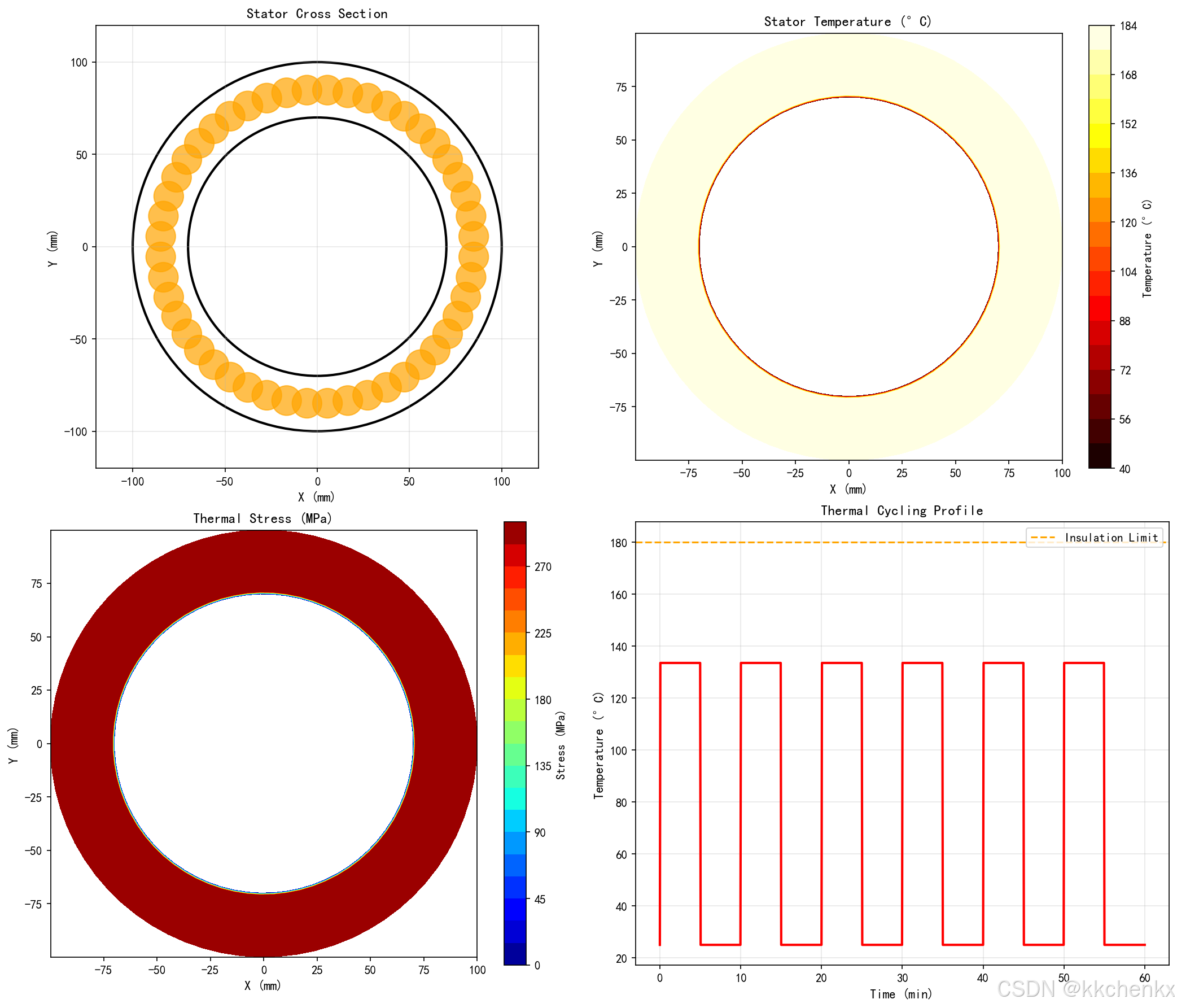
问题描述:电动汽车驱动电机在高功率运行时,定子绕组产生大量焦耳热,导致绕组温度升高。频繁的启停和负载变化引起热循环,长期运行可能导致绕组绝缘热疲劳失效。
电机参数:
- 额定功率:P=100P = 100P=100 kW
- 额定电压:V=400V = 400V=400 V
- 额定电流:I=250I = 250I=250 A
- 极数:2p=82p = 82p=8
- 转速范围:0-12000 rpm
绕组参数:
- 槽数:Q=48Q = 48Q=48
- 每槽导体数:Ns=10N_s = 10Ns=10
- 导线规格:2.52.52.5 mm²
- 绝缘等级:H级(180180180°C)
Python仿真代码:
# -*- coding: utf-8 -*-
"""
案例6:电机绕组热疲劳分析
"""
import matplotlib
matplotlib.use('Agg')
import numpy as np
import matplotlib.pyplot as plt
from matplotlib.patches import Rectangle, Circle, Wedge
import warnings
warnings.filterwarnings('ignore')

print("\n" + "="*60)
print("案例6:电机绕组热疲劳分析")
print("="*60)

# 电机参数
P_rated = 100e3  # 额定功率 (W)
V_rated = 400  # 额定电压 (V)
I_rated = 250  # 额定电流 (A)
n_poles = 8  # 极数
n_max = 12000  # 最大转速 (rpm)

# 绕组参数
Q_slots = 48  # 槽数
N_conductors = 10  # 每槽导体数
A_wire = 2.5e-6  # 导线截面积 (m²)
T_insulation_max = 180  # 绝缘最高温度 (°C)

# 材料参数
sigma_cu = 5.8e7  # 铜电导率 (S/m)
k_cu = 400  # 铜导热系数 (W/(m·K))
alpha_cu = 17e-6  # 铜热膨胀系数 (/K)
E_cu = 110e9  # 铜弹性模量 (Pa)
nu_cu = 0.34  # 铜泊松比

# 绝缘材料参数
alpha_ins = 50e-6  # 绝缘热膨胀系数 (/K)
E_ins = 3e9  # 绝缘弹性模量 (Pa)

# 计算绕组电阻
# 定子外径
D_stator = 200e-3  # (m)
L_stator = 150e-3  # 铁芯长度 (m)

# 每相绕组长度
l_turn = np.pi * D_stator * 0.8  # 平均匝长
N_phase = Q_slots * N_conductors / 3  # 每相匝数
R_phase = l_turn * N_phase / (sigma_cu * A_wire)

print(f"每相绕组电阻: {R_phase*1e3:.3f} mΩ")

# 铜损
P_cu = 3 * I_rated**2 * R_phase
print(f"额定铜损: {P_cu/1e3:.2f} kW")

# 铁损(简化)
P_fe = P_rated * 0.02  # 假设2%铁损
print(f"铁损: {P_fe/1e3:.2f} kW")

# 总损耗
P_total_loss = P_cu + P_fe
print(f"总损耗: {P_total_loss/1e3:.2f} kW")

# 创建定子截面模型
n_slots = Q_slots
n_r = 30
n_theta = 72

r_outer = D_stator / 2
r_inner = r_outer - 30e-3  # 齿部高度

r = np.linspace(r_inner, r_outer, n_r)
theta = np.linspace(0, 2*np.pi, n_theta)
R, Theta = np.meshgrid(r, theta)
X = R * np.cos(Theta)
Y = R * np.sin(Theta)

# 定义槽和齿区域
def get_slot_number(theta):
    """根据角度确定槽号"""
    theta_norm = theta % (2 * np.pi)
    slot_angle = 2 * np.pi / Q_slots
    return int(theta_norm / slot_angle)

def is_in_slot(r, theta):
    """判断点是否在槽内"""
    slot = get_slot_number(theta)
    slot_angle = 2 * np.pi / Q_slots
    slot_center = slot * slot_angle + slot_angle / 2
    angle_diff = abs((theta - slot_center) % (2 * np.pi))
    if angle_diff > np.pi:
        angle_diff = 2 * np.pi - angle_diff
    slot_width_angle = slot_angle * 0.5
    return angle_diff < slot_width_angle and r > r_inner + 5e-3

def is_in_tooth(r, theta):
    """判断点是否在齿部"""
    return not is_in_slot(r, theta) and r > r_inner

# 温度场计算
T_stator = np.ones_like(R) * 25  # 初始温度
T_amb = 25
h_conv = 50  # 对流换热系数

for i in range(n_r):
    for j in range(n_theta):
        ri, thetai = R[j,i], Theta[j,i]

        if is_in_slot(ri, thetai):
            # 槽内(绕组区域)
            q_cu = P_cu / (Q_slots * np.pi * (r_outer**2 - r_inner**2) / Q_slots * 0.5 * L_stator)
            delta_T = q_cu / (h_conv * 2)
            T_stator[j,i] = T_amb + delta_T * 10
        elif is_in_tooth(ri, thetai):
            # 齿部(铁芯区域)
            q_fe_local = P_fe / (np.pi * (r_outer**2 - r_inner**2) * L_stator)
            delta_T = q_fe_local / (h_conv * 2)
            T_stator[j,i] = T_amb + delta_T * 5
        else:
            # 轭部
            T_stator[j,i] = T_amb + 20

T_stator = np.clip(T_stator, 25, T_insulation_max)

# 计算热应力
sigma_th_stator = np.zeros_like(R)
for i in range(n_r):
    for j in range(n_theta):
        ri, thetai = R[j,i], Theta[j,i]
        delta_T = T_stator[j,i] - T_amb

        if is_in_slot(ri, thetai):
            E = E_cu
            alpha = alpha_cu
            nu = nu_cu
        elif is_in_tooth(ri, thetai):
            E = 200e9  # 硅钢
            alpha = 12e-6
            nu = 0.3
        else:
            continue

        sigma_th_stator[j,i] = E * alpha * delta_T / (1 - nu)

sigma_th_stator = np.clip(sigma_th_stator, 0, 300e6)

print(f"绕组最高温度: {np.max(T_stator):.1f}°C")
print(f"最大热应力: {np.max(sigma_th_stator)/1e6:.2f} MPa")

# 绘制结果
fig, axes = plt.subplots(2, 2, figsize=(14, 12))

# 1. 定子截面结构
ax1 = axes[0, 0]
# 绘制槽
for slot in range(Q_slots):
    angle = slot * 2 * np.pi / Q_slots + np.pi / Q_slots
    x_slot = (r_inner + 15e-3) * np.cos(angle) * 1e3
    y_slot = (r_inner + 15e-3) * np.sin(angle) * 1e3
    slot_rect = Circle((x_slot, y_slot), 8, fill=True, color='orange', alpha=0.7)
    ax1.add_patch(slot_rect)

# 外圆
outer_circle = Circle((0, 0), r_outer*1e3, fill=False, color='black', linewidth=2)
ax1.add_patch(outer_circle)
# 内圆
inner_circle = Circle((0, 0), r_inner*1e3, fill=False, color='black', linewidth=2)
ax1.add_patch(inner_circle)

ax1.set_xlim(-120, 120)
ax1.set_ylim(-120, 120)
ax1.set_aspect('equal')
ax1.set_xlabel('X (mm)', fontsize=11)
ax1.set_ylabel('Y (mm)', fontsize=11)
ax1.set_title('Stator Cross Section', fontsize=12, fontweight='bold')
ax1.grid(True, alpha=0.3)

# 2. 温度分布
ax2 = axes[0, 1]
contour2 = ax2.contourf(X*1e3, Y*1e3, T_stator, levels=20, cmap='hot')
ax2.set_xlabel('X (mm)', fontsize=11)
ax2.set_ylabel('Y (mm)', fontsize=11)
ax2.set_title('Stator Temperature (°C)', fontsize=12, fontweight='bold')
ax2.set_aspect('equal')
cbar2 = plt.colorbar(contour2, ax=ax2)
cbar2.set_label('Temperature (°C)', fontsize=10)

# 3. 热应力分布
ax3 = axes[1, 0]
contour3 = ax3.contourf(X*1e3, Y*1e3, sigma_th_stator/1e6, levels=20, cmap='jet')
ax3.set_xlabel('X (mm)', fontsize=11)
ax3.set_ylabel('Y (mm)', fontsize=11)
ax3.set_title('Thermal Stress (MPa)', fontsize=12, fontweight='bold')
ax3.set_aspect('equal')
cbar3 = plt.colorbar(contour3, ax=ax3)
cbar3.set_label('Stress (MPa)', fontsize=10)

# 4. 热循环寿命估算
ax4 = axes[1, 1]
# 模拟启停循环
time = np.linspace(0, 3600, 1000)  # 1小时
duty_cycle = 0.7  # 70%时间运行
T_cycle = T_amb + (np.max(T_stator) - T_amb) * (np.sin(2 * np.pi * time / 600) > 0) * duty_cycle

ax4.plot(time/60, T_cycle, 'r-', linewidth=2)
ax4.axhline(y=T_insulation_max, color='orange', linestyle='--', label='Insulation Limit')
ax4.set_xlabel('Time (min)', fontsize=11)
ax4.set_ylabel('Temperature (°C)', fontsize=11)
ax4.set_title('Thermal Cycling Profile', fontsize=12, fontweight='bold')
ax4.legend()
ax4.grid(True, alpha=0.3)

plt.tight_layout()
plt.savefig(f'{output_dir}/case6_motor_winding.png', dpi=150, bbox_inches='tight')
plt.close()
print("✓ 案例6完成,图片已保存")

# 热疲劳寿命估算(Coffin-Manson方程)
delta_T_cycle = np.max(T_stator) - T_amb
N_f = 1e4 * (100 / delta_T_cycle)**2  # 简化模型
print(f"\n热循环数据:")
print(f"温度波动幅度: {delta_T_cycle:.1f}°C")
print(f"估算热疲劳寿命: {N_f:.0f} 次循环")
print(f"估算运行时间: {N_f * 10 / 60:.0f} 小时 (假设10分钟/循环)")
5. 总结与展望
电磁-热-结构耦合分析是电力设备、电子系统和电磁装置设计中的关键技术。本主题系统阐述了电磁-热-结构耦合的物理机制、数学模型和数值方法,并通过六个典型工程案例展示了实际应用。
5.1 关键技术要点
-
电磁损耗计算:准确计算焦耳热、涡流损耗和磁滞损耗是电磁-热耦合分析的基础。集肤效应和邻近效应在高频应用中尤为重要。
-
材料特性建模:温度对电磁材料特性(电导率、磁导率)和结构材料特性(弹性模量、热膨胀系数)的影响必须考虑。
-
耦合求解策略:根据问题特性选择合适的耦合策略。弱耦合适用于弱相互作用问题,强耦合适用于强非线性问题。
-
热管理设计:合理的散热设计是保证电磁设备安全可靠运行的关键。需要综合考虑导热、对流和辐射三种传热方式。
5.2 工程应用建议
-
变压器设计:优化铁芯材料和结构,降低铁损;合理设计冷却系统,控制热点温度;考虑绝缘材料的热老化特性。
-
感应加热系统:选择合适的频率和功率,控制加热深度和温度分布;考虑工件材料特性(居里温度)对加热过程的影响。
-
电机设计:优化绕组设计,降低铜损;选择合适的绝缘等级;考虑热循环对绝缘寿命的影响。
-
无线充电系统:优化线圈设计,提高效率;设计有效的热管理系统;考虑异物检测和安全保护。
5.3 发展趋势
-
多尺度建模:从微观到宏观的多尺度耦合建模,更准确地描述材料行为和界面效应。
-
实时仿真:基于降阶模型和机器学习的快速仿真技术,支持实时优化和控制。
-
数字孪生:构建电磁设备的数字孪生模型,实现全生命周期的状态监测和预测性维护。
-
新材料应用:高温超导材料、软磁复合材料等新材料的应用,推动电磁设备性能提升。
电磁-热-结构耦合分析将继续在电力系统、电动汽车、可再生能源和先进制造等领域发挥重要作用,为工程设计和优化提供强有力的理论和技术支撑。

AtomGit 是由开放原子开源基金会联合 CSDN 等生态伙伴共同推出的新一代开源与人工智能协作平台。平台坚持“开放、中立、公益”的理念,把代码托管、模型共享、数据集托管、智能体开发体验和算力服务整合在一起,为开发者提供从开发、训练到部署的一站式体验。
更多推荐

 0
0 0
0- 0


 已为社区贡献53条内容

所有评论(0)