多场耦合优化-主题100-多场耦合仿真的未来展望
主题100:多场耦合仿真的未来展望
一、引言
1.1 系列教程回顾
经过99个主题的深入学习,我们已经系统性地掌握了多场耦合优化仿真的核心理论、数值方法、工程应用和前沿技术。从基础的热传导方程到复杂的量子-经典混合仿真,从简单的有限差分法到先进的机器学习加速算法,本系列教程构建了一个完整的知识体系。
已涵盖的核心领域:
- 基础理论(主题001-020):数学基础、数值方法、热-力-流-电磁耦合理论
- 核心应用(主题021-060):航空航天、能源动力、生物医学、环境科学
- 高级技术(主题061-080):拓扑优化、降阶模型、不确定性量化、实时仿真
- 前沿研究(主题081-099):人工智能、量子计算、数字孪生、核聚变
1.2 仿真科学的发展历程
工程仿真经历了从简单到复杂、从单一物理场到多物理场耦合、从离线计算到实时仿真的发展历程:
第一代(1960s-1980s):
- 有限元法的成熟与应用
- 单一物理场仿真
- 大型机时代的科学计算
第二代(1980s-2000s):
- 多物理场耦合仿真的兴起
- 商业仿真软件的出现(ANSYS、ABAQUS、COMSOL)
- 个人计算机普及带来的计算民主化
第三代(2000s-2020s):
- 高性能计算与并行仿真
- 多尺度、多物理场耦合
- 数据驱动的建模方法
第四代(2020s-):
- 人工智能与仿真的深度融合
- 数字孪生与实时仿真
- 量子-经典混合计算
- 自主仿真与智能优化
1.3 未来展望的意义
展望未来不仅是为了预测技术发展方向,更是为了:
- 识别潜在的突破点和技术瓶颈
- 指导研究资源的合理配置
- 培养适应未来需求的人才
- 促进跨学科合作与创新
本主题将系统性地展望多场耦合仿真的未来发展趋势,包括技术演进、跨学科融合、新兴应用和社会影响。
二、技术发展趋势
2.1 人工智能驱动的自主仿真
人工智能正在从根本上改变仿真的范式,从"人工建模+数值求解"向"数据驱动+智能推理"转变。
AI在仿真中的应用层次:
- 辅助层:AI辅助网格生成、参数设置、结果后处理
- 加速层:神经网络代理模型、降阶模型、快速预测
- 核心层:物理信息神经网络(PINN)、神经算子、AI求解器
- 自主层:自动建模、智能实验设计、自主优化
物理信息神经网络(PINN):
PINN将物理定律编码为神经网络的损失函数:
L=Ldata+λPDELPDE+λBCLBC\mathcal{L} = \mathcal{L}_{data} + \lambda_{PDE}\mathcal{L}_{PDE} + \lambda_{BC}\mathcal{L}_{BC}L=Ldata+λPDELPDE+λBCLBC
其中:
- Ldata\mathcal{L}_{data}Ldata:数据拟合损失
- LPDE\mathcal{L}_{PDE}LPDE:偏微分方程残差损失
- LBC\mathcal{L}_{BC}LBC:边界条件损失
神经算子(Neural Operators):
神经算子学习从输入函数(如初始条件、边界条件)到输出函数(如解场)的映射:
Gθ:a↦uG_\theta: a \mapsto uGθ:a↦u
代表性方法包括:
- DeepONet:分支网络+主干网络架构
- Fourier Neural Operator (FNO):在傅里叶空间学习算子
- Graph Neural Operator:基于图神经网络的算子学习
AI求解器的优势与挑战:
优势:
- 一旦训练完成,推理速度极快(毫秒级 vs 小时级)
- 可以处理高维问题(克服"维度灾难")
- 能够融合实验数据和物理模型
挑战:
- 泛化能力有限(外推困难)
- 缺乏严格的数学保证
- 训练成本高,需要大量数据
- 可解释性不足
2.2 量子-经典混合仿真
量子计算为特定类型的仿真问题提供了指数级加速的可能。
量子仿真的应用领域:
- 量子化学:分子电子结构计算、反应动力学
- 材料科学:强关联电子系统、拓扑材料
- 优化问题:组合优化、机器学习训练
- 线性代数:大规模线性系统求解
量子算法进展:
HHL算法(量子线性系统算法):
对于线性系统 Ax=bAx = bAx=b,HHL算法可以在 O(logN)O(\log N)O(logN) 时间内求解,相比经典算法的 O(N)O(N)O(N) 有指数级加速。
VQE(变分量子本征求解器):
用于求解分子基态能量:
E(θ)=⟨ψ(θ)∣H∣ψ(θ)⟩E(\theta) = \langle \psi(\theta) | H | \psi(\theta) \rangleE(θ)=⟨ψ(θ)∣H∣ψ(θ)⟩
通过经典-量子混合优化,调整参数 θ\thetaθ 使能量最小化。
量子机器学习:
量子神经网络(QNN)利用量子态的叠加和纠缠特性,理论上可以在某些任务上实现指数级加速。
NISQ时代的挑战:
当前量子计算机处于含噪声中等规模量子(NISQ)时代:
- 量子比特数量有限(50-1000个)
- 噪声和退相干问题严重
- 需要开发鲁棒的量子-经典混合算法
2.3 数字孪生与实时仿真
数字孪生技术将物理实体与虚拟模型实时连接,实现全生命周期的监控、预测和优化。
数字孪生的层次:
- 描述级:几何和物理属性的数字化表示
- 诊断级:实时状态监测和异常检测
- 预测级:基于仿真的性能预测和剩余寿命评估
- 自主级:自主决策和自适应控制
实时仿真的技术挑战:
- 计算速度:需要在毫秒级完成复杂仿真
- 模型精度:降阶模型与全阶模型的精度平衡
- 数据融合:传感器数据与仿真模型的有效融合
- 不确定性管理:实时处理模型和测量不确定性
边缘计算与云仿真:
- 边缘仿真:在设备端进行实时计算,降低延迟
- 云仿真:利用云计算资源进行大规模仿真
- 混合架构:边缘-云协同的分层仿真体系
2.4 多尺度与多物理场深度融合
未来的仿真将更加注重不同尺度、不同物理场之间的无缝耦合。
多尺度耦合方法:
- 串行耦合:从微观到宏观的顺序信息传递
- 并行耦合:同时求解不同尺度的模型
- 自适应耦合:根据局部特征动态选择模型尺度
跨尺度挑战:
- 时空尺度跨度:从飞秒到年,从埃到公里
- 模型异构性:量子力学、分子动力学、连续介质力学的耦合
- 计算资源分配:如何在不同尺度间分配计算资源
统一多物理场框架:
发展能够统一处理各种物理场的数学框架和数值方法:
- 广义守恒律的统一表达
- 自适应网格和模型选择
- 并行求解器的高效实现
三、跨学科融合趋势
3.1 仿真科学与数据科学的融合
数据科学方法正在深刻改变仿真的范式。
数据驱动的建模:
- 模型发现:从数据中发现控制方程(SINDy算法)
- 参数识别:贝叶斯方法、机器学习辅助的参数反演
- 模型降阶:基于数据的降阶模型(POD、DMD)
数字实验:
- 虚拟设计空间探索:利用仿真替代部分物理实验
- 自适应采样:智能选择仿真/实验点
- 不确定性量化:数据驱动的置信度评估
知识图谱与仿真:
- 构建领域知识图谱,支持智能建模
- 自然语言接口,降低仿真使用门槛
- 自动文献分析和知识提取
3.2 仿真与实验的深度融合
仿真与实验的界限正在变得模糊,形成"仿真-实验闭环"。
实验设计优化:
- 贝叶斯实验设计:最大化信息增益的实验规划
- 自适应实验:根据前期结果动态调整实验方案
- 数字孪生实验:虚实结合的混合实验
模型验证与确认(V&V):
- 验证(Verification):确认数值解的正确性
- 确认(Validation):评估模型对物理现实的预测能力
- 不确定性量化:量化数值误差和模型不确定性
自进化模型:
- 通过持续的数据反馈自动改进模型
- 在线学习适应新工况
- 模型可信度实时评估
3.3 仿真与制造的融合
仿真正在从设计阶段向制造全过程延伸。
增材制造仿真:
- 工艺参数优化
- 微观组织预测
- 残余应力和变形控制
在线质量监控:
- 实时仿真预测产品质量
- 自适应工艺调整
- 数字孪生工厂
供应链仿真:
- 复杂供应链建模
- 风险预测与缓解
- 可持续制造优化
3.4 仿真与生命科学的融合
生命科学为仿真提供了新的应用领域和挑战。
生物系统仿真:
- 多尺度生物模型(分子-细胞-组织-器官)
- 个性化医疗仿真
- 药物设计与筛选
神经形态计算:
- 类脑计算架构
- 神经形态芯片仿真
- 脑机接口仿真
合成生物学:
- 基因回路设计
- 代谢工程优化
- 人工生命系统
四、新兴应用领域
4.1 可持续工程与气候仿真
应对气候变化需要强大的仿真能力。
地球系统模式:
- 大气-海洋-陆地-海冰耦合
- 碳循环和生物地球化学循环
- 极端天气事件预测
能源系统转型:
- 可再生能源集成仿真
- 智能电网优化
- 氢能系统仿真
城市气候仿真:
- 城市热岛效应
- 空气污染扩散
- 绿色建筑优化
4.2 空间探索与深空探测
空间探索对仿真提出了极端条件下的建模需求。
深空任务仿真:
- 长时间轨道演化
- 自主导航与避障
- 资源就地利用
极端环境仿真:
- 强辐射环境
- 微重力物理
- 极端温度条件
空间制造与建设:
- 在轨制造仿真
- 月球/火星基地建设
- 太空资源开发
4.3 脑科学与认知仿真
理解大脑是21世纪最大的科学挑战之一。
全脑仿真:
- 神经元网络建模
- 大规模神经仿真(如Blue Brain Project)
- 意识与认知机制
类脑智能:
- 脉冲神经网络
- 神经形态计算
- 通用人工智能路径
脑疾病研究:
- 神经退行性疾病机制
- 药物作用仿真
- 神经调控技术
4.4 社会系统与复杂网络
仿真正在从自然科学向社会科学扩展。
经济系统仿真:
- 基于Agent的宏观经济模型
- 金融市场动力学
- 政策影响评估
城市交通仿真:
- 大规模交通流仿真
- 自动驾驶集成
- 智慧城市规划
公共卫生仿真:
- 传染病传播模型
- 医疗资源优化
- 健康政策评估
五、技术挑战与解决方案
5.1 计算效率挑战
挑战:
- 问题规模持续增长
- 实时性要求提高
- 能源效率约束
解决方案:
-
异构计算:
- CPU+GPU+FPGA协同
- 专用加速器(TPU、NPU)
- 存算一体架构
-
算法创新:
- 线性复杂度算法
- 随机化算法
- 量子-经典混合算法
-
近似计算:
- 自适应精度
- 统计容忍误差
- 感知驱动计算
5.2 模型可信度挑战
挑战:
- 模型复杂度增加导致验证困难
- 数据质量参差不齐
- 不确定性传播
解决方案:
-
不确定性量化:
- 概率方法
- 区间分析
- 模糊逻辑
-
验证与确认框架:
- 标准化流程
- 基准测试库
- 同行评议机制
-
可解释AI:
- 物理一致性约束
- 因果推理
- 可视化解释
5.3 人才与教育挑战
挑战:
- 跨学科人才短缺
- 知识体系更新快
- 实践能力培养不足
解决方案:
-
教育改革:
- 跨学科课程设置
- 项目驱动学习
- 产学研合作
-
开源生态:
- 开源软件平台
- 开放数据集
- 社区驱动创新
-
自动化工具:
- 低代码/无代码平台
- 智能助手
- 自动化工作流
5.4 伦理与社会挑战
挑战:
- 仿真结果误用
- 数据隐私问题
- 技术鸿沟扩大
解决方案:
-
伦理准则:
- 负责任的仿真
- 透明度原则
- 公平性考量
-
政策框架:
- 数据治理
- 算法审计
- 数字包容
-
公众参与:
- 科学传播
- 公众咨询
- 开放科学
六、Python仿真案例
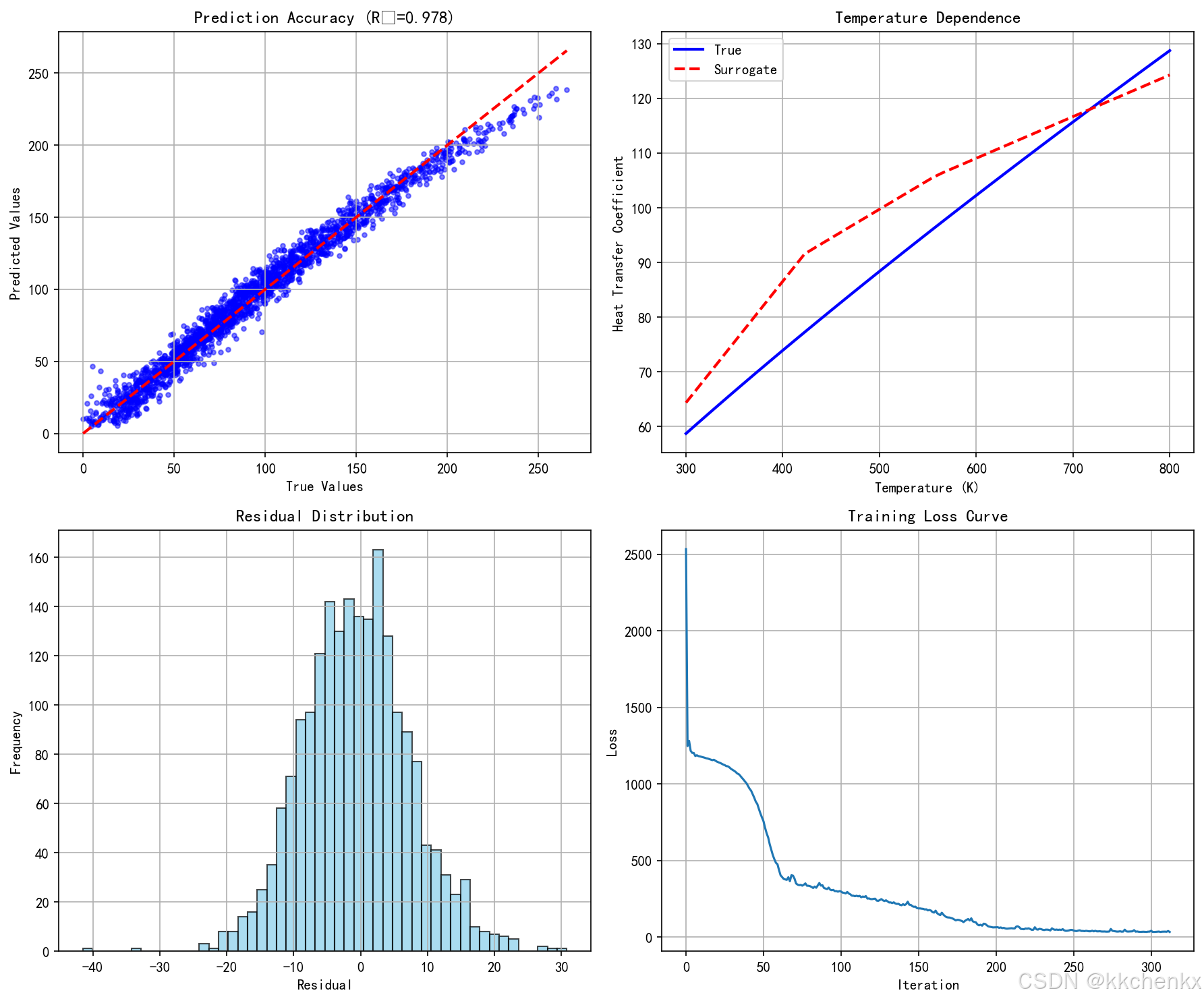
案例1:AI代理模型加速仿真
本案例演示使用神经网络构建代理模型,加速复杂仿真。
import numpy as np
import matplotlib.pyplot as plt
from sklearn.neural_network import MLPRegressor
from sklearn.model_selection import train_test_split
import matplotlib
matplotlib.use('Agg')

class SurrogateModel:
    """代理模型类"""
    def __init__(self):
        self.model = None

    def generate_training_data(self, n_samples=1000):
        """生成训练数据(模拟复杂物理过程)"""
        # 输入参数:温度、压力、流速
        X = np.random.rand(n_samples, 3)
        X[:, 0] = X[:, 0] * 500 + 300  # 温度 300-800 K
        X[:, 1] = X[:, 1] * 10 + 1     # 压力 1-11 atm
        X[:, 2] = X[:, 2] * 10 + 0.1   # 流速 0.1-10.1 m/s

        # 输出:传热系数(模拟复杂计算)
        T, P, v = X[:, 0], X[:, 1], X[:, 2]
        h = 10 * (T/300)**0.8 * P**0.5 * v**0.6 + np.random.normal(0, 5, n_samples)

        return X, h

    def train_model(self, X, y):
        """训练神经网络代理模型"""
        X_train, X_test, y_train, y_test = train_test_split(X, y, test_size=0.2)

        self.model = MLPRegressor(
            hidden_layer_sizes=(64, 32, 16),
            activation='relu',
            solver='adam',
            max_iter=1000,
            early_stopping=True
        )

        self.model.fit(X_train, y_train)

        train_score = self.model.score(X_train, y_train)
        test_score = self.model.score(X_test, y_test)

        return train_score, test_score

    def predict(self, X):
        """使用代理模型预测"""
        return self.model.predict(X)

    def plot_results(self, save_path='output/case1_surrogate_model.png'):
        """绘制代理模型结果"""
        # 生成数据
        X, y = self.generate_training_data(n_samples=2000)

        # 训练模型
        train_score, test_score = self.train_model(X, y)

        # 生成测试网格
        T_range = np.linspace(300, 800, 50)
        P_fixed = 5.0
        v_fixed = 5.0

        X_test = np.array([[T, P_fixed, v_fixed] for T in T_range])
        y_pred = self.predict(X_test)
        y_true = 10 * (T_range/300)**0.8 * P_fixed**0.5 * v_fixed**0.6

        fig, axes = plt.subplots(2, 2, figsize=(12, 10))

        # 预测 vs 真实值
        axes[0, 0].scatter(y, self.predict(X), alpha=0.5, s=10)
        axes[0, 0].plot([y.min(), y.max()], [y.min(), y.max()], 'r--', lw=2)
        axes[0, 0].set_xlabel('True Values')
        axes[0, 0].set_ylabel('Predicted Values')
        axes[0, 0].set_title(f'Prediction Accuracy (R²={test_score:.3f})')
        axes[0, 0].grid(True)

        # 温度影响
        axes[0, 1].plot(T_range, y_true, 'b-', linewidth=2, label='True')
        axes[0, 1].plot(T_range, y_pred, 'r--', linewidth=2, label='Surrogate')
        axes[0, 1].set_xlabel('Temperature (K)')
        axes[0, 1].set_ylabel('Heat Transfer Coefficient')
        axes[0, 1].set_title('Temperature Dependence')
        axes[0, 1].legend()
        axes[0, 1].grid(True)

        # 残差分布
        residuals = y - self.predict(X)
        axes[1, 0].hist(residuals, bins=50, edgecolor='black', alpha=0.7)
        axes[1, 0].set_xlabel('Residual')
        axes[1, 0].set_ylabel('Frequency')
        axes[1, 0].set_title('Residual Distribution')
        axes[1, 0].grid(True)

        # 训练曲线
        axes[1, 1].plot(self.model.loss_curve_)
        axes[1, 1].set_xlabel('Iteration')
        axes[1, 1].set_ylabel('Loss')
        axes[1, 1].set_title('Training Loss Curve')
        axes[1, 1].grid(True)

        plt.tight_layout()
        plt.savefig(save_path, dpi=150, bbox_inches='tight')
        plt.close()
        print(f"代理模型图已保存至: {save_path}")

# 运行案例1
surrogate = SurrogateModel()
surrogate.plot_results()
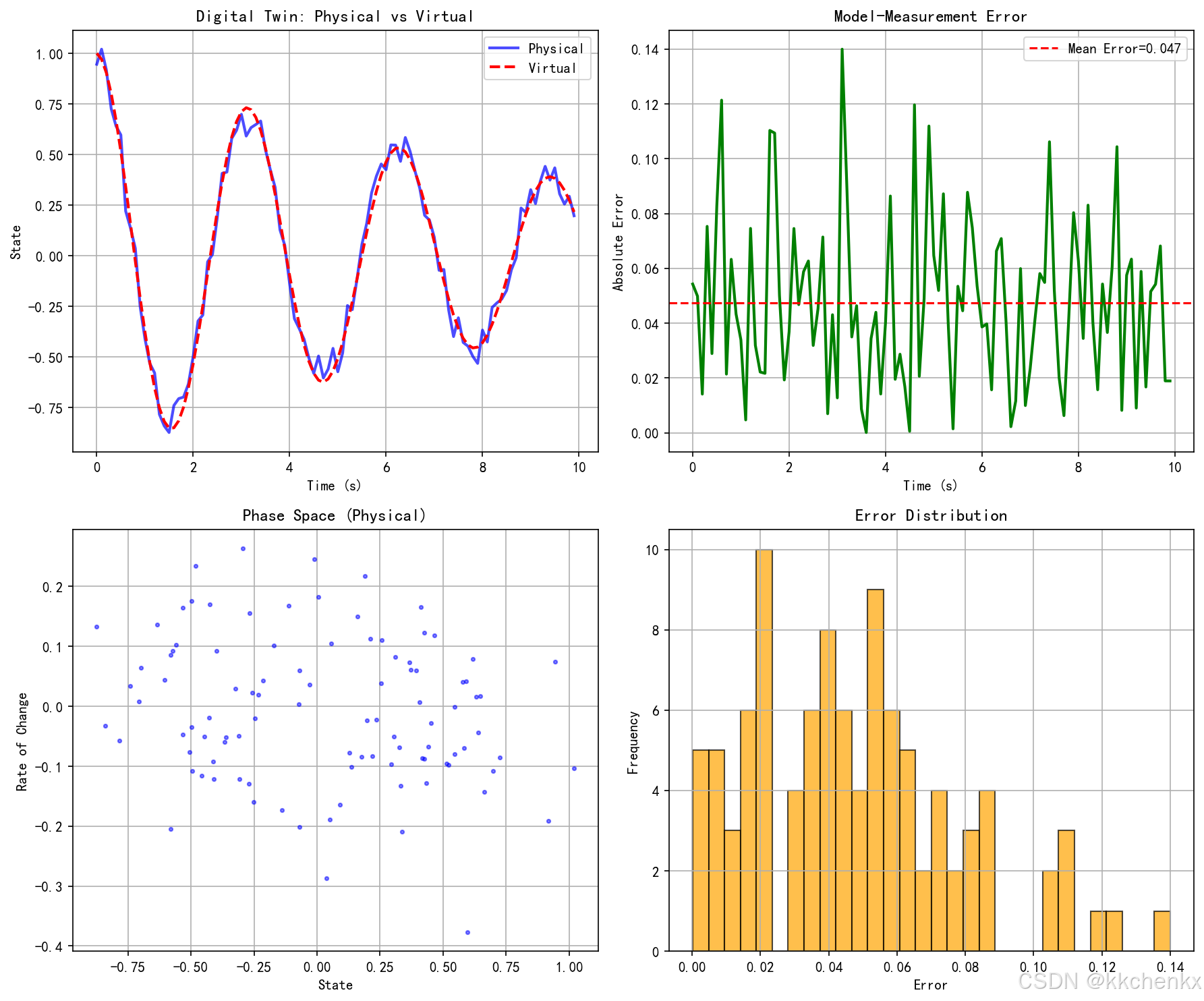
案例2:数字孪生概念演示
本案例演示数字孪生的基本框架,包括物理模型、虚拟模型和数据融合。
class DigitalTwin:
    """数字孪生概念演示类"""
    def __init__(self):
        self.physical_state = None
        self.virtual_state = None
        self.history = {'time': [], 'physical': [], 'virtual': [], 'error': []}

    def physical_model(self, t, params):
        """物理系统模型(真实系统)"""
        # 模拟一个衰减振荡系统
        A, omega, gamma = params
        return A * np.exp(-gamma * t) * np.cos(omega * t) + np.random.normal(0, 0.05)

    def virtual_model(self, t, params):
        """虚拟模型(仿真模型)"""
        A, omega, gamma = params
        return A * np.exp(-gamma * t) * np.cos(omega * t)

    def kalman_update(self, measurement, prediction, P, Q, R):
        """卡尔曼滤波更新"""
        # 预测更新
        P = P + Q

        # 卡尔曼增益
        K = P / (P + R)

        # 状态更新
        updated = prediction + K * (measurement - prediction)
        P = (1 - K) * P

        return updated, P

    def run_simulation(self, t_max=10, dt=0.1):
        """运行数字孪生仿真"""
        t = np.arange(0, t_max, dt)
        params = [1.0, 2.0, 0.1]  # A, omega, gamma

        P = 1.0  # 估计误差协方差
        Q = 0.01  # 过程噪声
        R = 0.1   # 测量噪声

        for ti in t:
            # 物理系统测量(带噪声)
            physical = self.physical_model(ti, params)

            # 虚拟模型预测
            virtual = self.virtual_model(ti, params)

            # 数据融合
            fused, P = self.kalman_update(physical, virtual, P, Q, R)

            # 记录历史
            self.history['time'].append(ti)
            self.history['physical'].append(physical)
            self.history['virtual'].append(virtual)
            self.history['error'].append(abs(physical - virtual))

        return self.history

    def plot_digital_twin(self, save_path='output/case2_digital_twin.png'):
        """绘制数字孪生结果"""
        history = self.run_simulation()

        fig, axes = plt.subplots(2, 2, figsize=(12, 10))

        t = np.array(history['time'])
        physical = np.array(history['physical'])
        virtual = np.array(history['virtual'])
        error = np.array(history['error'])

        # 物理 vs 虚拟
        axes[0, 0].plot(t, physical, 'b-', linewidth=2, label='Physical', alpha=0.7)
        axes[0, 0].plot(t, virtual, 'r--', linewidth=2, label='Virtual')
        axes[0, 0].set_xlabel('Time (s)')
        axes[0, 0].set_ylabel('State')
        axes[0, 0].set_title('Digital Twin: Physical vs Virtual')
        axes[0, 0].legend()
        axes[0, 0].grid(True)

        # 误差分析
        axes[0, 1].plot(t, error, 'g-', linewidth=2)
        axes[0, 1].axhline(y=np.mean(error), color='r', linestyle='--', label=f'Mean Error={np.mean(error):.3f}')
        axes[0, 1].set_xlabel('Time (s)')
        axes[0, 1].set_ylabel('Absolute Error')
        axes[0, 1].set_title('Model-Measurement Error')
        axes[0, 1].legend()
        axes[0, 1].grid(True)

        # 相空间图
        axes[1, 0].plot(physical[:-1], np.diff(physical), 'b.', alpha=0.5, markersize=5)
        axes[1, 0].set_xlabel('State')
        axes[1, 0].set_ylabel('Rate of Change')
        axes[1, 0].set_title('Phase Space (Physical)')
        axes[1, 0].grid(True)

        # 误差分布
        axes[1, 1].hist(error, bins=30, edgecolor='black', alpha=0.7, color='orange')
        axes[1, 1].set_xlabel('Error')
        axes[1, 1].set_ylabel('Frequency')
        axes[1, 1].set_title('Error Distribution')
        axes[1, 1].grid(True)

        plt.tight_layout()
        plt.savefig(save_path, dpi=150, bbox_inches='tight')
        plt.close()
        print(f"数字孪生图已保存至: {save_path}")

# 运行案例2
dtwin = DigitalTwin()
dtwin.plot_digital_twin()
案例3:多尺度耦合仿真框架
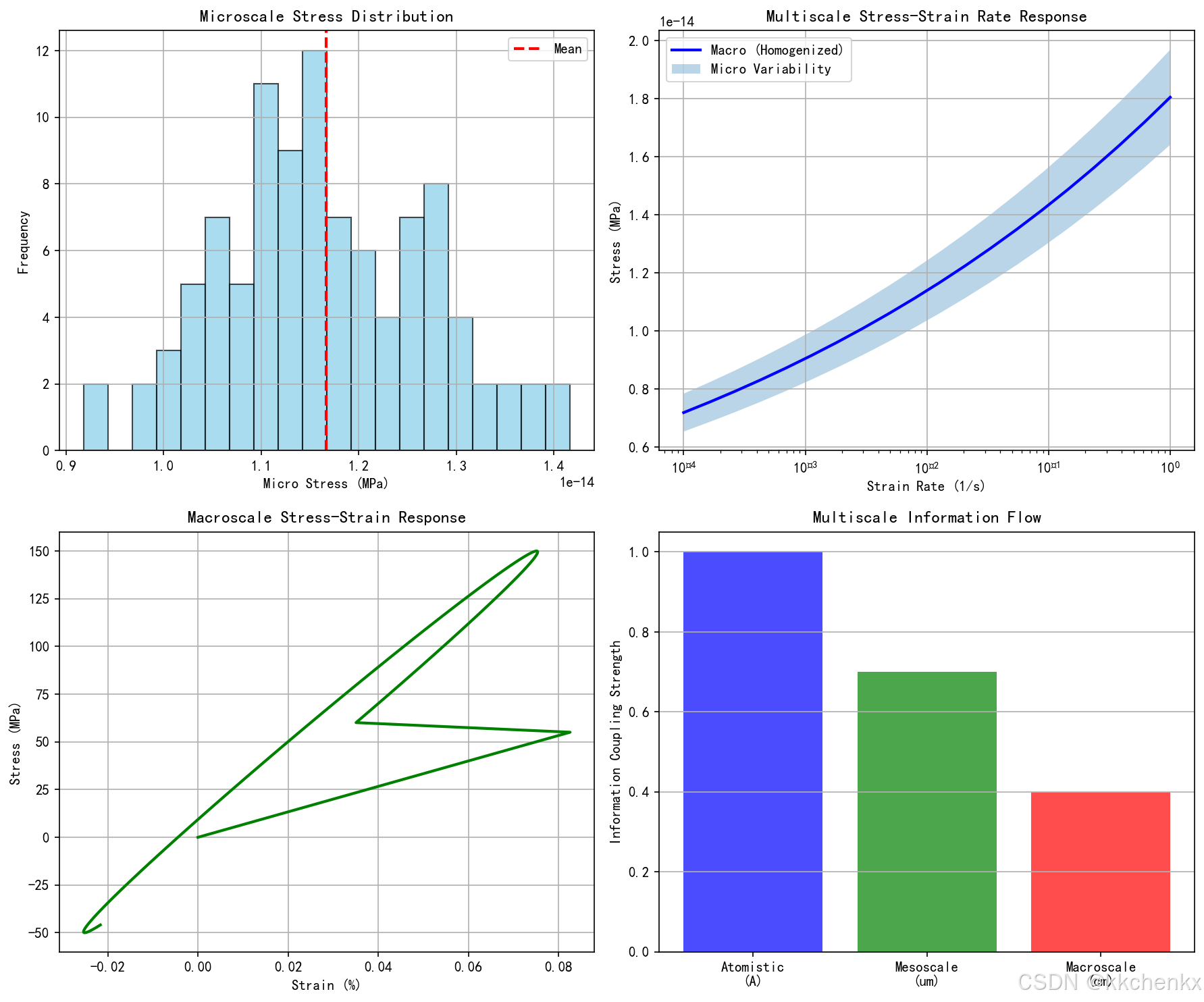
本案例演示多尺度仿真的基本框架,展示微观到宏观的信息传递。
class MultiscaleSimulation:
    """多尺度仿真框架类"""
    def __init__(self):
        self.micro_results = None
        self.macro_results = None

    def microscale_model(self, strain_rate, temperature, n_samples=100):
        """微观尺度模型(分子/晶体尺度)"""
        # 模拟位错运动导致的应力松弛
        activation_energy = 2.5  # eV
        k_b = 8.617e-5  # eV/K

        # Arrhenius型本构关系
        stress = np.zeros(n_samples)
        for i in range(n_samples):
            # 微观结构随机性
            barrier = np.random.normal(1.0, 0.1)
            stress[i] = 100 * strain_rate**0.1 * np.exp(-activation_energy/(k_b*temperature)) * barrier

        return stress

    def homogenization(self, micro_stress):
        """均匀化:从微观到宏观"""
        # 体积平均
        macro_stress = np.mean(micro_stress)
        # 统计波动
        std_stress = np.std(micro_stress)
        return macro_stress, std_stress

    def macroscale_model(self, load_history, temperature):
        """宏观尺度模型(连续介质)"""
        n_steps = len(load_history)
        strain = np.zeros(n_steps)
        stress = np.zeros(n_steps)

        # 粘塑性本构
        E = 200e9  # 弹性模量
        eta = 1e10  # 粘性系数

        for i in range(1, n_steps):
            dt = 0.1
            # 弹性应变
            strain_e = load_history[i] / E
            # 粘性应变
            strain_v = (load_history[i] - stress[i-1]) / eta * dt
            strain[i] = strain_e + strain_v
            stress[i] = load_history[i]

        return strain, stress

    def plot_multiscale(self, save_path='output/case3_multiscale.png'):
        """绘制多尺度仿真结果"""
        # 微观仿真
        strain_rates = np.logspace(-4, 0, 20)
        T = 800  # K

        micro_stresses = []
        macro_stresses = []
        std_stresses = []

        for sr in strain_rates:
            micro = self.microscale_model(sr, T)
            macro, std = self.homogenization(micro)
            micro_stresses.append(micro)
            macro_stresses.append(macro)
            std_stresses.append(std)

        # 宏观仿真
        t = np.linspace(0, 10, 100)
        load = 100e6 * np.sin(0.5 * t) + 50e6
        strain_macro, stress_macro = self.macroscale_model(load, T)

        fig, axes = plt.subplots(2, 2, figsize=(12, 10))

        # 微观应力分布示例
        axes[0, 0].hist(micro_stresses[10], bins=20, edgecolor='black', alpha=0.7)
        axes[0, 0].axvline(x=macro_stresses[10], color='r', linestyle='--', linewidth=2, label='Mean')
        axes[0, 0].set_xlabel('Micro Stress (MPa)')
        axes[0, 0].set_ylabel('Frequency')
        axes[0, 0].set_title('Microscale Stress Distribution')
        axes[0, 0].legend()
        axes[0, 0].grid(True)

        # 应变率敏感性(多尺度)
        axes[0, 1].semilogx(strain_rates, macro_stresses, 'b-', linewidth=2, label='Macro (Homogenized)')
        axes[0, 1].fill_between(strain_rates,
                                 np.array(macro_stresses) - np.array(std_stresses),
                                 np.array(macro_stresses) + np.array(std_stresses),
                                 alpha=0.3, label='Micro Variability')
        axes[0, 1].set_xlabel('Strain Rate (1/s)')
        axes[0, 1].set_ylabel('Stress (MPa)')
        axes[0, 1].set_title('Multiscale Stress-Strain Rate Response')
        axes[0, 1].legend()
        axes[0, 1].grid(True)

        # 宏观应力-应变曲线
        axes[1, 0].plot(strain_macro * 100, stress_macro / 1e6, 'g-', linewidth=2)
        axes[1, 0].set_xlabel('Strain (%)')
        axes[1, 0].set_ylabel('Stress (MPa)')
        axes[1, 0].set_title('Macroscale Stress-Strain Response')
        axes[1, 0].grid(True)

        # 多尺度信息传递示意
        scales = ['Atomistic\n(Å)', 'Mesoscale\n(μm)', 'Macroscale\n(cm)']
        coupling = [1.0, 0.7, 0.4]
        axes[1, 1].bar(scales, coupling, color=['blue', 'green', 'red'], alpha=0.7)
        axes[1, 1].set_ylabel('Information Coupling Strength')
        axes[1, 1].set_title('Multiscale Information Flow')
        axes[1, 1].grid(True, axis='y')

        plt.tight_layout()
        plt.savefig(save_path, dpi=150, bbox_inches='tight')
        plt.close()
        print(f"多尺度仿真图已保存至: {save_path}")

# 运行案例3
multiscale = MultiscaleSimulation()
multiscale.plot_multiscale()
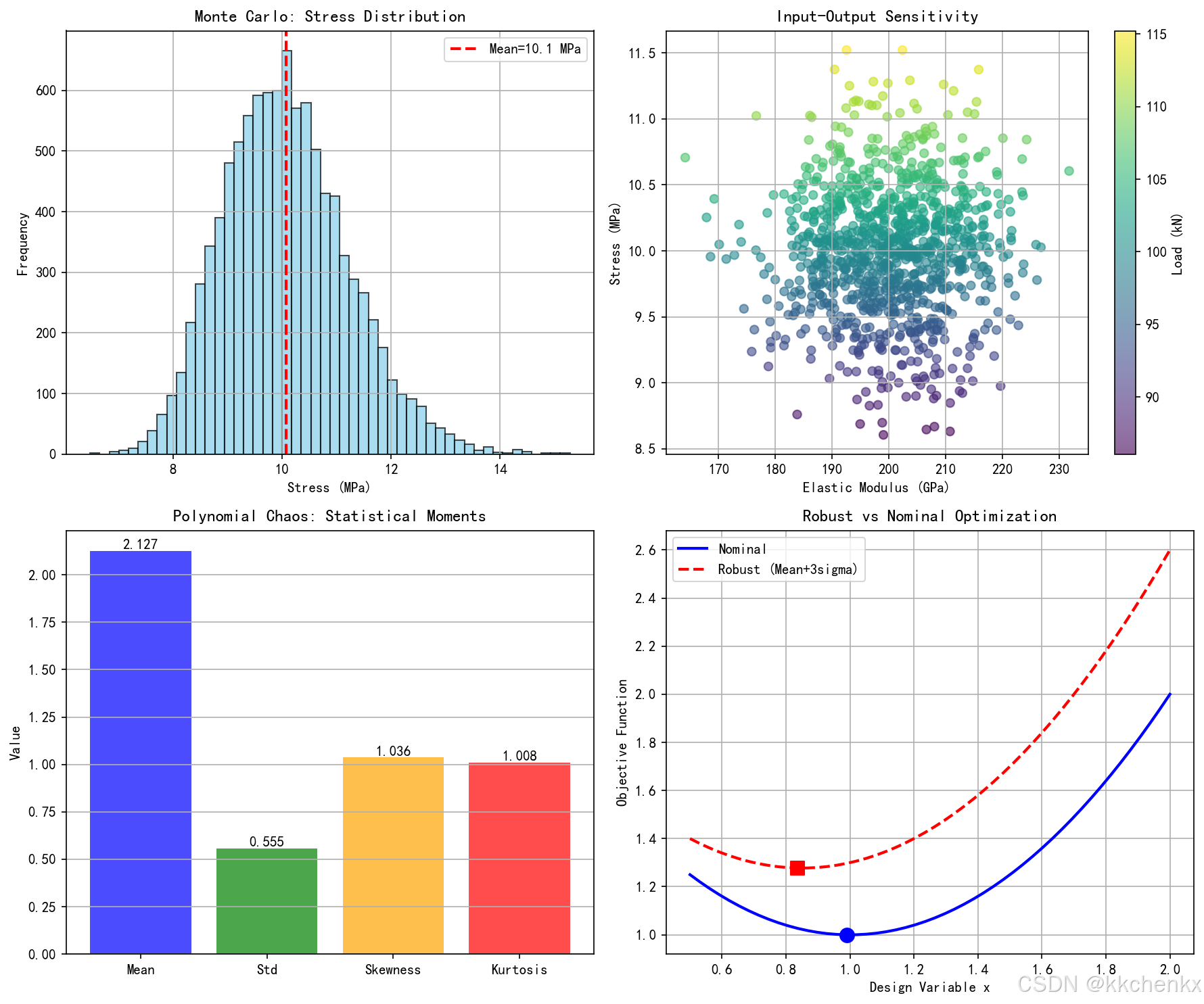
案例4:不确定性量化与鲁棒优化
本案例演示不确定性量化方法和鲁棒优化框架。
class UncertaintyQuantification:
    """不确定性量化与鲁棒优化类"""
    def __init__(self):
        pass

    def monte_carlo_simulation(self, n_samples=10000):
        """蒙特卡洛仿真"""
        # 输入不确定性
        E = np.random.normal(200e9, 10e9, n_samples)  # 弹性模量
        load = np.random.normal(100e3, 5e3, n_samples)  # 载荷
        dimension = np.random.normal(0.1, 0.005, n_samples)  # 尺寸

        # 输出:应力
        stress = load / (dimension**2)

        # 输出:位移
        displacement = load * dimension / (E * dimension**2)

        return stress, displacement

    def polynomial_chaos(self, order=3):
        """多项式混沌展开(简化)"""
        # 使用Hermite多项式(高斯随机变量)
        xi = np.random.randn(1000)

        # 简单的二次响应面
        y = 2 + 0.5*xi + 0.1*xi**2 + 0.05*np.random.randn(1000)

        # 估计统计矩
        mean = np.mean(y)
        std = np.std(y)
        skewness = np.mean(((y - mean)/std)**3)
        kurtosis = np.mean(((y - mean)/std)**4) - 3

        return mean, std, skewness, kurtosis, y

    def robust_optimization(self):
        """鲁棒优化示例"""
        # 设计变量范围
        x_range = np.linspace(0.5, 2.0, 50)

        # 名义性能
        f_nominal = x_range**2 - 2*x_range + 2

        # 考虑不确定性的鲁棒性能(均值+3σ)
        sigma = 0.1 * x_range  # 不确定性随x增加
        f_robust = f_nominal + 3 * sigma

        # 最优解
        idx_nominal = np.argmin(f_nominal)
        idx_robust = np.argmin(f_robust)

        return x_range, f_nominal, f_robust, idx_nominal, idx_robust

    def plot_uncertainty(self, save_path='output/case4_uncertainty.png'):
        """绘制不确定性量化结果"""
        fig, axes = plt.subplots(2, 2, figsize=(12, 10))

        # 蒙特卡洛结果
        stress, displacement = self.monte_carlo_simulation()

        axes[0, 0].hist(stress/1e6, bins=50, edgecolor='black', alpha=0.7, color='skyblue')
        axes[0, 0].axvline(x=np.mean(stress)/1e6, color='r', linestyle='--', linewidth=2,
                          label=f'Mean={np.mean(stress)/1e6:.1f} MPa')
        axes[0, 0].set_xlabel('Stress (MPa)')
        axes[0, 0].set_ylabel('Frequency')
        axes[0, 0].set_title('Monte Carlo: Stress Distribution')
        axes[0, 0].legend()
        axes[0, 0].grid(True)

        # 散点图:输入-输出关系
        E_samples = np.random.normal(200e9, 10e9, 1000)
        load_samples = np.random.normal(100e3, 5e3, 1000)
        stress_samples = load_samples / (0.01)

        scatter = axes[0, 1].scatter(E_samples/1e9, stress_samples/1e6,
                                     c=load_samples/1e3, cmap='viridis', alpha=0.6)
        axes[0, 1].set_xlabel('Elastic Modulus (GPa)')
        axes[0, 1].set_ylabel('Stress (MPa)')
        axes[0, 1].set_title('Input-Output Sensitivity')
        plt.colorbar(scatter, ax=axes[0, 1], label='Load (kN)')
        axes[0, 1].grid(True)

        # 多项式混沌统计矩
        mean, std, skew, kurt, y_samples = self.polynomial_chaos()

        moments = ['Mean', 'Std', 'Skewness', 'Kurtosis']
        values = [mean, std, skew, kurt]
        colors = ['blue', 'green', 'orange', 'red']

        bars = axes[1, 0].bar(moments, values, color=colors, alpha=0.7)
        axes[1, 0].set_ylabel('Value')
        axes[1, 0].set_title('Polynomial Chaos: Statistical Moments')
        axes[1, 0].grid(True, axis='y')

        # 添加数值标签
        for bar, val in zip(bars, values):
            height = bar.get_height()
            axes[1, 0].text(bar.get_x() + bar.get_width()/2., height,
                           f'{val:.3f}', ha='center', va='bottom')

        # 鲁棒优化
        x, f_nom, f_rob, idx_nom, idx_rob = self.robust_optimization()

        axes[1, 1].plot(x, f_nom, 'b-', linewidth=2, label='Nominal')
        axes[1, 1].plot(x, f_rob, 'r--', linewidth=2, label='Robust (Mean+3σ)')
        axes[1, 1].scatter(x[idx_nom], f_nom[idx_nom], color='blue', s=100, zorder=5, marker='o')
        axes[1, 1].scatter(x[idx_rob], f_rob[idx_rob], color='red', s=100, zorder=5, marker='s')
        axes[1, 1].set_xlabel('Design Variable x')
        axes[1, 1].set_ylabel('Objective Function')
        axes[1, 1].set_title('Robust vs Nominal Optimization')
        axes[1, 1].legend()
        axes[1, 1].grid(True)

        plt.tight_layout()
        plt.savefig(save_path, dpi=150, bbox_inches='tight')
        plt.close()
        print(f"不确定性量化图已保存至: {save_path}")

# 运行案例4
uq = UncertaintyQuantification()
uq.plot_uncertainty()
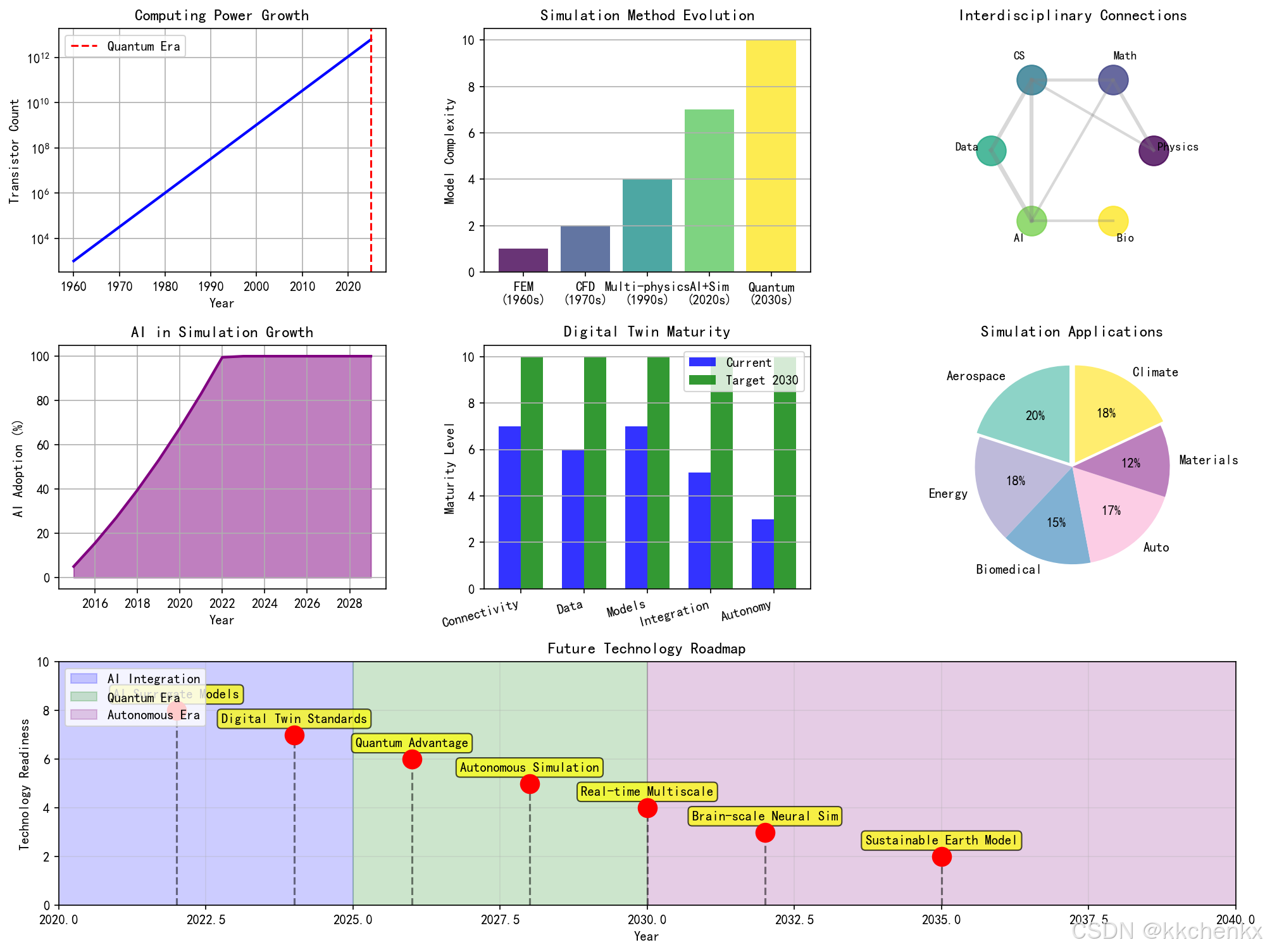
案例5:技术发展趋势可视化
本案例通过可视化展示仿真技术的发展趋势和跨学科融合。
class TechnologyTrends:
    """技术发展趋势可视化类"""
    def __init__(self):
        pass

    def plot_tech_evolution(self, save_path='output/case5_tech_trends.png'):
        """绘制技术演进趋势"""
        fig = plt.figure(figsize=(16, 12))

        # 创建子图网格
        gs = fig.add_gridspec(3, 3, hspace=0.3, wspace=0.3)

        # 1. 计算能力增长(摩尔定律)
        ax1 = fig.add_subplot(gs[0, 0])
        years = np.arange(1960, 2030, 5)
        transistors = 1000 * 2**((years - 1960) / 2)  # 指数增长
        ax1.semilogy(years, transistors, 'b-', linewidth=2)
        ax1.axvline(x=2025, color='r', linestyle='--', label='Quantum Era')
        ax1.set_xlabel('Year')
        ax1.set_ylabel('Transistor Count')
        ax1.set_title('Computing Power Growth')
        ax1.legend()
        ax1.grid(True)

        # 2. 仿真方法演进
        ax2 = fig.add_subplot(gs[0, 1])
        methods = ['FEM\n(1960s)', 'CFD\n(1970s)', 'Multi-physics\n(1990s)',
                   'AI+Sim\n(2020s)', 'Quantum\n(2030s)']
        complexity = [1, 2, 4, 7, 10]
        colors = plt.cm.viridis(np.linspace(0, 1, len(methods)))
        bars = ax2.bar(methods, complexity, color=colors, alpha=0.8)
        ax2.set_ylabel('Model Complexity')
        ax2.set_title('Simulation Method Evolution')
        ax2.grid(True, axis='y')

        # 3. 跨学科融合网络
        ax3 = fig.add_subplot(gs[0, 2])
        disciplines = ['Physics', 'Math', 'CS', 'Data', 'AI', 'Bio']
        connections = np.array([
            [0, 8, 6, 4, 5, 3],
            [8, 0, 7, 5, 6, 2],
            [6, 7, 0, 9, 9, 4],
            [4, 5, 9, 0, 10, 5],
            [5, 6, 9, 10, 0, 6],
            [3, 2, 4, 5, 6, 0]
        ])

        # 简化的弦图表示
        theta = np.linspace(0, 2*np.pi, len(disciplines), endpoint=False)
        x = np.cos(theta)
        y = np.sin(theta)

        for i in range(len(disciplines)):
            ax3.scatter(x[i], y[i], s=500, c=colors[i], alpha=0.8)
            ax3.annotate(disciplines[i], (x[i]*1.3, y[i]*1.3), ha='center', fontsize=9)
            for j in range(i+1, len(disciplines)):
                if connections[i, j] > 5:
                    ax3.plot([x[i], x[j]], [y[i], y[j]], 'gray', alpha=0.3, linewidth=connections[i,j]/3)

        ax3.set_xlim(-1.5, 1.5)
        ax3.set_ylim(-1.5, 1.5)
        ax3.set_aspect('equal')
        ax3.axis('off')
        ax3.set_title('Interdisciplinary Connections')

        # 4. AI在仿真中的应用增长
        ax4 = fig.add_subplot(gs[1, 0])
        years_ai = np.arange(2015, 2030)
        ai_adoption = 5 + 10 * (years_ai - 2015) + 0.5 * (years_ai - 2015)**2
        ai_adoption = np.minimum(ai_adoption, 100)
        ax4.fill_between(years_ai, ai_adoption, alpha=0.5, color='purple')
        ax4.plot(years_ai, ai_adoption, 'purple', linewidth=2)
        ax4.set_xlabel('Year')
        ax4.set_ylabel('AI Adoption (%)')
        ax4.set_title('AI in Simulation Growth')
        ax4.grid(True)

        # 5. 数字孪生成熟度
        ax5 = fig.add_subplot(gs[1, 1])
        dimensions = ['Connectivity', 'Data', 'Models', 'Integration', 'Autonomy']
        current = [7, 6, 7, 5, 3]
        target = [10, 10, 10, 10, 10]

        x_pos = np.arange(len(dimensions))
        width = 0.35
        ax5.bar(x_pos - width/2, current, width, label='Current', alpha=0.8, color='blue')
        ax5.bar(x_pos + width/2, target, width, label='Target 2030', alpha=0.8, color='green')
        ax5.set_xticks(x_pos)
        ax5.set_xticklabels(dimensions, rotation=15, ha='right')
        ax5.set_ylabel('Maturity Level')
        ax5.set_title('Digital Twin Maturity')
        ax5.legend()
        ax5.grid(True, axis='y')

        # 6. 应用领域分布
        ax6 = fig.add_subplot(gs[1, 2])
        applications = ['Aerospace', 'Energy', 'Biomedical', 'Auto', 'Materials', 'Climate']
        sizes = [20, 18, 15, 17, 12, 18]
        explode = [0.05, 0, 0, 0, 0, 0.05]
        colors_pie = plt.cm.Set3(np.linspace(0, 1, len(applications)))
        ax6.pie(sizes, explode=explode, labels=applications, autopct='%1.0f%%',
                colors=colors_pie, startangle=90)
        ax6.set_title('Simulation Applications')

        # 7. 未来技术路线图
        ax7 = fig.add_subplot(gs[2, :])
        ax7.set_xlim(2020, 2040)
        ax7.set_ylim(0, 10)

        # 技术里程碑
        milestones = [
            (2022, 'AI Surrogate Models', 8),
            (2024, 'Digital Twin Standards', 7),
            (2026, 'Quantum Advantage', 6),
            (2028, 'Autonomous Simulation', 5),
            (2030, 'Real-time Multiscale', 4),
            (2032, 'Brain-scale Neural Sim', 3),
            (2035, 'Sustainable Earth Model', 2),
        ]

        for year, label, y in milestones:
            ax7.scatter(year, y, s=200, c='red', zorder=5)
            ax7.annotate(label, (year, y+0.5), ha='center', fontsize=10,
                        bbox=dict(boxstyle='round,pad=0.3', facecolor='yellow', alpha=0.7))
            ax7.plot([year, year], [0, y], 'k--', alpha=0.5)

        # 技术发展阶段
        ax7.axvspan(2020, 2025, alpha=0.2, color='blue', label='AI Integration')
        ax7.axvspan(2025, 2030, alpha=0.2, color='green', label='Quantum Era')
        ax7.axvspan(2030, 2040, alpha=0.2, color='purple', label='Autonomous Era')

        ax7.set_xlabel('Year')
        ax7.set_ylabel('Technology Readiness')
        ax7.set_title('Future Technology Roadmap')
        ax7.legend(loc='upper left')
        ax7.grid(True, alpha=0.3)

        plt.savefig(save_path, dpi=150, bbox_inches='tight')
        plt.close()
        print(f"技术趋势图已保存至: {save_path}")

# 运行案例5
trends = TechnologyTrends()
trends.plot_tech_evolution()
七、总结与展望
7.1 核心要点回顾
本主题系统展望了多场耦合仿真的未来发展:
- 技术趋势:AI驱动的自主仿真、量子-经典混合计算、数字孪生、多尺度深度融合
- 跨学科融合:仿真与数据科学、实验科学、制造、生命科学的深度融合
- 新兴应用:可持续工程、空间探索、脑科学、社会系统
- 挑战与解决方案:计算效率、模型可信度、人才培养、伦理问题
7.2 对未来的思考
仿真科学正站在新的历史起点上。人工智能、量子计算、数字孪生等技术的融合,将带来前所未有的能力:
- 从离线到实时:仿真将成为物理系统的实时镜像
- 从专业到普及:仿真工具将更加易用,惠及更广泛的群体
- 从确定性到概率性:不确定性将成为仿真的内在组成部分
- 从单一到融合:跨学科、跨尺度的综合仿真将成为常态
7.3 给学习者的建议
面对快速发展的仿真技术,学习者应该:
- 打牢基础:数学、物理、编程是永恒的基础
- 保持开放:积极学习新技术,如AI、量子计算
- 注重实践:通过实际项目积累经验
- 跨学科视野:了解相关领域的知识和需求
- 伦理意识:负责任地使用仿真技术
7.4 结语
100个主题的学习之旅即将结束,但这只是仿真科学探索的开始。仿真技术正在深刻改变我们理解世界、设计产品和解决问题的方式。从微观粒子到宏观宇宙,从简单系统到复杂网络,仿真为我们提供了探索未知的强大工具。
未来属于那些能够将物理洞察、数学严谨、计算能力和创新思维结合起来的人。希望本系列教程能够为读者奠定坚实的基础,激发探索的热情,在仿真科学的广阔天地中开创属于自己的精彩篇章。
仿真科学,未来可期!

AtomGit 是由开放原子开源基金会联合 CSDN 等生态伙伴共同推出的新一代开源与人工智能协作平台。平台坚持“开放、中立、公益”的理念,把代码托管、模型共享、数据集托管、智能体开发体验和算力服务整合在一起,为开发者提供从开发、训练到部署的一站式体验。
更多推荐
 9
9 0
0- 0


 已为社区贡献58条内容

所有评论(0)