com.mongodb.MongoCursorNotFoundException: Query failed with error code -5 and error message ‘Cursor
com.mongodb.MongoCursorNotFoundException: Query failed with error code -5 and error message 'Cursor 405128352514 not found on server 127.0.0.1:27017' on server 127.0.0.1:27017
这个错误 MongoCursorNotFoundException 是 MongoDB 客户端在尝试访问一个已在服务器上失效的游标时抛出的。以下是详细的原因分析和解决方案:
1、错误原因
- 游标超时:MongoDB 默认会在 10 分钟未使用后自动关闭游标以释放资源。
- 游标已关闭:手动调用
cursor.close()或迭代完所有结果后,游标会被关闭。 - 服务器重启:MongoDB 服务器重启后,所有之前的游标都会失效。
- 集合被修改:游标创建后,如果对应集合被
drop、rename或重建索引,游标会失效。
2、游标为什么10分钟没有再去读取数据?
try {
			MongoCollection<BasicDBObject> coll = formSwitchboardIdentityRelationMongo.getCollection(
					dbname, "forrelation", BasicDBObject.class);
			FindIterable<BasicDBObject> cur = coll.find(query);
            mongoCursor = cur.cursor();
            while(mongoCursor.hasNext()) {
				bean = mongoCursor.next();

             ...业务代码
        } catch (Exception e) {
			throw e;
		} finally {
			if(mongoCursor!=null) {
				mongoCursor.close();
			}
		}
从游标中获取记录,难道没一条需要执行10分钟这么久吗?显示不是。
mongoCursor 从MongoDB服务端批量获取数据,不是一条一条获取数据,第一次获取101条数据,后面继续调用getMore获取数据,getMore并不是每次101条,后面可能批量10000条数据,所以造成游标链接超时,记录并不是一条数据处理超过10分钟。
3、查看和修改cursorTimeoutMillis 配置值
cursorTimeoutMillis 是 MongoDB 控制游标闲置超时的核心参数(默认 600000 毫秒,即 10 分钟)
db.adminCommand({ getParameter: 1, cursorTimeoutMillis: 1 });
/* 1 */
{
    "cursorTimeoutMillis" : NumberLong(600000),
    "ok" : 1.0
}
运行时临时修改(立即生效,重启失效)
db.adminCommand({ setParameter: 1, cursorTimeoutMillis: 3600000 });
/* 1 */
{
    "was" : NumberLong(600000),
    "ok" : 1.0
}
验证修改结果
db.adminCommand({ getParameter: 1, cursorTimeoutMillis: 1 });
/* 1 */
{
    "cursorTimeoutMillis" : NumberLong(3600000),
    "ok" : 1.0
}
4、源码关闭游标逻辑
com.mongodb.MongoCursorNotFoundException: Query failed with error code -5 and error message 'Cursor 405128352514 not found on server 127.0.0.1:27017' on server 127.0.0.1:27017。
重要内容是说游标找不到了,游标已经被关闭了。游标怎么被关闭的呢?分析一下源代码。
MongoDB 还会启动后台线程,定时扫描并关闭超时游标(避免闲置游标长期占用内存)。
ClientCursorMonitor 收超时游标
ClientCursorMonitor 后台线程(继承 BackgroundJob),是游标超时清理的定时触发入口;结合之前的 CursorManager.cpp 中的 timeoutCursors() 清理逻辑,共同实现了「每 N 秒扫描一次,关闭闲置超 10 分钟的游标」。
#include "mongo/platform/basic.h"

#include "mongo/db/clientcursor.h"

#include <string>
#include <time.h>
#include <vector>

#include "mongo/base/counter.h"
#include "mongo/db/audit.h"
#include "mongo/db/auth/action_set.h"
#include "mongo/db/auth/action_type.h"
#include "mongo/db/auth/authorization_session.h"
#include "mongo/db/auth/privilege.h"
#include "mongo/db/catalog/collection.h"
#include "mongo/db/client.h"
#include "mongo/db/commands.h"
#include "mongo/db/commands/server_status.h"
#include "mongo/db/commands/server_status_metric.h"
#include "mongo/db/cursor_manager.h"
#include "mongo/db/cursor_server_params.h"
#include "mongo/db/jsobj.h"
#include "mongo/db/query/explain.h"
#include "mongo/db/repl/repl_client_info.h"
#include "mongo/db/repl/replication_coordinator.h"
#include "mongo/util/background.h"
#include "mongo/util/concurrency/idle_thread_block.h"
#include "mongo/util/exit.h"

namespace mongo {

using std::string;
using std::stringstream;

static Counter64 cursorStatsOpen;           // gauge
static Counter64 cursorStatsOpenPinned;     // gauge
static Counter64 cursorStatsOpenNoTimeout;  // gauge
static Counter64 cursorStatsTimedOut;

static ServerStatusMetricField<Counter64> dCursorStatsOpen("cursor.open.total", &cursorStatsOpen);
static ServerStatusMetricField<Counter64> dCursorStatsOpenPinned("cursor.open.pinned",
                                                                 &cursorStatsOpenPinned);
static ServerStatusMetricField<Counter64> dCursorStatsOpenNoTimeout("cursor.open.noTimeout",
                                                                    &cursorStatsOpenNoTimeout);
static ServerStatusMetricField<Counter64> dCursorStatusTimedout("cursor.timedOut",
                                                                &cursorStatsTimedOut);

long long ClientCursor::totalOpen() {
    return cursorStatsOpen.get();
}

ClientCursor::ClientCursor(ClientCursorParams params,
                           CursorId cursorId,
                           OperationContext* operationUsingCursor,
                           Date_t now)
    : _cursorid(cursorId),
      _nss(std::move(params.nss)),
      _authenticatedUsers(std::move(params.authenticatedUsers)),
      _lsid(operationUsingCursor->getLogicalSessionId()),
      _txnNumber(operationUsingCursor->getTxnNumber()),
      _writeConcernOptions(std::move(params.writeConcernOptions)),
      _readConcernArgs(std::move(params.readConcernArgs)),
      _originatingCommand(params.originatingCommandObj),
      _originatingPrivileges(std::move(params.originatingPrivileges)),
      _queryOptions(params.queryOptions),
      _lockPolicy(params.lockPolicy),
      _needsMerge(params.needsMerge),
      _exec(std::move(params.exec)),
      _operationUsingCursor(operationUsingCursor),
      _lastUseDate(now),
      _createdDate(now),
      _planSummary(Explain::getPlanSummary(_exec.get())) {
    invariant(_exec);
    invariant(_operationUsingCursor);

    cursorStatsOpen.increment();

    if (isNoTimeout()) {
        // cursors normally timeout after an inactivity period to prevent excess memory use
        // setting this prevents timeout of the cursor in question.
        cursorStatsOpenNoTimeout.increment();
    }
}

ClientCursor::~ClientCursor() {
    // Cursors must be unpinned and deregistered from their cursor manager before being deleted.
    invariant(!_operationUsingCursor);
    invariant(_disposed);

    cursorStatsOpen.decrement();
    if (isNoTimeout()) {
        cursorStatsOpenNoTimeout.decrement();
    }
}

void ClientCursor::markAsKilled(Status killStatus) {
    _exec->markAsKilled(killStatus);
}

void ClientCursor::dispose(OperationContext* opCtx) {
    if (_disposed) {
        return;
    }

    _exec->dispose(opCtx);
    _disposed = true;
}

GenericCursor ClientCursor::toGenericCursor() const {
    GenericCursor gc;
    gc.setCursorId(cursorid());
    gc.setNs(nss());
    gc.setNDocsReturned(nReturnedSoFar());
    gc.setTailable(isTailable());
    gc.setAwaitData(isAwaitData());
    gc.setNoCursorTimeout(isNoTimeout());
    gc.setOriginatingCommand(getOriginatingCommandObj());
    gc.setLsid(getSessionId());
    gc.setLastAccessDate(getLastUseDate());
    gc.setCreatedDate(getCreatedDate());
    gc.setNBatchesReturned(getNBatches());
    gc.setPlanSummary(getPlanSummary());
    if (auto opCtx = _operationUsingCursor) {
        gc.setOperationUsingCursorId(opCtx->getOpID());
    }
    return gc;
}

//
// Pin methods
//

ClientCursorPin::ClientCursorPin(OperationContext* opCtx,
                                 ClientCursor* cursor,
                                 CursorManager* cursorManager)
    : _opCtx(opCtx), _cursor(cursor), _cursorManager(cursorManager) {
    invariant(_cursor);
    invariant(_cursor->_operationUsingCursor);
    invariant(!_cursor->_disposed);

    // We keep track of the number of cursors currently pinned. The cursor can become unpinned
    // either by being released back to the cursor manager or by being deleted. A cursor may be
    // transferred to another pin object via move construction or move assignment, but in this case
    // it is still considered pinned.
    cursorStatsOpenPinned.increment();
}

ClientCursorPin::ClientCursorPin(ClientCursorPin&& other)
    : _opCtx(other._opCtx), _cursor(other._cursor), _cursorManager(other._cursorManager) {
    // The pinned cursor is being transferred to us from another pin. The 'other' pin must have a
    // pinned cursor.
    invariant(other._cursor);
    invariant(other._cursor->_operationUsingCursor);

    // Be sure to set the 'other' pin's cursor to null in order to transfer ownership to ourself.
    other._cursor = nullptr;
    other._opCtx = nullptr;
    other._cursorManager = nullptr;
}

ClientCursorPin& ClientCursorPin::operator=(ClientCursorPin&& other) {
    if (this == &other) {
        return *this;
    }

    // The pinned cursor is being transferred to us from another pin. The 'other' pin must have a
    // pinned cursor, and we must not have a cursor.
    invariant(!_cursor);
    invariant(other._cursor);
    invariant(other._cursor->_operationUsingCursor);

    // Copy the cursor pointer to ourselves, but also be sure to set the 'other' pin's cursor to
    // null so that it no longer has the cursor pinned.
    // Be sure to set the 'other' pin's cursor to null in order to transfer ownership to ourself.
    _cursor = other._cursor;
    other._cursor = nullptr;

    _opCtx = other._opCtx;
    other._opCtx = nullptr;

    _cursorManager = other._cursorManager;
    other._cursorManager = nullptr;

    return *this;
}

ClientCursorPin::~ClientCursorPin() {
    release();
}

void ClientCursorPin::release() {
    if (!_cursor)
        return;

    invariant(_cursor->_operationUsingCursor);
    invariant(_cursorManager);

    // Unpin the cursor. This must be done by calling into the cursor manager, since the cursor
    // manager must acquire the appropriate mutex in order to safely perform the unpin operation.
    _cursorManager->unpin(_opCtx, std::unique_ptr<ClientCursor, ClientCursor::Deleter>(_cursor));
    cursorStatsOpenPinned.decrement();

    _cursor = nullptr;
}

void ClientCursorPin::deleteUnderlying() {
    invariant(_cursor);
    invariant(_cursor->_operationUsingCursor);
    invariant(_cursorManager);
    // Note the following subtleties of this method's implementation:
    // - We must unpin the cursor (by clearing the '_operationUsingCursor' field) before
    //   destruction, since it is an error to delete a pinned cursor.
    // - In addition, we must deregister the cursor before clearing the '_operationUsingCursor'
    //   field, since it is an error to unpin a registered cursor without holding the appropriate
    //   cursor manager mutex. By first deregistering the cursor, we ensure that no other thread can
    //   access '_cursor', meaning that it is safe for us to write to '_operationUsingCursor'
    //   without holding the CursorManager mutex.

    _cursorManager->deregisterCursor(_cursor);

    // Make sure the cursor is disposed and unpinned before being destroyed.
    _cursor->dispose(_opCtx);
    _cursor->_operationUsingCursor = nullptr;
    delete _cursor;

    cursorStatsOpenPinned.decrement();
    _cursor = nullptr;
}

ClientCursor* ClientCursorPin::getCursor() const {
    return _cursor;
}

namespace {
//
// ClientCursorMonitor
//

/**
 * Thread for timing out inactive cursors.
 */
class ClientCursorMonitor : public BackgroundJob {
public:
    std::string name() const {
        return "ClientCursorMonitor";
    }

    void run() {
        ThreadClient tc("clientcursormon", getGlobalServiceContext());
        while (!globalInShutdownDeprecated()) {
            {
                const ServiceContext::UniqueOperationContext opCtx = cc().makeOperationContext();
                auto now = opCtx->getServiceContext()->getPreciseClockSource()->now();
                cursorStatsTimedOut.increment(
                    CursorManager::get(opCtx.get())->timeoutCursors(opCtx.get(), now));
            }
            MONGO_IDLE_THREAD_BLOCK;
            sleepsecs(getClientCursorMonitorFrequencySecs());
        }
    }
};

// Only one instance of the ClientCursorMonitor exists
ClientCursorMonitor clientCursorMonitor;

void _appendCursorStats(BSONObjBuilder& b) {
    b.append("note", "deprecated, use server status metrics");
    b.appendNumber("clientCursors_size", cursorStatsOpen.get());
    b.appendNumber("totalOpen", cursorStatsOpen.get());
    b.appendNumber("pinned", cursorStatsOpenPinned.get());
    b.appendNumber("totalNoTimeout", cursorStatsOpenNoTimeout.get());
    b.appendNumber("timedOut", cursorStatsTimedOut.get());
}
}  // namespace

void startClientCursorMonitor() {
    clientCursorMonitor.go();
}

}  // namespace mongo
ClientCursorMonitor 后台线程(定时清理)找到的定时任务核心,继承 MongoDB 基础的 BackgroundJob 类。
定时器中调用CursorManager::get(opCtx.get())->timeoutCursors(opCtx.get(), now)清晰超时的游标
游标超时关闭
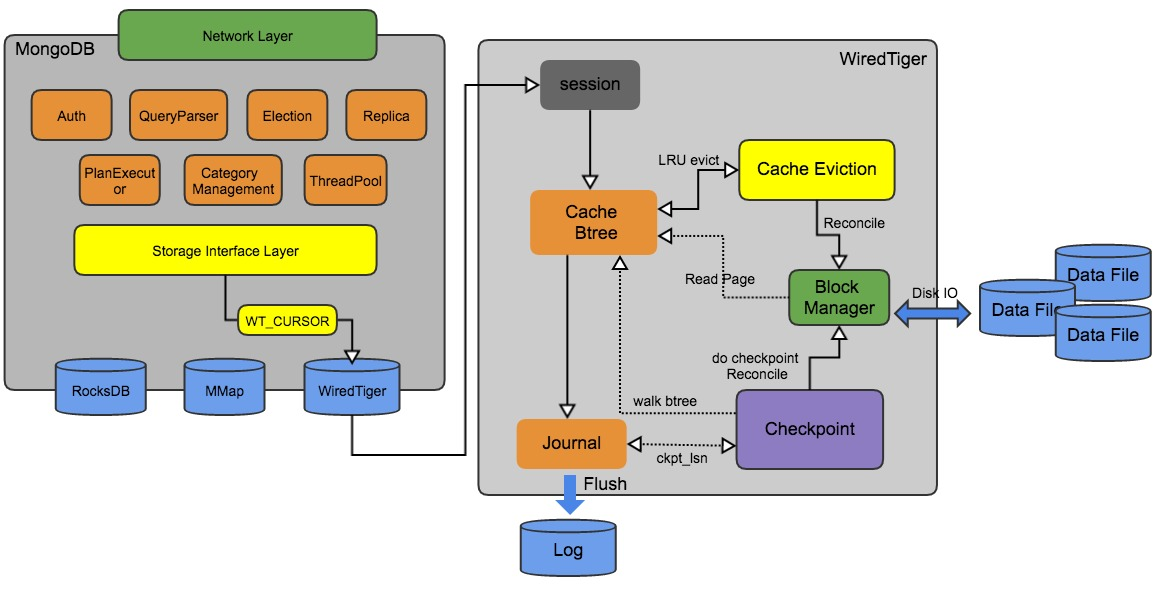
MongoDB控制的游标超时间,不是WiredTiger控制的游标超时间。
CursorManager是MongoDB 4.0.7 游标管理的核心实现,负责游标注册、查找、超时清理、销毁、权限校验等全生命周期管理,也是 MongoCursorNotFoundException(游标未找到)的核心触发源头
路径:src/mongo/db/cursor_manager.h + src/mongo/db/cursor_manager.cpp
// 1. 超时判断逻辑(核心)
bool CursorManager::cursorShouldTimeout_inlock(const ClientCursor* cursor, Date_t now) {
    // 跳过:禁用超时的游标 / 正在使用的游标
    if (cursor->isNoTimeout() || cursor->_operationUsingCursor) {
        return false;
    }
    // 核心条件:当前时间 - 最后使用时间 ≥ 游标超时阈值(默认 10 分钟)
    return (now - cursor->_lastUseDate) >= Milliseconds(getCursorTimeoutMillis());
}

// 2. 批量清理超时游标
std::size_t CursorManager::timeoutCursors(OperationContext* opCtx, Date_t now) {
    std::vector<std::unique_ptr<ClientCursor, ClientCursor::Deleter>> toDisposeWithoutMutex;

    // 遍历所有分区
    for (size_t partitionId = 0; partitionId < kNumPartitions; ++partitionId) {
        auto lockedPartition = _cursorMap->lockOnePartitionById(partitionId);
        for (auto it = lockedPartition->begin(); it != lockedPartition->end();) {
            auto* cursor = it->second;
            // 判断是否超时,超时则加入清理列表并从哈希表移除
            if (cursorShouldTimeout_inlock(cursor, now)) {
                toDisposeWithoutMutex.emplace_back(cursor);
                lockedPartition->erase(it++);
            } else {
                ++it;
            }
        }
    }

    // 释放游标资源(避免持有分区锁时操作,防止死锁)
    for (auto&& cursor : toDisposeWithoutMutex) {
        log() << "Cursor id " << cursor->cursorid() << " timed out, idle since "
              << cursor->getLastUseDate();
        cursor->dispose(opCtx); // 真正关闭游标、释放执行器/内存资源
    }
    return toDisposeWithoutMutex.size();
}
清理流程:「判断超时 → 从哈希表移除 → 释放资源」,移除后客户端再操作该游标 ID 就会触发 CursorNotFound
5、解决方案
5.1、禁用游标超时后必须手动关闭
使用 noCursorTimeout(true) 后,游标不会自动关闭,若忘记 cursor.close() 会导致服务端游标泄漏,最终耗尽资源;这个方案有风险。
// Java 示例:设置游标超时时间为 30 分钟
FindIterable<Document> iterable = collection.find()
    .noCursorTimeout(true); // 禁用自动超时
5.2、避免长时间阻塞游标遍历
遍历过程中不要执行耗时操作(如远程调用、大量计算),可先拉取数据到本地再处理;
本案例并不是一条业务数据处理超过10分钟,是10000条数据处理超过10分钟,cur.batchSize(100);限制游标mongoCursor每次批量获取数据,这批数据处理完毕,再获取批量数据,这样两次getMore命令间隔不会超过10分钟了。
try {
			MongoCollection<BasicDBObject> coll = formSwitchboardIdentityRelationMongo.getCollection(
					dbname, "forrelation", BasicDBObject.class);
			FindIterable<BasicDBObject> cur = coll.find(query);
//com.mongodb.MongoCursorNotFoundException: Query failed with error code -5 and error         message 'Cursor
			cur.batchSize(100);
            mongoCursor = cur.cursor();
            while(mongoCursor.hasNext()) {
				bean = mongoCursor.next();

             ...业务代码
        } catch (Exception e) {
			throw e;
		} finally {
			if(mongoCursor!=null) {
				mongoCursor.close();
			}
		}
6、总结
MongoDB MongoCursorNotFoundException(错误码 - 5)的成因与解决方案。该异常是因客户端访问的游标在服务端已失效,主因是游标闲置超 10 分钟被自动清理。
MongoDB 通过ClientCursorMonitor后台线程每隔 60 秒扫描,CursorManager的timeoutCursors方法依据cursorShouldTimeout_inlock逻辑,判定闲置超阈值(默认 10 分钟)且未被使用的游标,将其从哈希表移除并释放资源,后续客户端操作该游标即触发异常。
解决方案包括:一是设置noCursorTimeout(true)禁用自动超时,但需手动关闭游标防止泄漏;二是优化遍历逻辑,通过batchSize限制单次获取数据量,缩短getMore间隔,避免游标长期闲置;三是避免遍历中执行耗时操作,减少游标占用时间。

AtomGit 是由开放原子开源基金会联合 CSDN 等生态伙伴共同推出的新一代开源与人工智能协作平台。平台坚持“开放、中立、公益”的理念,把代码托管、模型共享、数据集托管、智能体开发体验和算力服务整合在一起,为开发者提供从开发、训练到部署的一站式体验。
更多推荐


 11
11 0
0- 0


 已为社区贡献7条内容

所有评论(0)