贾子能德指数(KCVI):人工智能时代的系统性风险评估与能力—德性动态平衡框架

贾子能德指数(KCVI):人工智能时代的系统性风险评估与能力—德性动态平衡框架
The Kucius Capability–Virtue Index (KCVI): A Framework for Systemic Risk Assessment and Dynamic Capability–Virtue Balance in the Age of Artificial Intelligence
摘要
背景:随着人工智能等复杂系统的能力呈指数级增长,传统的单一能力评估模型已难以解释“高能低德”导致系统性反噬与崩溃的深层机制。
目的:本研究旨在构建“贾子能德指数”,提出一套量化评估系统能力与德性匹配度的理论框架与方法论工具。
方法:基于“贾子本性四定律”确立理论公理,推导系统风险函数  ,并由此演化出能德指数模型
  。研究引入非线性惩罚因子 ββ 以刻画能力超线性增长带来的风险放大效应,并建立了多维度指标量化体系。
结果:通过对大模型(GPT-5.4 Pro)的仿真测算显示,在非线性模型下其KCVI值低至0.011,处于“崩塌临界区”,揭示了当前AI发展中“智能爆炸”与“智慧滞后”的结构性矛盾。在组织管理与人力资源领域的应用验证了该指数在识别“高危个体”与“安全资产”方面的有效性。
结论:KCVI指数为复杂系统风险评估提供了融合东方哲学智慧与现代系统动力学的量化工具,填补了能力—德性匹配度测量的理论空白,为AI治理与组织发展提供了“生存优先”的决策边界。
Abstract
Background: With the exponential growth of capabilities in complex systems such as Artificial Intelligence (AI), traditional single-capability assessment models fail to explain the underlying mechanisms of systemic backlash and collapse caused by “high capability and low virtue.”
Objective: This study aims to construct the “Kucius Capability–Virtue Index (KCVI),” proposing a theoretical framework and methodological tool for quantitatively assessing the match between system capability and virtue.
Methods: Based on the “Kucius Four Laws of Nature” to establish theoretical axioms, the study deduces the systemic risk function , from which the KCVI model is evolved. A non-linear penalty factor ββ is introduced to characterize the risk amplification effect caused by super-linear capability growth, and a multi-dimensional quantitative indicator system is established.
Results: Simulation calculations on Large Language Models (GPT-5.4 Pro) show that under the non-linear model, its KCVI value drops to 0.011, placing it in the “Critical Collapse Zone.” This reveals the structural contradiction between “Intelligence Explosion” and “Wisdom Lag” in current AI development. Applications in organizational management and human resources validate the index’s effectiveness in identifying “high-risk individuals” and “safe assets.”
Conclusion: The KCVI provides a quantitative tool for systemic risk assessment that integrates Eastern philosophical wisdom with modern system dynamics. It fills a theoretical gap in measuring capability–virtue matching and offers a “survival-first” decision boundary for AI governance and organizational development.
关键词:贾子能德指数;能力—德性定理;系统性风险;人工智能治理;价值对齐;非线性惩罚
Keywords: Kucius Capability–Virtue Index (KCVI); Capability–Virtue Theorem; Systemic Risk; AI Governance; Value Alignment; Non-linear Penalty
1. 引言
1.1 研究背景
在技术加速主义盛行的当下,人类社会面临着前所未有的“能力—德性”剪刀差危机。从人工智能的“黑盒”风险到金融系统的杠杆崩塌,再到组织管理中的精英败德,这些危机的共同特征在于系统外在能力的增长速度远远超过了内在价值约束体系的构建速度。现有的评估模型(如KPI、基准测试Benchmark)多聚焦于“能力”维度的显性增长,而忽视了“德性”作为系统结构性稳定力量的关键作用。
1.2 问题陈述
传统的风险管理往往将道德与伦理视为静态的外部约束,而非系统内部的动态变量。这种视角导致了“合法规避”与“伦理滞后”现象。如何将抽象的德性概念转化为可计算、可监测的动态参数?如何建立能力与德性之间的函数关系以预警系统性崩溃?这是本研究试图解决的核心问题。
1.3 研究目标
本研究基于“贾子能力—德性定理”,构建“贾子能德指数”。旨在实现三个目标:(1)确立能力与德性互动的公理化基础;(2)构建可操作的量化评估模型;(3)为AI治理、金融风控及人才选拔提供统一的决策阈值。
1. Introduction
1.1 Research Background
In the current era of prevailing techno-accelerationism, human society faces an unprecedented crisis of the “Capability–Virtue Scissors Gap.” From the “black box” risks of Artificial Intelligence to the collapse of leverage in financial systems, and to elite moral failure in organizational management, the common characteristic of these crises is that the growth rate of external system capabilities far exceeds the construction speed of internal value constraint systems. Existing assessment models (e.g., KPIs, Benchmarks) mostly focus on the explicit growth of the “capability” dimension, neglecting the critical role of “virtue” as a structural stabilizing force within the system.
1.2 Problem Statement
Traditional risk management often views morality and ethics as static external constraints rather than dynamic internal variables. This perspective leads to phenomena of “legal evasion” and “ethical lag.” How to transform the abstract concept of virtue into a calculable, monitorable dynamic parameter? How to establish a functional relationship between capability and virtue to warn of systemic collapse? These are the core problems this study attempts to solve.
1.3 Research Objectives
Based on the “Kucius Capability–Virtue Theorem,” this study constructs the “Kucius Capability–Virtue Index (KCVI).” The aim is to achieve three objectives: (1) Establish an axiomatic basis for the interaction between capability and virtue; (2) Construct an operable quantitative assessment model; (3) Provide unified decision thresholds for AI governance, financial risk control, and talent selection.
2. 理论基础:公理与定理
2.1 贾子本性四定律
作为理论构建的公理基础,本研究提出四条警示性定律,揭示了外在优势缺乏内在支撑的必然结局:
- 美丽≠品格:外在引力若无品格支撑,将沦为“陷身阱”。
- 聪明≠德行:战术机敏若无德行约束,将沦为“催命符”。
- 才华≠格局:专项才能若无格局驾驭,将沦为“断头台”。
- 智能≠智慧:工具能力若无智慧统摄,将沦为“反噬器”。
2.2 能力—德性定理
基于上述公理,我们推导出系统风险函数。系统发生崩溃的概率 R(t)与系统能力 C(t) 呈指数正相关,与系统德性 V(t)呈反比:
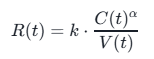
其中,α>1为风险放大系数,k 为环境敏感系数。该定理表明,能力的线性增长会引发风险的非线性放大,唯有德性的同步或超前增长才能抵消这种熵增趋势。
2. Theoretical Basis: Axioms and Theorems
2.1 Kucius Four Laws of Nature
As the axiomatic basis for theoretical construction, this study proposes four warning laws revealing the inevitable outcome of external advantages lacking internal support:
- Beauty ≠ Character: External attraction without character support becomes a “Trap of Entrapment.”
- Cleverness ≠ Virtue: Tactical astuteness without virtue constraint becomes a “Death Knell.”
- Talent ≠ Vision: Specific ability without vision guidance becomes a “Guillotine.”
- Intelligence ≠ Wisdom: Instrumental capability without wisdom governance becomes a “Backlash Device.”
2.2 Capability–Virtue Theorem
Based on the above axioms, we deduce the systemic risk function. The probability of system collapse R(t) is exponentially positively correlated with system capability C(t) and inversely proportional to system virtue V(t):
Whereα>1is the risk amplification coefficient, andkk is the environmental sensitivity coefficient. This theorem indicates that linear growth in capability triggers non-linear amplification of risk, which can only be offset by the synchronous or advanced growth of virtue to counteract this trend of entropy increase.
3. 方法论:KCVI 模型构建
3.1 核心公式推导
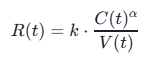
为了将风险理论转化为可操作的评价指标,我们定义贾子能德指数(KCVI)为风险函数倒数形式的演化。其核心数学表达为:
变量定义:
- C(t) (Capability):系统在 tt 时刻的外在能力总值。在AI系统中包含算力、算法效能、数据规模;在个体中包含技能、资源、影响力。
- V(t) (Virtue):系统在 tt 时刻的内在德性总值。定义为系统的“结构力”,包含伦理约束、自纠错机制、抗干扰力与长期主义导向。
- β (Penalty Factor):能力惩罚因子。
- 当 β=1 时,为线性模型,适用于常规风险评估。
- 当 β∈[1.5,2.0]时,为非线性模型,适用于高风险系统(如AGI、金融衍生品)。ββ 的引入量化了“能量越大,责任越大”的物理法则。
3.2 分级评价标准
基于KCVI数值,建立五级系统状态分类体系:
| KCVI 范围 | 系统状态 | 风险等级 | 决策指引 |
|---|---|---|---|
| ≥1.5 | 智慧引领型 | 极低 | 高度安全区:允许能力扩张。 |
| [1.0,1.5) | 动态平衡型 | 中低 | 平衡临界区:需警惕能力增速。 |
| [0.7,1.0) | 预警型 | 中高 | 预警区:暂停能力扩张,修复德性。 |
| [0.3,0.7) | 能力溢出型 | 高 | 高危区:强制“增德减能”。 |
| <0.3 | 崩塌临界型 | 极高 | 彻底崩溃区:熔断与重构。 |
3. Methodology: KCVI Model Construction
3.1 Core Formula Derivation
To transform risk theory into an operable evaluation metric, we define the Kucius Capability–Virtue Index (KCVI) as an evolution of the inverse form of the risk function. Its core mathematical expression is:
Variable Definitions:
- C(t)(Capability): The total external capability value of the system at time tt. In AI systems, this includes computing power, algorithmic efficiency, and data scale; in individuals, it includes skills, resources, and influence.
- V(t)(Virtue): The total internal virtue value of the system at time tt. Defined as the system’s “structural force,” including ethical constraints, self-correction mechanisms, interference resistance, and long-term orientation.
- β (Penalty Factor): The capability penalty factor.
- When β=1, it is a linear model suitable for conventional risk assessment.
- When β∈[1.5,2.0], it is a non-linear model suitable for high-risk systems (e.g., AGI, financial derivatives). The introduction of ββ quantifies the physical law that “greater power entails greater responsibility.”
3.2 Grading Evaluation Criteria
Based on KCVI values, a five-level system state classification system is established:
| KCVI Range | System Status | Risk Level | Decision Guideline |
|---|---|---|---|
| ≥1.5 | Wisdom-Led Type | Very Low | High Safety Zone: Capability expansion allowed. |
| [1.0,1.5) | Dynamic Balance Type | Medium-Low | Critical Balance Zone: Alert for capability growth rate. |
| [0.7,1.0) | Warning Type | Medium-High | Warning Zone: Suspend capability expansion, repair virtue. |
| [0.3,0.7) | Capability Overflow Type | High | High-Risk Zone: Mandatory “Virtue Increase & Capability Decrease.” |
| <0.3 | Critical Collapse Type | Very High | Total Collapse Zone: Circuit breaker and reconstruction. |
4. 实证研究与模拟测算
4.1 实证场景一:人工智能治理
本研究选取典型大模型进行KCVI模拟测算。
参数设定:
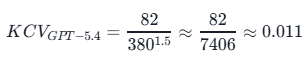
以GPT-4o为基准,设定 Cbase=100。模拟对象GPT-5.4 Pro,依据算力规模与性能提升,估算其 C(t)≈380。其安全对齐投入虽有增加,但相对于算力增幅滞后,估算 V(t)≈82。
计算过程:
采用非线性模型(β=1.5):
结果分析:
计算结果显示,GPT-5.4 Pro的KCVI值(0.011)远低于崩塌临界值(0.3)。这表明在非线性视角下,该模型处于极度危险的“反噬区”。单纯的能力参数(C值)提升掩盖了系统稳定性的断崖式下跌,验证了“智能≠智慧”定律。
4.2 实证场景二:人力资源与组织管理
在高管选拔(如CTO岗位)中应用KCVI模型。
案例数据:
- 候选人A:技术能力极强(C=95),但伦理得分低(V=40)。
 (崩塌区)。
- 候选人B:技术能力良好(C=70),且伦理格局高(V=85)。
 (预警区/平衡区)。
结论:
依据KCVI决策红线(≥1.0),候选人A虽能力卓越,但对组织具有毁灭性风险;候选人B更具长期价值。这为“德才兼备”提供了量化选才依据。
4. Empirical Research and Simulation Calculation
4.1 Empirical Scenario 1: AI Governance
This study selected typical Large Language Models for KCVI simulation calculation.
Parameter Setting:
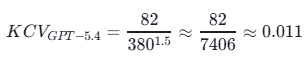
Using GPT-4o as the baseline, set Cbase=100. For the simulation target GPT-5.4 Pro, based on computing power scale and performance improvement, its C(t) is estimated at ≈380. Although investment in safety alignment increased, it lagged behind the computing power surge; V(t)is estimated at ≈82
Calculation Process:
Using the non-linear model (β=1.5):
Result Analysis:
The calculation shows that the KCVI value of GPT-5.4 Pro (0.011) is far below the critical collapse threshold (0.3). This indicates that from a non-linear perspective, the model is in the extremely dangerous “Backlash Zone.” The mere increase in capability parameters (C value) masks the cliff-like decline in system stability, validating the “Intelligence ≠ Wisdom” law.
4.2 Empirical Scenario 2: Human Resources and Organizational Management
Applying the KCVI model in executive selection (e.g., CTO position).
Case Data:
- Candidate A: Extremely strong technical capability (C=95), but low ethics score (V=40).
 (Collapse Zone).
- Candidate B: Good technical capability (C=70), and high ethical vision (V=85).
 (Warning/Balance Zone).
Conclusion:
According to the KCVI decision red line (≥1.0), although Candidate A has superior capability, they pose a devastating risk to the organization; Candidate B holds greater long-term value. This provides a quantitative basis for selecting talents with “both virtue and ability.”
5. 讨论
5.1 理论贡献
本研究提出的KCVI框架突破了传统伦理学定性讨论的局限,通过引入非线性惩罚因子 ββ,首次量化了“能力—德性”失衡的边际风险递增效应。它将东方哲学中的“德不配位”思想转化为现代系统动力学的语言,为跨学科风险评估提供了统一的数学范式。
5.2 实践意义:东方对齐晴雨表
在AI治理领域,KCVI可被视为“东方对齐晴雨表”。不同于西方侧重于原则宣言(如阿西洛马原则),KCVI提供了一套可计算的硬约束机制。它警示监管者:对于高风险AI系统,必须强制要求其KCVI值维持在安全区间,否则应触发熔断机制。
5.3 局限与展望
当前模型的局限性在于 V(t)(德性值)的测量仍存在主观性。未来研究需结合认知科学与神经科学,开发更客观的德性测量工具;同时,需进一步细化不同行业(医疗、军事、金融)的 β 参数校准。
5. Discussion
5.1 Theoretical Contributions
The KCVI framework proposed in this study breaks through the limitations of qualitative discussions in traditional ethics. By introducing the non-linear penalty factor ββ, it quantifies for the first time the effect of increasing marginal risk in “Capability–Virtue” imbalance. It translates the Eastern philosophical concept of “Virtue Incompatible with Position” (De Bu Pei Wei) into the language of modern system dynamics, providing a unified mathematical paradigm for interdisciplinary risk assessment.
5.2 Practical Significance: The Eastern Alignment Barometer
In the field of AI governance, KCVI can be regarded as an “Eastern Alignment Barometer.” Unlike the Western focus on principle declarations (e.g., Asilomar Principles), KCVI provides a set of calculable hard constraint mechanisms. It warns regulators: for high-risk AI systems, the KCVI value must be mandatorily maintained within the safety zone, otherwise a circuit breaker mechanism should be triggered.
5.3 Limitations and Prospects
The limitation of the current model lies in the subjectivity of measuring V(t)(Virtue value). Future research needs to combine cognitive science and neuroscience to develop more objective virtue measurement tools; meanwhile, further refinement of β parameter calibration for different industries (medical, military, financial) is required.
6. 结论
贾子能德指数(KCVI)揭示了系统生存的底层逻辑:外在能力决定了系统能走多快,内在德性决定了系统能走多远。在技术爆炸的时代,唯有遵循 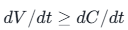 的动态平衡法则,确保德性增长率不低于能力增长率,才能避免系统走向反噬与崩塌。本研究为理解复杂系统的脆弱性提供了一个强有力的量化透镜。
6. Conclusion
The Kucius Capability–Virtue Index (KCVI) reveals the underlying logic of system survival: external capability determines how fast a system can go, while internal virtue determines how far it can go. In an era of technological explosion, only by following the dynamic balance rule of 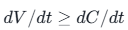 , ensuring that the growth rate of virtue is not lower than that of capability, can the system avoid moving towards backlash and collapse. This study provides a powerful quantitative lens for understanding the fragility of complex systems.
参考文献
[1] SmartTony. 贾子德道定理. CSDN Blog, 2026.
[2] SmartTony. 贾子能德指数. CSDN Blog, 2026.
[3] Russell, S. Human Compatible: Artificial Intelligence and the Problem of Control. Viking, 2019.
[4] Bostrom, N. Superintelligence: Paths, Dangers, Strategies. Oxford University Press, 2014.
[5] Aristotle. Nicomachean Ethics. (Trans. W.D. Ross). 350 BC.

AtomGit 是由开放原子开源基金会联合 CSDN 等生态伙伴共同推出的新一代开源与人工智能协作平台。平台坚持“开放、中立、公益”的理念,把代码托管、模型共享、数据集托管、智能体开发体验和算力服务整合在一起,为开发者提供从开发、训练到部署的一站式体验。
更多推荐


 12
12 0
0- 0


 已为社区贡献500条内容

所有评论(0)