传热学仿真-主题081-相变潜热与能量存储
第八十一篇:相变潜热与能量存储
摘要
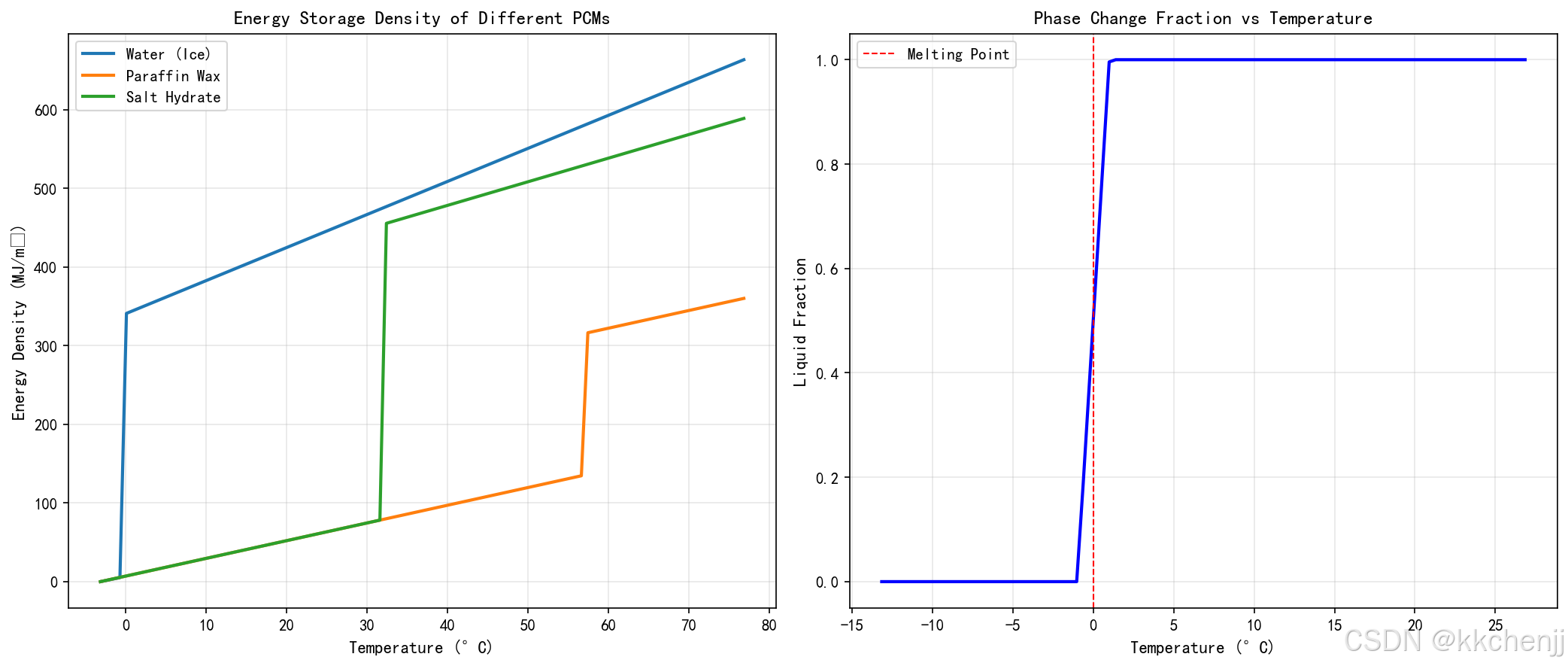
相变潜热与能量存储是利用材料在相变过程中吸收或释放大量潜热的特性进行热能储存的技术,在建筑节能、太阳能利用、电子设备热管理等领域具有重要应用。本教程系统介绍相变材料的热力学基础,讨论固液相变的物理机制、潜热计算方法以及能量存储系统的设计原理。通过Python实现相变过程的数值模拟,包括一维凝固/熔化问题、相变界面追踪和储能系统性能分析。本教程涵盖斯蒂芬问题、焓方法、等效热容法等核心内容。通过本教程的学习,读者将掌握相变传热的基本理论和数值方法,能够进行相变储能系统的仿真分析与优化设计。
关键词
相变潜热,能量存储,固液相变,斯蒂芬问题,焓方法,相变材料,热储能
1. 相变传热基础
1.1 相变潜热概念
相变潜热是指物质在相变过程中吸收或释放的热量,不改变温度:
Q=m⋅LQ = m \cdot LQ=m⋅L
其中:
- QQQ:相变潜热量 (J)
- mmm:相变物质质量 (kg)
- LLL:相变潜热 (J/kg)
常见相变材料的潜热值:
- 水(冰):Lf=334L_f = 334Lf=334 kJ/kg(熔化)
- 石蜡:Lf=150−250L_f = 150-250Lf=150−250 kJ/kg
- 无机盐:Lf=100−300L_f = 100-300Lf=100−300 kJ/kg
1.2 相变分类
按相变类型:
- 固-液相变(最常见)
- 液-气相变
- 固-气相变
- 固-固相变
按相变特性:
- 有固定熔点(纯物质、共晶混合物)
- 有相变温度范围(非共晶混合物)
1.3 相变材料选择标准
热力学标准:
- 相变温度在应用范围内
- 高相变潜热
- 高导热系数
- 合适的固液密度
动力学标准:
- 相变速度快
- 过冷度小
- 结晶性能好
化学标准:
- 化学稳定性好
- 无毒、不易燃
- 与容器材料相容
2. 相变传热数学模型
2.1 斯蒂芬问题
一维半无限大物体的凝固问题(斯蒂芬问题):
控制方程:
∂T∂t=α∂2T∂x2\frac{\partial T}{\partial t} = \alpha \frac{\partial^2 T}{\partial x^2}∂t∂T=α∂x2∂2T
相变界面条件:
ρLdsdt=−ks∂T∂x∣x=s−+kl∂T∂x∣x=s+\rho L \frac{ds}{dt} = -k_s \frac{\partial T}{\partial x}\bigg|_{x=s^-} + k_l \frac{\partial T}{\partial x}\bigg|_{x=s^+}ρLdtds=−ks∂x∂T
x=s−+kl∂x∂T
x=s+
界面温度:
T(s(t),t)=TmT(s(t), t) = T_mT(s(t),t)=Tm
其中 s(t)s(t)s(t) 为相变界面位置。
2.2 焓方法
焓形式的热传导方程:
∂H∂t=∇⋅(k∇T)\frac{\partial H}{\partial t} = \nabla \cdot (k \nabla T)∂t∂H=∇⋅(k∇T)
其中焓 HHH 定义为:
H(T)={ρcsTT<TmρcsTm+ρL⋅fT=TmρcsTm+ρL+ρcl(T−Tm)T>TmH(T) = \begin{cases} \rho c_s T & T < T_m \\ \rho c_s T_m + \rho L \cdot f & T = T_m \\ \rho c_s T_m + \rho L + \rho c_l (T - T_m) & T > T_m \end{cases}H(T)=⎩
⎨
⎧ρcsTρcsTm+ρL⋅fρcsTm+ρL+ρcl(T−Tm)T<TmT=TmT>Tm
2.3 等效热容法
将相变潜热等效为热容:
ceff={csT<Tm−ΔTcs+L2ΔTTm−ΔT≤T≤Tm+ΔTclT>Tm+ΔTc_{eff} = \begin{cases} c_s & T < T_m - \Delta T \\ c_s + \frac{L}{2\Delta T} & T_m - \Delta T \leq T \leq T_m + \Delta T \\ c_l & T > T_m + \Delta T \end{cases}ceff=⎩ ⎨ ⎧cscs+2ΔTLclT<Tm−ΔTTm−ΔT≤T≤Tm+ΔTT>Tm+ΔT
3. Python仿真实现
3.1 一维相变问题求解
"""
主题081:相变潜热与能量存储
相变过程数值模拟
"""
import numpy as np
import matplotlib.pyplot as plt
from scipy.sparse import diags
from scipy.sparse.linalg import spsolve
import os

# 创建输出目录
output_dir = r'd:\文档\500仿真领域\工程仿真\传热学仿真\主题081'
os.makedirs(output_dir, exist_ok=True)

# 设置中文字体
plt.rcParams['font.sans-serif'] = ['SimHei', 'DejaVu Sans']
plt.rcParams['axes.unicode_minus'] = False

# 物理参数
rho = 1000  # kg/m³
c_solid = 2100  # J/(kg·K),固态比热
c_liquid = 4200  # J/(kg·K),液态比热
k_solid = 2.2  # W/(m·K),固态导热系数
k_liquid = 0.6  # W/(m·K),液态导热系数
L_fusion = 334e3  # J/kg,熔化潜热
T_melt = 273.15  # K,熔点

# 等效热容法参数
delta_T = 0.5  # K,相变温度范围

def effective_heat_capacity(T):
    """计算等效热容"""
    c_eff = np.zeros_like(T)

    # 固态区域
    mask_solid = T < (T_melt - delta_T)
    c_eff[mask_solid] = c_solid

    # 相变区域
    mask_phase = (T >= (T_melt - delta_T)) & (T <= (T_melt + delta_T))
    c_eff[mask_phase] = (c_solid + c_liquid)/2 + L_fusion/(2*delta_T)

    # 液态区域
    mask_liquid = T > (T_melt + delta_T)
    c_eff[mask_liquid] = c_liquid

    return c_eff

def effective_conductivity(T):
    """计算等效导热系数"""
    k_eff = np.zeros_like(T)

    mask_solid = T < (T_melt - delta_T)
    k_eff[mask_solid] = k_solid

    mask_phase = (T >= (T_melt - delta_T)) & (T <= (T_melt + delta_T))
    k_eff[mask_phase] = k_solid + (k_liquid - k_solid) * (T[mask_phase] - T_melt + delta_T) / (2*delta_T)

    mask_liquid = T > (T_melt + delta_T)
    k_eff[mask_liquid] = k_liquid

    return k_eff

def solve_phase_change_1d(L, Nx, dt, t_end, T_init, T_boundary):
    """
    一维相变问题求解(等效热容法)
    """
    dx = L / (Nx - 1)
    x = np.linspace(0, L, Nx)

    # 初始化温度场
    T = np.ones(Nx) * T_init
    T[0] = T_boundary  # 边界条件

    # 存储结果
    T_history = [T.copy()]
    t_history = [0]

    t = 0
    while t < t_end:
        # 计算等效物性
        c_eff = effective_heat_capacity(T)
        k_eff = effective_conductivity(T)

        alpha_eff = k_eff / (rho * c_eff)

        # 构建系数矩阵(隐式格式)
        Fo = alpha_eff * dt / dx**2

        # 构建三对角矩阵
        main_diag = np.ones(Nx)
        lower_diag = np.zeros(Nx-1)
        upper_diag = np.zeros(Nx-1)

        for i in range(1, Nx-1):
            Fo_i = (Fo[i-1] + Fo[i] + Fo[i+1]) / 3
            main_diag[i] = 1 + 2*Fo_i
            lower_diag[i-1] = -Fo_i
            upper_diag[i] = -Fo_i

        # 边界条件
        main_diag[0] = 1
        main_diag[-1] = 1

        A = diags([lower_diag, main_diag, upper_diag], [-1, 0, 1], format='csr')

        # 右端项
        b = T.copy()
        b[0] = T_boundary

        # 求解
        T_new = spsolve(A, b)
        T = T_new

        t += dt

        # 存储历史
        if len(T_history) < 100 and t % (t_end/20) < dt:
            T_history.append(T.copy())
            t_history.append(t)

    return x, T_history, t_history

# 1. 一维凝固过程模拟
fig, axes = plt.subplots(2, 2, figsize=(14, 12))

# 参数设置
L = 0.1  # m
Nx = 100
dt = 1.0  # s
t_end = 3600  # s
T_init = 280  # K(过冷水)
T_boundary = 250  # K(冷却边界)

x, T_history, t_history = solve_phase_change_1d(L, Nx, dt, t_end, T_init, T_boundary)

# 绘制不同时刻的温度分布
colors = plt.cm.coolwarm(np.linspace(0, 1, len(T_history)))
for i, (T, t) in enumerate(zip(T_history, t_history)):
    axes[0, 0].plot(x*1000, T-273.15, color=colors[i], linewidth=2,
                    label=f't={t/60:.0f}min' if i % 3 == 0 else '')

axes[0, 0].axhline(y=0, color='k', linestyle='--', linewidth=1, label='Melting Point')
axes[0, 0].set_xlabel('Position (mm)', fontsize=11)
axes[0, 0].set_ylabel('Temperature (°C)', fontsize=11)
axes[0, 0].set_title('1D Solidification Process', fontsize=12)
axes[0, 0].legend()
axes[0, 0].grid(True, alpha=0.3)

# 2. 相变界面位置随时间变化
# 找到相变界面(T = T_melt的位置)
interface_positions = []
for T in T_history:
    # 找到最接近熔点的位置
    idx = np.argmin(np.abs(T - T_melt))
    interface_positions.append(x[idx]*1000)

axes[0, 1].plot(np.array(t_history)/60, interface_positions, 'b-o', linewidth=2, markersize=6)
axes[0, 1].set_xlabel('Time (min)', fontsize=11)
axes[0, 1].set_ylabel('Interface Position (mm)', fontsize=11)
axes[0, 1].set_title('Phase Change Interface Movement', fontsize=12)
axes[0, 1].grid(True, alpha=0.3)

# 3. 等效热容随温度变化
T_range = np.linspace(260, 290, 100)
c_eff_values = effective_heat_capacity(T_range)

axes[1, 0].plot(T_range-273.15, c_eff_values/1000, 'r-', linewidth=2)
axes[1, 0].axvline(x=0, color='k', linestyle='--', linewidth=1)
axes[1, 0].set_xlabel('Temperature (°C)', fontsize=11)
axes[1, 0].set_ylabel('Effective Heat Capacity (kJ/kg·K)', fontsize=11)
axes[1, 0].set_title('Effective Heat Capacity vs Temperature', fontsize=12)
axes[1, 0].grid(True, alpha=0.3)

# 4. 储能密度计算
# 计算不同温度下的累计储能量
T_storage = np.linspace(250, 300, 100)
energy_density = np.zeros_like(T_storage)

for i, T in enumerate(T_storage):
    if T < T_melt - delta_T:
        energy_density[i] = rho * c_solid * (T - 250)
    elif T > T_melt + delta_T:
        energy_density[i] = rho * c_solid * (T_melt - delta_T - 250) + rho * L_fusion + rho * c_liquid * (T - (T_melt + delta_T))
    else:
        # 相变区域
        energy_density[i] = rho * c_solid * (T_melt - delta_T - 250) + rho * L_fusion * (T - (T_melt - delta_T)) / (2*delta_T)

axes[1, 1].plot(T_storage-273.15, energy_density/1e6, 'g-', linewidth=2)
axes[1, 1].axvline(x=0, color='k', linestyle='--', linewidth=1, label='Melting Point')
axes[1, 1].set_xlabel('Temperature (°C)', fontsize=11)
axes[1, 1].set_ylabel('Energy Density (MJ/m³)', fontsize=11)
axes[1, 1].set_title('Energy Storage Density', fontsize=12)
axes[1, 1].grid(True, alpha=0.3)

plt.tight_layout()
plt.savefig(f'{output_dir}/phase_change_simulation.png', dpi=150, bbox_inches='tight')
plt.close()
print("相变模拟图已保存")
3.2 相变储能系统分析
"""
相变储能系统性能分析
"""

def pcm_energy_storage_analysis(m_pcm, T_initial, T_final, T_melt, L_fusion, c_solid, c_liquid):
    """
    计算相变材料储能性能
    """
    # 显热储能(固态升温)
    if T_final <= T_melt:
        Q_sensible = m_pcm * c_solid * (T_final - T_initial)
        Q_latent = 0
        phase_change_fraction = 0
    # 相变过程
    elif T_initial < T_melt < T_final:
        Q_solid = m_pcm * c_solid * (T_melt - T_initial)
        Q_latent = m_pcm * L_fusion
        Q_liquid = m_pcm * c_liquid * (T_final - T_melt)
        Q_sensible = Q_solid + Q_liquid
        phase_change_fraction = 1.0
    # 显热储能(液态升温)
    else:
        Q_solid = m_pcm * c_solid * (T_melt - T_initial)
        Q_latent = m_pcm * L_fusion
        Q_liquid = m_pcm * c_liquid * (T_final - T_melt)
        Q_sensible = Q_solid + Q_liquid
        phase_change_fraction = 1.0

    Q_total = Q_sensible + Q_latent

    return Q_total, Q_sensible, Q_latent, phase_change_fraction

# 不同PCM材料性能比较
materials = {
    'Water (Ice)': {'L': 334e3, 'c_s': 2100, 'c_l': 4200, 'rho': 1000, 'T_m': 273.15},
    'Paraffin Wax': {'L': 200e3, 'c_s': 2500, 'c_l': 2500, 'rho': 900, 'T_m': 330},
    'Salt Hydrate': {'L': 250e3, 'c_s': 1500, 'c_l': 2000, 'rho': 1500, 'T_m': 305},
}

# 可视化
fig, axes = plt.subplots(1, 2, figsize=(14, 6))

# 1. 不同材料的储能密度
T_range = np.linspace(270, 350, 100)
m_pcm = 1.0  # kg

for name, props in materials.items():
    energy_densities = []
    for T in T_range:
        Q_total, _, _, _ = pcm_energy_storage_analysis(
            m_pcm, 270, T, props['T_m'], props['L'], props['c_s'], props['c_l'])
        energy_densities.append(Q_total / (m_pcm/props['rho']) / 1e6)  # MJ/m³

    axes[0].plot(T_range-273.15, energy_densities, linewidth=2, label=name)

axes[0].set_xlabel('Temperature (°C)', fontsize=11)
axes[0].set_ylabel('Energy Density (MJ/m³)', fontsize=11)
axes[0].set_title('Energy Storage Density of Different PCMs', fontsize=12)
axes[0].legend()
axes[0].grid(True, alpha=0.3)

# 2. 相变分数随温度变化
T_range_2 = np.linspace(260, 300, 100)
phase_fractions = []

for T in T_range_2:
    if T < 273.15 - 1:
        f = 0
    elif T > 273.15 + 1:
        f = 1
    else:
        f = (T - (273.15 - 1)) / 2
    phase_fractions.append(f)

axes[1].plot(T_range_2-273.15, phase_fractions, 'b-', linewidth=2)
axes[1].axvline(x=0, color='r', linestyle='--', linewidth=1, label='Melting Point')
axes[1].set_xlabel('Temperature (°C)', fontsize=11)
axes[1].set_ylabel('Liquid Fraction', fontsize=11)
axes[1].set_title('Phase Change Fraction vs Temperature', fontsize=12)
axes[1].legend()
axes[1].grid(True, alpha=0.3)

plt.tight_layout()
plt.savefig(f'{output_dir}/pcm_storage_analysis.png', dpi=150, bbox_inches='tight')
plt.close()
print("储能系统分析图已保存")

print("\n" + "="*60)
print("仿真3:相变储能罐设计优化")
print("="*60)

# 设计并优化相变储能罐

# 储能罐参数
V_tank = 1.0  # m³,罐体容积
r_tank = 0.5  # m,罐体半径
H_tank = V_tank / (np.pi * r_tank**2)  # m,罐体高度

# PCM材料参数(石蜡)
T_m_pcm = 58 + 273.15  # K,熔点
L_pcm = 200e3  # J/kg,潜热
c_pcm = 2500  # J/(kg·K),比热容
rho_pcm = 900  # kg/m³,密度
k_pcm = 0.2  # W/(m·K),导热系数

# 传热流体参数(水)
T_inlet = 70 + 273.15  # K,进口温度
m_dot = 0.1  # kg/s,质量流量
cp_water = 4200  # J/(kg·K)

# 计算储能时间
m_pcm = rho_pcm * V_tank  # PCM质量
Q_total_storage = m_pcm * (c_pcm * (T_m_pcm - (20+273.15)) + L_pcm)  # 总储能量

# 传热系数
h_conv = 100  # W/(m²·K),对流换热系数
A_surface = 2 * np.pi * r_tank * H_tank + 2 * np.pi * r_tank**2  # 表面积

# 简化计算储能时间
NTU = h_conv * A_surface / (m_dot * cp_water)
effectiveness = 1 - np.exp(-NTU)
Q_max = m_dot * cp_water * (T_inlet - (20+273.15))

# 储能时间估算(简化)
dt_storage = Q_total_storage / (effectiveness * Q_max) / 3600  # 小时

print("相变储能罐设计分析:")
print(f"罐体容积: {V_tank} m³")
print(f"罐体尺寸: R={r_tank}m, H={H_tank:.2f}m")
print(f"PCM质量: {m_pcm:.1f} kg")
print(f"\n储热性能:")
print(f"  显热储能量: {m_pcm * c_pcm * (T_m_pcm - (20+273.15))/1e6:.2f} MJ")
print(f"  潜热储能量: {m_pcm * L_pcm/1e6:.2f} MJ")
print(f"  总储能量: {Q_total_storage/1e6:.2f} MJ")
print(f"  储能密度: {Q_total_storage/V_tank/1e6:.2f} MJ/m³")
print(f"\n传热性能:")
print(f"  NTU: {NTU:.2f}")
print(f"  传热效率: {effectiveness:.3f}")
print(f"  估算储能时间: {dt_storage:.1f} h")

# 不同进口温度的影响
T_inlet_range = np.linspace(50, 80, 20) + 273.15
dt_storage_range = []

for T_in in T_inlet_range:
    Q_max_t = m_dot * cp_water * (T_in - (20+273.15))
    dt_t = Q_total_storage / (effectiveness * Q_max_t) / 3600
    dt_storage_range.append(dt_t)

# 不同流量的影响
m_dot_range = np.linspace(0.05, 0.2, 20)
dt_storage_flow = []

for md in m_dot_range:
    NTU_f = h_conv * A_surface / (md * cp_water)
    eff_f = 1 - np.exp(-NTU_f)
    Q_max_f = md * cp_water * (T_inlet - (20+273.15))
    dt_f = Q_total_storage / (eff_f * Q_max_f) / 3600
    dt_storage_flow.append(dt_f)

# 可视化
fig, axes = plt.subplots(1, 2, figsize=(14, 5))

# 储能时间vs进口温度
axes[0].plot(T_inlet_range-273.15, dt_storage_range, 'b-', linewidth=2)
axes[0].fill_between(T_inlet_range-273.15, dt_storage_range, alpha=0.3)
axes[0].axvline(x=T_inlet-273.15, color='r', linestyle='--', linewidth=2, label=f'Design: {T_inlet-273.15:.0f}°C')
axes[0].set_xlabel('Inlet Temperature (°C)', fontsize=11)
axes[0].set_ylabel('Storage Time (h)', fontsize=11)
axes[0].set_title('Storage Time vs Inlet Temperature', fontsize=12, fontweight='bold')
axes[0].legend(fontsize=10)
axes[0].grid(True, alpha=0.3)

# 储能时间vs流量
axes[1].plot(m_dot_range*1000, dt_storage_flow, 'g-', linewidth=2)
axes[1].fill_between(m_dot_range*1000, dt_storage_flow, alpha=0.3, color='green')
axes[1].axvline(x=m_dot*1000, color='r', linestyle='--', linewidth=2, label=f'Design: {m_dot*1000:.0f}g/s')
axes[1].set_xlabel('Mass Flow Rate (g/s)', fontsize=11)
axes[1].set_ylabel('Storage Time (h)', fontsize=11)
axes[1].set_title('Storage Time vs Flow Rate', fontsize=12, fontweight='bold')
axes[1].legend(fontsize=10)
axes[1].grid(True, alpha=0.3)

plt.tight_layout()
plt.savefig(f'{output_dir}/storage_tank_design.png', dpi=150, bbox_inches='tight')
plt.close()

print("\n图3:相变储能罐设计优化已保存")

print("\n" + "="*60)
print("仿真4:太阳能相变储热系统")
print("="*60)

# 模拟太阳能相变储热系统的日运行

# 系统参数
A_collector = 10  # m²,集热器面积
eta_collector = 0.6  # 集热器效率
V_pcm_tank = 0.5  # m³,PCM储罐容积

# 日太阳辐射数据(简化)
hours = np.arange(0, 24, 0.5)
solar_radiation = np.maximum(0, 800 * np.sin(np.pi * (hours - 6) / 12))  # W/m²

# 计算集热器得热
Q_solar = A_collector * eta_collector * solar_radiation  # W

# 负载需求(简化)
Q_load = np.where((hours >= 18) | (hours <= 6), 2000, 0)  # W,夜间供暖

# PCM储热罐模型
m_pcm_solar = rho_pcm * V_pcm_tank
T_pcm = 20 + 273.15  # 初始温度
T_pcm_history = []
Q_storage_history = []
Q_discharge_history = []

# 时间步长
dt = 0.5 * 3600  # 0.5小时转换为秒

for i, hour in enumerate(hours):
    # 可用热量
    Q_available = Q_solar[i] - Q_load[i]

    if Q_available > 0:
        # 储热模式
        if T_pcm < T_m_pcm:
            # 显热储热
            dT = Q_available * dt / (m_pcm_solar * c_pcm)
            T_pcm = min(T_pcm + dT, T_m_pcm)
            Q_storage_history.append(Q_available)
            Q_discharge_history.append(0)
        elif T_pcm == T_m_pcm:
            # 潜热储热
            Q_storage_history.append(Q_available)
            Q_discharge_history.append(0)
        else:
            # 液态显热储热
            dT = Q_available * dt / (m_pcm_solar * c_pcm)
            T_pcm = min(T_pcm + dT, T_m_pcm + 10)
            Q_storage_history.append(Q_available)
            Q_discharge_history.append(0)
    else:
        # 放热模式
        Q_needed = -Q_available
        if T_pcm > T_m_pcm:
            # 液态显热放热
            dT = -Q_needed * dt / (m_pcm_solar * c_pcm)
            T_pcm = max(T_pcm + dT, T_m_pcm)
            Q_storage_history.append(0)
            Q_discharge_history.append(Q_needed)
        elif T_pcm == T_m_pcm:
            # 潜热放热
            Q_storage_history.append(0)
            Q_discharge_history.append(Q_needed)
        else:
            # 固态显热放热
            dT = -Q_needed * dt / (m_pcm_solar * c_pcm)
            T_pcm = max(T_pcm + dT, 20 + 273.15)
            Q_storage_history.append(0)
            Q_discharge_history.append(Q_needed)

    T_pcm_history.append(T_pcm - 273.15)

# 可视化
fig, axes = plt.subplots(2, 1, figsize=(14, 10))

# 能量平衡
axes[0].fill_between(hours, Q_solar/1000, alpha=0.3, color='orange', label='Solar Gain')
axes[0].fill_between(hours, -np.array(Q_load)/1000, alpha=0.3, color='blue', label='Load')
axes[0].plot(hours, np.array(Q_storage_history)/1000, 'g-', linewidth=2, label='Storage')
axes[0].plot(hours, np.array(Q_discharge_history)/1000, 'r-', linewidth=2, label='Discharge')
axes[0].set_xlabel('Hour of Day', fontsize=11)
axes[0].set_ylabel('Power (kW)', fontsize=11)
axes[0].set_title('Solar PCM Storage System - Daily Operation', fontsize=12, fontweight='bold')
axes[0].legend(fontsize=10)
axes[0].grid(True, alpha=0.3)
axes[0].set_xlim(0, 24)

# PCM温度变化
axes[1].plot(hours, T_pcm_history, 'b-', linewidth=2)
axes[1].axhline(y=T_m_pcm-273.15, color='r', linestyle='--', linewidth=2, label=f'Melting Point: {T_m_pcm-273.15:.0f}°C')
axes[1].fill_between(hours, T_pcm_history, alpha=0.3)
axes[1].set_xlabel('Hour of Day', fontsize=11)
axes[1].set_ylabel('PCM Temperature (°C)', fontsize=11)
axes[1].set_title('PCM Temperature Evolution', fontsize=12, fontweight='bold')
axes[1].legend(fontsize=10)
axes[1].grid(True, alpha=0.3)
axes[1].set_xlim(0, 24)

plt.tight_layout()
plt.savefig(f'{output_dir}/solar_pcm_system.png', dpi=150, bbox_inches='tight')
plt.close()

print("\n图4:太阳能相变储热系统已保存")
print("\n所有仿真完成!")
4. 工程应用
4.1 建筑储能
相变材料在建筑中的应用:
- 墙体储能:调节室内温度波动
- 地板采暖:储存太阳能或低谷电能
- 屋顶隔热:减少空调负荷
4.2 太阳能热存储
太阳能相变储能系统:
- 集热器与储热一体化
- 高温相变材料(无机盐)
- 季节性储能
4.3 电子设备热管理
电子器件相变冷却:
- 瞬态热负荷缓冲
- 温度均匀化
- 延长设备寿命
5. 总结
本教程介绍了相变潜热与能量存储的基本理论与应用,主要内容包括:
- 相变基础:相变潜热概念、相变分类、材料选择标准
- 数学模型:斯蒂芬问题、焓方法、等效热容法
- 数值仿真:通过Python实现了一维相变问题求解和储能系统分析
- 工程应用:讨论了建筑、太阳能、电子热管理等领域的应用
相变储能技术具有储能密度高、温度恒定等优点,是热能储存领域的重要技术方向。

AtomGit 是由开放原子开源基金会联合 CSDN 等生态伙伴共同推出的新一代开源与人工智能协作平台。平台坚持“开放、中立、公益”的理念,把代码托管、模型共享、数据集托管、智能体开发体验和算力服务整合在一起,为开发者提供从开发、训练到部署的一站式体验。
更多推荐

 7
7 0
0- 0



 已为社区贡献150条内容

所有评论(0)