26年大厂前端问到爆的1000道面试原题(含答案)
相信大家最近已经尝过了26年前端面试的苦,相对于大厂的面试来说,中小厂的面试内容可谓是五花八门,有的专精场景题,有的专精全栈,有的非要你表现出比AI更强的能力
那么针对此局如何破解?
结合2026年的技术趋势(AI辅助开发、RSC、ES2025等),我为你梳理了一份大厂前端面试的高频考点矩阵及典型原题示例,涵盖JS、框架、工程化、网络、性能及场景题。掌握了这些核心逻辑,足以应对95%的“爆款”提问。
关于“1000道题”的复习策略
大厂面试现在的趋势是:
- 反八股: 不会问“Vue生命周期有哪些”,而是问“在某个复杂业务场景下,生命周期钩子执行顺序与预期不符时如何排查”。
- 重工程: 代码不仅要能跑,还要考虑边界情况、内存泄漏、TS 类型体操。
- 考视野: 对 2026 年的新工具(如 Rspack、Turbopack)、新标准(Temporal、Decorator)要有自己的判断。
如果你需要针对某个具体知识点(比如“RSC 的原理”)的深度源码级答案,或者需要高频手写代码题(Promise、防抖节流、深拷贝、并发控制) 的完整实现,那么可以看看完整版本
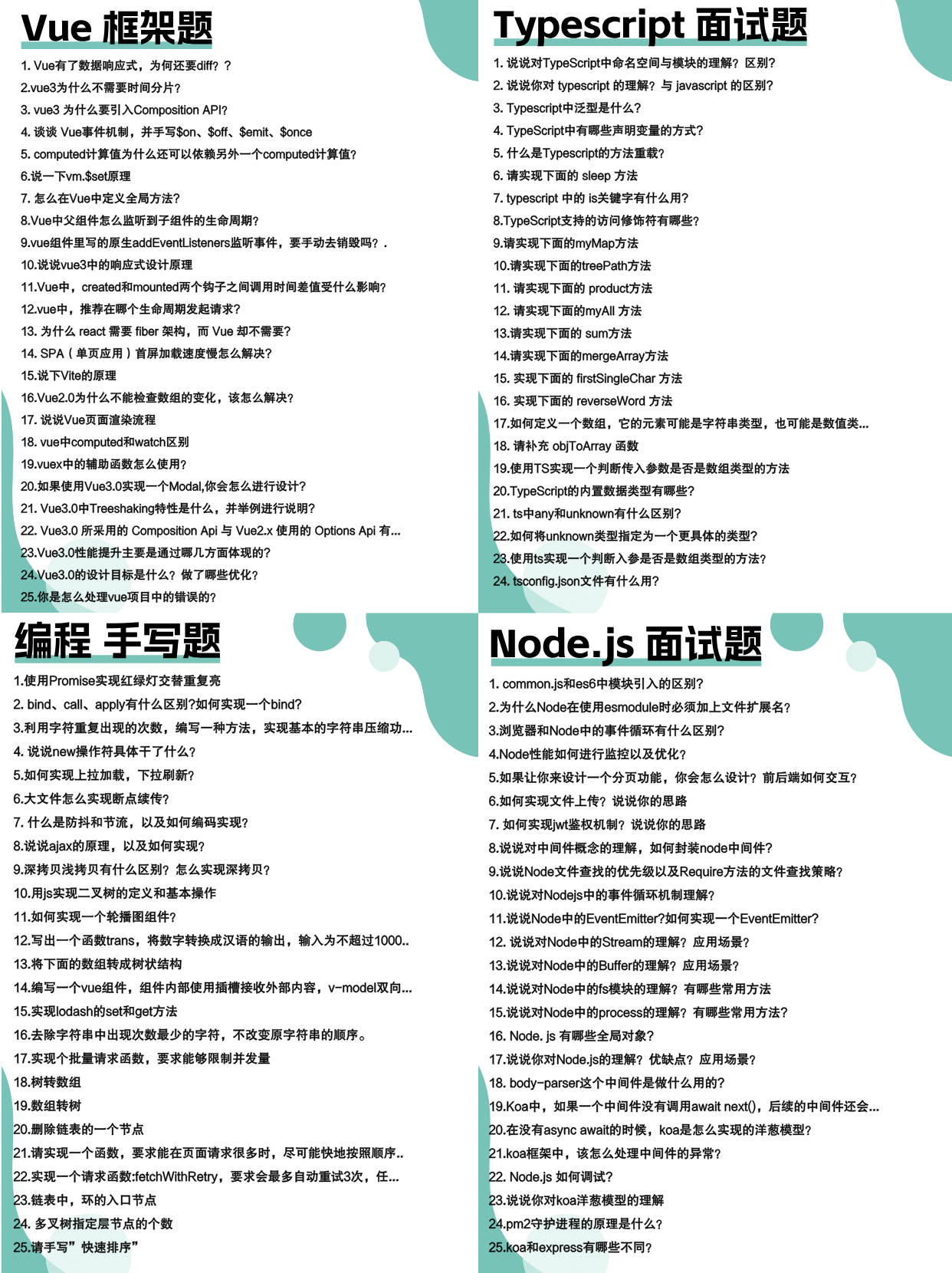
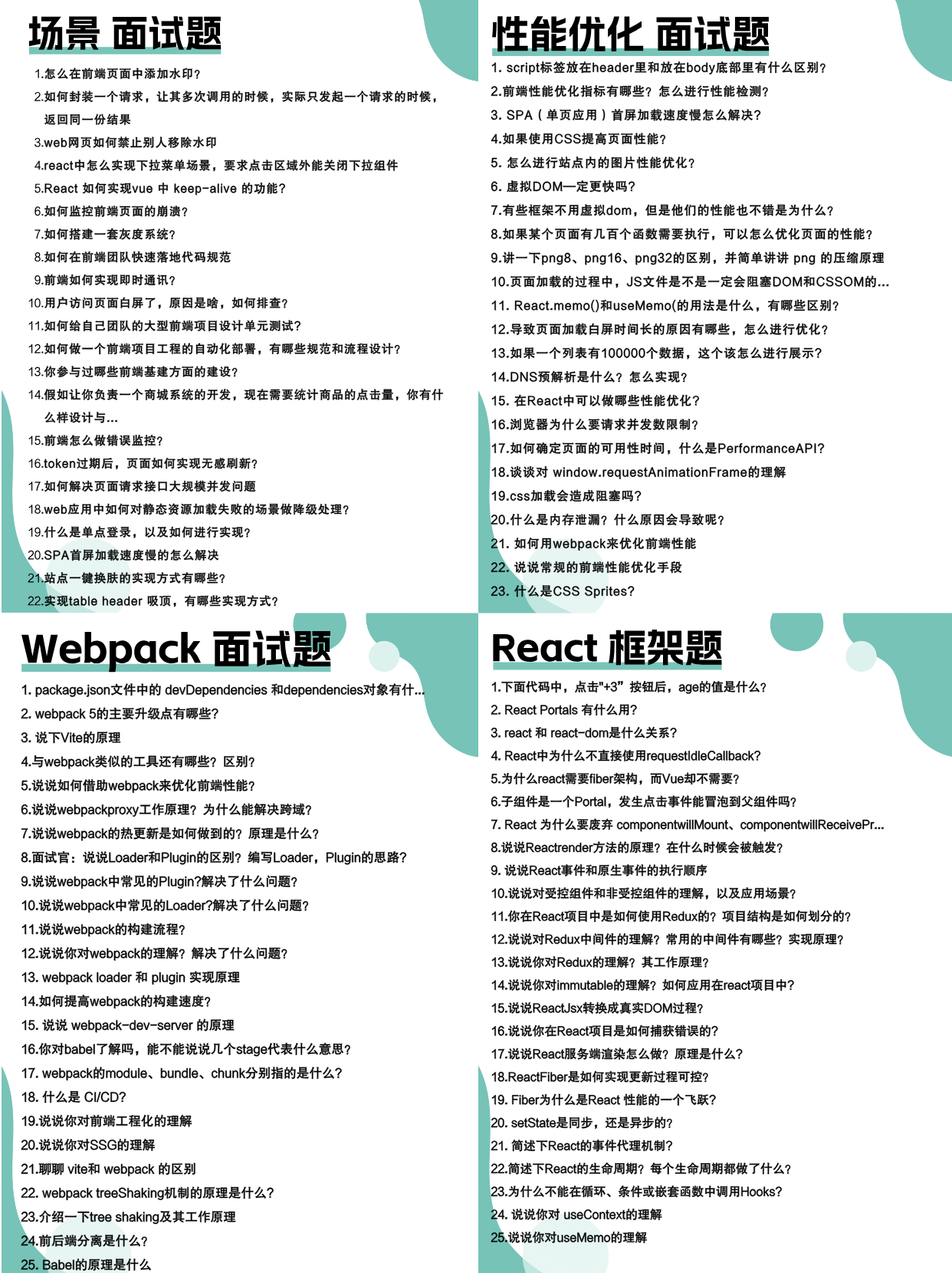
以下:https://github.com/encode-studio-fe-coder/natural_traffic/wiki/scan_material4
⼯程化思维与编译原理详解
⾯试真题1:了解过 AST 吗,请说说它的运⽤场景
代码的本质⸺字符串
字符串的⼀些操作,就是所谓的编译
主谓宾
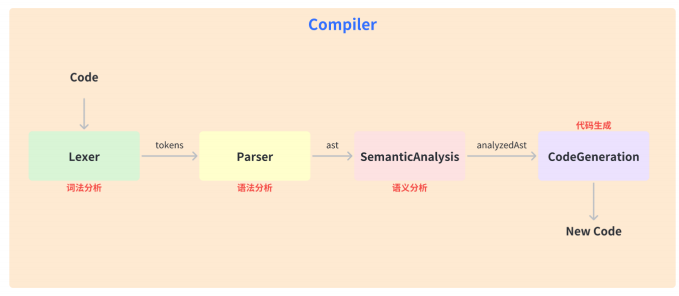
🏖 1. 词法分析(Lexical Analysis):将源代码转换成单词流,称为“词法单
元”(tokens),每个词法单元包含⼀个标识符和⼀个属性值,⽐如变量名、数字、操作
符等等。
2. 语法分析(Parsing):将词法单元流转换成抽象语法树(Abstract Syntax Tree,简称
AST),也就是标记所构成的数据结构,表⽰源代码的结构和规则。
3. 语义分析(Semantic Analysis):在AST上执⾏类型检查、作⽤域检查等操作,以确保代
码的正确性和安全性。
4. 代码⽣成(Code Generation):基于AST⽣成⽬标代码,包括优化代码结构、⽣成代码
⽂本、进⾏代码压缩等等。
下⾯是⼀个简单的JavaScript编译器⽰例代码:
其中:
lexer 是词法分析器,将源代码转换成词法单元流;parser 是语法分析器,将词法单元流转换成抽象语法树;
semanticAnalysis 是语义分析器,对抽象语法树进⾏语义分析;
codeGeneration 是代码⽣成器,将分析后的AST⽣成⽬标代码。
⼀个编译器最核⼼的代码
1 function compiler(sourceCode) {
2 // 词法分析
3 const tokens = lexer(sourceCode);
4
5 // 语法分析
6 const ast = parser(tokens);
7
8 // 语义分析
9 const analyzedAst = semanticAnalysis(ast);
10
11 // 代码⽣成
12 const code = codeGeneration(analyzedAst);
13
14 return code;
15 }
为什么在⼯作中需要⽤到编译原理,⼀个公式编辑器、⼀个字符串复杂处理。低代码平台更是需要详
细掌握 AST 及编译原理。airtable、coda、glide、fibery
1 LISP C
2
3 2 + 2 (add 2 2) add(2, 2)
4 4 - 2 (subtract 4 2) subtract(4, 2)
5 2 + (4 - 2) (add 2 (subtract 4 2)) add(2, subtract(4, 2))
将 LISP 语⾔的代码转为 C
编译器⽰例
1 function tokenizer(input) {
2
3 // A `current` variable for tracking our position in the code like a cursor.
4 let current = 0;
5
6 // And a `tokens` array for pushing our tokens to.
7 let tokens = [];
8
9 // We start by creating a `while` loop where we are setting up our `current`
10 // variable to be incremented as much as we want `inside` the loop.
11 //
12 // We do this because we may want to increment `current` many times within a
13 // single loop because our tokens can be any length.
14 while (current < input.length) {
15
16 // We're also going to store the `current` character in the `input`.
17 let char = input[current];
18
19 // The first thing we want to check for is an open parenthesis. This will
20 // later be used for `CallExpression` but for now we only care about the
21 // character.
22 //
23 // We check to see if we have an open parenthesis:
24 if (char === '(') {
25
26 // If we do, we push a new token with the type `paren` and set the value
27 // to an open parenthesis.
28 tokens.push({
29 type: 'paren',
30 value: '(',
31 });
32
33 // Then we increment `current`
34 current++;
35
36 // And we `continue` onto the next cycle of the loop.
37 continue;
38 }
39
40 // Next we're going to check for a closing parenthesis. We do the same exact
41 // thing as before: Check for a closing parenthesis, add a new token,
42 // increment `current`, and `continue`.
43 if (char === ')') {
44 tokens.push({
45 type: 'paren',
46 value: ')',
47 });
48 current++;
49 continue;
50 }
51
52 // Moving on, we're now going to check for whitespace. This is interesting
53 // because we care that whitespace exists to separate characters, but it
54 // isn't actually important for us to store as a token. We would only throw
55 // it out later.
56 //
57 // So here we're just going to test for existence and if it does exist we're
58 // going to just `continue` on.
59 let WHITESPACE = /\s/;
60 if (WHITESPACE.test(char)) {
61 current++;
62 continue;
63 }
64
65 // The next type of token is a number. This is different than what we have
66 // seen before because a number could be any number of characters and we
67 // want to capture the entire sequence of characters as one token.
68 //
69 // (add 123 456)
70 // ^^^ ^^^
71 // Only two separate tokens
72 //
73 // So we start this off when we encounter the first number in a sequence.
74 let NUMBERS = /[0-9]/;
75 if (NUMBERS.test(char)) {
76
77 // We're going to create a `value` string that we are going to push
78 // characters to.
79 let value = '';
80
81 // Then we're going to loop through each character in the sequence until
82 // we encounter a character that is not a number, pushing each character
83 // that is a number to our `value` and incrementing `current` as we go.
84 while (NUMBERS.test(char)) {
85 value += char;
86 char = input[++current];
87 }
88
89 // After that we push our `number` token to the `tokens` array.
90 tokens.push({ type: 'number', value });
91
92 // And we continue on.
93 continue;
94 }
95
96 // We'll also add support for strings in our language which will be any
97 // text surrounded by double quotes (").
98 //
99 // (concat "foo" "bar")
100 // ^^^ ^^^ string tokens
101 //
102 // We'll start by checking for the opening quote:
103 if (char === '"') {
104 // Keep a `value` variable for building up our string token.
105 let value = '';
106
107 // We'll skip the opening double quote in our token.
108 char = input[++current];
109
110 // Then we'll iterate through each character until we reach another
111 // double quote.
112 while (char !== '"') {
113 value += char;
114 char = input[++current];
115 }
116
117 // Skip the closing double quote.
118 char = input[++current];
119
120 // And add our `string` token to the `tokens` array.
121 tokens.push({ type: 'string', value });
122
123 continue;
124 }
125
126 // The last type of token will be a `name` token. This is a sequence of
127 // letters instead of numbers, that are the names of functions in our lisp
128 // syntax.
129 //
130 // (add 2 4)
131 // ^^^
132 // Name token
133 //
134 let LETTERS = /[a-z]/i;
135 if (LETTERS.test(char)) {
136 let value = '';
137
138 // Again we're just going to loop through all the letters pushing them to
139 // a value.
140 while (LETTERS.test(char)) {
141 value += char;
142 char = input[++current];
143 }
144
145 // And pushing that value as a token with the type `name` and continuing.
146 tokens.push({ type: 'name', value });
147
148 continue;
149 }
150
151 // Finally if we have not matched a character by now, we're going to throw
152 // an error and completely exit.
153 throw new TypeError('I dont know what this character is: ' + char);
154 }
155
156 // Then at the end of our `tokenizer` we simply return the tokens array.
157 return tokens;
158 }
159
160 /**
161 * ============================================================================
162 * ヽ/❀o ل͜ o\ノ
163 * THE PARSER!!!
164 * ============================================================================
165 */
166
167 /**
168 * For our parser we're going to take our array of tokens and turn it into an
169 * AST.
170 *
171 * [{ type: 'paren', value: '(' }, ...] => { type: 'Program', body: [...]
172 */
173
174 // Okay, so we define a `parser` function that accepts our array of `tokens`.
175 function parser(tokens) {
176
177 // Again we keep a `current` variable that we will use as a cursor.
178 let current = 0;
179
180 // But this time we're going to use recursion instead of a `while` loop. So we
181 // define a `walk` function.
182 function walk() {
183
184 // Inside the walk function we start by grabbing the `current` token.
185 let token = tokens[current];
186
187 // We're going to split each type of token off into a different code path,
188 // starting off with `number` tokens.
189 //
190 // We test to see if we have a `number` token.
191 if (token.type === 'number') {
192
193 // If we have one, we'll increment `current`.
194 current++;
195
196 // And we'll return a new AST node called `NumberLiteral` and setting its
197 // value to the value of our token.
198 return {
199 type: 'NumberLiteral',
200 value: token.value,
201 };
202 }
203
204 // If we have a string we will do the same as number and create a
205 // `StringLiteral` node.
206 if (token.type === 'string') {
207 current++;
208
209 return {
210 type: 'StringLiteral',
211 value: token.value,
212 };
213 }
214
215 // Next we're going to look for CallExpressions. We start this off when we
216 // encounter an open parenthesis.
217 if (
218 token.type === 'paren' &&
219 token.value === '('
220 ) {
221
222 // We'll increment `current` to skip the parenthesis since we don't care
223 // about it in our AST.
224 token = tokens[++current];
225
226 // We create a base node with the type `CallExpression`, and we're going
227 // to set the name as the current token's value since the next token after
228 // the open parenthesis is the name of the function.
229 let node = {
230 type: 'CallExpression',
231 name: token.value,
232 params: [],
233 };
234
235 // We increment `current` *again* to skip the name token.
236 token = tokens[++current];
237
238 // And now we want to loop through each token that will be the `params` of
239 // our `CallExpression` until we encounter a closing parenthesis.
240 //
241 // Now this is where recursion comes in. Instead of trying to parse a
242 // potentially infinitely nested set of nodes we're going to rely on
243 // recursion to resolve things.
244 //
245 // To explain this, let's take our Lisp code. You can see that the
246 // parameters of the `add` are a number and a nested `CallExpression` that
247 // includes its own numbers.
248 //
249 // (add 2 (subtract 4 2))
250 //
251 // You'll also notice that in our tokens array we have multiple closing
252 // parenthesis.
253 //
254 // [
255 // { type: 'paren', value: '(' },
256 // { type: 'name', value: 'add' },
257 // { type: 'number', value: '2' },
258 // { type: 'paren', value: '(' },
259 // { type: 'name', value: 'subtract' },
260 // { type: 'number', value: '4' },
261 // { type: 'number', value: '2' },
262 // { type: 'paren', value: ')' }, <<< Closing parenthesis
263 // { type: 'paren', value: ')' }, <<< Closing parenthesis
264 // ]
265 //
266 // We're going to rely on the nested `walk` function to increment our
267 // `current` variable past any nested `CallExpression`.
268
269 // So we create a `while` loop that will continue until it encounters a
270 // token with a `type` of `'paren'` and a `value` of a closing
271 // parenthesis.
272 while (
273 (token.type !== 'paren') ||
274 (token.type === 'paren' && token.value !== ')')
275 ) {
276 // we'll call the `walk` function which will return a `node` and we'll
277 // push it into our `node.params`.
278 node.params.push(walk());
279 token = tokens[current];
280 }
281
282 // Finally we will increment `current` one last time to skip the closing
283 // parenthesis.
284 current++;
285
286 // And return the node.
287 return node;
288 }
289
290 // Again, if we haven't recognized the token type by now we're going to
291 // throw an error.
292 throw new TypeError(token.type);
293 }
294
295 // Now, we're going to create our AST which will have a root which is a
296 // `Program` node.
297 let ast = {
298 type: 'Program',
299 body: [],
300 };
301
302 // And we're going to kickstart our `walk` function, pushing nodes to our
303 // `ast.body` array.
304 //
305 // The reason we are doing this inside a loop is because our program can have
306 // `CallExpression` after one another instead of being nested.
307 //
308 // (add 2 2)
309 // (subtract 4 2)
310 //
311 while (current < tokens.length) {
312 ast.body.push(walk());
313 }
314
315 // At the end of our parser we'll return the AST.
316 return ast;
317 }
318
319 /**
320 * ============================================================================
321 * ⌒(❀> <❀)⌒
322 * THE TRAVERSER!!!
323 * ============================================================================
324 */
325
326 /**
327 * So now we have our AST, and we want to be able to visit different nodes with
328 * a visitor. We need to be able to call the methods on the visitor whenever we
329 * encounter a node with a matching type.
330 *
331 * traverse(ast, {
332 * Program: {
333 * enter(node, parent) {
334 * // ...
335 * },
336 * exit(node, parent) {
337 * // ...
338 * },
339 * },
340 *
341 * CallExpression: {
342 * enter(node, parent) {
343 * // ...
344 * },
345 * exit(node, parent) {
346 * // ...
347 * },
348 * },
349 *
350 * NumberLiteral: {
351 * enter(node, parent) {
352 * // ...
353 * },
354 * exit(node, parent) {
355 * // ...
356 * },
357 * },
358 * });
359 */
360
361 // So we define a traverser function which accepts an AST and a
362 // visitor. Inside we're going to define two functions...
363 function traverser(ast, visitor) {
364
365 // A `traverseArray` function that will allow us to iterate over an array and
366 // call the next function that we will define: `traverseNode`.
367 function traverseArray(array, parent) {
368 array.forEach(child => {
369 traverseNode(child, parent);
370 });
371 }
372
373 // `traverseNode` will accept a `node` and its `parent` node. So that it can
374 // pass both to our visitor methods.
375 function traverseNode(node, parent) {
376
377 // We start by testing for the existence of a method on the visitor with a
378 // matching `type`.
379 let methods = visitor[node.type];
380
381 // If there is an `enter` method for this node type we'll call it with the
382 // `node` and its `parent`.
383 if (methods && methods.enter) {
384 methods.enter(node, parent);
385 }
386
387 // Next we are going to split things up by the current node type.
388 switch (node.type) {
389
390 // We'll start with our top level `Program`. Since Program nodes have a
391 // property named body that has an array of nodes, we will call
392 // `traverseArray` to traverse down into them.
393 //
394 // (Remember that `traverseArray` will in turn call `traverseNode` so we
395 // are causing the tree to be traversed recursively)
396 case 'Program':
397 traverseArray(node.body, node);
398 break;
399
400 // Next we do the same with `CallExpression` and traverse their `params`.
401 case 'CallExpression':
402 traverseArray(node.params, node);
403 break;
404
405 // In the cases of `NumberLiteral` and `StringLiteral` we don't have any
406 // child nodes to visit, so we'll just break.
407 case 'NumberLiteral':
408 case 'StringLiteral':
409 break;
410
411 // And again, if we haven't recognized the node type then we'll throw an
412 // error.
413 default:
414 throw new TypeError(node.type);
415 }
416
417 // If there is an `exit` method for this node type we'll call it with the
418 // `node` and its `parent`.
419 if (methods && methods.exit) {
420 methods.exit(node, parent);
421 }
422 }
423
424 // Finally we kickstart the traverser by calling `traverseNode` with our ast
425 // with no `parent` because the top level of the AST doesn't have a parent.
426 traverseNode(ast, null);
427 }
428
429 /**
430 * ============================================================================
431 * ( )
432 * THE TRANSFORMER!!!
433 * ============================================================================
434 */
435
436 /**
437 * Next up, the transformer. Our transformer is going to take the AST that we
438 * have built and pass it to our traverser function with a visitor and will
439 * create a new ast.
440 *
441 * ----------------------------------------------------------------------------
442 * Original AST | Transformed AST
443 * ----------------------------------------------------------------------------
444 * { | {
445 * type: 'Program', | type: 'Program',
446 * body: [{ | body: [{
447 * type: 'CallExpression', | type: 'ExpressionStatement',
448 * name: 'add', | expression: {
449 * params: [{ | type: 'CallExpression',
450 * type: 'NumberLiteral', | callee: {
451 * value: '2' | type: 'Identifier',
452 * }, { | name: 'add'
453 * type: 'CallExpression', | },
454 * name: 'subtract', | arguments: [{
455 * params: [{ | type: 'NumberLiteral',
456 * type: 'NumberLiteral', | value: '2'
457 * value: '4' | }, {
458 * }, { | type: 'CallExpression',
459 * type: 'NumberLiteral', | callee: {
460 * value: '2' | type: 'Identifier',
461 * }] | name: 'subtract'
462 * }] | },
463 * }] | arguments: [{
464 * } | type: 'NumberLiteral',
465 * | value: '4'
466 * ---------------------------------- | }, {
467 * | type: 'NumberLiteral',
468 * | value: '2'
469 * | }]
470 * (sorry the other one is longer.) | }
471 * | }
472 * | }]
473 * | }
474 * ----------------------------------------------------------------------------
475 */
476
477 // So we have our transformer function which will accept the lisp ast.
478 function transformer(ast) {
479
480 // We'll create a `newAst` which like our previous AST will have a program
481 // node.
482 let newAst = {
483 type: 'Program',
484 body: [],
485 };
486
487 // Next I'm going to cheat a little and create a bit of a hack. We're going to
488 // use a property named `context` on our parent nodes that we're going to push
489 // nodes to their parent's `context`. Normally you would have a better
490 // abstraction than this, but for our purposes this keeps things simple.
491 //
492 // Just take note that the context is a reference *from* the old ast *to* the
493 // new ast.
494 ast._context = newAst.body;
495
496 // We'll start by calling the traverser function with our ast and a visitor.
497 traverser(ast, {
498
499 // The first visitor method accepts any `NumberLiteral`
500 NumberLiteral: {
501 // We'll visit them on enter.
502 enter(node, parent) {
503 // We'll create a new node also named `NumberLiteral` that we will push
504 // the parent context.
505 parent._context.push({
506 type: 'NumberLiteral',
507 value: node.value,
508 });
509 },
510 },
511
512 // Next we have `StringLiteral`
513 StringLiteral: {
514 enter(node, parent) {
515 parent._context.push({
516 type: 'StringLiteral',
517 value: node.value,
518 });
519 },
520 },
521
522 // Next up, `CallExpression`.
523 CallExpression: {
524 enter(node, parent) {
525
526 // We start creating a new node `CallExpression` with a nested
527 // `Identifier`.
528 let expression = {
529 type: 'CallExpression',
530 callee: {
531 type: 'Identifier',
532 name: node.name,
533 },
534 arguments: [],
535 };
536
537 // Next we're going to define a new context on the original
538 // `CallExpression` node that will reference the `expression`'s argument
539 // so that we can push arguments.
540 node._context = expression.arguments;
541
542 // Then we're going to check if the parent node is a `CallExpression`.
543 // If it is not...
544 if (parent.type !== 'CallExpression') {
545
546 // We're going to wrap our `CallExpression` node with an
547 // `ExpressionStatement`. We do this because the top level
548 // `CallExpression` in JavaScript are actually statements.
549 expression = {
550 type: 'ExpressionStatement',
551 expression: expression,
552 };
553 }
554
555 // Last, we push our (possibly wrapped) `CallExpression` to the `parent`
556 // `context`.
557 parent._context.push(expression);
558 },
559 }
560 });
561
562 // At the end of our transformer function we'll return the new ast that we
563 // just created.
564 return newAst;
565 }
566
567 /**
568 * ============================================================================
569 * ヾ(〃^∇^)ノ♪
570 * THE CODE GENERATOR!!!!
571 * ============================================================================
572 */
573
574 /**
575 * Now let's move onto our last phase: The Code Generator.
576 *
577 * Our code generator is going to recursively call itself to print each node in
578 * the tree into one giant string.
579 */
580
581 function codeGenerator(node) {
582
583 // We'll break things down by the `type` of the `node`.
584 switch (node.type) {
585
586 // If we have a `Program` node. We will map through each node in the `body`
587 // and run them through the code generator and join them with a newline.
588 case 'Program':
589 return node.body.map(codeGenerator)
590 .join('\n');
591
592 // For `ExpressionStatement` we'll call the code generator on the nested
593 // expression and we'll add a semicolon...
594 case 'ExpressionStatement':
595 return (
596 codeGenerator(node.expression) +
597 ';' // << (...because we like to code the *correct* way)
598 );
599
600 // For `CallExpression` we will print the `callee`, add an open
601 // parenthesis, we'll map through each node in the `arguments` array and run
602 // them through the code generator, joining them with a comma, and then
603 // we'll add a closing parenthesis.
604 case 'CallExpression':
605 return (
606 codeGenerator(node.callee) +
607 '(' +
608 node.arguments.map(codeGenerator)
609 .join(', ') +
610 ')'
611 );
612
613 // For `Identifier` we'll just return the `node`'s name.
614 case 'Identifier':
615 return node.name;
616
617 // For `NumberLiteral` we'll just return the `node`'s value.
618 case 'NumberLiteral':
619 return node.value;
620
621 // For `StringLiteral` we'll add quotations around the `node`'s value.
622 case 'StringLiteral':
623 return '"' + node.value + '"';
624
625 // And if we haven't recognized the node, we'll throw an error.
626 default:
627 throw new TypeError(node.type);
628 }
629 }
630
631 /**
632 * ============================================================================
633 * ( * ‘ヮ’) ”
634 * !!!!!!!!THE COMPILER!!!!!!!!
635 * ============================================================================
636 */
637
638 /**
639 * FINALLY! We'll create our `compiler` function. Here we will link together
640 * every part of the pipeline.
641 *
642 * 1. input => tokenizer => tokens
643 * 2. tokens => parser => ast
644 * 3. ast => transformer => newAst
645 * 4. newAst => generator => output
646 */
647
648 function compiler(input) {
649 let tokens = tokenizer(input);
650 let ast = parser(tokens);
651 let newAst = transformer(ast);
652 let output = codeGenerator(newAst);
653
654 // and simply return the output!
655 return output;
656 }
657
658 /**
659 * ============================================================================
660 * (๑ ˂̵ )
661 * !!!!!!!!!!!!!!!!!!!!!!!!!!!!!!!!YOU MADE IT!!!!!!!!!!!!!!!!!!!!!!!!!!!!!!!!!
662 * ============================================================================
663 */
664
665 // Now I'm just exporting everything...
666 module.exports = {
667 tokenizer,
668 parser,
669 traverser,
670 transformer,
671 codeGenerator,
672 compiler,
673 };
以上具有MP4讲解,建议配合视频一起食用

AtomGit 是由开放原子开源基金会联合 CSDN 等生态伙伴共同推出的新一代开源与人工智能协作平台。平台坚持“开放、中立、公益”的理念,把代码托管、模型共享、数据集托管、智能体开发体验和算力服务整合在一起,为开发者提供从开发、训练到部署的一站式体验。
更多推荐



 7
7 0
0- 0


 已为社区贡献14条内容

所有评论(0)