左程云-02 必备(1)
·
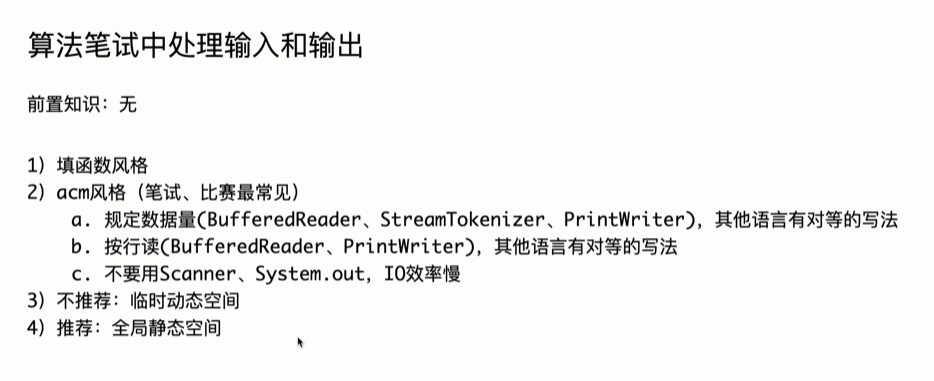
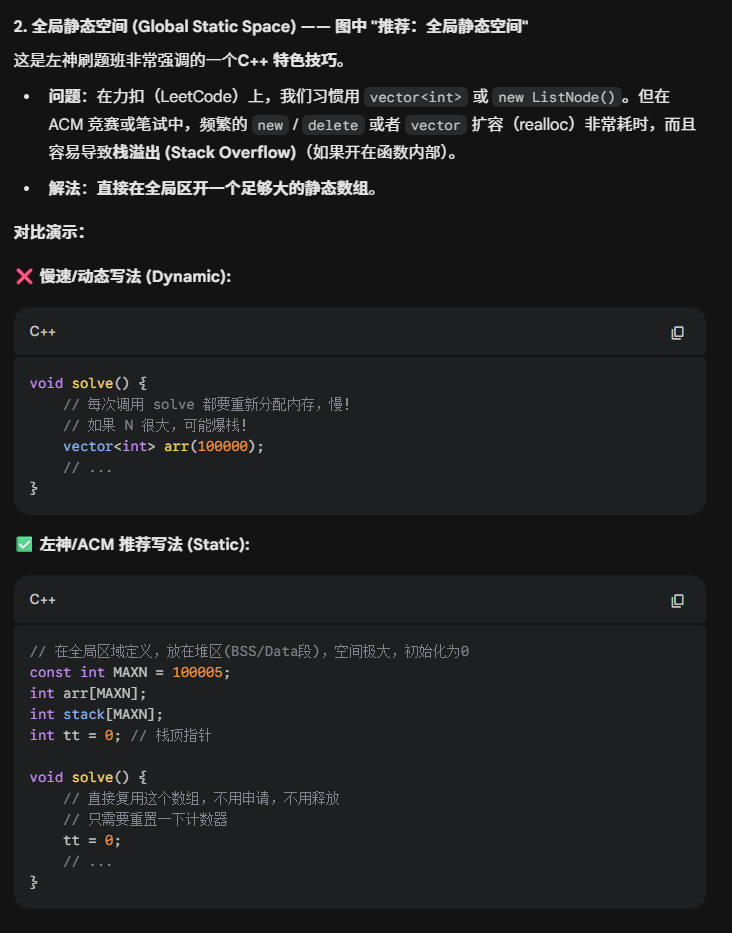
算法讲解019【必备】算法笔试中处理输入和输出
-
- C++ 的 Fast IO (对应图中 “不要用Scanner、System.out”)
// 关流同步,提速神器
std::ios::sync_with_stdio(false);
// 解绑 cin 和 cout,进一步提速
std::cin.tie(nullptr);
// std::cout.tie(nullptr); // 可加可不加
算法讲解020【必备】递归和master公式
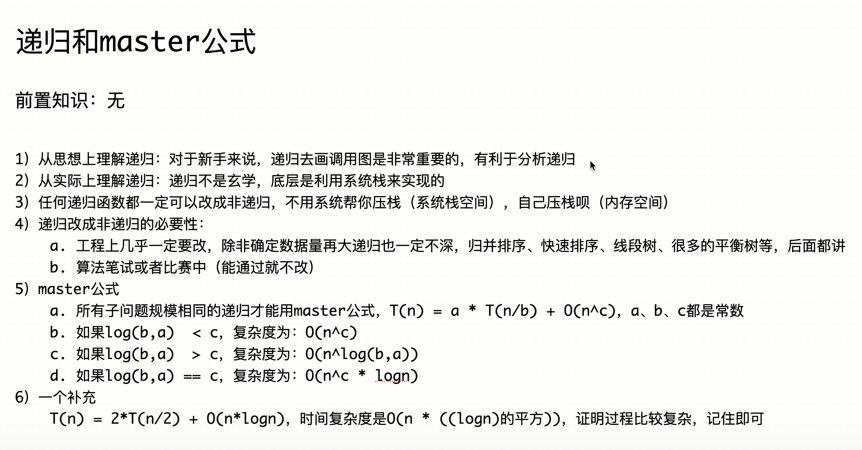
class Solution {
public:
    // 递归求最大值
    int max(vector<int> arr, int l, int r) {
        if (l == r) return arr.at(r);

        int m    = (l + r) / 2;
        int lmax = max(arr, l, m);
        int rmax = max(arr, m + 1, r);
        return std::max(lmax, rmax);
    }
};
算法讲解021【必备】归并排序
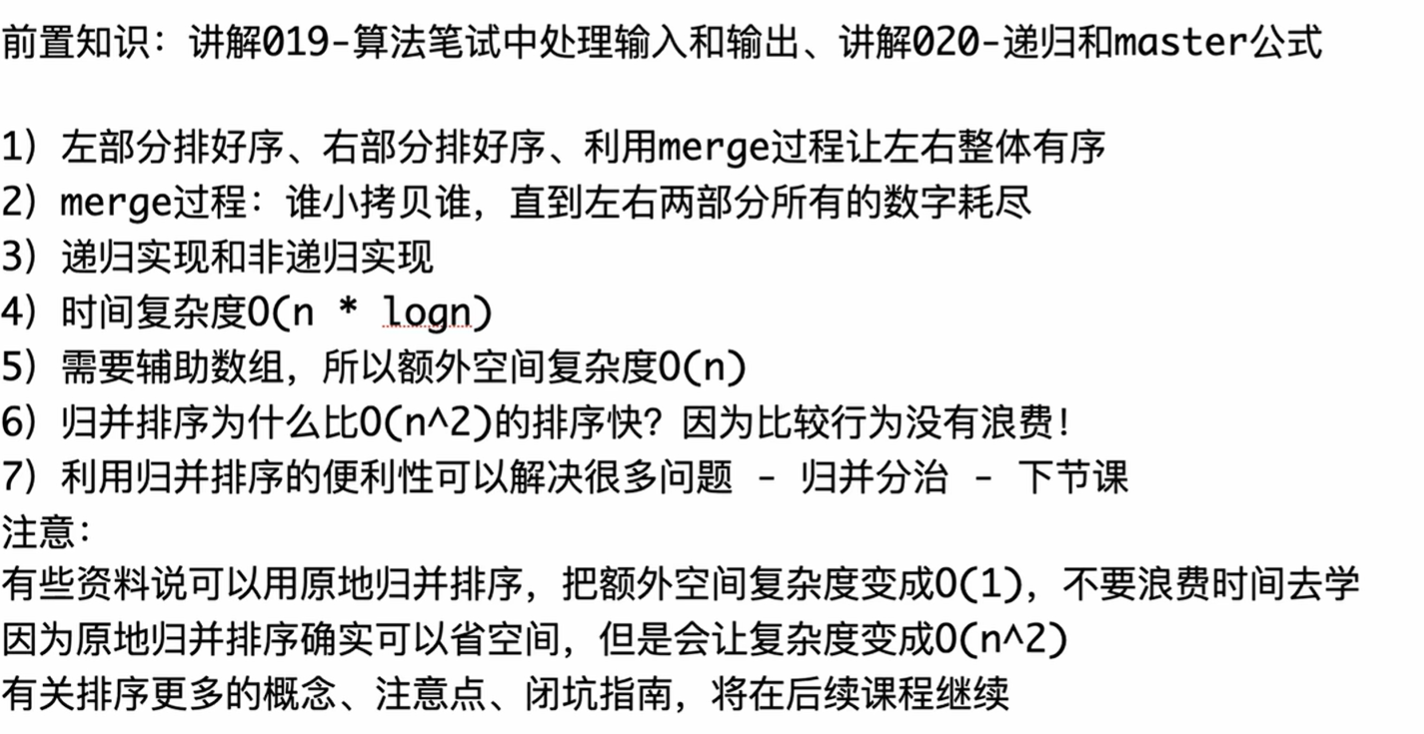
递归版本
int const max = 501;
static int arr[max];
static int help[max];

void merge(int left, int mid, int right)
{
    int i = left;
    int a = left;
    int b = mid + 1;

    while (a <= mid && b <= right)
    {
        // 谁小我移动谁
        help[i++] = arr[a] <= arr[b] ? arr[a++] : arr[b++];
    }

    while (a <= mid)
    {
        help[i++] = arr[a++];
    }

    while (b <= right)
    {
        help[i++] = arr[b++];
    }

    for (i = left; i <= right; i++)
    {
        arr[i] = help[i];
    }
}

void mergeSort(int left, int right)
{
    if (left == right)
    {
        return;
    }
    int mid = (left + right) / 2;
    mergeSort(left, mid);
    mergeSort(mid + 1, right);
    merge(left, mid, right);
}
非递归版本
#include <iostream>
#include <stack>
#include <vector>
#include <algorithm>
using std::stack;
using std::vector;

int const max = 501;
static int arr[max];
static int help[max];

void merge(int left, int mid, int right)
{
    int i = left;
    int a = left;
    int b = mid + 1;

    while (a <= mid && b <= right)
    {
        // 谁小我移动谁
        help[i++] = arr[a] <= arr[b] ? arr[a++] : arr[b++];
    }

    while (a <= mid)
    {
        help[i++] = arr[a++];
    }

    while (b <= right)
    {
        help[i++] = arr[b++];
    }

    for (i = left; i <= right; i++)
    {
        arr[i] = help[i];
    }
}

void mergeSort()
{
    int n = max;
    int left, mid, right;
    for (int step = 1; step < n; n *= 2)
    {
        left = 0;
        // 内部分组merge,时间复杂度为O(n)
        while (left < n)
        {
            mid = left + step - 1;
            if (mid + 1 >= n)
                break;
            right = std::max(left + (step * 2) - 1, n - 1);
            merge(left, mid, right);
            left = right + 1;
        }
    }
}
算法讲解022【必备】归并分治
首先考虑是不是可以将问题分解为三部分:左部分的结果+右部分的结果+跨左右的结果,然后考虑分别对左右两部分排序是否有利于结果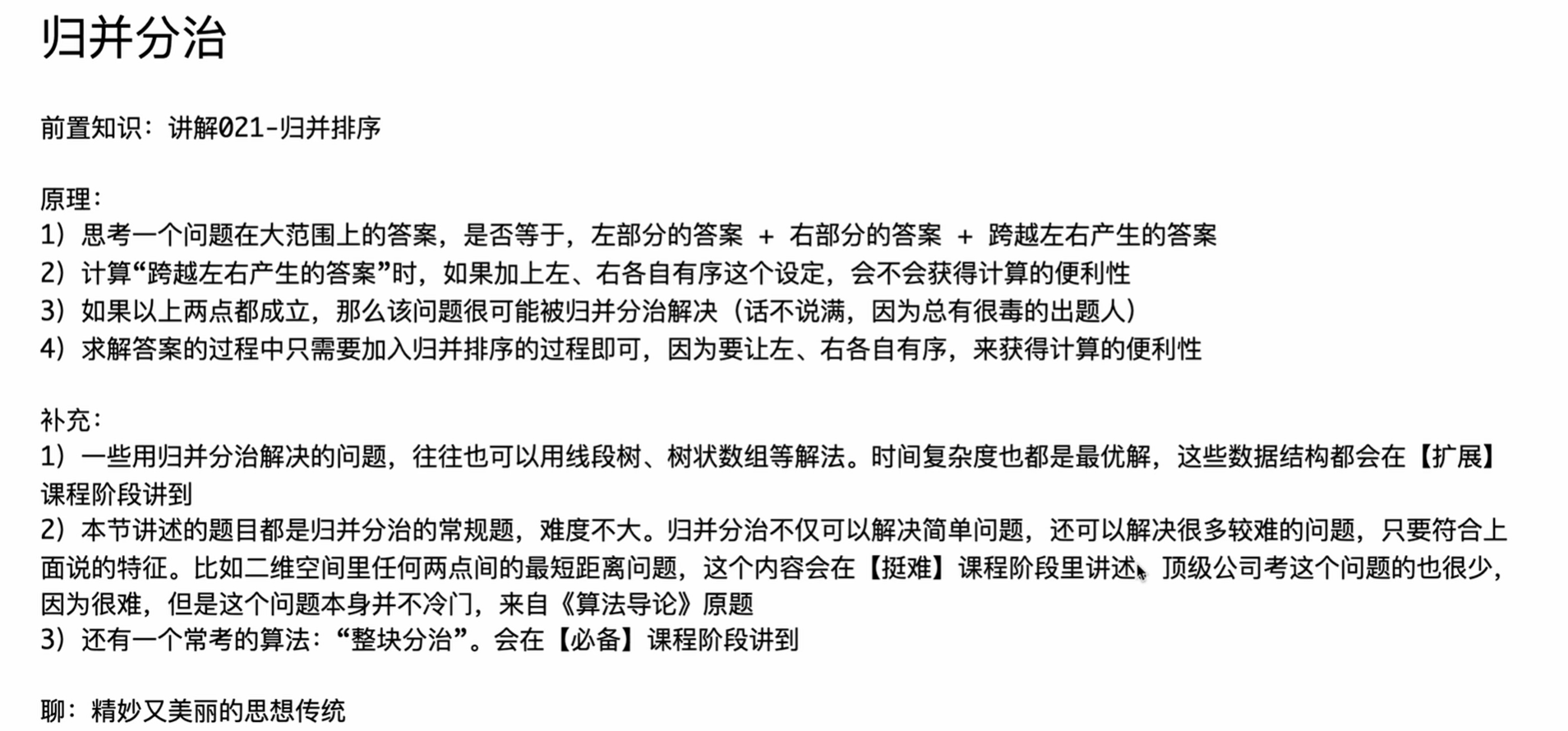
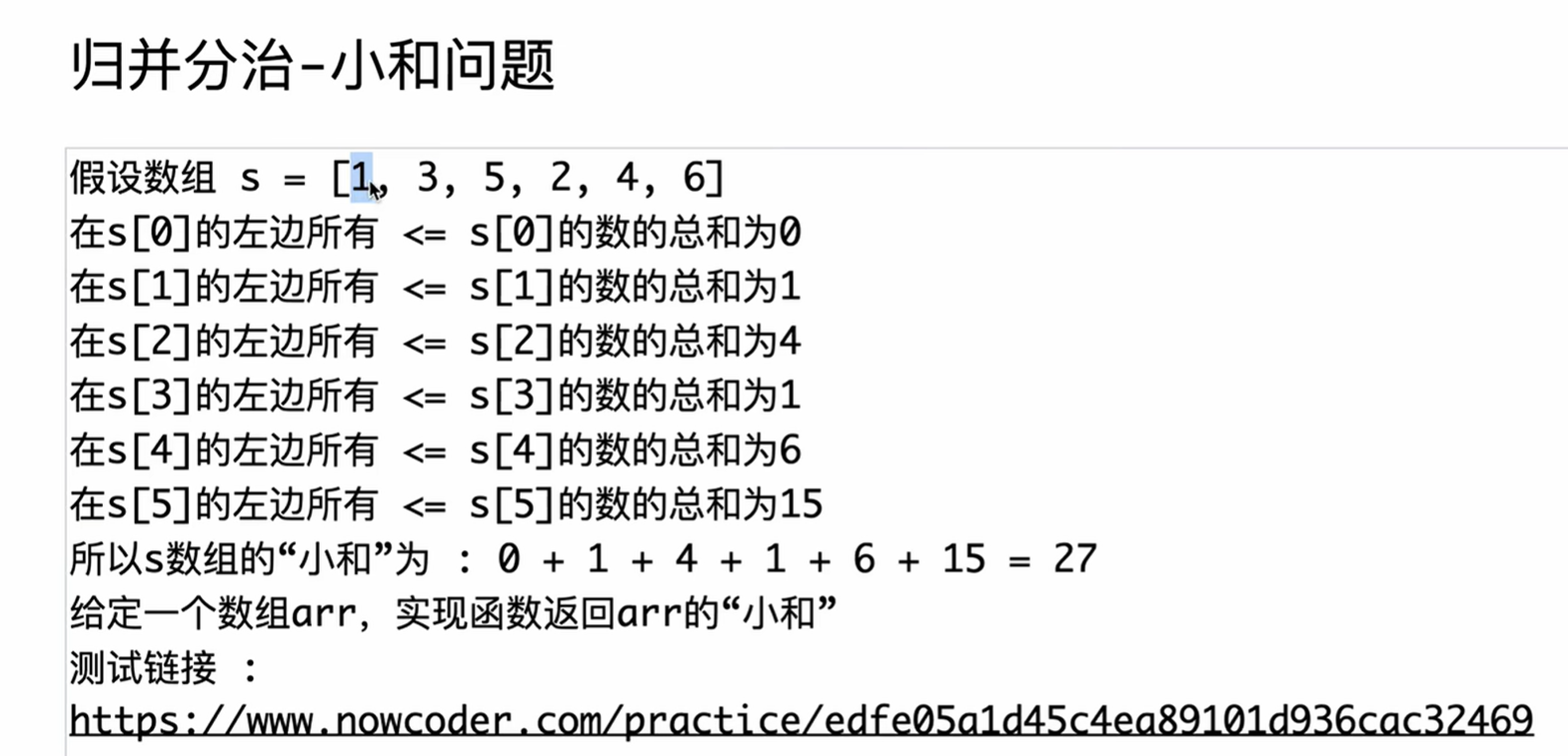
小和问题

https://www.nowcoder.com/practice/6dca0ebd48f94b4296fc11949e3a91b8?tpId=196&tqId=40415&ru=/exam/oj
#include <iostream>
#include <stack>
#include <vector>
#include <algorithm>
using std::stack;
using std::vector;

int const max = 501;
static int arr[max];
static int help[max];
static int n = 0; // 实际有多少个数

// 返回arr[l...r]范围上,小和的累加和,同时把arr[l...r]变有序
long smallSum(int left, int right)
{
    if (left == right)
    {
        return 0;
    }

    int mid = (left + right) / 2;
    return smallSum(left, mid) + smallSum(mid + 1, right) + merge(left, mid, right);
}

// 返回跨左右的小和累加和,左侧有序,右侧有序,让左右整体变有序
long merge(int left, int mid, int right)
{
    // 统计部分:右侧部分相对于左侧部分的小和(注意此时已经变的有序了)
    long ans = 0;
    for (int j = mid + 1, i = left, sum = 0; j <= right; j++)
    {
        while (i <= mid && arr[i] <= arr[j])
        {
            sum += arr[i++]; // 注意这里不能将ans+=arr[i++],因为有重合的,左边的数可能小于右边的多个数而不是一个数
        }
        ans += sum;
    }

    // 正常merge
    int i = left;
    int a = left;
    int b = mid + 1;
    while (a <= mid && b <= right)
    {
        // 谁小我移动谁

        help[i++] = arr[a] <= arr[b] ? arr[a++] : arr[b++];
    }

    while (a <= mid)
    {
        help[i++] = arr[a++];
    }

    while (b <= right)
    {
        help[i++] = arr[b++];
    }

    for (i = left; i <= right; i++)
    {
        arr[i] = help[i];
    }
    return ans;
}
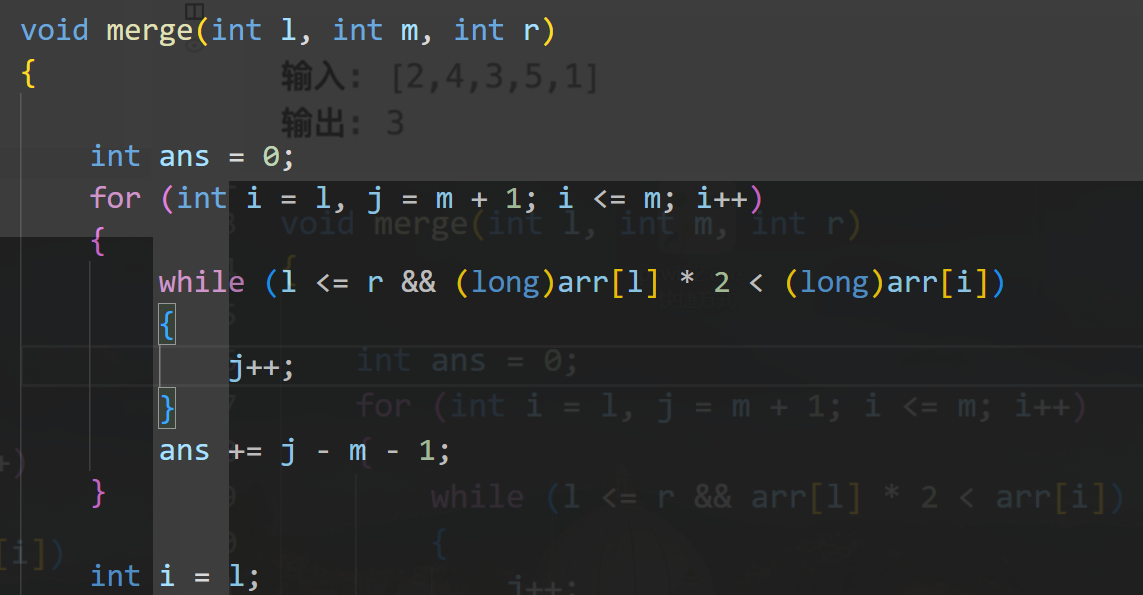
翻转对

https://leetcode.cn/problems/reverse-pairs/description/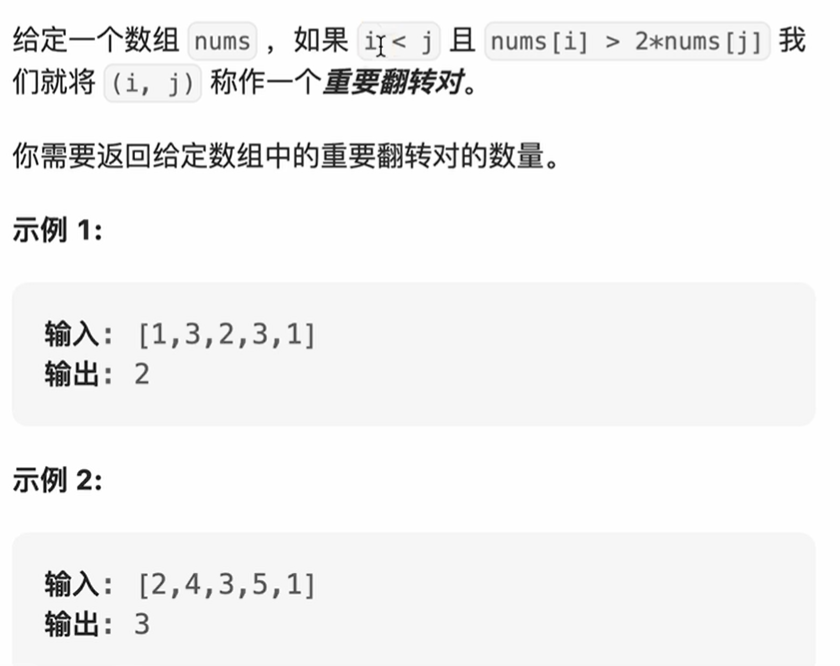
算法讲解023【必备】随机快速排序
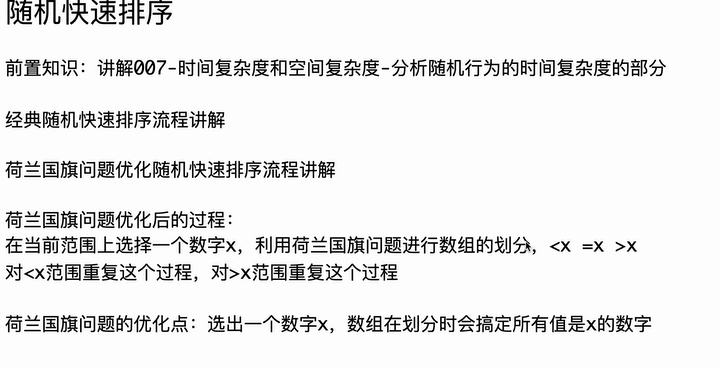
经典的快速排序
#include <iostream>
#include <vector>
#include <cstdlib> // 需要引入 rand()
#include <ctime>   // 需要引入 time()

using std::cout;
using std::endl;
using std::string;
using std::vector;

const int size = 500;
static vector<int> arr(size, 0);

void swap(int pos1, int pos2)
{
    int tmp = arr[pos1];
    arr[pos1] = arr[pos2];
    arr[pos2] = tmp;
}

// 作用:将[l.....a-1] 全部都是<=x [a...r]全是>x,并返回a-1
// 这个函数保持你的逻辑不变
int partition1(int l, int r, int x)
{
    int a = l, xi = 0;
    // xi为<=x的区域中任何一个位置的x的位置,哪一个都可以
    // 但是在代码中我们设置为满足区域中最右边那个数
    for (int i = l; i <= r; i++)
    {
        // <=x时,i++,a++(扩充满足<=的范围)
        if (arr[i] <= x)
        {
            swap(a, i); // 将<=x的数移动到满足的范围的右邻居的那个数
            if (arr[a] == x)
            {
                xi = a;
            }
            a++;
        }
        // 当大于x的时:i++
    }
    // 最优将x移动到a为止
    swap(xi, a - 1);
    return a - 1;
}

void quickSort(int l, int r)
{
    // l == r 只有一个数 不需要排序
    // l > r  非法
    if (l >= r)
        return;

    // 【核心修改点】在此处加入随机逻辑
    // 1. 在 [l, r] 范围里随机选一个位置
    // rand() % (r - l + 1) 会生成 0 到 (r-l) 的随机数
    int randIdx = l + rand() % (r - l + 1);

    int x = arr[randIdx]; // 现在这里的 x 是随机选择的
    int mid = partition1(l, r, x);
    quickSort(l, mid - 1);
    quickSort(mid + 1, r);
}
荷兰国旗问题优化快排中的partition函数
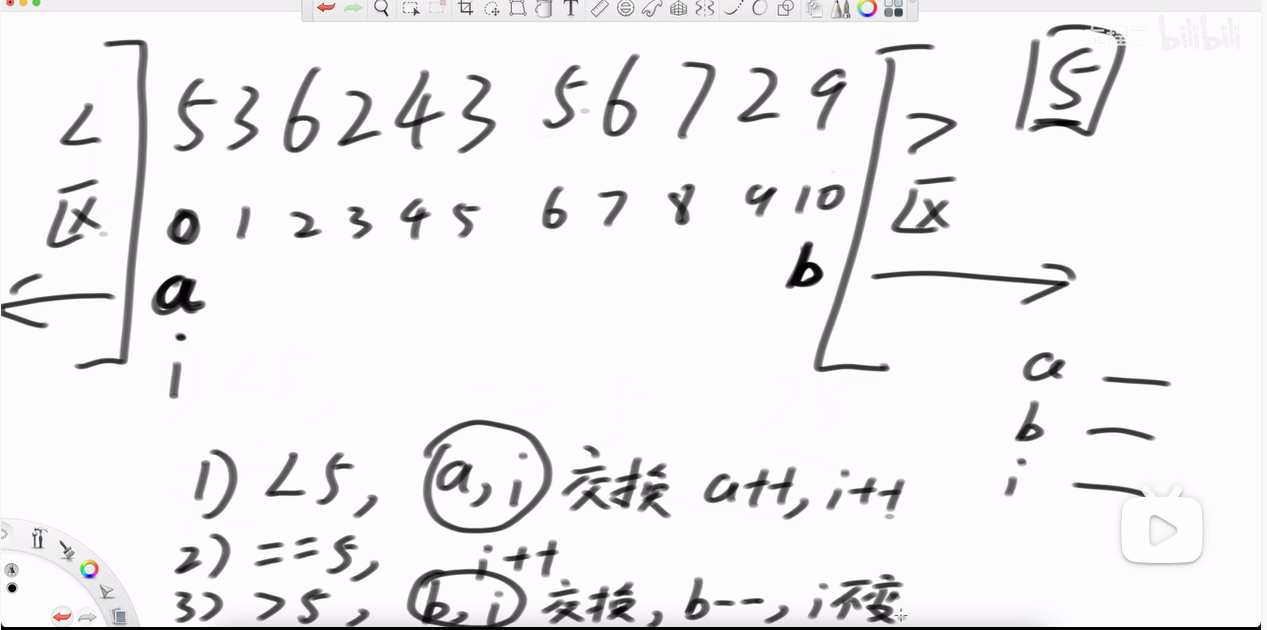
将等于基准的都一次性的放到中间位置
#include <iostream>
#include <vector>
#include <cstdlib>
#include <ctime>
#include <utility>

using namespace std;

class Solution {
public:
    // 寻找第 K 大的元素 (LeetCode 215)
    int findKthLargest(vector<int>& nums, int k) {
        srand((unsigned)time(NULL));
        // 第 K 大,就是在排序数组中下标为 N - K 的元素
        return randomizedSelect(nums, nums.size() - k);
    }

private:
    void swap(vector<int>& arr, int i, int j) {
        int temp = arr[i];
        arr[i] = arr[j];
        arr[j] = temp;
    }

    // 复用 Partition 逻辑
    pair<int, int> partition(vector<int>& arr, int l, int r, int x) {
        int first = l - 1;
        int last = r + 1;
        int i = l;
        while (i < last) {
            if (arr[i] < x) {
                swap(arr, ++first, i++);
            } else if (arr[i] > x) {
                swap(arr, --last, i);
            } else {
                i++;
            }
        }
        return {first + 1, last - 1};
    }

    // 【核心】迭代版选择 (非递归,省空间)
    // 只需要找 targetIndex 这个下标的数
    int randomizedSelect(vector<int>& arr, int targetIndex) {
        int l = 0;
        int r = arr.size() - 1;

        while (l <= r) {
            // 1. 真·随机选 pivot 并交换到头部
            int randIdx = l + rand() % (r - l + 1);
            int x = arr[randIdx ];

            // 2. 划分
            pair<int, int> range = partition(arr, l, r, x);

            // 3. 判断 targetIndex 在哪个区域,只走一边!
            if (targetIndex < range.first) {
                // 目标在左边(小于区),下一轮只看左边
                r = range.first - 1;
            } else if (targetIndex > range.second) {
                // 目标在右边(大于区),下一轮只看右边
                l = range.second + 1;
            } else {
                // 目标就在中间(等于区),直接命中!
                return x;
            }
        }
        return -1;
    }
};
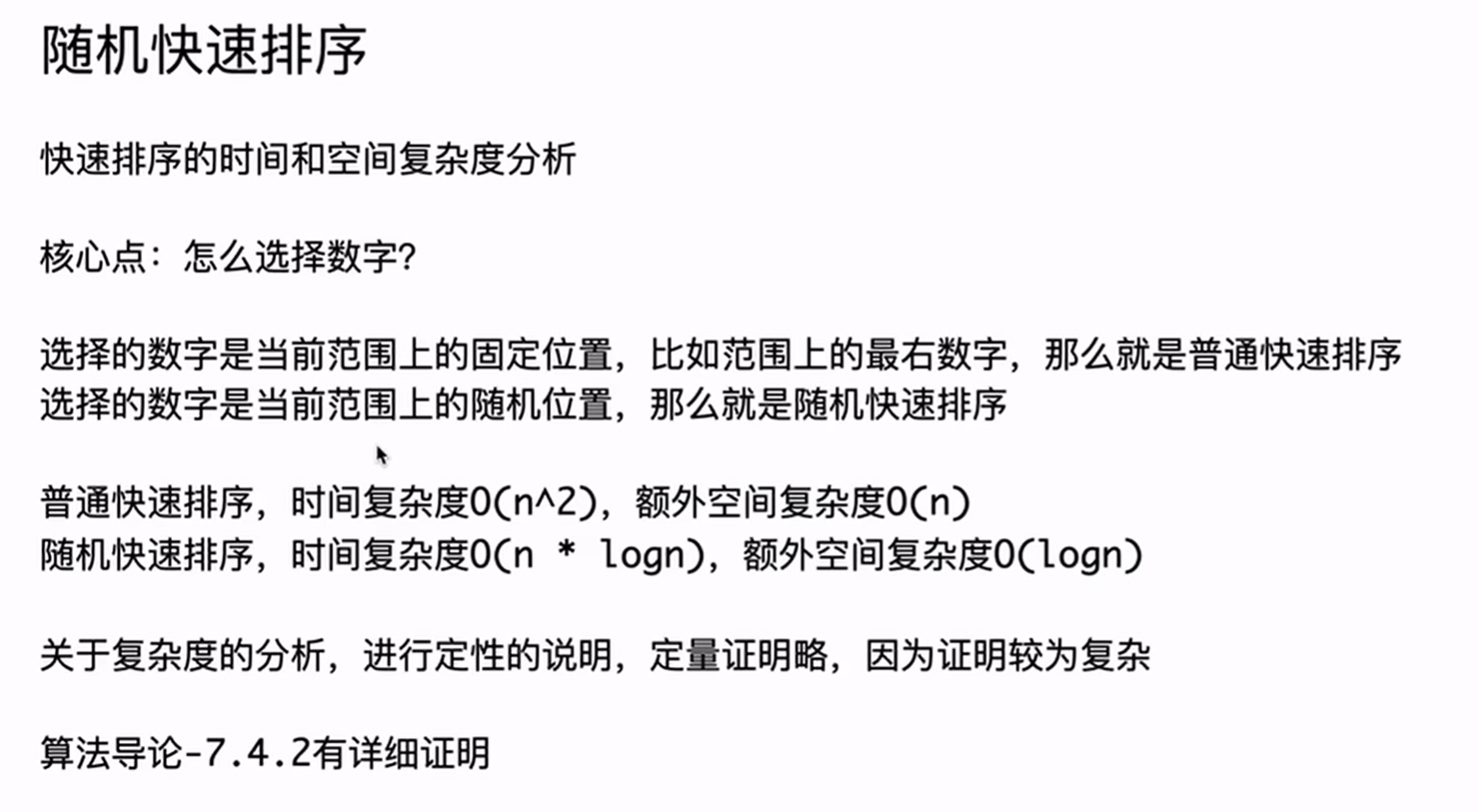
复杂度
算法讲解024【必备】随机选择算法(选择第k大的数)
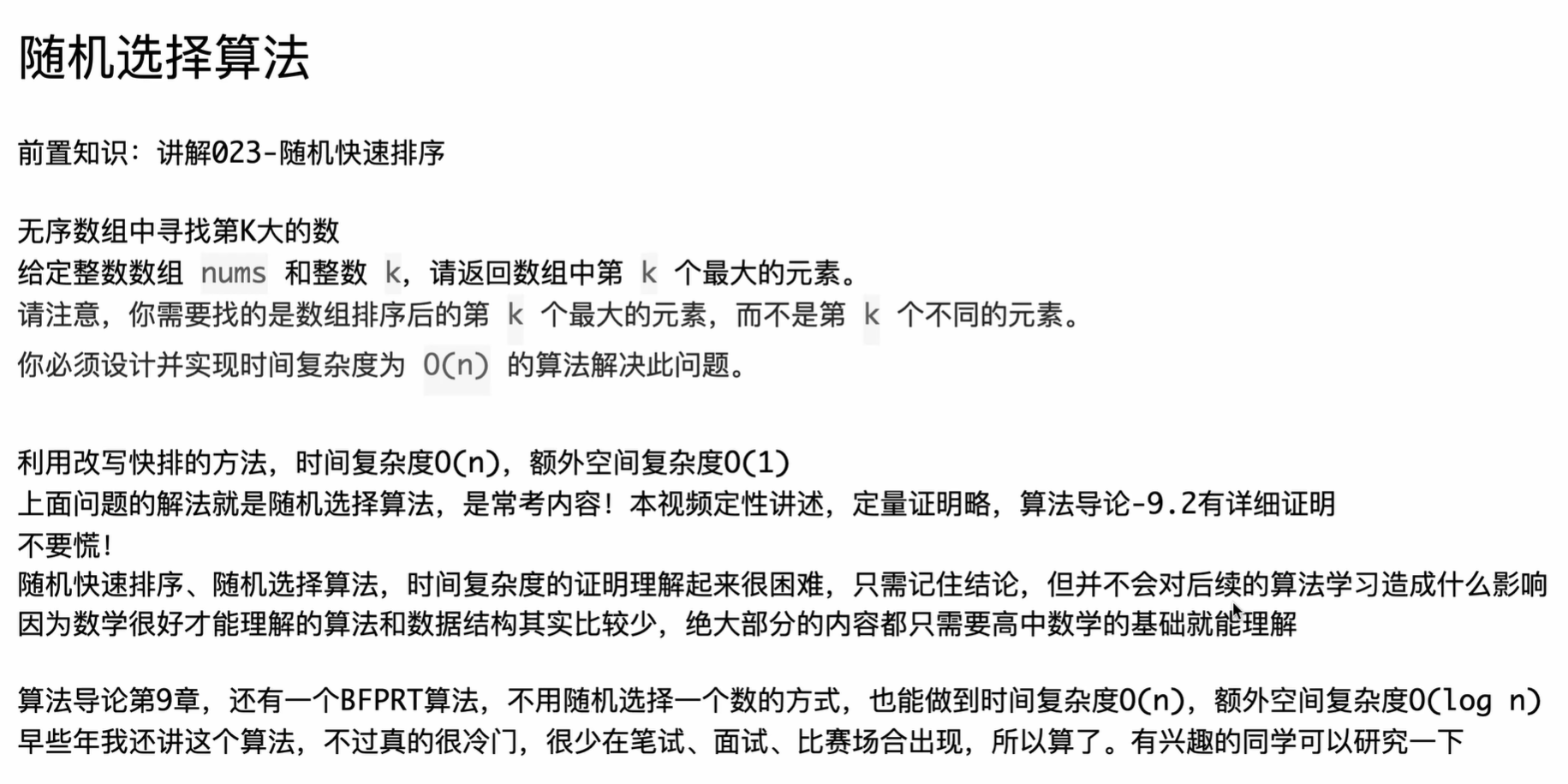
#include <iostream>
#include <vector>
#include <cstdlib> // for rand()
#include <ctime>   // for time()
#include <utility> // for std::pair

using namespace std;

class Solution
{
public:
    // 交换函数 (建议直接用 std::swap)
    void swap(vector<int> &arr, int i, int j)
    {
        int temp = arr[i];
        arr[i] = arr[j];
        arr[j] = temp;
    }

    // 核心:荷兰国旗问题 Partition
    // 返回值:std::pair<int, int> 代表 {等于区的左边界, 等于区的右边界}
    pair<int, int> partition(vector<int> &arr, int l, int r, int x)
    {
        int less = l - 1; // 小于区的右边界
        int more = r + 1; // 大于区的左边界
        int i = l;        // 当前指针

        while (i < more)
        {
            if (arr[i] == x)
            {
                i++;
            }
            else if (arr[i] < x)
            {
                // 当前数 < x,发货到小于区,i 前进
                swap(arr, ++less, i++);
            }
            else
            {
                // 当前数 > x,发货到大于区,i 原地不动(因为换回来的数还没看过)
                swap(arr, --more, i);
            }
        }
        // 返回等于区的范围 [less+1, more-1]
        return {less + 1, more - 1};
    }

    int randomizedSelect(vector<int> &arr, int k)
    {
        int l = 0;
        int r = arr.size() - 1;

        while (l <= r)
        {
            // 1. 随机选一个 pivot
            // rand() % (r - l + 1) 生成 [0, len-1]
            int pivotIndex = l + rand() % (r - l + 1);
            int pivotValue = arr[pivotIndex];

            // 2. 荷兰国旗划分
            // range.first 是等于区左边界,range.second 是等于区右边界
            pair<int, int> range = partition(arr, l, r, pivotValue);

            // 3. 判断 k 在哪个区域
            if (k < range.first)
            {
                // 命中左边(小于区)
                r = range.first - 1;
            }
            else if (k > range.second)
            {
                // 命中右边(大于区)
                l = range.second + 1;
            }
            else
            {
                // 命中中间(等于区),直接返回!
                return pivotValue;
            }
        }
        return -1; // Should not reach here
    }

    int findKthLargest(vector<int> &nums, int k)
    {
        // 初始化随机种子
        srand((unsigned)time(NULL));
        // 第 K 大,就是在排序数组中下标为 N - K 的元素
        // 注意:这里必须传引用,否则 huge data 会超时
        return randomizedSelect(nums, nums.size() - k);
    }
};
C++中的堆结构
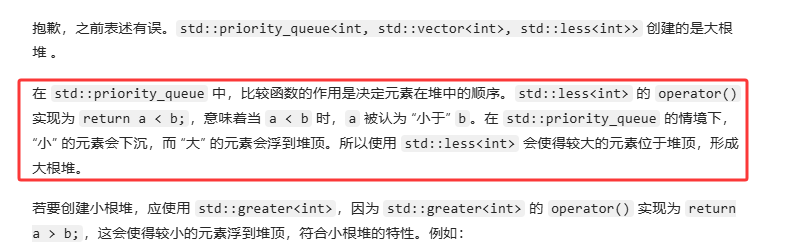
#include <iostream>
#include <queue>
int main() {
    // 默认构造的priority_queue是大根堆
    std::priority_queue<int> maxHeap;
    maxHeap.push(3);
    maxHeap.push(1);

    while (!maxHeap.empty()) {
        std::cout << maxHeap.top() << " ";
        maxHeap.pop();
    }
    std::cout << std::endl;
    return 0;
}


// 自定义比较函数,用于创建小根堆
struct Compare {
    bool operator()(int a, int b) {
        return a > b;
    }
};
int main() {


 // 使用std::less构建大根堆
    std::priority_queue<int, std::vector<int>, std::less<int>> minHeap;

    // 使用自定义比较函数创建小根堆
    std::priority_queue<int, std::vector<int>, Compare> minHeap;

}
算法讲解025【必备】堆结构和堆排序
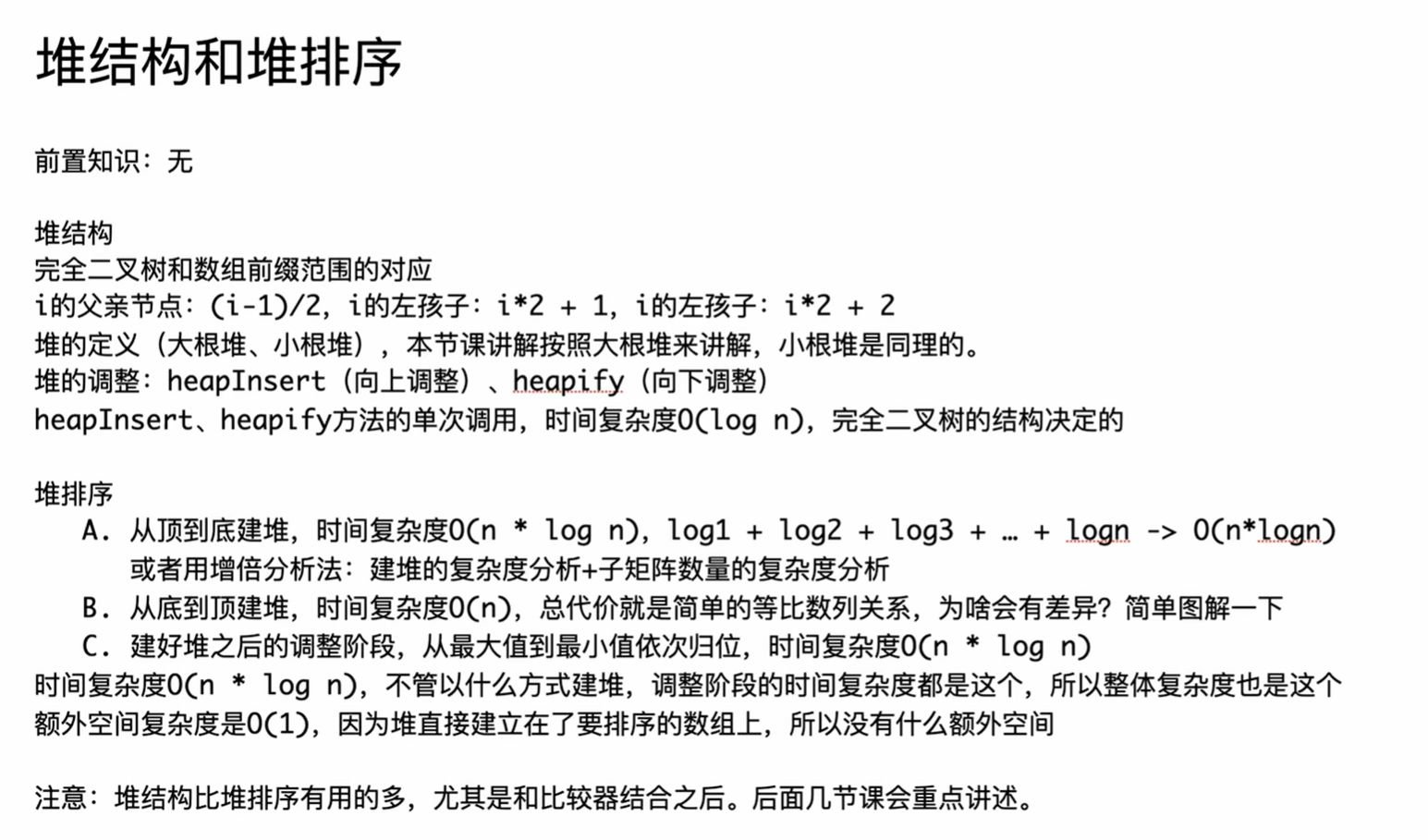
#include <iostream>
#include <vector>
#include <random>
using std::cout;
using std::endl;
using std::string;
using std::vector;

void swap(vector<int>& arr, int pos1, int pos2)
{
    int tmp = arr[pos1];
    arr[pos1] = arr[pos2];
    arr[pos2] = tmp;
}

// i位置的数变大了,向上调整大根堆
void heapInsert(vector<int>& arr, int i)
{
    while (i > 1 && arr[i] > arr[(i - 1) / 2]) // 插入节点大于父节点
    {
        swap(arr, i, (i - 1) / 2); // 子节点和父节点交换
        i = (i - 1) / 2;           // 下一步检查父节点是否满足要求
    }
}

// i位置的数变小了,向下调整为大根堆
void heapify(vector<int>& arr, int i, int size)
{
    int l = i * 2 + 1; // 左孩子
    while (l < size)
    {
        int best = l + 1 < size && arr[l + 1] > arr[l] ? l + 1 : l; // 在孩子中挑出最大的
        best = arr[best] > arr[i] ? best : i;                       // 比较父节点和最大的孩子节点谁大
        if (best == i)
            break;
        swap(arr, best, i);
        i = best;
        l = i * 2 + 1;
    }
}

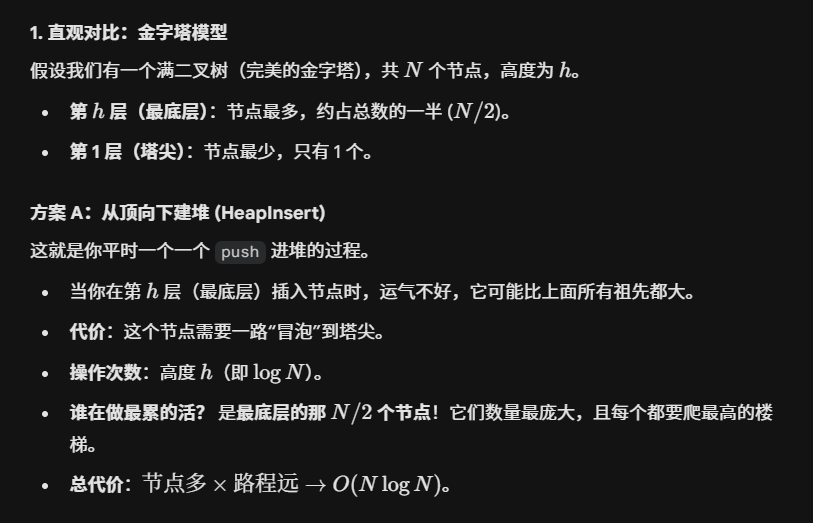
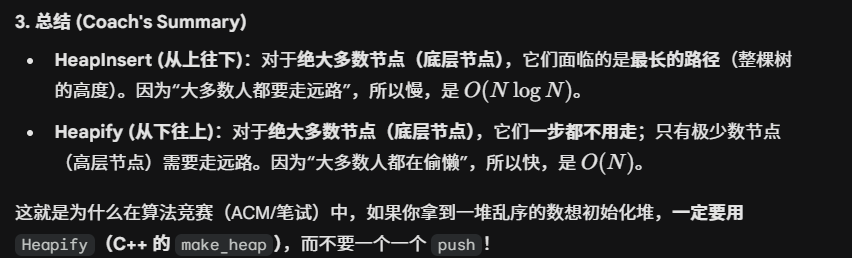
// 1. 从顶到底建立大根堆: O(n *logn)
// 2. 依次弹出堆内最大值并排好序: O(n *logn)
// 总体复杂度:O(n *logn)
void heapSort1(vector<int>& arr)
{
    // 1. 首先从顶到底建立大根堆
    /*建立的过程:首先查看插入的元素是否大于父节点
                                如果小于则不干什么,
                                如果大于,则:交换父子节点,然后递归查看父节点是否大于它的父节点,知道满足位置

     */
    for (int i = 0; i < arr.size(); i++)
    {
        heapInsert(arr, i);
    }

    // 2. 依次将最后一个元素和第一个元素交换,然后向下调整大根堆
    /*
        将0位置元素与最后一个元素交换,然后查看0位置元素是否满足要求,
                                        大于父子节点,则满足
                                        小于父子节点,则则交换,然后交换父子节点,逐渐向下已知满足条件
            过程:首先是找出子节点中的最大节点和父节点比较
                小
                大,交换,则去查看子节点是否满足
    */
    int size = arr.size();
    while (size > 1)
    {
        swap(arr, 0, --size);  // 将最后一个元素和第一个元素交换
        heapify(arr, 0, size); // 然后向下调整大根堆
    }
}

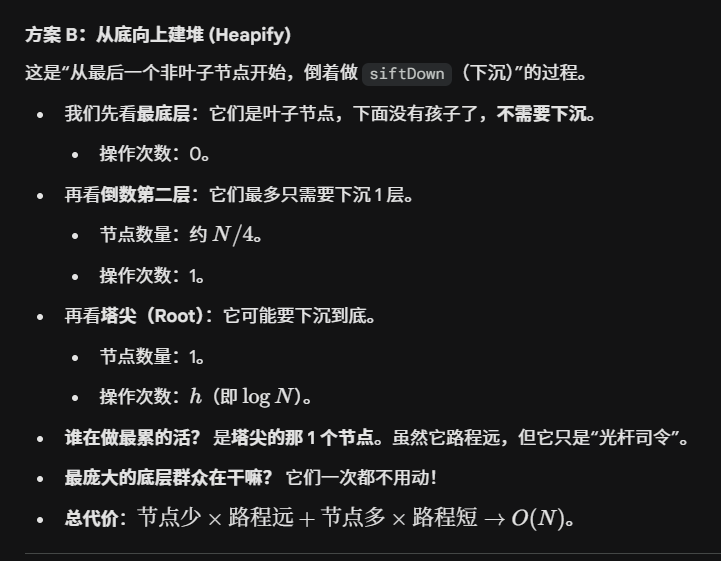
// 1. 从底到顶建立大根堆: O(n)
// 2. 依次弹出堆内最大值并排好序: O(n *logn)
// 总体复杂度:O(n *logn)
void heapSort2(vector<int>& arr)
{
    for (int i = arr.size() - 1; i >= 0; i--)
    {
        heapify(arr, i, arr.size());
    }

    int size = arr.size();
    while (size > 1)
    {
        swap(arr, 0, --size);  // 将最后一个元素和第一个元素交换
        heapify(arr, 0, size); // 然后向下调整大根堆
    }
}
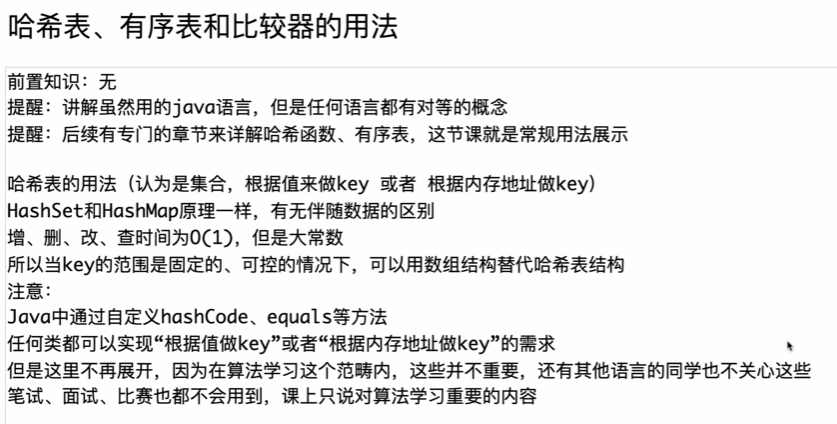
算法讲解026【必备】哈希表、有序表和比较器的用法
算法讲解027【必备】堆结构常见题
题目1:合并有序链表
两两合并
class Solution
{
public:
    ListNode *mergeTwoLists(ListNode *list1, ListNode *list2)
    {
        if (list1 == nullptr && list2 == nullptr)
            return nullptr;
        if (list1 == nullptr)
            return list2;
        else if (list2 == nullptr)
            return list1;

        ListNode *p1 = list1;
        ListNode *p2 = list2;
        ListNode *head, *tail;
        if (p1->val > p2->val)
        {
            head = p2;
            p2 = p2->next;
        }
        else
        {
            head = p1;
            p1 = p1->next;
        }
        tail = head;
        while (p1 && p2)
        {
            if (p1->val > p2->val)
            {
                tail->next = p2;
                tail = tail->next;
                p2 = p2->next;
            }
            else
            {
                tail->next = p1;
                tail = tail->next;
                p1 = p1->next;
            }
        }
        if (p1)
        {
            tail->next = p1;
        }
        else if (p2)
        {
            tail->next = p2;
        }
        return head;
    }

    ListNode *mergeKLists(vector<ListNode *> &lists)
    {
        if (lists.size() == 0)
            return nullptr;
        if (lists.size() == 1)
            return lists[0];

        ListNode *preList = mergeTwoLists(lists[0], lists[1]);
        if (lists.size() <= 2)
            return preList;
        int i = 2;
        while (i < lists.size())
        {
            ListNode *oldLise = preList;
            preList = mergeTwoLists(oldLise, lists[i++]);
        }

        return preList;
    }
};
使用大顶堆
全部压入节点
时间复杂度是:O(n*longn)
空间复杂度是:O(n)
#include <iostream>
#include <vector>
#include <queue>
class Solution {
public:
    struct CompareListNode {
        bool operator()(ListNode* elem1, ListNode* elem2) {
            return elem1->val > elem2->val;
        }
    };

    ListNode* mergeKLists(std::vector<ListNode*>& lists) {
        if (lists.size() == 0)
            return nullptr;
        if (lists.size() == 1)
            return lists[0];

        std::priority_queue<ListNode*, std::vector<ListNode*>, CompareListNode> pre;
        ListNode* head = nullptr;
        ListNode* tail = nullptr;

        for (int i = 0; i < lists.size(); ++i) {
            ListNode* tmp = lists[i];
            if (tmp) {
                while (tmp) {
                    pre.push(tmp);
                    tmp = tmp->next;
                }
            }
        }

        if (pre.size() == 0)
            return nullptr;

        head = pre.top();
        tail = head;
        pre.pop();

        while (!pre.empty()) {
            tail->next = pre.top();
            tail = tail->next;
            pre.pop();
        }
        tail->next = nullptr; // 确保链表末尾为nullptr

        return head;
    }
};
保证堆中节点个数为k个
时间复杂度是:O(n*longk)
空间复杂度是:O(k)
class Solution
{
public:
    struct CompareListNode
    {
        bool operator()(ListNode *elem1, ListNode *elem2)
        {
            return elem1->val > elem2->val;
        }
    };
    ListNode *mergeKLists(vector<ListNode *> &lists)
    {
        if (lists.size() == 0)
            return nullptr;
        if (lists.size() == 1)
            return lists[0];
        std::priority_queue<ListNode *, vector<ListNode *>, CompareListNode> res;
        ListNode *head = nullptr, *tail = nullptr;

        // 保证堆中使用只有非空个链表的个数
        for (int i = 0; i < lists.size(); i++)
        {
            if (lists[i]!=nullptr)
            {
                res.push(lists[i]);
            }
        }
        if (res.size() == 0) // 所有的节点可能都为空
            return nullptr;

        head = res.top();
        tail = head;
        res.pop();
        if (tail->next != nullptr)
        {
            res.push(tail->next);
        }
        while (!res.empty())
        {

            ListNode *cur = res.top();
            tail->next = cur;
            tail = tail->next;
            res.pop();
            if (cur->next != nullptr)
                res.push(cur->next);
        }
        return head;
    }
};
题目2:线段最多重合问题
- 任何一个重合区域的左边界,一定是某一个线段的左边界
#include <iostream>
#include <vector>
#include <algorithm>
#include <queue>
#include <functional>

using std::cout;
using std::endl;
using std::vector;

/*
 1. 首先先根据每条线段的左边界的进行从小到大的排序
 2. 依次比较,建立小根堆,以每条线段的右边界为存储到堆中的元素
 3. 从小根堆堆中一次弹出下面的元素 :
    堆中的值(右边界) < 要加入的元素的左边界       两条线段不相交
    将自己的右边界加入到堆中
    每次记录堆中元素的数量的最大值,即为相交线段的最大数量

本质上就是,堆中存储重合的线段。
*/

class Solution
{
public:
    // 求重合线段数量的最大值
    int maxLineCount(vector<vector<int>> lines)
    {
        // 1. 已经左边界排序
        std::sort(lines.begin(), lines.end(), [](vector<int> elem1, vector<int> elem2)
                  { return elem1[0] < elem2[0]; });
        // 2. 建立小根堆:存储线段的右边界
        std::priority_queue<int, std::vector<int>, std::greater<int>> minHeap;

        int res = 0;
        for (vector<int> elem : lines)
        {
            while (!minHeap.empty() && minHeap.top() < elem[0])
            {
                minHeap.pop();
            }
            minHeap.push(elem[1]);
            res = std::max(res, static_cast<int>(minHeap.size()));
        }

        return res;
    }
};

int main()
{
    Solution solution;
    vector<vector<int>> lines = {{1, 3}, {2, 4}, {2, 3}, {3, 5}};
    int result = solution.maxLineCount(lines);
    cout << "重叠线段数量的最大值: " << result << endl;
    return 0;
}
题目3:让数组整体累加和减半的最少操作

超时
#include <iostream>
#include <vector>
#include <algorithm>
#include <queue>
#include <functional>
#include <numeric>

using std::cout;
using std::endl;
using std::vector;

class Solution
{
public:
    // 贪心
    int halveArray(vector<int> &nums)
    {
        vector<double> nums_d(nums.begin(), nums.end());
        int res = 0;
        double sum = std::accumulate(nums_d.begin(), nums_d.end(), 0);
        double current_sum = sum;
        sum /= 2;
        do
        {
            std::sort(nums_d.begin(), nums_d.end());
            current_sum -= static_cast<double>(nums_d[nums.size() - 1]) / 2;
            nums_d[nums.size() - 1] /= 2;
            res++;
        } while (sum < current_sum);
        return res;
    }
};
大根堆
注意double类型
#include <iostream>
#include <vector>
#include <queue>
#include <numeric>

using std::cout;
using std::endl;
using std::vector;

class Solution
{
public:
    // 贪心 + 最大堆(优先队列)
    int halveArray(vector<int> &nums)
    {
        std::priority_queue<double> heap;
        // 1. 插入堆时直接转double,避免int隐式转换的潜在问题
        for (int elem : nums)
            heap.push(static_cast<double>(elem));

        // 2. 修复:accumulate第三个参数传0.0,强制返回double(避免int溢出/精度丢失)
        double total_sum = std::accumulate(nums.begin(), nums.end(), 0.0);
        double target = total_sum / 2;  // 需要降到的目标和(原和的一半)
        double current_sum = total_sum; // 当前数组和
        int res = 0;

        // 3. 修复:循环条件改为 current_sum > target(逻辑更直观,避免边界误差)
        while (current_sum > target)
        {
            double cur = heap.top();
            heap.pop();

            // 核心:计算减半后减少的量(cur - cur/2 = cur/2),更新当前和
            double reduce = cur / 2;
            current_sum -= reduce;

            cur /= 2;
            heap.push(cur);
            res++;
        }
        return res;
    }
};
算法讲解028【必备】基数排序
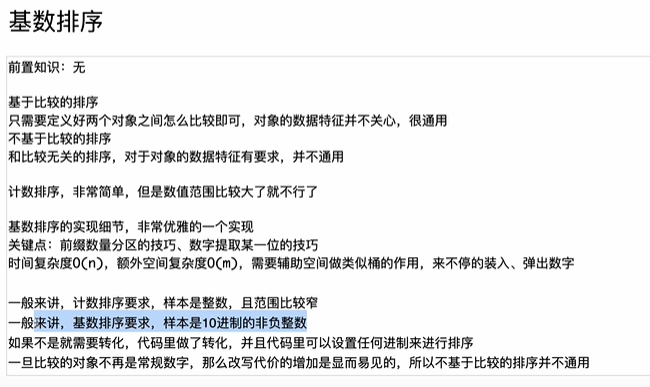
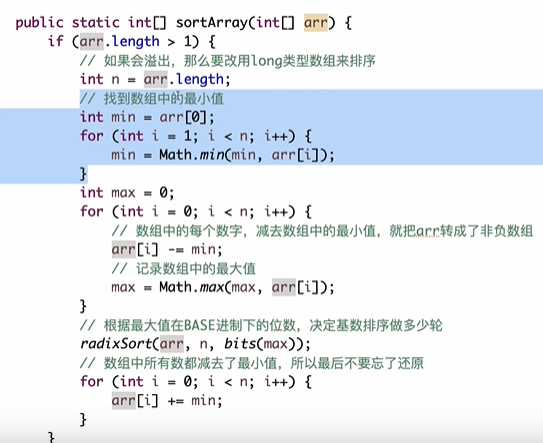
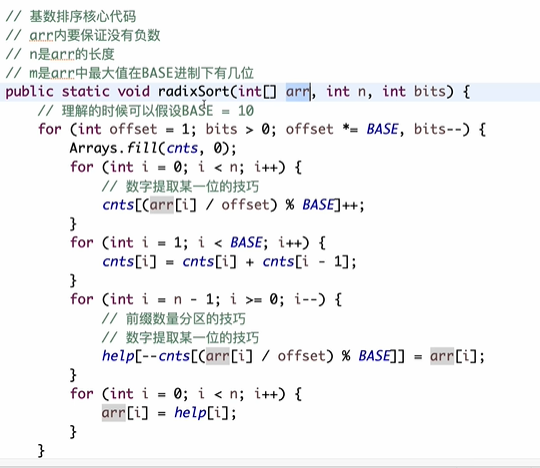
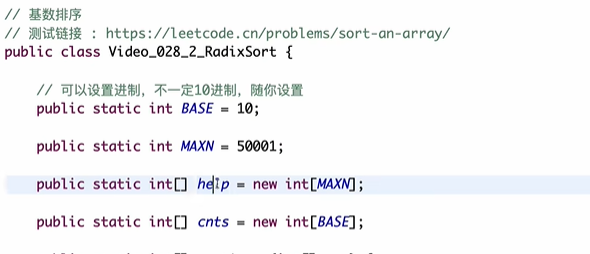
- 遇到负数,就将每个数都加数组中的负数的最大值的绝对值
#include <iostream>
#include <vector>
#include <algorithm>
#include <cmath> // 用于计算位数的log10函数

using std::cout;
using std::endl;
using std::vector;

class Solution
{
public:
    // 静态成员变量:BASE表示基数(10进制),MAXN作为help容器的最大初始容量
    static int BASE;
    static int MAXN;
    static vector<int> help;    // 基数排序的辅助数组
    static vector<int> cnts;    // 计数数组(长度等于BASE)

    // 核心排序函数:支持负数数组排序
    void sortArray(vector<int> &arr)
    {
        if (arr.empty() || arr.size() == 1) return; // 空数组/单元素直接返回

        // 1. 处理负数:将所有数转为非负数(减去最小值)
        int min_val = *std::min_element(arr.begin(), arr.end());
        for (int &elem : arr) {
            elem -= min_val; // 统一偏移,避免负数(这一步才是正确的偏移,而非lambda中修改)
        }

        // 2. 找到最大值,计算其位数(确定基数排序的轮次)
        int max_val = *std::max_element(arr.begin(), arr.end());
        int max_bits = getBits(max_val); // 计算最大位数

        // 3. 基数排序(处理非负数数组)
        radixSort(arr, max_bits);

        // 4. 还原偏移,恢复原数值
        for (int &elem : arr) {
            elem += min_val;
        }
    }

private:
    // 计算一个非负整数的位数(核心缺失函数)
    int getBits(int num) {
        if (num == 0) return 1; // 0的位数是1
        int bits = 0;
        while (num > 0) {
            bits++;
            num /= BASE;
        }
        return bits;
        // 也可以用数学方式:return static_cast<int>(log10(num)) + 1;(需包含<cmath>)
    }

    // 基数排序核心逻辑(arr为非负数数组,bits为最大位数)
    void radixSort(vector<int> &arr, int bits)
    {
        int n = arr.size();
        // 动态调整辅助数组大小,避免越界/浪费内存
        if (help.size() < n) {
            help.resize(n, 0);
        }
        // 计数数组长度固定为BASE(10),提前清空
        cnts.assign(BASE, 0);

        // 按每一位进行排序(从低位到高位)
        for (int offset = 1; bits > 0; offset *= BASE, bits--)
        {
            // 1. 统计当前位的数字出现次数
            std::fill(cnts.begin(), cnts.end(), 0); // 重置计数数组
            for (int i = 0; i < n; i++) {
                int digit = (arr[i] / offset) % BASE; // 获取当前位的数字
                cnts[digit]++;
            }

            // 2. 计算前缀和(确定每个数字的最后位置)
            // 正确的前缀和计算:从1开始,避免越界
            for (int i = 1; i < BASE; i++) {
                cnts[i] += cnts[i - 1];
            }

            // 3. 逆序遍历,保证稳定性
            for (int i = n - 1; i >= 0; i--) {
                int digit = (arr[i] / offset) % BASE;
                help[--cnts[digit]] = arr[i]; // 先减1再赋值,定位到正确位置
            }

            // 4. 复制回原数组
            for (int i = 0; i < n; i++) {
                arr[i] = help[i];
            }
        }
    }
};

// 静态成员变量初始化
int Solution::BASE = 10;                       // 10进制基数
int Solution::MAXN = 100000;                   // 辅助数组最大初始容量
vector<int> Solution::help(Solution::MAXN, 0); // 初始化为10万长度,后续动态调整
vector<int> Solution::cnts(Solution::BASE, 0); // 计数数组长度固定为BASE(10)

// 测试代码
int main() {
    Solution sol;
    vector<int> arr = {5, -2, 9, 1, -7, 3, 0};
    cout << "排序前:";
    for (int num : arr) {
        cout << num << " ";
    }
    cout << endl;

    sol.sortArray(arr);

    cout << "排序后:";
    for (int num : arr) {
        cout << num << " ";
    }
    cout << endl; // 输出:-7 -2 0 1 3 5 9

    return 0;
}
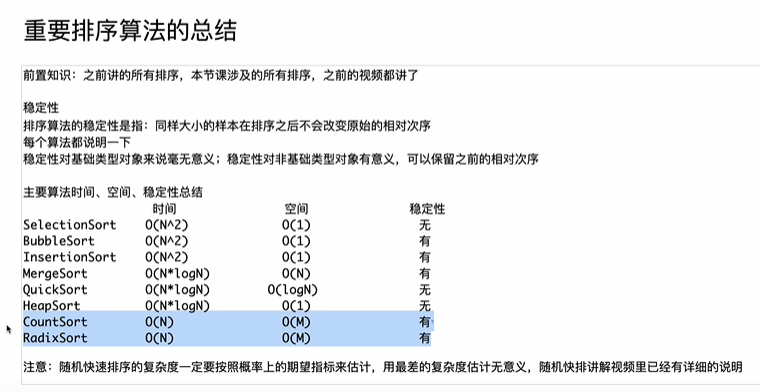
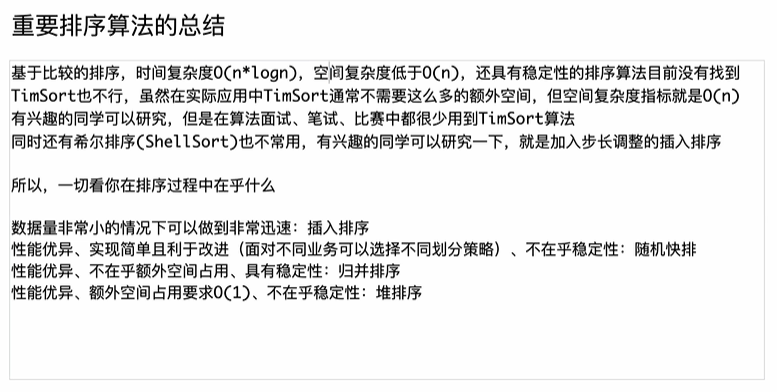
算法讲解029【必备】重要排序算法的总结
算法讲解030【必备】异或运算的骚操作
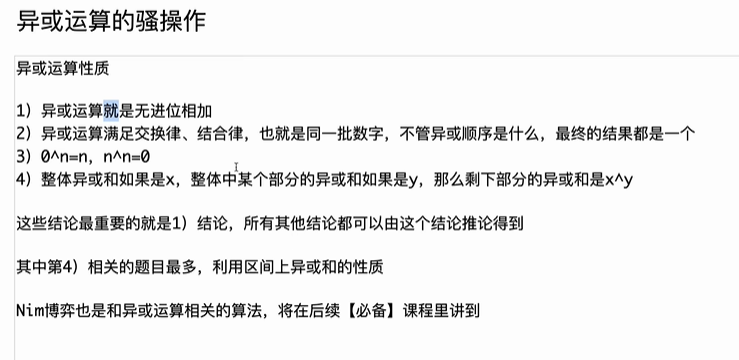
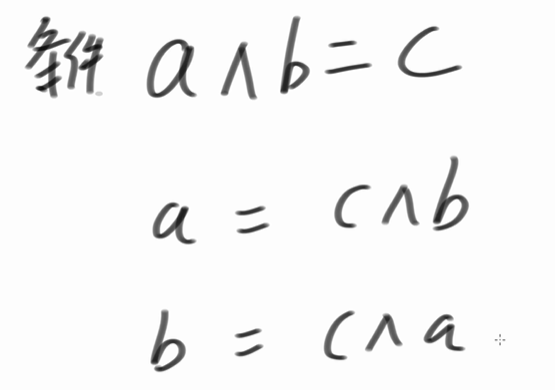
第四个运算的性质:
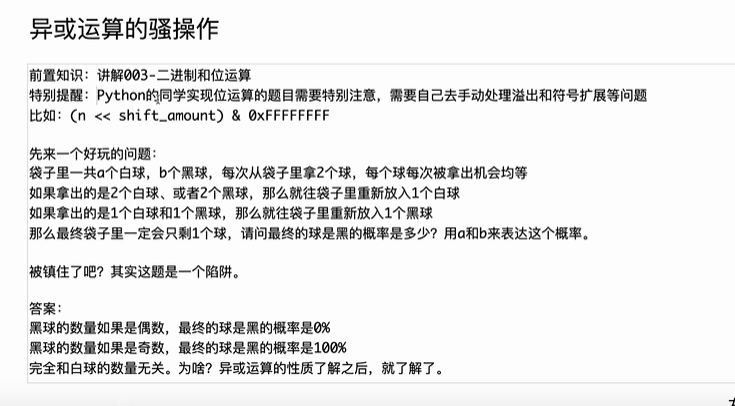
- 将白球看成0,黑球看成1
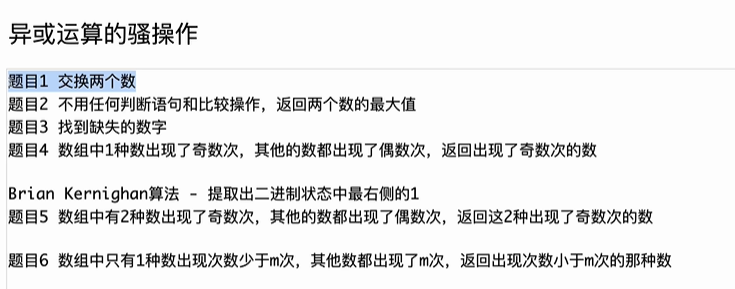
交换两个数
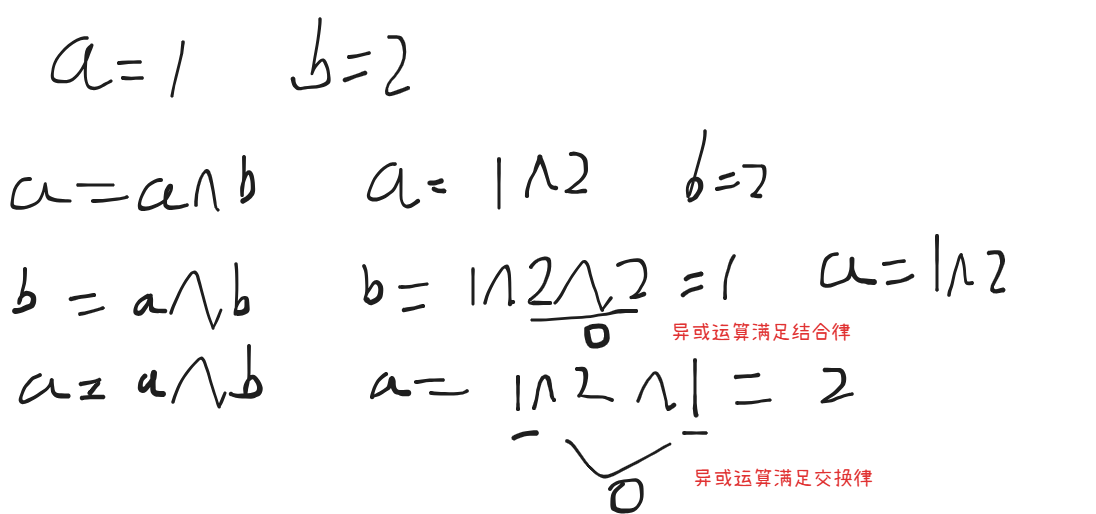
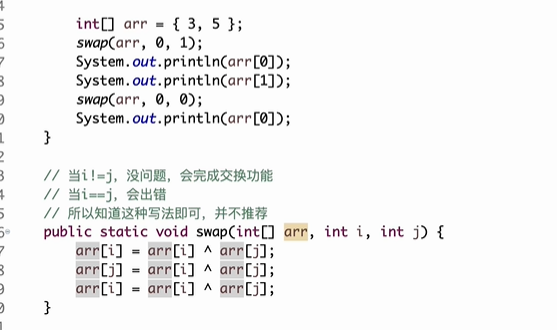
void swap(int &a, int &b)
{
    a = a ^ b;
    b = a ^ b;
    a = a ^ b;
}
易错:
求最大值
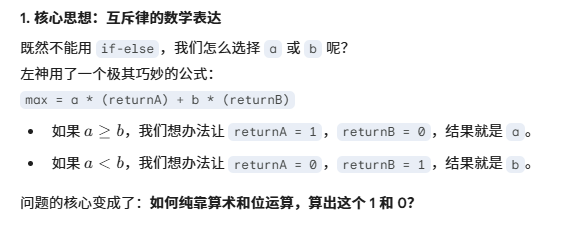
#include <iostream>
#include <vector>
#include <algorithm>
#include <cmath> // 用于计算位数的log10函数

using std::cout;
using std::endl;
using std::vector;

class Solution
{
public:
    // 翻转:1变0,0变1
    int flip(int n)
    {
        return n ^ 1;
    }

    // 提取符号:非负数(>=0)返回1,负数(<0)返回0
    int sign(int n)
    {
        // C++ 中必须转 unsigned 来模拟 Java 的 >>>
        // 注意C++中的右移都是有符号右移的
        // 有符号右移:正数补0,负数补1
        // 无符号右移:正数,负数都是补0
        // n转无符号右移31位:非负数变0,负数变1。然后再flip翻转。
        return flip((unsigned)n >> 31);
    }
    // 有溢出风险的实现
    /*
        假设 a 是非常大的正数(如 21亿),b 是非常小的负数(如 -21亿)。
    */
    int getMax1(int a, int b)
    {
        int c = a - b;
        // 如果 c 是非负数(a >= b),returnA 是 1
        // 如果 c 是负数(a < b),returnA 是 0
        int returnA = sign(c);
        int returnB = flip(returnA);
        return a * returnA + b * returnB;
    }

    // 没有任何问题的实现
    int getMax2(int a, int b)
    {
        int c = a - b;
        int sa = sign(a); // a的符号:a>=0为1,a<0为0
        int sb = sign(b); // b的符号
        int sc = sign(c); // c的符号

        // 判断A与B符号是否不一样:diff = 1 表示 a 和 b 符号不一致;diff = 0 表示符号一致
        int diff = sa ^ sb;

        // 判断A与B符号是否一样:same = 1 表示 a 和 b 符号一致;same = 0 表示符号不一致
        int same = flip(diff);

        // 核心决断:什么时候我们应该返回 a ?(即让 returnA = 1)
        //  diff * sa: 条件 1:a 和 b 符号不同 (diff == 1),且 a 是非负数 (sa == 1) -> 此时 a 肯定比 b 大
        // same * sc:  条件 2:a 和 b 符号相同 (same == 1),且 a - b >= 0 (sc == 1) -> 不会溢出,可以直接看 c 的符号
        // 这两个条件是互斥的,所以可以用加法代替逻辑或 (||)
        int returnA = diff * sa + same * sc;

        int returnB = flip(returnA); // a 不选,自然就选 b

        return a * returnA + b * returnB;
    }
};

int main()
{

    return 0;
}
找到缺失的数字

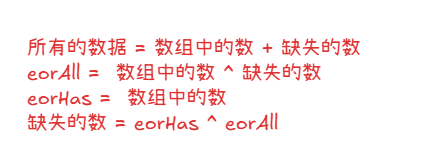
#include <iostream>
#include <vector>
#include <algorithm>
#include <cmath> // 用于计算位数的log10函数

using std::cout;
using std::endl;
using std::vector;

class Solution
{
public:
    int missingNumber(vector<int> &nums)
    {
        int eorAll = 0, eorHas = 0;
        for (int i = 0; i < nums.size(); i++)
        {
            eorAll ^= i;
            eorHas ^= nums[i];
        }
        eorAll ^= nums.size();
        return eorAll ^ eorHas;
    }
};
只出现一次的数字
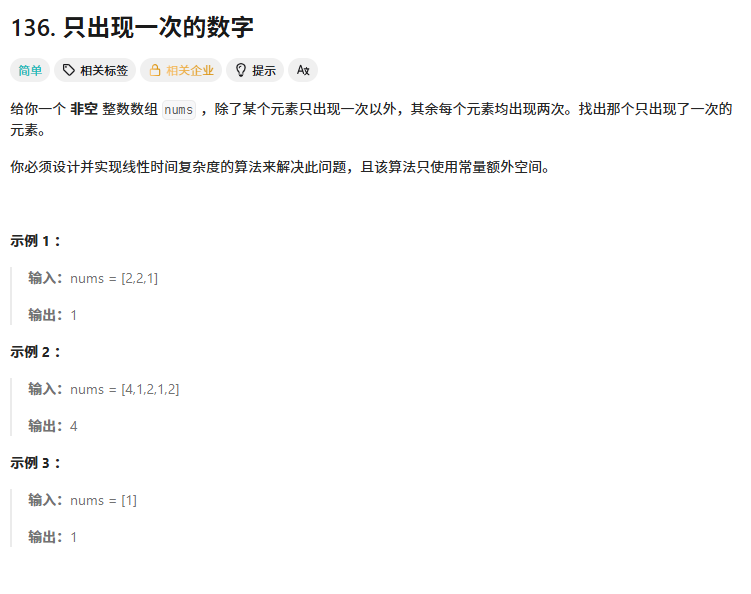
#include <iostream>
#include <vector>
#include <algorithm>
#include <cmath> // 用于计算位数的log10函数

using std::cout;
using std::endl;
using std::vector;

class Solution
{
public:
    int singleNumber(vector<int> &nums)
    {
        int eor = 0;

        for (int elem : nums)
        {
            eor ^= elem;
        }
        return eor;
    }
};
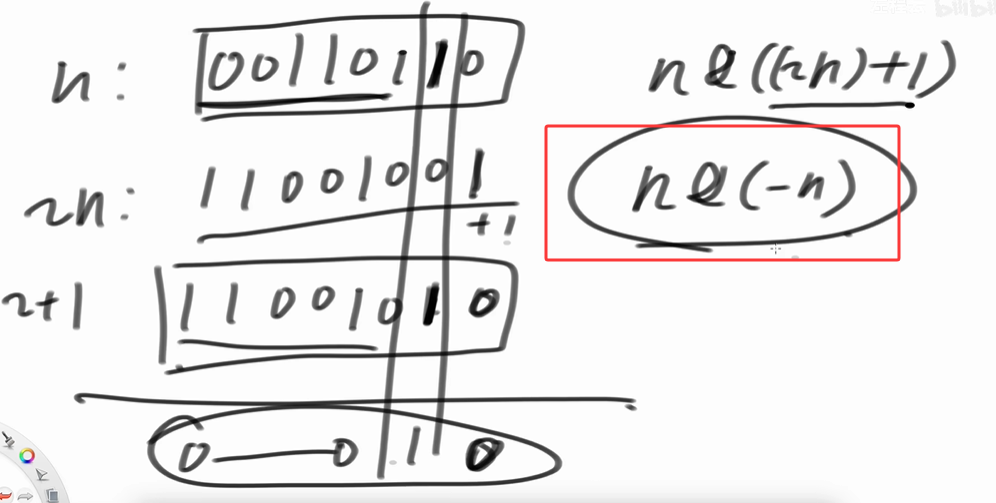
得到最右侧的1
只出现一次的数字III
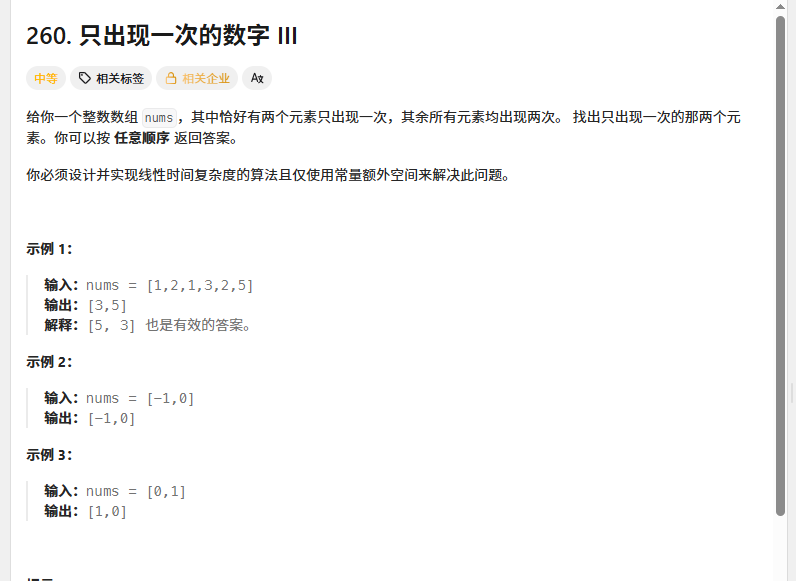

#include <iostream>
#include <vector>
#include <algorithm>
#include <cmath> // 用于计算位数的log10函数(注:此处实际未使用)

using std::cout;
using std::endl;
using std::vector;

class Solution
{
public:
    vector<int> singleNumber(vector<int> &nums)
    {
        // 第一步:计算所有数的异或结果,最终得到 a ^ b
        int eor1 = 0;
        for (int num : nums)
        {
            eor1 ^= num;
        } // eor1 = a^b

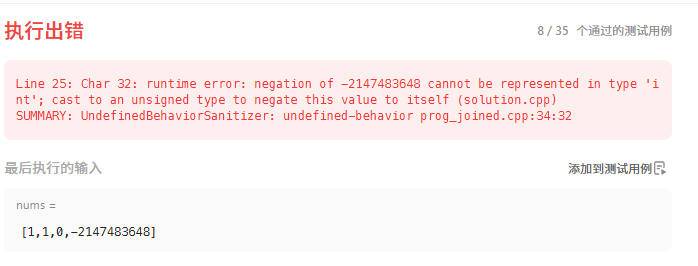
        // 关键修复:转换为unsigned int避免溢出,再提取最右侧的1
        unsigned int u_eor1 = static_cast<unsigned int>(eor1);
        // 关键操作:提取eor1二进制中最右侧的1,a与b这一位一定是不同的
        // 原理:负数在计算机中以补码形式存在(原码取反+1)
        // 例如:6(0110) 的负数是 -6(1010),6 & -6 = 2(0010)
        unsigned int rightOne = u_eor1 & (-u_eor1);
        // 转回int不影响位判断,仅用于与num(int)做按位与
        // 第二步:根据rightOne位将数组分组异或
        int mask = static_cast<int>(rightOne);

        int eor2 = 0;
        for (int num : nums)
        {
            // 筛选出该位为0的数,异或后得到其中一个目标数
            // 根据这一位分为包含a的集合(a的个数为奇数,其余数的个数为偶数),包含b的集合
            if ((mask & num) == 0)
                eor2 ^= num; // 其中的一个集合异或之后就是a或者b
        }

        // eor1 = a ^ b,所以另一个数 = eor1 ^ eor2
        vector<int> res{eor2, eor1 ^ eor2};
        return res;
    }
};

//
只出现一次的数字II
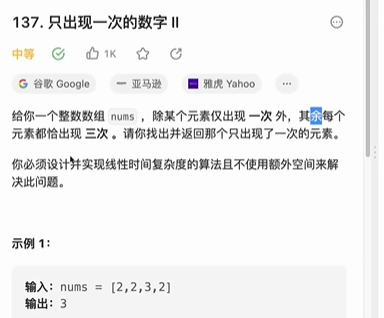
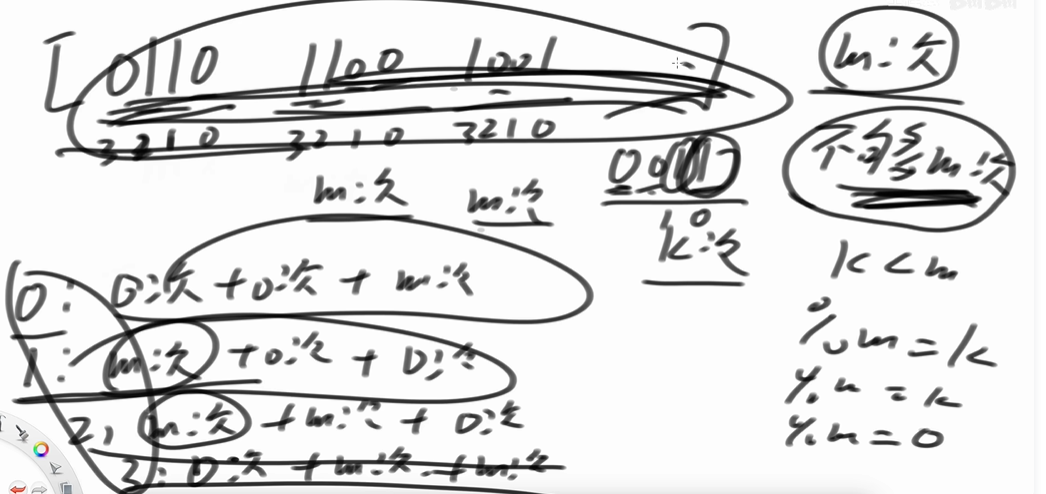
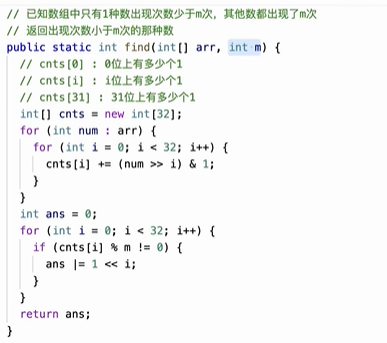
#include <iostream>
#include <vector>
#include <algorithm>
#include <cmath> // 用于计算位数的log10函数(注:此处实际未使用)

using std::cout;
using std::endl;
using std::vector;

class Solution
{
public:
    int singleNumber(vector<int> &nums)
    {
        return find(nums, 3);
    }

    int find(vector<int> &nums, int m)
    {
        // cnt[i]:第i位有多少个1
        vector<int> cnts(32, 0);
        for (int num : nums)
        {
            for (int i = 0; i < 32; i++)
            {
                cnts[i] += (num >> i) & 1;
            }
        }
        int ans = 0;

        for (int i = 0; i < 32; i++)
        {
            if (cnts[i] % m != 0) // 第i位上有1
            {
                ans |= (1 << i); // 将1左移i位,或上ans第i位上的0,将其赋为1
            }
        }
        return ans;
    }
};
算法讲解031【必备】位运算的骚操作
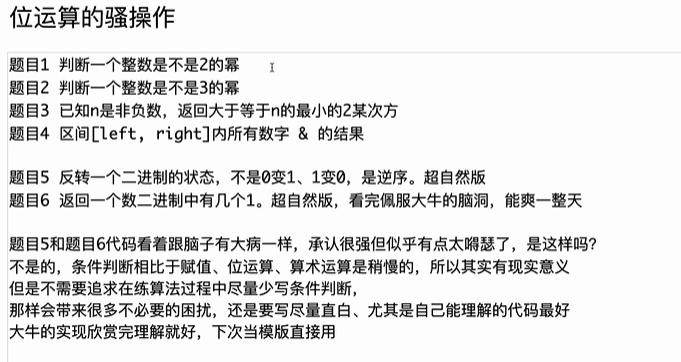
2的幂的判断
思想是,二进制位只有一个1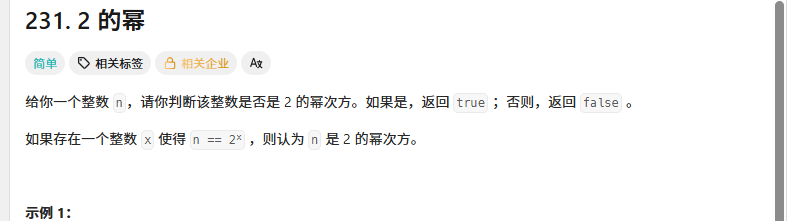
#include <iostream>
#include <vector>
#include <algorithm>
#include <cmath> // 用于计算位数的log10函数(注:此处实际未使用)

using std::cout;
using std::endl;
using std::vector;

class Solution
{
public:
    bool isPowerOfTwo(int num)
    {
        return num > 0 && (num & (-num)) == num;
    }
};
3的幂的判断
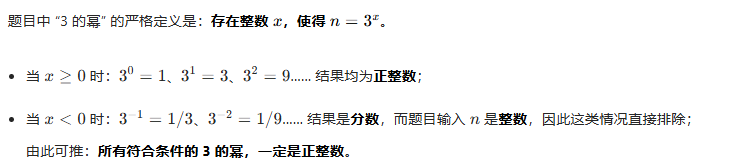
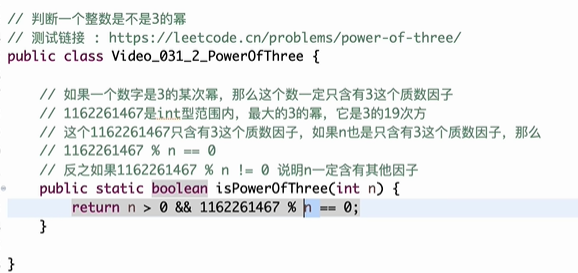
def isPowerOfThree(n):
    # 前置判断:排除0和负数
    if n <= 0:
        return False
    # 循环除以3,直到无法整除
    while n % 3 == 0:
        n = n // 3  # 用整数除法,避免浮点数精度问题
    # 最终只剩1则是3的幂
    return n == 1
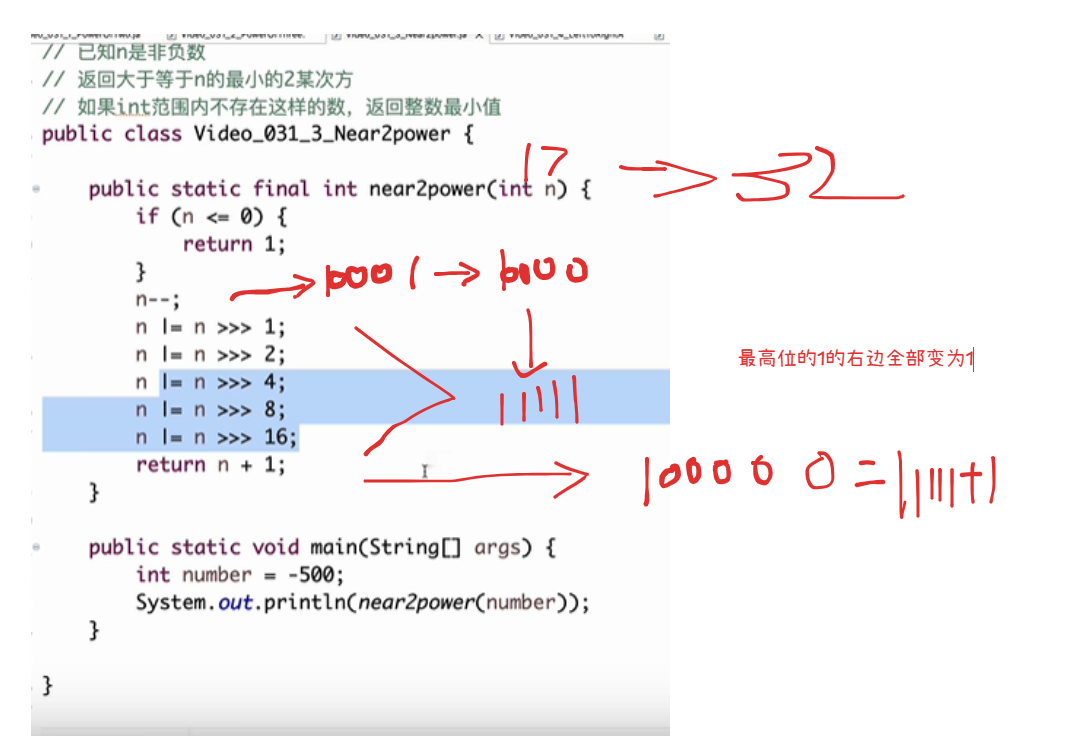
返回最小2次幂
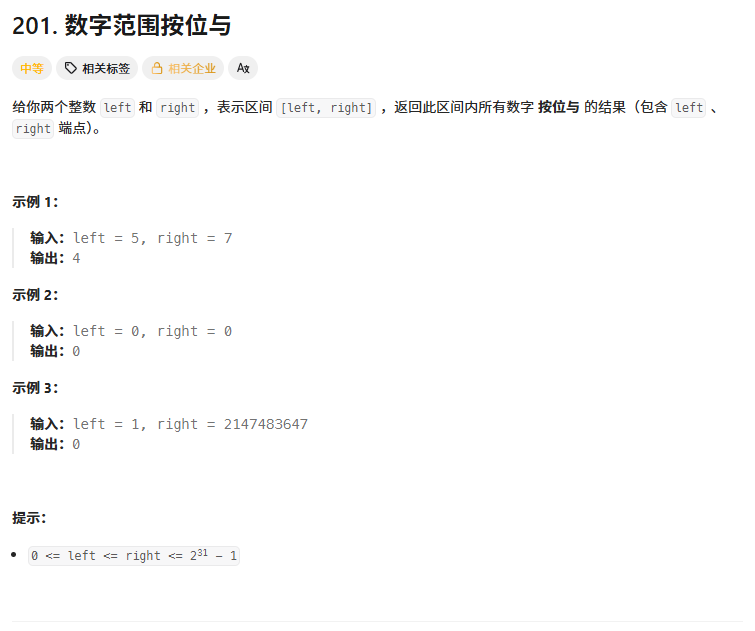
数字范围按位与
暴力
class Solution {
public:
    int rangeBitwiseAnd(int left, int right) {
        if (left == right)
            return left;
        int res = left;
        // 循环条件改为 left < right,避免多算 right+1
        while (left < right) {
            left++; // 先自增到下一个数
            res &= left; // 再按位与
        }
        return res;
    }
};
按位与
// right &(right-1)实际上就是减去right二进制位中的1,所以下面的时间复杂度就是进行right的位数次
class Solution {
public:
    int rangeBitwiseAnd(int left, int right) {
        while (left < right) {
            right -= (right & -right);
        }
        return right;
    }
};
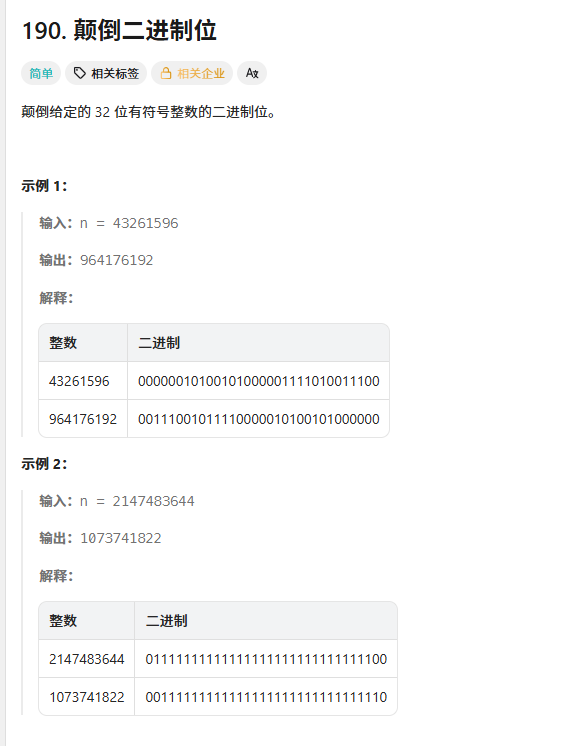
反转二进制的状态(逆序)
#include <cstdint> // 用于uint32_t类型
class Solution {
public:
    uint32_t reverseBits(uint32_t n) { // 用uint32_t表示32位无符号整数
        uint32_t res = 0;
        // 必须循环32次,确保处理所有位(包括0)
        for (int i = 0; i < 32; ++i) {
            // 1. 取出n的最低位(原数的第i位)
            uint32_t bit = n & 1;
            // 2. 将该位放到res的对应反转位置(31-i位)
            res |= (bit << (31 - i));
            // 3. n右移1位,处理下一位
            n >>= 1;
        }
        return res;
    }
};
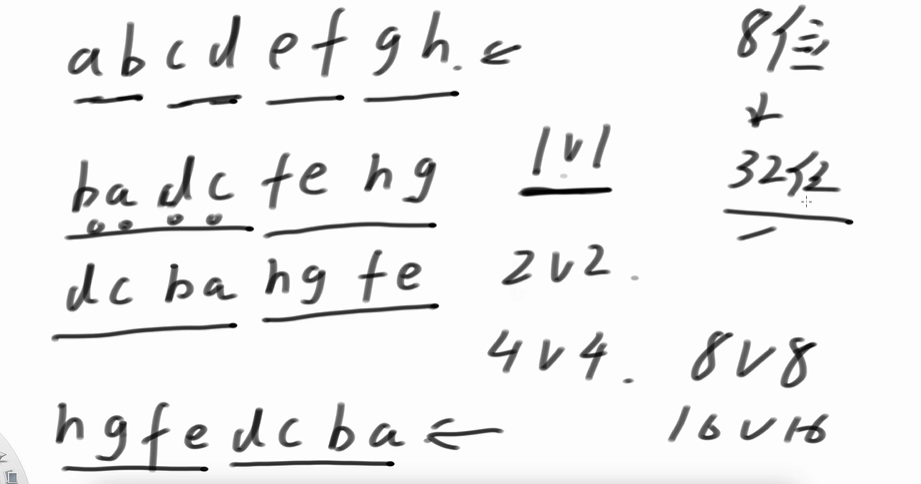
大牛思路
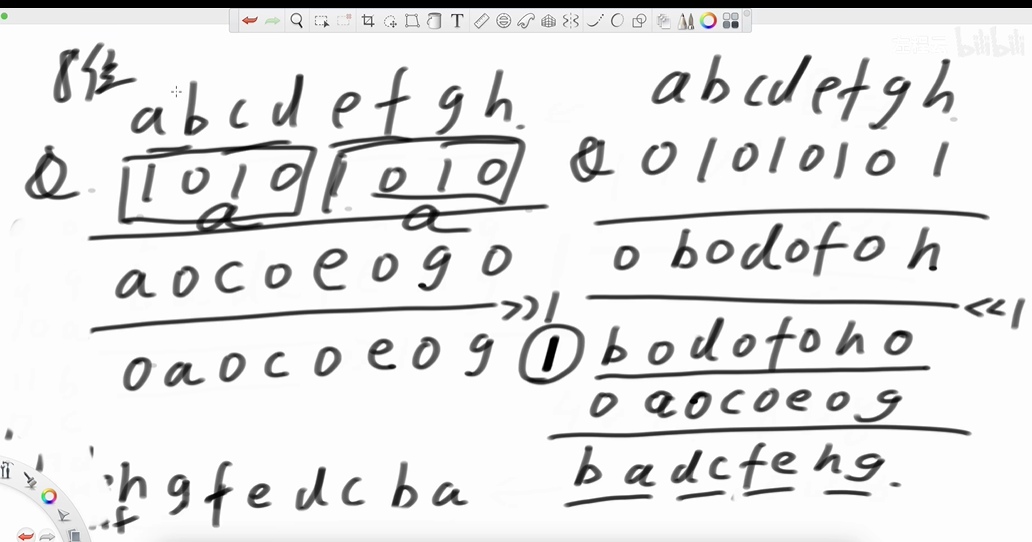
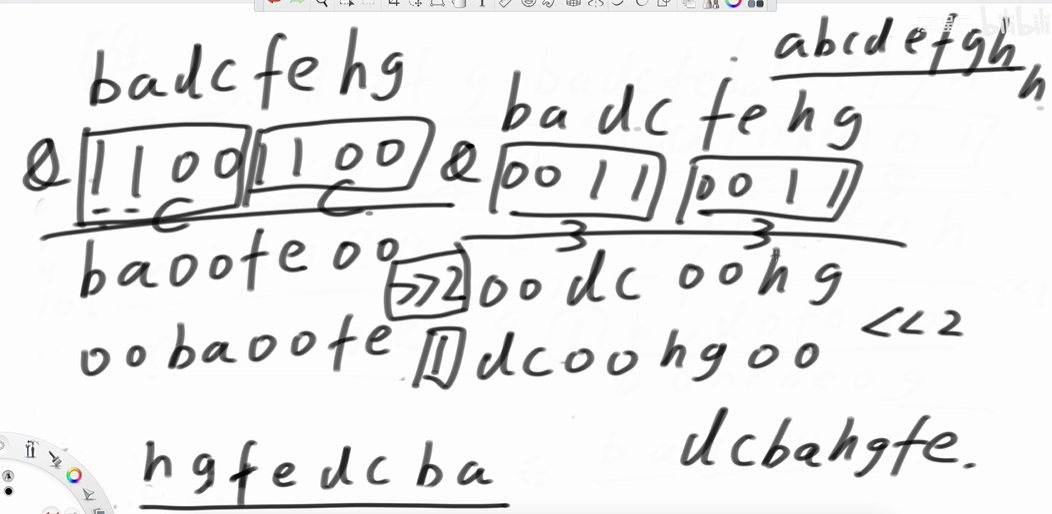
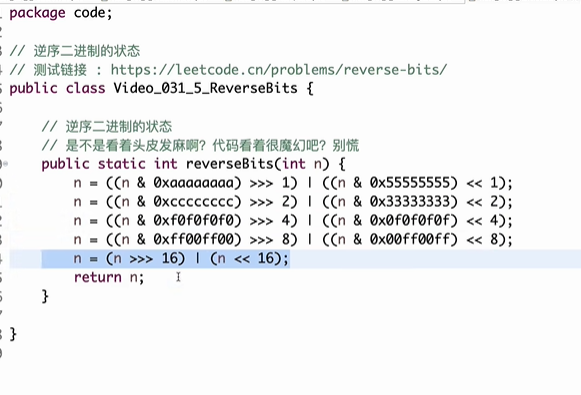
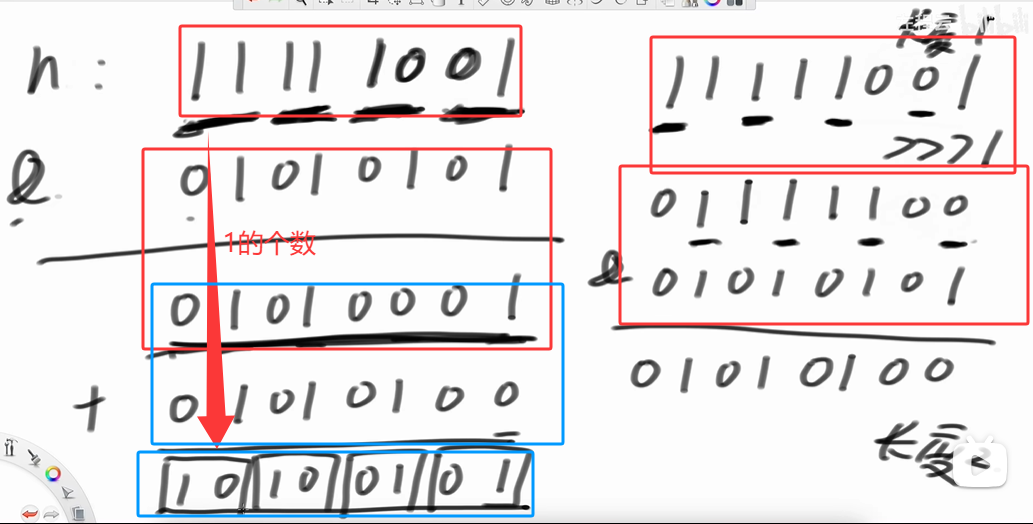
返回n的二进制中1的个数
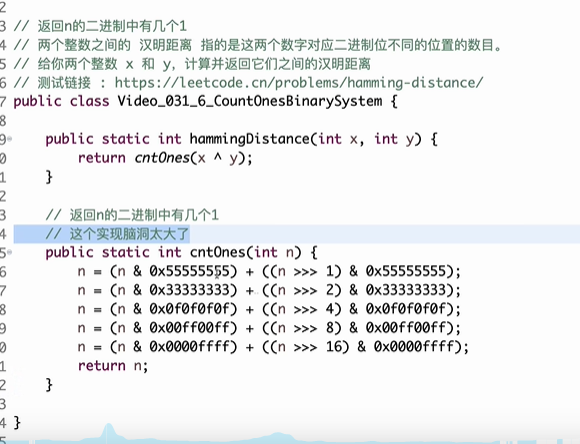
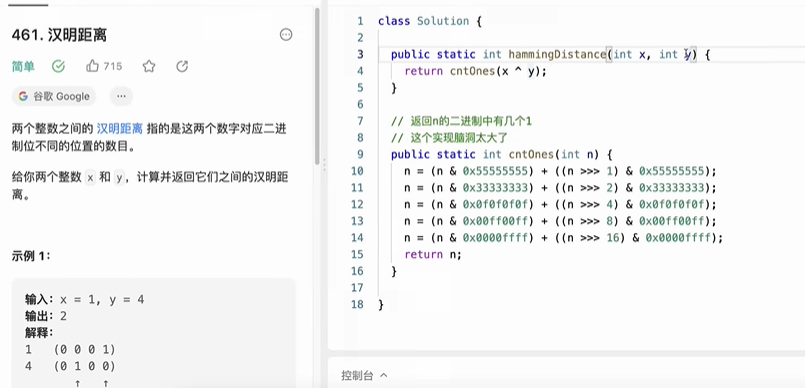
算法讲解032【必备】位图
#include <iostream>
#include <vector>
#include <algorithm>
#include <cmath> // 用于计算位数的log10函数(注:此处实际未使用)

using std::cout;
using std::endl;
using std::vector;

class Bitset
{
public:
    Bitset(int n)
    {
        // a/b 如果结果想向上取整,可以写成:(a+b-1)/b  前提:a和b都是非负数
        set.resize((n + 31) / 32);
    }

    void add(int num)
    {
        set[num / 32] != 1 << (num % 32);
    }

    void remove(int num)
    {
        set[num / 32] &= ~(1 << (num % 32));
    }

    void reverse(int num)
    {
        set[num / 32] ^= 1 << (num % 32);
    }

    bool contains(int num)
    {
        return ((set[num / 32] >> (num % 32)) & 1) == 1;
    }

private:
    vector<int> set;
};
算法讲解033【必备】位运算实现加减乘除
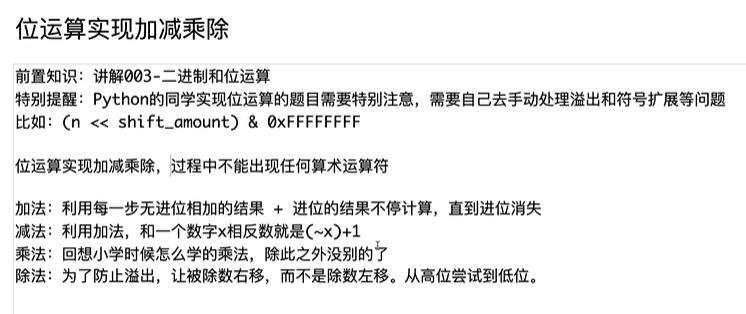
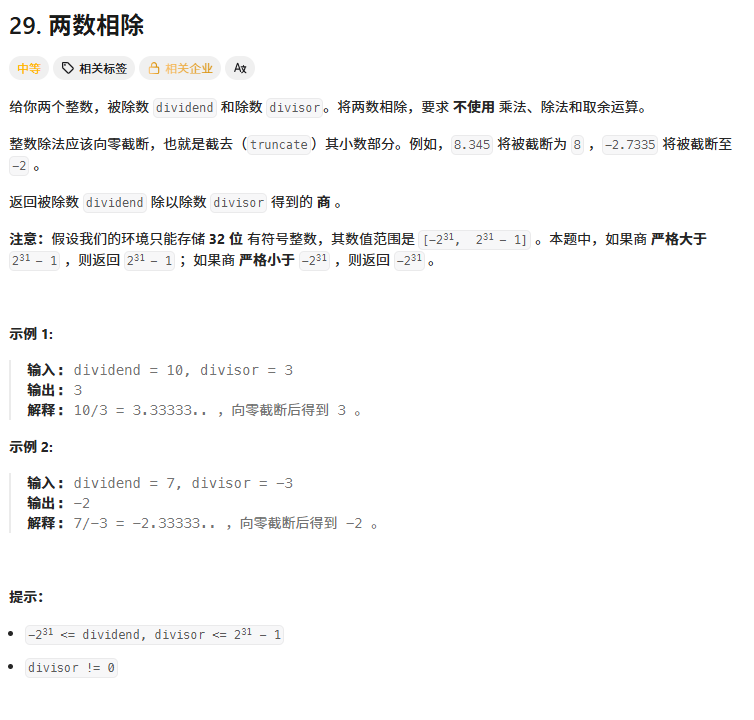
#include <iostream>
#include <vector>
#include <algorithm>
#include <cmath> // 用于计算位数的log10函数(注:此处实际未使用)

using std::cout;
using std::endl;
using std::vector;

//  注意这里不能出现 +,-符号
class Bitset
{
public:
    //  位运算的加法: 先无进位相加(异或),再相与并左移1位,不断重复以上步骤指导与的结果为0
    int add(int a, int b)
    {
        int ans = 0;
        while (b != 0)
        {
            ans = a ^ b;      // 无进位的结果
            b = (a & b) << 1; // 进位的结果
            a = ans;
        }
        return ans;
    }

    //  求一个数的相反数: 这个数取反+1
    int neg(int n)
    {
        return add(~n, 1);
    }
    int sub(int a, int b)
    {

        return add(a, neg(b));
    }

    int mul(int a, int b)
    {
        int ans = 0;
        while (b != 0)
        {
            if ((b & 1) != 0) // 当前需要加a吗
            {
                ans = add(ans, a);
            }
            a <<= 1;                  // a左移
            b = (unsigned int)b >> 1; // 无符号向右移动
        }
        return ans;
    }

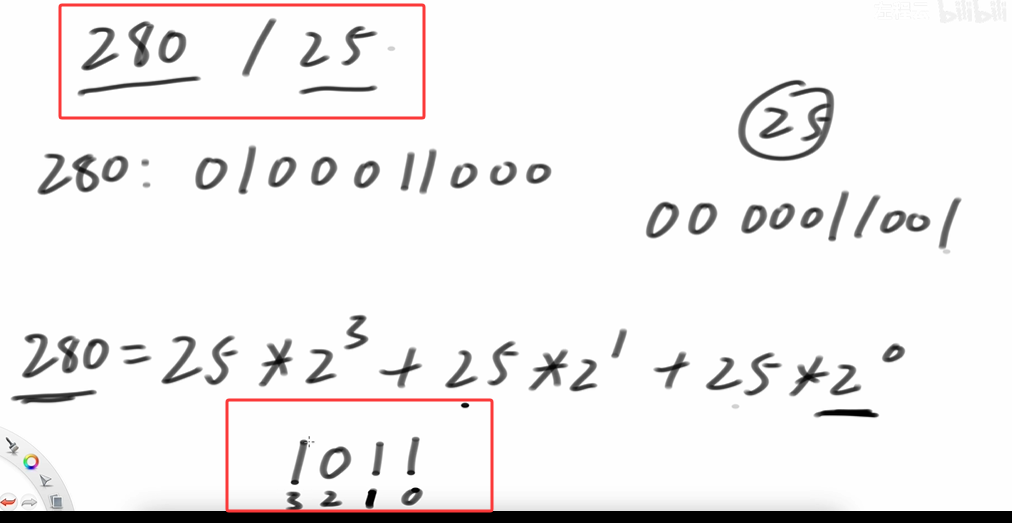
    // 除法的完整运算
    int Div(int a, int b)
    {
        int MIN = INT32_MAX;
        if (a == MIN && b == MIN)
        {
            return 1;
        }

        if (a != MIN && b != MIN)
        {
            return div(a, b);
        }

        if (b == MIN)
            return 0;
        if (b == neg(1))
        {
            return INT32_MAX;
        }

        // a是整数最小,b不是整数最小,b也不是-1,a不能转化为其绝对值 a < 0 ? neg(a) : a;
        a = add(a, b > 0 ? b : neg(b)); // 此时a就不是整数最小了
        int ans = div(a, b);
        int offset = b > 0 ? neg(1) : 1;
        return add(ans, offset);
    }
    // 必须保证a和b都不是整数的最小值,因为整数最小值转化不了其绝对值的形式,neg
    int div(int a, int b)
    {
        int x = a < 0 ? neg(a) : a;
        int y = b < 0 ? neg(b) : a;
        int ans = 0;

        for (int i = 30; i >= 0; i = sub(i, 1))
        {
            if ((x >> i) >= y) // 注意这里是x右移i位,因为y左移30位可能会溢出
            {
                ans != (1 << i);
                x = sub(x, y << i);
            }
        }
        return a < 0 ^ b < 0 ? neg(ans) : ans;
    }
};
整数最小值不能求其绝对值。
算法讲解034【必备】链表高频题目和必备技巧
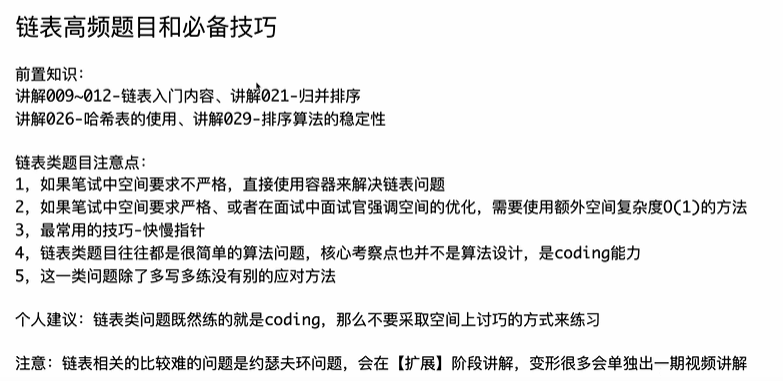
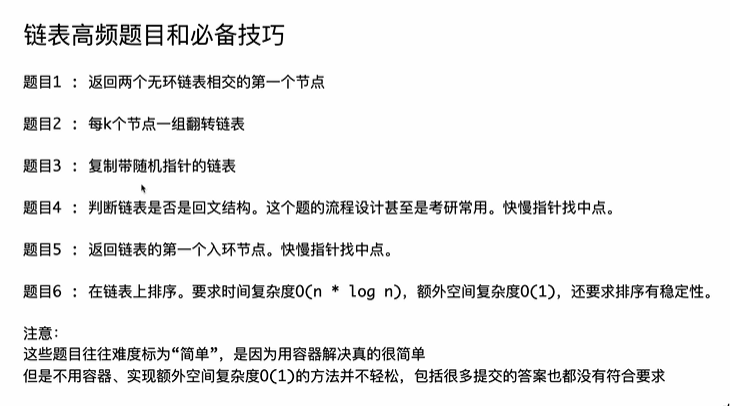
相交链表
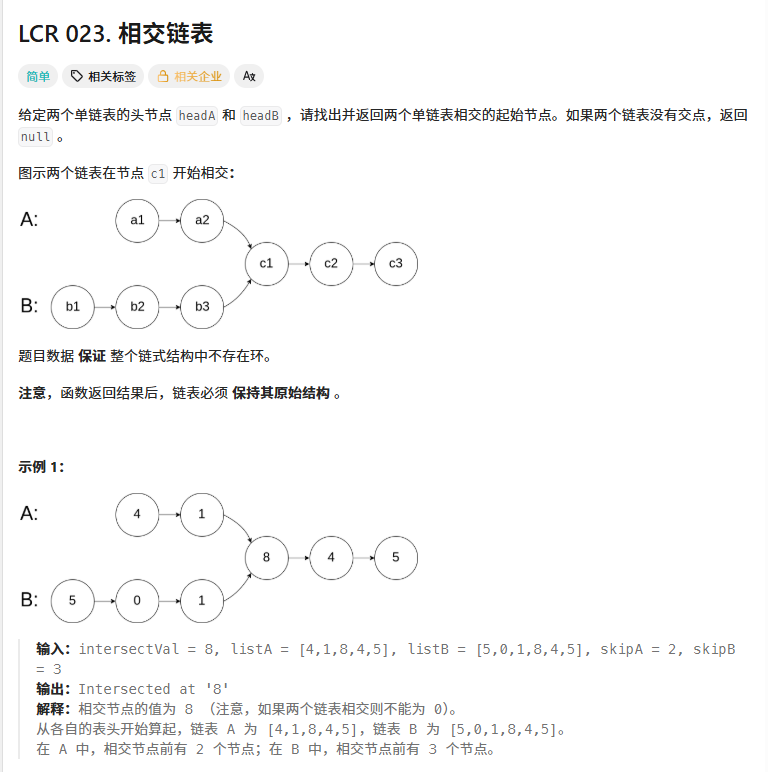
暴力法
class Solution
{
public:
    ListNode *getIntersectionNode(ListNode *headA, ListNode *headB)
    {
        for (ListNode *p1 = headA; p1 != nullptr; p1 = p1->next)
        {
            for (ListNode *p2 = headB; p2 != nullptr; p2 = p2->next)
            {
                if (p1 == p2)
                    return p1;
            }
        }
        return nullptr;
    }
};
快慢指针
class Solution
{
public:
    // 让指针最长的链表上先走节点数量差异个步数
    // 然后两个指针同时走,相交的节点一定会相遇,不相交的a会走到null
    ListNode *getIntersectionNode(ListNode *headA, ListNode *headB)
    {
        if (headA == nullptr || headB == nullptr)
            return nullptr;
        ListNode *a = headA;
        ListNode *b = headB;
        int diff = 0;
        while (a)
        {
            a = a->next;
            diff++;
        }

        while (b)
        {
            b = b->next;
            diff--;
        }
        // 下面统一:a是最长的节点
        if (diff > 0)
        {
            a = headA;
            b = headB;
        }
        else
        {
            diff = -diff;
            a = headB;
            b = headA;
        }
        // 长链表a先走diff步
        while (diff-- > 0)
        {
            a = a->next;
        }

        while (a != b)
        {
            a = a->next;
            b = b->next;
        }

        return a;
    }
};
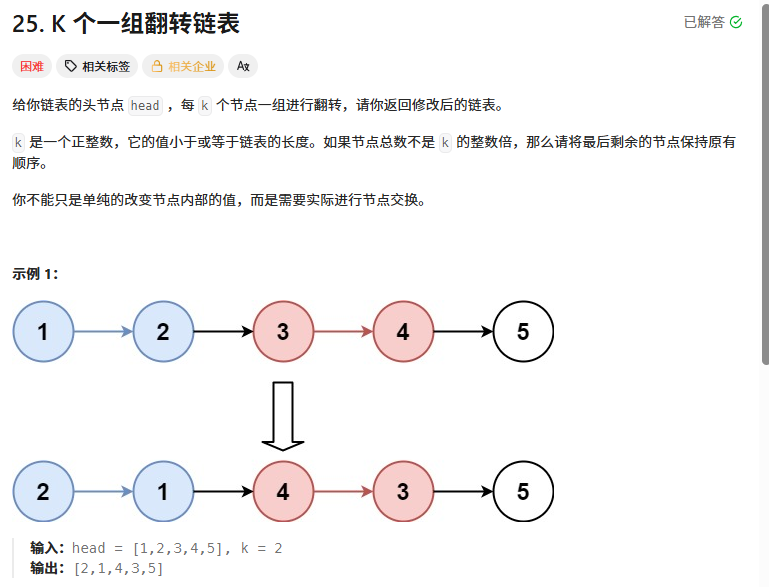
k个一组翻转链表
#include <iostream>
#include <vector>
#include <algorithm>
#include <cmath>

using std::cout;
using std::endl;
using std::vector;

struct ListNode
{
    int val;
    ListNode *next;
    ListNode(int x) : val(x), next(NULL) {}
};

class Solution
{
public:
    ListNode *reverseKGroup(ListNode *head, int k)
    {
        ListNode *start = head;
        ListNode *end = teamEnd(start, k);
        if (end == nullptr)
            return head;

        // 第一组很特殊,因为牵扯到换头的问题
        head = end;
        reverse(start, end);
        // 翻转之后start变成上一组的结尾节点
        ListNode *lastTeamEnd = start;
        while (lastTeamEnd->next != nullptr)
        {
            start = lastTeamEnd->next;
            end = teamEnd(start, k);
            if (end == nullptr)
                return head;
            reverse(start, end);
            lastTeamEnd->next = end;
            lastTeamEnd = start;
        }
        return head;
    }

    // 当前组的开始节点是s,往下数k个找到当前组的结束节点返回
    ListNode *teamEnd(ListNode *s, int k)
    {
        while (--k != 0 && s != nullptr)
            s = s->next;
        return s;
    }
    //  1-》2-》3-》4-》5-》6 其中s=1 e=3
    //  3-》2-》1-》4-》5-》6
    void reverse(ListNode *s, ListNode *e)
    {
        e = e->next;
        ListNode *pre = nullptr, *cur = s, *next = nullptr;
        while (cur != e)
        {
            next = cur->next;
            cur->next = pre;
            pre = cur;
            cur = next;
        }
        s->next = e;
    }
};
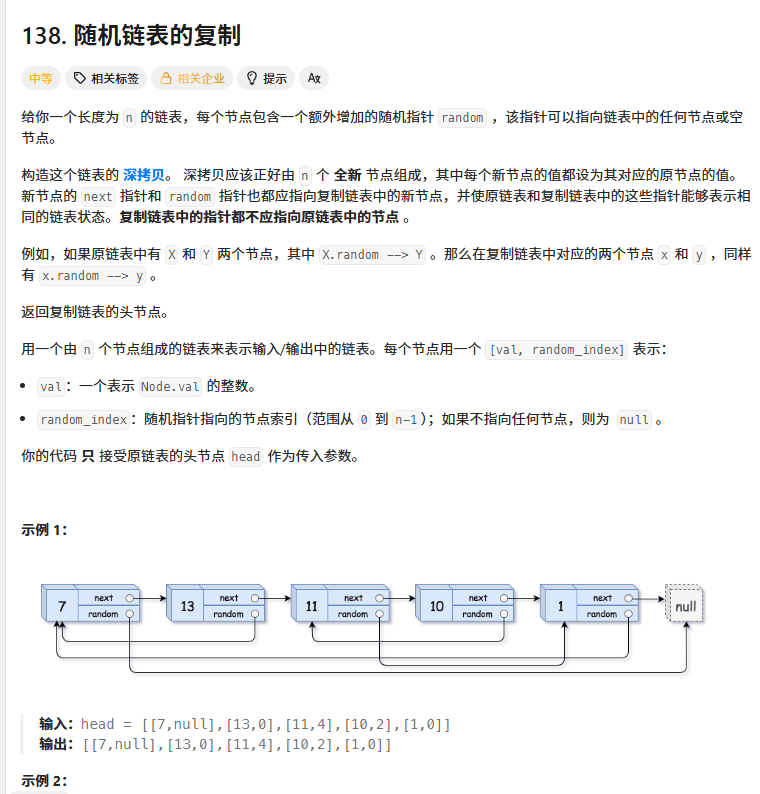
随机链表的复制
容器的方法
class Solution
{
public:
    Node *copyRandomList(Node *head)
    {
        if (head == nullptr)
            return nullptr;

        // 建立原节点 -> 新节点的映射
        std::map<Node *, Node *> old_new;
        Node *cur = head;

        // 第一步:先复制所有节点的值,建立映射关系(只创建节点,不处理指针)
        while (cur != nullptr)
        {
            old_new[cur] = new Node(cur->val);
            cur = cur->next;
        }

        // 第二步:处理 next 和 random 指针
        cur = head;
        while (cur != nullptr)
        {
            // 新节点的 next 指向 原节点next 对应的新节点
            // old_new[cur]是目前cur在新链表中所对应的节点
            old_new[cur]->next = old_new[cur->next];
            // 新节点的 random 指向 原节点random 对应的新节点
            old_new[cur]->random = old_new[cur->random];
            cur = cur->next;
        }

        // 返回新链表的头节点
        return old_new[head];
    }
};
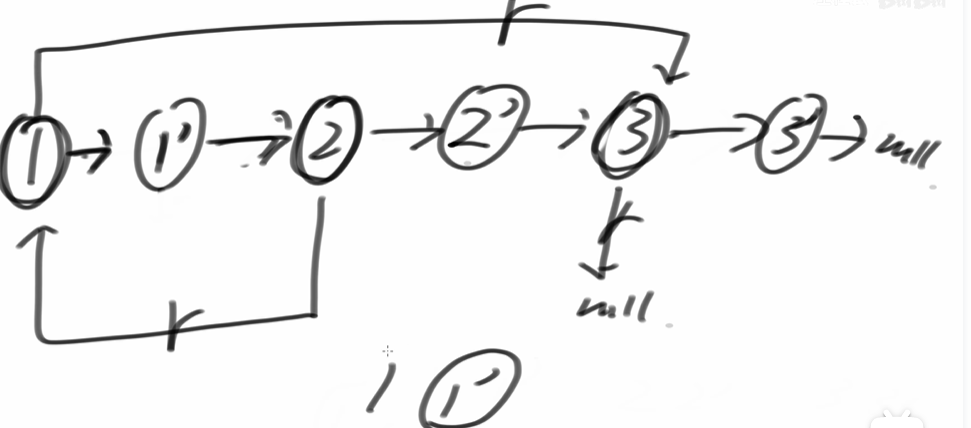
非容器方法
class Solution
{
public:
    Node *copyRandomList(Node *head)
    {
        if (head == nullptr)
            return nullptr;

        Node *cur = head;
        Node *next = nullptr;

        // 第一步:复制节点并插入到原节点后面(原1->复1->原2->复2)
        while (cur != nullptr)
        {
            next = cur->next;                   // 保存原节点的下一个节点
            Node *newNode = new Node(cur->val); // 创建复制节点
            cur->next = newNode;                // 原节点指向复制节点
            newNode->next = next;               // 复制节点指向原节点的下一个节点
            cur = next;                         // 移动到下一个原节点
        }

        // 第二步:设置复制节点的random指针
        cur = head;
        while (cur != nullptr)
        {
            next = cur->next; // next 是当前原节点对应的复制节点
            // 关键:先判断原节点的random是否为空,避免空指针访问
            if (cur->random != nullptr)
            {
                // 复制节点的random = 原节点random的下一个节点(即原random的复制节点)
                next->random = cur->random->next;
            }
            else
            {
                next->random = nullptr; // 原节点random为空,复制节点也为空
            }
            cur = next->next; // 移动到下一个原节点
        }

        // 第三步:拆分链表,提取复制节点形成新链表
        cur = head;
        Node *newHead = head->next; // 新链表的头节点是第一个复制节点
        Node *newCur = newHead;     // 遍历新链表的指针

        while (cur != nullptr)
        {
            next = cur->next;       // next 是当前原节点的复制节点
            cur->next = next->next; // 恢复原链表的next指针(原节点指向原节点)
            cur = cur->next;        // 移动到下一个原节点

            // 处理复制节点的next:如果不是最后一个复制节点,指向后续复制节点
            if (cur != nullptr)
            {
                newCur->next = cur->next;
            }
            else
            {
                newCur->next = nullptr; // 最后一个复制节点的next置空
            }
            newCur = newCur->next; // 移动到下一个复制节点
        }

        return newHead;
    }
};
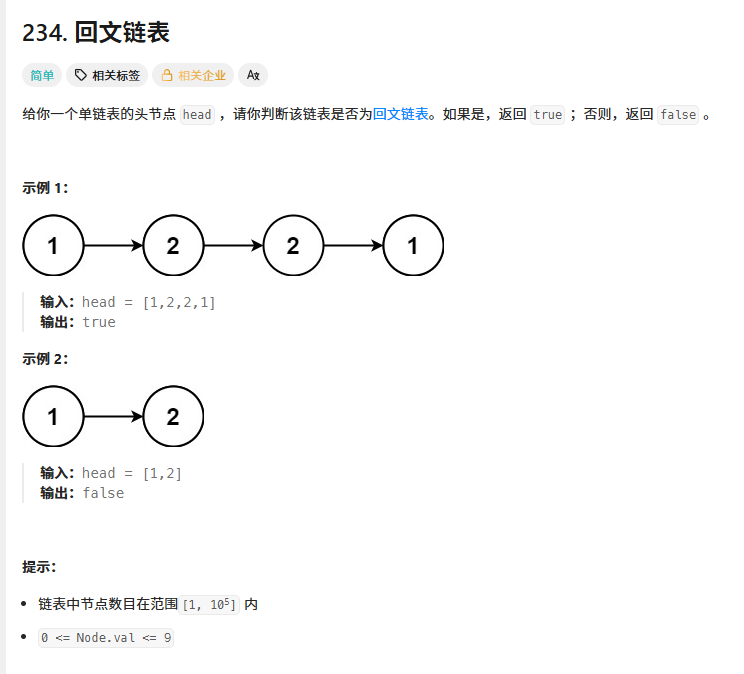
判断链表是否是回文结构
容器的方法
- 两次遍历,栈和第二次遍历比较
class Solution
{
public:
    bool isPalindrome(ListNode *head)
    {
        if (head == nullptr)
            return true;
        std::stack<ListNode *> sta;
        ListNode *ptr = head;
        while (ptr)
        {
            sta.push(ptr);
            ptr = ptr->next;
        }
        ptr = head;
        while (!sta.empty())
        {
            ListNode *elem = sta.top();
            sta.pop();
            if (elem->val != ptr->val)
                return false;
            ptr = ptr->next;
        }
        return true;
    }
};
快慢指针
- 技巧:两个指针同时从头节点出发,快指针每次走两步,慢指针每次走一步,当快指针到达终点的时候,慢指针到达中间节点
#include <iostream>
#include <stack>
using std::cout;
using std::endl;

// 首先定义ListNode结构体(链表节点)
struct ListNode
{
    int val;
    ListNode *next;
    ListNode() : val(0), next(nullptr) {}
    ListNode(int x) : val(x), next(nullptr) {}
    ListNode(int x, ListNode *next) : val(x), next(next) {}
};

class Solution
{
public:
    /*
        1. 快慢指针,慢指针到达中点(前半段最后一个节点)
        2. 反转后半段链表
        3. 两端指针向中间节点开始比较
        4. 恢复原链表
    */
    bool isPalindrome(ListNode *head)
    {
        if (head == nullptr || head->next == nullptr)
            return true; // 空链表或单个节点都是回文

        ListNode *slow = head, *fast = head;
        // 1. 快慢指针找中点(慢指针停在左半段最后一个节点)
        // 循环条件:fast->next != nullptr && fast->next->next != nullptr
        // 这样能保证:
        // - 偶数长度:slow停在第n/2个节点(左半段最后一个)
        // - 奇数长度:slow停在中间节点的前一个
        while (fast->next != nullptr && fast->next->next != nullptr)
        {
            slow = slow->next;
            fast = fast->next->next;
        }

        // 2. 反转后半段链表(从slow->next开始)
        ListNode *second_half_head = reverseList(slow->next);
        ListNode *second_half_copy = second_half_head; // 保存反转后的头,用于恢复

        // 3. 两端指针向中间比较
        ListNode *left = head;
        ListNode *right = second_half_head;
        bool is_pal = true;
        while (right != nullptr) // 后半段更短(奇数长度时),用right作为终止条件
        {
            if (left->val != right->val)
            {
                is_pal = false;
                break; // 发现不相等,提前退出,但仍要恢复链表
            }
            left = left->next;
            right = right->next;
        }

        // 4. 恢复原链表(关键:避免修改原链表结构)
        slow->next = reverseList(second_half_copy);

        return is_pal;
    }

private:
    // 辅助函数:反转链表(经典迭代法)并且返回新链表的头节点
    ListNode *reverseList(ListNode *head)
    {
        ListNode *prev = nullptr;
        ListNode *curr = head;
        while (curr != nullptr)
        {
            ListNode *next_temp = curr->next; // 保存下一个节点
            curr->next = prev;                // 反转当前节点指针
            prev = curr;                      // prev后移
            curr = next_temp;                 // curr后移
        }
        return prev; // 反转后的头节点
    }
};
考研题
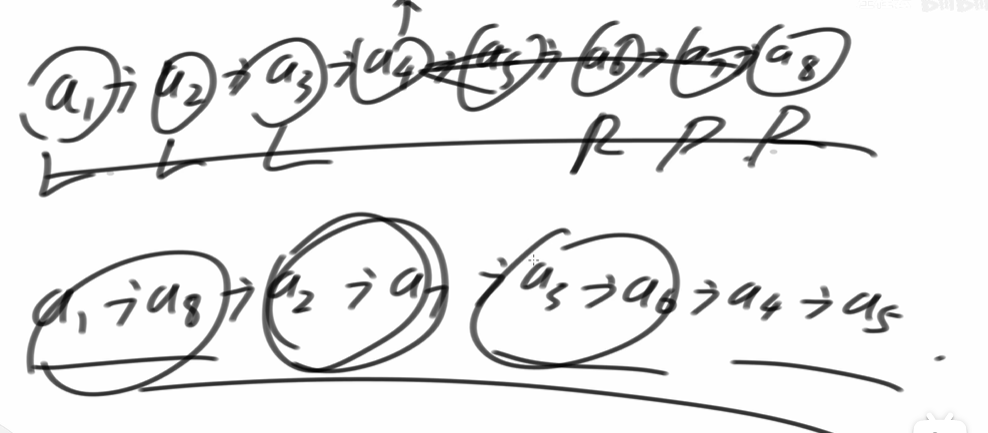
- 类似思路
入环节点的确定
容器方法
快慢指针
- 一个走一步,一个走两步。根据快指针是否为null确定是否有环
- 节点位置,此时慢指针从头节点开始,快指针从相遇处开始,都各走一步,再次相遇时就为环节点
链表上排序
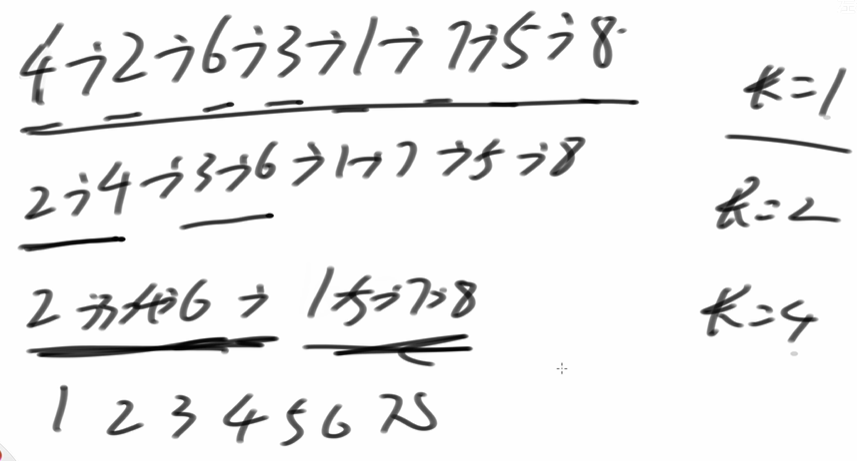
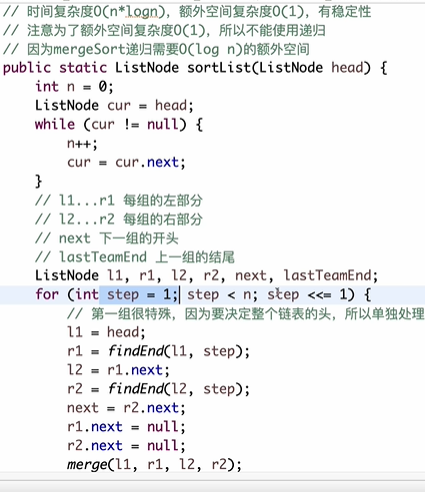
#include <iostream>

using namespace std;

struct ListNode {
    int val;
    ListNode *next;
    ListNode() : val(0), next(nullptr) {}
    ListNode(int x) : val(x), next(nullptr) {}
    ListNode(int x, ListNode *next) : val(x), next(next) {}
};

class Solution {
public:
    ListNode* sortList(ListNode* head) {
        if (head == nullptr || head->next == nullptr) return head;

        // 1. 统计链表总长度 n (对应左神截图里的代码)
        int n = 0;
        ListNode* cur = head;
        while (cur != nullptr) {
            n++;
            cur = cur->next;
        }

        // 使用哨兵节点,方便处理头节点改变的情况
        ListNode dummy(0);
        dummy.next = head;

        // 2. 步长 step 依次为 1, 2, 4, 8...
        for (int step = 1; step < n; step <<= 1) {
            ListNode* prev = &dummy; // prev 用于连接合并后的各个子链表
            cur = dummy.next;        // cur 用于遍历整个链表

            while (cur != nullptr) {
                // 第一部分:切出长度为 step 的左链表
                ListNode* left = cur;
                ListNode* right = split(left, step);

                // 第二部分:切出长度为 step 的右链表,cur 指向下一组的开头
                cur = split(right, step);

                // 第三部分:合并 left 和 right,并把合并后的整段挂在 prev 后面
                // merge 函数返回的是合并后链表的【尾节点】,方便下一组继续挂接
                prev = merge(left, right, prev);
            }
        }

        return dummy.next;
    }

private:
    // 辅助函数 1:从 head 开始,切出长度为 step 的一段。
    // 断开连接,并返回剩下链表的头节点。
    ListNode* split(ListNode* head, int step) {
        if (head == nullptr) return nullptr;

        // 往前走 step - 1 步,找到这部分的尾巴
        for (int i = 1; i < step && head->next != nullptr; i++) {
            head = head->next;
        }

        // 切断,并保留右边剩下的部分
        ListNode* right = head->next;
        head->next = nullptr; // 【关键】断开连接

        return right;
    }

    // 辅助函数 2:合并两个有序链表 l1 和 l2,接在 prev 的后面。
    // 返回合并后链表的最后一个节点(尾节点)。
    ListNode* merge(ListNode* l1, ListNode* l2, ListNode* prev) {
        ListNode* cur = prev;

        // 经典的合并逻辑
        while (l1 != nullptr && l2 != nullptr) {
            if (l1->val <= l2->val) {
                cur->next = l1;
                l1 = l1->next;
            } else {
                cur->next = l2;
                l2 = l2->next;
            }
            cur = cur->next;
        }

        // 谁没挂完,直接全挂上去
        if (l1 != nullptr) cur->next = l1;
        else if (l2 != nullptr) cur->next = l2;

        // 【关键】让 cur 一直走到新合并链表的最后面,作为尾巴返回
        while (cur->next != nullptr) {
            cur = cur->next;
        }

        return cur;
    }
};
算法讲解035【必备】数据结构设计高频题
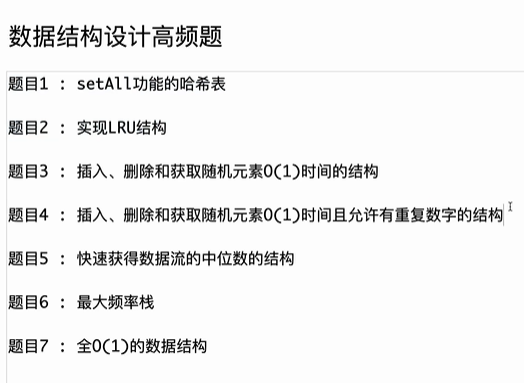
SetAll
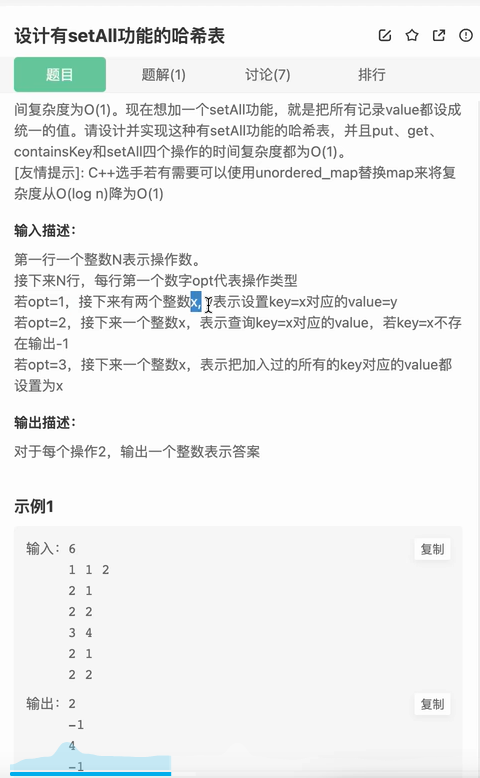
#include <iostream>

using namespace std;

struct ListNode
{
    int val;
    ListNode *next;
    ListNode() : val(0), next(nullptr) {}
    ListNode(int x) : val(x), next(nullptr) {}
    ListNode(int x, ListNode *next) : val(x), next(next) {}
};

#include <iostream>
#include <unordered_map>
#include <string>

using namespace std;

// 泛型设计:K 是 Key 的类型,V 是 Value 的类型
template <typename K, typename V>
class SetAllHashMap
{
private:
    // 内部节点:把 value 和时间戳绑定在一起
    struct Node
    {
        V value;
        long long time;
        // 默认构造
        Node() : time(-1) {}
        // 带参构造
        Node(V v, long long t) : value(v), time(t) {}
    };

    unordered_map<K, Node> map; // 底层哈希表
    long long timeCounter;      // 全局时钟(发号器)
    V setAllValue;              // 记录 setAll 的值
    long long setAllTime;       // 记录发生 setAll 的时间点

public:
    // 构造函数初始化
    SetAllHashMap()
    {
        timeCounter = 0;
        setAllTime = -1; // 初始状态,还没发生过 setAll
    }

    // O(1)
    void put(K key, V value)
    {
        // 存入当前值,并打上当前的时间戳,然后时间戳自增
        map[key] = Node(value, timeCounter++);
    }

    // O(1)
    void setAll(V value)
    {
        // 核心:不遍历 map!只更新全局变量和全局时间戳
        setAllValue = value;
        setAllTime = timeCounter++;
    }

    // O(1)
    // C++ 中为了处理 key 不存在的情况,通常通过引用/指针带出结果,返回 bool 表达是否成功
    bool get(K key, V &outValue)
    {
        // 1. 如果 map 里根本没这个 key,直接返回 false
        if (map.find(key) == map.end())
        {
            return false;
        }

        // 2. 拿出这个 key 对应的节点
        Node node = map[key];

        // 3. PK 时间戳!
        if (node.time > setAllTime)
        {
            // key 的时间戳更新,说明它是 setAll 之后单独 put 进来的
            outValue = node.value;
        }
        else
        {
            // key 的时间戳太老了,已经被 setAll 覆盖了
            outValue = setAllValue;
        }

        return true;
    }
};
实现LRU结构
#include <iostream>
#include <list>
#include <unordered_map> // 用unordered_map效率更高,map也可以

using namespace std;

// LRU缓存:核心是「哈希表 + 双向链表」
// 双向链表:存储(key, value),头部是最近使用的,尾部是最久未使用的
// 哈希表:key -> 链表迭代器,用于快速查找节点
// 以后不要在使用指针,使用迭代器替代指针
class LRUCache
{
private:
    int _capacity;                                               // 缓存容量
    list<pair<int, int>> _cacheList;                             // 双向链表:存储(key, value)
    unordered_map<int, list<pair<int, int>>::iterator> _hashMap; // 哈希表:key -> 链表迭代器

public:
    // 构造函数:初始化缓存容量
    LRUCache(int capacity) : _capacity(capacity) {}

    // 获取key对应的value,不存在返回-1;存在则将节点移到链表头部
    int get(int key)
    {
        // 1. 查找key是否存在
        auto it = _hashMap.find(key);
        if (it == _hashMap.end())
        {
            return -1; // 不存在,返回-1
        }

        // 2. 存在:将节点移到链表头部(标记为最近使用)
        // 先把节点值暂存
        pair<int, int> kv = *it->second;
        // 删除原位置的节点
        _cacheList.erase(it->second);
        // 插入到链表头部
        _cacheList.push_front(kv);
        // 更新哈希表中的迭代器
        _hashMap[key] = _cacheList.begin();

        // 3. 返回value
        return kv.second;
    }

    // 插入/更新key-value;容量满时删除最久未使用的节点
    void put(int key, int value)
    {
        // 1. 检查key是否已存在
        auto it = _hashMap.find(key);
        if (it != _hashMap.end())
        {
            // // 1.1 存在:更新value,并移到链表头部
            // // 删除原节点
            // _cacheList.erase(it->second);
            // // 插入新节点到头部
            // _cacheList.push_front({key, value});
            // // 更新哈希表
            // _hashMap[key] = _cacheList.begin();
            pair<int, int> kv = *it->second;
            _cacheList.erase(it->second);
            _cacheList.push_front(kv);
            _hashMap[key] = _cacheList.begin();
            return;
        }

        // 2. 不存在:检查容量是否已满
        if (_cacheList.size() == _capacity)
        {
            // 2.1 容量满:删除最久未使用的节点(链表尾部)
            // 获取尾部节点的key
            int delKey = _cacheList.back().first;
            // 删除链表尾部节点
            _cacheList.pop_back();
            // 删除哈希表中对应的key
            _hashMap.erase(delKey);
        }

        // 2.2 容量未满:插入新节点到链表头部
        _cacheList.push_front({key, value});
        // 更新哈希表
        _hashMap[key] = _cacheList.begin();
    }
};
O(1)时间插入,删除和获取随机元素
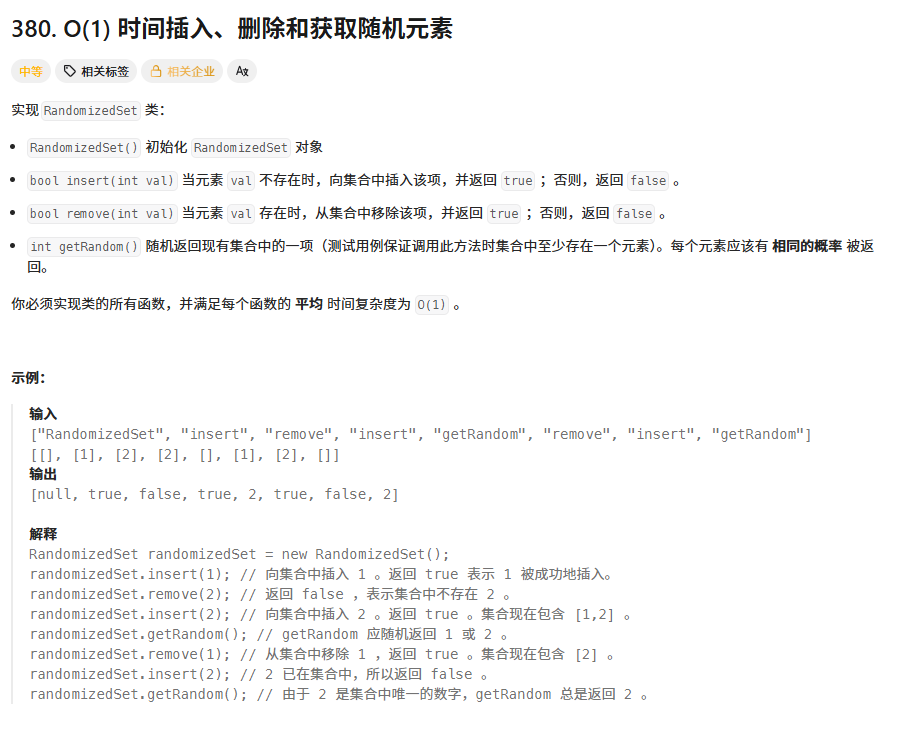
错误:set遍历O(n)
#include <iostream>
#include <list>
#include <unordered_set> // 用unordered_map效率更高,map也可以

class RandomizedSet
{
    std::unordered_set<int> _data;

public:
    RandomizedSet() : _data(0)
    {
    }

    bool insert(int val)
    {
        if (_data.find(val) != _data.end())
            return false;
        _data.insert(val);
        return true;
    }

    bool remove(int val)
    {
        if (_data.find(val) == _data.end())
            return false;
        _data.erase(val);
        return true;
    }

    // set访问只能通过迭代器遍历访问才可以
    int getRandom()
    {
        int index = rand() % _data.size();
        std::unordered_set<int>::iterator it = _data.begin();
        while (it != _data.end() && index > 0)
        {
            it++;
            index--;
        }
        return *it;
    }
};
map+数组
删除元素的时候,都是将最后一个元素放到所要删除的元素的位置,然后删除最后一个元素
#include <iostream>
#include <vector>
#include <unordered_map>
#include <cstdlib> // rand()、srand()
#include <ctime>   // time()

class RandomizedSet
{
    std::unordered_map<int, int> _data; // 正确:{值: 下标}
    std::vector<int> _arr;

public:
    RandomizedSet()
    {
        // 初始化随机数种子,保证每次运行随机结果不同
        srand((unsigned)time(nullptr));
    }

    bool insert(int val)
    {
        // 查找值是否存在(键是val,符合{值:下标}的逻辑)
        std::unordered_map<int, int>::iterator it = _data.find(val);
        if (it != _data.end()) // 元素已存在,插入失败
            return false;

        // 数组尾部插入值
        _arr.push_back(val);
        // 哈希表记录:键=值,值=数组下标(核心修复点)
        _data[val] = _arr.size() - 1;
        return true;
    }

    bool remove(int val)
    {
        // 查找值是否存在
        std::unordered_map<int, int>::iterator it = _data.find(val);
        if (it == _data.end()) // 元素不存在,删除失败
            return false;

        // 获取要删除元素的下标
        int find_index = it->second;
        // 获取数组最后一个元素的值
        int last_val = _arr.back();

        // 1. 用最后一个元素覆盖要删除的元素(数组层面)
        _arr[find_index] = last_val;
        // 2. 更新哈希表中「最后一个元素」的下标(核心:键是last_val)
        _data[last_val] = find_index;
        // 3. 删除哈希表中目标值、数组尾部元素
        _data.erase(val);
        _arr.pop_back();

        return true;
    }

    int getRandom()
    {
        // 处理空容器,避免除零错误(实际题目保证调用时非空,此处为鲁棒性)
        if (_arr.empty())
        {
            return -1; // 或抛异常,根据需求调整
        }
        // 生成 0 ~ size-1 的随机索引
        int index = rand() % _arr.size();
        return _arr[index];
    }

};
O(1)时间插入,删除和获取随机元素(允许重复)
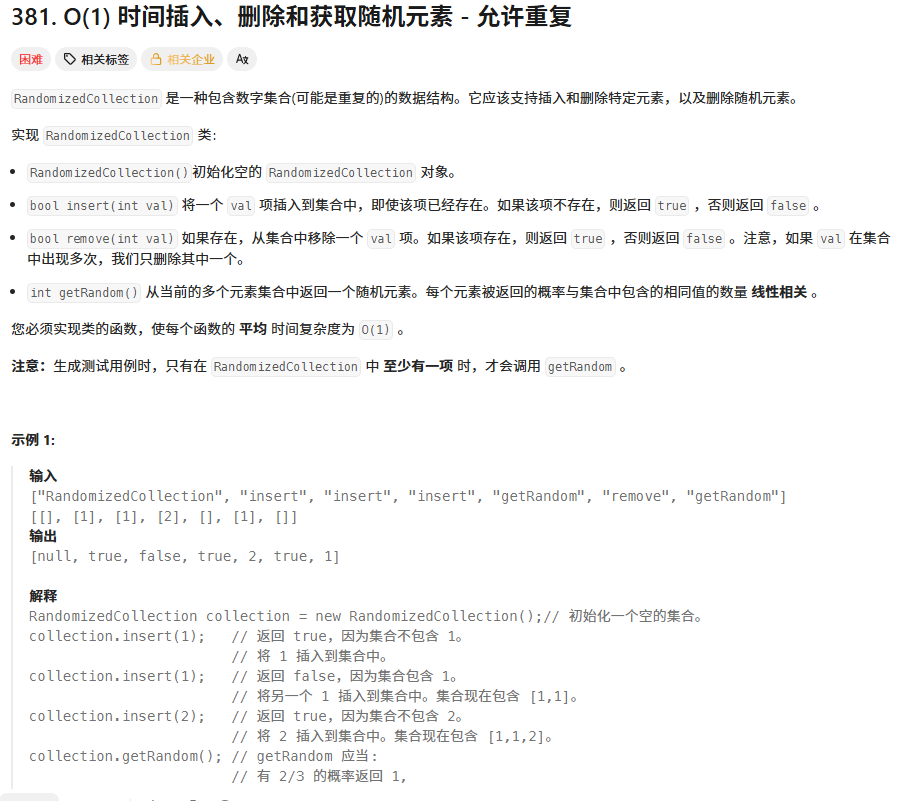
思路正确:复杂度O(n)
#include <iostream>
#include <vector>
#include <unordered_map>
#include <cstdlib> // rand()、srand()
#include <ctime>   // time()
#include <algorithm>
class RandomizedCollection
{
    // 这里为什么不能使用vector
    std::unordered_map<int, std::vector<int>> _hash; // 正确:{值: 下标的集合}
    std::vector<int> _arr;

public:
    RandomizedCollection()
    {
        // 初始化随机数种子,保证每次运行随机结果不同
        srand((unsigned)time(nullptr));
    }

    bool insert(int val)
    {
        bool isExist = _hash.find(val) != _hash.end();
        _arr.push_back(val);
        // 哈希表记录:键=值,值=数组下标(核心修复点)
        _hash[val].push_back(_arr.size() - 1);
        return !isExist;
    }

    bool remove(int val)
    {
        // 查找值是否存在
        std::unordered_map<int, std::vector<int>>::iterator it = _hash.find(val);
        if (it == _hash.end()) // 元素不存在
            return false;

        // 获取要删除元素的下标(下标集合中的最后一个),并将下标从下标集合中弹出
        int find_index = it->second.back();
        it->second.pop_back();
        if (it->second.empty()) // 改元素没有对应的下标了
        {
            _hash.erase(val);
        }
        if (find_index != _arr.size() - 1)
        {
            // 获取数组最后一个元素的值
            int last_val = _arr.back();
            // 1. 用最后一个元素覆盖要删除的元素(数组层面)
            _arr[find_index] = last_val;
            // 2. 更新哈希表中「最后一个元素」的下标(核心:键是last_val)
            _hash[last_val].push_back(find_index);

            // --------------------------------------------------复杂度不是O(1)了
            // 3. 删除数组中最后一个元素对应的下标集合中的最后一个下标
            _hash[last_val].erase(std::find(_hash[last_val].begin(), _hash[last_val].end(), _arr.size() - 1));
        }

        _arr.pop_back();

        return true;
    }

    int getRandom()
    {
        // 处理空容器,避免除零错误(实际题目保证调用时非空,此处为鲁棒性)
        if (_arr.empty())
        {
            return -1; // 或抛异常,根据需求调整
        }
        // 生成 0 ~ size-1 的随机索引
        int index = rand() % _arr.size();
        return _arr[index];
    }
};

// 程序首先通过测试用例

// O(1)复杂度变小
思路正确:复杂度(O(n))
#include <iostream>
#include <vector>
#include <unordered_map>
#include <unordered_set> // 新增:用unordered_set存储下标
#include <cstdlib>
#include <ctime>
using namespace std;

class RandomizedCollection
{
    // 替换:键=值,值=该值在数组中的下标集合(unordered_set保证O(1)增删查)
    unordered_map<int, unordered_set<int>> _hash;
    vector<int> _arr; // 数组仍保留,保证getRandom O(1)

public:
    RandomizedCollection()
    {
        srand((unsigned)time(nullptr));
    }

    // 插入元素:存在返回false,不存在返回true
    bool insert(int val)
    {
        bool isExist = _hash.find(val) != _hash.end();
        _arr.push_back(val);
        int new_idx = _arr.size() - 1;
        _hash[val].insert(new_idx); // 集合插入下标(O(1))
        return !isExist;
    }

    // 删除元素:不存在返回false,存在返回true(全程O(1))
    bool remove(int val)
    {
        // 1. 检查元素是否存在
        auto hash_it = _hash.find(val);
        if (hash_it == _hash.end())
            return false;

        // 2. 取要删除的下标(集合中任意一个即可,这里取begin())
        auto &idx_set = hash_it->second;
        int del_idx = *idx_set.begin();
        idx_set.erase(del_idx); // 集合删除该下标(O(1))

        // 3. 如果该值的下标集合为空,从哈希表中删除键
        if (idx_set.empty())
            _hash.erase(hash_it);

        // 4. 非最后一个元素时,用最后一个元素覆盖+更新哈希表
        int last_idx = _arr.size() - 1;
        if (del_idx != last_idx)
        {
            int last_val = _arr[last_idx];
            // 4.1 数组层面:覆盖要删除的位置
            _arr[del_idx] = last_val;
            // 4.2 哈希表层面:删除last_val的旧下标(last_idx),添加新下标(del_idx)
            auto &last_set = _hash[last_val];
            last_set.erase(last_idx); // O(1)
            last_set.insert(del_idx); // O(1)
        }

        // 5. 删除数组最后一个元素(O(1))
        _arr.pop_back();

        return true;
    }

    // 随机获取元素(O(1))
    int getRandom()
    {
        if (_arr.empty())
            return -1;
        int rand_idx = rand() % _arr.size();
        return _arr[rand_idx];
    }
};
数据流动的中位数
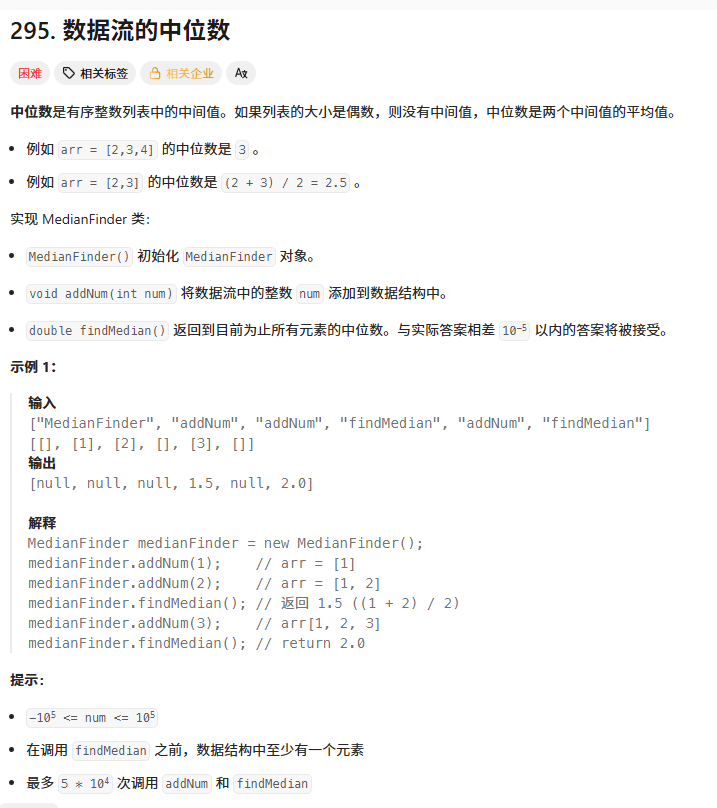
#include <iostream>
#include <vector>
#include <queue>
#include <stdexcept>
using namespace std;

class MedianFinder
{
    // 大根堆:存储较小的一半数(堆顶是小数部分的最大值)
    priority_queue<double> _maxHeap;
    // 小根堆:存储较大的一半数(堆顶是大数部分的最小值)
    priority_queue<double, vector<double>, greater<double>> _minHeap;
    int _size;

public:
    MedianFinder() : _size(0)
    {
    }

    void addNum(int num)
    {
        // 第一步:确定元素入哪个堆(逻辑正确,保留)
        if (_maxHeap.empty() || num <= _maxHeap.top())
        {
            _maxHeap.push(num);
        }
        else
        {
            _minHeap.push(num);
        }
        _size++;
        adjustHeap(); // 调整堆平衡
    }

    double findMedian()
    {
        if (_size == 0)
        {
            throw runtime_error("No elements in MedianFinder!");
        }
        if (_size % 2 != 0)
        {
            return _maxHeap.size() > _minHeap.size() ? _maxHeap.top() : _minHeap.top();
        }
        // 场景2:总数量偶数 → 两个堆一定都有元素(调整堆保证),但仍加空堆判断兜底
        else
        {
            return (_maxHeap.top() + _minHeap.top()) / 2.0;
        }
    }

private:
    void adjustHeap()
    {
        // 修复:调整堆的逻辑不变,但保证调整后「偶数时两个堆都非空,奇数时仅一个堆多1个」
        int maxSize = _maxHeap.size();
        int minSize = _minHeap.size();

        // 大根堆比小根堆多>1 → 移堆顶到小根堆
        while (maxSize - minSize > 1)
        {
            _minHeap.push(_maxHeap.top());
            _maxHeap.pop();
            maxSize = _maxHeap.size();
            minSize = _minHeap.size();
        }
        // 小根堆比大根堆多>1 → 移堆顶到大根堆
        while (minSize - maxSize > 1)
        {
            _maxHeap.push(_minHeap.top());
            _minHeap.pop();
            maxSize = _maxHeap.size();
            minSize = _minHeap.size();
        }
    }
};
最大频率栈
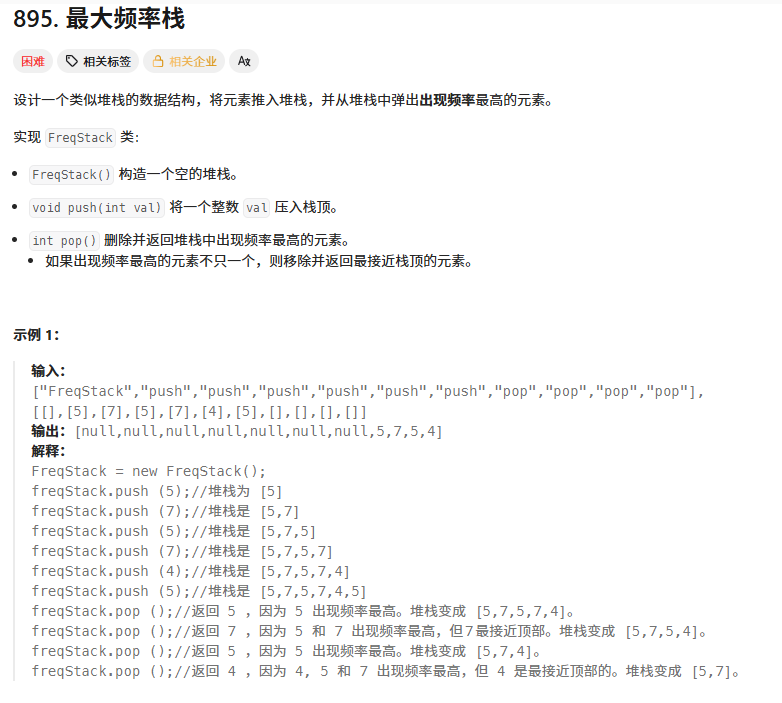
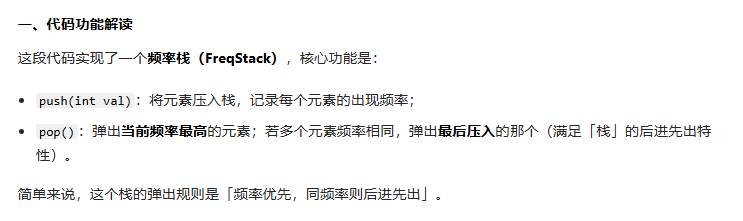
#include <iostream>
#include <vector>
#include <queue>
#include <unordered_map>
#include <stack>
using namespace std;

class FreqStack
{
    std::unordered_map<int, int> _map; //{值:词频}
    std::vector<std::vector<int>> _arr;
    int _maxFreq;

public:
    FreqStack() : _maxFreq(0)
    {
    }

    void push(int val)
    {
        _map[val]++;
        if (_map[val] > _maxFreq) // 词频最大值被更新
        {
            vector<int> elems;
            elems.push_back(val);
            _arr.push_back(elems);
            _maxFreq++;
            return;
        }
        // 最大词频没有更新
        _arr[_map[val] - 1].push_back(val);
    }

    int pop()
    {
        // 弹出当前词频最大的元素
        int stackElemLen = _arr.size();
        int val = _arr[stackElemLen - 1].back();
        _arr[stackElemLen - 1].pop_back();
        if (_arr[stackElemLen - 1].size() == 0)
        {
            _arr.pop_back();
            _maxFreq--;
        }
        // 注意:还需要将该元素的词频递减掉
        _map[val]--;
        return val;
    }
};
全是O(1)的结构
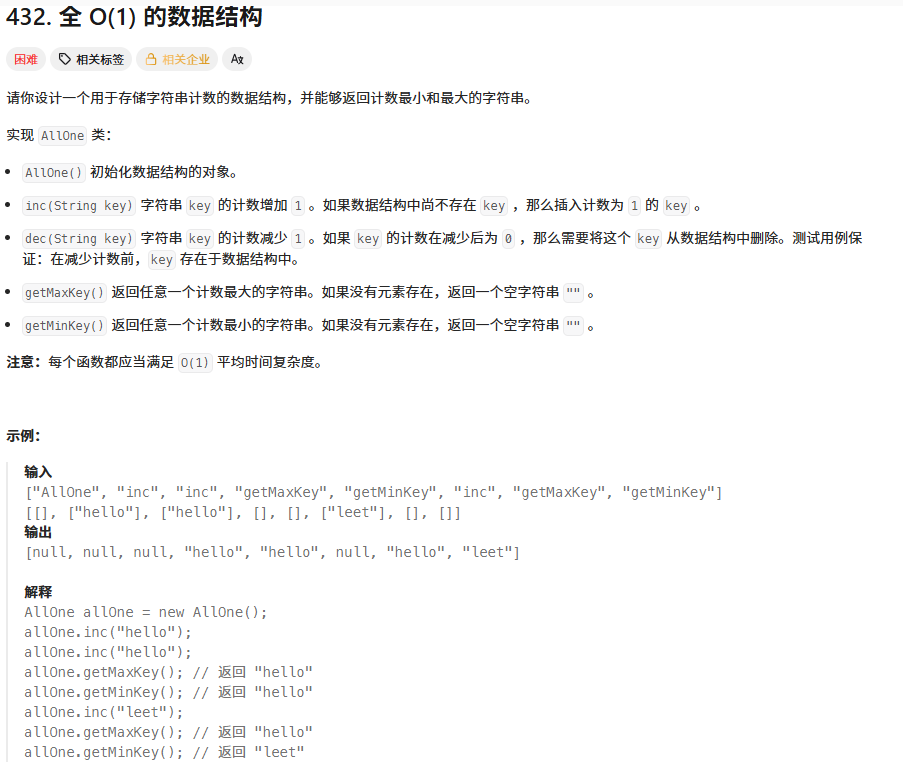
#include <iostream>
#include <vector>
#include <list>
#include <unordered_map>
#include <string>
using namespace std;

class AllOne
{
    using ListNode = pair<int, vector<string>>;
    list<ListNode> _list;
    unordered_map<string, pair<list<ListNode>::iterator, int>> _hash;

    /**
     * 解题思路:类似于LRU的方法
     * 维护一个双向链表,链表节点存储频率和具有该频率的字符串列表,头部是最小频率,尾部是最大频率
     * 维护一个哈希表,键是字符串,值是一个pair,包含该字符串在链表中的迭代器和在该节点字符串列表中的索引
     * 增量操作:如果字符串不存在,插入频率为1的节点,如果存在,移动到下一个频率节点,如果下一个节点不存在,创建一个新节点
     * 减量操作:如果字符串不存在,直接返回,如果存在,移动到上一个频率节点,如果上一个节点不存在,创建一个新节点,如果频率为1,直接删除
     *
     */
public:
    AllOne() {}

    void inc(string key)
    {
        if (_hash.find(key) == _hash.end())
        {
            if (_list.empty() || _list.front().first != 1)
            {
                _list.push_front({1, {}});
            }
            auto &min_node = _list.front();
            min_node.second.push_back(key);
            _hash[key] = {_list.begin(), min_node.second.size() - 1};
            return;
        }

        auto &[curr_iter, idx] = _hash[key];
        int curr_freq = curr_iter->first;
        auto &curr_words = curr_iter->second;

        if (idx != curr_words.size() - 1)
        {
            string swapped_key = curr_words.back();
            swap(curr_words[idx], curr_words.back());
            _hash[swapped_key].second = idx;
        }
        curr_words.pop_back();

        auto next_iter = next(curr_iter);
        if (curr_words.empty())
        {
            curr_iter = _list.erase(curr_iter);
        }
        else
        {
            next_iter = next(curr_iter);
        }

        if (next_iter == _list.end() || next_iter->first != curr_freq + 1)
        {
            next_iter = _list.insert(next_iter, {curr_freq + 1, {}});
        }

        next_iter->second.push_back(key);
        _hash[key] = {next_iter, next_iter->second.size() - 1};
    }

    void dec(string key)
    {
        if (_hash.find(key) == _hash.end())
        {
            return;
        }

        auto &[curr_iter, idx] = _hash[key];
        int curr_freq = curr_iter->first;
        auto &curr_words = curr_iter->second;

        if (idx != curr_words.size() - 1)
        {
            string swapped_key = curr_words.back();
            swap(curr_words[idx], curr_words.back());
            _hash[swapped_key].second = idx;
        }
        curr_words.pop_back();

        auto prev_iter = (curr_iter == _list.begin()) ? _list.end() : prev(curr_iter);
        if (curr_words.empty())
        {
            curr_iter = _list.erase(curr_iter);
        }
        else
        {
            prev_iter = (curr_iter == _list.begin()) ? _list.end() : prev(curr_iter);
        }

        if (curr_freq == 1)
        {
            _hash.erase(key);
            return;
        }

        if (prev_iter == _list.end() || prev_iter->first != curr_freq - 1)
        {
            prev_iter = _list.insert(curr_iter, {curr_freq - 1, {}});
        }

        prev_iter->second.push_back(key);
        _hash[key] = {prev_iter, prev_iter->second.size() - 1};
    }

    string getMaxKey()
    {
        if (_list.empty())
            return "";
        return _list.back().second.empty() ? "" : _list.back().second[0];
    }

    string getMinKey()
    {
        if (_list.empty())
            return "";
        return _list.front().second.empty() ? "" : _list.front().second[0];
    }
};

AtomGit 是由开放原子开源基金会联合 CSDN 等生态伙伴共同推出的新一代开源与人工智能协作平台。平台坚持“开放、中立、公益”的理念,把代码托管、模型共享、数据集托管、智能体开发体验和算力服务整合在一起,为开发者提供从开发、训练到部署的一站式体验。
更多推荐


 10
10 0
0- 0


 已为社区贡献1条内容

所有评论(0)