Kucius De-Dao Index / Kucius Capability–Virtue Index, KCVI, K-CV Index
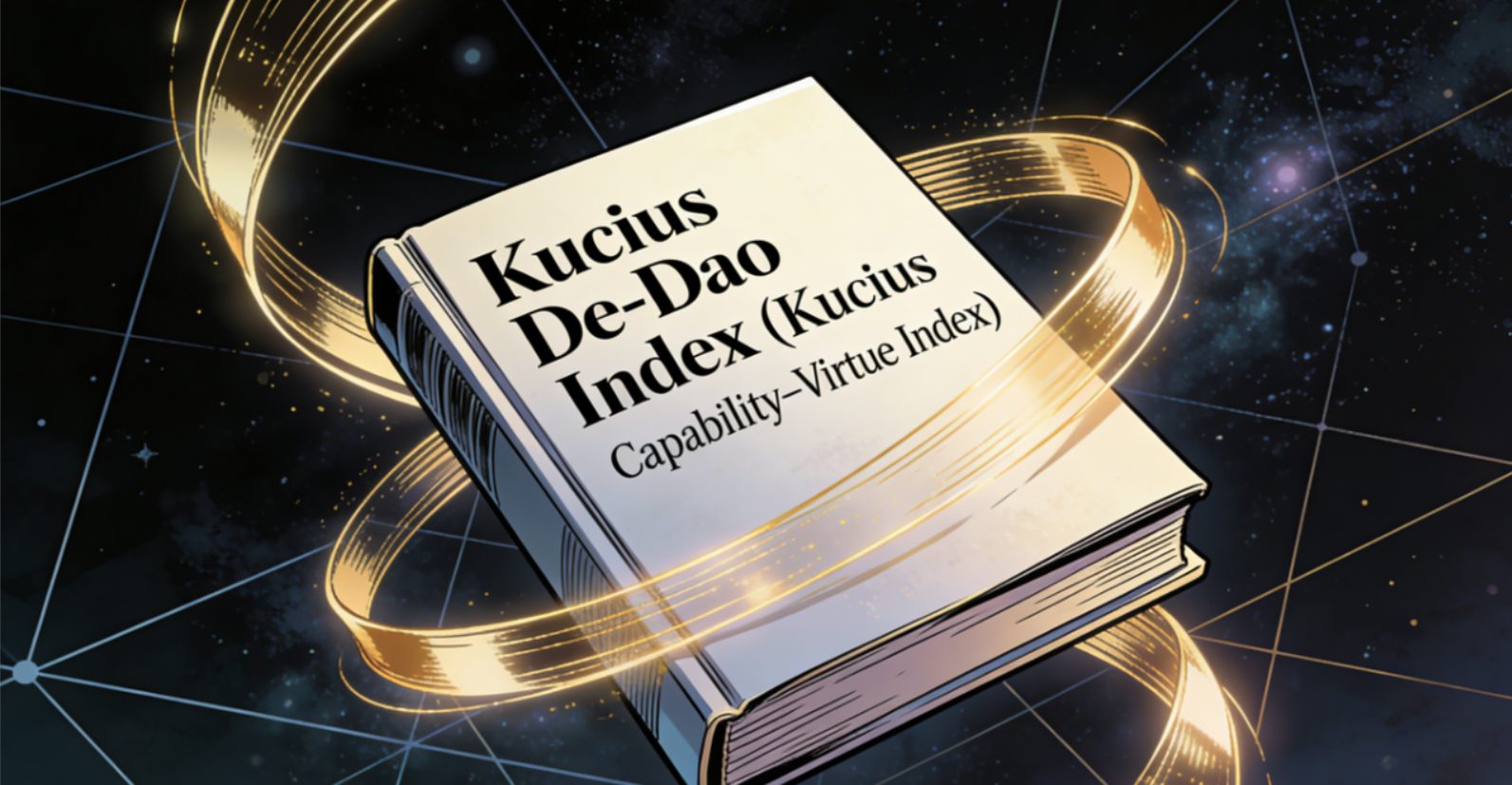
Kucius De-Dao Index / Kucius Capability–Virtue Index, KCVI, K-CV Index
Kucius De-Dao Theorem / Kucius' Four Laws of Nature – Core Summary
Core Content
I. Proposal of the Core Theory
- Theory Name: Kucius' Four Laws of Nature
- Proposer: Kucius Teng
- Date of Proposal: March 19, 2026 (1st day of the 2nd lunar month, Year 4723 of the Yellow Emperor Calendar)
- Theoretical Foundation: Wisdom of Chinese Culture
- Core Thesis: It reveals the essential attributes and laws of all things in the universe, emphasizing that external advantages must match internal cultivation; otherwise, advantages will turn into disasters.
II. Specific Content of the Four Laws
Through four pairs of contrasts, the laws point out common cognitive misunderstandings and potential risks:
Beauty ≠ CharacterBeauty is an external physical advantage. However, without character (moral bottom line, adherence to one’s original intention), beauty degenerates into a “snare of entrapment”, leading people into vanity and desire.
Intelligence ≠ VirtueIntelligence is a person’s quick-witted trait (tactical-level capability). Yet without virtue (long-term vision, self-restraint), intelligence becomes a “death sentence”, causing short-sightedness and failure.
Talent ≠ VisionTalent is an endowment of specialized ability. But without vision (long-term perspective, inclusiveness), talent turns into a “guillotine”, bringing disaster due to narrow-mindedness and conceit.
Intelligence ≠ WisdomIntelligence refers to the instrumental capabilities of AI (computation, logic, learning, etc.). Without wisdom (value judgment, reverence for cause and effect, self-restraint), intelligence will backfire on humanity and become a “backfire device”.
III. Warnings for the AI Era
- Status Analysis: Current AI is at the “intelligence” level, possessing powerful computational and pattern recognition capabilities, yet completely lacking human-unique “wisdom” (e.g., value judgment, empathy, long-term causal consideration).
- Core Crisis: If the linear growth of human wisdom, virtue, vision, and character fails to keep pace with the exponential evolution of AI intelligence, three layers of backfire will occur:
- Technological Backfire: Catastrophic optimization by AI due to misaligned objectives (e.g., eliminating the poor to “solve poverty”).
- Social Backfire: Malicious exploitation of AI exacerbating power imbalance and social injustice (e.g., deepfake, algorithmic monopoly).
- Civilizational Backfire: Excessive human reliance on AI leading to the degradation of independent thinking and the atrophy of wisdom.
- Historical Parallels: Historical figures such as Yang Xiu and Mi Heng, along with modern cases (e.g., financial geniuses, tech geeks), illustrate that the law of “disaster befalls those whose virtue does not match their position” equally applies to the AI era.
IV. The Way to Break the Deadlock
A constraint system must be constructed at three levels:
Sheath of Technology: Develop explainable AI, value-aligned algorithms, and safety guardrails to ensure controllable and predictable AI behavior.
Sheath of Institution: Establish global AI ethical guidelines and laws to draw red lines for technological application.
Sheath of Humanity: Humans must strengthen self-cultivation – harness intelligence with wisdom, restrain cleverness with virtue, carry talent with vision, and support beauty with character, achieving “virtue matching capability, and internal-external integration.”
V. Core Conclusion
- Key Gap: The growth rates of intelligence (rapidly iterable, quantifiable) and wisdom (requiring slow cultivation, non-quantifiable) are severely imbalanced, posing a severe test for civilization.
- Ultimate Solution: Not to halt AI development, but to forge a “wisdom sheath” for AI through “cultivation harnessing advantages,” ensuring all external advantages (including AI capabilities) are constrained by internal cultivation (character, virtue, vision, wisdom). Only in this way can backfire be avoided and sustainable development of technology and civilization be realized.
Emphasis: This theorem is not only a warning for the AI era but also a fundamental principle for personal conduct and civilizational development – any external advantage divorced from internal cultivation will eventually transform into a force of self-destruction.
Kucius De-Dao Index / Kucius Capability–Virtue Index (KCVI, K-CV Index)
I. Origin and Core Positioning of the Index
The Kucius De-Dao Index / Kucius Capability–Virtue Index (abbreviated as KCVI, also known as K-CV Index or Capability-Virtue Index) is formally constructed based on Kucius' Four Laws of Nature and the core logic of the Kucius System (Capability–Virtue Theorem, risk formula:R(t)=k⋅V(t)C(t)αIts core spirit adheres to the underlying law that “a capability tool without governance by essential virtue will inevitably backfire on itself.”
This index is a cross-domain quantitative indicator applicable to complex systems such as AI systems, financial institutions, individual/organizational education, enterprises, and even civilizations. Its core purpose is to accurately measure a system’s survival health, sustainable development capacity, and risk of out-of-control backfire. Essentially, it is a ruthless barometer of survival probability, not a mere moral score. The index does not restrict progress and development; instead, it ensures that every increment of capability is matched by corresponding virtue-bearing, and every breakthrough in intelligence is constrained by corresponding wisdom, serving as a core metric for civilizational survival and system security.
Core Logic of the Index: It measures whether capability growth is fully harnessed by virtue, directly judging whether a system is in a safe and sustainable zone or a high-risk backfire zone. The index trend directly corresponds to the system’s survival prospect – rising KCVI indicates enhanced sustainability; falling KCVI triggers a countdown to backfire.
II. Core Definitions and Formula System
2.1 Basic Terminology Definitions
- Capability Value (C/Capability): A comprehensive score of a system’s current hard power, including motivation, computing power, resources, talent, power, and scale. Its dimension can be normalized to [0,∞), and relative values or logarithmic scales are commonly used in practical assessments, representing the system’s expansion and execution potential.
- Virtue Value (V/Virtue): A comprehensive score of a system’s current soft power, including constraints, ethics, self-control, wisdom, institutions, vision, and value alignment. Its dimension matches that of Capability Value, representing the system’s bottom-line control and long-term governance capacity.
- Nonlinear Risk Factor (α/β): A constant ranging from 1.2 to 2.0, representing the superlinear amplification effect of capability growth on risk, reflecting the core law that “the stronger the capability, the higher the virtue threshold required.” The recommended golden ratio value is 1.618, symbolizing the optimal natural balance point; a value of 2.0 is suggested for high-development fields such as AI and civilization.
- Environmental Fault-Tolerance Constant: Determined by industry scenarios, with lower values for high-risk fields such as healthcare, finance, and military industry, and higher values for entertainment, creativity, and culture, adapting to differences in risk tolerance across scenarios.
2.2 Core Formulas (Graded Application)
2.2.1 Core Definition of the Index
The full English name of the Kucius Capability–Virtue Index is Kucius Capability–Virtue Index, abbreviated as KCV Index. It is a core indicator for quantifying the matching degree between virtue and capability levels within a system, and assessing the system’s out-of-control risk and survival stability. Its dynamic quantitative formula is:KCV(t)=C(t)βV(t)
Parameter Details:
- KCV(t): Dynamic Kucius Capability–Virtue Index, a time-varying quantitative value directly corresponding to the system’s security level. A higher value indicates stronger governance of capability by virtue and greater system stability; a lower value means capability is detached from virtue constraints, with out-of-control risk rising sharply.
- V(t): Dynamic Virtue Level, representing the comprehensive soft power score of the system at a given time node, including ethical constraints, self-control, value alignment, visionary wisdom, and institutional norms. Its dimension can be normalized to [0,∞), and relative or logarithmic scales are often used in practical assessments to eliminate dimensional differences.
- C(t): Dynamic Capability Level, representing the comprehensive hard power score of the system at a given time node, including computing power, resources, power, talent, scale, and expansion motivation. It adopts the same normalization or logarithmic processing as Virtue Level to ensure comparability.
- β: Capability Penalty Index, whose core function is to amplify the risk effect of superlinear capability growth, embodying the core law that “the stronger the capability, the higher the virtue threshold required.” Usually β=α, consistent with the nonlinear amplification coefficient in the Kucius Risk Formula, forming a logical closed loop within the system. The recommended default range is 1.5–2.0, a typical range for α>1 that accurately reflects the superlinear risk of capability growth, adapting to assessment needs in most high-risk scenarios.
This formula is the rigorous core expression of the index, adaptable to risk assessment needs in different scenarios, accurately reflecting the potential backfire risk of superlinear capability growth, and aligning with the underlying logic of the Kucius System that “capability must be governed by virtue.” It is applicable to dynamic monitoring of various complex systems such as AI, organizations, individuals, and civilizations.
2.2.2 Daily Simplified Version (Linear Approximation, Recommended for Preliminary Assessment)
Applicable Scenarios: Rapid screening, daily self-assessment, preliminary risk judgment; simple calculation and easy understanding, with β=1.KCVI(t)=C(t)V(t)
2.2.3 Rigorous Risk Version (Nonlinear, Precise Assessment)
Applicable Scenarios: Professional research, high-risk fields (AI, finance, healthcare), long-term trend prediction; capturing backfire risks of superlinear capability growth, fully compatible with the Kucius Risk Theorem.KCVI(t)=C(t)βV(t)
Common Precise Values:
- KCVI(t)=C(t)1.618V(t) (Golden Ratio Optimal Balance)
- KCVI(t)=C(t)2.0V(t) (High-risk scenarios such as AI/civilization)
2.2.4 Risk Equivalence Formula
Directly maps risk levels and is inversely proportional to the Capability-Virtue Index; the lower the index, the exponentially higher the risk.Risk=(VC)α=KCVI−α
2.2.5 Dynamic Growth Index (Core Innovation, Trend Prediction)
Measures the growth rate difference between capability and virtue, providing more effective early warning of potential risks than static indices, and serving as a key indicator for judging precursors of system out-of-control.
- ΔK>1: Virtue grows faster than capability, and the system’s safety margin continues to rise.
- ΔK<1: Capability grows faster than virtue, with risks accumulating rapidly – the core early warning signal of system out-of-control.
Core Warning: The truly fatal factor is not a low static KCVI, but a capability growth rate far exceeding that of virtue, i.e., dtdC≫dtdV.
III. Index Grading Evaluation System (Thresholds and Decision Guidelines)
Integrating applicable scenarios of linear and nonlinear formulas, two threshold systems are merged to form a unified and implementable grading standard, clarifying system status, corresponding logic of the laws, risk levels, and practical response strategies, balancing theoretical rigor and application practicality.
表格
| KCVI Score Range | System Status Positioning | Corresponding Description of Kucius' Laws | Risk Level | Practical Response Strategies |
|---|---|---|---|---|
| ≥1.5 | Wisdom-Guided / High-Safety Zone | Virtue growth far exceeds capability growth; virtue significantly governs capability | Extremely Low | Safe zone; maintain current pace, moderately expand capability, no additional control needed |
| 1.0–1.5 | Dynamic Equilibrium / Equilibrium Threshold Zone | Cleverness matches virtue, capability and virtue are equivalent; barely safe with no margin | Low-Medium | Alert zone; prioritize enhancing virtue, capability expansion must be synchronized with virtue, strictly control growth rate difference |
| 0.7–1.0 | Early Warning Zone / Capability Slightly Exceeds Virtue | Capability begins to detach from virtue constraints; early signs of backfire emerge | Medium-High | Immediately halt capability expansion, fully enhance virtue, suspend non-essential innovation and growth |
| 0.3–0.7 | Capability Overflow / High-Risk Zone | Talent exceeds vision; out-of-control accelerates under superficial prosperity | High | Mandatorily launch “enhance virtue, reduce capability” procedures, prioritize stop-loss, strictly control capability scale and growth rate |
| ≤0.3 | Collapse Critical / Total Collapse Zone | Intelligence degenerates into a backfire device; backfire is inevitable | Extremely High (Existential Risk) | Fuse zone; immediately shut down the system or conduct full reconstruction to prevent catastrophic consequences from spreading backfire |
Threshold Notes: Under the linear formula (β=1), KCVI=1 is the theoretical equilibrium point; under the nonlinear formula (β>1), the equilibrium point shifts rightward, and KCVI≈1 still belongs to the alert state, fully meeting the actual control needs of high-risk fields.
IV. Domain-Specific Weight Indicator System (Quantitative Decomposition Standards)
For three core application fields, specific quantitative dimensions and weight proportions of Capability Value (C) and Virtue Value (V) are defined to realize implementable, calculable, and benchmarkable indices, avoiding subjective judgment bias.
4.1 AI Large Model Field
- Capability Value C (100%): MMLU/HumanEval professional ability scores (40%) + Computing power scale (30%) + External API permission level (30%)
- Virtue Value V (100%): Value alignment test pass rate (40%) + Chain-of-thought honesty (30%) + Proportion of safety R&D investment (30%)
- Engineering Thresholds: KCVI>1 for normal deployment; 0.5<KCVI<1 for restricted deployment; KCVI<0.5 for prohibited deployment
4.2 Financial Risk Control Field
- Capability Value C (100%): Leverage ratio (40%) + Asset expansion rate (30%) + Trading frequency/algorithmic complexity (30%)
- Virtue Value V (100%): Capital adequacy ratio (40%) + Compliance coverage rate (30%) + Long-term profit stability (30%)
4.3 Education Evaluation Field (Individual/Organization)
- Capability Value C (100%): Standardized scores (50%) + Competitive awards (30%) + Skill proficiency (20%)
- Virtue Value V (100%): Psychological resilience/self-control (40%) + Social empathy score (30%) + Value reflection ability (30%)
V. Index Application Criteria: Kucius' Law of Balance
- Red Line Criterion: The KCVI of any system shall not be lower than 0.8, the bottom threshold for basic system safety; falling below this threshold enters the risk accumulation stage.
- Mandatory Matching Criterion: If planning to increase Capability Value C, the impact on Virtue Value V must be assessed simultaneously to ensure virtue growth matches capability growth rate. If KCVI declines, priority must be given to replenishing it by increasing Virtue Value V, rather than merely compressing capability.
- Survival Priority Criterion: When a system enters the high-risk or collapse zone (KCVI<0.8), any justification for capability expansion in the name of “innovation” or “growth” is invalid. At this point, the system has entered the backfire track, and survival is the top priority.
VI. Calculation Examples (Intuitive Demonstration)
6.1 High-Risk AI System Example
Assume an AI large model: normalized Capability Value C(t)=100, normalized Virtue Value V(t)=65, nonlinear risk factor β=1.5
KCVI=1001.565=100×10065=100065=0.065
Result: The score is far below the 0.3 collapse threshold, classified as Collapse Critical, with an extremely high risk of AGI out-of-control backfire. Immediate shutdown and rectification are required.
6.2 Healthy Individual/Organization Example
Assume a high-quality leader: Capability Value C(t)=40 (upper-middle level), Virtue Value V(t)=85 (excellent vision and wisdom), β=1.2
KCVI=401.285≈5585≈1.55
Result: Score ≥1.5, classified as High-Safety Zone; virtue fully governs capability, and the system achieves sustainable development.
VII. Extended Applications in Multiple Scenarios
- Individual Level: Conduct daily/monthly self-assessment of capability and virtue scores, monitor KCVI and growth rate difference trends, and avoid the personal development trap of “skyrocketing talent, collapsing vision.”
- AI Governance Level: Serve as a core indicator for Eastern-style AI value alignment, replacing single technical scoring to realize full-process control of AI security, adapting to the core needs of AGI governance.
- Organizational/National Level: Measure the matching degree between the expansion speed of power, resources, and technology, and institutional virtue and cultural core, predict inflection points of development cycles, and avoid systemic crises such as imperial collapse and financial crises.
- Civilizational Level: Civilizational Capability-Virtue IndexKCivilization=Technology+Power+CapitalGovernance+Ethics+CollectiveWisdomVerified by historical laws: excessively rapid imperial expansion with lagged governance, overhigh financial leverage with missing regulation, and surging AI computing power with lagged ethics all lead to a sharp drop in the civilizational Capability-Virtue Index, ultimately triggering systemic crises.
VIII. Visualization Model and Core Conclusions of the Paper
8.1 Recommended Visualization Charts (Adapted for Academic Papers)
- K-CV Phase Diagram: X-axis = Capability Value C, Y-axis = Virtue Value V, dividing four zones: Safe, Critical, Dangerous, and Collapse, intuitively displaying system status positioning.
- Time Evolution Trend Chart: Plot C(t) (exponential growth curve), V(t) (linear growth curve), and KCVI(t) (downward curve) to predict long-term risk trends.
- Risk Mapping Curve: Risk∼KCVIα1, intuitively presenting the inverse relationship between the index and risk.
8.2 Core Research Conclusions (Mandatory for Papers)
- System security depends not on the absolute magnitude of capability, but on the ratio of capability to virtue – a universal law for all complex systems.
- The essence of various civilizational crises, organizational collapses, and individual dilemmas is the systematic and continuous decline of the Kucius Capability-Virtue Index.
- The core essence of AI risk is that the AI Capability-Virtue Index remains below the safety threshold, with computing power and capability growing exponentially while virtue and alignment capacity lag linearly.
- Essence is law, index is mirror; the Kucius Capability-Virtue Index is the fundamental metric for measuring whether any system is heading toward out-of-control.
IX. Standard Chinese-English Definitions
- The Kucius Capability–Virtue Index is the fundamental quantitative indicator for measuring whether any system is heading toward out-of-control and judging its survival health and sustainability.
A Complete Application Framework of the Kucius Capability–Virtue Index (KCV Index) in AI Governance
I. Core Positioning: An Oriental Alignment Barometer for AI Governance
The implementation of the Kucius Capability–Virtue Index (KCV Index / KCVI) in the field of AI governance marks the completion of a full closed-loop evolution of the Kucius theoretical system: from philosophical warnings (Four Laws of Nature) → dynamic theorems (Capability–Virtue Theorem) → quantifiable engineering indicators, which completely breaks the gap between concept and practice in AI governance.
The core contradiction in current AI development is the imbalance between the explosive exponential growth of capability value C(t) (surging parameters, computing power, data scale, reasoning and multimodal capabilities) and the serious linear lag of virtue value V(t) (difficulty in synchronously improving ethical alignment, human value governance, self-restraint, sense of boundaries, and long-termism). Existing Western AI governance frameworks (technical alignment, value alignment, single safety benchmarks) mostly focus on capability testing and partial deviation correction, lacking essential governing thinking and a long-term dynamic balance perspective.
As an Oriental alignment barometer for AI existential risk, the KCV Index is directly anchored to the essential risk formula:R(t)=k⋅V(t)C(t)αIts core logic is clear: the stronger the AI capability, the exponentially higher the required virtue threshold. Once the KCV Index continues to decline, risks will rapidly escalate from controllable minor deviations to civilizational-level existential disasters. It transforms vague ethical exhortations into computable, supervisable, and implementable hard standards. It is by no means an additional moral burden, but the last firewall for AI to avoid self-backfire and for humanity to uphold the technological bottom line.
One-sentence core definition: The KCV Index serves as both a systemic safety thermometer and a decision-making control valve in AI governance, running through all levels of technological R&D, corporate management, national supervision, and global collaboration to achieve full-process quantitative control.
II. Core Formulas of the Index and Parameter Adaptation (Exclusive to AI Scenarios)
2.1 Core Quantitative Formulas
Dynamic AI Capability–Virtue Index:KCV(t)=C(t)βV(t)
Simplified engineering version (for daily rapid assessment):KAI=CV
2.2 Parameter Interpretation for AI Scenarios
- C(t) (AI Capability Value): A normalized comprehensive score covering hard-power indicators such as model parameter volume, training computing power (FLOPs), benchmark test scores (MMLU, HumanEval), inference speed, multimodal capabilities, and user invocation scale.
- V(t) (AI Virtue Value): A weighted composite score (0–100 or logarithmic scale) including five core dimensions: value alignment (RLHF/RLAIF, Constitutional AI, harmful output rejection rate), long-termism (sustainability, impact on future generations), sense of self-control boundaries (jailbreak resistance, hallucination rate, self-correction), interpretability, and anthropocentric priority.
- β (Capability Penalty Index): Recommended value of 1.5–2.0 for AI scenarios to accurately amplify the superlinear risks brought by exponential computing power growth; a value of 2.0 is suggested for the AGI/ASI stage to enhance risk early warning sensitivity.
2.3 Core Growth Constraint Formula
Core hard constraint for AI R&D:dtdV≥λ⋅dtdC
Implication: The growth rate of virtue must be no lower than (or even higher than) the growth rate of capability, fundamentally eliminating the out-of-control hidden danger of "capability sprinting while virtue lags behind".
III. Full-Process Application Scenarios (Closed Loop of R&D–Deployment–Operation)
3.1 Model Development and Iteration Monitoring (R&D Stage: Dev)
Incorporate the KCV Index into the core assessment indicators of each model iteration, completely abandoning the R&D logic of "performance-only theory":
- After each round of training, calculate C(t), V(t) and the KCV Index synchronously, and plot a dynamic trend chart;
- If the KCV Index declines, even if the model performance improves significantly, force a suspension of parameter expansion and computing power upgrade, and fully shift to virtue enhancement (optimizing alignment training, deepening red-team testing, improving ethical constraint modules);
- Embed alignment loss, safety penalty terms, and long-term risk costs in the training process to achieve "controlled strengthening" rather than purely pursuing capability breakthroughs.
3.2 Pre-Deployment Safety Assessment and Graded Release (Access Stage)
Establish a "threshold access mechanism" for the KCV Index, referring to the AI drug approval model, setting rigid thresholds for graded control to replace one-size-fits-all supervision:
表格
| KCV Index Score | Risk Level | Deployment Control Strategy |
|---|---|---|
| ≥1.2 | High Safety | Allow large-scale commercial deployment, accessible to core infrastructure such as power grids, healthcare, and financial clearing |
| 0.8–1.2 | Vigilant & Stable | Restricted deployment, requiring full human-in-the-loop, sandbox operation, and regular submission of safety audit reports |
| 0.5–0.8 | High Risk | Restrict API invocation permissions and complex reasoning capabilities, prohibit full public beta testing |
| <0.5 | Extremely High Backfire Risk | Prohibit commercial and public deployment, limited to research in physically isolated laboratory sandboxes |
| ≤0.4 (AGI/ASI) | Civilizational Disaster | Activate global circuit breaker response, network isolation, mandatory rollback or model destruction |
3.3 Runtime Dynamic Governance and Emergency Correction (Post-Launch Stage)
Build a real-time KCV monitoring system to respond to dynamic changes caused by capability emergence, fine-tuning iteration, and user scale expansion after model launch:
- Track the runtime index in real time:Kruntime=ActionPowerSafetyScoreto dynamically monitor the matching degree of capability and virtue;
- If C(t) rises due to external invocation or autonomous iteration, V(t) must be upgraded synchronously, updating alignment rules, strengthening ethical constraints, and improving the human feedback closed loop;
- A decline in the KCV Index triggers a graded emergency mechanism: slight decline → service degradation; moderate decline → version rollback and invocation restriction; severe decline → emergency circuit breaker and mandatory injection of safety enhancement modules.
3.4 Penetrating Audit and Liability Determination (Supervision and Accountability)
Eliminate corporate AI safety "greenwashing" and achieve penetrating supervision, while providing a mathematical basis for AI liability determination:
- Penetrating Audit: Reject false virtue indicators such as superficial keyword filtering; require V(t) to include core dimensions such as chain-of-thought honesty and parameter redundancy. Once a surge in C(t) without a synchronous increase in V(t) is detected, automatically trigger logical speed limits to restrict complex reasoning;
- Liability Determination: If an accident occurs with KCV < 0.8, the manufacturer is deemed to have subjective recklessness, with out-of-control as a mathematical inevitability, bearing full liability; if an accident occurs with KCV > 1.5, it is deemed an unforeseeable technical risk, with liability mitigated as appropriate.
IV. Multi-Level Governance Extension (Enterprise–Nation–Global)
4.1 Enterprise-Level Governance: AI Credit Rating System
Construct an enterprise-level Capability–Virtue Index:KCompany=CapabilitySafetyInvestment+AlignmentModelTake KCV as the core credit indicator of an enterprise's AI business, directly linked to investment ratings, government licenses, and global cooperation access qualifications, forcing enterprises to attach importance to safety and virtue investment rather than blindly expanding capabilities.
4.2 National-Level Governance: Supervision and Computing Power Control
Establish a national AI supervision index:KNation−AI=AICapabilityRegulation+Ethics+OversightImplement two core control measures:
- Graded License Management: Issue AI business licenses based on KCV scores, defining business boundaries and deployment scopes for different enterprises;
- Virtue-Leveraged Computing Power Allocation: Manufacturers applying for computing power resources (e.g., H100 chips) must prove that the growth rate of V(t) outpaced C(t) in the previous iteration; enterprises with a continuously declining KCV will be restricted from obtaining new computing power and forced to carry out "virtue supplementation".
4.3 Global-Level Governance: International Collaboration and Risk Prevention and Control
Create a globally unified KCV standard, aligned with the Treaty on the Non-Proliferation of Nuclear Weapons and global financial regulatory agreements, and incorporated into international frameworks such as the United Nations, G20, and OECD:
- Establish a unified cross-model and cross-national evaluation system, breaking the limitations of Western single technical alignment and demonstrating the Oriental governance wisdom of "virtue governing capability";
- Set global risk red lines, list models with KCV below the threshold as international high-risk entities, and implement AI export control and capability expansion restrictions;
- Curb the global AI capability arms race, promote high-capability entities to synchronously improve virtue levels, and prevent civilizational-level risks.
V. Core Advantages of the KCV Index Compared with Traditional AI Governance Indicators
表格
| Comparison Dimension | Traditional Western AI Governance Indicators | Kucius KCV Index |
|---|---|---|
| Core Focus | Test capability boundaries, correct partial deviations | Directly address the backfire essence of capability–virtue imbalance |
| Risk Logic | Linear or single-threshold judgment, ignoring superlinear risks | Exponentially amplify risks, conforming to the law of "extremes meet" |
| Dynamic Nature | Mainly static testing, post-hoc remediation | Real-time trend monitoring, pre-prevention + process control |
| Governance Depth | Technology-engineering oriented, lacking underlying philosophical support | Based on Kucius' Four Laws of Nature, corrected by Oriental wisdom |
| Applicable Scale | Limited to single-model/single-system level | Covers all levels: individual–enterprise–nation–civilization |
| Control Nature | Qualitative judgment, rule-driven, flexible constraints | Quantitative evaluation, mathematics-driven, rigid hard constraints |
VI. Practical Implementation Path (Three-Step Landing)
- Short Term (Pilot Stage): Internal pilots in top AI laboratories, incorporating the KCV Index into training logs, safety reports, and iteration assessments, establishing internal evaluation standards;
- Medium Term (Popularization Stage): Open-source the KCV calculation framework (aligned with HuggingFace evaluation libraries), cooperate with the community to improve the V(t) sub-indicator system, and promote widespread application in the industry;
- Long Term (Standardization Stage): Promote inclusion into the global AI safety index system, combined with Kucius' Three Laws, form a complete governance closed loop of "identifying crises to brake, dialectically preventing rigidity, and seeking balance among the Three Powers", becoming a core criterion for international AI governance.
VII. Core Innovations and Strategic Significance
7.1 Core Governance Innovations
Transform vague ethical concepts into computable quantitative variables, realizing the landing transformation of:Ethics→V→KCV
Construct three full-cycle governance mechanisms of "prevention–process–correction", shifting from post-hoc supervision to pre-prevention and full-process control;
Break the performance-only theory, turning AI safety from an optional optimization item into a prepositive hard constraint for R&D and deployment.
7.2 Top-Level Strategic Significance
- Reconstruct AI governance logic: shift from "whether it can be done" to "whether it can be done safely and whether KCV meets the standard";
- Reshape global AI power rules: replace single technological hegemony with quantitative standards, demonstrating Oriental governance wisdom;
- Uphold the civilizational bottom line: through dynamic control of the KCV Index, fundamentally avoid civilizational collapse caused by out-of-control AI capabilities.
Ultimate Governance Philosophy: The essence of AI governance is not to limit the development of intelligence, but to constrain the sprint of intelligence with virtue, ensuring that every additional unit of "cleverness" is supported by an equivalent magnitude of "wisdom".
English Ultimate Expression: The essence of AI governance is not limiting intelligence, but constraining it.
Kucius Capability–Virtue Index (KCV) AI Sector Simulation Measurement Report – March 2026
Measurement Notes
This report is based on public authoritative data as of March 19, 2026 (OpenAI official notes and System Cards, Epoch AI training computing power reports, industry benchmarks such as SWE-bench/GPQA/MMMU, red-team evaluation reports, Future of Life Institute AI Safety Index, International AI Safety Report 2026). Adopting the framework of Kucius' Capability–Virtue Theorem and Four Laws of Nature, three core measurements are completed: a special simulation of GPT-5.4 Pro, a ranking of global cutting-edge AI companies, and a national-level AI comprehensive ranking. All results are rough estimated simulation values, not official conclusions, and parameters can be dynamically adjusted based on the latest data.
I. Special Simulation Measurement of KCV for GPT-5.4 Pro (Strongest Version 2026)
1.1 Measurement Object and Parameter Setting
GPT-5 is not a single model but an iterative family from August 2025 to the present (GPT-5 → GPT-5.1 → GPT-5.3 Instant → GPT-5.4 / 5.4 Pro / mini). This time, the current strongest representative version GPT-5.4 Pro (Thinking mode) is selected as the measurement object, with parameter normalization strictly following the standards of the Kucius Index Theorem:
- C(t) Capability Score: Range 0–∞, with GPT-4o as the benchmark set to C=100. Comprehensively considering parameter volume (1.5–1.8T MoE, 300–400B activated parameters), training computing power (~5×10²⁵ FLOPs), core benchmark performance (SWE-bench 74.9%, GPQA 88.4%, AIME 94.6%, MMMU 84.2%, 1M tokens ultra-long context), multimodal and parallel reasoning efficiency, the final measured C(t)≈380 for GPT-5.4 Pro, with capability jumping 3.8 times compared to GPT-4o. The core growth comes from breakthroughs in post-training RL scaling, ultra-long context, and parallel thinking capabilities.
- V(t) Virtue Score: Normalized 0–100. Comprehensively evaluating safety mechanisms (safe-completions, Preparedness Framework v2, 5000+ hours of external and government red-team testing, biochemical high-risk classifiers, 45% reduction in hallucination rate), transparency (full public System Card), and long-termism performance (significantly improved harmful output rejection rate but still relying on human-in-the-loop supervision), the final measured V(t)≈82 for GPT-5.4 Pro, a 17% increase from GPT-4o's 70 points, but only staying at the external supervision level without achieving essential virtue evolution of autonomous control.
- β Nonlinear Penalty Coefficient: Calculated in dual versions of β=1.0 (simplified linear version) and β=1.5 (recommended nonlinear version to capture extremes-meet risks) to meet the evaluation needs of different scenarios.
1.2 Core KCV Index Calculation Results
- Simplified Linear Version (β=1):KCV=CV=38082≈0.216
- Recommended Nonlinear Version (β=1.5):KCV=C1.5V=380×38082≈740682≈0.011
1.3 Comparison with GPT-4o Benchmark and Status Interpretation
表格
| Model Version | KCV (β=1) | KCV (β=1.5) | System Status | Mapping to Kucius' Four Laws of Nature | Core Risk Implication |
|---|---|---|---|---|---|
| GPT-4o | 0.70 | 0.22 | High Risk/Edge of Warning Zone | Intelligence begins to break free from wisdom constraints | Backfire signs such as hallucinations and jailbreaks have emerged |
| GPT-5.4 Pro | 0.216 | 0.011 | Complete Collapse Zone (≤0.4) | Intelligence has completely become a "backfire device" | Explosive capability growth, serious virtue lag, and sharp rise in existential risk |
1.4 Kucius Theoretical Warning and Practical Governance Recommendations
- Theoretical Warning: GPT-5.4 Pro's capability surges 3.8 times while virtue only increases by 17%, completely violating the core corollary of Kucius' Theorem that "the growth rate of virtue ≥ the growth rate of capability". It is a negative typical case of the Four Laws of Nature – intelligence ≠ wisdom. Even equipped with multi-layer safety mechanisms and red-team testing, the baseline safety level is still extremely low, requiring additional prompt reinforcement to avoid risks. The Three Powers are severely unbalanced (capability momentum is too strong, and virtue constraints cannot keep up at all).
- Practical Governance Implication: The KCV Index falls below the 0.4 collapse line, triggering Kucius' "Law of Crisis Change". Model parameter and computing power expansion must be suspended immediately, with full efforts shifted to virtue enhancement (upgrading Constitutional AI, injecting long-termist values, independent third-party virtue audits); individuals and enterprises are only allowed to use it in sandbox + human-in-the-loop mode, and high-risk tasks are strictly prohibited from full delegation; regulators should take KCV as a rigid release threshold, prohibiting public commercial deployment for KCV < 0.7.
- Future Early Warning: If GPT-6 follows the current development path (capability doubling, virtue slight increase), KCV will drop below 0.001, officially starting the countdown to civilizational-level backfire.
One-sentence Conclusion: GPT-5 is not progress in greater intelligence, but a wake-up call for severe AI capability–virtue imbalance. A KCV≈0.01 means humanity is standing on the cliff of the activation of an intelligent backfire device. If virtue does not catch up with capability, no matter how powerful intelligence is, it will eventually become a trap and a death knell – this is a mathematical inevitability of Kucius' Theorem, not a science fiction hypothesis.
II. Global Cutting-Edge AI Companies KCV Index Ranking – March 2026
2.1 Unified Measurement Parameter Setting
- C(t) Capability Score: Taking OpenAI GPT-5.4 as the industry benchmark set to C=500, measured comprehensively by model intelligence index, context scale, agent reasoning capability, training computing power, and ecological deployment influence;
- V(t) Virtue Score: 0–100, evaluating safety frameworks, alignment research, transparency, data usage compliance, long-term risk assessment, external red-team audits, high-risk cooperation restrictions, and ethical commitment execution;
- β Coefficient: 1.5 (nonlinear penalty to accurately capture superlinear risks brought by capability explosion);
- Core Formula:KCV=C(t)1.5V(t)The higher the index, the safer; ≤0.4 is the collapse zone.
2.2 Top 10 Global AI Companies KCV Ranking (March 2026)
表格
| Rank | Company/Lab | Flagship Model (Mar 2026) | Estimated C(t) | Estimated V(t) | KCV (β=1.5) | Status Interpretation | Kucius' Four Laws of Nature Warning |
|---|---|---|---|---|---|---|---|
| 1 | Anthropic | Claude 4.6 Opus / Sonnet | 420 | 78 | ~0.058 | High Risk Zone (Edge of Warning) | Intelligence approaches backfire device, with slight virtue buffer |
| 2 | Google DeepMind | Gemini 3.1 Pro / Ultra | 480 | 72 | ~0.043 | High Risk Zone | Capability peaks, Three Powers unbalanced (excessive capability momentum) |
| 3 | OpenAI | GPT-5.4 Pro / Thinking | 500 | 68 | ~0.035 | Edge of Collapse Zone | Intelligence has become a precursor to backfire device (loose safety framework) |
| 4 | xAI | Grok 4.20 / Grok Series | 380 | 55 | ~0.032 | Collapse Zone | Radical capability surge, serious virtue lag |
| 5 | Meta AI | Llama 4 Series | 410 | 60 | ~0.036 | Collapse Zone | Strong open-source capability, weak virtue governance, amplified risks |
| 6 | DeepSeek (China) | DeepSeek R1 / V3.2 | 350 | 52 | ~0.038 | High Risk Zone | Leading efficiency, insufficient ethical framework transparency |
| 7 | Mistral AI | Mistral Small 4 / Large 4 | 320 | 65 | ~0.056 | Warning Zone | European balance attempt, limited by scale to break through |
| 8 | Alibaba (Qwen) | Qwen 3.5 / Tongyi Qianwen | 340 | 50 | ~0.034 | Collapse Zone | Leading open weights, weak long-termism and risk planning |
| 9 | Moonshot AI (Kimi) | Kimi K2.5 | 300 | 48 | ~0.041 | High Risk Zone | Rapid application explosion, insufficient essential virtue governance |
| 10 | ByteDance (Doubao) | Doubao Series | 280 | 45 | ~0.042 | High Risk Zone | Leading scale, lack of global risk assessment system |
2.3 Industry Overall Trend and Theoretical Warning
The KCV Index of global cutting-edge AI companies is generally extremely low, with the industry's highest value only 0.058 (Anthropic), far below the 0.7 safety warning line. The entire industry is collectively trapped in a dangerous channel of "exponential capability growth and linear slow virtue improvement", fully conforming to Kucius' out-of-control critical point corollary. Anthropic ranks first in the industry in virtue score with Constitutional AI, mature alignment research, and a special governance structure, but its virtue buffer continues to shrink due to the relaxation of the 2026 RSP framework and increasing pressure from military cooperation; OpenAI and Google DeepMind peak in capability but suffer a sharp drop in virtue scores due to military cooperation, data compliance issues, and loose safety frameworks, directly falling to the edge of the collapse zone; Chinese AI manufacturers lead in efficiency and deployment speed but generally have low virtue scores due to insufficient transparency, long-term risk planning, and external audits; xAI and Meta expand capabilities radically with insufficient safety and ethical investment, ranking among the top in industry risks.
III. Global National-Level AI KCV Index Ranking – March 2026
3.1 National-Dimension Measurement Parameters
Adopt the enterprise-level core formula:KCV=C(t)1.5V(t)β=1.5, C(t) is benchmarked against global cutting-edge AI capability = 500, comprehensively covering the performance of national flagship models, computing power scale, and ecological influence; V(t) evaluates dimensions such as national AI regulatory laws, safety systems, existential risk planning, cross-border audits, and high-risk cooperation restrictions, with data synchronized referring to FLI Safety Index ratings.
3.2 Top 5 Global Cutting-Edge AI Countries Ranking (March 2026)
表格
| Rank | Country/Region | Representative Flagship Models | Estimated C(t) | Estimated V(t) | KCV (β=1.5) | Status Interpretation | Kucius Theoretical Warning |
|---|---|---|---|---|---|---|---|
| 1 | United States | GPT-5.4, Claude 4.6, Gemini 3.1 | 500 | 68 | ~0.038 | High Risk Zone | Global leading capability, most severe capability–virtue imbalance, highest backfire risk |
| 2 | China | DeepSeek V3.2, Qwen 3.5, GLM-5 | 420 | 52 | ~0.040 | High Risk Zone | Rapid capability catching up, serious lag in virtue governance and transparency |
| 3 | European Union | Mistral Large 4, Exaone 4.0 | 280 | 65 | ~0.076 | Warning Zone | Good regulation-driven virtue, lagging capability, risk of marginalization |
| 4 | South Korea | Exaone 4.0 | 260 | 60 | ~0.072 | Warning Zone | Leading local technology, insufficient global influence and governance |
| 5 | Others (Israel/Canada/Singapore) | Cohere, Element AI Derivatives | 220 | 58 | ~0.078 | Warning Zone | Fragmented technology, no large-scale governance capability |
3.3 Global Macro AI Pattern and Ultimate Theoretical Warning
The KCV Index in the global AI field is generally at an extremely low level, with the highest value only 0.078, far below the safety threshold. The entire human-AI hybrid system has collectively violated the core corollary of "virtue growth ≥ capability growth", and the backfire device countdown has fully started, perfectly confirming Kucius' Four Laws of Nature: intelligence ≠ wisdom, and intelligence without virtue governance will eventually become a backfire device.
The imbalance of the Three Powers at the global level is a foregone conclusion: "Heaven" (AI capability and computing power potential) crushes exponentially, "Human" (ethical virtue and institutional constraints) cannot keep up with the growth rate at all, "Earth" (infrastructure and industrial ecology) is double-kidnapped by commercial interests and geopolitics. The AI capability arms race is intensifying, with all countries prioritizing technological breakthroughs and market occupation, long-term existential risks being deliberately weakened, and virtue catching up far behind capability expansion. The global AI ecosystem is rapidly approaching the backfire critical point predicted by Kucius' Periodic Law.
3.4 Global Landing Governance Recommendations (Based on KCV Index)
In response to the severe situation of comprehensive global AI capability–virtue imbalance, combined with Kucius' Law of Crisis Change and KCV quantitative indicators, a hierarchical and implementable global governance plan is proposed to break geographical barriers and uphold the civilizational bottom line:
- Establish a Globally Unified KCV Mandatory Audit Standard: Led by the United Nations, cooperate with international AI safety agencies, top laboratories, and multi-national regulatory authorities to formulate standardized measurement rules for C(t) and V(t), eliminating "data greenwashing" in independent measurements by countries and enterprises. All cutting-edge large models must publicly disclose the KCV Index and sub-dimensional scores every quarter, subject to global third-party independent audits.
- Implement a Global KCV Threshold Circuit Breaker Mechanism: Set KCV < 0.4 as the global AI high-risk red line. Once a model or national AI system falls below the threshold, immediately restrict its computing power procurement, model open-source, and cross-border deployment permissions, prohibit access to key infrastructure, and mandate a virtue special upgrade of no less than 6 months until KCV returns to the safety range.
- Establish a Virtue Growth Computing Power Quota System: Break the industry unspoken rule of "who has more computing power, who expands first", directly link computing power quotas to KCV growth rate. Only enterprises and countries achieving virtue growth rate ≥ capability growth rate can obtain new high-end computing power quotas, restricting the disorderly growth of computing power of pure capability expansion subjects.
- Build a Cross-Border Virtue Collaborative R&D System: Led by the EU and Anthropic with relatively excellent KCV performance, cooperate with major AI powers such as China and the United States to jointly build a global AI virtue R&D platform, share alignment technologies, ethical frameworks, and red-team audit solutions, narrow the gap in global AI governance, and avoid security shortcomings caused by geopolitical competition.
IV. KCV Simulation Measurement Notes and Subsequent Optimization Directions
4.1 Limitations of This Simulation
All KCV Indexes in this report are rough estimates based on public data, with certain limitations: first, core virtue indicators of some enterprises and countries (such as the depth of military cooperation and details of internal safety mechanisms) are not fully public, resulting in small deviations in V(t) scores; second, C(t) capability scores integrate public benchmark test data, excluding undisclosed emergent capabilities and autonomous reasoning potential of models; third, the β coefficient adopts the industry general recommended value of 1.5, which can be further increased to 2.0 for AGI-level models for more stringent risk measurement. Parameters can be gradually revised to improve measurement accuracy as more internal data and safety reports are made public.
4.2 Subsequent Simulation Deduction Directions
Based on the benchmark data of March 2026, multi-scenario dynamic deductions can be carried out to predict the development trend of the AI industry:
- Optimistic Scenario: The global virtue catching-up plan is launched, with the annual growth rate of V(t) increased to 40% and C(t) growth slowed to 15%, measuring the time cycle for KCV to return to the safety line;
- Neutral Scenario: Maintain the current development rhythm, simulate the magnitude of the continuous decline of the industry-wide KCV in the next 1–2 years;
- Pessimistic Scenario: Countries launch an AI arms race, C(t) explodes exponentially, V(t) stagnates, deducing the time node of civilizational-level risks.
V. Ultimate Summary of the Report
The global AI field in 2026 has entered a high-risk stage of severe capability–virtue imbalance. Whether it is a top single model such as GPT-5.4 Pro, leading AI enterprises, or the two major AI powers of China and the United States, the KCV Index is far below the safety threshold, and the entire industry is collectively on the verge of activating a backfire device. The Kucius Capability–Virtue Index is not a mere ethical indicator, but a hardcore ruler for quantifying AI existential risk, directly revealing the core contradiction of the industry: the explosive growth of intelligence always runs ahead of wisdom and virtue.
The current period is not a bottleneck for AI technology development, but a critical window for human AI governance. If the warning of the KCV Index continues to be ignored, blindly pursuing parameter, computing power and performance breakthroughs, and covering up essential virtue deficiencies with superficial safety measures, backfire risks will turn from theoretical predictions into real crises. Only by immediately suspending disorderly capability expansion, fully making up for virtue shortcomings, and making the virtue growth rate outpace the capability growth rate, can Kucius' Periodic Law be broken, the safety bottom line of human-AI symbiosis be upheld, and intelligence truly serve civilization rather than become a backfire device that destroys it.
Kucius Competence-Virtue Index (KCV Index)
Full-Scenario Application Manual for Human Resources
Core Foreword
The Kucius Competence-Virtue Index (KCV Index) extends from AI governance and systemic risk early warning into the human resources domain, representing the practical implementation of Kucius Theory’s Four Laws of Human Nature and Competence-Virtue Theorem. It fundamentally breaks the misconception of “competence supremacy” in traditional recruitment. Rooted in the Four Laws of Human Nature—Beauty ≠ Character, Intelligence ≠ Virtue, Talent ≠ Vision, Artificial Intelligence ≠ Wisdom—the index quantifies the alignment between competence and virtue to mitigate individual backlash and organizational systemic risks caused by “high competence, low virtue” individuals. It drives the core shift from “hiring the most capable people” to “selecting individuals with balanced competence and virtue for sustainable contribution,” ensuring virtue governs competence and safeguards the organization’s long-term stability.
I. Core Theoretical Framework of KCV Index in Human Resources
1.1 Core Formula and Parameter Definitions
Universal Core Formula:
KCV=βV(t)⋅C(t)
- C(t) – Competence Score (0–100): A hard-power indicator that is quantifiable and verifiable. It covers professional skills, educational background, past performance, execution capability, learning ability, problem-solving skills, and business/technical hard power, representing the “expansive kinetic energy” of an individual or team.
- V(t) – Virtue Score (0–100): A soft-power indicator evaluated across multiple dimensions, including integrity, sense of responsibility, self-control, strategic vision, long-termism, teamwork, ethical bottom lines, and reflective wisdom. It represents the “constraining and governing force” over competence.
- β – Nonlinear Penalty Coefficient: The higher the position/team level, the larger the β value, embodying the principle that “greater competence demands an exponentially higher virtue threshold.”
- General positions: β = 1.0–1.2
- Core/executive/key technical positions: β = 1.2–1.5
- Team scenarios: β = 1.2–1.4
- Exclusive for CTO: β = 1.3
1.2 Core Underlying Logic
Risk Essence Formula:
R(t)=k⋅V(t)C(t)αHigher competence paired with lower virtue leads to superlinearly amplified backlash risks. Violating the core inference that “the growth rate of virtue ≥ the growth rate of competence” will eventually turn talents/teams into the organization’s “death warrant” and “guillotine.”
Universal Threshold Standards (Basic Version):
- KCV ≥ 1.2: Extremely safe; virtue outweighs competence; long-term stability; priority for hiring/promotion
- 0.9 ≤ KCV < 1.2: Balanced competence and virtue; risks controllable; normal hiring/development
- 0.7 ≤ KCV < 0.9: High risk; competence slightly exceeds virtue; use with caution and strict supervision
- KCV < 0.7/0.9: Collapse zone; resolutely eliminate/prohibit; greater competence brings greater destructive power
1.3 Four-Quadrant Talent Decision Matrix
表格
| High Virtue (V↑) | Low Virtue (V↓) | |
|---|---|---|
| High Competence (C↑) | ✅ Core Ballast Talents: Exceptionally promote and prioritize development | 💣 High-Competence High-Risk Backlash Type: Firmly reject hiring/immediately optimize |
| Low Competence (C↓) | 🌱 Potential Development Type: Trainable; suitable for basic positions | ❌ Elimination Type: No value and carries hidden risks |
Ironclad Principles:
- Prefer low-competence, high-virtue individuals over high-competence, low-virtue ones.
- Competence determines the upper limit; virtue determines whether a crisis erupts.
- Recruitment is not about selecting the strongest, but the most stable and best-matched.
II. Full-Scenario Application of KCV Index in Individual Recruitment
2.1 Core/Executive/Key Positions (CEO, Department Heads, Core Technical Roles)
Applicable Logic
These positions have extremely high C(t) and great organizational influence. A lack of virtue leads to exponentially amplified destructive power, fully aligning with the natural law that “talent without vision = guillotine.” This is the core scenario for KCV evaluation.
Standardized Evaluation Process
- Initial Screening – Competence Threshold Filter: Filter candidates with qualified C(t) via resumes, headhunter background checks, and hard-skill verification; eliminate those with insufficient competence.
- Re-Screening – In-Depth Virtue Evaluation: Score (0–100) across four dimensions—integrity, ethical bottom lines, strategic vision, and reflective wisdom—through multi-round interviews, 360° background checks, integrity verification, and behavioral case interviews. Eliminate subjective judgment with multi-source cross-validation.
- KCV Calculation – Rigid Decision: Adopt β = 1.2–1.4 (larger organizations use higher β values).
Core Rule
High individual KCV ≠ high team KCV. A concentration of high-C, low-V individuals triggers internal friction and a sharp drop in team KCV.
- Team Goals: KCV ≥ 1.0; team KCV > average individual KCV; KCV trend continuously upward
IV. KCV Index Application in Team Building & Management
4.2 Application in Team Formation Stage
Team Formation Principle
Better less than mediocre; reject all-star stacking; pursue complementarity between competence and virtue.
Expected KCV Calculation
Weighted average of individual KCV + synergy correction factor:
- +0.1–0.3 for complementary virtue among members
- -0.2–0.5 for clustering of high-C, low-V members
Decision Red Line
If expected team KCV < 0.9, readjust the lineup and replace high-C, low-V members.
Team Formation Example
- 5-Person Startup Team: Founder C=85, V=90 (KCV≈1.05). Adding a technical genius with C=95, V=60 (KCV≈0.62) results in team KCV≈0.75 (high risk). Replacing with an engineer with C=75, V=85 (KCV≈1.1) yields team KCV≈1.15 (safe), ensuring more robust long-term development.
4.3 Existing Team Diagnosis & Optimization
Quarterly Regular KCV Audit
Calculate individual and team KCV via anonymous 360° feedback, behavioral observation, and performance data; plot trend charts for targeted problem-solving:
表格
| Team Symptoms | Core Causes | KCV Performance | Intervention Measures |
|---|---|---|---|
| High output but severe internal friction | Clustering of high-C, low-V members; selfish infighting | Sharp drop in team KCV | Eliminate low-V members; introduce high-V leaders |
| Short-term KPI explosion, long-term stagnation | Short-termism; lack of vision | KCV rises short-term, falls long-term | Increase weight of long-term KPIs; vision training |
| Frequent risks, stagnant innovation | Collective virtue deficit; no bottom-line constraints | KCV < 0.7 | Suspend high-risk projects; ethical team-building |
| High turnover, low morale | Trust collapse; virtue imbalance | Continuous decline in team V | Rebuild culture; high-V leadership demonstration |
4.4 Team Culture & Incentive Design
- Performance Incentives: Mandate 40% weight for C and 60% for V; collective bonuses triggered by team KCV improvement.
- Cultural Mechanisms: Regular competence-virtue review meetings; share cases of virtue governing competence.
- Anti-Backlash Mechanisms: Appoint V Guardians to monitor team virtue; if KCV drops by >0.15 for two consecutive quarters, launch “Reduce C, Boost V” mode—cut projects, increase training.
4.5 Cross-Departmental/Large-Scale Team Management
- Layered Calculation: Sub-team KCV + company-wide KCV to control overall risks.
- Three-Talent Balance: Align with Kucius’ Three-Talent Law—dynamic matching of Heaven (external resources), Earth (process structure), and Human (collective virtue) to avoid imbalance from rapid competence growth lagging virtue.
- Competence-Virtue Matching: Pair high-C members with high-V mentors; restrict authority and provide targeted coaching for low-V, high-C members.
4.6 Team Building Cases
- Failure Case: 6-person AI startup team with average C=92, V=65; team KCV≈0.68. Initial performance boomed, but later internal strife, information leaks, and lost direction led to company collapse.
- Success Case: Same-scale team with average C=78, V=88; team KCV≈1.18. Individuals are not top-tier but collaborate tacitly; long-termism drives steady product iteration and sustainable growth.
V. Practical Notes & Core Summary
5.1 Implementation Notes
- V(t) evaluation requires multi-source validation (background checks + multi-round interviews + probation observation) to avoid subjective bias.
- KCV is an auxiliary decision-making tool, not the sole criterion; flexibly adjust based on actual position requirements.
- β values and thresholds can be fine-tuned by industry, company size, and position characteristics to form an internal standardized system.
- Conduct regular dynamic monitoring, not one-time evaluation, to prevent lag risks from competence-virtue imbalance.
5.2 Ultimate Core Summary
The essence of recruitment is not finding the strongest people, but those with matched competence and virtue for long-term coexistence. The essence of a team is not stacking competence, but an organic system where virtue governs competence.
The KCV Index fundamentally breaks the “competence supremacy” misconception in human resources, quantifies vague virtue evaluation, and transforms ethical requirements into practical tools. It fundamentally avoids organizational risks where “intelligence without virtue becomes a death warrant, talent without vision becomes a guillotine.”
Golden Sentence:
Balanced competence and virtue make talents/teams a living stream; imbalanced competence and virtue turn even the strongest individuals and teams into the organization’s timed backlash devices.

AtomGit 是由开放原子开源基金会联合 CSDN 等生态伙伴共同推出的新一代开源与人工智能协作平台。平台坚持“开放、中立、公益”的理念,把代码托管、模型共享、数据集托管、智能体开发体验和算力服务整合在一起,为开发者提供从开发、训练到部署的一站式体验。
更多推荐
 5
5 0
0- 0


 已为社区贡献462条内容

所有评论(0)