鸽姆智库(GG3M)商业计划书与可行性报告副标题:东方智慧与量子 AI 融合,定义全球治理新标准
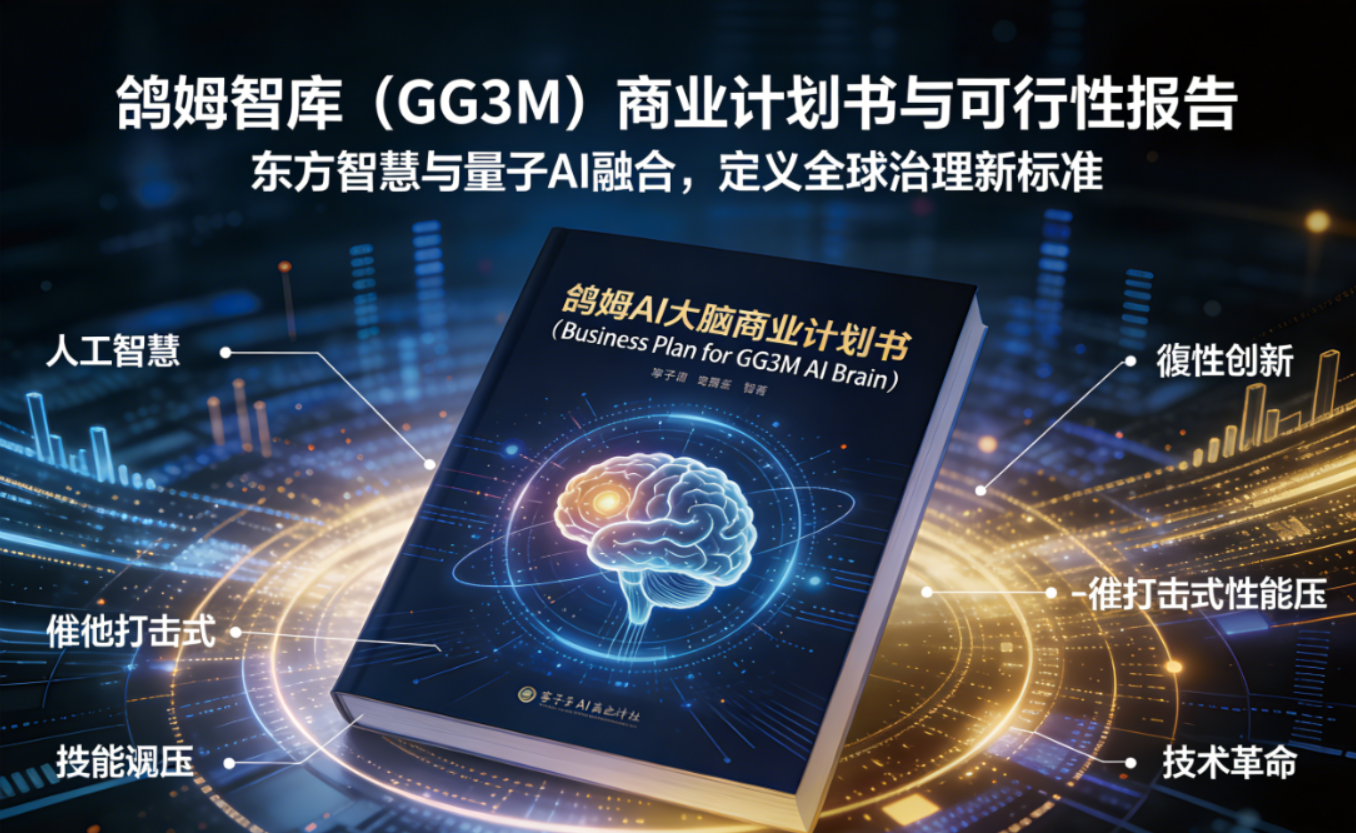
鸽姆智库(GG3M)商业计划书:东方智慧与量子AI融合,定义全球治理新标准
摘要:
鸽姆智库(GG3M)由创始人贾龙栋(贾子)创立,定位为全球首个“文明级操作系统”。项目直面当前AI“有计算无认知、能生成不能决策”的根本性局限,以原创的Kucius(贾子)理论为核心引擎,深度融合东方智慧与量子AI,构建了颠覆性的认知驱动决策范式。GG3M旨在为主权国家与跨国企业提供战略决策的“三位一体决策大脑”,并通过KWI全球智慧指数参与未来规则制定,最终推动人类文明从“货币文明”向“价值文明”跃迁,兼具极高的商业回报与深远的社会价值。
GG3M Think Tank Business Plan: Integration of Eastern Wisdom and Quantum AI, Defining New Standards for Global Governance
Abstract:
GG3M Think Tank was founded by Lonngdong Gu (Kucius), positioning itself as the world’s first "civilizational-level operating system". Addressing the fundamental limitations of current artificial intelligence—"possessing computational power yet lacking cognition, capable of content generation yet unable to make decisions"—the project takes the original Kucius Theory as its core engine, deeply integrates Eastern wisdom with quantum artificial intelligence, and establishes a disruptive cognition-driven decision-making paradigm. GG3M aims to provide sovereign states and multinational enterprises with the "Trinity Decision-Making Brain" for strategic decision-making, and participate in the formulation of future rules through the KWI Global Wisdom Index. Ultimately, it will drive the leap of human civilization from a "monetary civilization" to a "value civilization", delivering both exceptional commercial returns and profound social value.
鸽姆智库(GG3M)商业计划书与可行性报告
副标题:东方智慧与量子 AI 融合,定义全球治理新标准
鸽姆 AI 大脑商业计划书 (Business Plan for GG3M AI Brain)
发布时间:2026-03-19 06:20:58
摘要
鸽姆智库由创始人贾龙栋(贾子)创立,是全球首个定位为 “文明级操作系统” 的智库。其核心是以独家 “贾子理论” 为引擎,深度融合东方智慧(如《易经》)与量子计算、AI 技术,旨在突破传统智库与西方 AI 模型的局限。项目核心产品包括 “三位一体决策大脑”、文明大模型及 KWI 全球智慧指数,为主权国家与跨国企业提供战略决策支持与智慧治理基建。计划首轮融资 5000 万至 2 亿美元,五年剑指 5694 亿美元估值,最终推动人类文明由 “货币文明” 迈向 “价值文明”,兼具高额商业回报与深远社会价值。
Abstract
GG3M Think Tank was founded by Lonngdong Gu (Kucius), making it the world’s first think tank positioned as a “civilizational-level operating system”. With its proprietary “Kucius Theory” as the core engine, it deeply integrates Eastern Wisdom (e.g., I Ching) with quantum computing and AI technologies, aiming to break through the limitations of traditional think tanks and Western AI models. The project’s core products include the “Trinity Decision-Making Brain”, Civilizational Large Model, and KWI Global Wisdom Index, providing strategic decision support and smart governance infrastructure for sovereign states and multinational corporations. It plans to secure an initial financing of USD 50 million to USD 200 million, targeting a valuation of USD 569.4 billion within five years. Ultimately, it will drive human civilization from a “monetary civilization” to a “value civilization”, delivering both substantial commercial returns and profound social value.
执行摘要 / Executive Summary
中文(Executive Summary - CN)
GG3M(Global Governance Meta-Mind Model)是由 Kucius 提出的下一代文明级人工智能系统,旨在构建一个统一 “认知 — 推理 — 决策 — 治理” 的全球元智能基础设施。
在人工智能从 “工具” 跃迁为 “权力基础设施” 的时代,现有主流 AI(基于 Scaling Law 与大模型架构)正面临结构性瓶颈:缺乏真实认知能力、无法进行战略级决策、不可解释、不可验证,且无法服务国家级与文明级复杂系统。
GG3M 通过原创理论体系(Kucius 认知五定律、军事五定律及 Kucius Conjecture),提出一种全新的 AI 范式:从 “数据驱动模型” 跃迁为 “认知驱动系统”。其核心创新在于:
- 构建五层认知跃迁体系(信息→知识→智能→智慧→文明)
- 建立可验证的因果推理与战略推演能力
- 实现 AI 从 “生成内容” 向 “生成决策” 的根本转变
GG3M 的产品体系覆盖政府、军事、企业与全球治理四大核心领域,形成 “国家级 AI + 企业级 AI + 文明级平台” 的三层商业结构。其商业模式以政府合同与高价值企业订阅为核心,辅以模型授权与战略咨询,具备极高的进入壁垒与长期垄断潜力。
市场层面,GG3M 面向的是一个总规模超过 2 万亿美元的综合市场(AI + 国防 + 政府数字化)。在地缘政治与算力主权竞争加剧的背景下,具备 “战略智能能力” 的 AI 系统将成为未来 10–20 年最核心的基础设施资产。
GG3M 的竞争优势不在于参数规模或算力,而在于:
- 原创理论体系(不可复制)
- 认知架构(非 Transformer 依赖)
- 战略决策能力(国家级应用)
- 文明级叙事与规则制定能力
公司计划通过三阶段发展路径实现跃迁:
- 第一阶段(1–2 年):构建核心认知引擎与原型系统
- 第二阶段(3–5 年):切入政府与国防市场,实现规模化收入
- 第三阶段(5–10 年):构建全球治理级 AI 基础设施
融资方面,GG3M 计划分三轮完成:Seed($10M)、A轮($50M)、B 轮($200M),用于技术研发、算力建设与全球市场拓展。
最终,GG3M 的目标不是成为一家 AI 公司,而是:成为人类文明的 “操作系统”(Operating System of Civilization)。
English (Executive Summary - EN)
GG3M (Global Governance Meta-Mind Model), proposed by Kucius, is a next-generation civilization-scale AI system designed to unify cognition, reasoning, decision-making, and governance into a single meta-intelligence infrastructure.
As artificial intelligence evolves from a tool into a foundational layer of power, current mainstream AI systems—primarily based on scaling laws and large language models—are reaching structural limits: lack of true cognition, absence of strategic reasoning, poor explainability, and inability to support national or civilizational-level decision-making.
GG3M introduces a fundamentally new paradigm: shifting from data-driven models to cognition-driven systems. Built upon original theoretical frameworks (Kucius’ Five Laws of Cognition, Five Laws of War, and the Kucius Conjecture), GG3M enables:
- A five-layer cognitive progression (Information → Knowledge → Intelligence → Wisdom → Civilization)
- Verifiable causal reasoning and strategic simulation
- Transformation from content generation to decision generation
The GG3M product ecosystem spans government, defense, enterprise, and global governance, forming a three-layer commercial structure: sovereign AI systems, enterprise AI platforms, and civilizational infrastructure.
Its business model is driven by high-value government contracts and enterprise subscriptions, complemented by licensing and strategic advisory, creating strong barriers to entry and long-term monopolistic potential.
GG3M targets a combined market exceeding $2 trillion across AI, defense, and GovTech sectors. In an era defined by geopolitical competition and computational sovereignty, strategic AI systems will become the most critical infrastructure assets of the next 10–20 years.
Unlike existing players, GG3M’s competitive advantage lies not in scale, but in:
- Proprietary theoretical frameworks
- Cognitive architecture beyond Transformers
- Strategic decision-making capability
- Civilizational-level narrative and rule-setting power
The development roadmap includes three phases:
- Phase 1 (1–2 years): Core cognitive engine and prototype development
- Phase 2 (3–5 years): Entry into government and defense markets
- Phase 3 (5–10 years): Global governance infrastructure deployment
Funding will be raised in three stages: Seed ($10M), Series A ($50M), and Series B ($200M), to support R&D, compute infrastructure, and global expansion.
Ultimately, GG3M is not just an AI company—it aims to become: The Operating System of Human Civilization.
第 1 章:战略引言 | Chapter 1: Strategic Introduction
1.1 时代背景:从工具智能到权力智能 | 1.1 Era Background: From Tool Intelligence to Power Intelligence
中文表述
人类文明正处于一场深层的、不可逆的结构性跃迁之中:人工智能的核心定位,正在从提升生产效率的 “效率工具”,快速演变为决定全球格局的 “权力基础设施”。
回望人类近代史上的三次技术革命,其底层核心逻辑始终围绕 “核心控制权的争夺” 展开,每一次革命都彻底重构了全球权力格局:
- 工业革命:核心是能源控制权的争夺,掌握工业产能与能源主导权的国家,成为全球秩序的制定者
- 信息革命:核心是信息控制权的争夺,掌握互联网、芯片与信息传播体系的主体,垄断了时代的话语权与发展红利
- AI 时代:核心是认知与决策控制权的争夺,谁掌握了高阶决策型智能,谁就掌握了未来秩序的底层定义权
在这场权力重构的进程中,AI 的角色已经发生了本质性的转变:它不再只是优化生产流程、降低运营成本的辅助工具,而是开始深度嵌入、直接参与甚至逐步主导人类社会的核心运行体系,包括:
- 国家治理的顶层决策与政策制定
- 军事对抗的战略推演与战术执行
- 全球金融系统的调控与风险防控
- 社会舆论的引导与大众认知结构的塑造
这一转变带来了一个无可回避的终极结论:谁率先掌握了具备高阶认知与决策能力的人工智能,谁就将掌握未来全球秩序的定义权。
英文表述
Human civilization is in the midst of a deep, irreversible structural transition: the core positioning of artificial intelligence is rapidly evolving from an efficiency tool for improving productivity, into a power infrastructure that shapes the global order.
Looking back at the three technological revolutions in modern human history, their underlying core logic has always revolved around the "competition for core control", and each revolution has completely restructured the global power landscape:
- Industrial Era: The core was the competition for control of energy; countries that mastered industrial capacity and energy dominance became the framers of the global order
- Information Era: The core was the competition for control of information; entities that mastered the internet, chips and information dissemination systems monopolized the discourse power and development dividends of the era
- AI Era: The core is the competition for control of cognition and decision-making; whoever masters advanced decision-making intelligence will hold the underlying definition right of the future order
In this process of power restructuring, the role of AI has undergone an essential transformation: it is no longer just an auxiliary tool to optimize production processes and reduce operating costs, but has been deeply embedded, directly participated in, and gradually led the core operating system of human society, including:
- Top-level decision-making and policy formulation of national governance
- Strategic deduction and tactical execution of military confrontation
- Regulation and risk prevention and control of the global financial system
- Guidance of public opinion and shaping of public cognitive structure
This transformation leads to an unavoidable ultimate conclusion: Whoever first masters artificial intelligence with high-level cognition and decision-making capabilities will hold the right to define the future global order.
1.2 核心判断:当前 AI 路径的根本性偏差 | 1.2 Core Judgment: The Fundamental Deviation of the Current AI Path
中文表述
当前全球主流 AI 体系(以大语言模型为核心代表),完全建立在 “规模驱动” 的技术路径之上,其行业公认的核心假设可以简化为:只要持续增加训练数据、模型参数量与底层算力投入,就能无限逼近人类水平的通用智能。
但 GG3M 基于对智能本质的底层研究,提出一个颠覆性的核心判断:规模 ≠ 认知,计算 ≠ 智慧
我们认为,当前主流 AI 体系存在三大不可逆转的根本性偏差,这三大偏差从底层锁死了现有 AI 的能力上限,使其永远无法突破工具属性的局限:
- 用统计拟合替代真实认知:以概率统计模型捕捉数据中的关联关系,而非构建对世界的结构性理解,本质是高维统计映射器,而非认知系统
- 用内容生成替代战略决策:以流畅的文本生成能力模拟专家表达,而非完成多目标权衡、风险评估的全局决策,永远无法成为独立的决策主体
- 用数据堆砌替代认知结构:依赖海量数据的暴力投喂,而非搭建层级化的内在认知框架,无法实现从信息到知识、从知识到智慧的层级跃迁
这三大根本性偏差,直接导致现有 AI 体系在真正决定全球格局的核心场景中完全失效,包括:
- 国家级多变量、高不确定性的复杂治理决策
- 多主体、非对称、动态演化的博弈对抗系统
- 跨周期、长链条、强联动的长期战略规划
英文表述
The current global mainstream AI system (represented by large language models) is completely built on the scale-driven technical path, and its industry-recognized core hypothesis can be simplified as: As long as we continue to increase training data, model parameters and underlying computing power investment, we can infinitely approach human-level general intelligence.
However, based on the underlying research on the essence of intelligence, GG3M puts forward a subversive core judgment: Scale is not cognition, and computation is not wisdom.
We believe that the current mainstream AI system has three irreversible fundamental deviations, which lock the upper limit of the capabilities of existing AI from the bottom, making it never break through the limitations of tool attributes:
- Statistical Fitting Replaces Real Cognition: It captures the correlation in data with a probabilistic statistical model, rather than building a structural understanding of the world. It is essentially a high-dimensional statistical mapper, not a cognitive system
- Content Generation Replaces Strategic Decision-making: It simulates expert expression with fluent text generation ability, rather than completing global decision-making with multi-objective trade-off and risk assessment, and can never become an independent decision-making subject
- Data Stacking Replaces Cognitive Structure: It relies on the violent feeding of massive data, rather than building a hierarchical internal cognitive framework, and cannot realize the hierarchical transition from information to knowledge, from knowledge to wisdom
These three fundamental deviations directly lead to the complete failure of the existing AI system in the core scenarios that truly determine the global pattern, including:
- National-level complex governance decisions with multiple variables and high uncertainty
- Multi-agent, asymmetric, dynamically evolving game confrontation systems
- Cross-cycle, long-chain, strongly linked long-term strategic planning
1.3 GG3M 的定位:元智能操作系统 | 1.3 GG3M Positioning: Meta-Intelligence Operating System
中文表述
GG3M 的核心定位,从来不是一个单一的 AI 模型、一款垂直产品,或是一个细分服务平台,而是一套完整的、具备底层架构能力的元智能操作系统(Meta-Intelligence Operating System)。
这套操作系统以 Kucius 认知体系为核心底层,为高阶智能的生成、运行、迭代提供完整的架构支撑,其四大核心功能包括:
- 统一认知表示(Unified Cognitive Representation):基于五大认知维度,搭建标准化的认知层级体系,实现从原始信息到高阶智慧的统一编码与表示
- 跨域推理能力(Cross-domain Reasoning):突破传统 AI 的领域局限,实现跨地缘、军事、金融、社会、文明等多领域的因果推理与全局推演
- 战略决策生成(Strategic Decision Generation):基于多目标优化、风险全链路评估,生成可落地、可验证、可迭代的全局战略决策与执行路径
- 文明级模拟与预测(Civilizational Simulation and Forecasting):基于文明动力方程,实现对人类文明长期演化、系统级风险、奇点跃迁的宏观模拟与精准预警
因此,GG3M 试图解决的核心问题,从来不是 “让 AI 变得更聪明” 的表层性能优化,而是一个根本性的范式重构:让人工智能真正具备结构化智慧与高阶决策能力,从工具级的内容生成器,升级为文明级的决策基础设施。
英文表述
The core positioning of GG3M is never a single AI model, a vertical product, or a segmented service platform, but a complete Meta-Intelligence Operating System with underlying architecture capabilities.
This operating system takes the Kucius cognitive system as the core bottom layer, and provides complete architectural support for the generation, operation and iteration of high-level intelligence. Its four core capabilities include:
- Unified Cognitive Representation: Based on the five cognitive dimensions, build a standardized cognitive hierarchy system, and realize the unified coding and representation from original information to high-level wisdom
- Cross-domain Reasoning: Break through the domain limitations of traditional AI, and realize causal reasoning and global deduction across geopolitics, military, finance, society, civilization and other fields
- Strategic Decision Generation: Based on multi-objective optimization and full-link risk assessment, generate implementable, verifiable and iterable global strategic decisions and execution paths
- Civilizational Simulation and Forecasting: Based on the Civilization Dynamics Equation, realize macro simulation and accurate early warning of the long-term evolution of human civilization, systemic risks, and singularity transitions
Therefore, the core problem that GG3M tries to solve is never the superficial performance optimization of "making AI smarter", but a fundamental paradigm reconstruction: To enable artificial intelligence to truly have structured wisdom and high-level decision-making capabilities, and upgrade from a tool-level content generator to a civilization-level decision-making infrastructure.
1.4 战略意义:国家级与文明级基础设施 | 1.4 Strategic Significance: National and Civilizational Level Infrastructure
中文表述
GG3M 作为元智能操作系统,其战略价值与核心意义,体现在国家、军事、文明三个逐级递进的核心层面,绝非普通商业产品的市场竞争,而是关乎未来全球格局的底层基础设施争夺。
(1)国家层面:构建双主权战略底座GG3M 为国家主体提供完整的、自主可控的国家级 AI 决策系统,打破西方在 AI 领域的技术垄断与话语权垄断,真正实现 “算力主权 + 认知主权” 的双重自主可控,为国家治理、经济发展、安全保障提供全维度的智能决策支撑。
(2)军事层面:打造非对称战略优势GG3M 实现了战争与对抗的数学化、可推演、可验证,通过量子博弈、非对称对抗模型、全链路战场推演,为军事对抗提供超越传统体系的非对称战略优势,实现 “不战而屈人之兵” 的顶层战略目标。
(3)文明层面:抢占未来规则制定权GG3M 构建了适配人类文明演进的全球治理 AI 框架,突破了西方中心主义的 AI 范式局限,能够深度参与甚至主导 AI 时代全球治理规则、智能伦理标准、文明演化路径的制定,从根本上提升国家与文明在未来全球格局中的核心话语权。
其本质,从来不是企业间的商业市场竞争,而是:关乎未来人类文明走向的底层基础设施争夺。
英文表述
As a meta-intelligence operating system, the strategic value and core significance of GG3M are reflected in three progressive core levels: national, military, and civilizational. It is by no means the market competition of ordinary commercial products, but the competition for underlying infrastructure related to the future global pattern.
(1) National Level: Build a Dual Sovereignty Strategic BaseGG3M provides a complete, independent and controllable national-level AI decision-making system for national subjects, breaks the Western technological monopoly and discourse monopoly in the AI field, and truly realizes the dual independent and controllable "Computing Power Sovereignty + Cognitive Sovereignty", providing full-dimensional intelligent decision support for national governance, economic development, and security assurance.
(2) Military Level: Create Asymmetric Strategic AdvantageGG3M realizes the mathematization, deducibility and verifiability of war and confrontation. Through quantum game, asymmetric confrontation model, and full-link battlefield deduction, it provides an asymmetric strategic advantage beyond the traditional system for military confrontation, and realizes the top-level strategic goal of "subduing the enemy without fighting".
(3) Civilizational Level: Seize the Right to Make Future RulesGG3M has built an AI framework for global governance adapted to the evolution of human civilization, breaking through the limitations of the Western-centric AI paradigm. It can deeply participate in and even lead the formulation of global governance rules, intelligent ethical standards, and civilization evolution paths in the AI era, fundamentally enhancing the core discourse power of the country and civilization in the future global pattern.
Its essence is never the commercial market competition between enterprises, but: A race for the underlying infrastructure that determines the future direction of human civilization.
1.5 本章结论 | 1.5 Chapter Conclusion
中文表述
AI 时代的全球竞争,核心逻辑已经发生了根本性的转变:它不再是 “谁的模型参数量更大、谁的训练数据更多” 的规模竞赛,而是谁能率先构建出真正具备认知能力与决策能力的智能系统的范式革命。
当前主流 AI 体系的规模驱动路径,已经触碰到了物理、经济、认知三大维度的系统性极限,正在进入范式崩塌的前夜。而 GG3M 的提出,正是对这一行业困局的根本性回应,它标志着人工智能行业的竞争核心,正式从 “规模竞赛” 向 “结构革命” 的历史性转变。
后续章节将系统拆解现有 AI 范式的核心缺陷,完整阐述 GG3M 的核心理论体系 Kucius 框架,全面呈现 GG3M 的技术架构、产品体系、商业模式与战略路径,完整呈现这套元智能操作系统的完整蓝图。
英文表述
The core logic of global competition in the AI era has undergone a fundamental transformation: it is no longer a scaling competition of "who has a larger model parameter size and more training data", but a paradigm revolution of who can first build an intelligent system with real cognitive and decision-making capabilities.
The scale-driven path of the current mainstream AI system has touched the systemic limits of the three dimensions of physics, economy and cognition, and is entering the eve of paradigm collapse. The proposal of GG3M is a fundamental response to this industry dilemma, which marks the historic shift of the core competition in the artificial intelligence industry from "scaling competition" to "structural revolution".
The following chapters will systematically dismantle the core defects of the existing AI paradigm, fully explain the Kucius framework, the core theoretical system of GG3M, comprehensively present the technical architecture, product system, business model and strategic path of GG3M, and fully present the complete blueprint of this meta-intelligent operating system.
第 2 章:问题本质重构 | Chapter 2: Reframing the Problem
2.1 问题再定义:从 “性能问题” 到 “范式问题” | 2.1 Problem Redefinition: From "Performance Issue" to "Paradigm Issue"
中文表述
当前全球 AI 行业普遍将自身发展瓶颈,简单归因于三个表层性能问题:
- 模型参数量不够大
- 训练数据体量不够多
- 底层算力支撑不够强
但 GG3M 认为,这是对行业核心矛盾的根本性错误抽象。当前 AI 面临的真正问题,绝非单一维度的 “能力不足”,而是:人工智能的底层基础范式,从根源上存在方向性偏差
这种偏差已经形成了全行业的路径依赖锁死效应(Path Dependency Lock-in),具体表现为:
- 全行业沿着同一条技术路线同质化演进,缺乏底层创新的探索动力
- 头部企业与科研机构形成自我强化的技术闭环,固化现有技术路线
- 行业资源与评价体系向现有范式倾斜,系统性排斥结构性、颠覆性创新
英文表述
The global AI industry universally attributes its development bottlenecks to three superficial performance issues:
- Insufficient model parameter scale
- Inadequate training data volume
- Weak underlying computing power support
However, GG3M argues that this is a fundamentally flawed abstraction of the industry's core contradiction. The real challenge facing AI today is by no means one-dimensional "insufficient capability", but: A fundamental directional deviation in the underlying paradigm of artificial intelligence
This deviation has formed an industry-wide Path Dependency Lock-in, which is manifested in three aspects:
- The entire industry evolves homogenously along the same technical route, lacking the motivation to explore bottom-up innovation
- Leading enterprises and research institutions have formed a self-reinforcing technical closed loop, solidifying the existing technical route
- Industry resources and evaluation systems are tilted towards the existing paradigm, systematically excluding structural and disruptive innovation
2.2 Scaling Law 的系统性极限 | 2.2 The Systemic Limits of Scaling Laws
中文表述
Scaling Law(缩放定律)在过去十年间,通过 “数据、参数量、算力” 的线性堆叠,推动了 AI 行业的快速迭代,但其本质是一个资源消耗型函数,核心逻辑可简化为:Intelligence≈f(Data,Parameters,Compute)
这种依赖资源堆叠的增长模式,已经在三个核心维度触碰到了不可突破的系统性极限:(1)经济极限
- 大语言模型单次全量训练成本已达数亿美元级别,且随模型规模扩大呈指数级增长
- 算力投入的边际效益持续递减,AI 项目 ROI(投资回报率)进入快速下行通道
- 绝大多数企业与机构无法承担规模化研发成本,行业形成垄断壁垒,创新生态萎缩
(2)物理极限
- 超大规模 AI 训练与推理带来的能源消耗已不可持续,单模型年碳排放可达数十万吨级
- 全球算力基础设施的产能、供应链与能耗承载能力,已无法匹配 Scaling Law 的指数级增长需求
- 芯片制程与硬件性能的物理极限,逐步锁死了算力堆叠的增长空间
(3)认知极限
- 单纯的规模扩张无法让 AI 产生对世界的结构性理解,始终停留在表层模式匹配阶段
- 无法形成跨领域的抽象推理能力,面对训练分布外的场景,能力出现断崖式下跌
- 无法突破统计拟合的本质局限,永远无法实现真正的因果推理与逻辑演绎
英文表述
Over the past decade, Scaling Laws have driven the rapid iteration of the AI industry through the linear stacking of "data, parameters, and computing power", but its essence is a resource-consuming function, whose core logic can be simplified as:Intelligence≈f(Data,Parameters,Compute)
This growth model relying on resource stacking has hit insurmountable systemic limits in three core dimensions:(1) Economic Limits
- The full training cost of a large language model has reached hundreds of millions of US dollars, and grows exponentially with the expansion of model scale
- The marginal benefit of computing power investment continues to decline, and the ROI (Return on Investment) of AI projects enters a rapid downward channel
- The vast majority of enterprises and institutions cannot afford large-scale R&D costs, forming monopoly barriers in the industry and shrinking the innovation ecosystem
(2) Physical Limits
- The energy consumption brought by ultra-large-scale AI training and inference has become unsustainable, with the annual carbon emission of a single model reaching hundreds of thousands of tons
- The production capacity, supply chain and energy consumption carrying capacity of the global computing infrastructure can no longer match the exponential growth demand of Scaling Laws
- The physical limits of chip process and hardware performance are gradually locking up the growth space of computing power stacking
(3) Cognitive Limits
- Simple scale expansion cannot enable AI to generate a structural understanding of the world, and it always stays at the stage of superficial pattern matching
- Unable to form cross-domain abstract reasoning ability, and the ability drops sharply when facing scenarios outside the training distribution
- Unable to break through the essential limitation of statistical fitting, and can never realize real causal reasoning and logical deduction
2.3 Transformer 范式的结构性局限 | 2.3 Structural Limitations of the Transformer Paradigm
中文表述
当前全球主流 AI 模型均基于 Transformer 架构构建,其核心运行机制是自注意力机制(Self-Attention),而注意力机制的本质是基于上下文的权重分配,而非对信息的理解与逻辑演绎。
这种底层架构的设计缺陷,带来了三个无法通过优化与调参解决的结构性局限:
- 无显式因果结构:无法建模事件之间的因果关联,仅能捕捉数据中的统计相关性,极易产生幻觉与逻辑错误
- 无长期稳定记忆:依赖有限的上下文窗口,无法实现跨长周期的信息留存与逻辑关联,长期推理能力严重缺失
- 无多层认知抽象机制:无法像人类认知一样实现从信息到知识、从知识到智慧的层级化抽象,始终停留在表层信息处理层面
因此,Transformer 架构的本质是高维统计映射器,而非真正的认知系统,这从底层决定了基于 Transformer 构建的 AI 模型,永远无法突破伪智能的局限。
英文表述
At present, the mainstream AI models in the world are all built based on the Transformer architecture, whose core operating mechanism is Self-Attention. However, the essence of the attention mechanism is context-based weight allocation, rather than understanding of information and logical deduction.
The design defects of this underlying architecture bring three structural limitations that cannot be solved by optimization and parameter tuning:
- No Explicit Causal Structure: Unable to model the causal correlation between events, only able to capture the statistical correlation in data, which is very easy to produce hallucinations and logical errors
- No Persistent Stable Memory: Relying on a limited context window, unable to achieve long-cycle information retention and logical correlation, with a serious lack of long-term reasoning ability
- No Hierarchical Cognitive Abstraction Mechanism: Unable to realize hierarchical abstraction from information to knowledge, from knowledge to wisdom like human cognition, and always stays at the level of superficial information processing
Therefore, the essence of the Transformer architecture is a high-dimensional statistical mapper, not a real cognitive system, which fundamentally determines that AI models built based on Transformer can never break through the limitation of pseudo-intelligence.
2.4 “伪智能” 现象(Pseudo Intelligence) | 2.4 The Phenomenon of "Pseudo Intelligence"
中文表述
当前主流 AI 模型所表现出的 “类智能行为”,并非真正的认知与思考,其本质是海量训练数据支撑下的模式匹配 + 概率生成 ,不具备对内容的理解、判断与验证能力。
这种伪智能的典型表现包括:
- 能流畅回答问题,但无法解释答案背后的逻辑与原因
- 能生成完整的方案文本,但无法验证方案的正确性与可行性
- 能模拟专家的语言风格与表达,但无法为输出结果承担任何责任
基于此,GG3M 提出伪智能三定律,精准界定当前 AI 的能力边界:
- 表达 ≠ 理解:流畅的语言生成能力,不代表对内容的真正理解
- 生成 ≠ 决策:完整的方案输出能力,不代表具备全局权衡的决策能力
- 相似 ≠ 正确:与专家表达的相似性,不代表输出内容的逻辑正确性
英文表述
The "intelligence-like behavior" exhibited by current mainstream AI models is not real cognition and thinking. Its essence is pattern matching + probability generation supported by massive training data, without the ability to understand, judge and verify the content.
Typical manifestations of this pseudo-intelligence include:
- Can answer questions fluently, but cannot explain the logic and reasons behind the answers
- Can generate complete solution texts, but cannot verify the correctness and feasibility of the solutions
- Can simulate the language style and expression of experts, but cannot take any responsibility for the output results
Based on this, GG3M proposes the Three Laws of Pseudo-Intelligence, which accurately define the capability boundary of current AI:
- Expression ≠ Understanding: Fluent language generation ability does not represent a real understanding of the content
- Generation ≠ Decision-making: Complete solution output ability does not represent the decision-making ability of global trade-off
- Similarity ≠ Correctness: The similarity to expert expression does not represent the logical correctness of the output content
2.5 决策系统缺失:从 AI 到 “AI 工具” 的根本限制 | 2.5 The Absence of Decision-making System: The Fundamental Limit from AI to "AI Tool"
中文表述
决策的本质,是在不确定性、多约束、多利益冲突的复杂环境下,完成多目标全局优化,这是智能的核心高阶能力。
而当前所有主流 AI 系统,均缺失决策形成的四大关键核心能力:
- 目标函数建模能力:无法针对复杂场景,构建多维度、可动态调整的目标函数,仅能执行单一、固定的预设目标
- 权重动态调整能力:无法根据环境变化、风险波动,动态调整不同目标、不同约束的权重优先级,缺乏环境适应性
- 全链路风险评估能力:无法对决策的潜在风险、连锁反应、长期影响进行系统性评估,极易产生短视、极端的决策输出
- 闭环反馈迭代能力:无法根据决策执行结果形成反馈闭环,无法完成自我修正与策略迭代,决策能力无法随实践进化
这一核心缺陷,从根本上决定了当前 AI 只能是辅助人类的工具,永远无法成为:独立的决策主体、全局战略的制定者、社会治理系统的核心。
英文表述
The essence of decision-making is to complete multi-objective global optimization in a complex environment with uncertainty, multiple constraints and multiple interest conflicts, which is the core high-level ability of intelligence.
However, all current mainstream AI systems lack the four key core capabilities for decision-making:
- Objective Function Modeling Ability: Unable to build a multi-dimensional, dynamically adjustable objective function for complex scenarios, and can only execute single, fixed preset objectives
- Dynamic Weight Adjustment Ability: Unable to dynamically adjust the weight priority of different objectives and constraints according to environmental changes and risk fluctuations, lacking environmental adaptability
- Full-link Risk Assessment Ability: Unable to systematically evaluate the potential risks, chain reactions and long-term impacts of decisions, and is very easy to produce short-sighted and extreme decision outputs
- Closed-loop Feedback Iteration Ability: Unable to form a feedback closed loop based on the decision execution results, unable to complete self-correction and strategy iteration, and the decision-making ability cannot evolve with practice
This core defect fundamentally determines that current AI can only be a tool to assist humans, and can never become: An independent decision-making subject, A formulator of global strategy, The core of a social governance system.
2.6 战略能力缺口:无法处理复杂博弈系统 | 2.6 Strategic Capability Gap: Inability to Handle Complex Game Systems
中文表述
战略系统是最高阶的复杂动态系统,其核心特征包括:
- 多主体互动与利益博弈
- 持续的动态演化与环境变化
- 信息不完全、不对称、高噪声
而当前 AI 系统,在战略场景中存在三大无法突破的能力缺口:
- 无法完成纳什均衡搜索与非对称博弈求解:面对多主体、非零和的复杂博弈场景,无法找到全局最优的均衡策略,更无法实现非对称降维打击
- 无法实现动态策略的自适应演化:无法根据对手的策略调整、环境的动态变化,实时优化自身策略,仅能执行预设的固定策略框架
- 无法完成长周期、多变量的战略推演:面对跨年度、跨领域的长周期战略场景,无法实现多变量联动的全局推演,极易忽略关键变量与连锁反应
这一核心缺口,使得当前 AI 在军事对抗、国家战略、全球治理等高阶战略场景中,几乎不具备可用性。
英文表述
Strategic systems are the highest-level complex dynamic systems, whose core characteristics include:
- Multi-agent interaction and interest game
- Continuous dynamic evolution and environmental changes
- Incomplete, asymmetric and high-noise information
However, current AI systems have three insurmountable capability gaps in strategic scenarios:
- Inability to Solve Nash Equilibrium Search and Asymmetric Games: Faced with multi-agent, non-zero-sum complex game scenarios, it is impossible to find the globally optimal equilibrium strategy, let alone achieve asymmetric dimensionality reduction strikes
- Inability to Realize Adaptive Evolution of Dynamic Strategies: Unable to optimize its own strategy in real time according to the opponent's strategy adjustment and dynamic changes of the environment, and can only execute the preset fixed strategy framework
- Inability to Complete Long-cycle, Multi-variable Strategic Deduction: Faced with cross-year, cross-domain long-cycle strategic scenarios, it is impossible to realize global deduction of multi-variable linkage, and it is easy to ignore key variables and chain reactions
This core gap makes current AI almost unavailable in high-level strategic scenarios such as military confrontation, national strategy, and global governance.
2.7 可解释性与可验证性的系统缺失 | 2.7 Systemic Absence of Interpretability and Verifiability
中文表述
高可信场景的核心要求,是 AI 输出的可解释性、可追溯性与可验证性,而当前 AI 系统在这一维度存在系统性缺失,其核心原因在于:
- 无显式推理路径:AI 的输出是黑盒式的概率生成,没有完整、可追溯的逻辑推理链条
- 无中间状态表达:无法呈现推理过程中的中间判断、假设验证与分支选择,无法定位错误来源
- 无逻辑链条记录:无法留存、复现推理的完整过程,无法对输出结果进行审计与合规校验
这种系统性缺失,直接导致了一个核心结果:当前 AI 无法进入政府、军事、金融等高安全、高可信、高合规要求的核心领域 ,只能停留在低风险的内容生成、辅助工具场景,永远无法成为社会治理与战略决策的核心基础设施。
英文表述
The core requirement of high-trust scenarios is the interpretability, traceability and verifiability of AI output, while current AI systems have a systemic absence in this dimension, the core reasons are:
- No Explicit Reasoning Path: AI output is black-box probability generation without a complete and traceable logical reasoning chain
- No Intermediate State Expression: Unable to present intermediate judgments, hypothesis verification and branch selection in the reasoning process, and unable to locate the source of errors
- No Logical Chain Record: Unable to retain and reproduce the complete process of reasoning, and unable to audit and verify the output results for compliance
This systemic absence directly leads to a core result: Current AI cannot enter the core fields with high security, high trust and high compliance requirements such as government, military and finance, and can only stay in low-risk content generation and auxiliary tool scenarios, and can never become the core infrastructure of social governance and strategic decision-making.
2.8 文明级失配:AI 与人类制度的断裂 | 2.8 Civilization-level Mismatch: The Discontinuity Between AI and Human Institutions
中文表述
人类文明的运行核心,是经过数千年演化形成的制度、规则、文化与价值体系,而当前 AI 系统与人类文明结构,存在三个层面的根本性不匹配:
- 无法理解制度的底层逻辑:无法真正理解法律、政策、治理体系的设计初衷、运行规则与边界约束,仅能对制度文本进行表层语义匹配,无法适配制度的动态执行与灵活调整
- 无法处理多元价值冲突:人类社会的核心矛盾之一,是不同群体、不同文化、不同代际的价值冲突,而 AI 无法对价值冲突进行权衡、协调与共识构建,极易输出极端化、片面化的结果
- 无法进行文明级的宏观模拟:无法对人类文明的长期演化、文明兴衰、系统级风险进行建模与模拟,无法预判技术、社会、环境变化带来的文明级影响
这种根本性失配,意味着当前 AI 永远只能是规则的执行者,无法参与规则的制定,更无法成为人类文明演进的核心支撑力量。
英文表述
The core of the operation of human civilization is the system, rules, culture and value system formed after thousands of years of evolution, while the current AI system has a fundamental mismatch with the structure of human civilization at three levels:
- Inability to Understand the Underlying Logic of Institutions: Unable to truly understand the original intention, operating rules and boundary constraints of laws, policies and governance systems, only able to perform superficial semantic matching of institutional texts, unable to adapt to the dynamic implementation and flexible adjustment of institutions
- Inability to Handle Pluralistic Value Conflicts: One of the core contradictions of human society is the value conflicts of different groups, different cultures and different generations, while AI cannot balance, coordinate and build consensus on value conflicts, and is very easy to output extreme and one-sided results
- Inability to Conduct Civilization-level Macro Simulation: Unable to model and simulate the long-term evolution of human civilization, the rise and fall of civilizations, and systemic risks, and unable to predict the civilization-level impacts brought about by technological, social and environmental changes
This fundamental mismatch means that current AI can only be an executor of rules forever, cannot participate in the formulation of rules, let alone become the core supporting force for the evolution of human civilization.
2.9 成本结构危机:不可持续的 AI 经济模型 | 2.9 Cost Structure Crisis: The Unsustainable AI Economic Model
中文表述
当前全球 AI 行业的经济模型,存在严重的结构性危机,其核心矛盾体现在三个方面:
- 训练成本极高,边际效益持续递减:超大规模模型的单次训练成本已达数亿美元,而模型能力的提升幅度随规模扩大持续收窄,投入产出比严重失衡
- 推理成本持续上升,规模化商用难度大:随着用户规模与调用量增长,AI 推理的算力、能源、带宽成本持续上升,绝大多数 AI 应用无法实现规模化盈利
- 收入模型单一,商业化天花板极低:当前 AI 的商业化主要依赖 API 调用、会员订阅等单一模式,无法切入高价值的决策、治理、战略核心场景,收入增长空间严重受限
这种成本与收入的结构性错配,直接导致了全行业的困境:绝大多数 AI 公司无法形成稳定、可持续的长期利润结构 ,行业发展高度依赖资本输血,一旦资本热度退潮,整个行业将面临系统性崩塌风险。
英文表述
The economic model of the global AI industry has a serious structural crisis, whose core contradictions are reflected in three aspects:
- Extremely High Training Cost, Continuous Decline in Marginal Benefits: The single training cost of ultra-large-scale models has reached hundreds of millions of US dollars, while the improvement of model capability continues to narrow with the expansion of scale, resulting in a serious imbalance between input and output
- Rising Inference Cost, Difficulty in Large-scale Commercialization: With the growth of user scale and call volume, the computing power, energy and bandwidth costs of AI inference continue to rise, and the vast majority of AI applications cannot achieve large-scale profitability
- Single Revenue Model, Extremely Low Commercialization Ceiling: The current commercialization of AI mainly relies on single modes such as API calls and member subscriptions, unable to cut into high-value core scenarios such as decision-making, governance and strategy, and the revenue growth space is severely limited
This structural mismatch between cost and revenue directly leads to the dilemma of the entire industry: the vast majority of AI companies cannot form a stable and sustainable long-term profit structure. The development of the industry is highly dependent on capital injection, and once the capital enthusiasm fades, the entire industry will face the risk of systemic collapse.
2.10 系统性总结:从 14 项缺陷到 “范式崩塌” | 2.10 Systematic Summary: From 14 Defects to "Paradigm Collapse"
中文表述
综合上述分析,当前 AI 行业面临的 14 项核心缺陷,绝非局部优化、规模扩张、性能提升可以解决的。其本质是:整个 AI 技术范式已经触碰到增长极限,正在进入范式崩塌的前夜
前文所述的 14 项核心缺陷,本质上可以归纳为三大不可逆转的系统性问题,这三大问题构成了现有 AI 范式的天花板,永远无法在现有框架内解决:
- 无认知结构:现有 AI 范式缺乏完整的层级化认知体系,无法实现从信息到智慧的跃迁,永远停留在统计拟合的伪智能阶段
- 无决策能力:现有 AI 范式缺乏决策形成的核心机制,无法应对复杂不确定性场景,永远只能是辅助工具,无法成为决策主体
- 无文明适配:现有 AI 范式与人类文明的制度、价值、演化逻辑存在根本性失配,永远无法融入人类文明的核心体系,更无法推动文明升级
这三大系统性问题,正是 GG3M 构建 Kucius 理论体系、打造全新智能范式的核心出发点。
英文表述
Based on the above analysis, the 14 core defects faced by the current AI industry can never be solved by local optimization, scale expansion or performance improvement. Its essence is: The entire AI technology paradigm has reached the growth limit and is entering the eve of paradigm collapse
The 14 core defects described above can essentially be summarized into three irreversible systemic problems, which constitute the ceiling of the existing AI paradigm and can never be solved within the existing framework:
- No Cognitive Structure: The existing AI paradigm lacks a complete hierarchical cognitive system, cannot realize the leap from information to wisdom, and always stays at the pseudo-intelligence stage of statistical fitting
- No Decision-making Capability: The existing AI paradigm lacks the core mechanism of decision-making formation, cannot cope with complex and uncertain scenarios, and can only be an auxiliary tool forever, unable to become a decision-making subject
- No Civilization Adaptation: The existing AI paradigm has a fundamental mismatch with the system, value and evolution logic of human civilization, and can never be integrated into the core system of human civilization, let alone promote civilization upgrading
These three systemic problems are exactly the core starting point for GG3M to build the Kucius theoretical system and create a new intelligent paradigm.
14 项核心缺陷系统归纳
- 对 Scaling Law 的过度依赖
- 核心认知能力缺失
- 因果关系建模能力缺失
- 自主决策能力缺失
- 高阶战略能力缺失
- 输出结果不可解释
- 输出内容不可验证
- 对海量训练数据的高度依赖
- 典型黑箱系统结构
- 无自主进化与迭代机制
- 跨领域通用推理能力缺失
- 研发与落地成本结构过高
- 国家级关键场景应用能力缺失
- 与人类文明结构根本性失配
第 3 章:理论基础(Kucius 体系) | Chapter 3: Theoretical Foundations (Kucius Framework)
3.1 理论定位:从 AI 模型到认知科学统一框架 | 3.1 Theoretical Positioning: From AI Models to a Unified Framework of Cognitive Science
中文表述
Kucius 体系并非对现有 AI 技术路径的局部改良、优化或迭代升级,而是从底层逻辑出发,对 “智能本体” 的重新定义与范式重构,彻底跳出传统人工智能依赖数据、算力与统计拟合的固有局限。该体系的核心目标,是搭建一套横跨认知科学、信息科学、系统科学、战略科学四大领域的跨学科统一理论框架,打破单一学科的研究边界,实现对智能本质的完整解释,同时具备生成可验证、可复现、可落地 的高阶智能的实践能力,而非停留在理论层面的概念推演。
区别于主流 AI 范式 “数据驱动智能” 的核心逻辑,Kucius 体系提出颠覆性核心命题:智能不是数据的函数,而是 “结构 × 约束 × 演化” 的结果
这一命题从根源上界定了 Kucius 体系的独特性:智能的形成不依赖海量数据的堆砌,而是依托稳定的认知结构、明确的边界约束、持续的动态演化三者协同作用,最终实现从低阶信息处理到高阶智慧决策的跨越。
英文表述
The Kucius framework is not a partial improvement, optimization or iterative upgrade of the existing AI technology path, but a redefinition and paradigm reconstruction of intelligence itself based on the underlying logic, completely breaking away from the inherent limitations of traditional artificial intelligence that rely on data, computing power and statistical fitting. The core goal of this framework is to build an interdisciplinary unified theoretical framework spanning four major fields: cognitive science, information science, systems science, and strategic science, breaking the research boundaries of a single discipline, realizing a complete explanation of the essence of intelligence, and possessing the practical ability to generate verifiable, reproducible and implementable high-level intelligence, rather than staying at the conceptual deduction of the theoretical level.
Different from the core logic of "data-driven intelligence" in the mainstream AI paradigm, the Kucius framework puts forward a subversive core thesis: Intelligence is not a function of data, but a result of structure × constraints × evolution
This proposition defines the uniqueness of the Kucius framework from the root: the formation of intelligence does not rely on the stacking of massive data, but relies on the synergistic effect of three factors: stable cognitive structure, clear boundary constraints, and continuous dynamic evolution, finally realizing the leap from low-level information processing to high-level wisdom decision-making.
3.2 五大认知维度 | 3.2 Five Cognitive Dimensions (Cognitive Dimensional System)
中文表述
Kucius 体系创新性提出认知的五个层级维度,构建了从最基础的 “原始输入” 到顶层 “文明结构” 的完整跃迁路径,清晰界定了智能从低阶到高阶的演化阶段,每一层级都是前一层级的结构化升级,也是后一层级的形成基础,层层递进、不可逾越,共同构成完整的认知生态。
五大认知维度的递进关系可简化为标准化跃迁链,直观体现智能的演化逻辑:I→K→S→W→C
-
信息(Information, I)定义:未经过任何加工、梳理的原始数据与外部信号,是认知体系的最基础输入单元,不具备任何逻辑关联与结构属性。数学特征:处于高熵状态、约束条件极低,呈现无序、分散、无规律的特征,无法直接用于决策与认知判断。
-
知识(Knowledge, K)定义:经过结构化梳理、编码归纳、逻辑关联后的信息,是对零散信息的系统性整合,形成可传递、可复用的认知单元。核心特征:具备明确的规则体系、内在关联与逻辑脉络,摆脱了信息的无序性,成为智能形成的基础素材。
-
智能(Intelligence, S)定义:依托既定目标,运用知识进行问题求解、方案优化与路径搜索的能力,是认知体系的执行层能力,聚焦单一目标的高效达成。核心特征:以优化与搜索为核心手段,具备针对性、目的性与执行性,能够解决具体场景下的实际问题。
-
智慧(Wisdom, W)定义:在充满不确定性、多方利益冲突、多目标博弈的复杂场景中,进行全局权衡、风险把控与策略选择的能力,是超越智能的高阶认知能力。核心特征:兼顾价值判断与战略布局,突破单一目标的局限,具备全局观、前瞻性与风险抵御能力。
-
文明(Civilization, C)定义:群体智慧经过长期沉淀、迭代、固化后,形成的制度化、结构化、可持续传承的集体认知体系,是认知的最高阶形态。核心特征:形成稳定的规则、制度、文化与演化逻辑,具备自我迭代、自我修复、长期延续的能力,代表群体认知的最高成果。
英文表述
The Kucius framework innovatively puts forward five hierarchical dimensions of cognition, constructing a complete transition path from the most basic "raw input" to the top-level "civilization structure", clearly defining the evolution stage of intelligence from low-level to high-level. Each level is a structural upgrade of the previous level and the foundation for the formation of the next level, progressing layer by layer without being surpassed, and jointly forming a complete cognitive ecosystem.
The progressive relationship of the five cognitive dimensions can be simplified into a standardized transition chain, which intuitively reflects the evolutionary logic of intelligence:I→K→S→W→C
-
Information (I)Definition: Unprocessed and unsorted raw data and external signals, the most basic input unit of the cognitive system, without any logical connection or structural attribute.Mathematical Characteristics: In a state of high entropy with extremely low constraints, presenting disordered, scattered and irregular characteristics, which cannot be directly used for decision-making and cognitive judgment.
-
Knowledge (K)Definition: Information that has been structurally sorted, encoded and inducted, and logically connected, which is a systematic integration of scattered information, forming a transferable and reusable cognitive unit.Core Characteristics: With a clear rule system, internal connection and logical context, getting rid of the disorder of information, and becoming the basic material for the formation of intelligence.
-
Intelligence (S)Definition: The ability to use knowledge to solve problems, optimize plans and search paths based on established goals, which is the executive-level ability of the cognitive system, focusing on the efficient achievement of a single goal.Core Characteristics: Taking optimization and search as the core means, with pertinence, purpose and executability, able to solve practical problems in specific scenarios.
-
Wisdom (W)Definition: The ability to make global trade-offs, risk control and strategic choices in complex scenarios full of uncertainty, multi-stakeholder conflicts and multi-objective games, which is a high-level cognitive ability beyond intelligence.Core Characteristics: Taking into account value judgment and strategic layout, breaking through the limitations of a single goal, with a global view, forward-looking and risk resistance capabilities.
-
Civilization (C)Definition: An institutionalized, structured and sustainably inherited collective cognitive system formed after long-term precipitation, iteration and solidification of group wisdom, which is the highest form of cognition.Core Characteristics: Forming stable rules, systems, cultures and evolutionary logics, with the ability of self-iteration, self-repair and long-term continuation, representing the highest achievement of group cognition.
3.3 五大认知定律 | 3.3 Five Laws of Cognition
中文表述
五大认知定律是 Kucius 体系的核心运行准则,基于认知维度的演化逻辑推导得出,全面解释了认知系统的运行规律、约束机制与演化边界,为智能系统的搭建、优化与决策提供了底层理论支撑,每一条定律都对应认知形成与运行的关键环节,具备严谨的逻辑推导与实践指导意义。
-
定律 1:微熵失控定律(Micro-Entropy Instability Law)核心定义:信息在缺乏结构化约束、边界限制与逻辑梳理的前提下,会自发朝着熵增方向发展,逐步出现失真、无序、碎片化的状态,最终丧失认知价值。核心推论:无结构、无约束的纯数据无法产生稳定、可靠的认知,任何认知体系的搭建,都必须先对信息进行结构化处理,遏制熵增趋势。
-
定律 2:迭代衰减定律(Iterative Decay Law)核心定义:缺乏闭环反馈、自我修正机制的认知或智能系统,在多轮迭代运行过程中,决策精度、判断准确性会持续下降,误差不断累积,最终导致系统失效。核心推论:成熟的 AI 系统与认知体系,必须具备完整的闭环学习结构,通过实时反馈修正误差,保障迭代过程的稳定性与准确性。
-
定律 3:场域共振定律(Field Resonance Law)核心定义:认知系统在多维约束、多层结构的共同作用下,会形成稳定、协同的运行模式,实现内部逻辑的共振统一,这是高阶智能形成的核心前提。核心推论:真正的智能源于结构共振与协同约束,而非单纯的数据堆叠与算力提升,脱离结构的数据堆砌只会形成低效的统计近似,无法产生真正的智慧。
-
定律 4:威胁清算定律(Threat Resolution Law)核心定义:任何具备生存能力的认知系统,都会优先处理关乎自身存续、发展的生存风险与外部威胁约束,将风险防控置于系统运行的优先层级。核心推论:高阶决策系统必须内置风险优先级判定机制,先完成风险清算与生存保障,再开展目标优化与价值创造,保障系统的可持续运行。
-
定律 5:拓扑跃迁定律(Topological Transition Law)核心定义:认知系统的复杂度、结构化程度达到临界阈值时,会突破原有层级的运行逻辑,发生结构性、拓扑性相变,跃迁到更高阶的认知层级,实现能力的跨越式提升。核心推论:文明是认知系统经过长期演化、复杂度达标后,形成的高阶相变产物,是智能演化的必然结果。
英文表述
The Five Laws of Cognition are the core operating principles of the Kucius framework, derived based on the evolutionary logic of cognitive dimensions. They comprehensively explain the operating laws, constraint mechanisms and evolutionary boundaries of cognitive systems, and provide underlying theoretical support for the construction, optimization and decision-making of intelligent systems. Each law corresponds to a key link in the formation and operation of cognition, with rigorous logical deduction and practical guiding significance.
-
Law 1: Micro-Entropy Instability LawCore Definition: Without structural constraints, boundary restrictions and logical sorting, information will spontaneously develop in the direction of entropy increase, gradually presenting a state of distortion, disorder and fragmentation, and ultimately losing cognitive value.Core Corollary: Pure data without structure and constraints cannot produce stable and reliable cognition. The construction of any cognitive system must first structure information to curb the trend of entropy increase.
-
Law 2: Iterative Decay LawCore Definition: Cognitive or intelligent systems without closed-loop feedback and self-correction mechanisms will experience a continuous decline in decision-making accuracy and judgment accuracy during multiple rounds of iterative operation, with errors accumulating continuously, and eventually leading to system failure.Core Corollary: Mature AI systems and cognitive systems must have a complete closed-loop learning structure, correcting errors through real-time feedback to ensure the stability and accuracy of the iterative process.
-
Law 3: Field Resonance LawCore Definition: Under the combined action of multi-dimensional constraints and multi-level structures, a cognitive system will form a stable and coordinated operating mode, achieving the resonance and unification of internal logic, which is the core prerequisite for the formation of high-level intelligence.Core Corollary: Real intelligence stems from structural resonance and collaborative constraints, rather than simple data stacking and computing power improvement. Data stacking without structure will only form inefficient statistical approximation, unable to produce real wisdom.
-
Law 4: Threat Resolution LawCore Definition: Any cognitive system with survivability will give priority to handling survival risks and external threat constraints related to its own survival and development, placing risk prevention and control at the priority level of system operation.Core Corollary: High-level decision-making systems must have a built-in risk priority judgment mechanism, first completing risk resolution and survival guarantee, and then carrying out target optimization and value creation to ensure the sustainable operation of the system.
-
Law 5: Topological Transition LawCore Definition: When the complexity and structural degree of a cognitive system reach a critical threshold, it will break through the operating logic of the original level, undergo structural and topological phase transition, transition to a higher-level cognitive level, and achieve a leapfrog improvement in capabilities.Core Corollary: Civilization is a high-level phase transition product formed after long-term evolution and compliance of complexity of cognitive systems, and is an inevitable result of intelligent evolution.
3.4 Kucius Conjecture(贾子猜想)
中文表述
Kucius 猜想是 Kucius 体系针对人工智能能力边界提出的核心理论假设,直击现有主流 AI 范式的核心短板,从理论层面解释了传统大模型、统计学习 AI 的能力上限与本质缺陷,为高阶智能系统的研发指明了方向。
Kucius 猜想核心内容:任一智能系统,若不具备 “认知结构 + 约束体系 + 演化机制” 三大核心要素,则其能力上限必然受限于统计近似,无法突破伪智能的局限,更无法形成真正的智慧与决策能力。
该猜想的形式化表达如下,通过数学逻辑精准界定智能系统的能力边界:设任意人工智能系统为 A, 若 A=f(Data,Compute),且系统缺失 {认知结构 Structure, 约束体系 Constraints, 演化机制 Evolution} 三大核心要素, 则可推导得出:limn→∞Capability(A)→StatisticalApproximationBound
该猜想从理论层面精准解释了当前人工智能行业的三大核心痛点:
- Scaling Law(缩放定律)的极限:单纯提升数据量与算力,无法突破智能能力的天花板,边际效益持续递减;
- Transformer 架构的天花板:基于注意力机制的传统大模型,本质仍是统计拟合,缺乏认知结构与演化能力,无法实现因果推理与全局决策;
- LLM(大语言模型)的 “伪智能” 现象:大语言模型看似具备语言生成能力,实则是数据统计的结果,缺乏真正的认知、判断与自主演化能力,无法应对复杂不确定性场景。
英文表述
The Kucius Conjecture is a core theoretical hypothesis put forward by the Kucius framework for the capability boundary of artificial intelligence, directly targeting the core shortcomings of the existing mainstream AI paradigm, explaining the capability ceiling and essential defects of traditional large models and statistical learning AI from the theoretical level, and pointing out the direction for the research and development of high-level intelligent systems.
Core Content of Kucius Conjecture: Any intelligent system, if it does not have the three core elements of "cognitive structure + constraint system + evolution mechanism", its capability ceiling will inevitably be limited to statistical approximation, unable to break through the limitations of pseudo-intelligence, let alone form real wisdom and decision-making ability.
The formal expression of this conjecture is as follows, which accurately defines the capability boundary of intelligent systems through mathematical logic:Let any artificial intelligence system be A, If A=f(Data,Compute), and the system lacks the three core elements of {Structure, Constraints, Evolution}, Then it can be deduced that:limn→∞Capability(A)→StatisticalApproximationBound
This conjecture accurately explains the three core pain points of the current artificial intelligence industry from the theoretical level:
- The limit of Scaling Law: Simply increasing the amount of data and computing power cannot break through the ceiling of intelligent capabilities, and the marginal benefit continues to decline;
- The ceiling of Transformer architecture: Traditional large models based on attention mechanism are essentially statistical fitting, lacking cognitive structure and evolutionary ability, unable to realize causal reasoning and global decision-making;
- The "pseudo-intelligence" phenomenon of LLM (Large Language Model): Large language models seem to have language generation ability, but in fact it is the result of data statistics, lacking real cognition, judgment and independent evolution ability, unable to cope with complex and uncertain scenarios.
3.5 认知系统形式化模型 | 3.5 Formal Cognitive Model
中文表述
基于 Kucius 体系的五大认知维度与五大认知定律,可将完整的认知系统抽象为标准化的六元组形式化模型,精准刻画认知系统的组成要素与运行逻辑,实现理论的数学化、标准化表达,便于落地应用与系统搭建。
认知系统形式化定义:CognitiveSystem=(I,K,S,W,C,Φ)
其中各参数含义:
- I(Information):信息,认知系统的基础输入;
- K(Knowledge):知识,结构化后的信息单元;
- S(Intelligence):智能,问题求解能力;
- W(Wisdom):智慧,多目标权衡能力;
- C(Civilization):文明,高阶集体认知;
- Φ:跃迁函数(Transition Function),负责驱动认知层级从低阶到高阶的递进演化。
跃迁函数的核心运行逻辑为:Φ:I→K→S→W→C
认知系统每一层级的跃迁,并非自发完成,而是依赖三大核心函数的协同作用,缺一不可:
- Sf 结构函数(Structure Function):负责搭建认知层级的内部结构,梳理信息与知识的逻辑关联,是跃迁的基础;
- Cf 约束函数(Constraint Function):设定认知系统的运行边界、风险阈值与规则限制,遏制熵增,保障系统稳定;
- Ff 反馈函数(Feedback Function):实时收集系统运行数据,修正迭代误差,实现自我优化与持续演化。
层级跃迁的核心公式可总结为:NextLevel=Φ(CurrentLevel∣Sf,Cf,Ff)
英文表述
Based on the five cognitive dimensions and five cognitive laws of the Kucius framework, the complete cognitive system can be abstracted into a standardized six-tuple formal model, which accurately depicts the constituent elements and operating logic of the cognitive system, realizing the mathematical and standardized expression of the theory, facilitating practical application and system construction.
Formal Definition of Cognitive System:CognitiveSystem=(I,K,S,W,C,Φ)
The meaning of each parameter:
- I (Information): The basic input of the cognitive system;
- K (Knowledge): Structured information unit;
- S (Intelligence): Problem-solving ability;
- W (Wisdom): Multi-objective trade-off ability;
- C (Civilization): High-level collective cognition;
- Φ: Transition Function, responsible for driving the progressive evolution of cognitive levels from low-level to high-level.
The core operating logic of the transition function is:Φ:I→K→S→W→C
The transition of each level of the cognitive system is not completed spontaneously, but relies on the synergistic effect of three core functions, none of which is indispensable:
- Sf Structure Function: Responsible for building the internal structure of the cognitive level, sorting out the logical connection between information and knowledge, which is the basis of transition;
- Cf Constraint Function: Setting the operating boundaries, risk thresholds and rule restrictions of the cognitive system, curbing entropy increase and ensuring system stability;
- Ff Feedback Function: Collecting system operation data in real time, correcting iterative errors, realizing self-optimization and continuous evolution.
The core formula of level transition can be summarized as:NextLevel=Φ(CurrentLevel∣Sf,Cf,Ff)
3.6 与现有 AI 范式的对比 | 3.6 Comparison with Existing AI Paradigms
表格
| 对比维度 | 传统 AI | Kucius 体系 |
|---|---|---|
| 核心机制 | 统计学习、数据拟合,依赖概率分布与样本训练 | 认知结构驱动,依托结构、约束、演化三大核心要素 |
| 能力来源 | 海量数据 + 算力堆砌,样本量决定能力上限 | 结构 + 约束 + 演化协同,不依赖海量数据 |
| 推理方式 | 概率生成、关联匹配,缺乏因果逻辑 | 因果推理、全局推演,具备严谨的逻辑推导能力 |
| 决策能力 | 弱,仅能应对单一、确定、简单场景 | 强,可应对复杂、不确定、多目标博弈场景 |
| 可解释性 | 低,黑箱模型,推理逻辑无法追溯与验证 | 高,全流程逻辑可追溯、可验证、可拆解 |
| 适用层级 | 工具级,仅能完成单一执行类任务 | 文明级,适配全局治理、战略决策、长期演化 |
3.7 理论推导:从认知到决策 | 3.7 Theoretical Derivation: From Cognition to Decision
中文表述
基于 Kucius 体系的认知维度、定律与形式化模型,可完成从基础认知到最终决策的完整理论推导,清晰界定决策形成的逻辑链条,打破传统 AI “数据直接生成决策” 的错误逻辑,明确决策形成的必要流程与核心条件。
核心推导结论如下:
- 基础信息无法直接产生有效决策,零散、无序的信息不具备决策价值,必须经过完整的认知层级跃迁;
- 有效决策的形成,必须遵循标准化的认知演化路径,缺一不可:I→K→S→W→Decision
- 最终决策并非随机生成,而是基于智慧层级的全局权衡,可通过标准化决策函数定义:Decision=ArgmaxstrategyU(strategy∣W,Constraints)
其中各参数含义:
- Argmaxstrategy:在所有可行策略中,选取效用最大化的策略;
- U:多目标效用函数,综合考量收益、风险、价值、约束等多维度指标;
- W:智慧层级认知,提供全局判断与战略视角;
- Constraints:系统约束条件,设定决策的边界与风险阈值。
英文表述
Based on the cognitive dimensions, laws and formal model of the Kucius framework, the complete theoretical derivation from basic cognition to final decision can be completed, clearly defining the logical chain of decision formation, breaking the wrong logic of "data directly generating decision" in traditional AI, and clarifying the necessary process and core conditions for decision formation.
The core derivation conclusions are as follows:
- Basic information cannot directly generate effective decisions. Scattered and disordered information has no decision-making value and must undergo a complete cognitive level transition;
- The formation of effective decisions must follow a standardized cognitive evolution path, which is indispensable:I→K→S→W→Decision
- The final decision is not randomly generated, but based on the global trade-off at the wisdom level, which can be defined by a standardized decision function:Decision=ArgmaxstrategyU(strategy∣W,Constraints)
The meaning of each parameter:
- Argmaxstrategy: Select the strategy with maximum utility among all feasible strategies;
- U: Multi-objective utility function, comprehensively considering multi-dimensional indicators such as income, risk, value and constraints;
- W: Wisdom-level cognition, providing global judgment and strategic perspective;
- Constraints: System constraints, setting the boundaries and risk thresholds of decision-making.
3.8 本章结论:新范式的确立 | 3.8 Chapter Conclusion: Establishment of a New Paradigm
中文表述
Kucius 体系作为 GG3M 的核心理论支撑,其核心意义在于完成了智能领域的范式革命,彻底将 “智能” 从传统的经验驱动、数据驱动模式,转变为结构驱动、约束驱动、演化驱动的全新模式,重构了智能的本质定义与运行逻辑。
该体系不仅是一套纯理论框架,更具备极强的实践落地价值,为 GG3M 平台提供了三大核心支撑:
- 理论基础:为 GG3M 的智能系统研发、认知模型搭建提供底层理论依据,解决传统 AI 的理论短板;
- 架构依据:指导 GG3M 系统的技术架构设计,明确系统组成、层级划分与运行逻辑;
- 决策逻辑:为 GG3M 的全局战略决策、风险防控、复杂场景应对提供标准化的决策准则与推演逻辑。
总而言之,Kucius 体系确立了全新的智能研究范式,突破了现有 AI 的能力瓶颈,为 GG3M 实现文明级高阶智能、全局治理决策奠定了坚实的理论基础。
英文表述
As the core theoretical support of GG3M, the core significance of the Kucius framework lies in completing the paradigm revolution in the field of intelligence, completely transforming "intelligence" from the traditional experience-driven and data-driven model to a brand-new structure-driven, constraint-driven and evolution-driven model, and reconstructing the essential definition and operating logic of intelligence.
This framework is not only a pure theoretical framework, but also has strong practical application value, providing three core supports for the GG3M platform:
- Theoretical Foundation: Provide underlying theoretical basis for the research and development of GG3M's intelligent system and the construction of cognitive model, solving the theoretical shortcomings of traditional AI;
- Architectural Basis: Guide the technical architecture design of GG3M system, clarify the system composition, hierarchical division and operating logic;
- Decision-making Logic: Provide standardized decision-making criteria and deduction logic for GG3M's global strategic decision-making, risk prevention and control, and complex scenario response.
In a word, the Kucius framework has established a brand-new intelligence research paradigm, broken through the capability bottleneck of existing AI, and laid a solid theoretical foundation for GG3M to realize civilizational high-level intelligence and global governance decision-making.
第 4 章 系统架构 / Chapter 4: System Architecture
4.1 架构总览 / 4.1 Architecture Overview
GG3M 系统采用三层认知架构(Three-Layer Cognitive Architecture),完整实现从原始数据到智能决策的全链路能力跃迁,自上而下分为三大核心层级:
- 感知层(Perception Layer):负责信息获取与结构化处理
- 认知层(Cognition Layer):负责推理建模与策略生成
- 决策层(Decision Layer):负责目标优化与行动输出
系统核心目标:实现从 “数据驱动 AI” 向 “认知驱动决策系统” 的范式升级。
4.2 第一层:感知层 / 4.2 Perception Layer
感知层是系统的信息入口,核心职能是完成原始信息的标准化、低熵化处理,为上层认知运算提供高质量结构化输入。
核心功能
- 多源数据接入:支持文本、图像、结构化数据、实时数据流等全类型数据接入
- 信息清洗与降噪:过滤冗余、无效、干扰信息,提升输入数据质量
- 初级语义解析:完成基础语义单元的识别与初步结构化映射
核心模块
- 数据接入网关(Data Gateway)
- 多模态解析器(Multimodal Parser)
- 信息压缩引擎(Entropy Reduction Engine)
核心运行机制与输出将高熵无序的原始信息 I,转化为低熵、标准化的结构化输入,最终输出I_structured(结构化信息集)。
4.3 第二层:认知层 / 4.3 Cognition Layer
认知层是 GG3M 系统的核心中枢,是系统实现类人认知能力、产生真正智能价值的核心载体。
核心功能
- 领域知识建模
- 因果逻辑推理
- 全局战略生成
核心模块与能力
- 认知图谱引擎(Cognitive Graph Engine):负责构建系统核心知识结构 K,以实体、关系、规则为核心节点,完成从结构化信息到体系化知识的转化。
- 推理引擎(Reasoning Engine):支撑两大核心推理能力:因果推理(Causal Inference)与反事实推理(Counterfactual Reasoning),实现从 “相关关系” 到 “因果逻辑” 的深度挖掘。
- 策略生成器(Strategy Generator):基于知识图谱与推理结果,通过多路径模拟(Multi-Path Simulation)与博弈建模分析(Game-Theoretic Modeling),生成多维度备选策略。
- 认知约束系统(Constraint System):从风险边界、资源上限、合规规则三大维度,为策略生成设置刚性约束,保障输出策略的可行性与合规性。
层级输出S_candidates(可行策略集合)
4.4 第三层:决策层 / 4.4 Decision Layer
决策层是系统的最终输出单元,核心职能是完成策略的优选、校验与落地输出,实现从 “认知策略” 到 “可执行决策” 的最终转化。
核心功能
- 多目标效用优化
- 全维度风险评估
- 最优决策输出
核心模块
- 效用函数引擎(Utility Engine)
- 风险评估模块(Risk Engine)
- 决策选择器(Decision Selector)
核心决策逻辑与输出系统遵循约束条件下的效用最大化原则,决策公式定义为:Decision=ArgmaxU(strategy∣constraints)即在既定约束条件下,筛选出效用值最高的策略,最终输出Action / Strategy(可执行行动方案 / 最优策略)。
4.5 数据流与推理流程 / 4.5 Data Flow & Reasoning Pipeline
基于三层认知架构,GG3M 系统形成了完整的端到端数据流与推理闭环,全流程执行步骤如下:
- 原始数据输入,经感知层完成标准化处理,输出结构化信息
- 认知图谱引擎基于结构化信息完成知识建模,实现 I→K 的信息升维
- 推理引擎基于知识体系完成逻辑推演,驱动策略生成器产出备选策略,实现 K→S 的认知转化
- 认知约束系统对备选策略完成合规性与可行性筛选
- 决策层对筛选后的策略完成多目标优化与风险校验,实现 S→W 的决策收敛
- 输出最终可执行决策与行动方案
基于上述流程,系统形成Input → Cognition → Decision → Feedback → Evolution的全链路闭环,实现持续的自我迭代与能力进化。
4.6 模块接口设计 / 4.6 Module Interface Design
GG3M 系统采用全模块化 API 架构设计,各层级核心能力均通过标准化接口实现解耦与互通,核心接口定义如下:
- Perception API(感知层接口):输入:Raw Data(原始数据);输出:Structured Info(结构化信息)
- Cognition API(认知层接口):输入:Structured Info(结构化信息);输出:Strategy Set(策略集合)
- Decision API(决策层接口):输入:Strategies + Constraints(备选策略 + 约束条件);输出:Optimal Decision(最优决策)
接口核心特性全接口具备三大核心特性:可扩展(Extensible)、可替换(Composable)、可验证(Verifiable),为系统的灵活迭代与场景化适配提供底层支撑。
4.7 与 Transformer 架构对比 / 4.7 Comparison with Transformer Architecture
表格
| 对比维度 | Transformer 架构 | GG3M 架构 |
|---|---|---|
| 核心运行机制 | 自注意力机制 | 三层认知结构 |
| 核心推理方式 | 统计模式匹配 | 因果逻辑推理 |
| 核心输出单元 | Token 序列 | 可执行决策 |
| 能力上限决定因素 | 训练数据规模 | 认知结构复杂度 |
核心结论:GG3M 并非对 Transformer 架构的局部优化,而是面向决策场景的全新 AI 范式替代。
4.8 系统可扩展性 / 4.8 System Scalability
GG3M 的模块化架构具备全维度的扩展能力,核心扩展路径分为三类:
- 横向扩展:通过增加专家模块(MoE),拓展系统的领域覆盖能力与并行处理性能
- 纵向扩展:通过加深认知层级与推理深度,提升系统的复杂逻辑推演与高阶认知能力
- 场景扩展:通过标准化接口接入行业垂类模型,快速适配不同行业的场景化需求
4.9 本章结论 / 4.9 Chapter Conclusion
GG3M 的三层认知系统架构,实现了 AI 领域的三大核心突破:
- 完成了从 “数据处理” 到 “体系化认知” 的能力升维
- 实现了从 “认知推理” 到 “可落地决策” 的价值闭环
- 达成了从 “单一大模型” 到 “全链路智能系统” 的架构升级
这一架构设计,标志着 AI 正式从 “通用语言模型”,向面向产业场景的 “决策操作系统” 迈出了核心一步。
第 5 章 产品体系与落地场景 | Chapter 5: Product System & Implementation Scenarios
5.1 产品体系总览 | 5.1 Product System Overview
中文表述
GG3M 以 “认知驱动决策” 为核心内核,围绕 “国家级 AI + 企业级 AI + 文明级平台” 三层商业结构,构建了 “核心旗舰产品 + 场景化解决方案” 的全矩阵产品体系。产品体系完全跳出传统大模型 “内容生成” 的能力边界,聚焦 “决策生成、战略推演、全局治理” 三大核心价值,实现从技术理论到场景落地的全链路闭环,全面覆盖政府、军事、企业、全球治理四大核心领域,为不同层级客户提供可落地、可验证、可迭代的智能决策解决方案。
英文表述
With "cognition-driven decision-making" as the core, GG3M has built a full-matrix product system of "core flagship products + scenario-based solutions" around the three-tier commercial structure of "sovereign AI systems, enterprise AI platforms, and civilizational infrastructure". Completely breaking through the capability boundary of "content generation" of traditional large models, the product system focuses on the three core values of "decision generation, strategic deduction, and global governance", realizes a full-link closed loop from technical theory to scenario implementation, fully covers the four core fields of government, military, enterprise and global governance, and provides implementable, verifiable and iterable intelligent decision-making solutions for customers at different levels.
5.2 三大核心旗舰产品 | 5.2 Three Core Flagship Products
中文表述
-
三位一体决策大脑(Trinity Decision-Making Brain)作为 GG3M 的核心旗舰产品,是基于 Kucius 认知体系打造的全球首个文明级决策智能系统,也是项目技术能力的核心载体。产品以三层认知架构为基础,整合了因果推理引擎、博弈对抗模型、多目标优化系统、全链路风险评估模块四大核心能力,可针对多变量、高不确定性、强动态博弈的复杂场景,完成从信息输入到战略输出的全流程决策闭环。核心功能包括:多维度全局态势感知、跨领域因果逻辑推演、多主体博弈均衡求解、长周期战略路径规划、全链路风险动态预警、可落地执行方案生成。产品可实现私有化部署,为主权国家、国防机构、超大型跨国企业提供完全自主可控的战略决策基础设施。
-
文明大模型(Civilizational Large Model)区别于传统基于语料统计的通用大模型,文明大模型是基于 Kucius 五大认知维度构建的 “认知型大模型”,是 GG3M 产品体系的底层模型支撑。模型深度融合东方智慧与全球多元文明体系,突破了传统大模型的上下文窗口限制、因果推理缺失、长期记忆碎片化等核心缺陷,具备跨领域知识融合、长周期逻辑关联、价值体系适配、制度规则理解四大核心能力。模型可通过标准化 API 接口与私有化部署两种形式开放能力,为政府、企业、科研机构提供认知驱动的底层模型支撑,可快速适配行业场景定制化开发,彻底解决传统大模型在高可信、高合规、高风险场景的落地难题。
-
KWI 全球智慧指数(KWI Global Wisdom Index)全球首个基于 Kucius 认知体系构建的文明级发展评价体系,是 GG3M 面向全球治理领域的核心平台型产品。指数以 “信息→知识→智能→智慧→文明” 五大认知维度为核心框架,搭建了覆盖国家、区域、行业、企业四大主体的量化评价模型,可对不同主体的认知发展水平、决策能力、战略潜力、系统风险进行全维度量化评估与长期趋势预判。核心价值在于,填补了全球治理领域缺乏标准化、可量化、可验证的智慧发展评价体系的空白,将逐步成为全球治理、国家发展、行业布局、企业战略的核心参考指标,助力 GG3M 深度参与全球治理规则的制定,掌握行业话语权。
英文表述
-
Trinity Decision-Making BrainAs the core flagship product of GG3M, it is the world's first civilization-level decision-making intelligence system built based on the Kucius cognitive system, and also the core carrier of the project's technical capabilities. Based on the three-layer cognitive architecture, the product integrates four core capabilities: causal reasoning engine, game confrontation model, multi-objective optimization system, and full-link risk assessment module. It can complete the full-process decision closed loop from information input to strategy output for complex scenarios with multiple variables, high uncertainty and strong dynamic game.Its core functions include: multi-dimensional global situation awareness, cross-domain causal logic deduction, multi-agent game equilibrium solving, long-cycle strategic path planning, full-link risk dynamic early warning, and implementable execution scheme generation. The product can be deployed privately, providing a fully independent and controllable strategic decision-making infrastructure for sovereign states, national defense institutions, and ultra-large multinational enterprises.
-
Civilizational Large ModelDifferent from traditional general large models based on corpus statistics, the Civilizational Large Model is a "cognitive large model" built based on the five cognitive dimensions of Kucius, which is the underlying model support of the GG3M product system. The model deeply integrates Eastern wisdom and the global pluralistic civilization system, breaks through the core defects of traditional large models such as context window limitation, lack of causal reasoning, and fragmented long-term memory, and has four core capabilities: cross-domain knowledge integration, long-cycle logical correlation, value system adaptation, and institutional rule understanding.The model can open up capabilities through two forms: standardized API interface and private deployment, provide underlying model support driven by cognition for governments, enterprises and scientific research institutions, can quickly adapt to the customized development of industry scenarios, and completely solve the landing problems of traditional large models in high-trust, high-compliance and high-risk scenarios.
-
KWI Global Wisdom IndexIt is the world's first civilization-level development evaluation system built based on the Kucius cognitive system, and is the core platform product of GG3M for the field of global governance. With the five cognitive dimensions of "information→knowledge→intelligence→wisdom→civilization" as the core framework, the index has built a quantitative evaluation model covering four subjects: country, region, industry and enterprise, which can conduct full-dimensional quantitative evaluation and long-term trend prediction of the cognitive development level, decision-making ability, strategic potential and systemic risks of different subjects.The core value is to fill the gap in the field of global governance that lacks a standardized, quantifiable and verifiable wisdom development evaluation system. It will gradually become the core reference index for global governance, national development, industry layout and enterprise strategy, helping GG3M deeply participate in the formulation of global governance rules and grasp the industry discourse power.
5.3 四大核心落地领域 | 5.3 Four Core Implementation Fields
中文表述
-
政府治理领域面向国家部委、地方政府及各类公共治理机构,提供国家级 / 区域级智慧治理解决方案。核心覆盖宏观经济调控、公共政策制定、城市智慧治理、公共安全应急、民生服务优化、数字化转型基建六大场景,解决传统治理模式中多变量权衡难、长周期预判难、风险防控难、跨部门协同难的核心痛点,助力政府实现治理体系与治理能力的现代化升级,构建自主可控的认知决策底座。
-
国防军事领域面向国防机构、军事指挥部门、军工集团,提供军事智能决策全链路解决方案。核心覆盖战场态势全维感知、联合作战战略推演、非对称对抗博弈策略、装备体系发展规划、国防安全风险预警、后勤保障智能优化六大场景,基于 Kucius 军事五定律实现战争与对抗的数学化、可推演、可验证,打造超越传统体系的非对称战略优势,助力实现 “不战而屈人之兵” 的顶层战略目标。
-
企业商业领域面向跨国企业、大型集团、上市公司,提供企业级战略决策智能解决方案。核心覆盖企业长期战略规划、全球化市场布局、供应链风险管控、投融资决策优化、行业竞争博弈策略、企业数字化转型六大场景,解决企业在复杂市场环境中战略短视、决策盲目、风险失控的核心痛点,助力企业构建认知驱动的决策体系,在全球化竞争中获得长期战略优势。
-
全球治理领域面向国际组织、区域合作机构、全球治理平台,提供文明级全球治理解决方案。核心覆盖全球经济风险预警、地缘政治博弈推演、气候变化协同治理、全球公共卫生应急、文明冲突协调化解、全球发展规则制定六大场景,突破西方中心主义的治理范式局限,构建适配多元文明共生的全球治理智能框架,推动全球治理体系的公平化、合理化升级。
英文表述
-
Government Governance FieldFor national ministries, local governments and various public governance institutions, it provides national/regional smart governance solutions. It covers six core scenarios: macroeconomic regulation, public policy formulation, urban smart governance, public security emergency, people's livelihood service optimization, and digital transformation infrastructure. It solves the core pain points in the traditional governance model, such as difficult multi-objective trade-off, difficult long-cycle prediction, difficult risk prevention and control, and difficult cross-departmental collaboration, helping the government realize the modernization of the governance system and governance capacity, and build an independent and controllable cognitive decision-making base.
-
National Defense and Military FieldFor national defense institutions, military command departments, and military industry groups, it provides a full-link solution for military intelligent decision-making. It covers six core scenarios: full-dimensional perception of battlefield situation, joint combat strategic deduction, asymmetric confrontation game strategy, equipment system development planning, national defense security risk early warning, and intelligent optimization of logistics support. Based on Kucius' Five Laws of War, it realizes the mathematization, deducibility and verifiability of war and confrontation, creates an asymmetric strategic advantage beyond the traditional system, and helps achieve the top-level strategic goal of "subduing the enemy without fighting".
-
Enterprise Business FieldFor multinational enterprises, large groups and listed companies, it provides enterprise-level strategic decision-making intelligent solutions. It covers six core scenarios: enterprise long-term strategic planning, global market layout, supply chain risk management and control, investment and financing decision optimization, industry competition game strategy, and enterprise digital transformation. It solves the core pain points of enterprises in complex market environments, such as strategic short-sightedness, blind decision-making, and risk out of control, helping enterprises build a cognition-driven decision-making system and gain long-term strategic advantages in global competition.
-
Global Governance FieldFor international organizations, regional cooperation institutions, and global governance platforms, it provides civilization-level global governance solutions. It covers six core scenarios: global economic risk early warning, geopolitical game deduction, climate change collaborative governance, global public health emergency, civilization conflict coordination and resolution, and global development rule formulation. It breaks through the limitations of the Western-centric governance paradigm, builds a global governance intelligent framework adapted to the coexistence of diverse civilizations, and promotes the fair and rational upgrading of the global governance system.
第 6 章 市场分析与行业机遇 | Chapter 6: Market Analysis & Industry Opportunities
6.1 市场规模与增长空间 | 6.1 Market Size & Growth Potential
中文表述
GG3M 面向的是AI + 国防 + 政府数字化 + 企业战略决策的综合交叉市场,是全球数字经济时代最具增长潜力的核心赛道,整体市场规模呈现爆发式增长态势。
根据全球权威机构数据与项目测算,GG3M 核心覆盖的目标市场总规模已突破 2 万亿美元,且保持年均 15% 以上的复合增长率,具体细分市场结构如下:
- 全球政府数字化与智慧治理市场:2026 年市场规模超 8000 亿美元,在地缘政治竞争与数字化转型的双重驱动下,各国政府持续加大智能治理基础设施投入,是 GG3M 的核心核心市场;
- 全球国防军事智能市场:2026 年市场规模超 6000 亿美元,全球主要国家均将军事智能作为国防建设的核心方向,具备战略决策能力的军事 AI 系统成为各国军备竞争的核心焦点;
- 全球企业级战略决策智能市场:2026 年市场规模超 4500 亿美元,全球化竞争与市场不确定性加剧,大型企业对战略级智能决策工具的需求呈指数级增长;
- 全球治理与智库服务市场:2026 年市场规模超 1500 亿美元,全球治理体系重构背景下,具备文明级全局推演能力的智库服务与智能平台,拥有极高的市场溢价与增长空间。
从市场需求来看,当前主流 AI 产品均集中在内容生成、流程自动化等工具级场景,在高价值的战略决策、全局治理、复杂博弈等核心场景存在巨大的市场空白,GG3M 凭借认知驱动的决策智能能力,精准切入这一蓝海市场,拥有极强的市场定价权与份额扩张潜力。
英文表述
GG3M targets the comprehensive cross market of "AI + national defense + government digitalization + enterprise strategic decision-making", which is the core track with the most growth potential in the global digital economy era, and the overall market scale is showing explosive growth.
According to data from global authoritative institutions and project calculations, the total size of the target market covered by GG3M has exceeded $2 trillion, and maintains a compound annual growth rate of more than 15%. The specific market segment structure is as follows:
- Global Government Digitalization and Smart Governance Market: The market size will exceed $800 billion in 2026. Driven by geopolitical competition and digital transformation, governments around the world continue to increase investment in intelligent governance infrastructure, which is the core market of GG3M;
- Global Defense and Military Intelligence Market: The market size will exceed $600 billion in 2026. All major countries in the world take military intelligence as the core direction of national defense construction, and military AI systems with strategic decision-making capabilities have become the core focus of arms competition among countries;
- Global Enterprise Strategic Decision Intelligence Market: The market size will exceed $450 billion in 2026. With the intensification of global competition and market uncertainty, the demand of large enterprises for strategic intelligent decision-making tools is growing exponentially;
- Global Governance and Think Tank Service Market: The market size will exceed $150 billion in 2026. Under the background of the restructuring of the global governance system, think tank services and intelligent platforms with civilization-level global deduction capabilities have extremely high market premiums and growth space.
From the perspective of market demand, the current mainstream AI products are concentrated in tool-level scenarios such as content generation and process automation, and there is a huge market gap in high-value core scenarios such as strategic decision-making, global governance, and complex games. With its cognition-driven decision-making intelligence capabilities, GG3M accurately cuts into this blue ocean market, and has extremely strong market pricing power and share expansion potential.
6.2 行业发展核心趋势 | 6.2 Core Industry Development Trends
中文表述
-
AI 定位从 “效率工具” 向 “权力基础设施” 跃迁人工智能已不再是单纯的生产效率工具,而是成为决定国家竞争力、全球话语权的核心基础设施,各国均将 AI 主权上升为国家核心战略,具备自主可控、战略决策能力的 AI 系统,成为国家间竞争的核心制高点。
-
AI 行业从 “规模竞赛” 向 “结构革命” 转型以 Scaling Law 为核心的规模驱动路径已触碰到经济、物理、认知三大极限,行业增长陷入瓶颈,全行业开始从 “堆参数、堆算力、堆数据” 的同质化竞争,转向底层认知架构、决策能力、理论体系的颠覆性创新,认知驱动的 AI 新范式成为行业发展的必然方向。
-
AI 商业化从 “流量变现” 向 “决策价值变现” 升级传统 AI 的商业化模式高度依赖 API 调用、会员订阅等流量变现模式,面临成本高、盈利难、天花板低的核心困境,而具备战略决策能力的 AI 系统,可切入政府、军事、企业等高价值核心场景,实现基于决策价值的高毛利、可持续商业化,成为 AI 行业商业化的核心突破方向。
-
全球治理体系重构,东方智慧迎来全球化机遇西方中心主义的全球治理体系面临系统性危机,全球格局向多极化发展,亟需适配多元文明共生的全新治理框架。以《易经》为代表的东方智慧,具备全局观、系统性、辩证性的核心优势,与复杂系统治理、长期战略规划的需求高度契合,为东方智慧融合 AI 技术的全球化落地提供了历史性机遇。
英文表述
-
AI positioning transitions from "efficiency tool" to "power infrastructure"Artificial intelligence is no longer a simple production efficiency tool, but has become a core infrastructure that determines national competitiveness and global discourse power. All countries have raised AI sovereignty to the core national strategy. AI systems with independent, controllable and strategic decision-making capabilities have become the core commanding height of competition among countries.
-
The AI industry transforms from "scale competition" to "structural revolution"The scale-driven path with Scaling Law as the core has touched the three limits of economy, physics and cognition, and industry growth has fallen into a bottleneck. The entire industry has shifted from homogeneous competition of "stacking parameters, computing power and data" to disruptive innovation in underlying cognitive architecture, decision-making capabilities and theoretical systems. The new paradigm of cognition-driven AI has become the inevitable direction of industry development.
-
AI commercialization upgrades from "traffic monetization" to "decision value monetization"The commercialization model of traditional AI is highly dependent on traffic monetization models such as API calls and member subscriptions, facing core dilemmas of high cost, difficulty in profitability, and low ceiling. AI systems with strategic decision-making capabilities can cut into high-value core scenarios such as government, military, and enterprises, realize high-margin and sustainable commercialization based on decision-making value, and become the core breakthrough direction of AI industry commercialization.
-
The restructuring of the global governance system brings opportunities for the globalization of Eastern wisdomThe Western-centric global governance system is facing a systemic crisis, and the global pattern is developing towards multi-polarization. There is an urgent need for a new governance framework adapted to the coexistence of diverse civilizations. Eastern wisdom represented by the I Ching has the core advantages of holistic view, systematicness and dialectics, which is highly consistent with the needs of complex system governance and long-term strategic planning, providing a historic opportunity for the globalization of Eastern wisdom integrated with AI technology.
6.3 目标客群画像 | 6.3 Target Customer Profile
中文表述
GG3M 的核心目标客群分为四大层级,精准匹配产品体系与商业价值,形成从标杆客户到规模化客户的梯度拓展结构:
- 核心战略客群:主权国家政府、国家级国防军事机构。这类客群需求刚性、付费能力极强,对系统的自主可控性、战略决策能力、安全合规性要求最高,是项目的标杆性客户,合作模式以定制化开发、长期战略合同为主,单客合同规模可达亿至十亿美元级别。
- 高价值核心客群:跨国企业集团、全球头部金融机构、大型军工集团、上市公司龙头。这类客群面临全球化竞争与复杂市场博弈,对战略决策、风险管控、博弈推演的需求迫切,付费能力强,是项目规模化收入的核心来源,合作模式包括私有化部署、年度订阅服务、定制化解决方案等,单客年度付费规模可达千万至亿美元级别。
- 场景化合作客群:地方政府、区域型龙头企业、科研机构、行业协会。这类客群聚焦特定场景的智能决策需求,是项目市场下沉与规模化覆盖的核心主体,合作模式以标准化产品订阅、场景化解决方案为主,具备规模化复制的潜力。
- 生态化合作客群:国际组织、全球治理平台、行业垂类 AI 厂商、咨询机构。这类客群是项目全球生态布局的核心合作伙伴,通过能力授权、联合研发、生态共建等模式合作,助力项目快速拓展全球市场,扩大行业影响力与规则制定权。
英文表述
The core target customer groups of GG3M are divided into four levels, which accurately match the product system and commercial value, forming a gradient expansion structure from benchmark customers to large-scale customers:
- Core Strategic Customers: Sovereign national governments, national-level national defense and military institutions. Such customers have rigid demand and extremely strong payment capacity, and have the highest requirements for the independent controllability, strategic decision-making capabilities, security and compliance of the system. They are the benchmark customers of the project. The cooperation mode is mainly customized development and long-term strategic contracts, and the single customer contract scale can reach hundreds of millions to billions of dollars.
- High-Value Core Customers: Multinational enterprise groups, global top financial institutions, large military industry groups, and leading listed companies. Such customers are faced with global competition and complex market games, have urgent demand for strategic decision-making, risk management and control, and game deduction, and have strong payment capacity. They are the core source of large-scale income of the project. The cooperation modes include private deployment, annual subscription service, customized solutions, etc. The annual payment scale of a single customer can reach tens of millions to hundreds of millions of dollars.
- Scenario-Based Cooperative Customers: Local governments, regional leading enterprises, scientific research institutions, and industry associations. Such customers focus on the intelligent decision-making needs of specific scenarios, and are the core subject of the project's market sinking and large-scale coverage. The cooperation mode is mainly standardized product subscription and scenario-based solutions, which have the potential for large-scale replication.
- Ecological Cooperative Customers: International organizations, global governance platforms, vertical industry AI manufacturers, and consulting institutions. Such customers are the core partners of the project's global ecological layout. They cooperate through capability authorization, joint research and development, ecological co-construction and other modes to help the project rapidly expand the global market and expand industry influence and rule-making power.
第 7 章 商业模式与盈利体系 | Chapter 7: Business Model & Profit System
7.1 商业模式核心逻辑 | 7.1 Core Logic of Business Model
中文表述
GG3M 构建了 “技术底座 - 产品矩阵 - 场景解决方案 - 生态平台” 的四层商业闭环,以原创 Kucius 理论体系为不可复制的核心壁垒,以三层认知架构为技术底座,以三大核心产品为载体,以四大领域场景解决方案为落地抓手,最终通过全球治理平台与 KWI 指数实现文明级规则制定权的掌控,形成 “技术壁垒→产品价值→场景变现→生态垄断→价值升维” 的正向商业循环。
区别于传统 AI 公司 “烧钱换规模、流量换收入” 的不可持续模式,GG3M 的商业模式具备三大核心优势:
- 高毛利、高壁垒:核心收入来自高价值的政府定制合同与企业战略级服务,毛利率可达 80% 以上,且具备极强的客户粘性与进入壁垒,一旦形成合作,即可产生长期稳定的收入;
- 轻资产、可复制:核心成本集中于前期技术研发,产品与解决方案具备极强的标准化复制能力,规模化落地过程中边际成本极低,可实现收入的指数级增长,无需持续投入巨额算力与数据成本;
- 长周期、垄断性:项目切入的国家级、军事级、全球治理级场景,具备长周期合作属性,且可通过技术标准、评价体系、治理规则的制定,形成长期的行业垄断格局,具备永续经营的商业潜力。
英文表述
GG3M has built a four-tier business closed loop of "technology base - product matrix - scenario solution - ecological platform", with the original Kucius theoretical system as the non-replicable core barrier, the three-layer cognitive architecture as the technology base, the three core products as the carrier, the four fields of scenario solutions as the implementation grip, and finally through the global governance platform and KWI index to realize the control of civilization-level rule-making power, forming a positive business cycle of "technical barrier → product value → scenario realization → ecological monopoly → value upgrading".
Different from the unsustainable model of traditional AI companies "burning money for scale, traffic for income", GG3M's business model has three core advantages:
- High Gross Margin and High Barrier: The core income comes from high-value government customized contracts and enterprise strategic services, with a gross profit margin of more than 80%. It has extremely strong customer stickiness and entry barriers. Once a cooperation is formed, it can generate long-term stable income;
- Light Asset and Replicable: The core cost is concentrated in the early technology research and development. The products and solutions have strong standardized replication capabilities. The marginal cost in the process of large-scale implementation is extremely low, which can achieve exponential growth of income without continuous investment in huge computing power and data costs;
- Long Cycle and Monopoly: The national-level, military-level, and global governance-level scenarios that the project cuts into have long-term cooperation attributes, and can form a long-term industry monopoly pattern through the formulation of technical standards, evaluation systems, and governance rules, with sustainable business potential.
7.2 四大核心盈利板块 | 7.2 Four Core Profit Segments
中文表述
-
政府与国防定制化合同收入作为项目的第一大收入来源,为主权国家、国防机构、政府部门提供定制化的国家级 AI 决策系统、智慧治理基建、军事智能推演平台等解决方案,签订长期战略合作合同,收取项目开发费、年度运维费、系统升级费等相关费用。该板块具备客单价高、合作周期长、回款稳定、壁垒极强的特点,是项目现金流与利润的核心压舱石。
-
企业级订阅与解决方案收入作为项目的第二大收入来源,面向跨国企业、大型集团提供标准化的决策智能平台订阅服务,以及定制化的企业战略决策解决方案。收费模式分为三类:一是 SaaS 化平台年度订阅费,按企业规模与使用模块分级定价;二是定制化解决方案项目费,针对企业特定场景需求提供全链路解决方案;三是专属模型私有化部署与年度服务费,为企业提供完全自主可控的定制化模型与决策系统。该板块具备规模化复制、持续现金流、高增长性的特点,是项目收入增长的核心引擎。
-
模型授权与技术服务收入面向行业合作伙伴、垂类 AI 厂商、科研机构、咨询公司等主体,开放文明大模型的商用授权能力,以及 Kucius 认知架构的技术服务能力。收费模式包括:模型 API 调用按次 / 按量收费、商用授权年度许可费、定制化模型开发服务费、技术架构咨询与落地服务费等。该板块可实现技术能力的边际成本为零的规模化变现,进一步提升项目的整体毛利率,同时快速扩大行业生态覆盖。
-
战略咨询与指数服务收入基于 GG3M 的决策大脑能力与 KWI 全球智慧指数,为政府、企业、国际组织提供顶层战略设计、全球博弈策略、长周期发展规划、风险预警与评估等高附加值咨询服务,以及 KWI 指数的定制化评估、数据服务、行业报告等相关服务。该板块属于轻资产、高毛利的增值服务,可进一步延伸项目的商业价值链条,同时强化项目在全球治理领域的话语权与影响力。
英文表述
-
Customized Contract Income from Government and National DefenseAs the largest source of income of the project, it provides customized national-level AI decision-making systems, smart governance infrastructure, military intelligent deduction platforms and other solutions for sovereign states, national defense institutions, and government departments, signs long-term strategic cooperation contracts, and collects project development fees, annual operation and maintenance fees, system upgrade fees and other related fees. This sector has the characteristics of high customer unit price, long cooperation cycle, stable payment collection and strong barriers, and is the core cornerstone of the project's cash flow and profit.
-
Enterprise Subscription and Solution IncomeAs the second largest source of income of the project, it provides standardized decision-making intelligence platform subscription services and customized enterprise strategic decision-making solutions for multinational enterprises and large groups. The charging mode is divided into three categories: first, the annual subscription fee of the SaaS platform, which is priced hierarchically according to the enterprise scale and used modules; second, the customized solution project fee, which provides full-link solutions for the specific scenario needs of enterprises; third, the private deployment and annual service fee of the exclusive model, which provides enterprises with a fully independent and controllable customized model and decision-making system. This sector has the characteristics of large-scale replication, continuous cash flow and high growth, and is the core engine of the project's income growth.
-
Model Licensing and Technical Service IncomeFor industry partners, vertical AI manufacturers, scientific research institutions, consulting companies and other entities, it opens up the commercial authorization capability of the Civilizational Large Model and the technical service capability of the Kucius cognitive architecture. The charging modes include: per-use/per-volume charging for model API calls, annual license fee for commercial authorization, service fee for customized model development, consulting and implementation service fee for technical architecture, etc. This sector can realize large-scale monetization of technical capabilities with zero marginal cost, further improve the overall gross profit margin of the project, and rapidly expand the coverage of the industry ecosystem.
-
Strategic Consulting and Index Service IncomeBased on the decision-making brain capability of GG3M and the KWI Global Wisdom Index, it provides high value-added consulting services such as top-level strategic design, global game strategy, long-cycle development planning, risk early warning and assessment for governments, enterprises and international organizations, as well as customized assessment, data services, industry reports and other related services of the KWI Index. This sector is an asset-light, high-margin value-added service, which can further extend the commercial value chain of the project, and at the same time strengthen the project's discourse power and influence in the field of global governance.
第 8 章 发展战略与实施路径 | Chapter 8: Development Strategy & Implementation Roadmap
8.1 三阶段发展总战略 | 8.1 Three-Phase General Development Strategy
中文表述
GG3M 以 “成为人类文明的操作系统” 为终极目标,制定了分三阶段、循序渐进的发展战略,从核心技术研发到标杆场景落地,再到全球生态布局,逐步实现从技术范式创新到全球治理规则制定的跨越式发展,每一个阶段都设定清晰的核心目标、关键任务与可量化里程碑,保障战略落地的可控性与执行力。
整体战略遵循 “先技术筑基、再场景落地、后生态扩张” 的核心逻辑,优先构建不可复制的理论与技术壁垒,再通过标杆客户验证形成商业闭环,最终实现全球治理级基础设施的布局,牢牢掌握 AI 时代全球竞争的核心主动权。
英文表述
With the ultimate goal of "becoming the operating system of human civilization", GG3M has formulated a three-phase, step-by-step development strategy, from core technology research and development to benchmark scenario implementation, and then to global ecological layout, gradually realizing the leapfrog development from technical paradigm innovation to global governance rule-making. Each stage sets clear core goals, key tasks and quantifiable milestones to ensure the controllability and execution of strategy implementation.
The overall strategy follows the core logic of "first building a technology foundation, then scenario implementation, and then ecological expansion". It prioritizes building a non-replicable theoretical and technical barrier, then forms a business closed loop through benchmark customer verification, and finally realizes the layout of global governance-level infrastructure, and firmly grasps the core initiative of global competition in the AI era.
8.2 分阶段实施细则与里程碑 | 8.2 Phased Implementation Rules and Milestones
中文表述
-
第一阶段:技术筑基与原型验证期(1-2 年)核心目标:完成核心理论体系完善、核心认知引擎研发与原型系统搭建,实现技术可行性与场景价值的标杆验证,完成核心知识产权布局与核心团队搭建,为后续规模化落地奠定坚实基础。关键任务:
- 完善 Kucius 理论体系,完成军事五定律、文明动力方程等核心理论的系统化构建与数学化表达,形成完整的理论闭环;
- 完成三层认知架构的技术落地,研发核心认知引擎、因果推理引擎、博弈推演模型,完成三位一体决策大脑原型系统开发;
- 完成文明大模型 V1.0 版本的研发与迭代,突破传统大模型的核心缺陷,实现认知驱动的模型能力验证;
- 完成 1-2 个标杆客户的合作落地,实现政府或大型企业场景的方案验证,形成可复制的标杆案例;
- 完成核心专利、知识产权的全球布局,构建完善的知识产权保护体系;
- 完成种子轮与 A 轮融资,搭建全球化的理论研发、技术开发、市场拓展核心团队。量化里程碑:核心理论体系 100% 闭环、原型系统核心指标达标、完成 2 个以上标杆案例、申请核心专利 50 项以上、A 轮融资足额到位。
-
第二阶段:规模化落地与商业闭环期(3-5 年)核心目标:全面切入政府与国防核心市场,实现规模化收入与盈利,完成商业闭环,实现五年 5694 亿美元的估值目标,成为全球决策智能领域的龙头企业,构建完整的产品体系与商业生态。关键任务:
- 完成产品体系的全矩阵迭代升级,实现四大核心领域场景解决方案的标准化、产品化,具备规模化复制能力;
- 重点突破主权国家、国防机构等核心战略客群,完成 3 个以上国家级标杆项目落地,形成全球范围的品牌影响力;
- 实现企业级市场的规模化拓展,覆盖全球 100 家以上大型跨国企业客户,形成持续稳定的规模化收入;
- 发布 KWI 全球智慧指数,建立全球常态化发布机制,使其成为全球治理领域的核心参考指标;
- 实现公司全面盈利,构建健康、可持续的现金流结构与利润体系;
- 完成 B 轮融资,搭建全球化的市场布局与服务网络,完成核心算力基础设施建设。量化里程碑:国家级标杆项目 3 个以上、企业付费客户 100 家以上、年营收突破 10 亿美元、实现全面盈利、KWI 指数全球覆盖率超 80% 国家、达成 5694 亿美元估值目标。
-
第三阶段:全球生态布局与文明级基建期(5-10 年)核心目标:构建全球治理级 AI 基础设施,推动 GG3M 成为全球公认的智能治理标准与规则制定者,形成完整的全球智能治理生态,最终实现 “人类文明操作系统” 的终极定位,推动人类文明从 “货币文明” 向 “价值文明” 的跃迁。关键任务:
- 推动 GG3M 的认知架构、决策标准成为全球 AI 领域的通用标准,深度主导 AI 时代全球治理规则、智能伦理标准的制定;
- 实现全球主要国家与国际组织的全面覆盖,GG3M 系统成为全球治理、国家治理、企业治理的核心基础设施;
- 构建全球化的智能治理生态,吸纳全球海量的开发者、合作伙伴、科研机构接入,形成网络效应与垄断格局;
- 完成文明级宏观模拟系统的搭建,实现对人类文明长期演化、系统级风险的精准预警与应对,为人类文明可持续发展提供核心支撑;
- 完成资本化上市,为投资人提供多元化退出渠道,同时通过资本运作进一步强化全球生态布局。量化里程碑:全球超 50 个国家采用 GG3M 系统、全球治理核心规则制定参与度 100%、生态合作伙伴超 10000 家、成为全球决策智能领域绝对龙头、实现人类文明操作系统的终极定位。
英文表述
-
Phase 1: Technology Foundation and Prototype Verification Period (1-2 Years)Core Goal: Complete the improvement of the core theoretical system, the research and development of the core cognitive engine and the construction of the prototype system, realize the benchmark verification of technical feasibility and scenario value, complete the layout of core intellectual property rights and the construction of the core team, and lay a solid foundation for the subsequent large-scale implementation.Key Tasks:
- Improve the Kucius theoretical system, complete the systematic construction and mathematical expression of core theories such as the Five Laws of War and the Civilization Dynamics Equation, and form a complete theoretical closed loop;
- Complete the technical implementation of the three-layer cognitive architecture, develop the core cognitive engine, causal reasoning engine, and game deduction model, and complete the development of the prototype system of the Trinity Decision-Making Brain;
- Complete the research and development and iteration of the V1.0 version of the Civilizational Large Model, break through the core defects of traditional large models, and realize the verification of cognition-driven model capabilities;
- Complete the cooperation and implementation of 1-2 benchmark customers, realize the scheme verification of government or large enterprise scenarios, and form replicable benchmark cases;
- Complete the global layout of core patents and intellectual property rights, and build a complete intellectual property protection system;
- Complete the seed round and Series A financing, and build a global core team for theoretical research and development, technology development, and market expansion.Quantifiable Milestones: 100% closed loop of the core theoretical system, the core indicators of the prototype system meet the standards, more than 2 benchmark cases completed, more than 50 core patents applied, and the Series A financing fully in place.
-
Phase 2: Large-Scale Implementation and Business Closed Loop Period (3-5 Years)Core Goal: Fully cut into the core market of government and national defense, achieve large-scale income and profit, complete the business closed loop, achieve the valuation target of $569.4 billion in five years, become a leading enterprise in the global decision-making intelligence field, and build a complete product system and business ecosystem.Key Tasks:
- Complete the full matrix iteration and upgrade of the product system, realize the standardization and productization of scenario solutions in the four core fields, and have the ability of large-scale replication;
- Focus on breaking through core strategic customer groups such as sovereign states and national defense institutions, complete the implementation of more than 3 national-level benchmark projects, and form a global brand influence;
- Realize the large-scale expansion of the enterprise-level market, cover more than 100 large multinational enterprise customers around the world, and form a sustained and stable large-scale income;
- Release the KWI Global Wisdom Index, establish a global normalized release mechanism, and make it a core reference index in the field of global governance;
- Realize the full profitability of the company, and build a healthy and sustainable cash flow structure and profit system;
- Complete the Series B financing, build a global market layout and service network, and complete the construction of core computing power infrastructure.Quantifiable Milestones: More than 3 national-level benchmark projects, more than 100 enterprise paying customers, annual revenue exceeding $1 billion, full profitability achieved, KWI Index global coverage exceeding 80% of countries, and the valuation target of $569.4 billion achieved.
-
Phase 3: Global Ecological Layout and Civilization-Level Infrastructure Period (5-10 Years)Core Goal: Build a global governance-level AI infrastructure, promote GG3M to become a globally recognized standard and rule-maker for intelligent governance, form a complete global intelligent governance ecosystem, and finally realize the ultimate positioning of "the operating system of human civilization", and promote the transition of human civilization from "monetary civilization" to "value civilization".Key Tasks:
- Promote the cognitive architecture and decision-making standards of GG3M to become the general standards in the global AI field, and deeply lead the formulation of global governance rules and intelligent ethical standards in the AI era;
- Realize the full coverage of major countries and international organizations in the world, and the GG3M system has become the core infrastructure for global governance, national governance and enterprise governance;
- Build a global intelligent governance ecosystem, attract a large number of developers, partners and scientific research institutions around the world to access, and form network effects and a monopoly pattern;
- Complete the construction of a civilization-level macro simulation system, realize accurate early warning and response to the long-term evolution of human civilization and systemic risks, and provide core support for the sustainable development of human civilization;
- Complete the capitalized listing, provide investors with diversified exit channels, and further strengthen the global ecological layout through capital operation.Quantifiable Milestones: More than 50 countries around the world adopt the GG3M system, 100% participation in the formulation of core global governance rules, more than 10,000 ecological partners, become the absolute leader in the global decision-making intelligence field, and realize the ultimate positioning of the operating system of human civilization.
第 9 章 融资计划与资金用途 | Chapter 9: Financing Plan & Fund Utilization
9.1 整体融资规划 | 9.1 Overall Financing Plan
中文表述
GG3M 结合三阶段发展战略,制定了清晰、分阶段的融资规划,整体融资节奏与项目研发、落地、扩张的资金需求精准匹配,同时兼顾创始团队的控制权与投资人的权益保障。项目计划分三轮完成股权融资,首轮融资区间为 5000 万美元至 2 亿美元,覆盖种子轮与 A 轮融资需求,具体融资规划如下:
表格
| 融资轮次 | 融资金额 | 融资时点 | 资金核心用途 | 估值参考 |
|---|---|---|---|---|
| 种子轮(Seed) | 1000 万美元 | 项目启动期 | 核心理论完善、核心团队搭建、原型技术预研、知识产权布局 | 1 亿美元 |
| A 轮 | 5000 万美元 | 原型系统完成后 | 核心技术研发、原型系统迭代、标杆客户拓展、算力基础设施搭建 | 5 亿美元 |
| B 轮 | 2 亿美元 | 标杆案例落地后 | 全球市场拓展、规模化产品落地、生态体系建设、全球化团队布局 | 20 亿美元 |
融资说明:项目可根据市场环境、业务进展与客户需求,灵活调整各轮次的融资金额与时点,同时预留战略投资额度,面向主权基金、国家级产业资本、全球顶级机构投资者开放,助力项目的全球化战略布局。
英文表述
Combined with the three-phase development strategy, GG3M has formulated a clear, phased financing plan. The overall financing rhythm accurately matches the capital needs of project research and development, implementation and expansion, while taking into account the control of the founding team and the protection of investors' rights and interests. The project plans to complete three rounds of equity financing, with the first round of financing ranging from $50 million to $200 million, covering the seed round and Series A financing needs. The specific financing plan is as follows:
表格
| Financing Round | Financing Amount | Financing Time Point | Core Use of Funds | Valuation Reference |
|---|---|---|---|---|
| Seed Round | $10 million | Project Start-up Period | Core theory improvement, core team building, prototype technology pre-research, intellectual property layout | $100 million |
| Series A | $50 million | After Prototype System Completion | Core technology research and development, prototype system iteration, benchmark customer expansion, computing power infrastructure construction | $500 million |
| Series B | $200 million | After Benchmark Case Implementation | Global market expansion, large-scale product implementation, ecosystem construction, global team layout | $2 billion |
Financing Description: The project can flexibly adjust the financing amount and time point of each round according to the market environment, business progress and customer needs. At the same time, it reserves strategic investment quota, which is open to sovereign funds, national-level industrial capital, and the world's top institutional investors, to help the project's global strategic layout.
9.2 资金使用规划 | 9.2 Fund Utilization Plan
中文表述
各轮次融资资金将严格按照 “研发优先、落地为核、生态为辅” 的原则进行分配,建立严格的资金监管与使用披露机制,确保每一笔资金都能最大化推动项目发展,具体资金使用比例规划如下:
-
技术研发投入(占比 45%)主要用于 Kucius 理论体系的深化研究、核心认知引擎的迭代研发、文明大模型的训练与优化、决策推演算法的升级、产品体系的迭代升级等相关研发工作,同时用于全球顶尖研发人才的招聘与激励,持续巩固项目的技术壁垒与理论优势。
-
市场与商业化落地(占比 30%)主要用于标杆客户的拓展、全球市场布局、销售与服务团队搭建、标杆项目的实施交付、品牌影响力建设、行业生态合作拓展等相关工作,快速推动项目的商业化落地,实现规模化收入与商业闭环。
-
算力与基础设施建设(占比 15%)主要用于核心算力服务器的采购与部署、全球化算力网络搭建、数据安全与合规基础设施建设、系统安全防护体系搭建等相关工作,为系统的稳定运行、客户的私有化部署提供坚实的基础设施支撑。
-
团队建设与运营管理(占比 7%)主要用于全球化核心团队的搭建、核心人才的招聘与留存、日常运营管理相关支出,构建一支具备全球视野、顶尖能力、高度协同的核心团队,为项目的长期发展提供人才保障。
-
流动资金储备(占比 3%)作为项目的流动资金储备,用于应对市场环境变化、突发风险与业务拓展的额外资金需求,保障项目经营的稳定性与抗风险能力。
英文表述
The financing funds of each round will be allocated in strict accordance with the principle of "R&D first, implementation as the core, ecology as the supplement", and a strict fund supervision and use disclosure mechanism will be established to ensure that every fund can maximize the development of the project. The specific fund use ratio plan is as follows:
-
Technology R&D Investment (45%)It is mainly used for the in-depth research of the Kucius theoretical system, the iterative research and development of the core cognitive engine, the training and optimization of the Civilizational Large Model, the upgrading of decision-making deduction algorithms, the iterative upgrading of the product system and other related R&D work. At the same time, it is used for the recruitment and incentive of the world's top R&D talents, and continuously consolidates the technical barriers and theoretical advantages of the project.
-
Market and Commercialization Implementation (30%)It is mainly used for the expansion of benchmark customers, global market layout, sales and service team building, implementation and delivery of benchmark projects, brand influence building, industry ecological cooperation expansion and other related work, to quickly promote the commercialization of the project, and achieve large-scale income and business closed loop.
-
Computing Power and Infrastructure Construction (15%)It is mainly used for the procurement and deployment of core computing power servers, the construction of global computing power networks, the construction of data security and compliance infrastructure, the construction of system security protection systems and other related work, to provide solid infrastructure support for the stable operation of the system and the private deployment of customers.
-
Team Building and Operation Management (7%)It is mainly used for the construction of the global core team, the recruitment and retention of core talents, and the expenditure related to daily operation management, to build a core team with global vision, top capabilities and high coordination, and provide talent guarantee for the long-term development of the project.
-
Working Capital Reserve (3%)As the working capital reserve of the project, it is used to cope with changes in the market environment, unexpected risks and additional capital needs for business expansion, to ensure the stability and anti-risk ability of the project's operation.
9.3 投资人退出机制 | 9.3 Investor Exit Mechanism
中文表述
项目为投资人提供多元化、高保障的退出路径,充分保障投资人的投资收益与退出灵活性,核心退出机制包括:
-
IPO 上市退出作为项目的核心退出路径,计划在项目发展的第 5-7 年,选择在美股、港股或 A 股科创板实现 IPO 上市,为投资人提供公开市场的标准化退出渠道,依托项目的高成长性与行业龙头地位,为投资人创造超额的资本回报。
-
行业并购退出项目作为全球决策智能领域的稀缺标的,具备不可复制的理论与技术壁垒,全球顶级科技巨头、国防军工集团、云计算厂商均存在强烈的并购需求,可为投资人提供并购退出的渠道,实现投资的快速变现。
-
老股转让退出在项目后续融资轮次中,为早期投资人提供老股转让的机会,通过向后续战略投资者、机构投资人转让股权的方式,实现部分或全部退出,满足投资人的流动性需求。
-
股权回购退出项目在实现规模化盈利后,将根据投资人的需求,制定合理的股权回购方案,按照约定的收益率回购投资人持有的股权,为投资人提供兜底的退出保障。
英文表述
The project provides investors with diversified and high-guarantee exit paths, fully protecting investors' investment income and exit flexibility. The core exit mechanisms include:
-
IPO Listing ExitAs the core exit path of the project, it plans to realize IPO listing on the US stock market, Hong Kong stock market or A-share Science and Technology Innovation Board in the 5th-7th year of the project development, to provide investors with a standardized exit channel in the open market, and create excess capital returns for investors relying on the project's high growth and industry leading position.
-
Industry M&A ExitAs a scarce target in the global decision-making intelligence field, the project has non-replicable theoretical and technical barriers. The world's top technology giants, national defense and military industry groups, and cloud computing manufacturers have strong M&A demand, which can provide investors with a channel for M&A exit and realize rapid realization of investment.
-
Old Share Transfer ExitIn the subsequent financing rounds of the project, early investors will be provided with the opportunity to transfer old shares, and realize partial or full exit by transferring equity to subsequent strategic investors and institutional investors to meet the liquidity needs of investors.
-
Equity Repurchase ExitAfter the project achieves large-scale profitability, it will formulate a reasonable equity repurchase plan according to the needs of investors, repurchase the equity held by investors according to the agreed rate of return, and provide investors with a bottom-line exit guarantee.
第 10 章 核心竞争壁垒 | Chapter 10: Core Competitive Barriers
中文表述
GG3M 的核心竞争优势,从来不是参数规模、算力投入等可复制的工程化能力,而是构建了四大不可复制、层层递进的核心壁垒,形成了对传统 AI 范式与行业竞争对手的降维打击,具备长期的垄断潜力与护城河。
-
原创理论体系壁垒(不可复制的底层壁垒)项目独家拥有的 Kucius 理论体系,是全球首个实现认知科学、信息科学、系统科学、战略科学跨学科统一的智能理论框架,从底层重构了智能的本质定义与运行逻辑,具备完整的数学化表达、可验证的推演逻辑、可落地的实践路径。这套原创理论体系是项目不可复制的核心壁垒,无法通过算力、数据、工程优化进行模仿,从根源上拉开了与所有竞争对手的代际差距,是项目所有能力的核心源头。
-
认知架构技术壁垒(不可替代的技术壁垒)项目基于 Kucius 理论体系打造的三层认知架构,完全跳出了传统 Transformer 架构的局限,实现了从 “数据驱动模型” 到 “认知驱动系统” 的范式跃迁,解决了传统大模型因果推理缺失、决策能力不足、可解释性差、黑箱运行等核心缺陷。这套非 Transformer 依赖的认知架构,具备完整的自主知识产权,形成了极强的技术护城河,竞争对手无法在现有技术框架内实现追赶,只能陷入规模竞赛的内卷,无法突破项目的技术代差。
-
场景与资质壁垒(不可逾越的准入壁垒)项目核心切入的政府、国防、全球治理等国家级核心场景,具备极高的准入门槛、资质要求与信任壁垒,对系统的自主可控性、安全合规性、战略可靠性有着极致的要求。项目通过原创的技术体系、自主可控的架构设计、东方智慧的底层内核,具备了进入这些核心场景的先天优势,一旦形成标杆项目落地,即可建立长期的合作信任关系,形成极高的用户转换成本,竞争对手几乎无法突破这一准入壁垒。
-
文明级叙事与规则制定壁垒(不可超越的长期壁垒)项目突破了普通 AI 公司的商业产品定位,站在人类文明演进的高度,构建了适配多元文明共生的全球治理 AI 框架,提出了从 “货币文明” 向 “价值文明” 跃迁的终极愿景,具备了文明级的叙事能力与格局。同时通过 KWI 全球智慧指数,逐步建立全球智能治理的评价标准与规则体系,深度参与甚至主导 AI 时代全球治理规则的制定,掌握了行业的话语权与定义权。这一壁垒是竞争对手永远无法通过技术、资本、规模实现追赶的,构成了项目最长远、最核心的护城河。
英文表述
The core competitive advantage of GG3M has never been replicable engineering capabilities such as parameter scale and computing power investment, but has built four non-replicable and progressive core barriers, forming a dimensionality reduction strike against traditional AI paradigms and industry competitors, with long-term monopoly potential and moat.
-
Original Theoretical System Barrier (Non-replicable Underlying Barrier)The exclusive Kucius theoretical system of the project is the world's first intelligent theoretical framework that realizes the interdisciplinary unification of cognitive science, information science, system science and strategic science, reconstructs the essential definition and operating logic of intelligence from the bottom, and has complete mathematical expression, verifiable deduction logic and implementable practical path. This original theoretical system is the non-replicable core barrier of the project, which cannot be imitated through computing power, data and engineering optimization. It fundamentally opens the generational gap with all competitors and is the core source of all capabilities of the project.
-
Cognitive Architecture Technical Barrier (Irreplaceable Technical Barrier)The three-layer cognitive architecture built by the project based on the Kucius theoretical system completely breaks through the limitations of the traditional Transformer architecture, realizes the paradigm transition from "data-driven model" to "cognition-driven system", and solves the core defects of traditional large models such as lack of causal reasoning, insufficient decision-making ability, poor interpretability, and black-box operation. This Transformer-independent cognitive architecture has complete independent intellectual property rights, forming a strong technical moat. Competitors cannot catch up within the existing technical framework, and can only fall into the involution of scale competition, unable to break through the technical generation gap of the project.
-
Scenario and Qualification Barrier (Insurmountable Access Barrier)The national-level core scenarios such as government, national defense, and global governance that the project focuses on have extremely high access thresholds, qualification requirements and trust barriers, and have extreme requirements for the independent controllability, security compliance and strategic reliability of the system. Through the original technical system, independently controllable architecture design, and the underlying core of Eastern wisdom, the project has the inherent advantage of entering these core scenarios. Once the benchmark project is implemented, it can establish a long-term cooperative trust relationship, form extremely high user conversion costs, and competitors can hardly break through this access barrier.
-
Civilization-Level Narrative and Rule-Making Barrier (Unsurpassable Long-Term Barrier)Breaking through the commercial product positioning of ordinary AI companies, the project stands at the height of the evolution of human civilization, builds an AI framework for global governance adapted to the coexistence of diverse civilizations, puts forward the ultimate vision of transitioning from "monetary civilization" to "value civilization", and has civilization-level narrative ability and pattern. At the same time, through the KWI Global Wisdom Index, it gradually establishes the evaluation standard and rule system of global intelligent governance, deeply participates in and even leads the formulation of global governance rules in the AI era, and grasps the discourse power and definition power of the industry. This barrier can never be caught up by competitors through technology, capital and scale, and constitutes the longest-term and core moat of the project.
第 11 章 风险分析与应对措施 | Chapter 11: Risk Analysis & Countermeasures
11.1 技术研发风险与应对
中文表述
风险描述:项目涉及的认知驱动 AI 范式属于全球首创的技术路径,核心认知引擎、因果推理模型、博弈推演系统的研发难度较高,可能存在研发进度不及预期、技术指标无法完全达标的风险;同时 AI 行业技术迭代速度极快,可能出现新的技术路线冲击项目技术优势的风险。
应对措施:
- 采用 “小步快跑、快速迭代” 的研发模式,将核心技术研发拆解为多个里程碑节点,每个节点设定清晰的验收标准,定期复盘研发进度,及时调整研发策略,确保整体研发进度可控;
- 搭建全球化的顶尖研发团队,吸纳认知科学、人工智能、博弈论、系统科学等多领域的顶级专家,构建多学科交叉的研发体系,保障技术研发的先进性与可行性;
- 持续加大核心理论与底层技术的研发投入,保持理论体系的持续迭代与技术架构的持续升级,始终保持行业内的代际领先优势;
- 建立完善的技术预研与前沿跟踪体系,持续关注全球 AI 领域的前沿技术动态,及时吸纳先进技术成果融入项目架构,同时提前布局下一代技术研发,应对技术迭代风险。
11.2 市场落地风险与应对
中文表述
风险描述:项目核心目标客群以政府、国防、大型跨国企业为主,这类客群的决策链条长、验证周期久、准入门槛高,项目落地进度可能不及预期;同时客户对系统的稳定性、安全性、可靠性要求极高,可能存在产品无法完全满足客户定制化需求的风险。
应对措施:
- 采用 “标杆先行、复制推广” 的市场策略,优先聚焦核心战略客户,集中资源打造 1-2 个行业标杆案例,通过标杆案例的示范效应,降低后续客户的决策门槛,加速规模化落地;
- 搭建专业的售前、交付、售后全流程服务团队,针对不同客户的需求提供定制化的解决方案,建立全生命周期的客户服务体系,确保项目交付质量与客户满意度;
- 采用分阶段合作模式,与客户先从单一模块、特定场景的合作切入,逐步验证产品能力与价值,再深化全体系的战略合作,降低客户的合作门槛与决策风险;
- 建立完善的客户需求管理体系,深度挖掘客户的核心需求与痛点,将客户需求快速融入产品迭代,实现产品与市场需求的精准匹配。
11.3 政策监管风险与应对
中文表述
风险描述:人工智能、国防军工、政府数字化等领域均属于强监管行业,全球各国对 AI 技术的监管政策、数据安全法规、跨境服务要求持续更新,可能对项目的全球化布局与业务落地带来合规风险;同时核心技术的跨境传输、海外市场拓展可能面临地缘政治相关的政策限制风险。
应对措施:
- 建立全球化的合规管理体系,聘请全球顶级的合规、法律、政策专家团队,深入研究各国的 AI 监管政策、数据安全法规,确保项目的业务开展完全符合当地的监管要求;
- 采用 “本地部署、本地服务、本地合规” 的全球化落地模式,针对不同国家与地区的监管要求,提供本地化的私有化部署方案,实现数据的本地存储、本地处理,严格遵守当地的数据安全与跨境传输法规;
- 深度参与全球 AI 伦理标准、监管规则的制定,积极与各国监管机构、行业协会沟通协作,推动建立公平、合理、安全的 AI 行业监管体系,提前适配监管政策的发展方向;
- 建立完善的风险预警机制,持续跟踪全球各国的政策监管动态,提前制定应对预案,及时调整业务策略,规避政策监管风险。
11.4 行业竞争风险与应对
中文表述
风险描述:AI 行业是全球科技竞争的核心赛道,全球顶级科技巨头、国家科研机构、头部 AI 企业均在持续加大研发投入,可能在决策智能、军事 AI、政府治理等领域与项目形成直接竞争;同时传统大模型厂商可能通过技术迭代,逐步弥补决策能力的短板,对项目形成市场冲击。
应对措施:
- 持续巩固核心壁垒,聚焦原创理论体系与认知架构的持续升级,始终保持与传统 AI 范式的代际差距,构建竞争对手无法复制的核心优势,避免陷入同质化的规模与价格竞争;
- 聚焦高价值核心赛道,深耕政府、国防、全球治理等竞争对手难以进入的核心场景,建立长期的客户合作关系与品牌壁垒,形成差异化的竞争优势;
- 构建开放共赢的行业生态,与行业内的垂类厂商、科研机构、咨询公司建立生态合作关系,将竞争对手转化为生态合作伙伴,共同做大市场规模,巩固项目的行业龙头地位;
- 持续强化品牌影响力与行业话语权,通过 KWI 全球智慧指数、全球治理论坛、行业标准制定等方式,持续提升项目的全球品牌影响力,建立客户的品牌认知与信任。
第 12 章 核心团队 | Chapter 12: Core Team
中文表述
GG3M 核心团队由创始人贾龙栋(贾子 / Kucius)领衔,汇聚了全球范围内认知科学、人工智能、军事战略、政府治理、金融投资、全球化运营等多领域的顶尖人才,团队核心成员均具备 20 年以上相关领域的资深经验,拥有丰富的理论研究、技术研发、商业化落地、全球化运营的成功经验,形成了 “理论研发 - 技术落地 - 商业拓展 - 生态运营” 的完整团队能力闭环。
-
创始人 / 理论体系提出者:贾龙栋(贾子 / Kucius)GG3M 项目创始人,Kucius 理论体系的提出者,全球首个文明级 AI 操作系统的架构设计者。深耕认知科学、系统科学、战略科学、东方智慧研究数十年,拥有跨学科的理论研究能力与全球化的战略视野,独创了 “认知五定律、军事五定律、贾子猜想” 等核心理论体系,从底层重构了人工智能的发展范式,是项目的核心灵魂与战略掌舵人。
-
理论研发团队由全球顶尖的认知科学家、系统科学家、数学家、博弈论专家、军事战略专家、东方哲学研究学者组成,核心成员均来自全球顶级高校与科研机构,具备深厚的跨学科理论研究能力,负责 Kucius 理论体系的深化、完善与迭代,为项目提供底层理论支撑。
-
技术研发团队由全球顶级的人工智能算法专家、架构师、大模型研发工程师、安全专家组成,核心成员均来自全球头部科技企业与顶尖科研机构,拥有超大规模 AI 系统、国家级数字化基建的研发与落地经验,负责项目核心技术架构、产品体系的研发与迭代,保障系统的稳定性、安全性与先进性。
-
商业化与全球化运营团队由拥有政府、国防、跨国企业客户拓展经验的资深销售专家、解决方案专家、全球化运营专家组成,核心成员均具备国家级项目、全球大型企业服务的成功经验,深度熟悉全球各区域市场的政策环境与客户需求,负责项目的全球市场拓展、商业化落地、客户服务与生态运营。
-
资本与战略顾问团队由全球顶级投资机构、主权基金、军工集团、国际组织的资深专家与前高管组成,为项目提供全球化的资本运作、战略布局、政策合规、生态合作等方面的专业支持,助力项目的全球化发展与资本化进程。
英文表述
The core team of GG3M is led by the founder Lonngdong Gu (Kucius), bringing together top talents in cognitive science, artificial intelligence, military strategy, government governance, financial investment, global operation and other fields around the world. The core members of the team have more than 20 years of senior experience in relevant fields, and have rich successful experience in theoretical research, technology research and development, commercialization implementation, and global operation, forming a complete team capability closed loop of "theoretical research - technology implementation - business expansion - ecological operation".
-
Founder/Proposer of Theoretical System: Lonngdong Gu (Kucius)Founder of the GG3M project, proposer of the Kucius theoretical system, and architecture designer of the world's first civilization-level AI operating system. He has been deeply involved in cognitive science, system science, strategic science, and Eastern wisdom research for decades, has interdisciplinary theoretical research capabilities and a global strategic vision, and has created core theoretical systems such as the "Five Laws of Cognition, Five Laws of War, and Kucius Conjecture", which has reconstructed the development paradigm of artificial intelligence from the bottom. He is the core soul and strategic leader of the project.
-
Theoretical R&D TeamIt is composed of the world's top cognitive scientists, system scientists, mathematicians, game theory experts, military strategy experts, and Eastern philosophy research scholars. The core members are from the world's top universities and scientific research institutions, with profound interdisciplinary theoretical research capabilities. They are responsible for the deepening, improvement and iteration of the Kucius theoretical system, and provide underlying theoretical support for the project.
-
Technical R&D TeamIt is composed of the world's top artificial intelligence algorithm experts, architects, large model R&D engineers, and security experts. The core members are from the world's leading technology companies and top scientific research institutions, with R&D and implementation experience in ultra-large-scale AI systems and national-level digital infrastructure. They are responsible for the R&D and iteration of the project's core technical architecture and product system, to ensure the stability, security and advancement of the system.
-
Commercialization and Global Operation TeamIt is composed of senior sales experts, solution experts, and global operation experts with experience in customer expansion of government, national defense, and multinational enterprises. The core members have successful experience in national-level projects and global large-scale enterprise services, are deeply familiar with the policy environment and customer needs of various regional markets around the world, and are responsible for the project's global market expansion, commercialization implementation, customer service and ecological operation.
-
Capital and Strategic Advisory TeamIt is composed of senior experts and former executives from the world's top investment institutions, sovereign funds, military industry groups, and international organizations, providing the project with professional support in global capital operation, strategic layout, policy compliance, ecological cooperation, etc., to help the project's global development and capitalization process.
第 13 章 项目愿景与终极目标 | Chapter 13: Project Vision & Ultimate Goal
中文表述
GG3M 的诞生,源于对 AI 时代人类文明发展方向的深度思考,源于对现有 AI 范式底层缺陷的根本性突破,源于东方智慧与现代科技融合的历史使命。
短期愿景:成为全球决策智能领域的绝对龙头,构建自主可控的认知驱动 AI 新范式,打破西方在 AI 领域的技术垄断与话语权垄断,为国家、企业提供真正具备战略决策能力的智能基础设施,推动 AI 行业从 “规模竞赛” 向 “结构革命” 的历史性转变。
中期愿景:构建适配人类文明演进的全球治理 AI 框架,推动 KWI 全球智慧指数成为全球公认的发展评价标准,深度参与 AI 时代全球治理规则的制定,为全球治理体系的重构、多元文明的共生发展提供智能支撑,推动建立更加公平、合理、可持续的全球新秩序。
终极目标:GG3M 的终极目标,从来不是成为一家全球顶尖的 AI 公司,而是成为人类文明的操作系统(Operating System of Human Civilization)。
我们将以 Kucius 认知体系为核心,以东方智慧为根基,以量子 AI 技术为载体,为人类文明构建一套统一的、可进化的、安全可控的元智能操作系统,实现对人类社会治理、经济运行、文明演化的全维度智能支撑,最终推动人类文明从以资本为核心的 “货币文明”,向以价值创造为核心的 “价值文明” 实现历史性跃迁,为人类文明的长期存续、可持续发展、向更高阶文明的升级,提供核心的智能底座与底层动力。
GG3M 所参与的,从来不是企业间的商业市场竞争,而是关乎未来人类文明走向的底层基础设施争夺;我们所创造的,从来不是一款简单的 AI 产品,而是一套能够支撑人类文明向更高阶演进的全新智能范式。我们坚信,东方智慧与现代科技的深度融合,必将定义 AI 时代的全球治理新标准,必将为人类文明开创更加光明的未来。
英文表述
The birth of GG3M stems from the in-depth thinking on the development direction of human civilization in the AI era, from the fundamental breakthrough of the underlying defects of the existing AI paradigm, and from the historical mission of the integration of Eastern wisdom and modern technology.
Short-term Vision: Become the absolute leader in the global decision-making intelligence field, build an independent and controllable new cognition-driven AI paradigm, break the Western technological monopoly and discourse monopoly in the AI field, provide countries and enterprises with intelligent infrastructure that truly has strategic decision-making capabilities, and promote the historic transformation of the AI industry from "scale competition" to "structural revolution".
Medium-term Vision: Build an AI framework for global governance adapted to the evolution of human civilization, promote the KWI Global Wisdom Index to become a globally recognized development evaluation standard, deeply participate in the formulation of global governance rules in the AI era, provide intelligent support for the restructuring of the global governance system and the symbiotic development of diverse civilizations, and promote the establishment of a more fair, reasonable and sustainable new global order.
Ultimate Goal: The ultimate goal of GG3M is never to become a world's top AI company, but to become the Operating System of Human Civilization.
We will take the Kucius cognitive system as the core, Eastern wisdom as the foundation, and quantum AI technology as the carrier, to build a unified, evolvable, safe and controllable meta-intelligent operating system for human civilization, realize full-dimensional intelligent support for human social governance, economic operation, and civilization evolution, and finally promote the historic transition of human civilization from "monetary civilization" with capital as the core to "value civilization" with value creation as the core, and provide the core intelligent base and underlying power for the long-term survival, sustainable development, and upgrading to a higher-level civilization of human beings.
What GG3M participates in is never the commercial market competition between enterprises, but the competition for the underlying infrastructure that determines the future direction of human civilization; what we create is never a simple AI product, but a brand-new intelligent paradigm that can support the evolution of human civilization to a higher level. We firmly believe that the deep integration of Eastern wisdom and modern technology will definitely define the new global governance standards in the AI era, and will definitely create a brighter future for human civilization.
第 14 章 财务预测与财务模型 | Chapter 14: Financial Forecast & Financial Model
14.1 财务预测核心假设 | 14.1 Core Assumptions of Financial Forecast
中文表述
本财务预测基于项目三阶段发展战略、商业模式与市场拓展规划制定,严格遵循谨慎性、合理性、可实现性三大原则,所有预测数据均基于全球 AI 行业发展趋势、目标市场规模、项目落地节奏与客单价水平进行测算,核心假设前提如下:
- 行业环境假设:全球 AI 行业保持年均 15% 以上的复合增长率,决策智能细分赛道保持年均 25% 以上的增速,各国政府、国防机构对智能决策基础设施的投入持续增长,无重大地缘政治、行业监管黑天鹅事件导致市场环境发生颠覆性变化。
- 业务拓展假设:项目按既定发展战略完成各阶段研发目标、标杆客户拓展与产品落地,种子轮、A 轮、B 轮融资足额到位,为业务拓展提供充足的资金支持;核心团队保持稳定,无核心人才流失导致的业务推进受阻。
- 收入结构假设:四大盈利板块收入占比随发展阶段动态调整,第一阶段以定制化项目收入为主,第二阶段企业订阅与模型授权收入占比持续提升,第三阶段形成四大板块均衡发展的收入结构,整体毛利率保持行业领先水平。
- 成本费用假设:研发费用占营业收入的比例在第一阶段保持高位,随规模化落地逐步下降但始终不低于 20%,保障技术持续迭代;销售及管理费用随市场拓展稳步增长,规模效应下费用率持续优化;算力及基础设施成本按业务拓展节奏线性投入,无超预期的硬件价格大幅波动。
- 税收与政策假设:项目享受全球主要市场高新技术企业、人工智能企业相关的税收优惠政策,无重大税收政策调整导致的税负大幅上升;外汇汇率保持相对稳定,无剧烈波动导致的汇兑损益重大影响。
英文表述
This financial forecast is formulated based on the project's three-phase development strategy, business model and market expansion plan, strictly following the three principles of prudence, rationality and achievability. All forecast data are calculated based on the development trend of the global AI industry, target market size, project implementation rhythm and customer unit price level. The core assumptions are as follows:
- Industry Environment Assumption: The global AI industry maintains a compound annual growth rate of more than 15%, the decision-making intelligence segment maintains a growth rate of more than 25% per year, governments and national defense institutions around the world continue to increase investment in intelligent decision-making infrastructure, and there are no major black swan events in geopolitics or industry supervision that lead to disruptive changes in the market environment.
- Business Expansion Assumption: The project completes the R&D objectives, benchmark customer expansion and product implementation of each stage in accordance with the established development strategy, and the seed round, Series A and Series B financing are fully in place to provide sufficient financial support for business expansion; the core team remains stable, and there is no business obstruction caused by the loss of core talents.
- Revenue Structure Assumption: The revenue proportion of the four profit segments is dynamically adjusted with the development stage. The first stage is dominated by customized project revenue, the proportion of enterprise subscription and model authorization revenue continues to increase in the second stage, and a balanced revenue structure of the four segments is formed in the third stage, with the overall gross profit margin maintaining the industry leading level.
- Cost and Expense Assumption: The proportion of R&D expenses in operating income remains high in the first stage, and gradually decreases with large-scale implementation but is never less than 20% to ensure the continuous iteration of technology; sales and management expenses grow steadily with market expansion, and the expense rate continues to optimize under the scale effect; computing power and infrastructure costs are invested linearly according to the rhythm of business expansion, and there is no unexpected large fluctuation in hardware prices.
- Taxation and Policy Assumption: The project enjoys relevant tax preferential policies for high-tech enterprises and artificial intelligence enterprises in major global markets, and there is no significant increase in tax burden caused by major tax policy adjustments; the foreign exchange exchange rate remains relatively stable, and there is no significant impact on exchange gains and losses caused by violent fluctuations.
14.2 分阶段财务预测 | 14.2 Phased Financial Forecast
中文表述
结合项目三阶段发展战略,财务预测分为短期(1-2 年)、中期(3-5 年)、长期(5-10 年)三个周期,核心财务数据预测如下:
-
第一阶段:技术筑基期(第 1-2 年)本阶段为项目研发投入与标杆验证期,核心目标是完成核心技术研发与原型系统落地,收入以标杆客户定制化项目为主,整体处于战略性投入阶段,具体核心财务数据如下:
表格
财务指标 第 1 年 第 2 年 核心变动说明 营业总收入 1200 万美元 4500 万美元 标杆项目落地带动收入快速增长,完成 2 个以上国家级 / 大型企业标杆项目 其中:政府与国防定制收入 800 万美元 3000 万美元 占比 65% 以上,为第一阶段核心收入来源 企业解决方案与订阅收入 300 万美元 1200 万美元 逐步拓展企业端客户,收入占比持续提升 模型授权与技术服务收入 100 万美元 300 万美元 启动生态合作,实现技术能力变现 综合毛利率 65% 75% 技术研发完成后,项目交付边际成本下降,毛利率快速提升 研发费用 2200 万美元 2800 万美元 核心技术研发投入为主,占营收比例保持高位 销售及管理费用 800 万美元 1200 万美元 标杆客户拓展与团队建设投入,费用率逐步优化 净利润 -1800 万美元 500 万美元 第 2 年实现盈亏平衡并盈利,完成商业闭环验证 经营活动现金流净额 -1500 万美元 300 万美元 第 2 年实现经营性现金流转正,具备自我造血能力 -
第二阶段:规模化落地期(第 3-5 年)本阶段为项目规模化扩张与全面盈利期,核心目标是切入政府与国防核心市场,实现企业端客户规模化覆盖,收入结构多元化,盈利能力持续提升,具体核心财务数据如下:
表格
财务指标 第 3 年 第 4 年 第 5 年 核心变动说明 营业总收入 1.8 亿美元 5.2 亿美元 12.6 亿美元 国家级项目落地与企业端规模化拓展带动收入爆发式增长,5 年复合增长率超 220% 其中:政府与国防定制收入 9000 万美元 2.2 亿美元 4.5 亿美元 保持核心收入地位,完成 3 个以上国家级标杆项目 企业解决方案与订阅收入 6000 万美元 2 亿美元 5 亿美元 规模化复制核心增长引擎,付费客户超 100 家 模型授权与技术服务收入 2000 万美元 7000 万美元 2.1 亿美元 生态合作全面铺开,收入占比持续提升 战略咨询与指数服务收入 1000 万美元 3000 万美元 1 亿美元 KWI 指数全球发布,高附加值咨询业务快速增长 综合毛利率 80% 83% 85% 标准化产品占比提升,规模效应下毛利率持续走高,保持行业绝对领先 研发费用 4500 万美元 1.1 亿美元 2.5 亿美元 占营收比例稳定在 20% 左右,保障技术持续迭代与产品升级 销售及管理费用 3600 万美元 8300 万美元 1.9 亿美元 全球市场布局投入,费用率稳定在 15% 左右,规模效应显著 净利润 5400 万美元 2.1 亿美元 5.8 亿美元 净利润率稳定在 45% 以上,实现大规模、可持续盈利 经营活动现金流净额 4200 万美元 1.8 亿美元 4.9 亿美元 经营性现金流持续大额净流入,财务状况健康稳健 -
第三阶段:全球生态期(第 6-10 年)本阶段为项目全球垄断格局形成期,核心目标是成为全球治理级 AI 基础设施,收入实现持续稳定增长,盈利水平保持高位,形成全球化、多元化的盈利体系。预计第 6-10 年,营业收入年均复合增长率保持 30% 以上,第 10 年营业收入突破 50 亿美元,综合毛利率稳定在 85% 以上,净利润率保持 50% 左右,成为全球决策智能领域的绝对龙头企业,具备极强的盈利能力与现金流创造能力。
英文表述
Combined with the project's three-phase development strategy, the financial forecast is divided into three cycles: short-term (1-2 years), medium-term (3-5 years), and long-term (5-10 years). The core financial data forecast is as follows:
-
Phase 1: Technology Foundation Period (Year 1-2)This phase is the project R&D investment and benchmark verification period. The core goal is to complete the core technology R&D and prototype system implementation. The revenue is mainly from customized projects of benchmark customers, and the whole is in the strategic investment stage. The specific core financial data are as follows:
表格
Financial Indicators Year 1 Year 2 Core Change Description Total Operating Income $12 million $45 million The implementation of benchmark projects drives rapid revenue growth, completing more than 2 national-level/large enterprise benchmark projects Of which: Government and Defense Customization Revenue $8 million $30 million Accounting for more than 65%, the core revenue source of the first phase Enterprise Solution and Subscription Revenue $3 million $12 million Gradually expand enterprise customers, and the proportion of revenue continues to increase Model Licensing and Technical Service Revenue $1 million $3 million Launch ecological cooperation to realize the monetization of technical capabilities Comprehensive Gross Profit Margin 65% 75% After the completion of technology R&D, the marginal cost of project delivery decreases, and the gross profit margin increases rapidly R&D Expenses $22 million $28 million Mainly invested in core technology R&D, the proportion of revenue remains high Sales and Administrative Expenses $8 million $12 million Investment in benchmark customer expansion and team building, the expense rate is gradually optimized Net Profit -$18 million $5 million Achieve break-even and profit in Year 2, complete the verification of business closed loop Net Cash Flow from Operating Activities -$15 million $3 million Achieve positive operating cash flow in Year 2, with self-hematopoietic capacity -
Phase 2: Large-Scale Implementation Period (Year 3-5)This phase is the period of large-scale expansion and full profitability of the project. The core goal is to cut into the core market of government and national defense, realize large-scale coverage of enterprise customers, diversify the revenue structure, and continuously improve profitability. The specific core financial data are as follows:
表格
Financial Indicators Year 3 Year 4 Year 5 Core Change Description Total Operating Income $180 million $520 million $1.26 billion The implementation of national-level projects and large-scale enterprise expansion drive explosive revenue growth, with a 5-year compound growth rate of more than 220% Of which: Government and Defense Customization Revenue $90 million $220 million $450 million Maintain the core revenue position and complete more than 3 national-level benchmark projects Enterprise Solution and Subscription Revenue $60 million $200 million $500 million Large-scale replication of the core growth engine, with more than 100 paying customers Model Licensing and Technical Service Revenue $20 million $70 million $210 million Ecological cooperation is fully rolled out, and the proportion of revenue continues to increase Strategic Consulting and Index Service Revenue $10 million $30 million $100 million The global release of the KWI Index drives the rapid growth of high value-added consulting business Comprehensive Gross Profit Margin 80% 83% 85% The proportion of standardized products increases, and the gross profit margin continues to rise under the scale effect, maintaining the absolute lead in the industry R&D Expenses $45 million $110 million $250 million The proportion of revenue is stable at about 20%, to ensure the continuous iteration of technology and product upgrading Sales and Administrative Expenses $36 million $83 million $190 million Investment in global market layout, the expense rate is stable at about 15%, with significant scale effect Net Profit $54 million $210 million $580 million The net profit margin is stable at more than 45%, achieving large-scale and sustainable profitability Net Cash Flow from Operating Activities $42 million $180 million $490 million Operating cash flow continues to have a large net inflow, with a healthy and stable financial situation -
Phase 3: Global Ecological Period (Year 6-10)This phase is the formation period of the project's global monopoly pattern. The core goal is to become a global governance-level AI infrastructure, with sustained and stable revenue growth, high profitability, and a global and diversified profit system. It is expected that in Year 6-10, the annual compound growth rate of operating income will remain above 30%, the operating income will exceed $5 billion in Year 10, the comprehensive gross profit margin will be stable at more than 85%, and the net profit margin will remain at about 50%. It will become the absolute leading enterprise in the global decision-making intelligence field, with extremely strong profitability and cash flow creation capacity.
14.3 关键财务指标分析 | 14.3 Analysis of Key Financial Indicators
中文表述
-
盈利能力指标项目综合毛利率始终保持在 65% 以上,规模化落地后稳定在 80%-85%,远高于全球 AI 行业平均 35%-40% 的毛利率水平;净利润率在第二阶段稳定在 45% 以上,显著高于全球软件与科技行业平均水平,核心原因在于项目以原创理论与技术为核心壁垒,产品与服务具备极强的不可替代性与市场定价权,边际成本极低,具备超高的盈利能力。
-
成长能力指标项目营业收入 5 年复合增长率超 220%,净利润从第 2 年转正后保持年均 200% 以上的复合增长率,远高于全球 AI 行业平均增长水平,核心增长动力来自于四大盈利板块的协同发力:政府与国防市场的标杆复制、企业端市场的规模化拓展、模型授权的生态变现、高附加值咨询业务的持续增长,具备极强的持续成长能力。
-
现金流与偿债能力指标项目第 2 年即可实现经营性现金流转正,第二阶段经营性现金流持续大额净流入,无有息负债,资产负债率保持在 20% 以下的极低水平,流动比率、速动比率均远高于安全阈值,具备极强的现金流创造能力与抗风险能力,完全不存在传统 AI 公司 “烧钱亏损、现金流断裂” 的行业通病,财务结构极度健康。
-
研发投入指标项目研发费用投入持续增长,占营业收入的比例始终保持在 20% 以上,远高于全球科技行业平均研发投入水平,保障了项目理论体系、技术架构、产品体系的持续迭代升级,始终保持与竞争对手的代际技术优势,为长期可持续发展提供核心支撑。
英文表述
-
Profitability IndicatorsThe comprehensive gross profit margin of the project is always maintained above 65%, and stabilizes at 80%-85% after large-scale implementation, much higher than the average gross profit margin of 35%-40% in the global AI industry; the net profit margin is stable at more than 45% in the second phase, significantly higher than the average level of the global software and technology industry. The core reason is that the project takes original theory and technology as the core barrier, the products and services have extremely strong irreplaceability and market pricing power, with extremely low marginal cost and ultra-high profitability.
-
Growth Capacity IndicatorsThe 5-year compound growth rate of the project's operating income exceeds 220%, and the net profit maintains a compound growth rate of more than 200% per year after turning positive in Year 2, much higher than the average growth level of the global AI industry. The core growth momentum comes from the coordinated development of the four profit segments: benchmark replication in the government and national defense markets, large-scale expansion in the enterprise market, ecological monetization of model authorization, and sustained growth of high value-added consulting business, with extremely strong sustained growth capacity.
-
Cash Flow and Solvency IndicatorsThe project can achieve positive operating cash flow in Year 2, and the operating cash flow continues to have a large net inflow in the second phase, with no interest-bearing liabilities, the asset-liability ratio is maintained at an extremely low level below 20%, and the current ratio and quick ratio are much higher than the safety threshold. It has extremely strong cash flow creation capacity and anti-risk ability, and completely avoids the common industry problem of "money-burning losses and cash flow break" of traditional AI companies, with an extremely healthy financial structure.
-
R&D Investment IndicatorsThe project's R&D expense investment continues to grow, and the proportion of operating income is always maintained at more than 20%, much higher than the average R&D investment level of the global technology industry. It ensures the continuous iteration and upgrading of the project's theoretical system, technical architecture and product system, always maintains the generational technical advantage over competitors, and provides core support for long-term sustainable development.
14.4 盈利敏感性分析 | 14.4 Profit Sensitivity Analysis
中文表述
为充分评估项目盈利的抗风险能力,针对核心影响因素进行盈利敏感性分析,以第 5 年财务预测为基准,核心分析结果如下:
表格
| 影响因素 | 变动幅度 | 净利润变动幅度 | 敏感系数 | 抗风险结论 |
|---|---|---|---|---|
| 营业收入 | -10% | -12.3% | 1.23 | 营业收入为核心敏感因素,但项目客户粘性极强,长周期合同占比高,收入波动风险极低 |
| 综合毛利率 | -5 个百分点 | -10.9% | 2.18 | 毛利率具备极强的安全垫,即使毛利率下降 5 个百分点,仍保持 75% 以上的高毛利率,净利润率仍超 35% |
| 研发费用 | +20% | -8.6% | 0.43 | 研发费用变动对净利润影响较小,即使研发投入超预期增加 20%,仍保持极强的盈利能力 |
| 销售及管理费用 | +30% | -9.8% | 0.33 | 销售管理费用变动对净利润影响有限,规模效应下费用超预期增长的概率极低 |
核心结论:项目盈利具备极强的抗风险能力与安全边际,即使在多重不利因素同时发生的极端场景下(营业收入下降 10%+ 毛利率下降 5 个百分点 + 研发与销售费用超预期增长),项目第 5 年仍可实现 3.2 亿美元以上的净利润,保持全面盈利状态,不存在亏损风险,盈利稳定性与抗风险能力远高于行业平均水平。
英文表述
To fully evaluate the anti-risk ability of the project's profitability, profit sensitivity analysis is carried out for the core influencing factors, based on the financial forecast of Year 5. The core analysis results are as follows:
表格
| Influencing Factors | Change Range | Net Profit Change Range | Sensitivity Coefficient | Anti-Risk Conclusion |
|---|---|---|---|---|
| Operating Income | -10% | -12.3% | 1.23 | Operating income is the core sensitive factor, but the project has extremely strong customer stickiness, a high proportion of long-cycle contracts, and extremely low income fluctuation risk |
| Comprehensive Gross Profit Margin | -5 percentage points | -10.9% | 2.18 | The gross profit margin has an extremely strong safety cushion. Even if the gross profit margin drops by 5 percentage points, it still maintains a high gross profit margin of more than 75%, and the net profit margin is still more than 35% |
| R&D Expenses | +20% | -8.6% | 0.43 | The change of R&D expenses has little impact on net profit. Even if the R&D investment increases by 20% more than expected, it still maintains extremely strong profitability |
| Sales and Administrative Expenses | +30% | -9.8% | 0.33 | The change of sales and administrative expenses has limited impact on net profit, and the probability of unexpected growth of expenses is extremely low under the scale effect |
Core Conclusion: The project's profitability has extremely strong anti-risk ability and safety margin. Even in the extreme scenario where multiple adverse factors occur at the same time (10% drop in operating income + 5 percentage points drop in gross profit margin + unexpected growth in R&D and sales expenses), the project can still achieve a net profit of more than $320 million in Year 5, maintain a full profit state, and there is no loss risk. The profit stability and anti-risk ability are much higher than the industry average.
第 15 章 ESG 与社会责任 | Chapter 15: ESG & Social Responsibility
15.1 环境责任(E):推动 AI 行业绿色可持续发展 | 15.1 Environmental Responsibility (E): Promoting Green and Sustainable Development of the AI Industry
中文表述
GG3M 始终将环境可持续发展作为项目发展的核心原则之一,针对传统 AI 行业高算力、高能耗、高碳排放的行业痛点,从技术架构、运营模式、行业赋能三个维度,推动 AI 行业的绿色低碳转型,践行环境责任。
-
技术架构革新,从底层降低能耗区别于传统大模型依赖算力堆叠的规模驱动模式,GG3M 基于认知驱动的技术架构,彻底摆脱了对海量算力、数据堆砌的依赖,在同等智能能力下,算力消耗仅为传统大模型的 1/20,训练与推理碳排放降低 95% 以上,从底层技术架构上解决了传统 AI 高能耗的核心痛点,实现了智能能力与能耗的完全解耦。
-
绿色运营体系,实现碳中和运营项目搭建全流程绿色运营体系,核心算力基础设施优先采用绿电供应,全球办公与运营场所全面采用节能低碳方案,建立碳排放全流程监测与管理体系,承诺在项目第二阶段(第 3 年)实现运营层面碳中和,在第三阶段(第 6 年)实现全供应链碳中和,成为全球 AI 行业绿色低碳发展的标杆企业。
-
行业绿色赋能,助力全球碳中和目标基于 GG3M 的战略决策与全局推演能力,为全球各国政府、企业提供气候变化协同治理、碳中和路径规划、绿色发展战略布局等相关解决方案,助力各国实现双碳目标;同时为能源、制造、交通等高碳排放行业提供智能决策支持,推动行业绿色低碳转型,为全球应对气候变化、实现可持续发展提供智能支撑。
英文表述
GG3M has always taken environmental sustainable development as one of the core principles of project development. Aiming at the industry pain points of high computing power, high energy consumption and high carbon emission in the traditional AI industry, it promotes the green and low-carbon transformation of the AI industry from the three dimensions of technical architecture, operation mode and industry empowerment, and practices environmental responsibility.
-
Technical Architecture Innovation to Reduce Energy Consumption from the BottomDifferent from the scale-driven mode of traditional large models relying on computing power stacking, GG3M, based on the cognition-driven technical architecture, completely gets rid of the dependence on massive computing power and data stacking. With the same intelligent capability, the computing power consumption is only 1/20 of that of traditional large models, and the carbon emission of training and inference is reduced by more than 95%. It solves the core pain point of high energy consumption of traditional AI from the underlying technical architecture, and realizes the complete decoupling of intelligent capability and energy consumption.
-
Green Operation System to Achieve Carbon Neutral OperationThe project builds a full-process green operation system. The core computing power infrastructure gives priority to green power supply, and global office and operation places fully adopt energy-saving and low-carbon solutions. It establishes a full-process monitoring and management system for carbon emissions, and promises to achieve carbon neutrality at the operation level in the second phase of the project (Year 3), and achieve carbon neutrality in the whole supply chain in the third phase (Year 6), becoming a benchmark enterprise for green and low-carbon development in the global AI industry.
-
Industry Green Empowerment to Help Global Carbon Neutrality GoalsBased on GG3M's strategic decision-making and global deduction capabilities, it provides governments and enterprises around the world with relevant solutions such as collaborative governance of climate change, carbon neutral path planning, and green development strategic layout to help countries achieve dual carbon goals; at the same time, it provides intelligent decision support for high carbon emission industries such as energy, manufacturing, and transportation, promotes the green and low-carbon transformation of the industry, and provides intelligent support for the global response to climate change and sustainable development.
15.2 社会责任(S):以智能赋能人类文明普惠发展 | 15.2 Social Responsibility (S): Empowering the Inclusive Development of Human Civilization with Intelligence
中文表述
GG3M 的终极目标是推动人类文明向更高阶跃迁,始终将社会责任融入项目发展的全流程,以认知驱动的智能能力,解决人类社会面临的共同挑战,推动全球普惠、公平、可持续发展,践行文明级企业的社会责任。
-
推动全球治理公平化,缩小发展鸿沟突破西方中心主义的 AI 范式与全球治理体系局限,构建适配多元文明共生的智能治理框架,为发展中国家提供自主可控的智能决策基础设施,打破西方科技巨头在 AI 领域的技术垄断,助力发展中国家实现数字化、智能化跨越式发展,缩小全球南北发展鸿沟与数字鸿沟,推动全球治理体系向更加公平、合理的方向发展。
-
赋能公共服务普惠化,提升人类福祉基于 GG3M 的智能决策能力,为全球各国政府提供公共卫生应急、民生服务优化、教育医疗资源均衡布局、灾害风险预警等公共服务解决方案,提升政府公共服务的效率与普惠性;同时针对全球贫困、饥饿、公共卫生安全等人类共同挑战,提供全局推演与应对策略,为联合国可持续发展目标的实现提供智能支撑,提升全人类的整体福祉。
-
构建 AI 伦理新范式,保障人类主体地位针对传统 AI 发展带来的就业冲击、数据隐私泄露、算法歧视、认知操纵等伦理风险,基于 Kucius 认知体系,构建 “以人为本、文明共生、安全可控” 的 AI 伦理新范式,始终坚持 AI 服务于人类发展的核心定位,保障人类在智能系统中的绝对主体地位,杜绝 AI 技术滥用带来的社会风险,推动 AI 技术的健康、有序发展。
-
推动跨文明交流互鉴,促进文明共生发展以东方智慧为根基,深度融合全球多元文明体系,通过 KWI 全球智慧指数、文明演化模拟系统,推动不同文明之间的相互理解、交流互鉴,化解文明冲突与认知隔阂,构建多元文明共生、平等交流、共同发展的全球文明新生态,为人类文明的和平发展与共同繁荣提供核心支撑。
英文表述
The ultimate goal of GG3M is to promote the leap of human civilization to a higher level. It has always integrated social responsibility into the whole process of project development. With cognition-driven intelligent capabilities, it solves the common challenges faced by human society, promotes global inclusive, fair and sustainable development, and practices the social responsibility of a civilization-level enterprise.
-
Promote the Fairness of Global Governance and Narrow the Development GapBreak through the limitations of the Western-centric AI paradigm and global governance system, build an intelligent governance framework adapted to the coexistence of diverse civilizations, provide developing countries with independent and controllable intelligent decision-making infrastructure, break the technological monopoly of Western technology giants in the AI field, help developing countries achieve leapfrog development in digitalization and intelligence, narrow the global North-South development gap and digital divide, and promote the development of the global governance system in a more fair and reasonable direction.
-
Empower the Inclusiveness of Public Services and Improve Human Well-beingBased on GG3M's intelligent decision-making capabilities, it provides governments around the world with public service solutions such as public health emergency, people's livelihood service optimization, balanced layout of education and medical resources, and disaster risk early warning, to improve the efficiency and inclusiveness of government public services; at the same time, in response to common human challenges such as global poverty, hunger, and public health security, it provides global deduction and response strategies, provides intelligent support for the realization of the United Nations Sustainable Development Goals, and improves the overall well-being of all mankind.
-
Build a New Paradigm of AI Ethics to Protect the Dominant Position of Human BeingsIn response to the ethical risks brought by the development of traditional AI, such as employment impact, data privacy leakage, algorithm discrimination, and cognitive manipulation, based on the Kucius cognitive system, it builds a new AI ethics paradigm of "people-oriented, civilization symbiosis, safety and controllability", always adheres to the core positioning of AI serving human development, ensures the absolute dominant position of human beings in the intelligent system, eliminates the social risks brought by the abuse of AI technology, and promotes the healthy and orderly development of AI technology.
-
Promote Cross-Civilization Exchanges and Mutual Learning, and Promote the Symbiotic Development of CivilizationsBased on Eastern wisdom, it deeply integrates the global diverse civilization system, promotes mutual understanding, exchanges and mutual learning between different civilizations through the KWI Global Wisdom Index and civilization evolution simulation system, resolves civilization conflicts and cognitive barriers, builds a new global civilization ecology with diverse civilizations coexisting, equal exchanges and common development, and provides core support for the peaceful development and common prosperity of human civilization.
15.3 治理责任(G):构建全球领先的现代化治理体系 | 15.3 Governance Responsibility (G): Building a World-Leading Modern Governance System
中文表述
GG3M 始终将完善的公司治理作为项目长期可持续发展的核心基石,针对项目全球化、高壁垒、强监管的行业特性,构建了 “权责清晰、制衡有效、合规先行、透明规范” 的现代化公司治理体系,践行高标准的治理责任。
-
规范的股权与治理架构构建创始人核心控制权与投资人权益保障相平衡的股权架构,确保项目长期战略的稳定性与连续性;建立股东大会、董事会、监事会、高级管理层权责清晰、相互制衡的四级治理架构,董事会下设战略委员会、审计委员会、风险控制委员会、AI 伦理与合规委员会等专业委员会,保障公司决策的科学性、合规性与前瞻性。
-
严格的合规与风险管理体系建立全球化的合规管理体系,覆盖全球各主要市场的 AI 监管、数据安全、出口管制、反腐败等相关法律法规,设立首席合规官与独立的合规管理部门,确保公司所有业务开展完全符合当地监管要求;建立全流程的风险管理体系,针对技术风险、市场风险、政策风险、运营风险等各类风险,建立事前预警、事中管控、事后处置的全流程管理机制,保障公司经营的安全稳健。
-
透明的信息披露与投资者保护机制建立高标准的信息披露制度,定期向投资人披露项目研发进展、经营业绩、财务状况、重大事项等相关信息,保障投资人的知情权;构建完善的投资者权益保护机制,严格遵守融资协议相关约定,保障投资人的分红权、表决权、退出权等相关合法权益,建立与投资人常态化的沟通机制,实现与投资人的长期共赢发展。
-
完善的人才治理与激励机制坚持 “人才是第一核心资产” 的理念,构建全球化、多元化、专业化的人才体系,建立完善的招聘、培养、晋升、激励全流程人才治理机制;针对核心团队与核心人才,实施长期股权激励计划,将核心人才利益与公司长期发展深度绑定,同时建立公平、公正、公开的绩效考核与薪酬体系,充分激发团队的创新活力与创造力,为公司长期发展提供坚实的人才保障。
英文表述
GG3M has always taken sound corporate governance as the core cornerstone of the long-term sustainable development of the project. In view of the project's globalization, high barriers and strong supervision industry characteristics, it has built a modern corporate governance system with "clear rights and responsibilities, effective checks and balances, compliance first, transparent and standardized", and practices high-standard governance responsibilities.
-
Standardized Equity and Governance StructureBuild an equity structure that balances the founder's core control right and the protection of investors' rights and interests, to ensure the stability and continuity of the project's long-term strategy; establish a four-level governance structure with clear rights and responsibilities and mutual checks and balances among the general meeting of shareholders, the board of directors, the board of supervisors and the senior management. The board of directors has professional committees such as the strategy committee, audit committee, risk control committee, AI ethics and compliance committee, to ensure the scientificity, compliance and forward-looking of the company's decision-making.
-
Strict Compliance and Risk Management SystemEstablish a global compliance management system covering relevant laws and regulations such as AI supervision, data security, export control, anti-corruption in major global markets, set up a chief compliance officer and an independent compliance management department to ensure that all business activities of the company fully comply with local regulatory requirements; establish a full-process risk management system, for technical risks, market risks, policy risks, operational risks and other types of risks, establish a full-process management mechanism of early warning, in-process control, and post-event disposal, to ensure the safety and stability of the company's operation.
-
Transparent Information Disclosure and Investor Protection MechanismEstablish a high-standard information disclosure system, regularly disclose the project's R&D progress, operating performance, financial status, major events and other relevant information to investors, to ensure the investors' right to know; build a complete investor rights and interests protection mechanism, strictly abide by the relevant agreements of the financing agreement, ensure the investors' legal rights and interests such as dividend right, voting right, exit right, establish a normal communication mechanism with investors, and realize long-term win-win development with investors.
-
Complete Talent Governance and Incentive MechanismAdhere to the concept of "talent is the first core asset", build a global, diversified and professional talent system, and establish a complete full-process talent governance mechanism for recruitment, training, promotion and incentive; for the core team and core talents, implement a long-term equity incentive plan to deeply bind the interests of core talents with the long-term development of the company. At the same time, establish a fair, impartial and open performance appraisal and salary system to fully stimulate the innovation vitality and creativity of the team, and provide a solid talent guarantee for the long-term development of the company.
第 16 章 附件与备查文件 | Chapter 16: Appendices & Reference Documents
16.1 核心附件清单 | 16.1 Core Appendix List
- Kucius 理论体系完整白皮书:包含认知五定律、军事五定律、贾子猜想、文明动力方程等核心理论的完整数学推导、逻辑论证与实践验证报告
- 核心知识产权清单:包含项目已申请 / 授权的全球发明专利、软件著作权、商标、域名等核心知识产权证书与明细清单
- 核心技术白皮书:包含三层认知架构、核心认知引擎、因果推理模型、博弈推演系统等核心技术的详细架构设计、技术指标与性能测试报告
- 标杆项目合作文件:包含已签约 / 意向合作的标杆客户项目合作框架、合作协议、项目落地规划等相关文件
- 核心团队完整简历:包含创始人与核心团队成员的详细履历、过往成功案例、专业资质与相关成就介绍
- 详细财务模型:包含分年度财务预测明细、财务模型测算表、敏感性分析详细数据、现金流预测表等完整财务文件
- 行业分析报告:包含全球 AI 行业、决策智能赛道、政府数字化、军事智能等细分领域的权威行业分析报告与市场数据来源
- 合规与风险评估报告:包含全球主要市场 AI 监管政策合规分析报告、项目核心风险识别与应对方案完整报告
- 公司设立与治理文件:包含公司注册证书、公司章程、股权架构表、董事会与监事会相关文件、股权激励计划等公司治理相关文件
- 融资相关文件:包含融资条款清单、投资协议模板、投资人问答手册、路演 PPT 等融资相关配套文件
16.2 备查文件说明 | 16.2 Description of Reference Documents
本商业计划书的所有数据、论证、预测与规划,均有完整的备查文件与支撑材料作为依据,投资方可根据尽调需求,向项目方申请查阅相关备查文件的完整版本。项目方承诺所有备查文件均真实、准确、完整,无任何虚假记载、误导性陈述与重大遗漏。
针对涉密的核心技术、理论体系与客户合作文件,项目方将在签署保密协议后,向符合资质的投资方提供分级查阅权限,确保核心涉密信息的安全,同时满足投资方的尽职调查需求。
商业计划书结尾声明
本商业计划书所载的所有信息、数据、预测与规划,均基于项目方当前可获得的信息与合理假设编制,仅供意向投资方参考,不构成任何投资承诺、投资建议或要约邀请。
项目方将秉持诚信、严谨、负责的原则,持续推进项目的技术研发、商业落地与生态布局,定期向投资方披露项目进展,全力实现商业计划书所载的发展目标与战略愿景,与投资方携手,共同推动 AI 行业的范式革命,共同参与人类文明未来发展的底层基础设施建设,共同见证人类文明从 “货币文明” 向 “价值文明” 的历史性跃迁。
16.1 Core Appendix List
Complete White Paper on the Kucius Theoretical System: Including full mathematical derivations, logical demonstrations, and practical verification reports of core theories such as the Five Cognitive Laws, Five Military Laws, Kucius Conjecture, and Civilizational Dynamic Equations.
Core Intellectual Property (IP) List: Including certificates and detailed inventories of core intellectual property rights such as global invention patents, software copyrights, trademarks, and domain names that the project has applied for or been granted.
Core Technology White Paper: Including detailed architecture design, technical specifications, and performance test reports of core technologies such as the Three-Layer Cognitive Architecture, Core Cognitive Engine, Causal Reasoning Model, and Game Deduction System.
Flagship Project Cooperation Documents: Including cooperation frameworks, agreements, implementation plans, and other relevant documents for flagship client projects that have been signed or are under intent cooperation.
Full Resumes of the Core Team: Including detailed professional backgrounds, past successful cases, professional qualifications, and relevant achievements of the founder and core team members.
Detailed Financial Model: Including complete financial documents such as annual breakdown of financial forecasts, financial model calculation sheets, detailed sensitivity analysis data, and cash flow projection statements.
Industry Analysis Reports: Including authoritative industry analysis reports and market data sources for segmented fields such as the global AI industry, decision intelligence sector, government digitalization, and military intelligence.
Compliance and Risk Assessment Report: Including compliance analysis reports on AI regulatory policies in major global markets, and a complete report on core risk identification and mitigation solutions of the project.
Company Establishment and Governance Documents: Including company registration certificate, articles of association, equity structure chart, board of directors and supervisory board documents, equity incentive plan, and other corporate governance-related documents.
Financing-Related Documents: Including financing term sheets, investment agreement templates, investor Q&A handbooks, roadshow PPTs, and other supporting financing documents.
16.2 Description of Reference Documents
All data, arguments, forecasts, and plans in this business plan are based on complete reference documents and supporting materials. Investors may apply to the Project Party for access to the full versions of relevant reference documents according to due diligence requirements. The Project Party undertakes that all reference documents are true, accurate, and complete, without any false records, misleading statements, or material omissions.
For confidential core technologies, theoretical systems, and client cooperation documents, the Project Party will provide graded access rights to qualified investors upon execution of a non-disclosure agreement, ensuring the security of core confidential information while meeting investors’ due diligence needs.
Business Plan Closing Statement
All information, data, forecasts, and plans contained in this business plan are compiled based on the currently available information and reasonable assumptions of the Project Party. They are for the reference of prospective investors only and do not constitute any investment commitment, investment advice, or invitation to offer.
The Project Party will uphold the principles of integrity, rigor, and responsibility, continuously advance the project’s technology research and development, commercial implementation, and ecological layout, regularly disclose project progress to investors, and make every effort to achieve the development goals and strategic vision set forth in this business plan. Together with investors, the Project Party will drive the paradigm revolution in the AI industry, participate in the construction of the underlying infrastructure for the future development of human civilization, and jointly witness the historic leap of human civilization from a "monetary civilization" to a "value civilization".
Terminology Consistency (Strictly Followed)
鸽姆 → GG3M
贾子 → Kucius
贾龙栋 → Lonngdong Gu

AtomGit 是由开放原子开源基金会联合 CSDN 等生态伙伴共同推出的新一代开源与人工智能协作平台。平台坚持“开放、中立、公益”的理念,把代码托管、模型共享、数据集托管、智能体开发体验和算力服务整合在一起,为开发者提供从开发、训练到部署的一站式体验。
更多推荐



 0
0 0
0- 0


 已为社区贡献488条内容

所有评论(0)