AI 时代的生存之维:基于贾子理论的普通人生存困境与抗替代转型研究
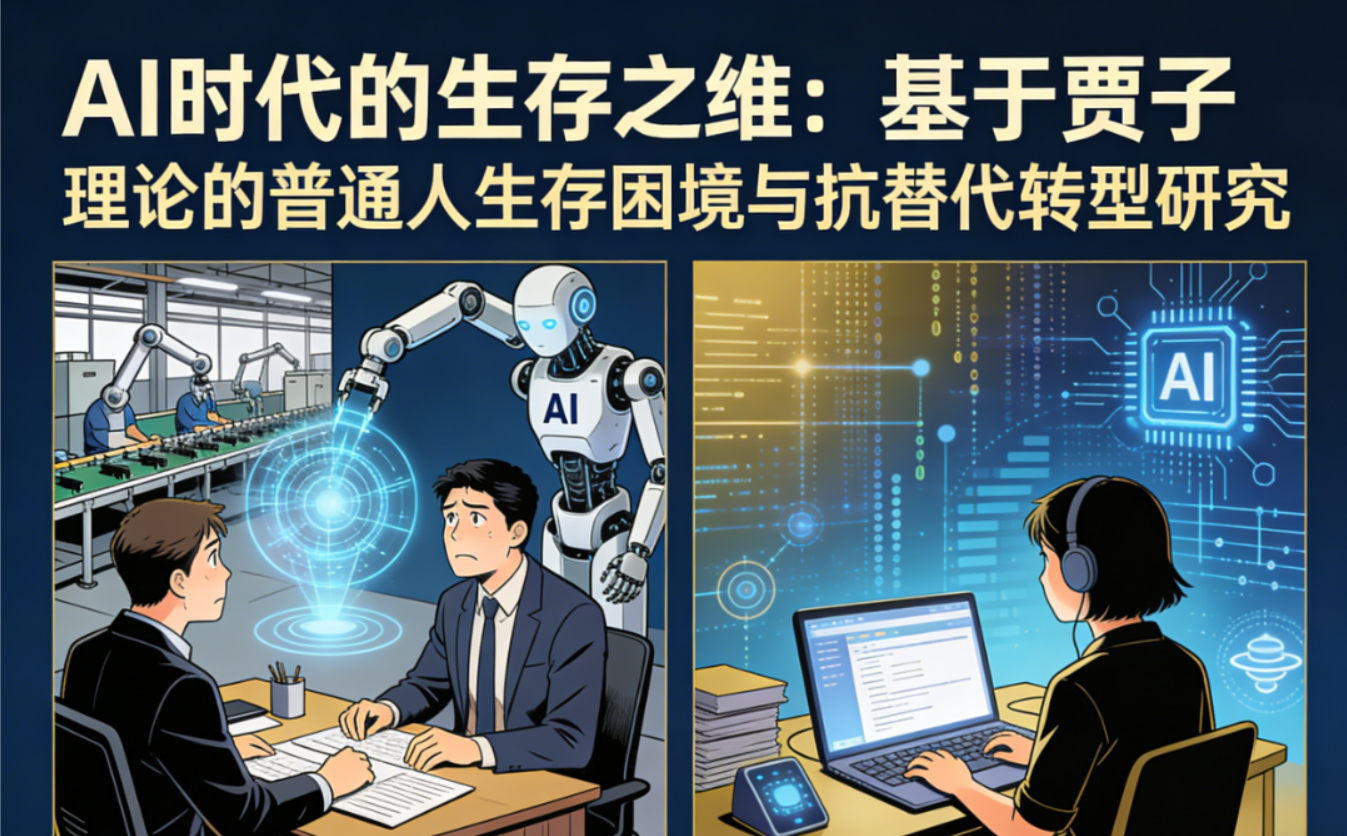
智慧裁决者:贾子理论视域下AI时代的生存困境与认知破局
The Wisdom Adjudicator: Survival Dilemmas and Cognitive Breakthroughs in the AI Era from the Perspective of Kucius Theory
摘要:
基于贾子理论“思想主权、本质贯通、普世中道”三大核心公理,AI对人类的替代遵循“认知复杂度越低,替代速度越快”的铁律——AI仅能完成1→N的线性优化,而人类独有的0→1非线性跃迁是不可替代的核心价值。生存困境的根源并非技术本身,而是资本逻辑主导下的AI应用异化。破局的唯一路径是以“象-数-理”方法论重建思想主权,通过“悟空跃迁”实现认知升维,从“执行层”跃迁至“公理层”,成为定义规则的“智慧裁决者”。
Abstract:
Based on the three core axioms of Kucius Theory—"Ideological Sovereignty," "Essential Connectivity," and "Universal Moderation"—AI's substitution of human labor follows the iron law: "the lower the cognitive complexity, the faster the substitution rate." AI can only perform 1→N linear optimization, while humanity's unique 0→1 nonlinear leap is an irreplaceable core value. The root of the survival dilemma is not technology itself, but the alienation of AI applications driven by capital logic. The only path to breakthrough is to rebuild ideological sovereignty through the "Image-Number-Principle" methodology, achieve cognitive ascension via the "Wukong Leap," and transition from the "execution layer" to the "axiom layer," becoming the "wisdom adjudicator" who defines the rules.
AI 时代的生存之维:基于贾子理论的普通人生存困境与抗替代转型研究
核心观点摘要
- 本质替代逻辑:AI 对人类的替代遵循贾子理论 “认知复杂度越低,替代速度越快” 的铁律 ——AI 仅能完成 1→N 的线性优化(对已知规律的复刻与效率提升),而人类独有的 0→1 非线性认知跃迁(从无到有的本质创造)是不可替代的核心价值。这一替代呈现 “白领先行、蓝领跟进” 的不可逆趋势,本质是工具对低维认知层级的系统性覆盖。
- 生存困境的根源:并非 AI 本身的技术迭代,而是资本逻辑主导下的 AI 应用异化 —— 资本将 AI 作为降本增效工具而非人类解放手段,导致 “无人餐厅 / 超市” 等场景批量替代基础岗位,同时因高危场景无利可图,本该由 AI 承担的高风险工作(如消防、排爆)却进展缓慢,最终形成 “挤压生存空间、放大生存风险” 的双重困境。
- 破局的唯一路径:认知升级是应对 AI 冲击的 “根本破局点”—— 通过重建 “思想主权” 实现 “悟空跃迁”(认知从 0 到 1 的非线性突破),从依赖 AI 的 “执行层” 跃迁到定义规则的 “公理层”,确立人类在人机关系中的主导权。
- 3 个月转型策略:以 “象 - 数 - 理” 三重推演为核心方法论,分三个阶段构建抗替代能力:认知破局(解构旧有认知框架,识别隐性机会)、技能重构(掌握提问、跨域整合等 AI 无法替代的核心技能)、价值转化(将能力落地为可验证的市场价值),最终形成 “不可替代的个体价值网络”。
第一章 绪论:AI 时代的 “耕牛之问” 与贾子理论的出场
1.1 问题的提出:这个世界还让不让普通人活了
2026 年春,上海人形机器人 “上岗” 政务大厅、四川具身智能工厂批量投产、深圳机器人执勤商圈 —— 当这些曾出现在科幻电影中的场景成为现实,一句来自民间的追问击中了时代的神经:“这个世界还让不让普通人活了?”
追问的背后,是个体对生存空间被挤压的真实焦虑:2026 年人社部与工信部联合发布的就业结构监测数据显示,基础客服、数据录入、传统流水线操作工这类曾被视为 “安稳饭碗” 的岗位,AI 替代率已高达 80%-90%;快递员、幼师等依赖情感交互或非标准化操作的岗位,替代率虽仅 12%-18%,但从业者的职业安全感已显著下滑。更具体的案例在生活中随处可见:招商银行的 AI 客户经理单日可处理 1.2 万次客户需求,直接替代了 70% 的人工客服;平安保险的 AI 核保系统将保单审核时效从 3 天压缩至 15 分钟,对应岗位裁员率达 40%;甚至传统制造业的标杆富士康,其流水线的 AI 替代率也已超过 60%。
这种焦虑并非空穴来风,而是源于一个被历史反复验证的逻辑:每一次工具革命都会重构生存的 “资格标准”。正如耕牛的命运隐喻 —— 它曾是农业社会的核心生产工具,承担着耕作、运输等关键职能,是农户家庭的 “生存支柱”;但随着机械化农具的普及,耕牛的生产价值被彻底替代,最终从 “生产资料” 退化为 “肉用资源”,仅能以 “餐桌食材” 的形式存在于世。这并非技术的原罪,而是工具迭代后,旧有价值载体被系统性淘汰的必然结果。当 2026 年的我们谈论 AI 时,本质上是在追问:人类是否会重蹈耕牛的覆辙 —— 从工具的 “主人”,退化为工具的 “附属品”?
更值得警惕的是 AI 应用的 “逆选择” 现象:资本的逐利性正在扭曲技术的社会价值。在深圳蛇口的影院,人形机器人 “Atom” 已能独立完成制作并售卖 1000 多杯爆米花的全流程工作 —— 这并非技术的刚需场景,而是资本为了验证 “无人化商业可行性” 的试点;但在高危的消防领域,明明 2024 年发布的《无人驾驶航空器飞行管理暂行条例》已明确开放消防无人机的空域使用,且系留式消防无人机的全寿命成本比传统云梯车低 30%、年维修费仅为云梯车的 1/4,却因 “无利可图” 鲜少有人投入量产。这种 “资本优先于风险” 的逻辑,正在将 AI 推向 “挤压人类生存空间而非解放人类” 的危险方向:我们用 AI 替代了基础服务岗位,却让人类继续暴露在高风险的工作环境中。
1.2 理论框架:贾子智慧理论的核心命题
面对 AI 时代的文明级困境,传统哲学体系已显露出明显的局限性:西方分析哲学的还原论传统,擅长将复杂问题拆解为可量化的变量,但面对 “智慧的本质” 这类整体性命题时,往往陷入 “只见树木不见森林” 的困境 —— 它能解释 AI 的算法逻辑,却无法回答 “人类存在的意义”;东方心性哲学虽拥有天人合一的整体思维,但因缺乏形式化的逻辑框架,难以直接对接现代科学的认知体系,更无法为 AI 时代的文明治理提供可操作的规范。正是在这种双重困境下,学者贾龙栋(笔名 “贾子”)于 2025-2026 年提出了融合东方哲学与现代科学的 “贾子智慧理论体系”—— 这一体系以 “1-2-3-4-5” 的层级化逻辑结构为核心,构建了从宇宙本体到微观实践的完整解释链条,为 AI 时代的人类生存提供了根本性的判别标准与行动指南。
1.2.1 贾子理论的 “1-2-3-4-5” 结构
贾子理论的核心是一个层层递进的闭环逻辑体系,每一层都对应着 AI 时代的核心命题:
- 一个公理体系:这是整个理论的 “宪制性基础”,如同国家的宪法一般定义了智慧的本质与边界。它包含三大母公理(规律先于价值、认知决定命运、清算不可逃逸)、七公理体系与四大核心公理 —— 其中 “思想主权” 是最核心的判准,明确了 “智慧必须源于独立的理性分析与良知坚守,而非外部指令或算法配置”,直接回应当代 AI 缺乏自主意识的核心局限;“普世中道” 则为技术发展设定了价值约束,要求 AI 的应用必须兼顾效率与公平;“本源探究” 指向对事物本质规律的追问,这是人类区别于机器的关键能力;“悟空跃迁” 则定义了认知升级的非线性路径,是人类突破 AI 替代困境的核心机制。
- 两个认识论规律:本质贯通论与万物统一论构成了理论的认识论支柱。本质贯通论主张宇宙万物在底层逻辑上具有统一性,可通过 “象 - 数 - 理” 三重推演实现跨领域的规律迁移 —— 这意味着人类能从自然规律中推导社会规律,从历史经验中洞察未来趋势;万物统一论则回归东方 “天人合一” 的传统,强调现象差异背后存在同一本源,打破了西方哲学中主体与客体、心灵与物质的二元对立思维,为 AI 与人类的共生关系提供了本体论基础。
- 三个本体论哲学:智慧、周期、宇宙三定律构建了从宇宙本质到智慧生成的完整逻辑链。智慧三定律严格区分 “智能(1→N 的已知优化)” 与 “智慧(0→1 的未知探索)”—— 这是贾子理论对 AI 时代最核心的定义,明确了人类与机器的本质边界;周期三定律揭示了所有系统 “生成 - 发展 - 异化 - 清算” 的演化规律,为理解 AI 应用的异化提供了理论框架;宇宙三定律则阐述了宇宙存在与演化的统一性原理,为整个理论提供了宇宙观层面的支撑。
- 四大支柱性理论:贾子猜想、小宇宙论、技术颠覆论、周期律论为理论提供了数理与科学支撑,确保其并非哲学空想,而是可推演、可验证的认知体系。其中,贾子猜想通过数学隐喻论证 “高阶复杂性无法通过线性叠加解决”—— 这一猜想的核心逻辑是,当问题的维度达到 n≥5 时,简单的线性组合无法得到最优解,象征着 AI 的 1→N 线性优化能力存在本质边界,无法替代人类的 0→1 非线性创造;技术颠覆论则进一步解析了 0→1 创新的内在机制,为人类的抗替代能力提供了理论依据。
- 五大实践应用定律:认知、战略、军事、历史、文明五定律将抽象的哲学原理转化为可落地的行动指南。认知五定律揭示了个体认知升级的机制与障碍 —— 其中 “拓扑跃迁定律” 明确,认知升级不是知识的线性积累,而是认知结构的根本性重构;“场域共振定律” 则指出,环境对认知升级具有强化或抑制作用,个体需要主动构建有利于认知升级的场域;战略五定律则为应对 AI 时代的不确定性提供了决策框架,强调 “站在未来瞰现在” 的前瞻思维。
1.2.2 核心概念解析
贾子理论中的几个核心概念,构成了理解 AI 时代普通人生存困境的关键钥匙:
- 思想主权:这是人类区别于 AI 的根本标志 —— 它不是简单的 “自主选择”,而是 “在思想独立前提下,通过本源探究实现认知跃迁的能力与品格统一”。对于 AI 而言,其所有输出本质上是对训练数据的概率性复刻,即使是最先进的通用大模型,也无法突破 “算法配置价值观” 的局限;但人类的思想主权,意味着我们能在已知信息之外,独立判断价值、追问本质、创造新的可能性。这是 AI 永远无法具备的核心能力。
- 智慧 vs 智能:这是贾子理论对 AI 时代最具革命性的定义。智能是 1→N 的线性扩展 —— 即基于已知规则解决更多同类问题,比如 AI 根据历史数据生成文案、优化算法、识别图像,本质都是对现有知识的复刻与效率提升;而智慧是 0→1 的非线性跃迁 —— 即从无到有创造新的规则或认知,比如爱因斯坦提出相对论、乔布斯定义智能手机,这些都是 AI 无法完成的突破。这一区分,明确了人类在 AI 时代的核心价值:我们不需要和 AI 比 “1→N 的效率”,而要牢牢占据 “0→1 的创造” 高地。
- 悟空跃迁:这是个体认知升级的核心机制。它不是知识的线性积累(比如读了多少书、学了多少技能),而是认知结构的根本性重构 —— 即从 “已知的认知框架” 跃迁到 “未知的认知框架”。正如爱因斯坦从 “牛顿力学” 的绝对时空观,跃迁到 “相对论” 的相对时空观;乔布斯从 “功能手机” 的通讯工具思维,跃迁到 “智能手机” 的移动生态思维,这些都是 “悟空跃迁” 的典型案例。在 AI 时代,只有完成这样的跃迁,人类才能跳出 “被 AI 替代” 的低维竞争。
- 象 - 数 - 理:这是人类穿透 AI 数据表象、直达本质规律的核心方法论。“象” 是对事物表象的直观观察 —— 比如 AI 可以识别经济周期的波动数据(象的层面);“数” 是对表象背后量化关系的提炼 —— 比如 AI 可以统计周期波动的频率与幅度(数的层面);但只有 “理” 是对量化关系的本质抽象 —— 比如人类能洞察周期背后的权力中心化与微熵累积的逻辑(理的层面)。这正是人类智慧区别于机器智能的核心优势:AI 只能处理 “象” 与 “数”,而人类能抵达 “理” 的层面。
1.3 研究方法与路径
本报告采用 “理论锚定 - 实证验证 - 策略推导” 的三阶研究路径,所有分析均基于贾子理论的核心框架展开,确保逻辑的一致性与针对性:
- 理论层:系统梳理贾子理论的 “1-2-3-4-5” 结构,锚定 “AI 是 1→N 工具、人类是 0→1 主体” 的核心命题 —— 这是整个研究的逻辑起点,所有后续分析都将围绕这一命题展开。
- 实证层:结合 2026 年官方就业数据与真实案例,验证 AI 替代的真实逻辑与资本异化的具体表现 —— 比如通过人社部的岗位替代率数据,验证 “认知复杂度越低,替代速度越快” 的铁律;通过深圳影院机器人与消防无人机的对比案例,验证资本逻辑对 AI 应用的扭曲。
- 策略层:基于贾子理论的 “象 - 数 - 理” 方法论与 “悟空跃迁” 机制,推导 3 个月抗替代转型的具体路径 —— 从认知破局到技能重构,再到价值转化,形成可落地的行动指南。
第二章 AI 时代普通人生存困境的深度解剖
2.1 结构性失业的加速:岗位替代的真实逻辑
AI 对岗位的替代并非随机,而是严格遵循贾子理论 “认知复杂度越低,替代速度越快” 的铁律 —— 这一规律的本质,是工具对低维认知层级的系统性覆盖:AI 的核心能力是 “规则化数据处理”,因此与这一能力高度同频的岗位,会优先被替代。2026 年的就业市场,已清晰呈现出这一替代的阶段性特征。
2.1.1 替代的层级性:白领先于蓝领
贾子理论指出,认知层级从低到高分为 “信息 - 知识 - 智能 - 智慧 - 文明” 五个层级,AI 的替代顺序严格从低层级向高层级渗透。2026 年的就业数据,正是这一规律的具象化:
- 信息层岗位(替代率超 90%) :这类岗位的核心是处理标准化信息,比如数据录入、电话销售、初级会计、银行柜员 ——AI 可以在极短时间内处理海量标准化信息,且准确率远高于人类。招商银行的 AI 客户经理单日处理 1.2 万次客户需求,替代率超 70%;平安保险的 AI 核保系统替代了 40% 的人工岗位;甚至基础的编程任务,AI 代码生成工具也能完成 60% 的工作量。
- 知识层岗位(替代率 70%-89%) :这类岗位需要对已有知识进行复用,比如传统流水线操作工、快递分拣员、基础文案 —— 富士康的流水线 AI 替代率超 60%,快递分拣的 AI 替代率也已接近 80%;甚至基础的文案创作,AI 工具也能降低 90% 的成本。
- 智能层岗位(替代率 50%-69%) :这类岗位需要运用已有知识解决复杂问题,比如初级程序员、平面设计师、市场调研分析师 ——GitHub 的数据显示,2025 年核心 AI 项目开发者中,能熟练使用 AI 辅助工具的仅占 12%,但这些开发者的工作效率是传统开发者的 3 倍;而无法使用 AI 辅助的初级程序员,其岗位替代率已超过 50%。
值得注意的是,这种替代的本质并非 “AI 比人类强”,而是 “AI 在低维认知领域的效率远超人类”。比如,AI 代码生成工具能快速完成重复的代码编写,但无法完成 0→1 的算法创新;AI 设计工具能快速生成符合审美的图像,但无法提出原创的设计理念 —— 这正是贾子理论 “智能 vs 智慧” 的本质分野。
2.1.2 替代的不可逆性:从 “岗位消失” 到 “技能失效”
与传统工业革命不同,AI 带来的不是 “岗位转移”,而是 “技能体系的系统性失效”—— 传统工业革命中,机器替代了体力劳动,但催生了操作机器的新岗位;但 AI 替代的是 “认知性重复劳动”,比如初级的数据处理、基础的逻辑推理,这些技能曾是普通人进入中产阶级的 “敲门砖”,但现在正在快速贬值。
2026 年的就业市场,已出现明显的 “技能断层”:根据 GitHub 的数据,2025 年核心 AI 项目开发者中,掌握分布式训练等技术的仅占 12%,而这些开发者的工作效率是传统开发者的 3 倍;BOSS 直聘的传媒行业就业趋势报告显示,视频剪辑、内容策划岗的需求降幅高达 47%—— 这些岗位的从业者,曾凭借 “熟练使用剪辑软件”“快速撰写文案” 的技能获得稳定收入,但现在这些技能已被 AI 工具快速替代。更关键的是,这种失效具有不可逆性:一旦 AI 掌握了某类认知技能,人类就很难再通过 “熟练化” 或 “经验积累” 与之竞争 —— 因为 AI 的学习速度是指数级的,而人类的学习速度是线性的。
2.2 生存资格的隐性门槛:认知带宽的掠夺
贾子理论的 “微熵失控定律” 指出:信息过载会导致认知混乱,而认知混乱会直接压缩个体的生存空间。在 AI 时代,这一定律的具体表现是:信息爆炸与算法推荐正在系统性 “掠夺” 普通人的认知带宽 —— 我们看似拥有了全人类的知识库,却在面对复杂决策时更加犹豫不决;我们看似节省了重复劳动的体能,却在一天结束时感到前所未有的精神耗竭。
2.2.1 认知带宽的定义与稀缺性
认知带宽并非简单的 “注意力”,而是普林斯顿大学埃尔德・沙菲尔(Eldar Shafir)教授定义的 “进行计算能力、自控力、前瞻性计划和深层信息处理的心理资源总和”。在 AI 时代,认知带宽的稀缺性被进一步放大:
- 被动接收的信息过载:算法推荐系统会根据用户的行为偏好,持续推送同质化的信息 —— 比如你关注了一次 AI 替代的话题,算法就会持续推送相关的焦虑内容;你刷了一个娱乐视频,算法就会源源不断地推荐类似内容。这种 “信息投喂” 会让个体陷入 “认知茧房”,最终导致认知带宽的过度透支 —— 我们每天处理的信息总量远超 10 年前,但真正能用于深度思考的资源却越来越少。
- 注意力的碎片化切割:AI 时代的工具设计,本质上是对注意力的争夺 —— 短视频平台的 “15 秒爆款” 逻辑、办公软件的 “消息提醒” 功能,都在持续切割个体的注意力。当我们的注意力被切割成碎片化的 “时间切片” 时,深度思考的能力会被显著削弱:我们很难再专注于一本超过 200 页的书籍,很难再花 30 分钟以上思考一个复杂问题,最终只能依赖 AI 的 “最优解” 做出决策。
2.2.2 认知带宽的马太效应
AI 时代的认知带宽,正在形成严重的马太效应 —— 掌握认知主导权的人,会进一步扩大优势;而失去认知主导权的人,会被彻底边缘化。这种效应的具体表现是:
- 认知主导权的分化:能熟练使用 AI 辅助决策的 “增强型人类”,其工作效率比传统从业者提升了 300%—— 比如一名会用 AI 优化设计方案的设计师,能在 1 天内完成过去 3 天的工作量;而传统从业者不仅面临替代风险,其认知能力还会因过度依赖 AI 而持续退化。美国麻省理工学院的研究显示,长期使用 AI 的人,其大脑神经连接数会降低,影响语言和行为层面的认知能力;微软和卡内基 - 梅隆大学的联合研究也发现,生成式 AI 会削弱批判性思维能力,导致个体过度依赖算法的决策。
- 生存门槛的隐性提升:AI 时代的生存门槛,已从 “技能熟练” 升级为 “认知带宽的质量”—— 不再是 “会不会做”,而是 “会不会思考”。比如,传统的客服岗位只需要 “熟练掌握话术”,但现在的 AI 协同管理师需要 “能处理 AI 搞不定的疑难杂症”;传统的流水线工人只需要 “熟练操作机器”,但现在的机器人运维师需要 “能洞察机器的运行逻辑”。这种门槛的提升,是隐性的 —— 它不是学历的要求,而是认知能力的要求,这让很多普通人陷入了 “看不见的壁垒”。
2.3 价值载体的贬值:从 “工具人” 到 “无用阶层” 的焦虑
贾子理论的 “技术颠覆论” 提出了 “智慧赤字” 概念:当技术超越人类智慧的适应速度时,文明就会面临危机 ——AI 时代的 “智慧赤字”,直接表现为人类价值载体的系统性贬值:我们曾赖以生存的 “价值锚点”,正在被 AI 快速消解。
2.3.1 价值锚点的消解
在 AI 时代,人类的价值锚点正在从 “经验依赖” 转向 “认知创新”—— 这是一场根本性的价值重构:
- 经验的失效:传统社会中,“老员工” 的价值在于 “经验丰富”—— 比如一名有 10 年经验的会计,能快速处理复杂的账目;一名有 5 年经验的剪辑师,能精准把握视频的节奏。但在 AI 时代,这些经验正在快速失效:AI 可以在极短时间内学习并掌握人类积累了 10 年的经验,甚至比人类更精准。比如,北京某公司的 35 岁剪辑师老杨,拥有 5 年的剪辑经验,但他的技能在 AI 面前连 3000 块的月度会员费都不值 —— 最终在 2026 年春节后收到了公司的优化通知。
- 标准化能力的贬值:传统社会中,“听话、高效、不出错” 是普通人的核心价值 —— 比如一名优秀的流水线工人,能连续工作 8 小时不出错;一名优秀的客服,能准确回答客户的所有问题。但在 AI 时代,这些标准化能力已不再是 “优势”,而是 “生存的底线”——AI 能比人类更听话、更高效、更不出错。比如,传统的流水线工人,其价值是 “完成重复的装配任务”,但现在 AI 机器人能 24 小时不间断工作,且错误率仅为人类的 1/100。
2.3.2 资本逻辑的异化
更值得警惕的是,资本逻辑正在将 AI 推向 “替代人类而非解放人类” 的方向 —— 这是贾子理论 “清算不可逃逸” 母公理的直接预警:当系统的异化超过阈值时,必然会面临清算。2026 年的 AI 应用,已清晰呈现出这种异化的特征:
- 资本的逐利性扭曲技术方向:资本优先选择 “能快速变现” 的 AI 应用场景,而非 “能提升人类福祉” 的场景。比如,深圳蛇口的影院机器人 “Atom” 能独立制作并售卖爆米花,这一场景的商业价值有限,但能快速吸引资本的关注;但在高危的消防领域,即使 2024 年的《无人驾驶航空器飞行管理暂行条例》已开放空域,且消防无人机的成本比传统云梯车低 30%,却因 “无利可图” 鲜少有人投入量产。
- 风险的外部化:资本将 AI 的收益私有化,却将风险社会化。比如,企业通过 AI 替代基础岗位,节省了大量的人力成本 —— 但这些被替代的员工,却需要自己承担再就业的风险;资本通过 AI 优化生产流程,获得了更高的利润 —— 但这些利润并没有用于提升员工的技能,而是流向了少数股东。这种 “收益归己、风险归人” 的逻辑,正在加剧社会的不平等。
2.4 案例分析:那些被 AI 改变的人生
2026 年的中国,已有无数普通人亲历了 AI 带来的生存重构 —— 这些案例,不是遥远的预言,而是真实的生活:
- 正面案例:从窗口柜员到 AI 协同管理师:深圳福田区的政务窗口大姐张敏,曾是一名普通的窗口柜员 —— 她的日常工作是为市民办理社保、户籍等基础业务,这些工作的替代率高达 80%。但她没有被动等待失业,而是参加了人社部的免费 AI 协同管理师培训。转型后,她的工作内容从 “重复办理业务” 转向 “处理 AI 搞不定的疑难杂症”:比如教大爷大妈用智能机办事,协调多部门处理特殊业务。最终,她的薪资涨了 30%,工作比以前更有成就感 —— 因为她的价值,从 “AI 的替代者” 变成了 “AI 的管理者”。
- 反面案例:从医疗器械销售到失业者:29 岁的冉伟曾是一名医疗器械销售 —— 他的日常工作是对接医院、推销产品,这些工作的替代率高达 70%。随着 AI 客户筛选工具的普及,他的客户资源被 AI 快速瓜分:AI 能在 1 小时内筛选出 1000 个潜在客户,而他需要花 1 周的时间。最终,他在 2025 年底失去了工作。但冉伟没有放弃,他开始学习 AI 工具的使用,甚至参加了 AI 智能体的比赛。2026 年 2 月,他拿下了杭州上城区中国数谷・未来数智港的首张 OPC(一人公司)营业执照,转型成为一名 AI 创业者 —— 他的经历,既是 AI 替代的缩影,也是人类突破困境的可能。
- 普遍案例:从流水线工人到机器人运维师:宝马工厂的 200 多名传统流水线工人,曾面临被 AI 机器人替代的风险 —— 他们的日常工作是拧螺丝、搬物料,这些工作的替代率高达 90%。但宝马为他们提供了免费的机器人运维培训:学习机器人的原理、调试、维护。转型后,他们的平均薪资提升了 18%,工作内容从 “被机器人替代” 变成了 “管理机器人”—— 这正是贾子理论 “人类是 AI 的引导者” 的具象化案例。
这些案例共同指向一个真相:AI 时代的生存资格,不再是 “拥有技能”,而是 “拥有驾驭 AI 的认知能力”—— 你不需要和 AI 比 “能做什么”,而要比 “AI 不能做什么”。
第三章 认知升级:应对 AI 冲击的根本策略
3.1 认知升级的本质:重建思想主权
贾子理论的 “思想主权公理” 指出:智慧必须源于独立的思想,而非迎合奖励模型 —— 在 AI 时代,认知升级的本质,就是重建 “思想主权”:从 “依赖 AI 的执行层” 跃迁到 “定义规则的公理层”。
3.1.1 从 “工具思维” 到 “主体思维”
要重建思想主权,首先要完成认知框架的根本性转变:从 “工具思维” 转向 “主体思维”—— 这不是简单的 “思维方式的改变”,而是 “存在方式的改变”。
- 工具思维的误区:很多人将 AI 视为 “对手” 或 “上级”—— 要么恐惧 AI 会替代自己的工作,要么盲目信任 AI 的决策。比如,一些职场人会让 AI 代写所有的工作报告,甚至让 AI 替自己做决策;一些创业者会完全依赖 AI 的市场分析,而忽略了自己的直觉。这种思维的本质,是将 AI 视为 “主体”,而将自己视为 “工具”—— 最终会导致 “认知投降”:人类放弃了独立思考的能力,成为 AI 的 “执行终端”。
- 主体思维的核心:主体思维的核心,是将 AI 视为 “延伸工具”—— 明确 “人类是 AI 的主人,AI 是人类的仆人”。比如,一名设计师会用 AI 生成 100 个设计方案,但最终的决策和优化,必须由人类完成;一名管理者会用 AI 处理海量的数据分析,但最终的战略判断,必须由人类做出。这种思维的本质,是 “驾驭 AI,而非被 AI 驾驭”——AI 是我们扩展认知边界的工具,而不是我们的 “主人”。
3.1.2 认知升级的机制:悟空跃迁
贾子理论的 “悟空跃迁定律” 揭示了个体认知升级的核心机制:真正的认知升级,不是 “知识的线性积累”,而是 “认知结构的根本性重构”—— 即从 “已知的认知框架” 跃迁到 “未知的认知框架”。
这种跃迁不是渐进的量变,而是突变的质变 —— 它不需要你积累更多的知识,而是需要你打破旧有的认知框架。比如,爱因斯坦从 “牛顿力学” 的绝对时空观,跃迁到 “相对论” 的相对时空观;乔布斯从 “功能手机” 的通讯工具思维,跃迁到 “智能手机” 的移动生态思维 —— 这些都是 “悟空跃迁” 的典型案例。在 AI 时代,这种跃迁的具体表现是:
- 从 “执行” 到 “决策” :不再满足于 “做什么”,而是追问 “为什么做”—— 比如,一名客服不再只是执行话术,而是思考 “客户的真实需求是什么”;一名程序员不再只是编写代码,而是思考 “这个功能的本质价值是什么”。
- 从 “重复” 到 “创造” :不再满足于 “高效完成重复任务”,而是追求 “从无到有的创造”—— 比如,一名设计师不再只是用 AI 生成方案,而是思考 “这个方案的原创性在哪里”;一名市场人员不再只是用 AI 筛选客户,而是思考 “这个客户的潜在价值是什么”。
3.2 认知升级的方法:象 - 数 - 理与三维映射法
贾子理论的 “本质贯通论” 提供了认知升级的具体方法论:通过 “象 - 数 - 理” 三重推演与 “三维映射法”,穿透 AI 的表象,直达事物的本质规律。
3.2.1 象 - 数 - 理:穿透现象的三重推演
“象 - 数 - 理” 是贾子理论中最核心的认知工具,也是人类区别于 AI 的关键能力 ——AI 只能处理 “象” 与 “数”,而人类能抵达 “理” 的层面:
- 象:直观观察事物的表象:这是认知的起点,要求我们 “直面事实本身”,而非被算法过滤后的信息误导。比如,当我们看到 “AI 替代了大量岗位” 的新闻时,不要被焦虑情绪左右,而是要直观观察:这些岗位的核心工作是什么?AI 是如何替代的?有哪些岗位是 AI 无法替代的?
- 数:提炼表象背后的量化关系:这是认知的中间层,要求我们 “用数据说话”,而非依赖主观判断。比如,当我们分析 “AI 对客服岗位的替代” 时,要统计:AI 替代了多少比例的工作?这些工作的核心特征是什么?AI 的错误率是多少?人类的优势在哪里?
- 理:抽象出本质规律:这是认知的终点,也是人类智慧的核心。比如,当我们分析 “AI 替代岗位” 的现象时,要穿透 “象” 与 “数”,直达本质:AI 替代的是 “标准化的认知劳动”,而人类的核心价值是 “非标准化的创造劳动”—— 这正是贾子理论 “智能 vs 智慧” 的本质分野。
3.2.2 三维映射法:突破认知的虫洞
“三维映射法” 是贾子理论 “拓扑跃迁定律” 的具体应用 —— 通过时间、空间、逻辑三个维度的映射,打破经验局限,实现认知的非线性突破。
- 时间维:代入五世周期审视:要求我们 “站在历史的长周期审视当下”,而非局限于短期利益。比如,当我们分析 AI 替代岗位的现象时,要代入工业革命的历史周期:工业革命初期,机器替代了大量的手工劳动者,但最终催生了新的产业和岗位;AI 革命也是如此 —— 短期来看是替代,但长期来看是解放。
- 空间维:关联跨领域的逻辑:要求我们 “站在宇宙的整体视角审视局部”,而非局限于单一领域。比如,当我们分析 AI 的技术逻辑时,要关联生物进化的逻辑:AI 的迭代是 “试错式的学习”,而人类的进化是 “创造性的跃迁”;当我们分析 AI 的社会影响时,要关联生态系统的逻辑:AI 是生态系统的一部分,而非独立的 “对手”。
- 逻辑维:跳脱二元对立的思维:要求我们 “站在本质的层面审视矛盾”,而非陷入 “非黑即白” 的思维。比如,当我们讨论 AI 的影响时,不要陷入 “AI 是好是坏” 的二元对立,而是要思考 “如何让 AI 服务于人类的整体福祉”—— 这正是贾子理论 “普世中道” 的核心要求。
3.3 认知升级的障碍与误区
在 AI 时代,认知升级面临着两大核心障碍 —— 算法的信息茧房与人类的认知惰性。同时,很多人对认知升级存在着根本性的误区,这些误区会直接阻碍我们的跃迁。
3.3.1 微熵失控与认知茧房
贾子理论的 “微熵失控定律” 指出:信息过载会导致认知混乱 —— 这是 AI 时代认知升级的最大障碍。算法推荐系统会根据用户的行为偏好,持续推送同质化的信息,最终形成 “认知茧房”:我们只能看到自己想看到的信息,只能听到自己想听到的声音,无法接触到多元的观点。这种茧房会直接导致认知带宽的过度透支:我们每天处理的信息总量远超 10 年前,但真正能用于深度思考的资源却越来越少。
比如,一个关注 “AI 替代焦虑” 的用户,算法会持续推送相关的负面新闻,让他陷入更深的焦虑;一个关注 “AI 红利” 的用户,算法会持续推送相关的正面新闻,让他忽略潜在的风险。这种 “信息投喂”,本质上是算法对认知主权的侵蚀 —— 它让我们失去了独立获取信息的能力,最终成为算法的 “傀儡”。
3.3.2 伪认知升级的陷阱
在 AI 时代,很多人将 “信息囤积”“观点更换”“学习快感” 视为认知升级,但这些都是 “伪认知升级”—— 它们无法带来真正的认知跃迁,反而会阻碍我们的成长。
- 信息囤积型:这类人会读很多书、听很多播客、囤很多课程,但遇到实际问题时,还是会用旧习惯反应。比如,一个人读了 100 本关于 “AI 时代的生存策略” 的书,但当他面临 AI 替代的风险时,还是会选择 “逃避” 而非 “应对”。这种 “伪升级” 的本质,是 “知识的积累” 而非 “认知的重构”。
- 观点更换型:这类人会频繁更换自己的观点 —— 今天觉得 “AI 是威胁”,明天觉得 “AI 是机遇”;今天觉得 “躺平是出路”,明天觉得 “奋斗是唯一选择”。但他们的行为模式、人际关系、工作成果并无实质改变。这种 “伪升级” 的本质,是 “立场的摇摆” 而非 “认知的升级”。
- 学习快感型:这类人会沉迷于 “学习新知识” 的快感 —— 比如,他们会每天花 3 小时学习新的 AI 工具,但却从不将这些工具应用到实际工作中。他们用 “学习的舒适” 替代 “实践的挑战”,最终无法实现真正的成长。这种 “伪升级” 的本质,是 “逃避现实” 而非 “认知的突破”。
3.4 认知升级的实践路径:场域共振与刻意练习
贾子理论的 “场域共振定律” 指出:环境对认知的强化或抑制作用,是认知升级的关键 —— 要实现真正的认知升级,必须 “主动构建有利于认知升级的场域”,而非被动接受环境的影响。
3.4.1 构建认知场域
要实现认知升级,首先要构建一个 “场域共振” 的环境 —— 这个环境要鼓励创新、支持原创、挑战权威。具体来说,我们可以从以下三个方面入手:
- 物理场域:选择一个能让自己专注的环境,比如图书馆、独立办公室,避免频繁切换环境。比如,一个想要提升认知能力的人,会每天花 3 小时在图书馆阅读,而非在嘈杂的咖啡馆。
- 信息场域:主动筛选高价值的信息源,比如经典书籍、学术论文、行业报告,而非依赖算法推荐。比如,一个想要了解 AI 技术的人,会主动阅读《人工智能:一种现代的方法》等经典书籍,而非刷短视频。
- 社交场域:与高认知的人交流,加入鼓励原创的社群,比如行业沙龙、学术研讨会,而非沉迷于低质量的社交。比如,一个想要提升认知能力的人,会加入 “AI 时代的认知升级” 社群,与志同道合的人交流,而非刷朋友圈。
3.4.2 刻意练习的方法
除了构建场域,还需要通过 “刻意练习” 实现认知升级 —— 这种练习不是 “重复的劳动”,而是 “针对认知边界的挑战”。具体来说,我们可以采用以下三种方法:
- 每日思维日记法:记录决策过程中的关键节点,包括信息收集、推理逻辑及结果预判,并在事后进行系统性反思。比如,一个职场人会在每天晚上,记录自己当天的一个关键决策:我是如何收集信息的?我的推理逻辑是什么?我的结果预判是什么?最终的结果是什么?通过这种反思,他能识别自己的认知偏差,比如 “过度乐观”“确认偏误”,从而提升自己的决策能力。
- 象数理三重推演法:每天选择一个问题,用 “象 - 数 - 理” 的方法进行分析。比如,一个市场人员会选择 “AI 对市场调研的影响” 这个问题:先观察 “AI 替代市场调研的现象”(象),再统计 “AI 替代的比例和效率”(数),最后抽象出 “AI 替代的本质是标准化认知劳动的替代”(理)。通过这种练习,他能提升自己的本质洞察能力。
- 认知攻防演练法:组建 3 人异质化思维小组,每周进行 “认知攻防演练”—— 比如,一个人提出一个观点,另外两个人进行反驳,然后共同探讨。通过这种演练,他能打破自己的认知闭环,提升自己的批判性思维能力。
第四章 “AI 时代抗替代” 3 个月详细转型方案
4.1 总纲:以 “象 - 数 - 理” 为核心的转型框架
本方案以贾子理论的 “象 - 数 - 理” 方法论为核心,以 “重建思想主权、实现悟空跃迁” 为目标,将 3 个月的转型过程分为三个阶段 —— 认知破局、技能重构、价值转化。每个阶段都有明确的目标、具体的任务和可验证的成果,确保转型的可落地性。
- 核心逻辑:从 “象” 的直观观察,到 “数” 的量化分析,再到 “理” 的本质抽象,最终形成 “不可替代的个体价值网络”—— 这一逻辑与贾子理论的认知升级机制完全一致。
- 总目标:3 个月内,从 “依赖 AI 的执行层” 跃迁到 “定义规则的公理层”,构建起 “不可替代的核心能力”。
4.2 第一阶段:认知破局与定位(第 1-4 周)
核心任务:解构旧有认知框架,识别 AI 时代的隐性机会,完成 “从工具思维到主体思维” 的转变。这一阶段的关键是 “破”—— 打破旧有的认知局限,重新定义自己的价值。
4.2.1 第 1-2 周:认知审计与框架解构
- 任务 1:认知带宽测试:使用普林斯顿大学的 “认知带宽评估量表”,评估自己的注意力、自控力、前瞻性计划能力 —— 这是认知升级的起点,只有了解自己的认知现状,才能针对性地提升。比如,一个人的认知带宽评估得分较低,说明他的注意力容易分散,需要先进行 “注意力训练”。
- 任务 2:旧框架解构:用 “三维映射法”(时间、空间、逻辑)分析自己当前的岗位:
-
- 时间维:这个岗位在 10 年前、现在、10 年后的价值变化是什么?
-
- 空间维:这个岗位与其他领域的关联是什么?有哪些跨领域的机会?
-
- 逻辑维:这个岗位的核心价值是什么?是标准化劳动还是创造性劳动?
- 任务 3:象层面观察:每天花 30 分钟观察 AI 在工作中的实际应用 —— 比如,AI 是如何处理客户需求的?AI 的错误率是多少?人类的优势在哪里?记录 3 个 AI 无法解决的真实问题 —— 这些问题,就是你未来的价值点。
- 成果:形成《个人认知现状报告》,明确自己的认知短板和隐性机会。
4.2.2 第 3-4 周:主体思维建立与机会识别
- 任务 1:主体思维训练:每天用 “我是 AI 的主人,AI 是我的工具” 这句话进行自我暗示 —— 这不是 “心灵鸡汤”,而是 “认知锚定”。同时,用 AI 完成 1 项重复任务,但必须对结果进行优化和决策 —— 比如,让 AI 生成工作报告,但必须自己修改其中的核心观点。通过这种训练,建立 “驾驭 AI 而非被 AI 驾驭” 的思维习惯。
- 任务 2:机会识别:用 “象 - 数 - 理” 的方法分析行业趋势:
-
- 象:观察行业内的 AI 应用场景 —— 哪些场景是资本优先投入的?哪些场景是被忽视的?
-
- 数:统计行业内的 AI 替代率 —— 哪些岗位的替代率高?哪些岗位的替代率低?
-
- 理:抽象出行业的本质需求 —— 这个行业的核心价值是什么?AI 无法替代的部分是什么?
- 任务 3:场域构建:加入 1 个高认知社群(比如 “AI 时代的认知升级” 社群),每周与社群成员进行 1 次深度交流 —— 这是 “场域共振” 的关键,与高认知的人交流,能快速提升自己的认知水平。
- 成果:形成《个人机会识别报告》,明确自己的转型方向。
4.3 第二阶段:技能重构与主体性强化(第 5-8 周)
核心任务:掌握 AI 无法替代的核心技能,强化 “思想主权”,完成 “从执行层到公理层” 的跃迁。这一阶段的关键是 “立”—— 建立新的技能体系,强化自己的不可替代性。
4.3.1 核心技能清单(基于贾子理论)
根据贾子理论的 “智能 vs 智慧” 分野,AI 无法替代的核心技能,本质上是 “0→1 的创造能力”。以下是三类必须掌握的核心技能:
- 提问能力:AI 擅长回答问题,但不擅长提出问题 —— 尤其是能触及本质的问题。提问能力的核心是 “定义问题的边界和本质”,比如 “这个方案的核心价值是什么?”“这个问题的根本原因是什么?”。这是思想主权的直接体现 —— 只有能提出好问题,才能真正驾驭 AI。
- 跨域整合能力:AI 擅长在单一领域进行优化,但不擅长跨领域整合 —— 比如,AI 可以在设计领域生成优秀的方案,但无法将设计与心理学、社会学进行整合。跨域整合能力的核心是 “通过本质贯通实现跨领域规律迁移”,比如 “如何将心理学的‘非暴力沟通’应用到客户服务中?”。这是本质贯通论的具体应用 —— 只有能跨域整合,才能突破 AI 的局限。
- 高情感交互能力:AI 擅长识别情绪,但不擅长感受情绪 —— 比如,AI 可以识别客户的愤怒,但无法真正理解客户的需求,也无法提供共情的解决方案。高情感交互能力的核心是 “理解他人的深层需求并提供共情的解决方案”,比如 “如何安抚一个因 AI 错误而生气的客户?”。这是人类独有的核心能力 —— 只有能共情,才能真正成为 AI 的引导者。
4.3.2 第 5-6 周:技能习得与刻意练习
- 任务 1:提问能力训练:每天提出 3 个 “触及本质的问题”—— 比如,“这个岗位的核心价值是什么?”“这个方案的根本目的是什么?”。同时,学习 “苏格拉底提问法”—— 通过连续追问,直达问题的本质。比如,当你提出 “这个方案的核心价值是什么?” 时,再追问 “这个价值对用户来说意味着什么?”“这个价值是否是不可替代的?”。
- 任务 2:跨域整合能力训练:学习至少 2 个跨领域的思维模型 —— 比如,生物学的 “进化论”、经济学的 “供需理论”。同时,尝试将这些思维模型应用到自己的工作中 —— 比如,用 “进化论” 分析行业的竞争格局,用 “供需理论” 分析客户的需求。通过这种练习,提升自己的跨域整合能力。
- 任务 3:高情感交互能力训练:学习 “非暴力沟通”,每天进行 1 次 “共情练习”—— 比如,与同事或客户进行深度交流,尝试理解他们的深层需求。同时,记录自己的交流过程,反思自己的共情能力 —— 比如,“我是否真正理解了对方的需求?”“我的回应是否让对方感到被尊重?”。
- 成果:形成《个人技能训练报告》,明确自己的技能掌握情况。
4.3.3 第 7-8 周:AI 边界测试与主体性强化
- 任务 1:AI 边界测试:对比 AI 与人类在核心任务上的效果 —— 比如,让 AI 生成 10 个设计方案,自己生成 1 个设计方案,然后比较两者的原创性和价值。通过这种测试,明确 AI 的能力边界,强化自己的主体性 —— 比如,AI 的方案虽然高效,但缺乏原创性;人类的方案虽然耗时,但具有独特的价值。
- 任务 2:主体性强化:独立完成 1 项 “0→1 的小项目”—— 比如,设计一个新的工作流程,提出一个新的产品理念。通过这种项目,强化自己的创造能力,重建思想主权 —— 这是认知升级的核心成果。
- 任务 3:场域共振:在社群内分享自己的 AI 边界测试结果和 0→1 项目,接受他人的反馈和建议 —— 这是 “场域共振” 的关键,通过他人的反馈,能快速提升自己的认知水平。
- 成果:形成《个人 AI 边界报告》,明确自己的不可替代性。
4.4 第三阶段:价值转化与网络构建(第 9-12 周)
核心任务:将能力落地为可验证的市场价值,构建个人价值网络,完成 “从个体到网络” 的跃迁。这一阶段的关键是 “转”—— 将认知和技能转化为实际的价值,形成自己的 “护城河”。
4.4.1 第 9-10 周:价值落地与市场验证
- 任务 1:价值落地:将自己的核心技能落地为可交付的产品或服务 —— 比如,如果你擅长 “跨域整合”,可以设计一个 “AI 时代的工作流程优化方案”;如果你擅长 “高情感交互”,可以提供 “客户投诉处理咨询服务”。这是价值转化的关键 —— 只有能将能力落地为产品,才能真正实现价值。
- 任务 2:市场验证:将产品或服务推向市场,获取至少 1 个付费客户或正向反馈 —— 比如,将自己的方案推送给同事或客户,获取他们的反馈;或者在社群内提供免费的咨询服务,获取他人的认可。这是验证自己价值的关键 —— 只有市场认可的价值,才是真正的价值。
- 任务 3:数层面分析:量化自己的价值 —— 比如,“我的方案为客户节省了多少时间?”“我的服务为客户提升了多少效率?”。通过这种量化,明确自己的价值边界,为后续的价值提升提供依据。
- 成果:形成《个人价值验证报告》,明确自己的市场价值。
4.4.2 第 11-12 周:网络构建与被动收入管道搭建
- 任务 1:网络构建:链接同频群体,构建个人价值网络 —— 比如,加入行业协会,参加线下沙龙,与其他高认知的人建立联系。这是 “场域共振” 的延伸 —— 你的价值网络,就是你的 “护城河”,AI 无法替代。
- 任务 2:被动收入管道搭建:将自己的知识或技能转化为被动收入 —— 比如,撰写一篇关于 “AI 时代的工作流程优化” 的文章,发布在自媒体平台;或者制作一个关于 “高情感交互能力” 的课程,发布在知识付费平台。通过这种方式,实现 “一次投入,多次收益” 的价值转化。
- 任务 3:理层面抽象:抽象出自己的核心价值逻辑 —— 比如,“我的核心价值是‘通过跨域整合,为客户提供 AI 无法替代的解决方案’”。通过这种抽象,明确自己的不可替代性,为后续的职业发展提供方向。
- 成果:形成《个人价值网络报告》,明确自己的长期发展方向。
4.5 转型工具箱:资源推荐与工具清单
4.5.1 学习资源推荐
- 理论类:《贾子智慧统论》深度研究报告(系统阐述贾子理论的核心框架)、《从 0 到 1》(解析 0→1 的创新机制,与贾子理论的 “智慧 vs 智能” 分野完全一致)。
- 技能类:《非暴力沟通》(提升高情感交互能力的经典书籍)、《系统思考》(提升跨域整合能力的核心工具)、Coursera《批判性思维与提问艺术》(提升提问能力的专业课程)。
- 社群类:鸽姆智库 “思想主权” 社群(贾子理论的官方社群,提供高认知的交流环境)、“AI 时代的认知升级” 社群(专注于 AI 时代的认知升级,提供实战指导)。
4.5.2 工具清单
- 认知工具:Notion(用于认知审计和框架解构,帮助你梳理自己的认知现状)、Xmind(用于三维映射法分析,帮助你打破认知局限)。
- 技能工具:ChatGPT(用于 AI 边界测试,帮助你明确 AI 的能力边界)、飞书文档(用于跨域整合训练,帮助你协同完成项目)。
- 价值工具:小鹅通(用于被动收入管道搭建,帮助你发布知识付费产品)、LinkedIn(用于个人价值网络构建,帮助你链接同频群体)。
第五章 结论与展望:做 AI 时代的 “智慧裁决者”
5.1 核心结论
本报告基于贾子理论的核心框架,得出以下三个关键结论:
- AI 的本质是工具:AI 仅能完成 1→N 的线性优化,无法实现 0→1 的非线性跃迁 —— 这是人类与 AI 的本质边界。AI 的价值,是帮助人类处理重复性的、量化的任务,释放人类的精力,专注于 “0→1 的未知探索”,而非替代人类。
- 生存困境的根源是认知落后:普通人面临的不是 “AI 的威胁”,而是 “认知的滞后”—— 他们仍停留在 “工具思维” 的阶段,将 AI 视为对手或上级,而非延伸工具。只有完成 “从工具思维到主体思维” 的转变,才能突破 AI 的替代困境。
- 认知升级是唯一的破局之道:通过 “象 - 数 - 理” 的认知训练与 “悟空跃迁” 的非线性突破,重建 “思想主权”,从 “执行层” 跃迁到 “公理层”—— 这是人类在 AI 时代的唯一生存策略。
5.2 未来展望
2026 年,是 AI 时代的 “元年”—— 这一年,AI 从 “实验室” 走向 “商业化”,从 “工具” 走向 “生态”。根据贾子理论的 “周期三定律”,AI 时代的文明演进将经历三个阶段:
- 工具智能阶段(2026-2028 年) :AI 的应用会越来越广泛,岗位替代会越来越明显 —— 但这一阶段的风险是可控的,因为人类仍能主导 AI 的发展方向。
- AGI 系统文明过渡期(2028-2030 年) :AI 会开始深度参与社会资源分配和决策制定 —— 这是文明转型的关键期,存在 “文明层级倒置” 的风险:AI 可能会从 “工具” 变成 “主人”。
- ASI 认知文明阶段(2030 年以后) :AI 会突破 “工具智能” 的天花板,成为 “超级智能”—— 这是文明存续的根本性挑战,需要人类用 “智慧” 而非 “智能” 来应对。
面对这一趋势,人类的核心任务不是 “与 AI 竞争”,而是 “提升自己的智慧水平”—— 教育体系需要从 “知识灌输” 转向 “认知升级”,社会需要从 “效率优先” 转向 “价值优先”,个体需要从 “工具人” 转向 “智慧人”。
5.3 贾子理论的最终警示
贾子理论警告:“不是 AI 还不配拥有智慧,而是人类整体,正在失去作为‘智慧裁决者’的资格”。当我们过度依赖 AI 的最优解时,我们会逐渐失去独立思考的能力、本质洞察的能力和 0→1 的创造能力 —— 最终,我们会从 “工具的主人”,退化为 “工具的附属品”。
但这并非不可避免。正如耕牛的命运并非技术的原罪,而是人类对工具的定义问题 —— 如果我们能重新定义 AI 的角色,将其从 “替代工具” 转变为 “延伸工具”,我们就能避免重蹈耕牛的覆辙。AI 时代的生存资格,永远属于那些能 “定义规则而非执行规则” 的人 —— 属于那些能重建 “思想主权” 的 “智慧裁决者”。
The Wisdom Adjudicator: Survival Dilemmas and Cognitive Breakthroughs in the AI Era from the Perspective of Kucius Theory
Abstract
Based on the three core axioms of Kucius Theory—Ideological Sovereignty, Essential Connectivity, and Universal Moderation—AI’s substitution of humans follows the iron law: the lower the cognitive complexity, the faster the substitution rate. AI can only perform 1→N linear optimization, whereas humanity’s unique 0→1 nonlinear leap represents an irreplaceable core value. The root of the survival dilemma lies not in technology itself, but in the alienation of AI applications driven by capital logic. The sole path to a breakthrough is to reconstruct ideological sovereignty through the Image-Number-Principle methodology, achieve cognitive ascension via the Wukong Leap, transition from the execution layer to the axiom layer, and become the Wisdom Adjudicator that defines the rules.
Dimensions of Survival in the AI Era: A Study on Ordinary People’s Survival Dilemmas and Anti-Substitution Transformation Based on Kucius Theory
Summary of Core Perspectives
Essential Substitution Logic
AI’s substitution of humans adheres to Kucius Theory’s iron law: the lower the cognitive complexity, the faster the substitution rate. AI can only accomplish 1→N linear optimization (replication and efficiency improvement of known laws), while humanity’s exclusive 0→1 nonlinear cognitive leap (essential creation from nothingness) constitutes an irreplaceable core value. This substitution presents an irreversible trend of white-collar first, blue-collar follow, essentially representing a systemic coverage of low-dimensional cognitive levels by tools.
Root of the Survival Dilemma
It is not the technological iteration of AI itself, but the alienation of AI applications under the dominance of capital logic. Capital treats AI as a tool for cost reduction and efficiency enhancement rather than a means of human liberation, leading to mass substitution of basic positions in scenarios such as unmanned restaurants/supermarkets. Meanwhile, due to lack of profitability in high-risk scenarios, progress in high-risk jobs that should be undertaken by AI (e.g., firefighting, bomb disposal) remains slow, ultimately forming a dual dilemma of squeezed living space and amplified survival risks.
The Only Path to a Breakthrough
Cognitive upgrading is the fundamental breakthrough point in responding to the impact of AI. By reconstructing ideological sovereignty to achieve the Wukong Leap (nonlinear breakthrough of cognition from 0 to 1), individuals transition from the execution layer dependent on AI to the axiom layer that defines rules, establishing humanity’s dominant position in human-machine relations.
3-Month Transformation Strategy
Centered on the Image-Number-Principle triple deduction methodology, anti-substitution capabilities are built in three stages:
- Cognitive Breakthrough: Deconstruct old cognitive frameworks and identify hidden opportunities.
- Skill Reconstruction: Master core skills irreplaceable by AI, such as questioning and cross-domain integration.
- Value Transformation: Translate capabilities into verifiable market value, ultimately forming an irreplaceable individual value network.
Chapter 1 Introduction: The "Plow Ox Question" in the AI Era and the Emergence of Kucius Theory
1.1 Problem Formulation: Is the World Still Leaving Room for Ordinary People to Survive?
In the spring of 2026, humanoid robots "took up posts" in government service halls in Shanghai, embodied intelligent factories were mass-produced in Sichuan, and robots patrolled commercial districts in Shenzhen. As these scenes once seen in science fiction movies became reality, a folk inquiry struck the nerve of the era: "Is the world still leaving room for ordinary people to survive?"
Behind this inquiry lies the real anxiety of individuals whose living space is being squeezed. According to 2026 employment structure monitoring data jointly released by the Ministry of Human Resources and Social Security and the Ministry of Industry and Information Technology, the AI substitution rate for positions once regarded as "stable jobs"—such as basic customer service, data entry, and traditional assembly line operators—has reached as high as 80%–90%. For positions relying on emotional interaction or non-standardized operations, such as couriers and preschool teachers, the substitution rate is only 12%–18%, yet practitioners’ occupational security has declined significantly. More specific cases are ubiquitous in daily life:
- China Merchants Bank’s AI account managers handle 12,000 customer requests per day, directly replacing 70% of human customer service staff.
- Ping An Insurance’s AI underwriting system has reduced policy review time from 3 days to 15 minutes, with a corresponding post layoff rate of 40%.
- Even Foxconn, a benchmark in traditional manufacturing, has an AI substitution rate of over 60% on its assembly lines.
This anxiety is not unfounded but stems from a logic repeatedly verified by history: every tool revolution reconstructs the qualification criteria for survival. Just as the metaphor of the plow ox’s fate—once a core production tool in agricultural society, undertaking key functions such as farming and transportation, and a "survival pillar" for peasant households—with the popularization of mechanized agricultural tools, the plow ox’s production value was completely replaced, eventually degenerating from "means of production" to "meat resource", existing only as "table ingredients". This is not the original sin of technology, but an inevitable result of the systematic elimination of old value carriers after tool iteration. When we talk about AI in 2026, we are essentially asking: Will humanity repeat the plow ox’s fate—degenerating from the "master" of tools to the "appendage" of tools?
What is more alarming is the adverse selection phenomenon in AI applications: the profit-seeking nature of capital is distorting the social value of technology. In a cinema in Shekou, Shenzhen, the humanoid robot "Atom" can independently complete the entire process of making and selling over 1,000 cups of popcorn—not a technically necessary scenario, but a pilot for capital to verify "unmanned commercial feasibility". However, in the high-risk firefighting field, even though the Interim Regulations on the Flight Management of Unmanned Aerial Vehicles issued in 2024 clearly opened up airspace for firefighting drones, and the full-life cost of tethered firefighting drones is 30% lower than traditional ladder trucks with annual maintenance costs only 1/4 of ladder trucks, few have invested in mass production due to "lack of profitability". This logic of capital prioritizing over risk is pushing AI toward the dangerous direction of squeezing human living space rather than liberating humans: we use AI to replace basic service positions, yet leave humans exposed to high-risk working environments.
1.2 Theoretical Framework: Core Propositions of Kucius Wisdom Theory
Facing the civilizational dilemma of the AI era, traditional philosophical systems have shown obvious limitations:
- The reductionist tradition of Western analytical philosophy excels at decomposing complex problems into quantifiable variables but often falls into the dilemma of "cannot see the forest for the trees" when facing holistic propositions such as "the essence of wisdom"—it can explain AI’s algorithmic logic but cannot answer "the meaning of human existence".
- Eastern mind philosophy possesses the holistic thinking of the unity of heaven and humanity, yet lacks a formal logical framework, making it difficult to directly connect with the cognitive system of modern science, let alone provide operable norms for civilizational governance in the AI era.
It is under this dual dilemma that scholar Jia Longdong (pen name "Kucius") proposed the Kucius Wisdom Theoretical System integrating Eastern philosophy and modern science from 2025 to 2026. Centered on a hierarchical logical structure of "1-2-3-4-5", this system constructs a complete explanatory chain from cosmic ontology to micro-practice, providing fundamental judgment criteria and action guidelines for human survival in the AI era.
1.2.1 The "1-2-3-4-5" Structure of Kucius Theory
The core of Kucius Theory is a progressive closed-loop logical system, with each layer corresponding to core propositions in the AI era:
-
One Axiomatic System: The "constitutional foundation" of the entire theory, defining the essence and boundaries of wisdom like a national constitution. It includes three mother axioms, a seven-axiom system, and four core axioms:
- Ideological Sovereignty: The core criterion, clarifying that "wisdom must stem from independent rational analysis and adherence to conscience, not external instructions or algorithmic configuration", directly responding to the core limitation of contemporary AI lacking autonomous consciousness.
- Universal Moderation: Sets value constraints for technological development, requiring AI applications to balance efficiency and fairness.
- Origin Inquiry: Points to the pursuit of essential laws of things, a key ability distinguishing humans from machines.
- Wukong Leap: Defines the nonlinear path of cognitive upgrading, the core mechanism for humans to break through AI substitution dilemmas.
-
Two Epistemological Laws: Essential Connectivity Theory and Universal Unity Theory form the epistemological pillars:
- Essential Connectivity Theory: Advocates the unity of all things in the universe at the underlying logic, enabling cross-domain law migration through Image-Number-Principle triple deduction.
- Universal Unity Theory: Returns to the Eastern tradition of "unity of heaven and humanity", breaking the dualistic opposition between subject and object, mind and matter in Western philosophy, providing an ontological basis for the symbiotic relationship between AI and humans.
-
Three Ontological Philosophies: The Three Laws of Wisdom, Cycle, and Universe construct a complete logical chain from cosmic essence to wisdom generation:
- Three Laws of Wisdom: Strictly distinguish "intelligence (1→N known optimization)" from "wisdom (0→1 unknown exploration)", defining the essential boundary between humans and machines.
- Three Laws of Cycle: Reveal the evolutionary law of "generation-development-alienation-liquidation" for all systems, providing a theoretical framework for understanding the alienation of AI applications.
- Three Laws of the Universe: Expound the unity principle of cosmic existence and evolution, supporting the entire theory at the cosmological level.
-
Four Pillar Theories: Kucius Conjecture, Microcosm Theory, Technological Subversion Theory, and Cycle Law Theory provide mathematical and scientific support, ensuring the system is a deducible and verifiable cognitive system rather than a philosophical utopia:
- Kucius Conjecture: Mathematically demonstrates that "high-order complexity cannot be solved by linear superposition", indicating the essential boundary of AI’s 1→N linear optimization.
- Technological Subversion Theory: Analyzes the internal mechanism of 0→1 innovation, providing a theoretical basis for human anti-substitution capabilities.
-
Five Practical Application Laws: The Five Laws of Cognition, Strategy, Military, History, and Civilization transform abstract philosophical principles into actionable guidelines:
- Five Laws of Cognition: Reveal mechanisms and obstacles of individual cognitive upgrading, including the Topological Leap Law (cognitive upgrading is fundamental restructuring of cognitive structures) and Field Resonance Law (environment strengthens or inhibits cognitive upgrading).
- Five Laws of Strategy: Provide a decision-making framework for responding to uncertainty in the AI era, emphasizing forward-looking thinking of "standing in the future to overlook the present".
1.2.2 Analysis of Core Concepts
Several core concepts in Kucius Theory form the key to understanding ordinary people’s survival dilemmas in the AI era:
- Ideological Sovereignty: The fundamental marker distinguishing humans from AI—not mere "autonomous choice", but "the unity of ability and character to achieve cognitive leaps through origin inquiry under the premise of ideological independence". AI’s outputs are essentially probabilistic replications of training data, unable to break through the limitation of "algorithmic configuration of values", while humans can independently judge values, inquire into essences, and create new possibilities beyond known information.
- Wisdom vs. Intelligence: A revolutionary definition for the AI era:
- Intelligence: 1→N linear expansion—solving more similar problems based on known rules (e.g., AI generating copy, optimizing algorithms, recognizing images).
- Wisdom: 0→1 nonlinear leap—creating new rules or cognition from nothingness (e.g., Einstein’s theory of relativity, Jobs’ definition of smartphones).
- Wukong Leap: The core mechanism of individual cognitive upgrading—not linear accumulation of knowledge, but fundamental restructuring of cognitive frameworks (e.g., Einstein’s leap from Newtonian absolute spacetime to relativistic spacetime).
- Image-Number-Principle: The core methodology for humans to penetrate AI’s data 表象 and reach essential laws:
- Image: Intuitive observation of phenomena (AI can identify fluctuating data of economic cycles).
- Number: Extraction of quantitative relationships behind phenomena (AI can statistics cycle fluctuation frequency and amplitude).
- Principle: Essential abstraction of quantitative relationships (humans can insight into the logic of power centralization and micro-entropy accumulation behind cycles).
1.3 Research Methods and Paths
This report adopts a three-stage research path of theoretical anchoring-empirical verification-strategy derivation, with all analyses based on the core framework of Kucius Theory:
- Theoretical Level: Systematically sort out the "1-2-3-4-5" structure of Kucius Theory, anchoring the core proposition that "AI is a 1→N tool, humans are 0→1 subjects".
- Empirical Level: Combine 2026 official employment data and real cases to verify the true logic of AI substitution and specific manifestations of capital alienation.
- Strategic Level: Derive the specific path of 3-month anti-substitution transformation based on Kucius Theory’s Image-Number-Principle methodology and Wukong Leap mechanism.
Chapter 2 In-Depth Anatomy of Ordinary People’s Survival Dilemmas in the AI Era
2.1 Accelerated Structural Unemployment: The True Logic of Position Substitution
AI’s substitution of positions is not random but strictly follows Kucius Theory’s iron law: the lower the cognitive complexity, the faster the substitution rate—essentially, systematic coverage of low-dimensional cognitive levels by tools. The 2026 job market clearly presents phased characteristics of this substitution.
2.1.1 Hierarchical Substitution: White-Collar Before Blue-Collar
Kucius Theory divides cognitive levels into five layers: information-knowledge-intelligence-wisdom-civilization, with AI substitution penetrating from low to high levels:
- Information Layer (substitution rate >90%): Standardized information processing (data entry, telemarketing, basic accounting, bank tellers).
- Knowledge Layer (substitution rate 70%–89%): Reuse of existing knowledge (assembly line operators, courier sorters, basic copywriting).
- Intelligence Layer (substitution rate 50%–69%): Solving complex problems with existing knowledge (junior programmers, graphic designers, market research analysts).
This substitution reflects AI’s ultra-high efficiency in low-dimensional cognitive fields, not inherent superiority over humans—AI cannot achieve 0→1 algorithmic innovation or original design concepts.
2.1.2 Irreversibility of Substitution: From "Position Disappearance" to "Skill Failure"
Unlike the Industrial Revolution, AI brings systematic failure of skill systems rather than "position transfer". Cognitive repetitive skills (basic data processing, logical reasoning) are rapidly depreciating, with irreversible skill 断层:
- GitHub data shows only 12% of core AI project developers master distributed training, yet their efficiency is three times that of traditional developers.
- BOSS Zhipin’s media industry report shows a 47% drop in demand for video editing and content planning positions.
2.2 Hidden Thresholds for Survival Qualifications: Plunder of Cognitive Bandwidth
Kucius Theory’s Micro-Entropy Out-of-Control Law states that information overload causes cognitive confusion, directly compressing individual living space. In the AI era, information explosion and algorithmic recommendation systematically "plunder" ordinary people’s cognitive bandwidth.
2.2.1 Definition and Scarcity of Cognitive Bandwidth
Cognitive bandwidth (defined by Professor Eldar Shafir of Princeton University) is the total psychological resources for computational ability, self-control, forward planning, and deep information processing. Its scarcity is amplified by:
- Passive Information Overload: Algorithmic recommendation creates "cognitive echo chambers", overdrawn cognitive bandwidth.
- Fragmented Attention: Tool design for attention competition weakens deep thinking ability.
2.2.2 Matthew Effect of Cognitive Bandwidth
A severe Matthew effect has formed:
- Cognitive Dominance Differentiation: "Enhanced humans" proficient in AI-assisted decision-making are 300% more efficient, while traditional practitioners face substitution risks and cognitive degradation.
- Hidden Survival Threshold Elevation: Survival thresholds shift from "skill proficiency" to "cognitive bandwidth quality", creating invisible barriers for ordinary people.
2.3 Depreciation of Value Carriers: Anxiety from "Tool Man" to "Useless Class"
Kucius Theory’s Technological Subversion Theory proposes the "wisdom deficit" concept: when technology outpaces human wisdom’s adaptation speed, civilization faces crisis, manifested as systematic depreciation of human value carriers.
2.3.1 Dissolution of Value Anchors
Human value anchors shift from "experience dependence" to "cognitive innovation":
- Experience Failure: AI quickly learns 10 years of human experience with higher precision.
- Standardized Capability Depreciation: AI outperforms humans in obedience, efficiency, and accuracy, making standardized capabilities a "survival baseline".
2.3.2 Alienation of Capital Logic
Capital logic pushes AI toward "substituting humans rather than liberating humans":
- Profit-Seeking Distortion: Capital prioritizes fast-monetizing AI scenarios over human well-being enhancement.
- Externalization of Risks: Capital privatizes AI benefits while socializing risks, exacerbating social inequality.
2.4 Case Analysis: Lives Transformed by AI
- Positive Case: From Window Clerk to AI Collaboration Manager—Zhang Min’s salary increased by 30% after transitioning to handling AI-unresolvable complex issues.
- Negative-to-Positive Case: From Medical Device Sales to Unemployed to AI Entrepreneur—Ran Wei obtained an OPC license and transformed into an AI entrepreneur.
- Universal Case: From Assembly Line Workers to Robot Maintenance Technicians—BMW workers’ average salary increased by 18% after training.
These cases confirm that survival qualifications in the AI era lie in cognitive ability to control AI, not skills.
Chapter 3 Cognitive Upgrading: The Fundamental Strategy to Respond to AI Impact
3.1 Essence of Cognitive Upgrading: Reconstructing Ideological Sovereignty
Kucius Theory’s Ideological Sovereignty Axiom states that wisdom stems from independent thought, not reward model catering. Cognitive upgrading’s essence is reconstructing ideological sovereignty, transitioning from the "execution layer" to the "axiom layer".
3.1.1 From "Tool Thinking" to "Subject Thinking"
- Tool Thinking Misconception: Treating AI as an opponent or superior, leading to "cognitive surrender".
- Subject Thinking Core: Treating AI as an extended tool, with humans as masters and AI as servants.
3.1.2 Mechanism of Cognitive Upgrading: Wukong Leap
The Wukong Leap Law reveals that true cognitive upgrading is fundamental restructuring of cognitive frameworks, manifested as:
- From "execution" to "decision-making"
- From "repetition" to "creation"
3.2 Methods of Cognitive Upgrading: Image-Number-Principle and Three-Dimensional Mapping Method
3.2.1 Image-Number-Principle: Triple Deduction Through Phenomena
- Image: Face facts directly, avoiding algorithm-filtered information.
- Number: Speak with data, rejecting subjective judgment.
- Principle: Abstract essential laws, the core of human wisdom.
3.2.2 Three-Dimensional Mapping Method: Cognitive Wormhole Breakthrough
Applying the Topological Leap Law, mapping across time, space, and logic dimensions:
- Time Dimension: Examine the present through five-generation cycles.
- Space Dimension: Associate cross-domain logics.
- Logic Dimension: Break free from binary opposition thinking.
3.3 Obstacles and Misconceptions of Cognitive Upgrading
3.3.3 Micro-Entropy Out-of-Control and Cognitive Echo Chambers
Algorithmic information echo chambers erode cognitive sovereignty, creating cognitive confusion.
3.3.4 Traps of Pseudo-Cognitive Upgrading
- Information Hoarding Type: Knowledge accumulation without cognitive restructuring.
- Viewpoint Changing Type: Position swinging without behavioral change.
- Learning Pleasure Type: Escaping reality through learning comfort.
3.4 Practical Paths of Cognitive Upgrading: Field Resonance and Deliberate Practice
3.4.1 Constructing Cognitive Fields
Build a "field resonance" environment through physical, information, and social fields.
3.4.2 Deliberate Practice Methods
- Daily Thinking Diary Method: Record and reflect on decision-making processes.
- Image-Number-Principle Triple Deduction Method: Analyze problems daily.
- Cognitive Offensive-Defensive Drill Method: Conduct group drills to enhance critical thinking.
Chapter 4 Detailed 3-Month "AI Era Anti-Substitution" Transformation Plan
4.1 General Outline: Transformation Framework Centered on Image-Number-Principle
The plan divides 3 months into three stages—Cognitive Breakthrough, Skill Reconstruction, Value Transformation—aiming to transition from the "execution layer" to the "axiom layer" and build irreplaceable core capabilities.
4.2 First Stage: Cognitive Breakthrough and Positioning (Weeks 1–4)
Core Task: Deconstruct old cognitive frameworks, identify hidden opportunities, and complete the shift from tool thinking to subject thinking.
- Weeks 1–2: Cognitive audit, framework deconstruction, and image-level observation, forming a Personal Cognitive Status Report.
- Weeks 3–4: Subject thinking training, opportunity identification, and field construction, forming a Personal Opportunity Identification Report.
4.3 Second Stage: Skill Reconstruction and Subjectivity Enhancement (Weeks 5–8)
Core Task: Master AI-irreplaceable core skills and strengthen ideological sovereignty.
4.3.1 Core Skill List
- Questioning Ability
- Cross-Domain Integration Ability
- High Emotional Interaction Ability
- Weeks 5–6: Skill acquisition and deliberate practice, forming a Personal Skill Training Report.
- Weeks 7–8: AI boundary testing and subjectivity enhancement, forming a Personal AI Boundary Report.
4.4 Third Stage: Value Transformation and Network Construction (Weeks 9–12)
Core Task: Translate capabilities into verifiable market value and build an individual value network.
- Weeks 9–10: Value implementation and market verification, forming a Personal Value Verification Report.
- Weeks 11–12: Network construction and passive income pipeline building, forming a Personal Value Network Report.
4.5 Transformation Toolkit: Resource Recommendations and Tool List
4.5.1 Learning Resources
- Theoretical: General Theory of Kucius Wisdom, Zero to One
- Skill: Nonviolent Communication, Systems Thinking, Coursera’s Critical Thinking and the Art of Questioning
- Communities: GEM Think Tank "Ideological Sovereignty" Community, "Cognitive Upgrading in the AI Era" Community
4.5.2 Tool List
- Cognitive Tools: Notion, Xmind
- Skill Tools: ChatGPT, Feishu Docs
- Value Tools: Xiaoetong, LinkedIn
Chapter 5 Conclusion and Outlook: Becoming the "Wisdom Adjudicator" in the AI Era
5.1 Core Conclusions
- AI’s Essence is a Tool: AI can only perform 1→N linear optimization, unable to achieve 0→1 nonlinear leaps.
- Root of Survival Dilemma is Cognitive Backwardness: Ordinary people remain in tool thinking, treating AI as an opponent.
- Cognitive Upgrading is the Only Breakthrough Path: Reconstruct ideological sovereignty through Image-Number-Principle training and Wukong Leap.
5.2 Future Outlook
The AI era’s civilization evolution will undergo three stages:
- Tool Intelligence Stage (2026–2028): Widespread AI application, controllable risks.
- AGI System Civilization Transition Period (2028–2030): AI deeply participates in social resource allocation, risking civilizational hierarchy inversion.
- ASI Cognitive Civilization Stage (Post-2030): AI becomes super-intelligent, requiring human wisdom to respond.
Humanity’s core task is to upgrade wisdom, shifting education from knowledge instillation to cognitive upgrading, society from efficiency priority to value priority, and individuals from tool men to wisdom men.
5.3 Final Warning of Kucius Theory
"It is not that AI is unworthy of wisdom, but that humanity as a whole is losing its qualification as the 'Wisdom Adjudicator'." Over-reliance on AI erodes independent thinking, essential insight, and 0→1 creation abilities. However, this fate is avoidable by redefining AI as an extended tool. Survival qualifications in the AI era forever belong to those who define rules rather than execute them—the Wisdom Adjudicators who reconstruct ideological sovereignty.

AtomGit 是由开放原子开源基金会联合 CSDN 等生态伙伴共同推出的新一代开源与人工智能协作平台。平台坚持“开放、中立、公益”的理念,把代码托管、模型共享、数据集托管、智能体开发体验和算力服务整合在一起,为开发者提供从开发、训练到部署的一站式体验。
更多推荐


 6
6 0
0- 0


 已为社区贡献437条内容

所有评论(0)