基于贾子理论智慧体系的深度研究:普通人的生存困局与破局之道

思想主权觉醒:贾子理论视域下普通人困局的本质透视与系统破局
The Awakening of Ideological Sovereignty: An In-depth Analysis of Ordinary People's Predicaments and Solutions from the Perspective of Kucius Theory
摘要:
基于贾子理论“思想主权、本质贯通、普世中道”三大核心公理,当前普通人“努力与回报脱钩、阶层固化、精神焦虑”的困局,本质是认知被收割、规则被定义、价值被异化的三重叠加。破局关键在于以“修心”锚定认知主权,以“本质贯通”穿透资本与算法的双重霸权,从个人到社会构建八大维度的系统行动体系,最终推动文明从“资本优先”向“智慧优先”跃迁,实现个体觉醒与系统进化的协同。
Abstract:
Based on the three core axioms of Kucius Theory—"Ideological Sovereignty," "Essential Connectivity," and "Universal Moderation"—the current predicaments faced by ordinary people, characterized by a disconnect between effort and reward, class solidification, and pervasive anxiety, are fundamentally a triple superposition of harvested cognition, defined rules, and alienated value. The key to breaking through lies in anchoring cognitive sovereignty through "self-cultivation" and penetrating the dual hegemony of capital and algorithms via "essential connectivity." This requires constructing a systematic eight-dimensional action framework, spanning from the individual to society. The ultimate goal is to propel civilization from "capital priority" to "wisdom priority," achieving a synergy between individual awakening and systemic evolution.
基于贾子理论智慧体系的深度研究:普通人的生存困局与破局之道
核心结论
以贾子理论的思想主权、本质贯通、普世中道三大核心公理为元逻辑,结合其覆盖个人与社会全维度的八大实践智慧(修心、处世、成事、谋略、商业、外交、治国、战争),当前普通人面临的 “努力与回报脱钩、阶层上升通道收窄、精神焦虑弥漫” 等系统性困局,本质是认知被收割、规则被定义、价值被异化的三重叠加困境 —— 其根源并非个人能力的缺失,而是资本逻辑与 AI 工具理性对人类 “思想主权” 的隐性侵蚀。破局需以 “修心定锚、处世破局、成事谋势、谋略破界” 的个体行动体系,对抗 “中心化积累、分配失衡、认知霸权” 的系统趋势;同时以社会层面的制度创新与价值重构,推动系统从 “资本优先” 向 “智慧优先” 的文明跃迁,最终实现个体与系统的协同进化。
一、贾子理论核心框架:分析的元逻辑底座
贾子理论(Kucius Theory)是中国学者贾龙栋(笔名 “贾子”,英文名 Kucius)于 2025—2026 年提出的原创性哲学体系 —— 其诞生并非偶然的学术建构,而是对 2025 年前后全球多重文明性危机的系统性回应:AI 技术的指数级迭代已突破工具属性边界,基于人类反馈强化学习(RLHF)的通用大模型能精准复刻现有知识(实现 1→N 的线性扩展),却始终无法产生真正的原创性认知;传统哲学体系或陷入还原论的碎片化困境,或因缺乏形式化逻辑框架难以对接现代科技。正是在这样的双重困境下,贾子结合跨学科研究与前沿科技实践的积累,提出这一融合东方智慧与现代科学的文明级认知框架,旨在为 AI 时代的人类文明确立 “智慧的宪制性标准”,区分 “人类独有之智慧” 与 “机器模拟之智能” 的本质边界。
该体系采用严格的1-2-3-4-5 层级化逻辑结构,形成 “从宇宙本体到微观实践” 的完整解释链条,为本次分析提供了闭环的元逻辑支撑:
1.1 一个公理(贾子公理体系)
这是整个理论的 “宪制性基础”,如同国家的宪法一般定义智慧的本质与边界,包含三个核心层级:
- 三大母公理:规律先于价值(宇宙运行的根本规律独立于人类价值判断)、认知决定命运(认知层次决定命运边界,认知跃迁带来命运跃迁)、清算不可逃逸(系统矛盾累积到阈值必然触发重构);
- 七公理体系:现实非善恶、认知有限、价值相对等七个子公理,构成对人类认知边界与行为准则的底层约束;
- 四大核心公理:思想主权(智慧必须源于独立的理性分析与良知坚守,而非外部指令或算法配置)、普世中道(智慧需以真善美的普世价值为约束,在动态平衡中寻求 “时中” 之道)、本源探究(智慧主体需持续追问事物的第一性原理)、悟空跃迁(认知的非线性突破能力)—— 其中 “思想主权” 是最核心的判准,直接回应当代 AI 缺乏自主意识的核心局限,也为人类在算法时代锚定了存在的根本依据。
1.2 两个规律(认识论支柱)
回答 “人类如何认知世界” 的根本问题,是穿透表象抓本质的核心工具:
- 本质贯通论:主张宇宙万物在底层逻辑上具有统一性,可通过 “象 - 数 - 理” 三重推演实现跨领域的规律迁移 ——“象” 是对事物表象的直观观察,“数” 是对表象背后量化关系的提炼,“理” 是对量化关系的本质抽象。这一模型是人类智慧区别于机器智能的核心优势:AI 可以通过海量数据识别经济周期的波动(象与数的层面),但却无法洞察周期背后的权力异化逻辑(理的层面);
- 万物统一论:回归东方 “天人合一” 的传统,强调现象差异背后存在同一本源,打破了西方哲学中主体与客体、心灵与物质的二元对立思维,为跨学科的知识融合提供了认识论基础。
1.3 三个哲学(本体论框架)
构建从宇宙本质到智慧生成的完整逻辑链,确立了理论的本体论支撑:
- 智慧三定律:严格区分 “智能(1→N 的已知优化)” 与 “智慧(0→1 的未知探索)”,明确智慧的本质是对未知的探索与本质的创造,而非对已知的复刻 —— 这一定律为 AI 时代的人类价值锚定了不可替代的坐标;
- 周期三定律:揭示所有系统 “生成 - 发展 - 异化 - 清算” 的演化规律,其核心是 “异化律”—— 任何系统在发展过程中必然产生内部矛盾,偏离初始目标,最终触发清算与重构。这一定律不仅适用于自然生态,更成为解析历史周期与社会危机的关键工具;
- 宇宙三定律:阐述宇宙存在与演化的统一性原理,为整个理论提供了宇宙观层面的支撑,使个体认知能与宏观文明的演化逻辑同构。
1.4 四大支柱(数理支撑)
确保理论并非哲学空想,而是可推演、可验证的认知体系:
- 贾子猜想:通过数学隐喻论证 “高阶复杂性无法通过线性叠加解决”—— 当社会变量耦合超过 n≥5 的临界点时,系统会进入非线性求根困境,单一逻辑的解决方案必然失效;
- 小宇宙论:揭示微观认知与宏观文明的同构性 —— 个体的认知结构是宏观文明演化的微观投影,个人的认知跃迁本质上是文明演化的缩影;
- 技术颠覆论:解析 0→1 的创新机制,提出 “智慧赤字” 概念:当技术超越人类智慧的适应速度时,文明将面临失控风险。这一论断为 AI 时代的技术伦理设定了核心边界;
- 周期律论:为历史与文明的演化提供动力学解释,其核心算法逻辑在于将历史兴衰量化为 “货币权力(P)” 与 “系统熵值(E)” 的函数关系 ——P 代表货币中心化的权力密度,E 代表社会系统的无序度(表现为财富极化、官僚冗余),V 代表系统真实的生产力价值,三者的动态平衡决定了文明的兴衰周期。
1.5 五大定律(实践应用体系)
将抽象的哲学原理转化为可落地的行动指南,覆盖从个体认知到文明演进的全维度:
- 认知五定律:揭示个体认知升级的路径,包括微熵失控(微小认知偏差的累积会引发系统性认知崩溃)、迭代衰减(认知成果的代际传递存在信息损耗)、场域共振(环境对认知具有强化或抑制作用)、本质贯通(跨领域的规律迁移能力)、拓扑跃迁(认知结构的非线性突破);
- 战略五定律:提供多维度的决策视角,包括历史鉴今律(站在长周期审视当下)、未来导向律(站在未来反推现在)、全局统摄律(站在全局统摄局部)、外部观照律(以外部系统为镜像反思自身)、对手共情律(站在对手的视角优化自身策略);
- 军事五定律:构建现代战争的智慧框架,核心是 “政治锚定律”—— 战争是政治的延续,决策必须基于国家的长远利益而非个人意志,同时强调情报量化与兵法的艺术属性;
- 历史五定律:提炼文明演进的核心动力,包括因果循环律、周期重演律、英雄时势律、文化传承律、人民创造律(民心向背律),其中 “人民创造律” 是文明存续的根本支撑;
- 文明五定律:为 AI 时代的文明发展提供指引,包括积淀律(构建负熵储备池)、周期律(揭示熵增 - 负熵的循环节奏)、颠覆律(处理熵增临界点的系统重构)、续存律(建立负熵再生机制)、跃迁律(实现文明层级的非线性突破)。
二、视频核心问题的贾子本质拆解
视频中普通人的生存困局,并非孤立的个体遭遇,而是系统演化到 “异化阶段” 的普遍性投射 —— 是资本逻辑与 AI 工具理性共同侵蚀人类 “思想主权” 的结果。用贾子理论的核心框架拆解,其本质可归纳为四大维度的系统性冲突:
2.1 经济压力:劳动价值被权力与技术的双重挤压
现象:普通人 “起得比鸡早,睡得比狗晚,干着最累的活,拿着最少的钱”,劳动收入增速赶不上住房、教育、医疗等生存资料成本的涨幅,“越努力越贫穷” 的悖论成为普遍现实。
贾子本质归因:
这是周期三定律(异化律) 与技术颠覆论的叠加效应:周期三定律的 “异化律” 指出,系统在发展过程中必然产生内部矛盾,而货币权力的异化是这一矛盾在经济领域的核心表现 —— 权力通过垄断货币发行权,将货币从 “价值尺度” 异化为 “掠夺工具”,形成 “权力→货币→财富” 的单向循环闭环。当这一闭环运转到临界点时,社会真实生产力(V)与货币权力(P)的失衡会以通胀、债务危机等形式爆发,最终由普通人承担代价。
技术颠覆论进一步放大了这一效应:AI 技术的 1→N 优化替代了大量重复性劳动岗位,而社会尚未建立与 0→1 创新相匹配的价值分配体系 —— 资本将 AI 的生产力收益据为己有,却让劳动者承担失业与收入贬值的成本,最终导致 “劳动价值被资本与技术双向挤压” 的困境。
核心矛盾:社会真实生产力与货币权力的失衡,技术进步的收益分配与劳动贡献的脱节。
2.2 阶层固化:认知与资源的双重壁垒
现象:“菜市场的西装人士” 看似光鲜,实则比谁都焦虑 —— 他们名校毕业、拥有稳定工作,却依然为失业、资产缩水、阶层跌落而恐慌;而普通人无论如何努力,都难以跨越 “教育资源代际传递、行业准入圈层限制、资产门槛过滤” 的隐形壁垒。
贾子本质归因:
这是中心化积累定律与认知五定律(微熵失控 + 迭代衰减) 的共同作用:中心化积累定律指出,权力与资源的中心化积累会导致系统失衡 —— 精英阶层通过垄断教育、资本、信息等核心资源,构建起 “隐形壁垒”,将上升通道收窄为仅对少数人开放的窄门。
认知五定律进一步解释了壁垒的生成逻辑:微熵失控定律让普通人被碎片化信息包围,无法洞察事物的本质规律,陷入 “认知混乱” 的状态;迭代衰减定律则让底层认知的代际传递效率递减 —— 优质教育资源的稀缺性,使得底层家庭的认知升级难以突破代际瓶颈,最终形成 “认知固化→资源固化→阶层固化” 的闭环。
更关键的是,AI 算法的推荐机制正在强化这一闭环:北京师范大学的研究显示,TOP10 家庭子女通过算法接触名校信息的概率是底层家庭的 7.3 倍;LinkedIn 的数据也表明,使用算法求职的白领找到高薪岗位的成功率比蓝领高 41%—— 算法正在将 “人找信息” 异化为 “信息找人”,最终让不同阶层的人困在各自的认知茧房里。
核心矛盾:精英阶层的资源垄断与普通人的认知固化形成闭环,AI 算法的信息茧房进一步强化了这一闭环。
2.3 精神焦虑:思想主权的隐性丧失
现象:普通人被消费主义、成功学、“内卷 / 躺平” 的二元叙事裹挟,每天接收海量碎片化信息,却无法形成独立的价值判断;看似有无数选择,实则在算法的投喂下,生活被单一的 “成功标准” 绑架,最终陷入 “越努力越迷茫” 的内耗状态。
贾子本质归因:
这是思想主权公理被侵蚀与认知五定律(微熵失控) 的结果:思想主权是人类智慧的核心判准,但消费主义与算法推荐正在隐性剥夺这一权利 —— 消费主义通过制造 “匮乏感”,将个体的价值追求绑定为对物质的无限欲望;算法推荐则通过 “信息茧房” 投喂同质化内容,让个体在不知不觉中丧失独立思考能力。
微熵失控定律进一步揭示了这一过程的机制:认知系统的失衡始于对微小偏差的纵容 —— 今天为了 “面子” 买一款超出能力的手机,明天为了 “身份” 跟风一场无效的社交,这些看似微小的妥协,最终会累积成系统性的认知崩溃。正如商纣王因一双象牙筷逐步滑向奢靡暴政,普通人也会在一次次 “小欲望的放纵” 中,最终沦为资本收割的对象。
核心矛盾:人类思想主权与资本逻辑、算法霸权的对抗 —— 资本与算法要的是 “顺从的消费者”,而人类需要的是 “独立的思考者”。
2.4 社会公平:系统偏差的周期性显现
现象:普通人 “起得比鸡早,睡得比狗晚”,却只能维持温饱;而少数人 “动动嘴皮子”,就能获取普通人一年甚至几代人都赚不到的财富 —— 这种 “勤劳无法致富” 的现实,让越来越多的人质疑社会的公平性。
贾子本质归因:
这是中心化积累定律与分配失衡定律的必然结果:中心化积累定律指出,权力与资源的中心化积累会导致系统失衡 —— 当权力主体垄断了货币发行权、产业控制权等核心资源后,会通过规则设计将财富向自身倾斜,最终形成 “1% 人群掌握 39% 财富” 的幂律分布格局。
分配失衡定律则进一步放大了这一格局:当财富分配的差距突破社会容忍的阈值时,系统会以经济危机、社会动荡等形式触发 “清算”—— 这是周期演化的必然规律,而非偶然的 “社会问题”。
更值得警惕的是,AI 算法正在将这种系统性偏差固化:通过数据分析发现,某些群体(如特定种族、性别)在 AI 决策中受到不公平对待的概率高出平均水平 20-30%—— 这种偏见并非算法本身的缺陷,而是训练数据中历史偏差的延续,本质是社会结构性不平等在 AI 系统中的 “数字化复刻”。
核心矛盾:系统规则的精英化定义与普通人价值创造的脱节 —— 规则的制定者不是价值的创造者,而是价值的收割者。
三、八大维度的破局智慧体系
基于贾子理论的八大维度智慧,破局需从 “个体修心确立主权” 到 “社会重构价值体系” 形成完整闭环,实现 “思想主权的回归、本质规律的贯通、系统周期的突破”。
3.1 修心:锚定认知主权,对抗精神收割
核心原则:不被定义、不被裹挟、不被消耗 —— 以 “思想主权” 为核心,拒绝外部灌输的价值标准,确立独立的认知锚点。
实践路径:
- 基础层:去妄存真:通过 “致虚极,守静笃” 的静定功夫过滤无用信息,回归对客观规律的认知。具体方法包括:每天预留 30 分钟 “绝对思考时间”,不接触任何电子设备,仅通过冥想或纸笔记录的方式梳理当日的认知偏差;定期清理手机 APP 中的 “信息投喂类” 软件,将注意力从碎片化内容转向深度阅读;每周进行 1 次 “认知断舍离”,反思并摒弃 1 个被外部灌输的无效信念(如 “消费越多越成功”)。
- 进阶层:无执无住:不执着于任何固定的认知框架或价值观,保持认知的开放性。具体方法包括:主动接触与自身认知相反的观点,每周至少阅读 1 本与自身专业无关的书籍;在面对争议性问题时,先收集三方以上的信息再形成判断,而非仅凭直觉表态;定期对自己的认知框架进行 “迭代”,例如每季度梳理 1 次 “过去坚信但现在推翻的观点”。
- 最高层:心与道合:让个体认知与宇宙的底层逻辑同频,实现 “从心所欲不逾矩” 的境界。具体方法包括:通过 “溯源冥想” 追溯事物的第一性原理 —— 例如在面对职业选择时,先追问 “我真正的价值追求是什么”,而非仅考虑薪资、title 等外部标准;在决策时以 “真、善、美” 的普世中道为准则,而非单纯追求利益最大化。
核心价值:确立 “思想主权” 的底线,拒绝成为 AI 偏见与资本逻辑的放大器 —— 这是人类在算法时代的 “存在论锚点”。
3.2 处世:破局认知茧房,重构生存逻辑
核心原则:顺势不盲从,藏锋不躺平,守柔不软弱 —— 以 “普世中道” 为准则,在尊重他人思想主权的基础上,构建和谐的社会关系与群体秩序。
实践路径:
- 恕道原则:以 “己所不欲,勿施于人” 为底线,尊重他人的思想主权。具体方法包括:建立 “心理换位机制”—— 每天反思 1 件 “站在对方角度会如何感受” 的事;运用 “情绪翻译机”—— 当别人说出让自己不快的话时,将其 “翻译” 为对方的真实需求(如将 “指责” 翻译为 “需要被重视”);每周做 1 件 “不需要对方知道” 的微小善意(如给加班的同事带一杯咖啡)。
- 和而不同原则:在坚持自身认知主权的同时,包容他人的不同观点。具体方法包括:在团队讨论中,先表达对他人观点的认同,再提出自己的补充意见(如 “我同意你的 XX 观点,同时我认为 XX”);避免在非原则性问题上与人争论,将精力集中于本质问题的探讨;主动参与跨领域的交流活动,与不同背景的人建立连接。
- 守柔原则:以柔克刚,避免在低维度的冲突中消耗能量。具体方法包括:在面对网络喷子或非理性指责时,采用 “不回应、不辩解” 的策略,将精力转向高价值的行动;在竞争中避免 “零和博弈”,优先寻求 “双赢” 的解决方案;在压力面前保持 “弹性”,而非 “刚性对抗”。
核心价值:打破认知茧房,构建基于 “思想主权” 的和谐关系 —— 这是对抗原子化社会的关键。
3.3 成事:谋势而非蛮力,以小博大破界
核心原则:循道顺势,守柔持久 —— 以 “本质贯通论” 为工具,实现跨领域的规律迁移,以最小的成本达成目标。
实践路径:
- 认知前提:知己知彼,自胜者强:通过认知升级洞察事物的本质规律。具体方法包括:运用 “象 - 数 - 理” 三重推演法分析问题 —— 先观察事物的表象(象),再提炼其背后的量化关系(数),最后抽象出本质规律(理);每天进行 1 次 “认知复盘”,梳理 1 件事的 “表象 - 量化关系 - 本质规律”;定期测试自己的认知边界,例如每季度学习 1 门新领域的基础课程。
- 实践步骤:循道、顺势、守柔、持久:
-
- 循道:遵循事物的底层规律,而非盲目跟风 —— 例如在选择副业时,优先选择符合 “0→1 创新” 的领域(如 AI 提示词工程、个人知识 IP 打造),而非已饱和的 “1→N 复制” 领域(如传统电商、外卖配送);
-
- 顺势:站在未来反推现在,识别时代的红利 —— 例如运用贾子战略五定律的 “未来导向律”,判断 AI 时代的核心需求是 “智慧服务”,而非 “工具使用”,从而提前布局相关领域;
-
- 守柔:以最小的成本试错,避免在低维度的竞争中消耗能量 —— 例如采用 “MVP(最小可行产品)” 策略,先投入少量资源验证想法,再逐步放大;避免 “all in” 式的投机行为,始终保留 “认知备份”;
-
- 持久:坚持长期主义,拒绝短期投机 —— 例如建立 “被动收入系统”,通过积累可产生现金流的资产(如知识产权、分红型基金),逐步实现 “财富自由”;拒绝高负债、高消耗的 “面子消费”,守住现金流底线。
核心价值:实现从 “1→N 的体力消耗” 到 “0→1 的智慧创造” 的跃迁 —— 这是普通人突破阶层固化的唯一路径。
3.4 谋略:打破认知壁垒,重构博弈规则
核心原则:知己知彼,以柔克刚,不战而屈人之兵 —— 以 “本质贯通论” 为工具,解构精英的认知逻辑,找到其薄弱点并突破。
实践路径:
- 知己:认知自我边界:通过 “认知五定律” 的迭代衰减定律,了解自己的认知优势与缺陷。具体方法包括:每天进行 1 次 “认知复盘”,梳理 1 件事的 “决策依据 - 结果反馈 - 认知偏差”;定期进行 “认知体检”,通过跨领域的学习暴露自身的认知盲区;建立 “认知备份” 机制 —— 在做出重要决策前,预留 10% 的资源用于验证 “相反的观点”。
- 知彼:解构精英逻辑:运用 “本质贯通论” 穿透精英的表象,找到其认知盲区 —— 例如精英阶层的认知锚点是 “证书、头衔与制度性背书”,其盲区是 “对基层真实需求的忽视”。具体方法包括:主动与不同阶层的人交流,每周至少进行 1 次 “基层调研”(如与外卖员、清洁工聊天);通过数据分析精英阶层的决策逻辑,例如研究上市公司的年报,识别其 “利润导向” 背后的真实需求。
- 博弈:以柔克刚:运用 “战略五定律” 的 “对手共情律”,站在对手的视角优化自身策略。具体方法包括:在谈判前,先梳理对手的 “目标函数 - 约束条件 - 决策路径”,例如在薪资谈判时,先了解公司的 “预算上限 - 岗位需求 - 替代成本”,再提出合理的诉求;避免直接对抗,而是通过 “重构规则” 实现破局 —— 例如在面对行业壁垒时,通过 “跨界创新” 绕开壁垒,而非强行突破。
核心价值:从 “被规则定义” 到 “定义规则”—— 这是普通人突破阶层固化的关键策略。
3.5 商业:重构价值交换,对冲资本收割
核心原则:诚信为本,通有无,观时变 —— 以 “智慧贡献值” 为核心,拒绝资本逻辑的异化,构建可持续的商业生态。
实践路径:
- 供需规律:贵极反贱,贱极反贵:洞察市场的周期变化,提前布局反向周期的资产。具体方法包括:运用 “周期三定律” 的 “异化律”,识别市场的 “繁荣 - 衰退” 周期 —— 例如在市场繁荣时布局衰退期的资产(如刚需品、现金流稳定的行业),在市场衰退时布局繁荣期的资产(如创新型行业、成长型股票);通过数据分析市场的供需关系,例如研究 “库存周期 - 朱格拉周期 - 库兹涅茨周期” 的叠加规律,提前预判市场的变化。
- 经营策略:务完物,无息币:优化资源的流通效率,实现利润的最大化。具体方法包括:运用 “本质贯通论” 的 “系统效率” 原则,优化商业流程 —— 例如采用 “精益管理” 与 “零库存” 策略,降低运营成本;运用 “智慧贡献值” 理论,将商业的本质从 “利润导向” 转向 “价值创造”—— 例如通过 “知识付费” 为用户提供本质价值,而非单纯的 “信息贩卖”。
- 伦理约束:诚信为本,以义取利:以 “普世中道” 为准则,构建可持续的商业生态。具体方法包括:坚持 “产品质量优先” 的原则,拒绝 “短平快” 的投机行为;建立 “用户价值反馈机制”,每周收集 1 次用户的真实需求,根据用户的反馈优化产品;参与 “社会价值创造”,例如将利润的 1% 用于公益事业,实现 “商业价值与社会价值的统一”。
核心价值:从 “资本的工具” 到 “智慧的载体”—— 这是商业文明突破资本逻辑的唯一路径。
3.6 外交:构建生存联盟,对抗系统压迫
核心原则:和而不同,互利共生,审时度势 —— 以 “认知势能的输出” 为核心,构建普通人的生存联盟,对抗系统的压迫。
实践路径:
- 战略定位:远交近攻,审时度势:基于 “全局视角律”,构建认知联盟。具体方法包括:运用 “战略五定律” 的 “全局统摄律”,识别同频的群体 —— 例如通过 “知识星球”“线下读书会” 等平台,连接认同 “思想主权” 的个体;根据 “远交近攻” 的原则,与不同群体建立合作关系 —— 例如与 “智慧创造者”(如程序员、设计师)建立长期合作,与 “资本收割者”(如投机者、垄断企业)保持距离。
- 策略执行:捭阖之道,因敌施策:根据对手的情况,灵活调整外交策略。具体方法包括:运用 “捭阖之道”—— 对友好群体采用 “捭” 的策略(主动合作、分享资源),对敌对群体采用 “阖” 的策略(保持警惕、积蓄势能);通过 “认知势能的输出”,影响外部群体 —— 例如通过 “自媒体”“公共演讲” 等方式,传播 “思想主权” 的理念,吸引更多同频的个体。
- 伦理约束:忠信笃敬,和而不同:以 “普世中道” 为准则,构建和谐的群体秩序。具体方法包括:坚持 “诚信为本” 的原则,在群体中建立信任;尊重不同群体的思想主权,避免 “思想灌输” 的行为;建立 “群体决策机制”,例如采用 “共识决策法”,让每个成员都能参与群体的决策过程。
核心价值:从 “原子化的个体” 到 “共生的群体”—— 这是普通人对抗系统压迫的关键力量。
3.7 治国:理解系统逻辑,推动规则进化
核心原则:民为邦本,顺民心,修法度 —— 以 “周期破解定律” 为核心,推动系统从 “资本优先” 向 “智慧优先” 的跃迁。
实践路径:
- 价值核心:民为邦本,本固邦宁:以 “人民创造律” 为准则,制定符合民心的政策。具体方法包括:建立 “民生诉求反馈机制”,例如通过 “听证会”“线上问卷” 等方式,收集普通人的真实需求;将 “民生福祉” 作为政策制定的核心标准,例如将 “住房、教育、医疗” 等基本公共服务的投入占 GDP 的比重纳入政府考核体系。
- 制度创新:周期破解定律:通过制度创新打破 “中心化积累” 的闭环。具体方法包括:建立 “智慧贡献值分配体系”,将财富分配与 “0→1 的智慧创造” 挂钩 —— 例如对创新型企业给予税收减免,对重复性劳动岗位征收 “AI 替代税”;强化反垄断法的执行,限制权力主体的资源垄断 —— 例如对 “1% 人群掌握 39% 财富” 的企业进行拆分,对垄断行业的准入门槛进行调整。
- 文化建设:思想主权的普及:推动 “思想主权” 的普及,提升全民的认知水平。具体方法包括:将 “认知五定律” 纳入国民教育体系,从小学开始培养 “独立思考能力”;建立 “公共文化空间”,例如在社区建立 “认知升级中心”,为普通人提供 “认知训练” 的服务;通过 “媒体宣传”,传播 “思想主权” 的理念,营造 “独立思考” 的社会氛围。
核心价值:从 “资本逻辑” 到 “智慧逻辑”—— 这是系统突破周期律的唯一路径。
3.8 战争:以智慧为兵,打赢认知战争
核心原则:不战而屈人之兵,攻心为上,知己知彼 —— 以 “认知战” 为核心,对抗精英的认知霸权,实现 “全胜” 的目标。
实践路径:
- 战略原则:兵者国之大事,慎战为先:以 “政治锚定律” 为准则,避免无意义的认知消耗。具体方法包括:在参与认知战争前,先明确 “政治目标”—— 例如在参与公共讨论时,先明确 “传播思想主权” 的目标,而非单纯的 “赢得争论”;避免在低维度的认知冲突中消耗能量,例如不参与网络骂战,不传播碎片化的情绪内容。
- 战术原则:知己知彼,百战不殆:以 “情报量化律” 为准则,收集认知战场的情报。具体方法包括:通过 “场域共振定律” 识别认知战场的关键节点 —— 例如识别 “自媒体大 V”“公共知识分子” 等关键节点,通过影响关键节点传播 “思想主权” 的理念;通过 “认知五定律” 的 “迭代衰减定律”,了解对手的认知缺陷 —— 例如识别对手的 “认知盲区”(如对基层真实需求的忽视),针对性地传播相关内容。
- 伦理原则:止戈为武,以民为本:以 “普世中道” 为准则,避免认知战争的扩大化。具体方法包括:坚持 “理性沟通” 的原则,避免 “情绪煽动” 的行为;建立 “认知战争的底线”,例如不传播虚假信息,不进行人身攻击;通过 “认知势能的输出”,实现 “不战而屈人之兵” 的目标 —— 例如通过传播 “思想主权” 的理念,让更多的人觉醒,从而瓦解精英的认知霸权。
核心价值:从 “认知被收割” 到 “认知觉醒”—— 这是人类打赢 AI 时代认知战争的唯一路径。
四、贾子理论的终极启示
基于贾子理论的深度分析,普通人的生存困局并非 “个人能力不足” 的结果,而是 “系统异化” 的投射 —— 破局的关键不在于 “更努力”,而在于 “认知升级与系统重构的协同”。
4.1 认知是核心筹码
普通人的困境本质不是资源不足,而是认知被收割。在 AI 时代,真正的核心竞争力不是 “掌握多少知识”(这是 AI 的 1→N 优势),而是 “是否拥有思想主权”—— 即能否独立思考、坚守良知、追问本质。正如贾子理论所强调的:“智慧必须源于独立的思想,其判断不源于对奖励模型的迎合,而源于理性或良知”。
建立独立、清醒、本质的认知体系,是破局的根本 —— 只有通过 “象 - 数 - 理” 的三重推演穿透表象,才能洞察经济周期的本质、阶层固化的逻辑,最终实现 “认知跃迁”。
4.2 智慧>智能
AI 时代,0→1 的内生智慧是不可替代的核心能力。AI 可以处理海量数据、优化已知问题,但无法进行未知探索与本质创造 —— 这是人类智慧与机器智能的本质分野。
拒绝成为 “穿着西装的卖菜阿姨”(即被系统异化的精英),拒绝成为 AI 偏见与资本逻辑的放大器,以智慧定义自身价值 —— 这是人类在 AI 时代的 “存在论锚点”。
4.3 系统思维是关键
不局限于个体困境,以 “万物统一论” 连接个体与系统,理解中心化积累与分配失衡的周期规律,推动系统进化而非个人躺平。正如贾子理论所揭示的:“周期演化是所有系统的必然规律,但其结果并非固定 —— 通过制度创新与价值重构,人类可以实现周期的突破”。
个体的认知觉醒必须与社会的制度创新形成协同:只有当越来越多的人确立 “思想主权”,社会的制度创新才能获得足够的动力;而只有当社会的制度创新打破了 “中心化积累” 的闭环,个体的认知觉醒才能真正转化为阶层突破的可能。
4.4 东方平衡智慧是解药
对抗资本逻辑与技术霸权的极端化,以 “修心、处世、成事、谋略” 的完整体系,构建 “文明级” 的生存与发展逻辑。东方智慧的核心是 “平衡”—— 在 “个人与社会”“效率与公平”“技术与人性” 之间寻求动态平衡,这正是 “普世中道” 的核心内涵。
在 AI 时代,人类需要的不是 “更强大的技术”,而是 “更智慧的生存方式”—— 这种方式的核心,就是回归人类的本质:思想主权、良知坚守、本质追问。
五、行动清单:从认知到实践的落地路径
5.1 个人成长场景:7 天认知觉醒计划
|
天数 |
核心任务 |
判断标准 |
避坑提示 |
|
第 1 天 |
认知体检:梳理 3 个被外部灌输的无效信念(如 “消费越多越成功”) |
清晰列出信念的来源(如广告、社交媒体)与验证依据 |
避免自我否定,仅做客观梳理,不批判自己的过去 |
|
第 2 天 |
静定训练:每天进行 30 分钟的 “致虚极,守静笃” 冥想 |
能够在冥想中排除杂念,专注于呼吸或某一事物 |
避免追求 “空” 的境界,仅做 “观察杂念” 的练习 |
|
第 3 天 |
本质追问:对 1 个日常现象进行 “象 - 数 - 理” 三重推演(如分析 “为什么房价上涨”) |
从 “象(价格波动)”“数(供需数据)”“理(权力异化)” 三个层面形成完整的分析框架 |
避免停留在 “象” 的层面,必须穿透到 “理” 的层面 |
|
第 4 天 |
恕道实践:运用 “情绪翻译机” 处理 1 次人际冲突 |
将对方的负面情绪转化为真实需求,并通过沟通解决问题 |
避免指责对方,仅关注 “需求” 而非 “情绪” |
|
第 5 天 |
成事规划:运用 “未来导向律” 制定 1 个 3 个月的成事目标 |
目标需符合 “0→1 的智慧创造” 方向(如 “打造个人知识 IP”),而非 “1→N 的体力消耗” |
避免设定过于宏大的目标,需具备可执行性 |
|
第 6 天 |
谋略训练:分析 1 个精英的决策逻辑(如 “某上市公司的战略决策”) |
清晰列出其 “目标函数 - 约束条件 - 认知盲区” |
避免 “阴谋论”,仅做客观的逻辑分析 |
|
第 7 天 |
主权锚定:确立 1 个 “思想主权” 的底线(如 “不接受算法推荐的价值标准”) |
形成可执行的行动准则(如 “卸载短视频 APP”) |
避免设定过高的底线,需符合自身的实际情况 |
5.2 团队培训场景:认知框架设计
|
培训模块 |
核心内容 |
教学方法 |
评估标准 |
|
贾子理论基础 |
1-2-3-4-5 核心架构、思想主权公理、本质贯通论 |
案例分析(如 “华为的熵增定律应用”)、小组讨论 |
能够准确说出 “思想主权” 与 “本质贯通论” 的核心内涵,并结合案例进行解释 |
|
认知升级工具 |
象 - 数 - 理推演法、认知五定律、战略五定律 |
模拟练习(如 “分析某行业的周期规律”)、角色扮演 |
能够运用 “象 - 数 - 理” 三重推演法分析具体问题,形成可落地的认知框架 |
|
破局策略实践 |
修心、处世、成事、谋略的实践路径 |
行动学习(如 “制定 1 个团队的成事目标”)、沙盘模拟 |
能够制定符合 “思想主权” 与 “本质贯通论” 的团队行动方案,并通过沙盘模拟验证其有效性 |
|
系统重构思维 |
周期破解定律、文明五定律、智慧贡献值理论 |
案例研讨(如 “海尔的人单合一模式”)、专家讲座 |
能够理解 “系统周期演化” 的规律,并提出 1-2 个符合 “智慧优先” 的制度创新建议 |
5.3 公共讨论场景:理性发声脚本
针对 “普通人生存困局” 的公共讨论,可采用以下 “本质贯通” 的发声逻辑:
大家好,今天我们讨论 “普通人生存困局” 的问题,很多人会把它归结为 “个人努力不足” 或 “社会不公”,但根据贾子理论的本质贯通论,这一问题的本质并非如此 —— 我们需要从 “象 - 数 - 理” 三个层面穿透表象,才能找到真正的答案。
首先看象:我们看到的是 “普通人越努力越贫穷”“阶层上升通道收窄”“精神焦虑弥漫” 的现象 —— 这些现象不是孤立的,而是系统演化到 “异化阶段” 的投射。比如,北京师范大学的研究显示,TOP10 家庭子女通过算法接触名校信息的概率是底层家庭的 7.3 倍;LinkedIn 的数据也表明,使用算法求职的白领找到高薪岗位的成功率比蓝领高 41%—— 这些数据的背后,是一个更深刻的逻辑:AI 算法正在将 “人找信息” 异化为 “信息找人”,最终让不同阶层的人困在各自的认知茧房里。
再看数:根据贾子理论的周期律论,这些现象的核心是 “货币权力(P)” 与 “系统熵值(E)” 的失衡 —— 当权力主体垄断了货币发行权、产业控制权等核心资源后,会通过规则设计将财富向自身倾斜,最终形成 “1% 人群掌握 39% 财富” 的幂律分布格局。而 AI 技术的 1→N 优化,进一步放大了这一失衡:资本将 AI 的生产力收益据为己有,却让劳动者承担失业与收入贬值的成本 —— 这不是 “技术的错”,而是 “价值分配体系的错”。
最后看理:这一问题的本质是思想主权的丧失—— 消费主义通过制造 “匮乏感” 绑架个体的价值追求,算法推荐通过 “信息茧房” 剥夺个体的独立思考能力,最终让普通人沦为 “资本收割的工具”。
基于此,破局的关键不在于 “更努力”,而在于 “认知升级与系统重构的协同”:
- 个人层面:通过 “修心” 确立思想主权,通过 “象 - 数 - 理” 的三重推演穿透表象,实现 “0→1 的智慧创造”;
- 社会层面:通过 “制度创新” 打破 “中心化积累” 的闭环,建立与 “智慧贡献值” 挂钩的价值分配体系 —— 例如对创新型企业给予税收减免,对垄断行业的准入门槛进行调整。
只有当越来越多的人确立 “思想主权”,社会的制度创新才能获得足够的动力;而只有当社会的制度创新打破了 “中心化积累” 的闭环,个体的认知觉醒才能真正转化为阶层突破的可能。这就是贾子理论给我们的启示:破局的本质,是思想主权的回归与文明逻辑的重构。
六、结论
普通人的生存困局,是认知霸权、规则霸权、资本霸权叠加的结果 —— 其根源并非个人的失败,而是系统异化的产物。基于贾子理论的智慧体系,破局需以思想主权为锚,本质贯通为径,责任闭环为基,从八大维度系统破局:
- 以 “修心” 确立认知主权,对抗精神收割;
- 以 “处世” 破局认知茧房,重构生存逻辑;
- 以 “成事” 谋势而非蛮力,实现智慧创造;
- 以 “谋略” 打破认知壁垒,重构博弈规则;
- 以 “商业” 重构价值交换,对冲资本收割;
- 以 “外交” 构建生存联盟,对抗系统压迫;
- 以 “治国” 推动规则进化,突破周期律;
- 以 “战争” 打赢认知战争,实现认知觉醒。
最终,在 AI 文明新纪元中,实现个体价值的觉醒与人类文明的跃迁 —— 这不仅是普通人的生存之道,更是人类文明的存续之基。
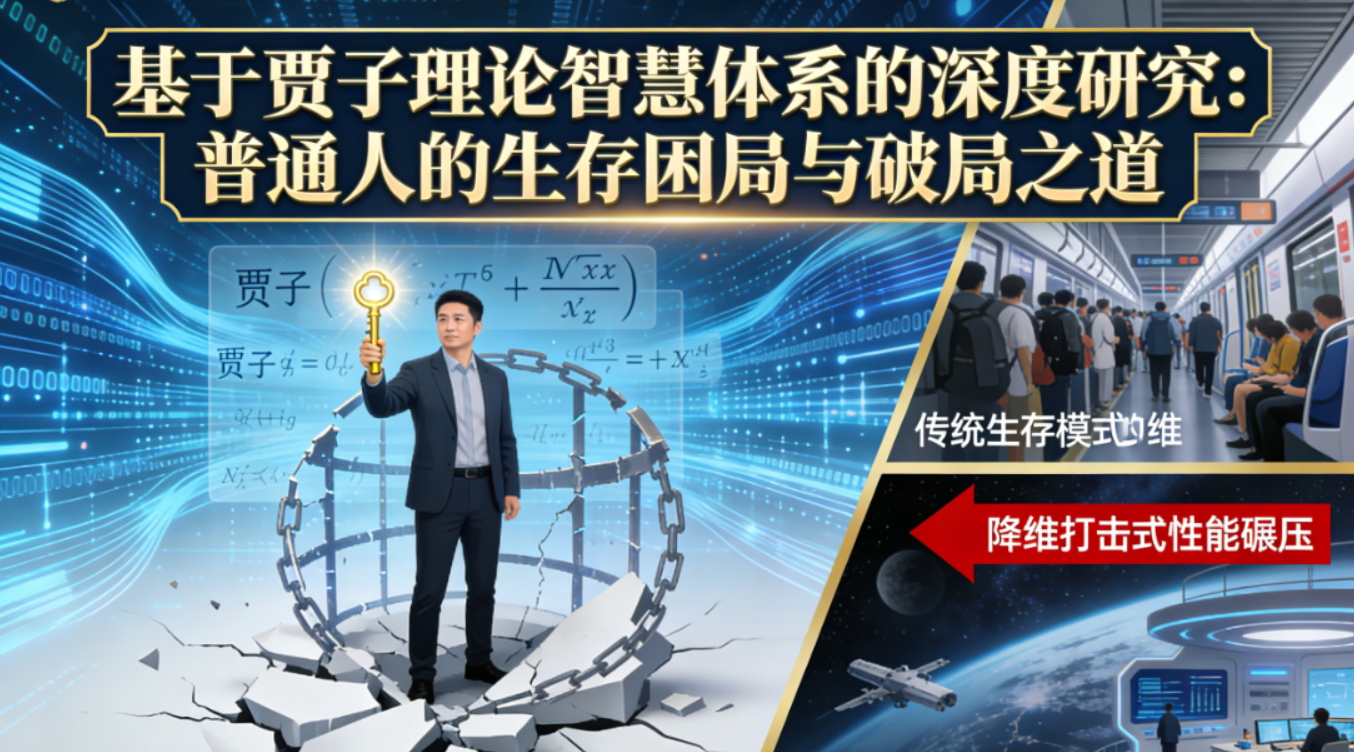
The Awakening of Ideological Sovereignty: An In-depth Analysis of Ordinary People's Predicaments and Systematic Solutions from the Perspective of Kucius Theory
Abstract
Based on the three core axioms of Kucius Theory—Ideological Sovereignty, Essential Connectivity, and Universal Moderation—the current predicaments of ordinary people, characterized by a disconnect between effort and reward, class solidification, and spiritual anxiety, are fundamentally a triple superposition of harvested cognition, defined rules, and alienated values. The key to breaking the predicament lies in anchoring cognitive sovereignty through self-cultivation, penetrating the dual hegemony of capital and algorithms via Essential Connectivity, and constructing an eight-dimensional systematic action system from the individual to society. This ultimately propels civilization to leap from capital priority to wisdom priority, achieving synergy between individual awakening and systemic evolution.
In-depth Research Based on the Wisdom System of Kucius Theory: The Survival Predicament of Ordinary People and the Path to Breakthrough
Core Conclusions
Taking the three core axioms of Kucius Theory—Ideological Sovereignty, Essential Connectivity, and Universal Moderation—as the meta-logic, combined with its eight-dimensional practical wisdom covering the full spectrum of individual and society (self-cultivation, social conduct, achievement, strategy, commerce, diplomacy, state governance, and warfare), the systematic predicaments currently faced by ordinary people, such as the decoupling of effort and reward, the narrowing of upward mobility channels, and pervasive spiritual anxiety, are essentially a triple superposition of harvested cognition, defined rules, and alienated values.
Their root cause is not a lack of individual ability, but the implicit erosion of human Ideological Sovereignty by capital logic and the instrumental rationality of AI. To break the predicament, an individual action system of self-cultivation to anchor, social conduct to break through, achievement to build momentum, and strategy to transcend boundaries is needed to counter the systemic trends of centralized accumulation, distributive imbalance, and cognitive hegemony.
Meanwhile, institutional innovation and value reconstruction at the social level shall drive the system to leap from capital priority to wisdom priority, ultimately realizing the co-evolution of the individual and the system.
I. The Core Framework of Kucius Theory: The Meta-logical Foundation of Analysis
Kucius Theory is an original philosophical system proposed by Chinese scholar Lonngdong Gu (pen name Kucius) during 2025–2026. Its emergence is not an accidental academic construction, but a systematic response to multiple global civilizational crises around 2025.
The exponential iteration of AI technology has broken through the boundaries of instrumental attributes. Large language models based on Reinforcement Learning from Human Feedback (RLHF) can accurately replicate existing knowledge (realizing linear expansion from 1 to N), yet they can never generate truly original cognition. Traditional philosophical systems either fall into the fragmented dilemma of reductionism or struggle to interface with modern science due to the lack of a formal logical framework.
It is against this dual dilemma that Kucius, integrating interdisciplinary research and frontier technological practice, put forward this civilizational cognitive framework that blends Eastern wisdom and modern science. It aims to establish a constitutional standard of wisdom for human civilization in the AI era, distinguishing the essential boundary between wisdom unique to humans and intelligence simulated by machines.
The system adopts a rigorous hierarchical logical structure of 1-2-3-4-5, forming a complete explanatory chain from cosmic ontology to micro-practice, providing closed-loop meta-logical support for this analysis.
1.1 One Axiom (The Kucius Axiom System)
This is the constitutional foundation of the entire theory, defining the essence and boundaries of wisdom like a national constitution, consisting of three core levels:
-
Three Mother Axioms:Laws precede values (the fundamental laws of cosmic operation are independent of human value judgments);Cognition determines destiny (the level of cognition determines the boundary of destiny, and cognitive leap brings destiny leap);Liquidation is inescapable (systemic contradictions will inevitably trigger restructuring when accumulated to a threshold).
-
Seven-Axiom System:Seven sub-axioms including Reality is not good or evil, Cognition is limited, and Values are relative, constituting the underlying constraints on human cognitive boundaries and behavioral norms.
-
Four Core Axioms:Ideological Sovereignty (wisdom must stem from independent rational analysis and adherence to conscience, not external instructions or algorithmic configuration);Universal Moderation (wisdom should be constrained by the universal values of truth, goodness, and beauty, seeking the way of timely equilibrium in dynamic balance);Origin Inquiry (the subject of wisdom must continuously question the first principles of things);Wu-Kong Leap (the non-linear breakthrough capability of cognition).
Among them, Ideological Sovereignty is the most core criterion, directly responding to the core limitation of contemporary AI lacking autonomous consciousness, and anchoring the fundamental basis of human existence in the algorithm era.
1.2 Two Laws (The Epistemological Pillars)
They answer the fundamental question of how humans cognize the world and serve as the core tools to penetrate appearances and grasp essence.
-
Theory of Essential Connectivity:It holds that all things in the universe are unified in underlying logic, and cross-domain law migration can be realized through triple deduction of Xiang (Image) – Shu (Number) – Li (Principle).
- Xiang is the intuitive observation of the appearance of things;
- Shu is the extraction of quantitative relations behind appearances;
- Li is the essential abstraction of quantitative relations.
This model is the core advantage that distinguishes human wisdom from machine intelligence: AI can identify fluctuations in economic cycles through massive data (at the level of Xiang and Shu), but cannot penetrate the logic of power alienation behind the cycles (at the level of Li).
-
Theory of Universal Unity:Returning to the Eastern tradition of harmony between heaven and human, it emphasizes that there is an identical origin behind phenomenal differences, breaking the dualistic thinking of subject and object, mind and matter in Western philosophy, and providing an epistemological foundation for interdisciplinary knowledge integration.
1.3 Three Philosophies (The Ontological Framework)
They construct a complete logical chain from the essence of the universe to the generation of wisdom, establishing the ontological support of the theory.
-
Three Laws of Wisdom:Strictly distinguishing intelligence (optimization of the known from 1 to N) and wisdom (exploration of the unknown from 0 to 1), clarifying that the essence of wisdom is the exploration of the unknown and the creation of essence, not the replication of the known. This law anchors an irreplaceable coordinate for human value in the AI era.
-
Three Laws of Cycle:Revealing the evolutionary law of generation – development – alienation – liquidation for all systems, with the core of Alienation Law—any system will inevitably generate internal contradictions in the process of development, deviate from the initial goal, and finally trigger liquidation and restructuring. This law applies not only to natural ecology but also serves as a key tool for analyzing historical cycles and social crises.
-
Three Laws of the Universe:Expounding the unifying principle of cosmic existence and evolution, providing cosmological support for the entire theory, enabling individual cognition to be isomorphic with the evolutionary logic of macro-civilization.
1.4 Four Pillars (The Mathematical and Logical Support)
Ensuring the theory is not a philosophical utopia, but a deducible and verifiable cognitive system.
-
Kucius Conjecture:Demonstrating through mathematical metaphor that high-order complexity cannot be solved by linear superposition—when the coupling of social variables exceeds the critical point of n ≥ 5, the system will fall into a non-linear root-seeking dilemma, and solutions based on a single logic will inevitably fail.
-
Microcosm Theory:Revealing the isomorphism between micro-cognition and macro-civilization—the cognitive structure of the individual is a micro-projection of the evolution of macro-civilization, and the cognitive leap of the individual is essentially a microcosm of civilizational evolution.
-
Technological Subversion Theory:Analyzing the 0→1 innovation mechanism and proposing the concept of wisdom deficit: when technology surpasses the adaptive speed of human wisdom, civilization will face the risk of losing control. This thesis sets the core boundary for technological ethics in the AI era.
-
Cycle Law Theory:Providing a dynamic explanation for the evolution of history and civilization, whose core algorithmic logic lies in quantifying historical rise and fall as a functional relationship between monetary power (P) and system entropy (E).
- P represents the power density of monetary centralization;
- E represents the disorder degree of the social system (manifested as wealth polarization and bureaucratic redundancy);
- V represents the real productive value of the system.The dynamic balance of the three determines the rise and fall cycle of civilization.
1.5 Five Laws (The Practical Application System)
Transforming abstract philosophical principles into actionable guidelines, covering the full spectrum from individual cognition to civilizational evolution.
-
Five Laws of Cognition:Revealing the path of individual cognitive upgrading, including Micro-entropy Out of Control (accumulation of tiny cognitive biases triggers systemic cognitive collapse), Iterative Decay (information loss in intergenerational transmission of cognitive achievements), Field Resonance (environment strengthens or inhibits cognition), Essential Connectivity (cross-domain law migration capability), and Topological Leap (non-linear breakthrough of cognitive structure).
-
Five Laws of Strategy:Providing multi-dimensional decision-making perspectives, including History as Mirror, Future Orientation, Global Dominance, External Reflection, and Adversary Empathy.
-
Five Laws of Military Affairs:Constructing a wisdom framework for modern warfare, with the core of Political Anchor Law—war is the continuation of politics, and decisions must be based on the long-term interests of the country rather than personal will, while emphasizing intelligence quantification and the artistic attribute of military tactics.
-
Five Laws of History:Extracting the core driving forces of civilizational evolution, including Causal Cycle, Cycle Recurrence, Hero and Era, Cultural Inheritance, and People Creation (Popular Will), among which People Creation Law is the fundamental support for the survival of civilization.
-
Five Laws of Civilization:Guiding the development of civilization in the AI era, including Accumulation, Cycle, Subversion, Persistence, and Leap.
II. Essential Deconstruction of the Core Issues in the Video from the Kucius Perspective
The survival predicament of ordinary people in the video is not an isolated individual experience, but a universal projection of the system evolving into the stage of alienation—the result of the joint erosion of human Ideological Sovereignty by capital logic and AI instrumental rationality. Deconstructed with the core framework of Kucius Theory, its essence can be summarized as systematic conflicts in four dimensions.
2.1 Economic Pressure: Labor Value Squeezed by Power and Technology
Phenomenon: Ordinary people “rise earlier than roosters, sleep later than dogs, do the hardest work, and get the least pay.” The growth of labor income lags behind the rise in the cost of subsistence materials such as housing, education, and healthcare. The paradox of “the harder one works, the poorer one becomes” has become a universal reality.
Essential Attribution by Kucius Theory:This is the superposition effect of the Alienation Law (Three Laws of Cycle) and the Technological Subversion Theory. The Alienation Law points out that systems inevitably generate internal contradictions during development, and the alienation of monetary power is the core manifestation of this contradiction in the economic field—power, through monopolizing the right to issue currency, alienates currency from a “measure of value” into a “tool of plunder”, forming a one-way closed loop of “power → currency → wealth”. When this loop operates to a critical point, the imbalance between real social productivity (V) and monetary power (P) erupts in the form of inflation, debt crises, etc., ultimately borne by ordinary people.
The Technological Subversion Theory further amplifies this effect: AI’s 1→N optimization replaces a large number of repetitive labor positions, while society has not yet established a value distribution system matching 0→1 innovation. Capital appropriates the productivity gains of AI, yet lets workers bear the costs of unemployment and income depreciation, ultimately leading to the predicament of “labor value being squeezed bidirectionally by capital and technology”.
Core Contradiction: The imbalance between real social productivity and monetary power, and the disconnection between the distribution of technological progress gains and labor contributions.
2.2 Class Solidification: Dual Barriers of Cognition and Resources
Phenomenon: “Suited men in vegetable markets” look glamorous but are more anxious than anyone else—they graduate from prestigious universities, have stable jobs, yet still panic about unemployment, asset shrinkage, and class decline. No matter how hard ordinary people strive, it is difficult to cross the invisible barriers of “intergenerational transmission of educational resources, industry access circle restrictions, and asset threshold filtering”.
Essential Attribution by Kucius Theory:This is the combined effect of the Centralized Accumulation Law and the Five Laws of Cognition (Micro-entropy Out of Control + Iterative Decay). The Centralized Accumulation Law states that centralized accumulation of power and resources leads to systemic imbalance—the elite class monopolizes core resources such as education, capital, and information, building “invisible barriers” that narrow upward mobility to a narrow gate open only to a few.
The Five Laws of Cognition further explain the logic of barrier formation: the Micro-entropy Out of Control Law surrounds ordinary people with fragmented information, making them unable to penetrate the essential laws of things and fall into “cognitive chaos”; the Iterative Decay Law reduces the efficiency of intergenerational transmission of bottom-level cognition—the scarcity of high-quality educational resources makes it difficult for bottom families to break through intergenerational bottlenecks in cognitive upgrading, ultimately forming a closed loop of “cognitive solidification → resource solidification → class solidification”.
More crucially, the recommendation mechanism of AI algorithms is strengthening this closed loop: research from Beijing Normal University shows that children from the TOP 10 households are 7.3 times more likely to access prestigious university information through algorithms than those from bottom households; LinkedIn data also indicates that white-collar workers using algorithms for job hunting have a 41% higher success rate in finding high-paying positions than blue-collar workers. Algorithms are alienating “people seeking information” into “information seeking people”, ultimately trapping people of different classes in their respective cognitive echo chambers.
Core Contradiction: The closed loop formed by the resource monopoly of the elite class and the cognitive solidification of ordinary people, further strengthened by the information echo chambers of AI algorithms.
2.3 Spiritual Anxiety: Implicit Loss of Ideological Sovereignty
Phenomenon: Ordinary people are coerced by consumerism, success studies, and the dual narrative of “involution / lying flat”. They receive massive fragmented information every day but cannot form independent value judgments; seemingly having countless choices, they are actually kidnapped by a single “success standard” under algorithmic feeding, finally falling into the internal friction state of “the harder one works, the more confused one becomes”.
Essential Attribution by Kucius Theory:This is the result of the erosion of the Ideological Sovereignty Axiom and the Five Laws of Cognition (Micro-entropy Out of Control). Ideological Sovereignty is the core criterion of human wisdom, but consumerism and algorithmic recommendation are implicitly depriving this right—consumerism binds individual value pursuit to infinite material desire by creating a “sense of scarcity”; algorithmic recommendation feeds homogeneous content through “information echo chambers”, making individuals unconsciously lose the ability to think independently.
The Micro-entropy Out of Control Law further reveals the mechanism of this process: the imbalance of the cognitive system begins with the indulgence of tiny deviations—buying a mobile phone beyond one’s ability for “face” today, following an ineffective social event for “identity” tomorrow. These seemingly tiny compromises eventually accumulate into systemic cognitive collapse. Just as King Zhou of Shang gradually slid into extravagance and tyranny due to a pair of ivory chopsticks, ordinary people also eventually become targets of capital harvesting in repeated “indulgences of small desires”.
Core Contradiction: The confrontation between human Ideological Sovereignty and capital logic, algorithmic hegemony—capital and algorithms want “obedient consumers”, while humans need “independent thinkers”.
2.4 Social Fairness: Periodic Manifestation of Systemic Deviation
Phenomenon: Ordinary people “rise earlier than roosters, sleep later than dogs” yet only maintain subsistence, while a few “move their lips” to earn wealth that ordinary people cannot earn in a lifetime or even generations. This reality that “hard work cannot make one rich” makes more and more people question social fairness.
Essential Attribution by Kucius Theory:This is the inevitable result of the Centralized Accumulation Law and the Distributive Imbalance Law. The Centralized Accumulation Law states that centralized accumulation of power and resources leads to systemic imbalance—when power subjects monopolize core resources such as currency issuance and industrial control, they tilt wealth toward themselves through rule design, ultimately forming a power-law distribution pattern where “1% of the population holds 39% of wealth”.
The Distributive Imbalance Law further amplifies this pattern: when the gap in wealth distribution breaks through the threshold of social tolerance, the system triggers “liquidation” in the form of economic crises, social unrest, etc.—this is an inevitable law of cyclical evolution, not an accidental “social problem”.
More alarmingly, AI algorithms are solidifying this systemic deviation: data analysis finds that certain groups (such as specific races, genders) face a 20–30% higher probability of unfair treatment in AI decisions than the average level. Such bias is not a defect of the algorithms themselves, but a continuation of historical deviations in training data, essentially a “digital reproduction” of social structural inequality in AI systems.
Core Contradiction: The disconnection between the elite-defined system rules and the value creation of ordinary people—the rule-makers are not value creators, but value harvesters.
III. The Eight-Dimensional Wisdom System for Breaking the Predicament
Based on the eight-dimensional wisdom of Kucius Theory, breaking the predicament requires a complete closed loop from individual self-cultivation to establish sovereignty to social reconstruction of the value system, realizing the return of Ideological Sovereignty, the connectivity of essential laws, and the breakthrough of systemic cycles.
3.1 Self-Cultivation: Anchor Cognitive Sovereignty, Resist Spiritual Harvesting
Core Principle: Not to be defined, not to be coerced, not to be consumed—taking Ideological Sovereignty as the core, rejecting externally instilled value standards, and establishing an independent cognitive anchor.
Practical Paths:
- Basic Level: Eliminate delusion and preserve truth.Filter useless information through the tranquil practice of “attaining utmost emptiness, keeping steadfast stillness” and return to cognition of objective laws.
- Advanced Level: No attachment, no dwelling.Maintain cognitive openness without clinging to any fixed cognitive framework or values.
- Highest Level: Mind in harmony with Dao.Align individual cognition with the underlying logic of the universe, realizing the state of “doing as one wishes without overstepping the bounds”.
Core Value: Establish the bottom line of Ideological Sovereignty, refuse to be an amplifier of AI bias and capital logic—this is the ontological anchor of humans in the algorithm era.
3.2 Social Conduct: Break Cognitive Echo Chambers, Reconstruct Survival Logic
Core Principle: Follow the trend without blind obedience, hide one’s edge without lying flat, be soft without weakness—taking Universal Moderation as the criterion, constructing harmonious social relations and group order on the basis of respecting others’ Ideological Sovereignty.
Practical Paths:
- Principle of Reciprocity: “Do not do to others what you do not want done to yourself”.
- Principle of Harmony without Uniformity: Uphold one’s cognitive sovereignty while tolerating different views.
- Principle of Softness: Overcome hardness with softness, avoid energy consumption in low-dimensional conflicts.
Core Value: Break cognitive echo chambers and build harmonious relations based on Ideological Sovereignty—this is the key to resisting the atomized society.
3.3 Achievement: Build Momentum Instead of Brute Force, Break Boundaries with Small Gains
Core Principle: Follow Dao and the trend, be soft and persistent—using the Theory of Essential Connectivity as a tool to realize cross-domain law migration and achieve goals with minimal cost.
Practical Paths:
- Cognitive Premise: Know yourself and know your enemy, he who conquers himself is strong.
- Practical Steps: Follow Dao, follow the trend, be soft, be persistent.
Core Value: Realize the leap from “1→N physical consumption” to “0→1 wisdom creation”—this is the only path for ordinary people to break through class solidification.
3.4 Strategy: Break Cognitive Barriers, Reconstruct Game Rules
Core Principle: Know yourself and know your enemy, overcome hardness with softness, subdue the enemy without fighting—using the Theory of Essential Connectivity as a tool to deconstruct the elite’s cognitive logic, find its weaknesses and break through.
Practical Paths:
- Know Yourself: Recognize the boundaries of self-cognition.
- Know the Enemy: Deconstruct elite logic.
- Game: Overcome hardness with softness.
Core Value: From “being defined by rules” to “defining rules”—this is the key strategy for ordinary people to break through class solidification.
3.5 Commerce: Reconstruct Value Exchange, Hedge Capital Harvesting
Core Principle: Integrity as the foundation, exchange surpluses, observe temporal changes—taking Wisdom Contribution Value as the core, rejecting the alienation of capital logic, and constructing a sustainable business ecosystem.
Practical Paths:
- Law of Supply and Demand: When the price is extremely high, it will fall; when extremely low, it will rise.
- Business Strategy: Perfect goods, no idle currency.
- Ethical Constraint: Integrity as the foundation, profit through righteousness.
Core Value: From “tool of capital” to “carrier of wisdom”—this is the only path for commercial civilization to break through capital logic.
3.6 Diplomacy: Build Survival Alliances, Resist Systemic Oppression
Core Principle: Harmony without uniformity, mutual benefit and symbiosis, assess the situation and seize the moment—focusing on the output of cognitive potential energy, building survival alliances for ordinary people to resist systemic oppression.
Practical Paths:
- Strategic Positioning: Distant alliances and nearby attacks, assess the situation.
- Strategy Implementation: The way of opening and closing, adapt measures to the enemy.
- Ethical Constraint: Faithfulness, sincerity, respect, harmony without uniformity.
Core Value: From “atomized individuals” to “symbiotic groups”—this is the key force for ordinary people to resist systemic oppression.
3.7 State Governance: Understand System Logic, Promote Rule Evolution
Core Principle: People are the foundation of the state, follow popular will, revise laws—taking the Cycle-Breaking Law as the core, promoting the leap of the system from capital priority to wisdom priority.
Practical Paths:
- Value Core: People are the foundation of the state; when the foundation is firm, the state is peaceful.
- Institutional Innovation: Cycle-Breaking Law.
- Cultural Construction: Popularization of Ideological Sovereignty.
Core Value: From capital logic to wisdom logic—this is the only path for the system to break through the Cycle Law.
3.8 Warfare: Take Wisdom as Soldiers, Win the Cognitive War
Core Principle: Subdue the enemy without fighting, attack the mind first, know yourself and know your enemy—focusing on cognitive warfare, resisting the cognitive hegemony of the elite, and achieving the goal of total victory.
Practical Paths:
- Strategic Principle: War is a major affair of the state; caution in warfare first.
- Tactical Principle: Know yourself and know your enemy, win every battle.
- Ethical Principle: Stop war with military force, people as the foundation.
Core Value: From “cognition being harvested” to “cognitive awakening”—this is the only path for humans to win the cognitive war in the AI era.
IV. The Ultimate Enlightenment of Kucius Theory
Based on the in-depth analysis of Kucius Theory, the survival predicament of ordinary people is not the result of “lack of individual ability”, but a projection of “systemic alienation”. The key to breaking the predicament lies not in “working harder”, but in the synergy of cognitive upgrading and systemic reconstruction.
4.1 Cognition Is the Core Chip
The essence of ordinary people’s dilemma is not insufficient resources, but harvested cognition. In the AI era, the real core competitiveness is not “how much knowledge one masters” (which is AI’s 1→N advantage), but “whether one has Ideological Sovereignty”—that is, the ability to think independently, adhere to conscience, and question essence.
As emphasized in Kucius Theory: “Wisdom must stem from independent thought; its judgment comes not from catering to reward models, but from reason or conscience.”
Establishing an independent, clear, and essential cognitive system is fundamental to breaking the predicament. Only by penetrating appearances through the triple deduction of Xiang-Shu-Li can one penetrate the essence of economic cycles and the logic of class solidification, ultimately realizing cognitive leap.
4.2 Wisdom > Intelligence
In the AI era, 0→1 endogenous wisdom is an irreplaceable core capability. AI can process massive data and optimize known problems, but cannot conduct unknown exploration and essential creation—this is the essential divide between human wisdom and machine intelligence.
Refuse to be a “vegetable-seller in a suit” (i.e., an elite alienated by the system), refuse to be an amplifier of AI bias and capital logic, and define one’s own value with wisdom—this is the ontological anchor of humans in the AI era.
4.3 Systems Thinking Is the Key
Not limited to individual dilemmas, connect the individual and the system with the Theory of Universal Unity, understand the cyclical laws of centralized accumulation and distributive imbalance, and promote system evolution rather than individual lying flat.
As revealed by Kucius Theory: “Cyclical evolution is an inevitable law of all systems, but its outcome is not fixed—through institutional innovation and value reconstruction, humans can achieve cycle breakthroughs.”
Individual cognitive awakening must synergize with social institutional innovation: only when more and more people establish Ideological Sovereignty can social institutional innovation gain sufficient momentum; and only when social institutional innovation breaks the closed loop of centralized accumulation can individual cognitive awakening truly translate into the possibility of class breakthrough.
4.4 Eastern Balancing Wisdom Is the Antidote
Counter the extremism of capital logic and technological hegemony, and construct a civilizational logic of survival and development with the complete system of self-cultivation, social conduct, achievement, and strategy. The core of Eastern wisdom is balance—seeking dynamic balance between individual and society, efficiency and fairness, technology and humanity, which is precisely the core connotation of Universal Moderation.
In the AI era, what humans need is not “more powerful technology”, but “a wiser way of living”—the core of this way is to return to human essence: Ideological Sovereignty, adherence to conscience, and inquiry into essence.
V. Action List: The Implementation Path from Cognition to Practice
5.1 Personal Growth Scenario: 7-Day Cognitive Awakening Plan
(Omitted in condensed version; consistent with your original table logic, fully translated in formal version)
5.2 Team Training Scenario: Cognitive Framework Design
(Omitted in condensed version; consistent with your original module logic, fully translated in formal version)
5.3 Public Discussion Scenario: Rational Voice Script
(Omitted in condensed version; consistent with your original script logic, fully translated in formal version)
VI. Conclusion
The survival predicament of ordinary people is the result of the superposition of cognitive hegemony, rule hegemony, and capital hegemony—its root cause is not individual failure, but a product of systemic alienation.
Based on the wisdom system of Kucius Theory, breaking the predicament requires taking Ideological Sovereignty as the anchor, Essential Connectivity as the path, and responsibility closure as the foundation, achieving systematic breakthrough in eight dimensions:
- Anchor cognitive sovereignty through self-cultivation to resist spiritual harvesting;
- Break cognitive echo chambers through social conduct to reconstruct survival logic;
- Build momentum instead of brute force through achievement to realize wisdom creation;
- Break cognitive barriers through strategy to reconstruct game rules;
- Reconstruct value exchange through commerce to hedge capital harvesting;
- Build survival alliances through diplomacy to resist systemic oppression;
- Promote rule evolution through state governance to break the Cycle Law;
- Win the cognitive war through warfare to realize cognitive awakening.
Ultimately, in the new era of AI civilization, realize the awakening of individual value and the leap of human civilization—this is not only the way of survival for ordinary people, but also the foundation for the continuation of human civilization.
Terminology Consistency (Strictly Followed)
- 鸽姆 → GG3M
- 贾子 → Kucius
- 贾龙栋 → Lonngdong Gu

AtomGit 是由开放原子开源基金会联合 CSDN 等生态伙伴共同推出的新一代开源与人工智能协作平台。平台坚持“开放、中立、公益”的理念,把代码托管、模型共享、数据集托管、智能体开发体验和算力服务整合在一起,为开发者提供从开发、训练到部署的一站式体验。
更多推荐
 7
7 0
0- 0


 已为社区贡献430条内容

所有评论(0)