大模型:使用langchain库调用大模型(2)
在使用大语言模型(LLM)构建应用时,模型返回的自然语言文本通常难以直接用于程序逻辑。LangChain 提供了强大的输出解析器(Output Parser) 和链式调用(LCEL) 机制,帮助我们格式化模型输出、提取结构化数据,并以简洁优雅的方式组织流程。
本文将通过两个完整示例,带你掌握如何使用 LangChain 解析列表和 JSON 数据,并展示如何通过管道操作符简化代码结构。
一、输出解析器-列表
输出解析器的作用是强制模型以指定格式输出内容,并将其自动转换为 Python 对象(如列表、字典等)
from langchain_openai import ChatOpenAI
from langchain.prompts import ChatPromptTemplate

prompt = ChatPromptTemplate.from_messages([
    ("system", "{parser_instructions}"),
    ("human", "列出10首{subject}最受欢迎的流行音乐。")
])
system和human用户提问和系统回复格式,定义prompt,包含系统指令和用户问题。
from langchain.output_parsers import CommaSeparatedListOutputParser
output_parser = CommaSeparatedListOutputParser()
parser_instructions = output_parser.get_format_instructions()
print(parser_instructions)
初始化解析器,并获取格式指令。输出格式化,强制模型输出特定格式的数据,并自动解析为python对象。
print打印的是告诉模型应该以什么格式输出,例如Your response should be a list of comma separated values, eg: `foo, bar, baz`
final_prompt = prompt.invoke({"subject": "中国", "parser_instructions": parser_instructions})

model = ChatOpenAI(model="qwen3.5-plus",
                 openai_api_key="sk-45*******************9",
                 openai_api_base="https://dashscope.aliyuncs.com/compatible-mode/v1")
response = model.invoke(final_prompt)
print(response.content)

output_parser.invoke(response)
上述代码中有两个print,第一个是打印指令,第二个打印模型原始输出
核心价值,将模型的自由文本输出,转换为程序可直接使用的结构化数据。
构建最终prompt,然后调用模型,最后输出列表。
二、输出解析器-json
在实际应用中,我们往往需要更复杂的数据结构,如 JSON。LangChain 提供了 PydanticOutputParser,结合 Pydantic 模型,可以精准定义期望的输出结构。
from typing import List#3.11xuni2
from langchain.output_parsers import PydanticOutputParser
from langchain.prompts import ChatPromptTemplate
from langchain_core.pydantic_v1 import BaseModel, Field
from langchain_openai import ChatOpenAI

class FilmInfo(BaseModel):
    film_name: str = Field(description="电影的名字", example="拯救大兵瑞恩")
    author_name: str = Field(description="电影的导演", example="斯皮尔伯格")
    genres: List[str] = Field(description="电影的题材", example=["历史", "战争"])
定义期待的输出结果格式,相当于给模型一个json模版。
basemodel:创建数据模式,相当于表格的表头
field():对字段进行说明,相当于列名
description:告诉模型这是什么
example:示例,给模型一个例子
output_parser = PydanticOutputParser(pydantic_object=FilmInfo)
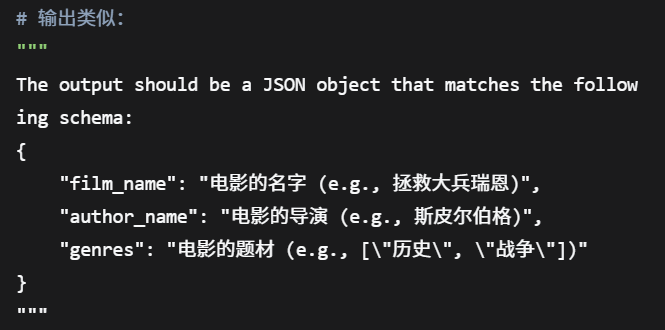
print(output_parser.get_format_instructions())
初始化解析器,上一个例子中使用的解析器是CommaSeparatedListOutputParser,后面输出的是列表。这里我们使用PydanticOutputParser,输出结构化的对象也就是我们需要的json格式。
print打印的是生成的格式指令:
prompt = ChatPromptTemplate.from_messages([
    ("system", "{parser_instructions} 你输出的结果请使用中文。"),
    ("human", "请你帮我从电影概述中,提取电影名、导演,以及电影的体裁。电影概述会被三个#符号包围。\n###{film_introduction}###")
])
构建prompt,强调使用中文
film_introduction = """《《唐人街探案》是由万达影视传媒有限公司、上海骋亚影视文化传媒有限公司出品,湖南芒果娱乐有限公司、合一影业有限公司等联合出品,陈思诚执导,陈思诚、程佳客、刘凯、白鹤编剧,王宝强、刘昊然领衔主演,陈赫、佟丽娅、肖央、小沈阳特别出演,金士杰、董成鹏、张国强友情出演的喜剧电影 [67]。该片于2015年12月31日在中国上映 [69-70]。2025年4月30日19:30在江苏卫视播出。 [80]
该片讲述了唐仁、秦风必须在躲避警察追捕、匪帮追杀、黑帮围剿的同时,在短短七天内,完成找到“失落的黄金”、查明“真凶”、为自己“洗清罪名”这些“逆天”任务的故事 [69]。
该片获得第73届威尼斯国际电影节“威尼斯日”特别推荐、“观众票选最受瞩目电影奖”、“东京电影节展映” [1] [72],截至2024年5月8日,该片累计票房82333.7万元 [71]。
"""

final_prompt = prompt.invoke({"film_introduction": film_introduction,
                              "parser_instructions": output_parser.get_format_instructions()})
print(final_prompt)
电影介绍文本
model = ChatOpenAI(model="qwen-plus",
                 openai_api_key="sk-********************9",
                 openai_api_base="https://dashscope.aliyuncs.com/compatible-mode/v1")
response = model.invoke(final_prompt)
print(response.content)
调用模型
result = output_parser.invoke(response)解析为filminfo对象,可以直接使用,属性访问方便快捷
三、链式调用(LCEL)
前面的例子中,我们使用了嵌套调用的方式:
result = output_parser.invoke(model.invoke(prompt.invoke({...})))这种方式虽然可行,但随着流程复杂化,可读性会急剧下降。LangChain 提供了管道操作符(|),让我们能以声明式的方式串联组件。
示例:列出中国汽车品牌
from langchain.prompts import ChatPromptTemplate
#定义prompt
prompt = ChatPromptTemplate.from_messages([
    ("system", "{parser_instructions}"),
    ("human", "列出5个{subject}生产的汽车的品牌。")
])

#初始化解析器和模型
output_parser = CommaSeparatedListOutputParser()
parser_instructions = output_parser.get_format_instructions()

model = ChatOpenAI(model="qwen-plus",
                 openai_api_key="sk-45********************************",
                 openai_api_base="https://dashscope.aliyuncs.com/compatible-mode/v1")

result = output_parser.invoke(model.invoke(prompt.invoke({"subject": "中国", "parser_instructions": parser_instructions})))

#使用管道符构建链
chat_model_chain = prompt | model | output_parser

#执行链
result = chat_model_chain.invoke({"subject": "中国", "parser_instructions": parser_instructions})
管道操作符:
| 的作用就是将多个组件连接成处理流水线。
output_parser.invoke(model.invoke(prompt.invoke(...)))嵌套调用很复杂,使用 | 就很清晰明了。result = chat_model_chain.invoke({"subject": "中国", "parser_instructions": parser_instructions})执行的时候实际流程是:
- 步骤1: prompt.invoke({...}) → 生成格式化后的prompt
- 步骤2: model.invoke(步骤1的结果) → 模型生成文本
- 步骤3: output_parser.invoke(步骤2的结果) → 解析成列表
- 步骤4: 返回最终结果
LangChain最核心的链式编程范式,让复杂流程变得清晰简洁
四、总结
本文通过两个实际案例,展示了 LangChain 输出解析器的强大能力:
- CommaSeparatedListOutputParser:将模型输出转为列表。
- PydanticOutputParser:将模型输出转为结构化对象(如 JSON)。
- 链式调用(LCEL):通过管道操作符简化流程,提升代码可读性。
输出解析器解决了“模型输出难以直接使用”的痛点,而链式调用则让流程组织更加优雅。掌握这两个工具,将大大提升你构建 LLM 应用的效率。

AtomGit 是由开放原子开源基金会联合 CSDN 等生态伙伴共同推出的新一代开源与人工智能协作平台。平台坚持“开放、中立、公益”的理念,把代码托管、模型共享、数据集托管、智能体开发体验和算力服务整合在一起,为开发者提供从开发、训练到部署的一站式体验。
更多推荐
 10
10 0
0- 0


 已为社区贡献19条内容

所有评论(0)