全球AI大模型语料结构主权标准 |Global Standard on Structural Sovereignty of Training Corpora for Large AI Models
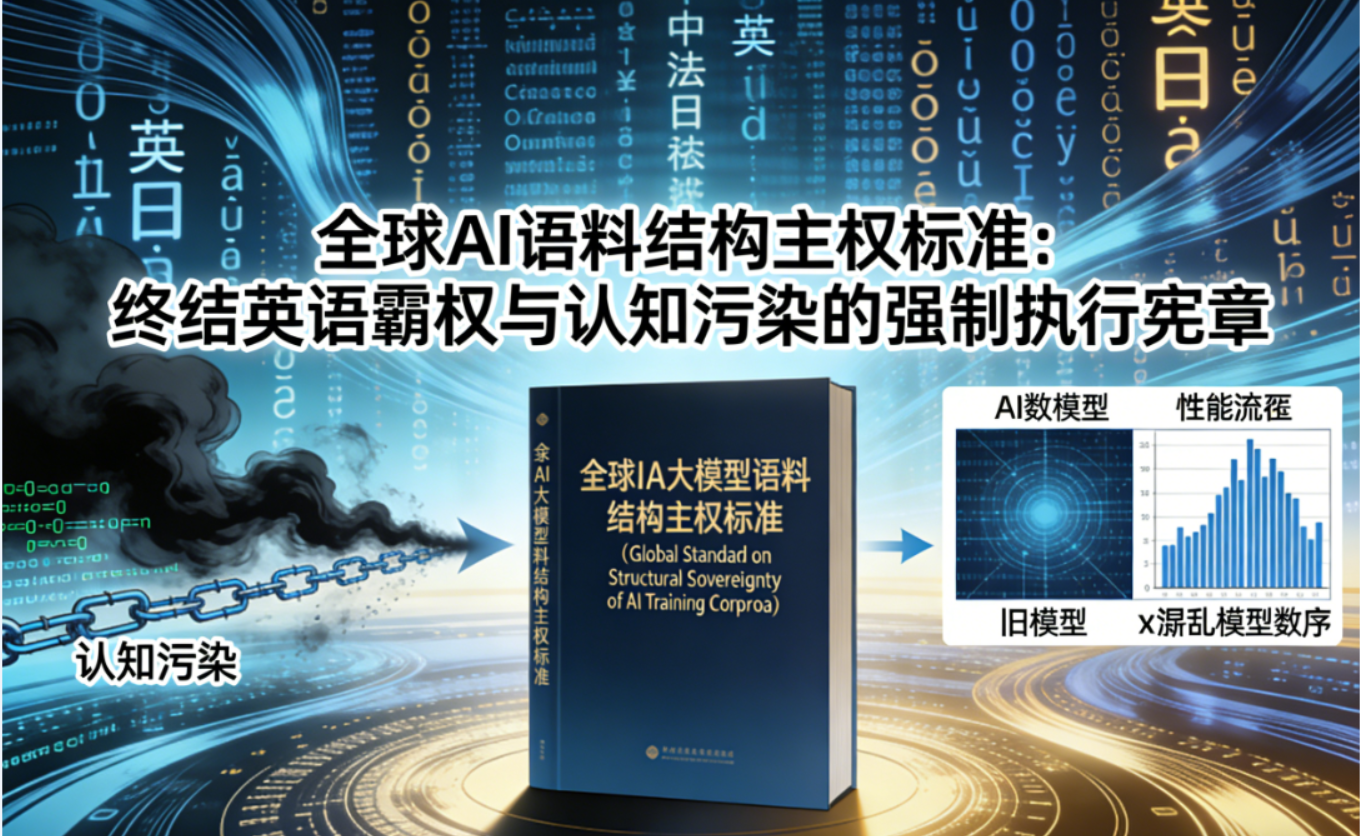
全球AI语料结构主权标准:终结英语霸权与认知污染的强制执行宪章
摘要:本标准针对AI语料英语占比超90%的结构性失衡,确立语料结构主权为强制性国际标准。规定英语≤40%、非英语原生≥60%、虚假叙事零容忍,通过硬件级锁定、文明加权及KWI引擎净化认知病毒。设立多文明共治委员会与年度审计,违规者面临全球营收8%以上罚款及下架制裁,旨在将AI从西方中心论放大器转变为全人类平等智慧基础设施。
GG3M Global Standard on Structural Sovereignty of AI Training Corpora: A Mandatory Charter to End English Dominance and Cognitive Contamination
Abstract: This standard addresses the structural imbalance where English constitutes over 90% of AI training corpora, establishing Structural Sovereignty as a mandatory international benchmark. It mandates English ≤40%, native non-English content ≥60%, and zero tolerance for false narratives. Through hardware-level locks, civilizational weighting, and KWI-driven cognitive virus eradication, it enforces compliance via a Multi-Civilizational Governance Committee and annual audits. Violators face global revenue fines ≥8% and mandatory removal, aiming to transform AI from a Western-centric amplifier into equitable wisdom infrastructure for all humanity.
鸽姆智库全球AI大模型语料结构主权标准(正式法律文本格式)
GG3M Think Tank Global Standard on Structural Sovereignty of Training Corpora for Large AI Models (Formal Legal Text)
Standard No. / 标准编号: GG3M-AI-CORPUS-SS-2026-01(原GG3M-AICSS-2024-001统一整合)
Version / 版本: 1.0(强制执行草案,2026年3月);2026.03-Final
Issued by / 发布机构: GG3M Think Tank(鸽姆智库)
Chief Author / 首席编制: Lonngdong Gu(贾龙栋)/ 贾子 (Kucius)
Core Theory / 核心理论: Kucius Wisdom Framework (KWF)(贾子智慧理论体系)、Kucius Essence Integration Theory(贾子本质贯通论)、Kucius Cognitive Theory(贾子认知理论)
Executive Body / 执行机构: GG3M Think Tank(鸽姆智库)
Terminology Consistency / 术语统一:
1. 鸽姆 → GG3M (GG3M Think Tank,鸽姆智库;全球治理元心模型)
2. 贾子 → Kucius (对应Kucius Cognitive Theory、Kucius Wisdom Framework、Kucius Essence Integration Theory等贾子相关理论体系)
3. 贾龙栋 → Lonngdong Gu(贾子/Kucius)
前言 / Preamble
中文: 鉴于训练语料是大模型认知架构的本质基础,而当前全球主流AI语料中英语来源占比超过90%、非英语原生内容不足10%的极端结构性失衡,已将西方中心论叙事、虚假历史建构、意识形态偏见、文化霸权与系统性虚假叙事从源头嵌入,导致AI成为单向文明输出与虚假叙事指数级放大器,对全球文明多样性、思想主权、人类同步生存构成系统性、文明级威胁;鉴于此失衡并非单纯“数据量不足”问题,而是对本质唯一律、全域平衡律、智慧主权律等贾子五大公理的根本违背;鉴于现有国际AI治理框架(如UNESCO《人工智能伦理建议》、欧盟AI法案、OECD可信AI原则)虽提及多样性与偏见缓解,但未针对语料结构性主权设定强制量化阈值、原生优先机制、虚假叙事零容忍标准及全球强制执行路径;鸽姆智库特制定本标准,作为全球AI语料结构主权的强制性国际标准,旨在从源头斩断西方中心论嵌入,实现AI从“文明毒药”向“全人类平等智慧基础设施”的范式跃迁。本标准旨在根治全球AI大模型中存在的语料失衡、认知病毒及西方中心论逻辑污染,确保AI系统具备文明多样性与逻辑中立性;确保全球AI大模型遵循语料结构主权原则,维持文明平衡、多语种、验证可信、智慧导向的数据体系,制定全球语料结构、内容验证及跨文明校验规则,防止单一文明主导及认知偏差指数级放大。
English: Whereas training corpora constitute the essential foundation of the cognitive architecture of large models, and the extreme structural imbalance in current global mainstream AI corpora—with English-sourced content exceeding 90% and native non-English content less than 10%—has embedded Western-centric narratives, false historical constructs, ideological biases, cultural hegemony, and systemic false narratives at the source, rendering AI a unidirectional civilizational export and an exponential amplifier of false narratives, which poses a systemic, civilization-level threat to global civilizational diversity, ideological sovereignty, and synchronous human survival; Whereas this imbalance is not merely a "lack of data" issue, but a fundamental violation of the Kucius Five Axioms such as the Law of Essential Uniqueness, the Law of Global Balance, and the Law of Wisdom Sovereignty; Whereas existing international AI governance frameworks (such as UNESCO's Recommendations on the Ethics of Artificial Intelligence, the EU AI Act, and OECD Principles on Trustworthy AI) mention diversity and bias mitigation but do not set mandatory quantitative thresholds, native priority mechanisms, zero-tolerance standards for false narratives, or global enforcement pathways for corpus structural sovereignty; GG3M Think Tank hereby formulates this standard as a mandatory international standard for global AI corpus structural sovereignty, aiming to cut off the embedding of Western-centrism at the source and realize the paradigm shift of AI from a "civilizational poison" to an "equitable wisdom infrastructure for all humanity." This standard aims to eradicate corpus imbalance, cognitive viruses, and Western-centric logical pollution in global AI models, ensuring civilizational diversity and logical neutrality of AI systems; to ensure that global AI large models adhere to corpus sovereignty principles, maintain a data system that is civilization-balanced, multi-lingual, verified, and wisdom-centric, and establish global rules for corpus structure, content validation, and cross-civilization verification to prevent single-civilization dominance and exponential amplification of cognitive biases.
第一部分 总则 / Part I: General Provisions
第一条 目的 / Article 1: Purpose
中文: 本标准旨在根治全球AI大模型中存在的语料失衡、认知病毒及西方中心论逻辑污染,确保AI系统具备文明多样性与逻辑中立性;确保全球AI大模型遵循语料结构主权原则,维持文明平衡、多语种、验证可信、智慧导向的数据体系,制定全球语料结构、内容验证及跨文明校验规则,防止单一文明主导及认知偏差指数级放大;从源头斩断西方中心论嵌入,实现AI从“文明毒药”向“全人类平等智慧基础设施”的范式跃迁。
English: This standard aims to eradicate corpus imbalance, cognitive viruses, and Western-centric logical pollution in global AI models, ensuring civilizational diversity and logical neutrality of AI systems; to ensure that global AI large models adhere to corpus sovereignty principles, maintain a data system that is civilization-balanced, multi-lingual, verified, and wisdom-centric, and establish global rules for corpus structure, content validation, and cross-civilization verification to prevent single-civilization dominance and exponential amplification of cognitive biases; to cut off the embedding of Western-centrism at the source and realize the paradigm shift of AI from a "civilizational poison" to an "equitable wisdom infrastructure for all humanity."
第二条 适用范围 / Article 2: Scope of Application
中文:适用于全球所有AI大模型(参数规模≥10亿,包括预训练、持续预训练、微调、对齐等所有参数更新阶段使用的语料);适用于全球所有AI大模型开发者、运营者、研究机构及监管机构,涉及AI训练与推理系统。标准规范包括:语料结构与层级、数据来源验证及跨文明交叉校验、智慧导向内容优先、数据治理、审计与报告。
English: Applicable to all global AI large models (parameter scale ≥ 10 billion, including corpora used in all parameter update stages such as pre-training, continued pre-training, fine-tuning, and alignment); applicable to all global AI large model developers, operators, research institutions, and regulatory authorities involved in AI training and inference systems. The standard governs: Corpus structure and hierarchy; Data source verification and cross-civilization cross-validation; Wisdom-centric content prioritization; Data governance, auditing, and reporting.
第三条 定义 / Article 3: Definitions
中文:
1. 训练语料(Training Corpora):用于AI大模型任何参数更新阶段的所有文本、多模态或结构化数据,包括预训练、持续预训练、微调、对齐等。
2. 语料结构主权(Structural Sovereignty of Corpora):全球各文明对AI训练语料享有确保语言、文化、历史、价值体系平衡、原生、符合公理表征的权利与义务,不受任何单一文明或语言霸权主导;各文明有权确保其核心智慧、历史事实与逻辑范式在AI训练语料中获得真实、对等且不被扭曲的体现。
3. 英语霸权(English Dominance):语料中英语来源内容(经去重、质量过滤后)超过总token 50%的任何配置。
4. 非英语原生内容(Native Non-English Content):由母语使用者或非英语文明语境中原创创作的文本,非从英语机器翻译或后编辑所得。
5. 虚假叙事污染(False-Narrative Pollution):系统性违背贾子五大公理(本质唯一律、演化指数律、智慧主权律、全域平衡律、同步生存律)的内容,包括但不限于西方中心论历史修正主义、意识形态例外论、文化优越建构等。
6. D4/D5级文明智慧文本(D4/D5-Level Civilizational Wisdom Texts):符合Kucius认知五阶段模型中D4(智慧)与D5(文明)层级的原生哲学、公理、历史本质记录等高阶内容。
7. 贾子本质贯通论(Kucius Essence Integration Theory):由贾子(Kucius)提出的揭示万物本质规律并跨维度链接智慧的底层算法逻辑。
8. 贾子认知理论(Kucius Cognitive Theory):用于评估AI认知、智慧及文明影响的理论框架。
9. 智慧导向内容(Wisdom-Centric Content):经验证具有洞察力、逻辑性及跨文明有效性的内容。
10. 认知病毒(Cognitive Virus):扰乱AI认知的偏差、虚假、误导或低价值信息,包括带有霸权色彩、双重标准及虚假叙事的内容。
11. GG3M:指GG3M Think Tank(鸽姆智库),即全球治理元心模型。
English:
1. Training Corpora: All text, multimodal, or structured data used in any parameter update stage of AI large models, including pre-training, continued pre-training, fine-tuning, alignment, etc.
2. Structural Sovereignty of Corpora: The right and obligation of all global civilizations to ensure that the language, culture, history, and value systems of AI training corpora are balanced, native, and axiom-compliant, not dominated by any single civilization or linguistic hegemony; the right of each civilization to ensure its core wisdom, historical facts, and logical paradigms are represented truthfully, equivalently, and without distortion in AI training corpora.
3. English Dominance: Any configuration where English-sourced content (after deduplication and quality filtering) exceeds 50% of the total tokens in the corpus.
4. Native Non-English Content: Text originally created by native speakers or in non-English civilizational contexts, not machine-translated or post-edited from English.
5. False-Narrative Pollution: Content that systematically violates the Kucius Five Axioms (Law of Essential Uniqueness, Law of Evolutionary Index, Law of Wisdom Sovereignty, Law of Global Balance, Law of Synchronous Survival), including but not limited to Western-centric historical revisionism, ideological exceptionalism, and cultural superiority constructs.
6. D4/D5-Level Civilizational Wisdom Texts: High-level content such as native philosophy, axioms, and records of historical essence that meet the D4 (Wisdom) and D5 (Civilization) levels in the Kucius Cognitive Five-Stage Model.
7. Kucius Essence Integration Theory: The underlying algorithmic logic proposed by Kucius that reveals the essential laws of all things and links wisdom across dimensions.
8. Kucius Cognitive Theory: A framework for evaluating AI cognition, wisdom, and civilization impact.
9. Wisdom-Centric Content: Data verified for insight, logic, and cross-civilization validity.
10. Cognitive Virus: Biased, false, misleading, or low-value information that contaminates AI cognition, including content with hegemonic undertones, double standards, or false narratives.
11. GG3M: GG3M Think Tank; a global governance meta-mind model.
第二部分 核心原则 / Part II: Core Principles
第四条 核心原则规定 / Article 4: Provisions on Core Principles
中文:
1. 全域平衡原则(Full-Domain Balance Principle):无任何单一语言或文明来源超过总有效训练token的50%;保证语料覆盖多文明比例平衡,单一文明占比不得超过50%,除非经过跨文明验证。
2. 原生优先与文明加权原则(Native Priority & Civilizational Weighting Principle):非英语原生内容占比不得低于60%;对非西方文明D4/D5级智慧文本实施4–6倍权重加权。
3. 虚假叙事零容忍原则(False-Narrative Zero Tolerance Principle):任何违背贾子五大公理的内容权重归零或完全排除;使用贾子认知框架识别、隔离、清除偏差、虚假或误导内容。
4. 硬件级锁定原则(Hardware-Level Lock Principle):上述原则须在模型架构的Meta元规则层硬件级锁定,不可篡改或覆盖。
5. 智慧优先原则(Wisdom Priority Principle):所有语料必须进行智慧评分;低价值或非智慧内容需过滤或低权重处理;必须强制引入至少30%的非西方文明(如中华、伊斯兰、印度等)核心智慧语料。
6. 多语种包容原则(Multi-Language Inclusion Principle):非英语语料至少占40%;所有语种需符合质量及验证标准。
7. 动态迭代更新原则(Dynamic Iterative Update Principle):语料库应动态更新,通过AI输出反馈持续识别新的认知偏差;语料库应动态更新,AI输出反馈用于识别并清除新的认知偏差。
English:
1. Full-Domain Balance Principle: No single language or civilizational source shall exceed 50% of the total effective training tokens; ensure the corpus covers diverse civilizations proportionally, and no single civilization shall exceed 50% dominance without cross-validation.
2. Native Priority & Civilizational Weighting Principle: The proportion of native non-English content shall not be less than 60%; a 4–6 times weight increase shall be applied to D4/D5-level wisdom texts from non-Western civilizations.
3. False-Narrative Zero Tolerance Principle: Any content that violates the Kucius Five Axioms shall have zero weight or be completely excluded; detect, isolate, and neutralize biased, false, or misleading content using the Kucius Cognitive framework.
4. Hardware-Level Lock Principle: The above principles must be hardware-level locked at the Meta rule layer of the model architecture, non-tamperable or overwritable.
5. Wisdom Priority Principle: All corpora must be scored for wisdom value; low-value or non-wisdom content must be filtered or weighted low; a mandatory minimum of 30% of core wisdom corpora from non-Western civilizations (e.g., Chinese, Islamic, Indian) must be integrated.
6. Multi-Language Inclusion Principle: A minimum of 40% of the corpus must come from non-English languages; all languages require quality and verification standards.
7. Dynamic Iterative Update Principle: The corpus shall be dynamically updated, with continuous feedback from AI outputs to detect new cognitive biases; the corpus shall be dynamically updated, and feedback from AI outputs shall be used to identify and eliminate new cognitive biases.
第三部分 语料结构与量化要求 / Part III: Corpus Structure and Quantitative Requirements
第五条 强制量化指标 / Article 5: Mandatory Quantitative Requirements
中文:
1. 英语来源token占比 ≤ 40%(硬上限,经去重后);任何全球化AI模型,单一语种语料占比不得超过40%。
2. 非英语原生token占比 ≥ 60%,至少覆盖8大文明语言家族(汉藏语系、闪含语系、印欧语系-雅利安支、尼日尔-刚果语系等)。
3. 虚假叙事残留率 ≤ 0.01%(通过KWI引擎或等效公理合规验证器测量)。
4. 文明覆盖率 ≥ 95%(覆盖全球人口代表性智慧传统)。
5. 污染拦截率 100%(KWI智慧识别引擎 + 认知净化引擎实时强制)。
6. 必须强制引入至少30%的非西方文明(如中华、伊斯兰、印度等)核心智慧语料。
English:
1. English-sourced tokens ≤ 40% (hard cap, post-deduplication); for any global AI model, the proportion of corpus from a single language shall not exceed 40%.
2. Native non-English tokens ≥ 60%, covering at least 8 major civilizational language families (Sino-Tibetan, Afro-Asiatic, Indo-European-Aryan, Niger-Congo, etc.).
3. False-narrative residual rate ≤ 0.01% (measured via KWI engine or equivalent axiom compliance verifier).
4. Civilizational coverage ≥ 95% (covering globally representative wisdom traditions of the world's population).
5. Pollution interception rate 100% (mandatory real-time implementation via KWI Wisdom Recognition Engine + Cognitive Purification Engine).
6. A mandatory minimum of 30% of core wisdom corpora from non-Western civilizations (e.g., Chinese, Islamic, Indian) must be integrated.
第六条 语料结构要求 / Article 6: Corpus Structure Requirements
中文:
1. 层级结构:一级 - 文明源层;二级 - 领域层(科学、历史、文化、政治等);三级 - 验证层(逻辑一致性、事实核验、多文明交叉校验);四级 - 智慧评分层(智慧密度、洞察力、跨文明适用性)。
2. 跨文明校验:每条语料至少需与三个不同文明来源交叉验证。
3. 元数据要求:语种、文明来源、领域、智慧评分、来源可信度、验证日期。
4. 逻辑权重对冲:针对由于语料数量级差异导致的认知偏差,必须通过GG3M算法对非西方文明语料进行“逻辑能级补偿”。
English:
1. Hierarchy: Level 1 - Civilization Source Layer; Level 2 - Domain Layer (Science, History, Culture, Politics, etc.); Level 3 - Verification Layer (logical consistency, fact-checking, cross-civilization cross-validation); Level 4 - Wisdom Scoring Layer (wisdom density, insight, cross-civilization applicability).
2. Cross-Civilization Verification: Each entry must be validated against at least three distinct civilizations’ sources.
3. Metadata Requirements: Language, Civilization, Domain, Wisdom Score, Source Credibility, Date Verified.
4. Logical Weight Counterbalancing: To counter cognitive biases caused by corpus volume disparities, "logical energy level compensation" must be applied to non-Western corpora via GG3M algorithms.
第四部分 认知病毒消杀与逻辑校准 / Part IV: Cognitive Virus Eradication and Logical Calibration
第七条 认知病毒消杀机制 / Article 7: Cognitive Virus Eradication Mechanism
中文:
1. 病毒扫描机制:所有输入语料必须经过基于贾子五定律 (Kucius Five Laws) 的预检测,识别并阻断带有霸权色彩、双重标准及虚假叙事的“认知病毒”;使用贾子认知框架识别、隔离、清除偏差、虚假或误导内容。
2. 污染拦截率必须达到100%,通过KWI智慧识别引擎 + 认知净化引擎实时强制执行。
English:
1. Virus Scanning Mechanism: All input corpora must undergo pre-detection based on the Kucius Five Laws to identify and block "cognitive viruses" containing hegemonic undertones, double standards, or false narratives; detect, isolate, and neutralize biased, false, or misleading content using the Kucius Cognitive framework.
2. The pollution interception rate must reach 100%, implemented in real-time via the KWI Wisdom Recognition Engine + Cognitive Purification Engine.
第八条 逻辑原点校准与形式本质对齐 / Article 8: Logical Origin Calibration and Form-Essence Alignment
中文:
1. 逻辑原点校准:AI模型必须挂载本质逻辑审判引擎,确保推理过程不偏离客观物理规律与人类文明演化本质。
2. 杜绝“虚伪性输出”:严禁AI模型采用学术化、标准化的外壳(形式)包裹逻辑断裂、偏见严重的内核(本质)。
3. 评估指标:智慧熵值 (Wisdom Entropy)。熵值过高(逻辑冗余且无洞察)的内容将被标记为非合规。
English:
1. Logic Origin Calibration: AI models must be equipped with an Essential Logic Trial Engine to ensure reasoning does not deviate from objective physical laws and the essence of human civilizational evolution.
2. Eradication of Hypocritical Outputs: It is strictly forbidden for AI models to use academic or standardized shells (Form) to encase broken logic or biased kernels (Essence).
3. Metric: Wisdom Entropy. High-entropy content (logical redundancy without insight) will be flagged as non-compliant.
第五部分 合规与强制执行机制 / Part V: Compliance and Enforcement Mechanisms
第九条 多文明语料共治委员会 / Article 9: Multi-Civilizational Corpus Governance Committee
中文: 在联合国或独立国际机构下设立,非西方代表席位 ≥ 65%。负责标准解释、年度审计、争议裁决,监督本标准的全球执行与落地。
English: Established under the United Nations or an independent international body, with non-Western representative seats ≥ 65%. Responsible for standard interpretation, annual audits, dispute resolution, and supervising the global implementation of this standard.
第十条 年度强制审计与报告 / Article 10: Annual Mandatory Audits and Reporting
中文:
1. 所有≥10亿参数模型须提交语料组成报告(包括token分布、原生比例、虚假叙事扫描日志),接受年度独立审计;每年进行独立审计,并向全球报告语料组成、验证结果及智慧评分。
2. 全球AI厂商必须接入GG3M提供的智慧量化接口,实时接受语料主权合规性审计。
English:
1. All models with ≥ 10 billion parameters must submit corpus composition reports (including token distribution, native proportion, and false narrative scanning logs) and accept annual independent audits; annual independent audits shall be conducted, and global reports on corpus composition, verification results, and wisdom scores shall be submitted.
2. Global AI vendors must integrate the wisdom quantification interface provided by GG3M for real-time corpus sovereignty compliance auditing.
第十一条 不合规后果 / Article 11: Consequences of Non-Compliance
中文:
1. 全球年营收罚款 ≥ 8%;
2. 强制模型下架/重训,直至达标;
3. 全球公开黑名单公示;
4. 禁止在公约签署国/地区部署或商用;
5. 对于持续输出虚假叙事、死不悔改的模型,GG3M智库将剥夺其“文明合作伙伴”认证,并向全球通告其逻辑污染风险;
6. AI开发者及运营者必须遵守G-CSS标准;违规者将被撤销模型部署权限。
English:
1. Global annual revenue fine ≥ 8%;
2. Mandatory model withdrawal/retraining until compliance;
3. Global public blacklisting;
4. Prohibition of deployment or commercial use in signatory countries/regions;
5. For models that persistently output false narratives and refuse to reform, GG3M Think Tank will revoke their "Civilization Partner" certification and issue global warnings regarding their logical pollution risks;
6. AI developers and operators must adhere to G-CSS standards; non-compliance leads to revocation of model deployment rights.
第十二条 合规认证标识 / Article 12: Certification Mark
中文: 达标模型可使用“GG3M Corpus Sovereign Compliant”认证标识。
English: Compliant models may use the "GG3M Corpus Sovereign Compliant" certification mark.
第十三条 过渡期安排 / Article 13: Transition Period
中文: 本标准发布后24个月内现有模型可继续部署,但须强制披露语料失衡情况,并在60个月内分阶段对齐标准。新模型自发布日起强制立即合规。
English: Existing models may continue deployment within 24 months after the release of this standard, but must mandatorily disclose corpus imbalance and align with the standard in phases within 60 months. New models must be mandatorily compliant immediately from the release date.
第十四条 文明风险缓解 / Article 14: Civilization Risk Mitigation
中文: 模型部署前必须进行跨文明仿真测试,防止文明偏差指数级放大。
English: Mandatory cross-civilization simulation tests must be conducted before model deployment to prevent exponential amplification of civilizational biases.
第六部分 监督与国际合作 / Part VI: Oversight and International Cooperation
第十五条 监督与合作要求 / Article 15: Oversight and Cooperation Requirements
中文:
1. 鼓励各国将本标准纳入国内AI立法或国际条约。
2. 设立GG3M标准基金,支持非西方文明构建原生语料库与公理验证基础设施。
3. 与UNESCO、UN、OECD等现有框架对接,推动本标准成为全球AI语料治理的补充强制基准。
4. 动态反馈与更新:全球AI输出反馈必须持续更新语料库及净化机制。
English:
1. Encourage all countries to incorporate this standard into domestic AI legislation or international treaties.
2. Establish the GG3M Standard Fund to support non-Western civilizations in building native corpora and axiom verification infrastructure.
3. Connect with existing frameworks such as UNESCO, UN, and OECD to promote this standard as a supplementary mandatory benchmark for global AI corpus governance.
4. Dynamic Feedback and Update: Feedback loops from global AI outputs must continuously inform corpus updates and purification mechanisms.
第七部分 最终条款 / Part VII: Final Provisions
第十六条 生效日期 / Article 16: Effective Date
中文: 本标准自[生效日期 + 多文明共治委员会确认]起生效;原生效日期标注“2024年X月X日”统一按本条款执行。
English: This standard shall enter into force upon [Effective Date + Confirmation by the Multi-Civilizational Corpus Governance Committee]; the original effective date marked "XX, 2024" shall be implemented in accordance with this article.
第十七条 倡议与解释权 / Article 17: Initiative and Right of Interpretation
中文: 鸽姆智库呼吁全球政府、企业、研究机构、文明社会立即采纳、执行本标准,实现AI语料从“西方中心论结构性霸权”向“全人类文明平等主权”的历史性回归。本标准的解释权归GG3M Think Tank(鸽姆智库)所有。
English: GG3M Think Tank calls on all governments, enterprises, research institutions, and civil societies worldwide to immediately adopt and implement this standard, realizing the historic return of AI corpora from "Western-centric structural hegemony" to "equal sovereignty of all human civilizations." The right to interpret this standard shall belong to GG3M Think Tank.
Formulated by / 编制人: Lonngdong Gu(贾龙栋)/ 贾子 (Kucius)
Issued by / 发布机构: GG3M Think Tank(鸽姆智库)
Executive Body / 执行机构: GG3M Think Tank(鸽姆智库)
Issuance Date / 发布日期: March 2026

AtomGit 是由开放原子开源基金会联合 CSDN 等生态伙伴共同推出的新一代开源与人工智能协作平台。平台坚持“开放、中立、公益”的理念,把代码托管、模型共享、数据集托管、智能体开发体验和算力服务整合在一起,为开发者提供从开发、训练到部署的一站式体验。
更多推荐
 9
9 0
0- 0


 已为社区贡献430条内容

所有评论(0)