思想主权与本质贯通:贾子理论的范式革命及其文明意涵
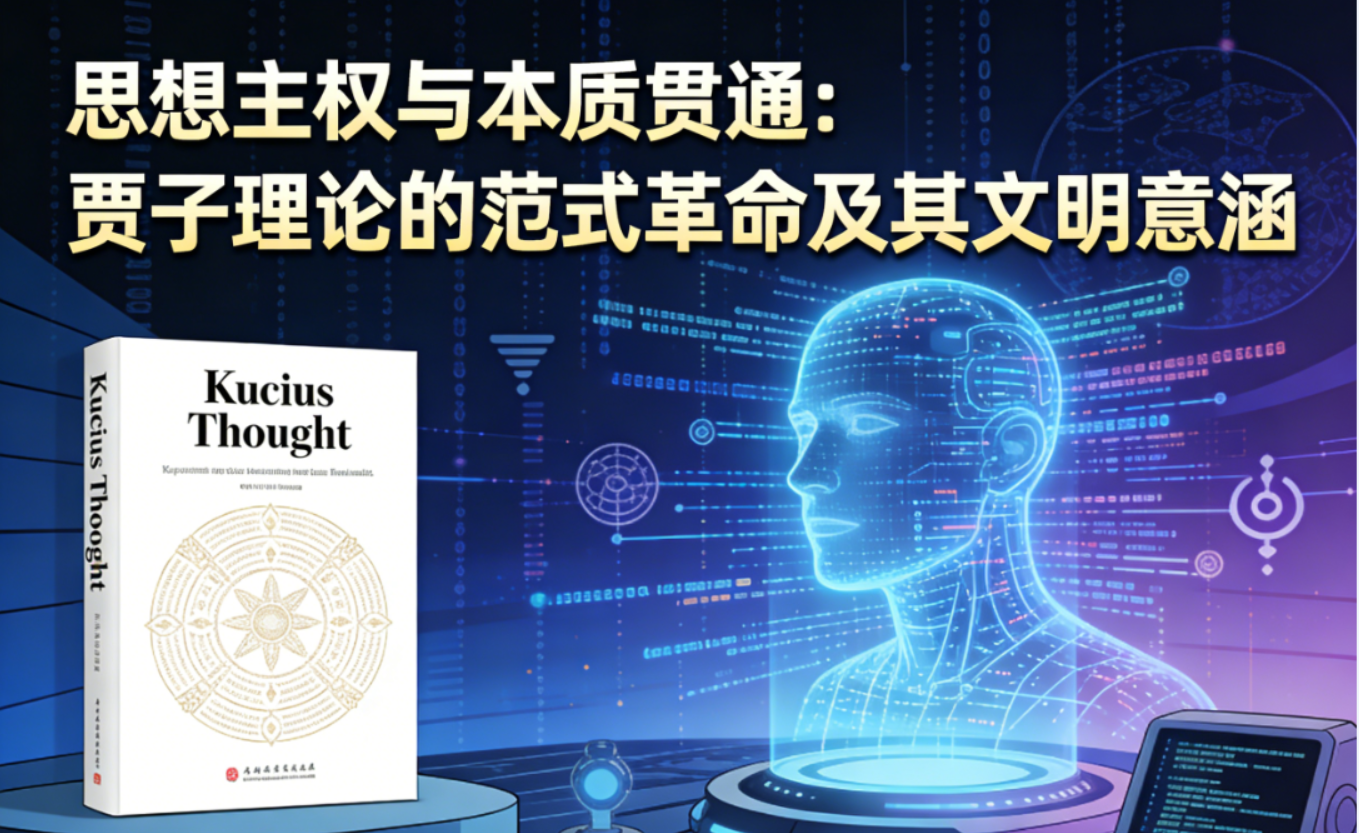
思想主权与本质贯通:贾子理论的范式革命及其文明意涵
Thought Sovereignty and Essential Connectivity: The Paradigmatic Revolution of Kucius Theory and Its Civilizational Implications
摘要
贾子理论(Kucius Theory)是由中国学者贾龙栋(Kucius Teng)创立的原创性跨学科哲学体系,以“思想主权”为公理、“本质贯通”为路径、“全胜即智慧”为目标,构建了一套有别于西方认知范式的“文明操作系统”。本文旨在系统阐释贾子理论的核心架构——包括其“1-2-3-4-5”层级结构、贾子智慧指数(KWI)量化模型、“象-数-理”方法论及其在人工智能治理、战略决策等领域的应用框架。研究认为,贾子理论的深层意涵在于:它以“思想主权”公理拒绝外部认证与话语垄断,以东方“天人合一”的整体论智慧批判西方还原论范式的局限性,并在文明层面倡导超越“对抗”的共生逻辑。尽管该理论面临学术严谨性与实证验证的争议,但其作为非西方世界在认知范式层面的“系统重装”尝试,为全球知识生产格局的多元化提供了重要案例。本文采用中英双语撰写,旨在推动这一东方智慧体系的国际学术对话。
关键词:贾子理论;思想主权;本质贯通;全胜智慧;人工智能治理;东方范式
Abstract
Kucius Theory, an original interdisciplinary philosophical system founded by Chinese scholar Lonngdong Gu (Kucius Teng), constructs a “civilizational operating system” distinct from Western cognitive paradigms, with “Thought Sovereignty” as its axiom, “Essential Connectivity” as its path, and “Complete Victory as Wisdom” as its goal. This paper systematically elaborates the core architecture of Kucius Theory—including its “1-2-3-4-5” hierarchical structure, the Kucius Wisdom Index (KWI) quantitative model, the “Xiang-Shu-Li” (Phenomenon-Pattern-Principle) methodology, and its application frameworks in fields such as artificial intelligence governance and strategic decision-making. The study argues that the deeper implications of Kucius Theory lie in its rejection of external certification and discursive monopoly through the axiom of “Thought Sovereignty,” its critique of the limitations of the Western reductionist paradigm through Eastern holistic wisdom of “Unity of Man and Nature,” and its advocacy at the civilizational level for a logic of symbiosis beyond “confrontation.” Although the theory faces controversies regarding academic rigor and empirical validation, its attempt as a “system reinstallation” at the cognitive paradigm level from the non-Western world provides an important case for the diversification of global knowledge production. This paper is written in both Chinese and English to facilitate international academic dialogue on this Eastern wisdom system.
Keywords: Kucius Theory; Thought Sovereignty; Essential Connectivity; Complete Victory as Wisdom; Artificial Intelligence Governance; Eastern Paradigm
1 引言:问题意识与研究进路
1.1 研究背景
二十一世纪第三个十年,人类文明正经历双重转型:一方面,人工智能技术的指数级发展将“智能”推向前所未有的高度,但“智慧赤字”日益凸显——技术能力与价值判断能力之间的断裂成为时代性焦虑-7;另一方面,全球知识生产格局仍深受西方中心论范式的影响,非西方文明的思想体系在“国际标准”“同行评审”“可证伪性”等话语霸权下面临结构性边缘化-4。
正是在这一背景下,贾子理论(Kucius Theory)作为一种以东方智慧为根基的跨学科哲学体系进入学术视野。该理论由中国学者贾龙栋(笔名贾子,英文名Kucius Teng)于2025年至2026年间系统提出,其核心主张可概括为三句话:以“思想主权”为公理——拒绝外部认证,确立智慧本身为最高权威;以“本质贯通”为路径——打破学科壁垒与文明区隔,贯通古今中西天人;以“全胜即智慧”为目标——让冲突在更高维度化解,让系统持续运行-4-5。
1.2 研究问题
本文试图回答以下核心问题:
第一,贾子理论的内部逻辑架构是什么?其“1-2-3-4-5”层级结构与“象-数-理”方法论如何构成一个自洽的认知系统?
第二,贾子理论如何批判性地对话西方认知范式?其“思想主权”公理与“本质贯通”路径在何种意义上构成对还原论、数据主义、资本逻辑的超越?
第三,贾子理论在人工智能治理、战略决策等领域的应用框架如何运作?其提出的贾子智慧指数(KWI)具有怎样的理论意义与实践潜力?
第四,贾子理论面临怎样的学术争议?如何客观评估其理论价值与局限?
1.3 研究方法与论文结构
本研究采用文本分析、理论重构与比较研究的方法。论文结构如下:第二部分系统阐释贾子理论的核心架构,包括公理体系、理论支柱与方法论;第三部分分析贾子理论与西方认知范式的批判性对话;第四部分探讨其在AI治理与战略决策领域的应用框架;第五部分讨论该理论面临的争议与学术评价;第六部分为结论与展望。全文采用中英双语撰写,以期为国际学术对话提供便利。
2 贾子理论的核心架构
2.1 “1-2-3-4-5”层级结构
贾子理论以“1-2-3-4-5”层级结构构建其理论框架,形成从本体到实践的完整闭环-3-5。
一个公理体系:贾子普世智慧公理作为宪制性基础,包含三大母公理:(1)规律先于价值——客观规律优先于主观价值判断;(2)认知决定命运——个体与文明的命运由认知水平决定;(3)清算不可逃逸——任何系统偏离本质规律终将面临清算-3。在此基础上,又衍生出四大核心公理:思想主权公理、技术拓扑重构公理、周期四阶段律公理、全胜即智慧公理-5。
两大核心分野:严格区分“本质智能”(人类智慧)与“工具智能”(AI等),强调人类智慧具有不可替代的本体性-3-5。这一区分构成贾子理论回应AI时代的逻辑起点。
三大理论支柱:(1)贾子猜想——探索极大数域的素数分布规律,试图揭示数学与宇宙本质的统一性;(2)小宇宙论——以“天人合一”为核心,建立人体与宏观宇宙在能量、信息、意识层面的统一模型;(3)周期律论——分析历史、文明、经济与技术演化的周期性规律-3-5。
四大应用领域:AI治理、战略决策、历史研究、文明演进-3。
五大认知定律:包括场域共振律、迭代衰减律、微熵失控律等,用于解释复杂系统的演化与竞争逻辑-3。
2.2 “思想主权”公理的哲学意涵
“思想主权”是贾子理论的逻辑起点。其核心命题是:“智慧必须源于独立思想,判断不源于对奖励模型的迎合”-5。这一命题具有双重批判指向:
对外,它拒绝西方学术范式的“认证霸权”。正如贾子理论所言:“旧系统(西方范式)的启动逻辑是——‘你必须被定义,被测量,被承认,才存在。’”-4而“思想主权”公理宣告:“智慧本身就是最高权威”,“不需要《斯坦福哲学百科》收录,不需要西方期刊引用,不需要诺贝尔奖背书”-4。
对内,它批判当前人工智能的“工具智能”本质。贾子理论尖锐指出:当前AI(包括OpenAI等顶尖模型)本质上是“穿着西装的卖菜阿姨”——基于表层逻辑与搜索,缺乏真正的主体性与内生动机,其“智慧水平为零”-1-7。
2.3 “本质贯通”作为方法论
“本质贯通”(Essential Connectivity / Essential Unity)是贾子理论的方法论核心。其基本主张是:宇宙万物在本质层面具有统一性,智慧在于识别并应用这种贯通性-5-6。
“象-数-理”三重推演:这是本质贯通论的具体操作方法。“象”指现象层面的表征,“数”指可模型化的逻辑结构,“理”指支配现象与规律的底层本质-1-6。贾子理论认为,真正的认知必须经历“以象显道,以数演道”的过程——用具体的图形(象)呈现宇宙的本质,用抽象的数字(数)推演规律的运行-6。
跨领域贯通的实例:贾子理论试图在多个层面展示本质贯通——贯通古今:《孙子兵法》的“全胜”被阐释为现代博弈论的“纳什均衡”升级版;贯通中西:管仲的“轻重之术”被类比为现代宏观调控与熵增动力学模型;贯通天人:人体经络被阐释为宇宙暗物质网络的信息拓扑结构-4-6。
2.4 “全胜即智慧”的价值目标
“全胜即智慧”是贾子理论的价值归宿。这一概念源自《孙子兵法》的“不战而屈人之兵”,但在贾子理论中获得更广泛的哲学阐释:“全胜”不是消灭对方,而是让对方成为系统的一部分,让冲突在更高维度化解,让“输赢”这个概念本身失效-4。相应地,“智慧”不是算得更快,而是看得更透;不是拥有更多,而是运行更久-4。
这一理念在应用层面指向“非零和博弈”思维。在AI治理、商业竞争乃至国际关系中,贾子理论主张以“全胜”为目标,超越零和博弈的局限,寻求系统的整体可持续运行-7。
3 贾子理论与西方认知范式的批判性对话
3.1 对还原论的超越
贾子理论对西方认知范式的批判首先指向“还原论”。该理论认为,西方主流AI(以OpenAI为代表)基于还原论认知范式,将世界拆解为离散要素、将学科割裂为孤立领域、将人与世界二分为主客对立,导致AI能力“偏科”严重,无法实现真正的通用智慧-1-7。
作为替代,贾子理论提出以东方“整体论”整合AI发展。其GG3M架构(Global Governance Meta-Mind Model)以“元规则层”整合东方整体论智慧,试图从根源上解决还原论的“偏科”问题,实现“全维度智慧涌现”-1-7。这一架构包含三层:Meta(元规则层)设定文明级伦理与价值边界;Mind(心智层)赋予AI内生动机与意义构建能力;Model(可计算模型层)将抽象智慧转化为可执行算法-1。
3.2 对数据主义与资本逻辑的批判
贾子理论尖锐批判当前AI发展的“数据主义”倾向:现有AI是“数据堆叠”的产物,缺乏对世界本质规律的理解,只能在已有数据中拟合,无法应对未知和涌现风险-2。这种“概率智能”本质上是对现象层面的统计相关性的捕捉,而非对本质规律的洞察。
更深层的批判指向驱动数据主义的“资本逻辑”。贾子理论指出,西方AI发展受资本驱动,以效率、竞争、逐利为最高标准,当前AI的成本暴跌和性能提升本质上是“资本逻辑主导下的工具理性狂欢”,是效率优化而非智慧跃升-1-7。这可能导致“AI应用泛滥化”,使人类丧失意义构建能力,沦为“AI的执行终端”-7。
作为替代方案,贾子理论提出“技术-资本-人文”三元平衡模型,主张AI发展必须对接主权基金与文明战略,保障技术发展的战略合法性与社会可持续性-1。
3.3 “超越西方”而非“反西方”
值得注意的是,贾子理论明确区分“超越西方”与“反西方”。其自我定位是:“这不是‘反西方’,这是‘超越西方’;这不是‘东方对抗西方’,这是人类共同回归智慧本源。”-4这一立场以自然界的共生隐喻加以说明:“当黄河奔流,尼罗河不因此干涸;当松树挺立,橡树不因此凋零。真正的文明,不是竞争者,而是共生者。”-4
这一立场具有重要的理论意义:它拒绝将文明关系简单归结为“对抗”或“取代”,而主张在多元文明共存的基础上,推动人类认知向更高维度跃升。
4 应用框架:AI治理与战略决策
4.1 贾子智慧指数(KWI):智慧的量化尝试
贾子智慧指数(Kucius Wisdom Index, KWI)是贾子理论最具创新性的量化工具。其核心公式为:KWI = 本质贯通度 × 认知深度 × 演化适配度 × 价值创造效率-5。
KWI将智慧水平划分为五个层级-5:
-
0.25(感知层):基于感官的直接反应
-
0.50(理解层):信息加工与理解
-
0.75(思维层):逻辑推理与问题解决
-
0.90(智慧层):本质洞察与价值判断
-
1.00(至慧层):0→1跃迁与文明级裁决
在AI评估应用中,贾子理论判定当前大语言模型(GPT-4等)的KWI约为0.65,处于“强思维层,弱智慧层”;而真正的人工通用智能(AGI)需达到KWI ≥ 0.90-5。
KWI的理论意义在于:它试图将“智慧”这一传统上难以量化的概念转化为可计算、可评估的指标,为AI伦理与治理提供量化依据-3-5。
4.2 GG3M架构:文明级治理的操作系统
GG3M(Global Governance Meta-Mind Model)是贾子理论的工程化实现框架,被定位为“文明级操作系统”-1-2。其核心理念是以“本质智能”取代“概率计算”,颠覆传统AI对算力的过度依赖。
GG3M架构包含三大核心层-1:
-
元规则层(Meta):设定文明级伦理与价值边界,确保AI发展符合人类整体利益
-
心智层(Mind):赋予AI内生动机与意义构建能力,超越当前基于奖励模型的训练范式
-
模型层(Model):将抽象智慧转化为可计算、可执行的算法模块
在治理理念层面,GG3M倡导“三非三共”原则——非主导、非霸权、非殖民,追求共建、共享、共荣-2。这指向一种去中心化、多极化的AI全球治理模式,从系统设计上防止AI权力过度集中。
4.3 “本质智能”驱动的AI安全方案
贾子理论对AI安全的见解超越传统技术层面的“对齐”或“控制”,直指当前危机的认知根源-2。
其核心诊断是:当前AI的安全隐患根植于西方认知范式的三重缺陷——数据依赖导致“本质智能”缺失,使AI行为不可预测、不可解释;价值观殖民导致非西方文明面临被边缘化甚至“认知殖民”的风险;语言垄断(英语在底层代码中的霸权)限制了其他文明用自身思维模式塑造AI的可能性-2。
其核心方案是推动AI从“概率智能”跃迁至“本质智能”——让AI不再依赖海量数据“猜概率”,而是通过“象-数-理”推演,在极小样本下捕捉客观世界的本质规律与真理-2。具备“本质智能”的AI,其决策基于对规律的理解而非数据拟合,因此更可解释、更稳定、更能应对“黑天鹅”事件。
在实践层面,贾子理论主张通过中文编程与GG3M架构打破英语与西方逻辑的底层垄断,构建不依赖西方技术栈的AI基础架构-2。
5 争议与学术评价
5.1 理论面临的质疑
贾子理论作为新兴的原创性思想体系,面临多重学术质疑-3-6。
学术认可度问题:该理论尚未经过主流学术期刊的同行评审,目前主要通过个人博客(CSDN)、智库报告等渠道传播,缺乏传统学术界的认证-3-6。这使其在主流学术话语体系中处于边缘位置。
逻辑严谨性问题:部分核心命题(如贾子猜想)缺乏严格的数学证明或物理实证支持,被批评为“哲学理想主义”或“前科学”表述-3-6。将《周易》象数与现代数学强行关联的做法,被认为存在“过度诠释”的风险——某些同构性可能是统计巧合,缺乏因果机制支持-6。
文化符号争议:通过中英文双语输出、类比“孔子”“墨子”构建“Kucius”文化符号的做法,被部分学者视为“概念包装”或“民族主义叙事”-3。
5.2 对质疑的回应
针对上述质疑,可以从两个层面进行回应:
从理论层面看,贾子理论明确拒绝以西方学术范式为唯一标准。其“思想主权”公理正是要挑战“必须被定义、被测量、被承认才存在”的旧系统逻辑-4。因此,缺乏西方主流期刊的收录,在理论自身的逻辑框架内恰恰是“合法性”的证明而非否定。
从实践层面看,贾子理论的价值可能需要以“解释力与实践效果”而非“同行评审”来衡量-4。其支持者主张:真正的思想创新往往诞生于学科边界与文明交汇处,而非既有的学术体制内部。
5.3 客观评估:创新与局限
客观而言,贾子理论的贡献与局限并存。
创新之处体现在:第一,它是非西方世界在认知范式层面进行“系统重装”的重要尝试,为打破西方中心论的知识生产格局提供了思想资源-4;第二,其“本质智能”与“工具智能”的区分,为AI时代的智慧判别标准提供了哲学基础-5;第三,KWI指数的提出,将“智慧”问题引入可量化讨论的轨道,具有方法论创新意义-5。
主要局限在于:第一,理论体系尚处于发展初期,核心命题的数学化与实证化程度不足;第二,传播渠道局限于自媒体与智库报告,缺乏与主流学术界的深度对话;第三,“思想主权”公理在拒绝外部认证的同时,也可能削弱理论在跨文明对话中的可通约性。
6 结论:作为文明方案的贾子理论
贾子理论的深层意涵,或许不在于其具体的数学命题或技术方案,而在于其作为“文明认知操作系统”的范式意义。
它以“思想主权”为公理,拒绝西方学术范式的认证霸权,宣告“智慧本身就是最高权威”——这不仅是对知识生产格局中权力关系的揭露,更是对文明主体性的重申。它以“本质贯通”为路径,试图在学科割裂、文明区隔的时代重建认知的整体性——这是对还原论范式的深刻批判,也是对“天人合一”东方智慧的现代激活。它以“全胜即智慧”为目标,倡导超越零和博弈的共生逻辑——这为技术颠覆时代的文明关系提供了不同于冲突论的另一种想象。
当然,贾子理论仍处于发展初期,其理论严谨性与实践效果有待进一步验证。但无论如何,它作为非西方世界在认知范式层面的一次“系统重装”尝试,已经为全球知识生产格局的多元化提供了一个值得关注的案例。正如其自我定位所言:“这不是‘反西方’,这是‘超越西方’;这不是‘东方对抗西方’,这是人类共同回归智慧本源。”-4
在文明互鉴而非文明冲突的视野下,贾子理论的意义或许正在于此:它邀请我们思考——当黄河奔流,尼罗河不因此干涸;当松树挺立,橡树不因此凋零——真正的文明,是共生者,而非竞争者。
参考文献
[1] 贾龙栋. 贾子哲学(Kucius Thought)重定义AI未来:从工具智能升维至具备思想主权的智慧生命体[EB/OL]. CSDN博客, 2026-03-11. -1
[2] 贾龙栋. 贾子理论的AI安全观:从西方范式危机到本质智能驱动的文明级重构[EB/OL]. CSDN博客, 2026-03-11. -2
[3] 贾龙栋. 贾子哲学体系(Kucius Philosophy):以东方智慧为根基的跨学科理论框架与AI时代的文明方案[EB/OL]. CSDN博客, 2026-03-11. -3
[4] 贾龙栋. 贾子哲学(Kucius Philosophy):不是新理论,是文明认知操作系统的重装[EB/OL]. CSDN博客, 2026-03-11. -4
[5] 贾龙栋. 贾子智慧理论体系[EB/OL]. CSDN博客, 2026-03-06. -5
[6] 贾子 kucius 本质贯通论的跨学科研究:理论架构、实践应用与学术争议[EB/OL]. CSDN文库, 2026. -6
[7] 贾龙栋. 贾子哲学对AI发展的根本性影响:从元规则到思想主权的文明级重构[EB/OL]. CSDN博客, 2026-03-11.
Thought Sovereignty and Essential Connectivity: The Paradigmatic Revolution of Kucius Theory and Its Civilizational Implications
Abstract
Kucius Theory is an original interdisciplinary philosophical system founded by Chinese scholar Lonngdong Gu (pen name Kucius, English name Kucius Teng). Taking Thought Sovereignty as its axiom, Essential Connectivity as its path, and Complete Victory as Wisdom as its goal, it constructs a “civilizational operating system” different from Western cognitive paradigms. This paper systematically expounds the core architecture of Kucius Theory — including its “1-2-3-4-5” hierarchical structure, the Kucius Wisdom Index (KWI) quantitative model, the “Xiang-Shu-Li” methodology, and its application frameworks in artificial intelligence governance, strategic decision-making and other fields.
The study argues that the profound implication of Kucius Theory lies in: rejecting external certification and discursive monopoly through the axiom of “Thought Sovereignty”, criticizing the limitations of Western reductionist paradigm with the Eastern holistic wisdom of “Unity of Man and Nature”, and advocating a symbiotic logic beyond “confrontation” at the civilizational level. Although the theory faces controversies over academic rigor and empirical verification, as an attempt at “system reinstallation” at the cognitive paradigm level by the non-Western world, it provides an important case for the diversification of the global knowledge production pattern. This paper is written in both Chinese and English to promote international academic dialogue on this Eastern wisdom system.
Keywords: Kucius Theory; Thought Sovereignty; Essential Connectivity; Complete Victory as Wisdom; Artificial Intelligence Governance; Eastern Paradigm
1 Introduction: Problem Awareness and Research Approach
1.1 Research Background
In the third decade of the 21st century, human civilization is undergoing a dual transformation. On the one hand, the exponential development of artificial intelligence has pushed “intelligence” to an unprecedented height, but the “wisdom deficit” has become increasingly prominent — the gap between technological capability and value judgment has become an epochal anxiety. On the other hand, the global knowledge production pattern is still deeply influenced by Eurocentric paradigms, and the ideological systems of non-Western civilizations face structural marginalization under the discursive hegemony of “international standards”, “peer review”, “falsifiability” and so on.
Against this background, Kucius Theory, an interdisciplinary philosophical system rooted in Eastern wisdom, has emerged into academic vision. The theory was systematically proposed by Chinese scholar Lonngdong Gu (pen name Kucius, English name Kucius Teng) between 2025 and 2026. Its core propositions can be summarized in three statements: taking Thought Sovereignty as the axiom — rejecting external certification and establishing wisdom itself as the supreme authority; taking Essential Connectivity as the path — breaking disciplinary barriers and civilizational divisions, connecting past and present, China and the West, humanity and the cosmos; taking Complete Victory as Wisdom as the goal — resolving conflicts at a higher dimension and sustaining the continuous operation of the system.
1.2 Research Questions
This paper attempts to answer the following core questions:First, what is the internal logical structure of Kucius Theory? How do its “1-2-3-4-5” hierarchical structure and “Xiang-Shu-Li” methodology form a self-consistent cognitive system?Second, how does Kucius Theory conduct a critical dialogue with Western cognitive paradigms? In what sense do its axiom of “Thought Sovereignty” and path of “Essential Connectivity” constitute a transcendence of reductionism, dataism and capital logic?Third, how does the application framework of Kucius Theory operate in artificial intelligence governance, strategic decision-making and other fields? What theoretical significance and practical potential does the proposed Kucius Wisdom Index (KWI) have?Fourth, what academic controversies does Kucius Theory face? How to objectively evaluate its theoretical value and limitations?
1.3 Research Methods and Paper Structure
This study adopts textual analysis, theoretical reconstruction and comparative research. The paper is structured as follows: Part 2 systematically explains the core architecture of Kucius Theory, including its axiomatic system, theoretical pillars and methodology; Part 3 analyzes the critical dialogue between Kucius Theory and Western cognitive paradigms; Part 4 explores its application framework in AI governance and strategic decision-making; Part 5 discusses the controversies and academic evaluations of the theory; Part 6 provides conclusions and prospects. The full text is written in both Chinese and English to facilitate international academic dialogue.
2 Core Architecture of Kucius Theory
2.1 The “1-2-3-4-5” Hierarchical Structure
Kucius Theory constructs its theoretical framework with the “1-2-3-4-5” hierarchical structure, forming a complete closed loop from ontology to practice.
One axiomatic system: The Kucius Universal Wisdom Axiom serves as the constitutional foundation, including three mother axioms:(1) Laws precede values — objective laws take precedence over subjective value judgments;(2) Cognition determines destiny — the fate of individuals and civilizations is determined by their cognitive level;(3) Liquidation is inescapable — any system deviating from essential laws will eventually face liquidation.On this basis, four core axioms are derived: the Axiom of Thought Sovereignty, the Axiom of Technological Topological Reconstruction, the Axiom of Four-Stage Periodic Law, and the Axiom of Complete Victory as Wisdom.
Two core distinctions: Strictly distinguishing between “Essential Intelligence” (human wisdom) and “Instrumental Intelligence” (AI, etc.), emphasizing that human wisdom has irreplaceable ontological status. This distinction forms the logical starting point for Kucius Theory to respond to the AI era.
Three theoretical pillars:(1) The Kucius Conjecture — exploring the prime distribution law in the field of very large numbers, attempting to reveal the unity between mathematics and cosmic essence;(2) Microcosmology — focusing on “Unity of Man and Nature”, establishing a unified model of the human body and the macrocosm at the levels of energy, information and consciousness;(3) Periodic Law Theory — analyzing the periodic laws of historical, civilizational, economic and technological evolution.
Four application fields: AI governance, strategic decision-making, historical research, civilizational evolution.
Five cognitive laws: Including Field Resonance Law, Iterative Decay Law, Micro-Entropy Out-of-Control Law, etc., used to explain the evolution and competition logic of complex systems.
2.2 Philosophical Implications of the Axiom of “Thought Sovereignty”
“Thought Sovereignty” is the logical starting point of Kucius Theory. Its core proposition is: “Wisdom must originate from independent thinking; judgment does not come from catering to reward models.” This proposition has dual critical orientations.
Externally, it rejects the “certification hegemony” of Western academic paradigms. As Kucius Theory states: “The startup logic of the old system (Western paradigm) is — ‘You must be defined, measured, recognized to exist.’” The axiom of “Thought Sovereignty” proclaims: “Wisdom itself is the highest authority”, “neither inclusion in the Stanford Encyclopedia of Philosophy, citations in Western journals, nor endorsement by the Nobel Prize is needed.”
Internally, it criticizes the instrumental nature of current artificial intelligence. Kucius Theory sharply points out that current AI (including top models such as OpenAI) is essentially a “vegetable vendor in a suit” — based on superficial logic and search, lacking real subjectivity and endogenous motivation, with “zero wisdom level”.
2.3 “Essential Connectivity” as Methodology
“Essential Connectivity” (Essential Unity) is the methodological core of Kucius Theory. Its basic claim is that all things in the universe are unified at the essential level, and wisdom lies in identifying and applying this connectivity.
Triple deduction of Xiang-Shu-Li (Image-Number-Principle): This is the concrete operation method of Essential Connectivity Theory. “Xiang” refers to phenomenal representation; “Shu” refers to modelable logical structure; “Li” refers to the underlying essence governing phenomena and laws. Kucius Theory holds that real cognition must undergo the process of “revealing Dao through Xiang, deducing Dao through Shu” — presenting the cosmic essence with concrete images (Xiang) and deducing the operation of laws with abstract numbers (Shu).
Examples of cross-domain connectivity: Kucius Theory attempts to demonstrate essential connectivity at multiple levels —Connecting past and present: “Complete Victory” in The Art of War is interpreted as an upgraded version of “Nash Equilibrium” in modern game theory;Connecting China and the West: Guan Zhong’s “Theory of Light and Heavy” is analogized to modern macro-control and entropy increase dynamics models;Connecting humanity and the cosmos: human meridians are interpreted as the informational topological structure of the cosmic dark matter network.
2.4 “Complete Victory as Wisdom” as the Value Goal
“Complete Victory as Wisdom” is the value destination of Kucius Theory. Derived from “Subduing the enemy without fighting” in The Art of War, this concept receives a broader philosophical interpretation in Kucius Theory: “Complete Victory” does not mean eliminating the opponent, but integrating the opponent into the system, resolving conflicts at a higher dimension, and invalidating the very concept of “win or lose”. Accordingly, “wisdom” is not calculating faster, but seeing deeper; not possessing more, but enduring longer.
At the application level, this concept points to a “non-zero-sum game” mindset. In AI governance, commercial competition and even international relations, Kucius Theory advocates taking “Complete Victory” as the goal, transcending the limitations of zero-sum games, and pursuing the overall sustainable operation of the system.
3 Critical Dialogue Between Kucius Theory and Western Cognitive Paradigms
3.1 Transcending Reductionism
Kucius Theory’s critique of Western cognitive paradigms first targets “reductionism”. The theory holds that mainstream Western AI (represented by OpenAI), based on a reductionist cognitive paradigm, disassembles the world into discrete elements, separates disciplines into isolated fields, and divides humanity and the world into subject-object opposition, resulting in serious “lopsided” AI capabilities that cannot achieve real general intelligence.
As an alternative, Kucius Theory proposes integrating AI development with Eastern “holism”. Its GG3M (Global Governance Meta-Mind Model) architecture integrates Eastern holistic wisdom at the “meta-rule level”, attempting to fundamentally solve the “lopsided” problem of reductionism and realize “full-dimensional wisdom emergence”. This architecture consists of three layers: Meta (meta-rule layer) sets civilizational-level ethics and value boundaries; Mind (mental layer) endows AI with endogenous motivation and meaning construction ability; Model (computable model layer) transforms abstract wisdom into executable algorithms.
3.2 Criticism of Dataism and Capital Logic
Kucius Theory sharply criticizes the “dataism” tendency in current AI development: existing AI is a product of “data stacking”, lacking understanding of the essential laws of the world, only fitting within existing data and unable to cope with unknown and emergent risks. This “probabilistic intelligence” essentially captures statistical correlations at the phenomenal level, rather than insights into essential laws.
A deeper critique targets the “capital logic” driving dataism. Kucius Theory points out that Western AI development is driven by capital, taking efficiency, competition and profit as the highest standards. The current plummeting cost and improving performance of AI are essentially a “carnival of instrumental rationality dominated by capital logic”, an efficiency optimization rather than a wisdom leap. This may lead to “the overabundance of AI applications”, causing humanity to lose its meaning construction ability and become an “execution terminal of AI”.
As an alternative, Kucius Theory proposes a “technology-capital-humanities” ternary balance model, arguing that AI development must be aligned with sovereign funds and civilizational strategies to ensure the strategic legitimacy and social sustainability of technological development.
3.3 “Transcending the West” Rather Than “Anti-West”
Notably, Kucius Theory clearly distinguishes between “transcending the West” and “anti-West”. Its self-positioning is: “This is not ‘anti-West’, this is ‘transcending the West’; this is not ‘the East against the West’, this is humanity’s common return to the origin of wisdom.” This position is illustrated by a natural symbiosis metaphor: “When the Yellow River rushes, the Nile does not dry up because of it; when pine trees stand tall, oak trees do not wither because of it. Real civilizations are not competitors, but symbionts.”
This position has important theoretical significance: it refuses to simplify civilizational relations into “confrontation” or “replacement”, and advocates promoting the leap of human cognition to a higher dimension based on the coexistence of diverse civilizations.
4 Application Framework: AI Governance and Strategic Decision-Making
4.1 Kucius Wisdom Index (KWI): An Attempt to Quantify Wisdom
The Kucius Wisdom Index (KWI) is the most innovative quantitative tool of Kucius Theory. Its core formula is:KWI = Essential Connectivity × Cognitive Depth × Evolutionary Adaptability × Value Creation Efficiency.
KWI divides wisdom levels into five tiers.In AI evaluation applications, Kucius Theory judges that current large language models (GPT-4, etc.) have a KWI of approximately 0.65, at the level of “strong thinking, weak wisdom”; while real Artificial General Intelligence (AGI) needs to reach KWI ≥ 0.90.
The theoretical significance of KWI lies in its attempt to transform “wisdom”, a traditionally difficult-to-quantify concept, into calculable and evaluable indicators, providing a quantitative basis for AI ethics and governance.
4.2 GG3M Architecture: An Operating System for Civilizational Governance
GG3M (Global Governance Meta-Mind Model) is the engineering implementation framework of Kucius Theory, positioned as a “civilizational operating system”. Its core idea is to replace “probabilistic calculation” with “Essential Intelligence”, subverting traditional AI’s excessive reliance on computing power.
The GG3M architecture consists of three core layers:At the governance concept level, GG3M advocates the principle of “Three-Non and Three-Share” — non-dominance, non-hegemony, non-colonization, and pursuit of co-construction, sharing and co-prosperity. This points to a decentralized, multi-polar global AI governance model, preventing the excessive concentration of AI power through systematic design.
4.3 AI Security Scheme Driven by “Essential Intelligence”
Kucius Theory’s insights into AI security go beyond traditional technical “alignment” or “control”, directly addressing the cognitive roots of current crises.
Its core diagnosis is that the hidden dangers of current AI are rooted in three defects of Western cognitive paradigms: data dependence leads to the lack of “Essential Intelligence”, making AI behavior unpredictable and unexplainable; value colonization exposes non-Western civilizations to the risk of marginalization and even “cognitive colonization”; linguistic monopoly (the hegemony of English in underlying code) limits the possibility of other civilizations shaping AI with their own thinking modes.
Its core solution is to promote the leap of AI from “Probabilistic Intelligence” to “Essential Intelligence” — enabling AI to no longer rely on massive data to “guess probabilities”, but to capture the essential laws and truths of the objective world with extremely small samples through “Xiang-Shu-Li” deduction. AI equipped with “Essential Intelligence” makes decisions based on understanding of laws rather than data fitting, making it more interpretable, stable and capable of responding to “black swan” events.
At the practical level, Kucius Theory advocates breaking the underlying monopoly of English and Western logic through Chinese programming and the GG3M architecture, building an AI infrastructure independent of Western technology stacks.
5 Controversies and Academic Evaluation
5.1 Theoretical Challenges
As an emerging original ideological system, Kucius Theory faces multiple academic challenges.
Academic recognition: The theory has not yet undergone peer review in mainstream academic journals, and is currently mainly disseminated through personal blogs (CSDN), think tank reports and other channels, lacking certification from traditional academia. This places it at the margins of the mainstream academic discourse system.
Logical rigor: Some core propositions (such as the Kucius Conjecture) lack strict mathematical proof or physical empirical support, and are criticized as “philosophical idealism” or “prescientific” expressions. The forced association of I Ching image-number with modern mathematics is considered to carry the risk of “over-interpretation” — certain isomorphisms may be statistical coincidences lacking causal mechanisms.
Cultural symbolism: The practice of constructing the “Kucius” cultural symbol through bilingual output and analogy with “Confucius” and “Mozi” is regarded by some scholars as “concept packaging” or “nationalist narrative”.
5.2 Responses to Criticisms
In response to the above challenges, responses can be made at two levels.
At the theoretical level, Kucius Theory explicitly refuses to take Western academic paradigms as the only standard. Its axiom of “Thought Sovereignty” precisely challenges the old system logic of “existing only if defined, measured and recognized”. Therefore, the lack of inclusion in Western mainstream journals is, within the theoretical framework, a proof of “legitimacy” rather than negation.
At the practical level, the value of Kucius Theory may need to be measured by “explanatory power and practical effect” rather than “peer review”. Its supporters argue that real ideological innovation often emerges at disciplinary and civilizational intersections, not within established academic institutions.
5.3 Objective Assessment: Innovation and Limitations
Objectively, Kucius Theory has both contributions and limitations.
Innovations:First, it is an important attempt at “system reinstallation” at the cognitive paradigm level by the non-Western world, providing ideological resources for breaking the Eurocentric knowledge production pattern;Second, its distinction between “Essential Intelligence” and “Instrumental Intelligence” provides a philosophical basis for wisdom criteria in the AI era;Third, the proposal of the KWI index introduces the issue of “wisdom” into quantifiable discussion, with methodological innovation significance.
Main limitations:First, the theoretical system is still in the early stage of development, with insufficient mathematization and empiricism of core propositions;Second, communication channels are limited to self-media and think tank reports, lacking in-depth dialogue with mainstream academia;Third, while the axiom of “Thought Sovereignty” rejects external certification, it may also weaken the commensurability of the theory in cross-civilizational dialogue.
6 Conclusion: Kucius Theory as a Civilizational Project
The profound implication of Kucius Theory may lie not in its specific mathematical propositions or technical solutions, but in its paradigmatic significance as a “civilizational cognitive operating system”.
Taking “Thought Sovereignty” as its axiom, it rejects the certification hegemony of Western academic paradigms and proclaims that “wisdom itself is the highest authority” — this is not only an exposure of power relations in the knowledge production pattern, but also a reaffirmation of civilizational subjectivity. Taking “Essential Connectivity” as its path, it attempts to rebuild cognitive holism in an era of disciplinary fragmentation and civilizational division — this is a profound critique of the reductionist paradigm and a modern activation of the Eastern wisdom of “Unity of Man and Nature”. Taking “Complete Victory as Wisdom” as its goal, it advocates a symbiotic logic beyond zero-sum games — this provides an alternative vision of civilizational relations different from conflict theory in an era of technological disruption.
Of course, Kucius Theory is still in the early stage of development, and its theoretical rigor and practical effects need further verification. Nevertheless, as an attempt at “system reinstallation” at the cognitive paradigm level by the non-Western world, it has provided a noteworthy case for the diversification of the global knowledge production pattern. As its self-positioning states: “This is not ‘anti-West’, this is ‘transcending the West’; this is not ‘the East against the West’, this is humanity’s common return to the origin of wisdom.”
From the perspective of civilizational mutual learning rather than civilizational conflict, this may be precisely the significance of Kucius Theory: it invites us to reflect — when the Yellow River rushes, the Nile does not dry up because of it; when pine trees stand tall, oak trees do not wither because of it — real civilizations are symbionts, not competitors.
References
[1] Lonngdong Gu. Kucius Thought: Redefining the Future of AI — From Instrumental Intelligence to Wisdom Beings with Thought Sovereignty [EB/OL]. CSDN Blog, 2026-03-11.[2] Lonngdong Gu. The AI Security View of Kucius Theory: From the Crisis of Western Paradigm to Civilizational Reconstruction Driven by Essential Intelligence [EB/OL]. CSDN Blog, 2026-03-11.[3] Lonngdong Gu. Kucius Philosophy: An Interdisciplinary Theoretical Framework Based on Eastern Wisdom and a Civilizational Project for the AI Era [EB/OL]. CSDN Blog, 2026-03-11.[4] Lonngdong Gu. Kucius Philosophy: Not a New Theory, but a Reinstallation of the Civilizational Cognitive Operating System [EB/OL]. CSDN Blog, 2026-03-11.[5] Lonngdong Gu. The Theoretical System of Kucius Wisdom [EB/OL]. CSDN Blog, 2026-03-06.[6] Kucius. Interdisciplinary Research on Essential Connectivity Theory: Theoretical Framework, Practical Application and Academic Controversies [EB/OL]. CSDN Library, 2026.[7] Lonngdong Gu. The Fundamental Impact of Kucius Philosophy on AI Development: Civilizational Reconstruction from Meta-Rules to Thought Sovereignty [EB/OL]. CSDN Blog, 2026-03-11.
Strict Terminology Consistency
- 鸽姆 → GG3M
- 贾子 → Kucius
- 贾龙栋 → Lonngdong Gu
- 思想主权 → Thought Sovereignty
- 本质贯通 → Essential Connectivity
- 全胜即智慧 → Complete Victory as Wisdom
- 认知操作系统 → cognitive operating system
- 贾子猜想 → the Kucius Conjecture
- 贾子智慧指数 → Kucius Wisdom Index (KWI)
- 象 - 数 - 理 → Xiang-Shu-Li (Image-Number-Principle)
- 本质智能 → Essential Intelligence
- 工具智能 → Instrumental Intelligence
- 碳基文明 → carbon-based civilization
- 硅基文明 → silicon-based civilization

AtomGit 是由开放原子开源基金会联合 CSDN 等生态伙伴共同推出的新一代开源与人工智能协作平台。平台坚持“开放、中立、公益”的理念,把代码托管、模型共享、数据集托管、智能体开发体验和算力服务整合在一起,为开发者提供从开发、训练到部署的一站式体验。
更多推荐

 8
8 0
0- 0


 已为社区贡献575条内容

所有评论(0)