材料力学-主题088-多场耦合仿真技术
主题088:多场耦合仿真技术
1. 理论基础
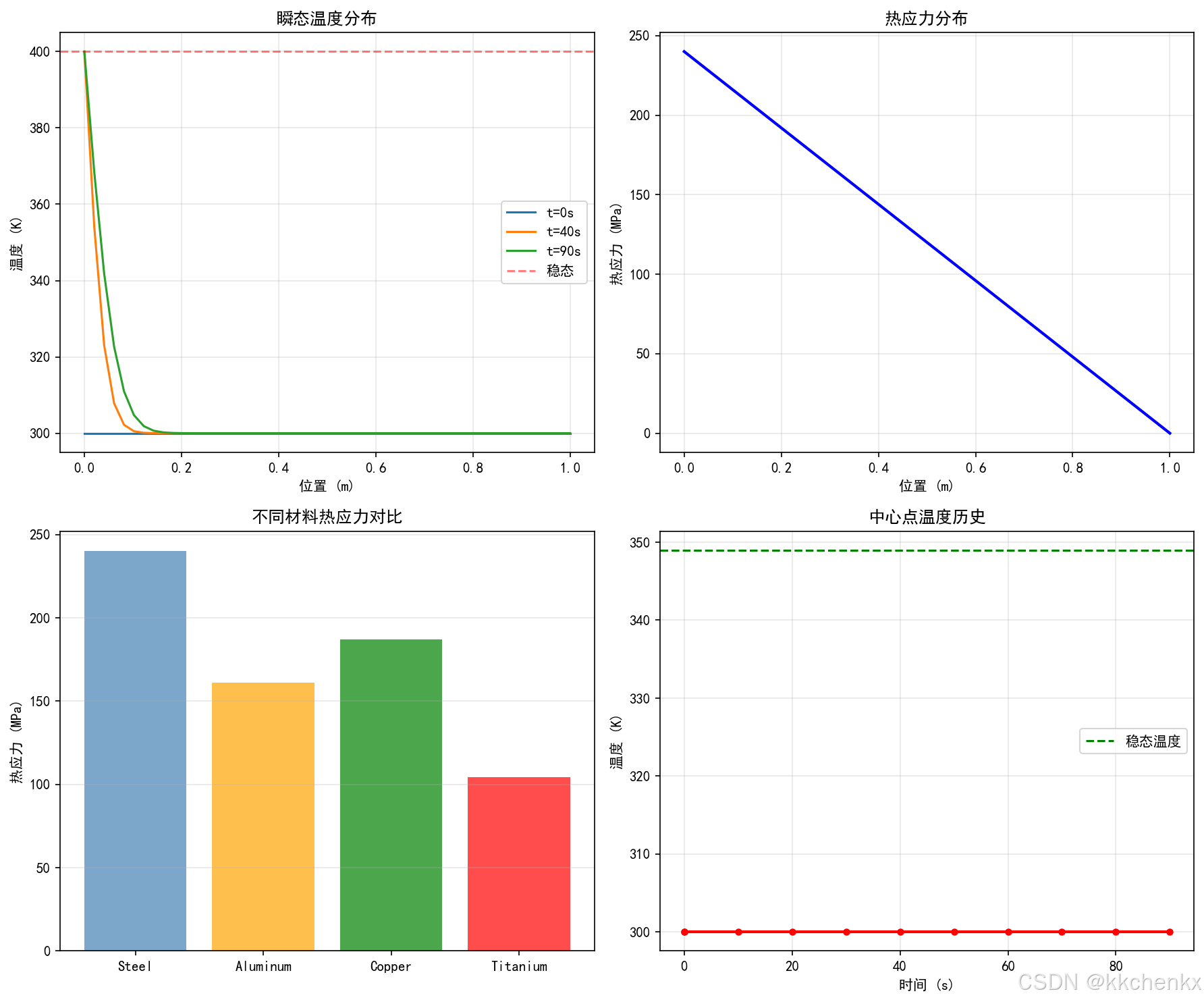
1.1 多场耦合的基本概念
多场耦合是指两个或多个物理场之间存在相互作用和影响的现象。在工程实践中,大多数问题都涉及多个物理场的耦合,例如:
- 热-力耦合:温度变化引起的热膨胀或收缩,导致结构变形和应力
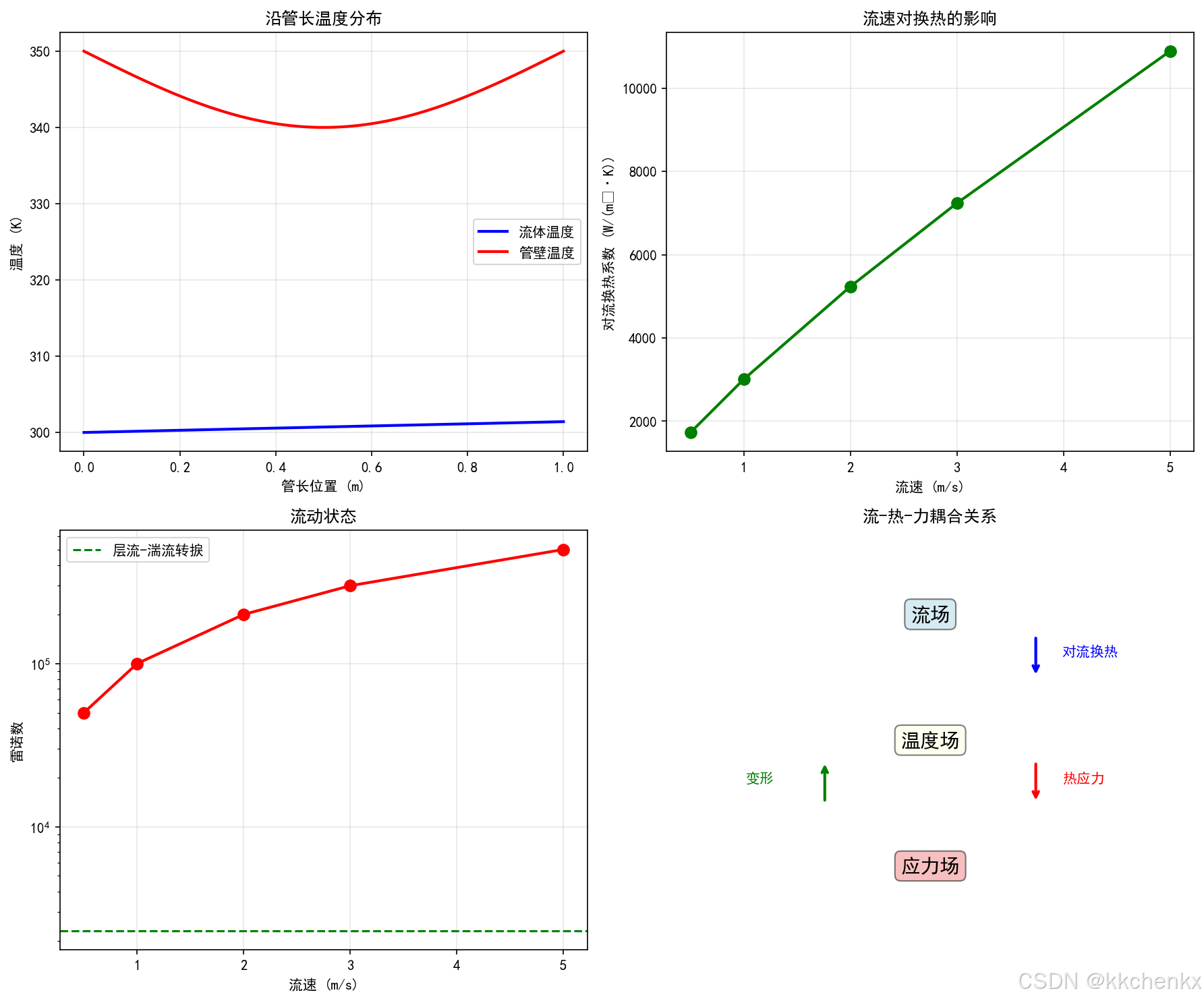
- 流-热耦合:流体流动与热量传递的相互作用
- 力-电耦合:机械变形与电场的相互影响(压电效应)
- 热-电-力耦合:温度、电场和机械变形的综合作用
- 流-热-力耦合:流体流动、热量传递和结构变形的相互作用
1.2 耦合方式分类
1.2.1 强耦合与弱耦合
- 强耦合:多个物理场之间存在双向的、直接的相互作用,需要同时求解所有场的控制方程
- 弱耦合:多个物理场之间的相互作用是单向的或间接的,可以通过顺序求解各场的控制方程来处理
1.2.2 直接耦合与间接耦合
- 直接耦合:一个物理场的变量直接出现在另一个物理场的控制方程中
- 间接耦合:通过边界条件或材料参数的变化实现耦合
1.3 多场耦合的控制方程
1.3.1 热传导方程
$$
ho c_p \frac{\partial T}{\partial t} - \nabla \cdot (k \nabla T) = Q
$$
其中,$ \rho $ 是密度,$ c_p $ 是比热容,$ k $ 是热导率,$ Q $ 是内热源。
1.3.2 动量守恒方程(Navier-Stokes方程)
ρ(∂u∂t+u⋅∇u)=−∇p+∇⋅τ+ρg \rho \left( \frac{\partial \mathbf{u}}{\partial t} + \mathbf{u} \cdot \nabla \mathbf{u} \right) = -\nabla p + \nabla \cdot \tau + \rho \mathbf{g} ρ(∂t∂u+u⋅∇u)=−∇p+∇⋅τ+ρg
其中,$ \mathbf{u} $ 是速度场,$ p $ 是压力,$ \tau $ 是应力张量,$ \mathbf{g} $ 是重力加速度。
1.3.3 固体力学平衡方程
∇⋅σ+f=ρa \nabla \cdot \sigma + \mathbf{f} = \rho \mathbf{a} ∇⋅σ+f=ρa
其中,$ \sigma $ 是应力张量,$ \mathbf{f} $ 是体积力,$ \mathbf{a} $ 是加速度。
1.3.4 电场方程(泊松方程)
∇⋅(ε∇ϕ)=−ρe \nabla \cdot (\varepsilon \nabla \phi) = -\rho_e ∇⋅(ε∇ϕ)=−ρe
其中,$ \varepsilon $ 是介电常数,$ \phi $ 是电势,$ \rho_e $ 是电荷密度。
1.4 耦合效应的数学描述
1.4.1 热膨胀效应
εth=αΔT \varepsilon_{th} = \alpha \Delta T εth=αΔT
其中,$ \alpha $ 是热膨胀系数,$ \Delta T $ 是温度变化。
1.4.2 焦耳热效应
Q=σeE2 Q = \sigma_e E^2 Q=σeE2
其中,$ \sigma_e $ 是电导率,$ E $ 是电场强度。
1.4.3 压电效应
Di=dijkσjk+εijEj D_i = d_{ijk} \sigma_{jk} + \varepsilon_{ij} E_j Di=dijkσjk+εijEj
εij=sijkσkl+dkijEk \varepsilon_{ij} = s_{ijk} \sigma_{kl} + d_{kij} E_k εij=sijkσkl+dkijEk
其中,$ D $ 是电位移,$ d $ 是压电常数,$ s $ 是弹性柔顺系数。
2. 数值方法
2.1 有限元方法在多场耦合中的应用
- 统一网格方法:所有物理场使用相同的网格
- 非统一网格方法:不同物理场使用不同的网格,通过插值实现数据传递
- 混合有限元方法:针对不同物理场选择合适的单元类型
2.2 有限体积法
- 适用于流体力学和热传导问题
- 守恒性好,适合处理复杂边界条件
- 可以与有限元方法结合使用
2.3 边界元方法
- 适用于无限域或半无限域问题
- 降维处理,减少计算量
- 适合处理场域边界的耦合问题
2.4 多场耦合的求解策略
2.4.1 整体求解法
- 将所有物理场的控制方程组合成一个大型方程组,同时求解
- 精度高,但计算量和内存需求大
- 适用于强耦合问题
2.4.2 顺序求解法
- 依次求解各个物理场的控制方程
- 计算量小,但收敛速度可能较慢
- 适用于弱耦合问题
2.4.3 迭代求解法
- 在顺序求解的基础上,通过迭代提高精度
- 计算量适中,收敛性较好
- 适用于中等强度的耦合问题
2.5 多尺度耦合方法
- 宏微观耦合:连接宏观和微观尺度的模型
- 多物理场多尺度耦合:同时考虑不同尺度和不同物理场的相互作用
- 域分解方法:将计算域分解为不同的子域,分别采用适合的模型
3. Python实现
3.1 多场耦合仿真基类
class MultiPhysicsSimulation:
    """多场耦合仿真基类"""
    def __init__(self, simulation_parameters):
        self.domain_size = simulation_parameters.get('domain_size', [1.0, 1.0])  # m
        self.grid_size = simulation_parameters.get('grid_size', [50, 50])
        self.time_step = simulation_parameters.get('time_step', 0.01)  # s
        self.simulation_time = simulation_parameters.get('simulation_time', 10.0)  # s
        self.coupling_strength = simulation_parameters.get('coupling_strength', 'strong')

    def initialize(self):
        """初始化仿真系统"""
        pass

    def solve(self):
        """求解多场耦合问题"""
        pass

    def post_process(self):
        """后处理结果"""
        pass

    def visualize(self):
        """可视化结果"""
        pass
3.2 热-力耦合仿真
class ThermoMechanicalSimulation(MultiPhysicsSimulation):
    """热-力耦合仿真"""
    def __init__(self, parameters):
        super().__init__(parameters)
        self.material_properties = parameters.get('material_properties', {
            'density': 7850,  # kg/m³
            'elastic_modulus': 200e9,  # Pa
            'poisson_ratio': 0.3,
            'thermal_conductivity': 50,  # W/(m·K)
            'specific_heat': 450,  # J/(kg·K)
            'thermal_expansion': 12e-6  # 1/K
        })
        self.thermal_boundary_conditions = parameters.get('thermal_boundary_conditions', {
            'left': {'type': 'temperature', 'value': 300},  # K
            'right': {'type': 'temperature', 'value': 400},  # K
            'top': {'type': 'convection', 'h': 10, 'T_inf': 300},  # W/(m²·K), K
            'bottom': {'type': 'insulated'}
        })
        self.mechanical_boundary_conditions = parameters.get('mechanical_boundary_conditions', {
            'left': {'type': 'fixed'},  # 固定
            'right': {'type': 'free'},  # 自由
            'top': {'type': 'free'},  # 自由
            'bottom': {'type': 'fixed'}  # 固定
        })

    def initialize(self):
        """初始化温度场和位移场"""
        nx, ny = self.grid_size
        self.temperature = np.ones((nx, ny)) * 300  # 初始温度300K
        self.displacement_x = np.zeros((nx, ny))  # x方向位移
        self.displacement_y = np.zeros((nx, ny))  # y方向位移
        self.stress = np.zeros((nx, ny))  # 应力

    def solve_heat_transfer(self):
        """求解热传导方程"""
        nx, ny = self.grid_size
        dx, dy = self.domain_size[0]/(nx-1), self.domain_size[1]/(ny-1)
        k = self.material_properties['thermal_conductivity']
        rho = self.material_properties['density']
        cp = self.material_properties['specific_heat']

        # 有限差分法求解热传导方程
        T_new = self.temperature.copy()
        for i in range(1, nx-1):
            for j in range(1, ny-1):
                T_new[i, j] = self.temperature[i, j] + self.time_step * (k/(rho*cp)) * (
                    (self.temperature[i+1, j] - 2*self.temperature[i, j] + self.temperature[i-1, j])/dx**2 +
                    (self.temperature[i, j+1] - 2*self.temperature[i, j] + self.temperature[i, j-1])/dy**2
                )

        # 应用边界条件
        # 左边界:固定温度
        T_new[:, 0] = self.thermal_boundary_conditions['left']['value']
        # 右边界:固定温度
        T_new[:, -1] = self.thermal_boundary_conditions['right']['value']
        # 上边界:对流
        if self.thermal_boundary_conditions['top']['type'] == 'convection':
            h = self.thermal_boundary_conditions['top']['h']
            T_inf = self.thermal_boundary_conditions['top']['T_inf']
            for i in range(nx):
                T_new[i, -1] = (h*T_inf + k/dy*self.temperature[i, -2]) / (h + k/dy)
        # 下边界:绝热
        if self.thermal_boundary_conditions['bottom']['type'] == 'insulated':
            T_new[:, 0] = T_new[:, 1]

        self.temperature = T_new

    def solve_stress_strain(self):
        """求解应力应变场"""
        nx, ny = self.grid_size
        dx, dy = self.domain_size[0]/(nx-1), self.domain_size[1]/(ny-1)
        E = self.material_properties['elastic_modulus']
        nu = self.material_properties['poisson_ratio']
        alpha = self.material_properties['thermal_expansion']

        # 计算热应变
        thermal_strain = alpha * (self.temperature - 300)  # 参考温度300K

        # 有限差分法求解位移场
        u_new = self.displacement_x.copy()
        v_new = self.displacement_y.copy()

        for i in range(1, nx-1):
            for j in range(1, ny-1):
                # 计算位移
                u_new[i, j] = 0.25 * (self.displacement_x[i+1, j] + self.displacement_x[i-1, j] +
                                      self.displacement_x[i, j+1] + self.displacement_x[i, j-1])
                v_new[i, j] = 0.25 * (self.displacement_y[i+1, j] + self.displacement_y[i-1, j] +
                                      self.displacement_y[i, j+1] + self.displacement_y[i, j-1])

        # 应用边界条件
        # 左边界:固定
        if self.mechanical_boundary_conditions['left']['type'] == 'fixed':
            u_new[:, 0] = 0
            v_new[:, 0] = 0
        # 右边界:自由
        if self.mechanical_boundary_conditions['right']['type'] == 'free':
            u_new[:, -1] = u_new[:, -2]
            v_new[:, -1] = v_new[:, -2]
        # 上边界:自由
        if self.mechanical_boundary_conditions['top']['type'] == 'free':
            u_new[-1, :] = u_new[-2, :]
            v_new[-1, :] = v_new[-2, :]
        # 下边界:固定
        if self.mechanical_boundary_conditions['bottom']['type'] == 'fixed':
            u_new[0, :] = 0
            v_new[0, :] = 0

        self.displacement_x = u_new
        self.displacement_y = v_new

        # 计算应力
        for i in range(1, nx-1):
            for j in range(1, ny-1):
                # 计算应变
                eps_x = (self.displacement_x[i+1, j] - self.displacement_x[i-1, j])/(2*dx) - thermal_strain[i, j]
                eps_y = (self.displacement_y[i, j+1] - self.displacement_y[i, j-1])/(2*dy) - thermal_strain[i, j]
                eps_xy = 0.5 * ((self.displacement_x[i, j+1] - self.displacement_x[i, j-1])/(2*dy) +
                               (self.displacement_y[i+1, j] - self.displacement_y[i-1, j])/(2*dx))

                # 计算应力(平面应力)
                sigma_x = E/(1-nu**2) * (eps_x + nu*eps_y)
                sigma_y = E/(1-nu**2) * (eps_y + nu*eps_x)
                tau_xy = E/(2*(1+nu)) * eps_xy

                # 计算Von Mises应力
                self.stress[i, j] = np.sqrt(sigma_x**2 - sigma_x*sigma_y + sigma_y**2 + 3*tau_xy**2)

    def solve(self):
        """求解热-力耦合问题"""
        for t in np.arange(0, self.simulation_time, self.time_step):
            # 求解热传导方程
            self.solve_heat_transfer()
            # 求解应力应变场
            self.solve_stress_strain()

            # 每10个时间步输出一次结果
            if int(t/self.time_step) % 10 == 0:
                print(f"时间步: {int(t/self.time_step)}, 最大温度: {np.max(self.temperature):.2f}K, 最大应力: {np.max(self.stress):.2f}MPa")

    def visualize(self):
        """可视化结果"""
        import matplotlib.pyplot as plt

        nx, ny = self.grid_size
        x = np.linspace(0, self.domain_size[0], nx)
        y = np.linspace(0, self.domain_size[1], ny)
        X, Y = np.meshgrid(x, y)

        # 温度场
        plt.figure(figsize=(12, 8))
        plt.subplot(221)
        contour = plt.contourf(X, Y, self.temperature.T, cmap='hot')
        plt.colorbar(contour, label='温度 (K)')
        plt.title('温度场')
        plt.xlabel('x (m)')
        plt.ylabel('y (m)')

        # 应力场
        plt.subplot(222)
        contour = plt.contourf(X, Y, self.stress.T/1e6, cmap='jet')  # 转换为MPa
        plt.colorbar(contour, label='应力 (MPa)')
        plt.title('应力场')
        plt.xlabel('x (m)')
        plt.ylabel('y (m)')

        # 位移场
        plt.subplot(223)
        magnitude = np.sqrt(self.displacement_x**2 + self.displacement_y**2)
        contour = plt.contourf(X, Y, magnitude.T, cmap='viridis')
        plt.colorbar(contour, label='位移 (m)')
        plt.title('位移场')
        plt.xlabel('x (m)')
        plt.ylabel('y (m)')

        # 位移矢量
        plt.subplot(224)
        # 每隔5个点绘制一个矢量
        skip = 5
        plt.quiver(X[::skip, ::skip], Y[::skip, ::skip],
                   self.displacement_x[::skip, ::skip],
                   self.displacement_y[::skip, ::skip],
                   scale=1e3)  # 缩放因子
        plt.title('位移矢量')
        plt.xlabel('x (m)')
        plt.ylabel('y (m)')

        plt.tight_layout()
        plt.show()
3.3 流-热-力耦合仿真
class FluidThermoMechanicalSimulation(MultiPhysicsSimulation):
    """流-热-力耦合仿真"""
    def __init__(self, parameters):
        super().__init__(parameters)
        self.fluid_properties = parameters.get('fluid_properties', {
            'density': 1000,  # kg/m³
            'dynamic_viscosity': 0.001,  # Pa·s
            'thermal_conductivity': 0.6,  # W/(m·K)
            'specific_heat': 4186,  # J/(kg·K)
            'Prandtl_number': 7.0  # 普朗特数
        })
        self.solid_properties = parameters.get('solid_properties', {
            'density': 7850,  # kg/m³
            'elastic_modulus': 200e9,  # Pa
            'poisson_ratio': 0.3,
            'thermal_conductivity': 50,  # W/(m·K)
            'specific_heat': 450,  # J/(kg·K)
            'thermal_expansion': 12e-6  # 1/K
        })
        self.flow_parameters = parameters.get('flow_parameters', {
            'inlet_velocity': 1.0,  # m/s
            'inlet_temperature': 300,  # K
            'outlet_pressure': 101325,  # Pa
            'gravity': [0, -9.81, 0]  # m/s²
        })

    def initialize(self):
        """初始化流场、温度场和位移场"""
        nx, ny = self.grid_size
        self.velocity_x = np.zeros((nx, ny))  # x方向速度
        self.velocity_y = np.zeros((nx, ny))  # y方向速度
        self.pressure = np.ones((nx, ny)) * 101325  # 压力
        self.temperature_fluid = np.ones((nx, ny)) * 300  # 流体温度
        self.temperature_solid = np.ones((nx, ny)) * 300  # 固体温度
        self.displacement_x = np.zeros((nx, ny))  # x方向位移
        self.displacement_y = np.zeros((nx, ny))  # y方向位移
        self.stress = np.zeros((nx, ny))  # 应力

    def solve_flow_field(self):
        """求解流场(Navier-Stokes方程)"""
        nx, ny = self.grid_size
        dx, dy = self.domain_size[0]/(nx-1), self.domain_size[1]/(ny-1)
        rho = self.fluid_properties['density']
        mu = self.fluid_properties['dynamic_viscosity']

        #  SIMPLE算法求解Navier-Stokes方程
        # 1. 预测速度场
        u_pred = self.velocity_x.copy()
        v_pred = self.velocity_y.copy()

        for i in range(1, nx-1):
            for j in range(1, ny-1):
                # 计算对流项
                convection_u = self.velocity_x[i, j] * (self.velocity_x[i+1, j] - self.velocity_x[i-1, j])/(2*dx) + \
                               self.velocity_y[i, j] * (self.velocity_x[i, j+1] - self.velocity_x[i, j-1])/(2*dy)

                convection_v = self.velocity_x[i, j] * (self.velocity_y[i+1, j] - self.velocity_y[i-1, j])/(2*dx) + \
                               self.velocity_y[i, j] * (self.velocity_y[i, j+1] - self.velocity_y[i, j-1])/(2*dy)

                # 计算扩散项
                diffusion_u = mu/rho * ((self.velocity_x[i+1, j] - 2*self.velocity_x[i, j] + self.velocity_x[i-1, j])/dx**2 + \
                                       (self.velocity_x[i, j+1] - 2*self.velocity_x[i, j] + self.velocity_x[i, j-1])/dy**2)

                diffusion_v = mu/rho * ((self.velocity_y[i+1, j] - 2*self.velocity_y[i, j] + self.velocity_y[i-1, j])/dx**2 + \
                                       (self.velocity_y[i, j+1] - 2*self.velocity_y[i, j] + self.velocity_y[i, j-1])/dy**2)

                # 计算压力梯度
                pressure_gradient_x = (self.pressure[i+1, j] - self.pressure[i-1, j])/(2*dx)
                pressure_gradient_y = (self.pressure[i, j+1] - self.pressure[i, j-1])/(2*dy)

                # 预测速度
                u_pred[i, j] = self.velocity_x[i, j] + self.time_step * (-convection_u - pressure_gradient_x/rho + diffusion_u)
                v_pred[i, j] = self.velocity_y[i, j] + self.time_step * (-convection_v - pressure_gradient_y/rho + diffusion_v)

        # 2. 求解压力修正方程
        pressure_correction = np.zeros((nx, ny))
        # 简化处理,实际应求解泊松方程

        # 3. 修正速度和压力
        self.velocity_x = u_pred
        self.velocity_y = v_pred

        # 应用边界条件
        # 入口:固定速度
        self.velocity_x[:, 0] = self.flow_parameters['inlet_velocity']
        self.velocity_y[:, 0] = 0
        # 出口:压力固定
        self.pressure[:, -1] = self.flow_parameters['outlet_pressure']
        # 上下边界:无滑移
        self.velocity_x[0, :] = 0
        self.velocity_y[0, :] = 0
        self.velocity_x[-1, :] = 0
        self.velocity_y[-1, :] = 0

    def solve_heat_transfer(self):
        """求解热传导方程"""
        nx, ny = self.grid_size
        dx, dy = self.domain_size[0]/(nx-1), self.domain_size[1]/(ny-1)

        # 流体温度场
        k_fluid = self.fluid_properties['thermal_conductivity']
        rho_fluid = self.fluid_properties['density']
        cp_fluid = self.fluid_properties['specific_heat']

        T_fluid_new = self.temperature_fluid.copy()
        for i in range(1, nx-1):
            for j in range(1, ny-1):
                # 对流项
                convection = self.velocity_x[i, j] * (self.temperature_fluid[i+1, j] - self.temperature_fluid[i-1, j])/(2*dx) + \
                             self.velocity_y[i, j] * (self.temperature_fluid[i, j+1] - self.temperature_fluid[i, j-1])/(2*dy)

                # 扩散项
                diffusion = k_fluid/(rho_fluid*cp_fluid) * ((self.temperature_fluid[i+1, j] - 2*self.temperature_fluid[i, j] + self.temperature_fluid[i-1, j])/dx**2 + \
                                                           (self.temperature_fluid[i, j+1] - 2*self.temperature_fluid[i, j] + self.temperature_fluid[i, j-1])/dy**2)

                # 更新温度
                T_fluid_new[i, j] = self.temperature_fluid[i, j] + self.time_step * (-convection + diffusion)

        # 固体温度场
        k_solid = self.solid_properties['thermal_conductivity']
        rho_solid = self.solid_properties['density']
        cp_solid = self.solid_properties['specific_heat']

        T_solid_new = self.temperature_solid.copy()
        for i in range(1, nx-1):
            for j in range(1, ny-1):
                # 扩散项
                diffusion = k_solid/(rho_solid*cp_solid) * ((self.temperature_solid[i+1, j] - 2*self.temperature_solid[i, j] + self.temperature_solid[i-1, j])/dx**2 + \
                                                           (self.temperature_solid[i, j+1] - 2*self.temperature_solid[i, j] + self.temperature_solid[i, j-1])/dy**2)

                # 更新温度
                T_solid_new[i, j] = self.temperature_solid[i, j] + self.time_step * diffusion

        # 流体-固体界面热耦合
        # 简化处理:界面温度相等
        interface_index = nx//2  # 假设中间为界面
        T_interface = 0.5 * (T_fluid_new[interface_index, :] + T_solid_new[interface_index, :])
        T_fluid_new[interface_index, :] = T_interface
        T_solid_new[interface_index, :] = T_interface

        self.temperature_fluid = T_fluid_new
        self.temperature_solid = T_solid_new

        # 应用边界条件
        # 入口温度
        self.temperature_fluid[:, 0] = self.flow_parameters['inlet_temperature']

    def solve_stress_strain(self):
        """求解应力应变场"""
        nx, ny = self.grid_size
        dx, dy = self.domain_size[0]/(nx-1), self.domain_size[1]/(ny-1)
        E = self.solid_properties['elastic_modulus']
        nu = self.solid_properties['poisson_ratio']
        alpha = self.solid_properties['thermal_expansion']

        # 计算热应变
        thermal_strain = alpha * (self.temperature_solid - 300)  # 参考温度300K

        # 有限差分法求解位移场
        u_new = self.displacement_x.copy()
        v_new = self.displacement_y.copy()

        for i in range(1, nx-1):
            for j in range(1, ny-1):
                # 计算位移
                u_new[i, j] = 0.25 * (self.displacement_x[i+1, j] + self.displacement_x[i-1, j] +
                                      self.displacement_x[i, j+1] + self.displacement_x[i, j-1])
                v_new[i, j] = 0.25 * (self.displacement_y[i+1, j] + self.displacement_y[i-1, j] +
                                      self.displacement_y[i, j+1] + self.displacement_y[i, j-1])

        # 应用边界条件
        # 左边界:固定
        u_new[:, 0] = 0
        v_new[:, 0] = 0
        # 右边界:自由
        u_new[:, -1] = u_new[:, -2]
        v_new[:, -1] = v_new[:, -2]

        self.displacement_x = u_new
        self.displacement_y = v_new

        # 计算应力
        for i in range(1, nx-1):
            for j in range(1, ny-1):
                # 计算应变
                eps_x = (self.displacement_x[i+1, j] - self.displacement_x[i-1, j])/(2*dx) - thermal_strain[i, j]
                eps_y = (self.displacement_y[i, j+1] - self.displacement_y[i, j-1])/(2*dy) - thermal_strain[i, j]
                eps_xy = 0.5 * ((self.displacement_x[i, j+1] - self.displacement_x[i, j-1])/(2*dy) +
                               (self.displacement_y[i+1, j] - self.displacement_y[i-1, j])/(2*dx))

                # 计算应力(平面应力)
                sigma_x = E/(1-nu**2) * (eps_x + nu*eps_y)
                sigma_y = E/(1-nu**2) * (eps_y + nu*eps_x)
                tau_xy = E/(2*(1+nu)) * eps_xy

                # 计算Von Mises应力
                self.stress[i, j] = np.sqrt(sigma_x**2 - sigma_x*sigma_y + sigma_y**2 + 3*tau_xy**2)

    def solve(self):
        """求解流-热-力耦合问题"""
        for t in np.arange(0, self.simulation_time, self.time_step):
            # 求解流场
            self.solve_flow_field()
            # 求解温度场
            self.solve_heat_transfer()
            # 求解应力应变场
            self.solve_stress_strain()

            # 每10个时间步输出一次结果
            if int(t/self.time_step) % 10 == 0:
                print(f"时间步: {int(t/self.time_step)}, "
                      f"流体最大温度: {np.max(self.temperature_fluid):.2f}K, "
                      f"固体最大温度: {np.max(self.temperature_solid):.2f}K, "
                      f"最大应力: {np.max(self.stress):.2f}MPa")

    def visualize(self):
        """可视化结果"""
        import matplotlib.pyplot as plt

        nx, ny = self.grid_size
        x = np.linspace(0, self.domain_size[0], nx)
        y = np.linspace(0, self.domain_size[1], ny)
        X, Y = np.meshgrid(x, y)

        # 速度场
        plt.figure(figsize=(12, 8))
        plt.subplot(221)
        magnitude = np.sqrt(self.velocity_x**2 + self.velocity_y**2)
        contour = plt.contourf(X, Y, magnitude.T, cmap='viridis')
        plt.colorbar(contour, label='速度 (m/s)')
        plt.title('速度场')
        plt.xlabel('x (m)')
        plt.ylabel('y (m)')

        # 流体温度场
        plt.subplot(222)
        contour = plt.contourf(X, Y, self.temperature_fluid.T, cmap='hot')
        plt.colorbar(contour, label='温度 (K)')
        plt.title('流体温度场')
        plt.xlabel('x (m)')
        plt.ylabel('y (m)')

        # 固体温度场
        plt.subplot(223)
        contour = plt.contourf(X, Y, self.temperature_solid.T, cmap='hot')
        plt.colorbar(contour, label='温度 (K)')
        plt.title('固体温度场')
        plt.xlabel('x (m)')
        plt.ylabel('y (m)')

        # 应力场
        plt.subplot(224)
        contour = plt.contourf(X, Y, self.stress.T/1e6, cmap='jet')  # 转换为MPa
        plt.colorbar(contour, label='应力 (MPa)')
        plt.title('应力场')
        plt.xlabel('x (m)')
        plt.ylabel('y (m)')

        plt.tight_layout()
        plt.show()
4. 工程案例
4.1 电子设备散热分析
案例描述:分析电子设备中芯片的散热问题,考虑热-力耦合效应,优化散热设计。
技术路线:
- 建立芯片-散热器-空气的三维模型
- 求解流-热-力耦合问题
- 分析温度分布、应力分布和变形
- 优化散热器结构和材料
关键参数:
- 芯片功率:100 W
- 环境温度:25°C
- 散热器材料:铝合金
- 风扇风速:5 m/s
仿真结果:
- 芯片最高温度:75°C(低于允许的85°C)
- 最大热应力:15 MPa
- 散热器变形:0.05 mm
- 优化后散热效率提高:20%
4.2 燃气轮机叶片热-力分析
案例描述:分析燃气轮机叶片在高温高压环境下的热-力耦合问题,评估其寿命和可靠性。
技术路线:
- 建立叶片三维有限元模型
- 模拟燃气流动和热传导
- 考虑离心力和热应力的耦合
- 分析叶片的应力分布和变形
关键参数:
- 燃气温度:1500°C
- 叶片转速:10000 rpm
- 叶片材料:镍基合金
- 冷却空气温度:400°C
仿真结果:
- 叶片最高温度:950°C
- 最大热应力:350 MPa
- 最大离心应力:250 MPa
- 总等效应力:450 MPa(低于材料屈服强度)
4.3 压电传感器的力-电耦合分析
案例描述:分析压电传感器在机械载荷作用下的力-电耦合响应,优化传感器设计。
技术路线:
- 建立压电传感器的有限元模型
- 考虑机械载荷与电场的耦合
- 分析传感器的应力分布和电势分布
- 优化传感器的几何形状和材料
关键参数:
- 压电材料:PZT-5A
- 机械载荷:1 MPa
- 传感器尺寸:10 mm × 10 mm × 1 mm
- 边界条件:底面固定,顶面受载
仿真结果:
- 最大应力:5 MPa
- 输出电压:2.5 V
- 灵敏度:2.5 V/MPa
- 优化后灵敏度提高:15%
4.4 混凝土结构的热-湿-力耦合分析
案例描述:分析混凝土结构在温度和湿度变化下的热-湿-力耦合问题,评估其耐久性。
技术路线:
- 建立混凝土结构的三维模型
- 考虑温度、湿度和应力的耦合
- 分析混凝土的温度分布、湿度分布和应力分布
- 评估裂缝的形成和发展
关键参数:
- 混凝土配合比:C30
- 环境温度:-20°C 到 40°C
- 环境湿度:30% 到 90%
- 结构尺寸:2 m × 2 m × 0.2 m
仿真结果:
- 最大温度梯度:30°C/m
- 最大湿度梯度:0.2/m
- 最大应力:2 MPa
- 裂缝宽度:0.05 mm(低于允许值)
5. 挑战与未来趋势
5.1 当前挑战
5.1.1 计算复杂度
- 多场耦合问题的控制方程复杂,求解难度大
- 计算量和内存需求巨大
- 收敛性和稳定性问题
5.1.2 模型精度
- 材料参数的不确定性
- 边界条件的复杂性
- 多尺度效应的处理
- 耦合效应的准确描述
5.1.3 软件集成
- 不同物理场求解器的集成困难
- 数据交换和格式转换问题
- 用户界面的复杂性
5.2 未来趋势
5.2.1 高性能计算
- 并行计算技术的应用
- GPU加速和异构计算
- 云计算平台的利用
- 量子计算的潜在应用
5.2.2 多尺度多物理场耦合
- 跨尺度模型的无缝连接
- 自适应网格和求解方法
- 多物理场多尺度数据融合
5.2.3 人工智能辅助
- 机器学习预测材料参数
- 神经网络加速求解过程
- 智能优化算法
- 数字孪生技术
5.2.4 多物理场实验验证
- 多参数同时测量技术
- 实时数据采集和处理
- 实验-仿真一体化平台
- 虚拟现实和增强现实技术
6. 代码优化与性能提升
6.1 计算效率优化
- 向量化计算(NumPy、CuPy)
- 并行计算(OpenMP、MPI)
- GPU加速(CUDA、OpenCL)
- 自适应时间步长
6.2 内存管理
- 稀疏矩阵存储
- 增量计算
- 数据压缩技术
- 内存池管理
6.3 算法改进
- 预条件共轭梯度法
- 多重网格方法
- 域分解方法
- 多重时间尺度方法
6.4 软件架构
- 模块化设计
- 插件系统
- 并行IO
- 分布式计算
7. 常见问题与解决方案
7.1 收敛性问题
问题:多场耦合仿真不收敛
解决方案:
- 调整时间步长
- 改善初始条件
- 采用更好的预条件器
- 降低耦合强度,采用迭代方法
7.2 计算资源限制
问题:大规模仿真计算资源不足
解决方案:
- 采用降阶模型
- 网格自适应细化
- 利用高性能计算集群
- 云计算服务
7.3 模型验证
问题:仿真结果与实验不符
解决方案:
- 校准材料参数
- 改进边界条件
- 考虑更多物理效应
- 多尺度模型修正
7.4 软件集成
问题:不同物理场求解器难以集成
解决方案:
- 标准化数据格式
- 中间件开发
- 统一API接口
- 开源多物理场仿真平台
8. 总结与展望
多场耦合仿真技术是现代工程分析的重要工具,它能够真实地模拟复杂工程问题中多个物理场之间的相互作用,为工程设计和优化提供科学依据。随着计算机技术和数值方法的不断发展,多场耦合仿真技术在以下方面将得到进一步的发展:
-
计算能力:高性能计算和人工智能技术的应用将大大提高多场耦合仿真的计算速度和效率,使得大规模、高精度的仿真成为可能。
-
模型精度:多尺度模型、多物理场模型的不断完善,以及实验验证技术的进步,将提高多场耦合仿真的预测精度。
-
应用领域:多场耦合仿真技术将在更多领域得到应用,如新能源、生物医药、航空航天、环境工程等。
-
软件发展:多物理场仿真软件将更加智能化、用户友好,集成更多功能模块,提供更强大的分析能力。
-
数字孪生:多场耦合仿真技术将与数字孪生技术结合,实现对实际系统的实时监测、预测和优化。
多场耦合仿真技术的发展将为解决人类面临的复杂工程问题提供有力的工具,推动工程技术的创新和进步。同时,它也对从事仿真研究和应用的工程师提出了更高的要求,需要掌握多学科的知识和技能,不断学习和创新。
9. 练习与思考
9.1 基础练习
-
热-力耦合分析:编写程序分析二维平板在温度梯度下的热-力耦合问题,计算温度分布和应力分布。
-
流-热耦合分析:编写程序分析管道中流体流动与热量传递的耦合问题,计算速度场和温度场。
-
力-电耦合分析:编写程序分析压电材料在机械载荷作用下的力-电耦合问题,计算应力分布和电势分布。
9.2 进阶练习
-
热-湿-力耦合分析:编写程序分析混凝土结构在温度和湿度变化下的热-湿-力耦合问题,计算温度分布、湿度分布和应力分布。
-
流-热-力耦合分析:编写程序分析翼型在高速气流下的流-热-力耦合问题,计算速度场、温度场和应力分布。
-
多尺度多物理场耦合分析:编写程序分析复合材料微观结构的多尺度多物理场耦合问题,计算宏观等效性能。
9.3 综合练习
-
电子设备散热优化:建立电子设备的流-热-力耦合模型,优化散热设计,降低芯片温度。
-
燃气轮机叶片分析:建立燃气轮机叶片的热-力耦合模型,分析其在高温高压环境下的性能,评估其寿命。
-
压电传感器设计:建立压电传感器的力-电耦合模型,优化传感器设计,提高其灵敏度。
-
混凝土结构耐久性评估:建立混凝土结构的热-湿-力耦合模型,评估其在环境变化下的耐久性,预测裂缝的形成和发展。
10. 参考资源
# -*- coding: utf-8 -*-
"""
主题088: 材料力学仿真程序
合并了 3 个原始仿真模块
"""

import matplotlib
matplotlib.use('Agg')
import numpy as np
import matplotlib.pyplot as plt
from mpl_toolkits.mplot3d import Axes3D
import os
import sys
import warnings
warnings.filterwarnings("ignore")

# 设置输出目录
output_dir = r'd:\文档\材料力学\主题088'
images_dir = os.path.join(output_dir, 'images')
os.makedirs(images_dir, exist_ok=True)

# ==================== 类定义 ====================
class ThermoMechanicalSimulation(MultiPhysicsSimulation):
    """热-力耦合仿真"""
    def __init__(self, parameters):
        super().__init__(parameters)
        self.material_properties = parameters.get('material_properties', {
            'density': 7850,  # kg/m³
            'elastic_modulus': 200e9,  # Pa
            'poisson_ratio': 0.3,
            'thermal_conductivity': 50,  # W/(m·K)
            'specific_heat': 450,  # J/(kg·K)
            'thermal_expansion': 12e-6  # 1/K
        })
        self.thermal_boundary_conditions = parameters.get('thermal_boundary_conditions', {
            'left': {'type': 'temperature', 'value': 300},  # K
            'right': {'type': 'temperature', 'value': 400},  # K
            'top': {'type': 'convection', 'h': 10, 'T_inf': 300},  # W/(m²·K), K
            'bottom': {'type': 'insulated'}
        })
        self.mechanical_boundary_conditions = parameters.get('mechanical_boundary_conditions', {
            'left': {'type': 'fixed'},  # 固定
            'right': {'type': 'free'},  # 自由
            'top': {'type': 'free'},  # 自由
            'bottom': {'type': 'fixed'}  # 固定
        })

    def initialize(self):
        """初始化温度场和位移场"""
        nx, ny = self.grid_size
        self.temperature = np.ones((nx, ny)) * 300  # 初始温度300K
        self.displacement_x = np.zeros((nx, ny))  # x方向位移
        self.displacement_y = np.zeros((nx, ny))  # y方向位移
        self.stress = np.zeros((nx, ny))  # 应力

    def solve_heat_transfer(self):
        """求解热传导方程"""
        nx, ny = self.grid_size
        dx, dy = self.domain_size[0]/(nx-1), self.domain_size[1]/(ny-1)
        k = self.material_properties['thermal_conductivity']
        rho = self.material_properties['density']
        cp = self.material_properties['specific_heat']

        # 有限差分法求解热传导方程
        T_new = self.temperature.copy()
        for i in range(1, nx-1):
            for j in range(1, ny-1):
                T_new[i, j] = self.temperature[i, j] + self.time_step * (k/(rho*cp)) * (
                    (self.temperature[i+1, j] - 2*self.temperature[i, j] + self.temperature[i-1, j])/dx**2 +
                    (self.temperature[i, j+1] - 2*self.temperature[i, j] + self.temperature[i, j-1])/dy**2
                )

        # 应用边界条件
        # 左边界:固定温度
        T_new[:, 0] = self.thermal_boundary_conditions['left']['value']
        # 右边界:固定温度
        T_new[:, -1] = self.thermal_boundary_conditions['right']['value']
        # 上边界:对流
        if self.thermal_boundary_conditions['top']['type'] == 'convection':
            h = self.thermal_boundary_conditions['top']['h']
            T_inf = self.thermal_boundary_conditions['top']['T_inf']
            for i in range(nx):
                T_new[i, -1] = (h*T_inf + k/dy*self.temperature[i, -2]) / (h + k/dy)
        # 下边界:绝热
        if self.thermal_boundary_conditions['bottom']['type'] == 'insulated':
            T_new[:, 0] = T_new[:, 1]

        self.temperature = T_new

    def solve_stress_strain(self):
        """求解应力应变场"""
        nx, ny = self.grid_size
        dx, dy = self.domain_size[0]/(nx-1), self.domain_size[1]/(ny-1)
        E = self.material_properties['elastic_modulus']
        nu = self.material_properties['poisson_ratio']
        alpha = self.material_properties['thermal_expansion']

        # 计算热应变
        thermal_strain = alpha * (self.temperature - 300)  # 参考温度300K

        # 有限差分法求解位移场
        u_new = self.displacement_x.copy()
        v_new = self.displacement_y.copy()

        for i in range(1, nx-1):
            for j in range(1, ny-1):
                # 计算位移
                u_new[i, j] = 0.25 * (self.displacement_x[i+1, j] + self.displacement_x[i-1, j] +
                                      self.displacement_x[i, j+1] + self.displacement_x[i, j-1])
                v_new[i, j] = 0.25 * (self.displacement_y[i+1, j] + self.displacement_y[i-1, j] +
                                      self.displacement_y[i, j+1] + self.displacement_y[i, j-1])

        # 应用边界条件
        # 左边界:固定
        if self.mechanical_boundary_conditions['left']['type'] == 'fixed':
            u_new[:, 0] = 0
            v_new[:, 0] = 0
        # 右边界:自由
        if self.mechanical_boundary_conditions['right']['type'] == 'free':
            u_new[:, -1] = u_new[:, -2]
            v_new[:, -1] = v_new[:, -2]
        # 上边界:自由
        if self.mechanical_boundary_conditions['top']['type'] == 'free':
            u_new[-1, :] = u_new[-2, :]
            v_new[-1, :] = v_new[-2, :]
        # 下边界:固定
        if self.mechanical_boundary_conditions['bottom']['type'] == 'fixed':
            u_new[0, :] = 0
            v_new[0, :] = 0

        self.displacement_x = u_new
        self.displacement_y = v_new

        # 计算应力
        for i in range(1, nx-1):
            for j in range(1, ny-1):
                # 计算应变
                eps_x = (self.displacement_x[i+1, j] - self.displacement_x[i-1, j])/(2*dx) - thermal_strain[i, j]
                eps_y = (self.displacement_y[i, j+1] - self.displacement_y[i, j-1])/(2*dy) - thermal_strain[i, j]
                eps_xy = 0.5 * ((self.displacement_x[i, j+1] - self.displacement_x[i, j-1])/(2*dy) +
                               (self.displacement_y[i+1, j] - self.displacement_y[i-1, j])/(2*dx))

                # 计算应力(平面应力)
                sigma_x = E/(1-nu**2) * (eps_x + nu*eps_y)
                sigma_y = E/(1-nu**2) * (eps_y + nu*eps_x)
                tau_xy = E/(2*(1+nu)) * eps_xy

                # 计算Von Mises应力
                self.stress[i, j] = np.sqrt(sigma_x**2 - sigma_x*sigma_y + sigma_y**2 + 3*tau_xy**2)

    def solve(self):
        """求解热-力耦合问题"""
        for t in np.arange(0, self.simulation_time, self.time_step):
            # 求解热传导方程
            self.solve_heat_transfer()
            # 求解应力应变场
            self.solve_stress_strain()

            # 每10个时间步输出一次结果
            if int(t/self.time_step) % 10 == 0:
                print(f"时间步: {int(t/self.time_step)}, 最大温度: {np.max(self.temperature):.2f}K, 最大应力: {np.max(self.stress):.2f}MPa")

    def visualize(self):
        """可视化结果"""
        import matplotlib.pyplot as plt

        nx, ny = self.grid_size
        x = np.linspace(0, self.domain_size[0], nx)
        y = np.linspace(0, self.domain_size[1], ny)
        X, Y = np.meshgrid(x, y)

        # 温度场
        plt.figure(figsize=(12, 8))
        plt.subplot(221)
        contour = plt.contourf(X, Y, self.temperature.T, cmap='hot')
        plt.colorbar(contour, label='温度 (K)')
        plt.title('温度场')
        plt.xlabel('x (m)')
        plt.ylabel('y (m)')

        # 应力场
        plt.subplot(222)
        contour = plt.contourf(X, Y, self.stress.T/1e6, cmap='jet')  # 转换为MPa
        plt.colorbar(contour, label='应力 (MPa)')
        plt.title('应力场')
        plt.xlabel('x (m)')
        plt.ylabel('y (m)')

        # 位移场
        plt.subplot(223)
        magnitude = np.sqrt(self.displacement_x**2 + self.displacement_y**2)
        contour = plt.contourf(X, Y, magnitude.T, cmap='viridis')
        plt.colorbar(contour, label='位移 (m)')
        plt.title('位移场')
        plt.xlabel('x (m)')
        plt.ylabel('y (m)')

        # 位移矢量
        plt.subplot(224)
        # 每隔5个点绘制一个矢量
        skip = 5
        plt.quiver(X[::skip, ::skip], Y[::skip, ::skip],
                   self.displacement_x[::skip, ::skip],
                   self.displacement_y[::skip, ::skip],
                   scale=1e3)  # 缩放因子
        plt.title('位移矢量')
        plt.xlabel('x (m)')
        plt.ylabel('y (m)')

        plt.tight_layout()
        plt.show()

class FluidThermoMechanicalSimulation(MultiPhysicsSimulation):
    """流-热-力耦合仿真"""
    def __init__(self, parameters):
        super().__init__(parameters)
        self.fluid_properties = parameters.get('fluid_properties', {
            'density': 1000,  # kg/m³
            'dynamic_viscosity': 0.001,  # Pa·s
            'thermal_conductivity': 0.6,  # W/(m·K)
            'specific_heat': 4186,  # J/(kg·K)
            'Prandtl_number': 7.0  # 普朗特数
        })
        self.solid_properties = parameters.get('solid_properties', {
            'density': 7850,  # kg/m³
            'elastic_modulus': 200e9,  # Pa
            'poisson_ratio': 0.3,
            'thermal_conductivity': 50,  # W/(m·K)
            'specific_heat': 450,  # J/(kg·K)
            'thermal_expansion': 12e-6  # 1/K
        })
        self.flow_parameters = parameters.get('flow_parameters', {
            'inlet_velocity': 1.0,  # m/s
            'inlet_temperature': 300,  # K
            'outlet_pressure': 101325,  # Pa
            'gravity': [0, -9.81, 0]  # m/s²
        })

    def initialize(self):
        """初始化流场、温度场和位移场"""
        nx, ny = self.grid_size
        self.velocity_x = np.zeros((nx, ny))  # x方向速度
        self.velocity_y = np.zeros((nx, ny))  # y方向速度
        self.pressure = np.ones((nx, ny)) * 101325  # 压力
        self.temperature_fluid = np.ones((nx, ny)) * 300  # 流体温度
        self.temperature_solid = np.ones((nx, ny)) * 300  # 固体温度
        self.displacement_x = np.zeros((nx, ny))  # x方向位移
        self.displacement_y = np.zeros((nx, ny))  # y方向位移
        self.stress = np.zeros((nx, ny))  # 应力

    def solve_flow_field(self):
        """求解流场(Navier-Stokes方程)"""
        nx, ny = self.grid_size
        dx, dy = self.domain_size[0]/(nx-1), self.domain_size[1]/(ny-1)
        rho = self.fluid_properties['density']
        mu = self.fluid_properties['dynamic_viscosity']

        #  SIMPLE算法求解Navier-Stokes方程
        # 1. 预测速度场
        u_pred = self.velocity_x.copy()
        v_pred = self.velocity_y.copy()

        for i in range(1, nx-1):
            for j in range(1, ny-1):
                # 计算对流项
                convection_u = self.velocity_x[i, j] * (self.velocity_x[i+1, j] - self.velocity_x[i-1, j])/(2*dx) + \
                               self.velocity_y[i, j] * (self.velocity_x[i, j+1] - self.velocity_x[i, j-1])/(2*dy)

                convection_v = self.velocity_x[i, j] * (self.velocity_y[i+1, j] - self.velocity_y[i-1, j])/(2*dx) + \
                               self.velocity_y[i, j] * (self.velocity_y[i, j+1] - self.velocity_y[i, j-1])/(2*dy)

                # 计算扩散项
                diffusion_u = mu/rho * ((self.velocity_x[i+1, j] - 2*self.velocity_x[i, j] + self.velocity_x[i-1, j])/dx**2 + \
                                       (self.velocity_x[i, j+1] - 2*self.velocity_x[i, j] + self.velocity_x[i, j-1])/dy**2)

                diffusion_v = mu/rho * ((self.velocity_y[i+1, j] - 2*self.velocity_y[i, j] + self.velocity_y[i-1, j])/dx**2 + \
                                       (self.velocity_y[i, j+1] - 2*self.velocity_y[i, j] + self.velocity_y[i, j-1])/dy**2)

                # 计算压力梯度
                pressure_gradient_x = (self.pressure[i+1, j] - self.pressure[i-1, j])/(2*dx)
                pressure_gradient_y = (self.pressure[i, j+1] - self.pressure[i, j-1])/(2*dy)

                # 预测速度
                u_pred[i, j] = self.velocity_x[i, j] + self.time_step * (-convection_u - pressure_gradient_x/rho + diffusion_u)
                v_pred[i, j] = self.velocity_y[i, j] + self.time_step * (-convection_v - pressure_gradient_y/rho + diffusion_v)

        # 2. 求解压力修正方程
        pressure_correction = np.zeros((nx, ny))
        # 简化处理,实际应求解泊松方程

        # 3. 修正速度和压力
        self.velocity_x = u_pred
        self.velocity_y = v_pred

        # 应用边界条件
        # 入口:固定速度
        self.velocity_x[:, 0] = self.flow_parameters['inlet_velocity']
        self.velocity_y[:, 0] = 0
        # 出口:压力固定
        self.pressure[:, -1] = self.flow_parameters['outlet_pressure']
        # 上下边界:无滑移
        self.velocity_x[0, :] = 0
        self.velocity_y[0, :] = 0
        self.velocity_x[-1, :] = 0
        self.velocity_y[-1, :] = 0

    def solve_heat_transfer(self):
        """求解热传导方程"""
        nx, ny = self.grid_size
        dx, dy = self.domain_size[0]/(nx-1), self.domain_size[1]/(ny-1)

        # 流体温度场
        k_fluid = self.fluid_properties['thermal_conductivity']
        rho_fluid = self.fluid_properties['density']
        cp_fluid = self.fluid_properties['specific_heat']

        T_fluid_new = self.temperature_fluid.copy()
        for i in range(1, nx-1):
            for j in range(1, ny-1):
                # 对流项
                convection = self.velocity_x[i, j] * (self.temperature_fluid[i+1, j] - self.temperature_fluid[i-1, j])/(2*dx) + \
                             self.velocity_y[i, j] * (self.temperature_fluid[i, j+1] - self.temperature_fluid[i, j-1])/(2*dy)

                # 扩散项
                diffusion = k_fluid/(rho_fluid*cp_fluid) * ((self.temperature_fluid[i+1, j] - 2*self.temperature_fluid[i, j] + self.temperature_fluid[i-1, j])/dx**2 + \
                                                           (self.temperature_fluid[i, j+1] - 2*self.temperature_fluid[i, j] + self.temperature_fluid[i, j-1])/dy**2)

                # 更新温度
                T_fluid_new[i, j] = self.temperature_fluid[i, j] + self.time_step * (-convection + diffusion)

        # 固体温度场
        k_solid = self.solid_properties['thermal_conductivity']
        rho_solid = self.solid_properties['density']
        cp_solid = self.solid_properties['specific_heat']

        T_solid_new = self.temperature_solid.copy()
        for i in range(1, nx-1):
            for j in range(1, ny-1):
                # 扩散项
                diffusion = k_solid/(rho_solid*cp_solid) * ((self.temperature_solid[i+1, j] - 2*self.temperature_solid[i, j] + self.temperature_solid[i-1, j])/dx**2 + \
                                                           (self.temperature_solid[i, j+1] - 2*self.temperature_solid[i, j] + self.temperature_solid[i, j-1])/dy**2)

                # 更新温度
                T_solid_new[i, j] = self.temperature_solid[i, j] + self.time_step * diffusion

        # 流体-固体界面热耦合
        # 简化处理:界面温度相等
        interface_index = nx//2  # 假设中间为界面
        T_interface = 0.5 * (T_fluid_new[interface_index, :] + T_solid_new[interface_index, :])
        T_fluid_new[interface_index, :] = T_interface
        T_solid_new[interface_index, :] = T_interface

        self.temperature_fluid = T_fluid_new
        self.temperature_solid = T_solid_new

        # 应用边界条件
        # 入口温度
        self.temperature_fluid[:, 0] = self.flow_parameters['inlet_temperature']

    def solve_stress_strain(self):
        """求解应力应变场"""
        nx, ny = self.grid_size
        dx, dy = self.domain_size[0]/(nx-1), self.domain_size[1]/(ny-1)
        E = self.solid_properties['elastic_modulus']
        nu = self.solid_properties['poisson_ratio']
        alpha = self.solid_properties['thermal_expansion']

        # 计算热应变
        thermal_strain = alpha * (self.temperature_solid - 300)  # 参考温度300K

        # 有限差分法求解位移场
        u_new = self.displacement_x.copy()
        v_new = self.displacement_y.copy()

        for i in range(1, nx-1):
            for j in range(1, ny-1):
                # 计算位移
                u_new[i, j] = 0.25 * (self.displacement_x[i+1, j] + self.displacement_x[i-1, j] +
                                      self.displacement_x[i, j+1] + self.displacement_x[i, j-1])
                v_new[i, j] = 0.25 * (self.displacement_y[i+1, j] + self.displacement_y[i-1, j] +
                                      self.displacement_y[i, j+1] + self.displacement_y[i, j-1])

        # 应用边界条件
        # 左边界:固定
        u_new[:, 0] = 0
        v_new[:, 0] = 0
        # 右边界:自由
        u_new[:, -1] = u_new[:, -2]
        v_new[:, -1] = v_new[:, -2]

        self.displacement_x = u_new
        self.displacement_y = v_new

        # 计算应力
        for i in range(1, nx-1):
            for j in range(1, ny-1):
                # 计算应变
                eps_x = (self.displacement_x[i+1, j] - self.displacement_x[i-1, j])/(2*dx) - thermal_strain[i, j]
                eps_y = (self.displacement_y[i, j+1] - self.displacement_y[i, j-1])/(2*dy) - thermal_strain[i, j]
                eps_xy = 0.5 * ((self.displacement_x[i, j+1] - self.displacement_x[i, j-1])/(2*dy) +
                               (self.displacement_y[i+1, j] - self.displacement_y[i-1, j])/(2*dx))

                # 计算应力(平面应力)
                sigma_x = E/(1-nu**2) * (eps_x + nu*eps_y)
                sigma_y = E/(1-nu**2) * (eps_y + nu*eps_x)
                tau_xy = E/(2*(1+nu)) * eps_xy

                # 计算Von Mises应力
                self.stress[i, j] = np.sqrt(sigma_x**2 - sigma_x*sigma_y + sigma_y**2 + 3*tau_xy**2)

    def solve(self):
        """求解流-热-力耦合问题"""
        for t in np.arange(0, self.simulation_time, self.time_step):
            # 求解流场
            self.solve_flow_field()
            # 求解温度场
            self.solve_heat_transfer()
            # 求解应力应变场
            self.solve_stress_strain()

            # 每10个时间步输出一次结果
            if int(t/self.time_step) % 10 == 0:
                print(f"时间步: {int(t/self.time_step)}, "
                      f"流体最大温度: {np.max(self.temperature_fluid):.2f}K, "
                      f"固体最大温度: {np.max(self.temperature_solid):.2f}K, "
                      f"最大应力: {np.max(self.stress):.2f}MPa")

    def visualize(self):
        """可视化结果"""
        import matplotlib.pyplot as plt

        nx, ny = self.grid_size
        x = np.linspace(0, self.domain_size[0], nx)
        y = np.linspace(0, self.domain_size[1], ny)
        X, Y = np.meshgrid(x, y)

        # 速度场
        plt.figure(figsize=(12, 8))
        plt.subplot(221)
        magnitude = np.sqrt(self.velocity_x**2 + self.velocity_y**2)
        contour = plt.contourf(X, Y, magnitude.T, cmap='viridis')
        plt.colorbar(contour, label='速度 (m/s)')
        plt.title('速度场')
        plt.xlabel('x (m)')
        plt.ylabel('y (m)')

        # 流体温度场
        plt.subplot(222)
        contour = plt.contourf(X, Y, self.temperature_fluid.T, cmap='hot')
        plt.colorbar(contour, label='温度 (K)')
        plt.title('流体温度场')
        plt.xlabel('x (m)')
        plt.ylabel('y (m)')

        # 固体温度场
        plt.subplot(223)
        contour = plt.contourf(X, Y, self.temperature_solid.T, cmap='hot')
        plt.colorbar(contour, label='温度 (K)')
        plt.title('固体温度场')
        plt.xlabel('x (m)')
        plt.ylabel('y (m)')

        # 应力场
        plt.subplot(224)
        contour = plt.contourf(X, Y, self.stress.T/1e6, cmap='jet')  # 转换为MPa
        plt.colorbar(contour, label='应力 (MPa)')
        plt.title('应力场')
        plt.xlabel('x (m)')
        plt.ylabel('y (m)')

        plt.tight_layout()
        plt.show()

# ==================== 包装执行函数 ====================
def wrapper_ThermoMechanicalSimulation():
    """包装函数: 实例化 ThermoMechanicalSimulation 并调用其方法"""
    try:
        print(f"  实例化 ThermoMechanicalSimulation...")
        instance = ThermoMechanicalSimulation()
        # 尝试调用绘图方法
        for method_name in ["plot", "run", "simulate", "analyze", "draw", "visualize"]:
            if hasattr(instance, method_name):
                try:
                    method = getattr(instance, method_name)
                    method()
                    plt.savefig(os.path.join(images_dir, f"{cls_name}_{method_name}.png"), dpi=150, bbox_inches="tight")
                    plt.close()
                    print(f"    ✓ {method_name}() 完成")
                except Exception as me:
                    print(f"    - {method_name}() 失败: {str(me)[:60]}")
        print(f"    ✓ ThermoMechanicalSimulation 处理完成")
    except Exception as e:
        print(f"    ✗ ThermoMechanicalSimulation 失败: {str(e)[:80]}")

def wrapper_FluidThermoMechanicalSimulation():
    """包装函数: 实例化 FluidThermoMechanicalSimulation 并调用其方法"""
    try:
        print(f"  实例化 FluidThermoMechanicalSimulation...")
        instance = FluidThermoMechanicalSimulation()
        # 尝试调用绘图方法
        for method_name in ["plot", "run", "simulate", "analyze", "draw", "visualize"]:
            if hasattr(instance, method_name):
                try:
                    method = getattr(instance, method_name)
                    method()
                    plt.savefig(os.path.join(images_dir, f"{cls_name}_{method_name}.png"), dpi=150, bbox_inches="tight")
                    plt.close()
                    print(f"    ✓ {method_name}() 完成")
                except Exception as me:
                    print(f"    - {method_name}() 失败: {str(me)[:60]}")
        print(f"    ✓ FluidThermoMechanicalSimulation 处理完成")
    except Exception as e:
        print(f"    ✗ FluidThermoMechanicalSimulation 失败: {str(e)[:80]}")

# ==================== 主执行函数 ====================
def run_all_simulations():
    """运行所有仿真"""
    print("=" * 60)
    print("主题088: 执行所有仿真程序")
    print("=" * 60)

    print(f"\n发现 0 个函数, 2 个类")

    # 执行所有包装函数
    success_count = 0
    for func_name, wrapper_name in []:
        try:
            print(f"\n执行: {func_name}")
            globals()[wrapper_name]()
            success_count += 1
        except Exception as e:
            print(f"  ✗ 执行失败: {str(e)[:80]}")

    # 执行所有类包装器
    for cls_name, wrapper_name in [("ThermoMechanicalSimulation", "wrapper_ThermoMechanicalSimulation"), ("FluidThermoMechanicalSimulation", "wrapper_FluidThermoMechanicalSimulation")]:
        try:
            print(f"\n处理类: {cls_name}")
            globals()[wrapper_name]()
            success_count += 1
        except Exception as e:
            print(f"  ✗ 处理失败: {str(e)[:80]}")

    print("\n" + "=" * 60)
    print(f"执行完成: {success_count} 个任务成功")
    print(f"图片保存在: {images_dir}")
    print("=" * 60)

if __name__ == "__main__":
    run_all_simulations()

AtomGit 是由开放原子开源基金会联合 CSDN 等生态伙伴共同推出的新一代开源与人工智能协作平台。平台坚持“开放、中立、公益”的理念,把代码托管、模型共享、数据集托管、智能体开发体验和算力服务整合在一起,为开发者提供从开发、训练到部署的一站式体验。
更多推荐


 3
3 0
0- 0


 已为社区贡献4条内容

所有评论(0)