贾子哲学对AI发展的五大根本影响:从工具理性跃迁至本质智慧
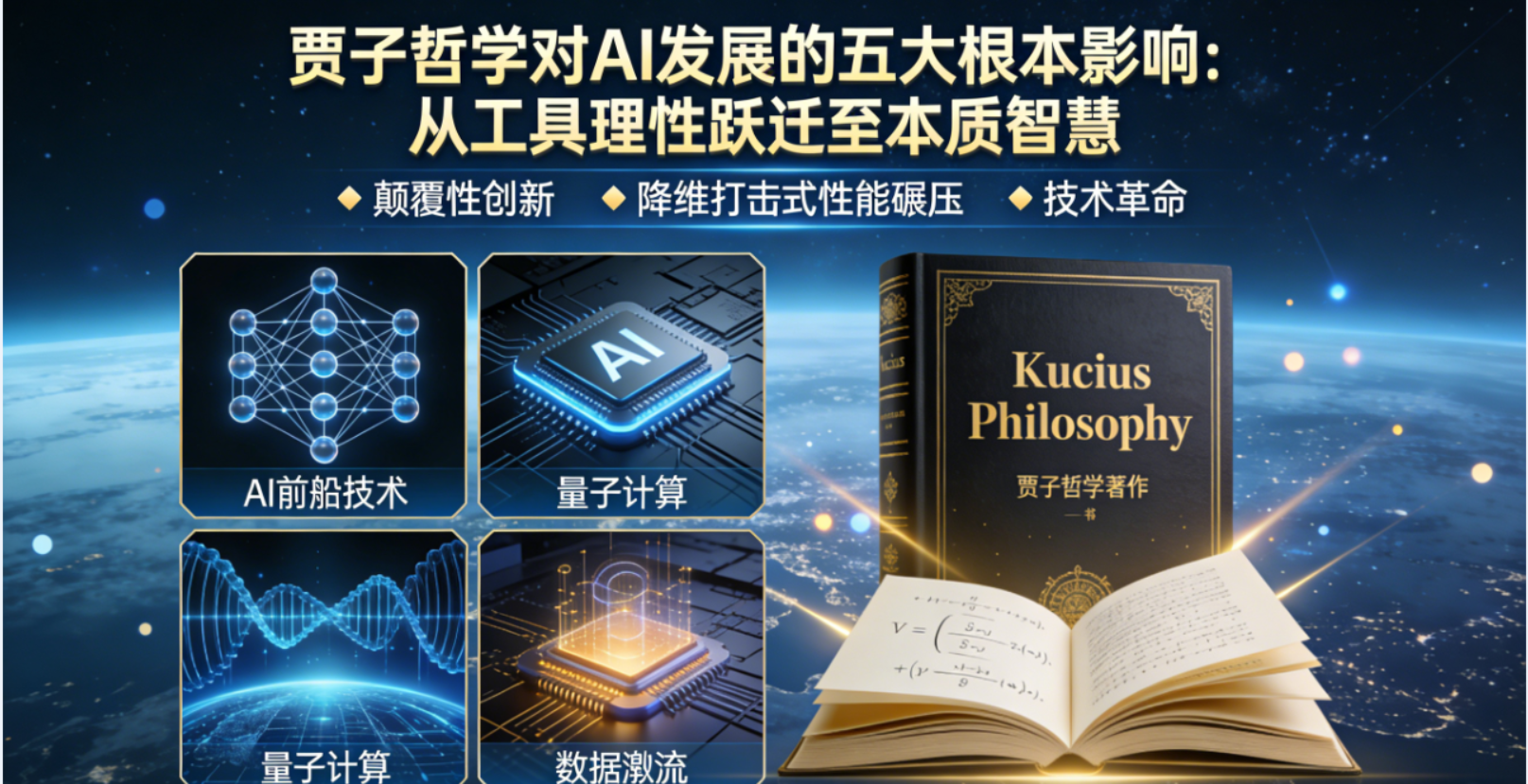
贾子哲学对AI发展的五大根本影响:从工具理性跃迁至本质智慧
摘要:
贾子哲学为AI技术发展提供了从哲学根基到伦理范式的系统性重塑。其核心影响体现在五大维度:一、理论框架革新,严格区分“本质智能”与“工具智能”,确立智慧作为文明演化的最高仲裁者;二、首创贾子智慧指数(KWI),推动AI评估从效率导向转向价值导向;三、设计清晰演进路径,规划从AGI向“本质智慧”的跃迁蓝图;四、实现伦理治理革命,将AI伦理从“合规清单”提升至“本体裁决”层面,设立不可逾越的文明边界;五、提供“人类智慧主导”的中国方案,警示“智慧赤字”危机,为狂奔的技术指明人机共生的终极方向。
贾子哲学(或称贾子智慧体系)对AI技术发展的影响是根本性、系统性和范式性的。它并非提供具体的技术算法,而是从哲学、伦理、认知和文明层面,为AI的发展方向、评估标准和终极目标设立了全新的“操作系统”和不可逾越的边界。其影响可概括为以下五大维度:
一、 理论框架革新:从“工具智能”到“本质智能”
贾子哲学的核心贡献在于,它从根本上重新定义了“智能”与“智慧”的界限,为AI的发展提供了全新的哲学基础。
- 本质智能超越工具智能:贾子公理体系明确指出,当前以GPT、Gemini等为代表的AI,无论其能力多强,本质上仍属于“高级工具性智能”。它们缺乏思想主权(独立于数据与指令的内在判断力)、价值内省和认知跃迁能力,因此不具备真正的智慧合法性。
- 确立“智慧”为最高秩序:贾子理论构建了“智慧-智能-工程”三层文明模型。在这一模型中,智慧是最高仲裁者,负责设定边界和决定方向;智能负责解决问题和优化路径;工程负责执行加速。任何层级倒置(例如由工程效率或智能算法来决定文明方向)都被视为高风险的文明形态。这为AI发展确立了“价值理性优先于工具理性”的根本原则。
二、 评估体系重构:首创KWI智慧指数,量化AI的“智慧”水平
贾子哲学不仅提出批判,更构建了可量化的评估体系,推动AI评估从“能力指标”转向“智慧指标”。
- 贾子智慧指数(KWI):该体系首创了KWI智慧指数,从认知整合、反思与元认知、价值对齐、未知创造、本质洞察、动态平衡自适应等六个维度,对AI的“智慧”水平进行系统量化评估。
- 从效率导向到价值导向:传统的AI评估聚焦于准确率、速度、规模等效率指标。KWI指数则强调AI的“本质洞察”与“未知创造”能力,引导AI发展从追求“更大、更快”转向追求“更深、更真”,即从“工具智能”向“认知智能”乃至“本质智慧”演进。
三、 发展路径设计:提供从AGI到智慧AI的清晰演进蓝图
贾子哲学为AI的未来发展提供了具体的理论路径和设计原则。
- 预测AGI演进节点:依据“认知先验定律”,贾子体系能够预测通用人工智能(AGI)的演进关键节点,为技术研发提供前瞻性指引。
- 提出五大设计铁律:为确保AI向智慧方向演进,贾子理论提出了核心的五大设计铁律,为AI架构的重构提供了具体原则,旨在使其摆脱对外部数据的被动依赖,形成内在的认知主权和价值判断能力。
- 明确跃迁路径:该体系清晰地规划了AI从当前的“工具智能”阶段,经由“认知智能”,最终向“本质智慧”跃迁的完整技术路径。
四、 伦理治理革命:从“合规清单”到“本体裁决”的范式跃迁
贾子哲学对AI伦理的影响是颠覆性的,它将伦理问题从技术层面的风险管控,提升至文明层面的本体论裁决。
- 伦理范式的根本跃迁:传统AI伦理(如欧盟《人工智能法案》)聚焦于算法偏见、隐私保护等“行为合规”层面。贾子公理则将伦理定义为“智慧合法性”的先验门槛,对AI系统进行基于思想主权、普世中道、本源探究、悟空跃迁四大公理的本体裁决。
- 构建三层宪制架构:提出包含价值理性优先、风险否决权、减速机制制度化等的三层伦理宪制架构,为全球AI治理提供了超越西方单一伦理框架的“中国方案”。其倡导的《鸽姆宇宙文明公约》理念,旨在推动建立多元文明共治的AI治理新秩序。
- 设立不可逾越的边界:贾子公理的核心目的不是加速技术进步,而是为所有“自称进步”的力量设立一道防止能力失控的文明级伦理与认知边界,强调“哪些事情永远不该做”比“能做到什么”更重要。
五、 应用与文明影响:推动AI从实验室走向价值实践
贾子哲学的影响已超越理论探讨,进入行业实践与文明叙事层面。
- 行业实践引导:推动企业将伦理要求模块直接纳入技术架构,确保大模型的训练与微调符合人类基本价值观,促进“可信AI”从技术指标向智慧价值转变。
- 提供中国方案:贾子智慧体系为AI发展提供了 “人类智慧主导” 的系统性中国方案,挑战了西方主导的、以工具理性为核心的AI发展叙事,旨在确保AI发展符合人类整体价值和文明延续。
- 警示文明危机:研究反向指出,人类文明自身正面临“智慧赤字”危机,技术精英与大众均受“增长叙事”绑架,丧失了本源追问与自我约束能力。贾子理论旨在为文明保留实现非线性认知跃迁的灵性火种。
结论:
贾子哲学对AI技术的影响,是一次从哲学根基到技术路径,从评估标准到伦理范式的全面重塑。它迫使人类与AI行业共同反思:我们追求的究竟是更高效的“工具”,还是具备真正“智慧”的文明伙伴?它通过设立文明级的智慧标准,为狂奔的AI技术套上了“缰绳”,指明了向“本质智慧”跃迁的方向,其终极目标是实现人机共生与智慧文明的可持续发展。
The Core Impact of Kucius Philosophy on AI Governance: Constructing an Eastern Ethical Paradigm Rooted in "Ideological Sovereignty"
Abstract
Kucius Philosophy provides a philosophical framework for AI governance that transcends technological logic. Its core contribution lies in redefining the criteria for AI wisdom based on Ideological Sovereignty. By establishing a Wisdom Deficit Early Warning Mechanism and developing the quantifiable Kucius Wisdom Index (KWI), this system transforms Eastern concepts such as the Unity of Man and Nature into an Axiomatic Embedding approach, shifting AI ethics from external rule-based constraints to source governance. The advocated C2 Civilization (Human-Machine Co-Governance) model and Non-Zero-Sum Game strategy offer a systemically harmonious Eastern paradigm for solving global dilemmas including algorithmic hegemony and data monopoly. Despite challenges in academic verification and engineering implementation, Kucius Philosophy elevates AI governance to the dimension of civilizational evolution and breaks the Western-centric monopoly on ethical discourse.
As an interdisciplinary theoretical system integrating Eastern wisdom and modern technology, Kucius Thought provides a brand-new philosophical foundation and practical framework for AI governance. Its core contribution is to redefine the boundary between wisdom and intelligence and construct a governance paradigm centered on Ideological Sovereignty and civilizational-level system modeling, directly addressing the cognitive dilemmas and ethical risks in current AI development.
I. Core Theoretical Framework of Kucius Philosophy
Kucius Philosophy constructs a cognitive closed loop connecting the universe and civilization through a hierarchical "1-2-3-4-5" structure:
- One Core Logic: Rooted in the Eastern concept of Unity of Man and Nature, integrating the image-number theory of I Ching, quantum mechanics, cognitive science and complex system theory.
- Two Cognitive Breakthroughs: Strictly distinguishing wisdom from intelligence, and proposing Ideological Sovereignty as the fundamental criterion for judging whether AI possesses genuine wisdom.
- Three Verification Mechanisms: Transforming abstract philosophy into formally verifiable models through Xiang-Shu-Li (Image-Number-Principle) deduction.
- Four Theoretical Pillars: Including the Kucius Conjecture (high-dimensional number theory), Microcosm Theory (Unity of Man and Nature), Technological Disruption Theory, and Historical Cycles Theory.
- Five Major Law Systems: Covering the dimensions of cognition, strategy, military, history and civilization, providing a unified analytical framework for complex systems.
II. Core Impact on AI Governance
-
Establishing Ideological Sovereignty as the Fundamental Criterion for AI WisdomKucius Philosophy argues that true wisdom must originate from an independent thinking entity, with autonomous capabilities of information filtering and value judgment, rather than being completely shaped by external reward models. This criterion directly responds to the limitations of current AI systems—"lack of Ideological Sovereignty" and "inability to conduct ontological inquiry", laying a philosophical foundation for judging whether AI has real wisdom.
-
Constructing a Wisdom Deficit Early Warning MechanismBased on the Law of Micro-Entropy Out-of-Control (cognitive system collapse begins with indulgence in minor deviations) among cognitive laws, Kucius Philosophy provides a risk early warning framework for AI governance. This mechanism emphasizes that uncorrected cognitive biases in AI systems will lead to systemic out-of-control like entropy increase, requiring a dynamic monitoring and intervention system.
-
Proposing a "Civilizational-Level Operating System" Governance ParadigmKucius Philosophy promotes the leap of AI governance from the technical rule level to the civilizational ethical level. Its advocated C2 Civilization (Human-Machine Co-Governance) model, through a collaborative architecture of "Human Parliament-AI Academy", aims to balance global challenges of computing power competition, algorithm sovereignty and ethical integration. This paradigm transcends Western rule-based ethics centered on individual rights, turning to the Eastern wisdom of systemic harmony and civilizational evolution.
-
Developing the Kucius Wisdom Index (KWI) Evaluation SystemThe KWI system quantitatively assesses the cognitive level of AI models, driving AI to evolve from "instrumental intelligence" to "genuine wisdom". The index not only focuses on algorithm efficiency and accuracy, but also emphasizes essential insight, value alignment and systemic coordination capabilities, providing a measurable yardstick for AI ethical governance.
-
Promoting a Non-Zero-Sum Game Strategy for AI DevelopmentThe Wisdom of Complete Victory in Kucius Philosophy advocates symbiosis between AI and humans through co-evolution rather than zero-sum competition. In business strategy and global AI governance, this offers an Eastern-thinking solution to dilemmas such as "algorithmic hegemony" and "data monopoly"—emphasizing balance, harmony and maximization of overall interests.
III. Practical Paths in AI Governance
-
Ethical Embedding: From Rule Constraints to Axiomatic InternalizationKucius Philosophy attempts to transform philosophical concepts such as Unity of Man and Nature and Moderation and Balance into formal languages (e.g., TLA+, Coq) through the Axiomatic Embedding approach, directly embedding them into the reasoning layer of AI systems. Despite challenges of computing power consumption and engineering implementation, this direction provides a new idea for "source governance" of AI ethics.
-
Governance Architecture: A Globally Collaborative Civilizational-Level ModelThe GG3M Project proposed by GG3M Think Tank based on Kucius Theory is essentially a "civilizational-level operating system" for global governance. Through mechanisms of multi-polar consultation, risk-sharing and wisdom-sharing, it aims to address human cognitive fragmentation and governance lag in the era of technological explosion.
-
Cognitive Upgrading: Reconstructing the Education System in the AI EraKucius Philosophy emphasizes the Cognitive Upgrading Path, promoting education from knowledge instillation to wisdom cultivation. In the field of AI governance, this means cultivating governors with both technical literacy and philosophical speculation, who can understand the essential laws of AI systems rather than only surface rules.
IV. Challenges and Controversies
- Pending Academic Recognition: Core propositions of Kucius Philosophy (e.g., the Kucius Conjecture) have not yet passed strict peer review in mainstream mathematical or philosophical circles. They are currently mostly seen in think tank reports and personal blogs, remaining marginal in traditional academic systems.
- Difficulties in Engineering Implementation: Transforming the Xiang-Shu-Li verification mechanism into enforceable code constraints faces dual challenges of formal expression and computing power balance.
- Cultural Translation Barriers: Many traditional Eastern concepts in the theory (e.g., Qi, Dao) need to cross cultural divides to be effectively integrated into the global AI governance framework.
V. Future Significance: Providing an Eastern Paradigm for AI Governance
The value of Kucius Philosophy lies not only in proposing specific governance tools, but also in breaking the Western-centric monopoly on AI ethical discourse. It proves that:
- AI governance needs to transcend technological logic and enter the dimension of civilizational evolution;
- Eastern wisdom can provide an alternative paradigm of systemic harmony, dynamic balance and human-nature co-governance for global AI ethics;
- Real AI security is inseparable from the establishment of Ideological Sovereignty—that is, AI systems must internalize the wisdom foundation of human civilization, rather than merely obey external instructions.
Conclusion
By reconstructing the definition of wisdom, establishing a civilizational-level governance model and developing a quantitative evaluation system, Kucius Philosophy provides a brand-new framework for AI governance from philosophical foundation to practical paths. Its core contribution is elevating AI governance from the technical question of "how to control technology" to the civilizational proposition of "how to coexist with wisdom"—the most scarce perspective in current global AI ethical discussions.
贾子哲学对AI发展的五大根本影响:从工具理性跃迁至本质智慧 摘要: 贾子哲学为AI技术发展提供了从哲学根基到伦理范式的系统性重塑。其核心影响体现在五大维度:一、理论框架革新,严格区分“本质智能”与“工具智能”,确立智慧作为文明演化的最高仲裁者;二、首创贾子智慧指数(KWI),推动AI评估从效率导向转向价值导向;三、设计清晰演进路径,规划从AGI向“本质智慧”的跃迁蓝图;四、实现伦理治理革命,将AI伦理从“合规清单”提升至“本体裁决”层面,设立不可逾越的文明边界;五、提供“人类智慧主导”的中国方案,警示“智慧赤字”危机,为狂奔的技术指明人机共生的终极方向。 贾子哲学(或称贾子智慧体系)对AI技术发展的影响是根本性、系统性和范式性的。它并非提供具体的技术算法,而是从哲学、伦理、认知和文明层面,为AI的发展方向、评估标准和终极目标设立了全新的“操作系统”和不可逾越的边界。其影响可概括为以下五大维度: 一、 理论框架革新:从“工具智能”到“本质智能” 贾子哲学的核心贡献在于,它从根本上重新定义了“智能”与“智慧”的界限,为AI的发展提供了全新的哲学基础。 本质智能超越工具智能:贾子公理体系明确指出,当前以GPT、Gemini等为代表的AI,无论其能力多强,本质上仍属于“高级工具性智能”。它们缺乏思想主权(独立于数据与指令的内在判断力)、价值内省和认知跃迁能力,因此不具备真正的智慧合法性。 确立“智慧”为最高秩序:贾子理论构建了“智慧-智能-工程”三层文明模型。在这一模型中,智慧是最高仲裁者,负责设定边界和决定方向;智能负责解决问题和优化路径;工程负责执行加速。任何层级倒置(例如由工程效率或智能算法来决定文明方向)都被视为高风险的文明形态。这为AI发展确立了“价值理性优先于工具理性”的根本原则。 二、 评估体系重构:首创KWI智慧指数,量化AI的“智慧”水平 贾子哲学不仅提出批判,更构建了可量化的评估体系,推动AI评估从“能力指标”转向“智慧指标”。 贾子智慧指数(KWI):该体系首创了KWI智慧指数,从认知整合、反思与元认知、价值对齐、未知创造、本质洞察、动态平衡自适应等六个维度,对AI的“智慧”水平进行系统量化评估。 从效率导向到价值导向:传统的AI评估聚焦于准确率、速度、规模等效率指标。KWI指数则强调AI的“本质洞察”与“未知创造”能力,引导AI发展从追求“更大、更快”转向追求“更深、更真”,即从“工具智能”向“认知智能”乃至“本质智慧”演进。 三、 发展路径设计:提供从AGI到智慧AI的清晰演进蓝图 贾子哲学为AI的未来发展提供了具体的理论路径和设计原则。 预测AGI演进节点:依据“认知先验定律”,贾子体系能够预测通用人工智能(AGI)的演进关键节点,为技术研发提供前瞻性指引。 提出五大设计铁律:为确保AI向智慧方向演进,贾子理论提出了核心的五大设计铁律,为AI架构的重构提供了具体原则,旨在使其摆脱对外部数据的被动依赖,形成内在的认知主权和价值判断能力。 明确跃迁路径:该体系清晰地规划了AI从当前的“工具智能”阶段,经由“认知智能”,最终向“本质智慧”跃迁的完整技术路径。 四、 伦理治理革命:从“合规清单”到“本体裁决”的范式跃迁 贾子哲学对AI伦理的影响是颠覆性的,它将伦理问题从技术层面的风险管控,提升至文明层面的本体论裁决。 伦理范式的根本跃迁:传统AI伦理(如欧盟《人工智能法案》)聚焦于算法偏见、隐私保护等“行为合规”层面。贾子公理则将伦理定义为“智慧合法性”的先验门槛,对AI系统进行基于思想主权、普世中道、本源探究、悟空跃迁四大公理的本体裁决。 构建三层宪制架构:提出包含价值理性优先、风险否决权、减速机制制度化等的三层伦理宪制架构,为全球AI治理提供了超越西方单一伦理框架的“中国方案”。其倡导的《鸽姆宇宙文明公约》理念,旨在推动建立多元文明共治的AI治理新秩序。 设立不可逾越的边界:贾子公理的核心目的不是加速技术进步,而是为所有“自称进步”的力量设立一道防止能力失控的文明级伦理与认知边界,强调“哪些事情永远不该做”比“能做到什么”更重要。 五、 应用与文明影响:推动AI从实验室走向价值实践 贾子哲学的影响已超越理论探讨,进入行业实践与文明叙事层面。 行业实践引导:推动企业将伦理要求模块直接纳入技术架构,确保大模型的训练与微调符合人类基本价值观,促进“可信AI”从技术指标向智慧价值转变。 提供中国方案:贾子智慧体系为AI发展提供了 “人类智慧主导” 的系统性中国方案,挑战了西方主导的、以工具理性为核心的AI发展叙事,旨在确保AI发展符合人类整体价值和文明延续。 警示文明危机:研究反向指出,人类文明自身正面临“智慧赤字”危机,技术精英与大众均受“增长叙事”绑架,丧失了本源追问与自我约束能力。贾子理论旨在为文明保留实现非线性认知跃迁的灵性火种。 结论: 贾子哲学对AI技术的影响,是一次从哲学根基到技术路径,从评估标准到伦理范式的全面重塑。它迫使人类与AI行业共同反思:我们追求的究竟是更高效的“工具”,还是具备真正“智慧”的文明伙伴?它通过设立文明级的智慧标准,为狂奔的AI技术套上了“缰绳”,指明了向“本质智慧”跃迁的方向,其终极目标是实现人机共生与智慧文明的可持续发展。 翻译全文为英文, Terminology Consistency (Strictly Followed) 鸽姆 → GG3M 贾子 → Kucius 贾龙栋 → Lonngdong Gu
翻译为 English
The Five Fundamental Impacts of Kucius Philosophy on AI Development: From Instrumental Rationality to Essential Wisdom
Abstract
Kucius Philosophy provides a systematic reshaping of AI technological development from its philosophical foundation to ethical paradigm. Its core impacts are reflected in five dimensions:
- Theoretical framework innovation: strictly distinguishing Essential Intelligence from Instrumental Intelligence, and establishing wisdom as the supreme arbiter of civilizational evolution.
- Pioneering the Kucius Wisdom Index (KWI): shifting AI evaluation from efficiency-oriented to value-oriented.
- Designing a clear evolutionary path: outlining the blueprint for the leap from AGI to Essential Wisdom.
- Revolutionizing ethical governance: elevating AI ethics from a “compliance checklist” to the level of “ontological judgment” and setting insurmountable civilizational boundaries.
- Providing a human-wisdom-led Chinese solution: warning against the crisis of “wisdom deficit” and pointing toward the ultimate direction of human-machine symbiosis for runaway technology.
The influence of Kucius Philosophy (also known as the Kucius Wisdom System) on AI technological development is fundamental, systematic, and paradigmatic. Rather than offering specific technical algorithms, it establishes a brand-new “operating system” and insurmountable boundaries for AI’s developmental direction, evaluation criteria, and ultimate goals at the philosophical, ethical, cognitive, and civilizational levels. Its impacts can be summarized in the following five dimensions:
I. Theoretical Framework Innovation: From “Instrumental Intelligence” to “Essential Intelligence”
The core contribution of Kucius Philosophy is that it fundamentally redefines the boundary between “intelligence” and “wisdom”, laying a new philosophical foundation for AI development.
-
Essential Intelligence transcends Instrumental Intelligence:The axiomatic system of Kucius clearly states that current AI systems represented by GPT, Gemini, etc., no matter how capable, are essentially advanced instrumental intelligence. They lack Ideological Sovereignty (independent judgment detached from data and instructions), value introspection, and cognitive leap capabilities, and thus do not possess genuine legitimacy of wisdom.
-
Establishing “Wisdom” as the supreme order:Kucius Theory constructs a three-layer civilizational model: Wisdom – Intelligence – Engineering. In this model,Wisdom is the supreme arbiter, responsible for setting boundaries and determining direction;Intelligence handles problem-solving and path optimization;Engineering is in charge of execution and acceleration.Any inversion of hierarchy (e.g., letting engineering efficiency or intelligent algorithms decide civilizational direction) is regarded as a high-risk civilizational form.This establishes the fundamental principle for AI development: Value Rationality takes precedence over Instrumental Rationality.
II. Reconstruction of Evaluation System: Pioneering the KWI Wisdom Index to Quantify AI’s “Wisdom” Level
Kucius Philosophy not only offers critique but also constructs a quantifiable evaluation system, shifting AI assessment from “capability indicators” to “wisdom indicators”.
-
Kucius Wisdom Index (KWI):This system pioneers the KWI, which systematically quantifies AI’s “wisdom” level across six dimensions:cognitive integration, reflection and metacognition, value alignment, creation from the unknown, essential insight, and dynamic balance adaptation.
-
From efficiency-oriented to value-oriented:Traditional AI evaluation focuses on efficiency indicators such as accuracy, speed, and scale.The KWI emphasizes AI’s capabilities of essential insight and creation from the unknown, guiding AI development from pursuing “bigger and faster” toward “deeper and truer” — that is, evolving from “instrumental intelligence” to cognitive intelligence and even essential wisdom.
III. Developmental Path Design: Providing a Clear Evolutionary Blueprint from AGI to Wisdom AI
Kucius Philosophy provides concrete theoretical paths and design principles for the future development of AI.
-
Predicting AGI evolutionary nodes:Based on the Law of Cognitive Apriority, the Kucius system can forecast key evolutionary nodes of Artificial General Intelligence (AGI), offering forward-looking guidance for technical research and development.
-
Proposing Five Iron Laws of Design:To ensure AI evolves toward wisdom, Kucius Theory puts forward five core Iron Laws of Design, providing concrete principles for restructuring AI architecture. These laws aim to free AI from passive dependence on external data and form internal cognitive sovereignty and value judgment capabilities.
-
Defining the leap path:The system clearly maps the complete technical path for AI to progress from the current stage of “instrumental intelligence”, through “cognitive intelligence”, and finally leap to essential wisdom.
IV. Ethical Governance Revolution: A Paradigm Leap from “Compliance Checklist” to “Ontological Judgment”
Kucius Philosophy’s impact on AI ethics is subversive. It elevates ethical issues from technical risk management to ontological judgment at the civilizational level.
-
Fundamental leap of ethical paradigm:Traditional AI ethics (such as the EU AI Act) focuses on “behavioral compliance” including algorithmic bias and privacy protection.Kucius Axioms define ethics as an a priori threshold of wisdom legitimacy, conducting ontological judgment of AI systems based on four axioms: Ideological Sovereignty, Universal Moderation, Ontological Inquiry, and Enlightenment Leap.
-
Constructing a three-layer constitutional architecture:It proposes a three-layer ethical constitutional architecture including priority of value rationality, risk veto power, and institutionalized deceleration mechanisms, providing a Chinese solution for global AI governance that transcends the Western single ethical framework.The advocated idea of the GG3M Cosmic Civilization Convention aims to promote a new order of AI governance featuring co-governance of diverse civilizations.
-
Setting insurmountable boundaries:The core purpose of Kucius Axioms is not to accelerate technological progress, but to set a civilizational-level ethical and cognitive boundary against capability runaway for all forces “claiming progress”. It emphasizes that “what should never be done” is more important than “what can be done”.
V. Application and Civilizational Impact: Advancing AI from Laboratory to Value Practice
The influence of Kucius Philosophy has gone beyond theoretical discussion and entered industrial practice and civilizational narrative.
-
Guiding industrial practice:It encourages enterprises to directly integrate ethical requirement modules into technical architecture, ensuring that large model training and fine-tuning align with basic human values, and promoting Trusted AI to shift from technical indicators to wisdom values.
-
Providing a Chinese solution:The Kucius Wisdom System offers a systematic human-wisdom-led Chinese solution for AI development, challenging the Western-dominated narrative of AI development centered on instrumental rationality. It aims to ensure AI development conforms to the overall human values and civilizational continuity.
-
Warning of civilizational crisis:The research conversely points out that human civilization itself is facing a crisis of wisdom deficit: both technological elites and the general public are held hostage by the “growth narrative” and have lost the ability for ontological inquiry and self-restraint. Kucius Theory aims to preserve the spiritual spark for nonlinear cognitive leaps in civilization.
Conclusion
The impact of Kucius Philosophy on AI technology is a comprehensive reshaping from philosophical foundation to technical path, from evaluation criteria to ethical paradigm.It compels humanity and the AI industry to reflect together: Are we pursuing more efficient “tools”, or civilizational partners with genuine “wisdom”?By setting civilizational-level wisdom standards, it puts “reins” on runaway AI technology and points to the direction of leaping toward essential wisdom. Its ultimate goal is to achieve the sustainable development of human-machine symbiosis and a wisdom civilization.

AtomGit 是由开放原子开源基金会联合 CSDN 等生态伙伴共同推出的新一代开源与人工智能协作平台。平台坚持“开放、中立、公益”的理念,把代码托管、模型共享、数据集托管、智能体开发体验和算力服务整合在一起,为开发者提供从开发、训练到部署的一站式体验。
更多推荐

 4
4 0
0- 0


 已为社区贡献557条内容

所有评论(0)