材料力学-主题073-生物材料力学仿真
主题073:生物材料力学仿真
1. 生物材料概述
生物材料(Biomaterials)是一类与生物系统相互作用,用于诊断、治疗、修复或替换人体组织或器官的材料。生物材料力学仿真旨在通过数值模拟方法,研究生物材料的力学行为、与生物组织的相互作用,以及在生理环境下的性能变化。
1.1 生物材料分类
| 材料类型 | 组成 | 特点 | 应用领域 | 力学特性 |
|---|---|---|---|---|
| 金属生物材料 | 钛合金、不锈钢、钴铬合金 | 高强度、良好的生物相容性 | 人工关节、骨科植入物 | 高弹性模量、高强度 |
| 陶瓷生物材料 | 氧化铝、氧化锆、羟基磷灰石 | 生物惰性、良好的骨结合能力 | 牙科种植体、骨修复 | 高硬度、脆性大 |
| 聚合物生物材料 | 聚乙烯、聚乳酸、聚乙醇酸 | 可降解、易加工 | 缝合线、组织工程支架 | 低弹性模量、韧性好 |
| 复合材料 | 聚合物-陶瓷复合、聚合物-金属复合 | 综合性能优异 | 骨修复、软骨替代 | 可调控的力学性能 |
| 天然生物材料 | 胶原蛋白、壳聚糖、丝素蛋白 | 优异的生物相容性、可降解 | 组织工程、药物载体 | 低强度、易降解 |
| 生物活性材料 | 生物玻璃、磷酸钙水泥 | 能与骨组织形成化学键合 | 骨修复、牙科材料 | 中等强度、生物活性 |
1.2 生物材料的特殊要求
- 生物相容性:不引起宿主不良反应
- 生物降解性:在适当时间内降解并被人体吸收
- 力学相容性:与周围组织的力学性能匹配
- 生物活性:能与生物组织形成良好的界面结合
- 灭菌性:可通过常规方法灭菌
- 加工性:易于加工成所需形状
1.3 生物材料力学仿真的挑战
- 复杂的生理环境:体液、酶、细胞等因素的影响
- 时间依赖性:材料的降解和性能演变
- 多尺度特性:从分子到组织的多尺度结构
- 非线性行为:大变形、粘弹性、塑性等
- 生物-材料界面:材料与生物组织的相互作用
2. 生物材料力学特性
2.1 金属生物材料
钛合金(Ti6Al4V):
- 弹性模量:110-117 GPa
- 屈服强度:800-900 MPa
- 抗拉强度:900-1000 MPa
- 延伸率:10-15%
- 密度:4.43 g/cm³
钴铬合金(CoCrMo):
- 弹性模量:220-250 GPa
- 屈服强度:450-550 MPa
- 抗拉强度:750-950 MPa
- 延伸率:10-20%
- 密度:8.3-8.5 g/cm³
2.2 陶瓷生物材料
羟基磷灰石(HA):
- 弹性模量:80-120 GPa
- 抗压强度:800-1200 MPa
- 抗弯强度:80-150 MPa
- 硬度:5-6 GPa
- 密度:3.16 g/cm³
氧化锆(ZrO₂):
- 弹性模量:200-230 GPa
- 抗压强度:2000-2500 MPa
- 抗弯强度:900-1200 MPa
- 硬度:12-14 GPa
- 密度:5.6-6.0 g/cm³
2.3 聚合物生物材料
超高分子量聚乙烯(UHMWPE):
- 弹性模量:0.5-1.5 GPa
- 屈服强度:20-30 MPa
- 抗拉强度:35-50 MPa
- 延伸率:300-500%
- 密度:0.93-0.97 g/cm³
聚乳酸(PLA):
- 弹性模量:2.7-3.5 GPa
- 屈服强度:50-70 MPa
- 抗拉强度:55-75 MPa
- 延伸率:3-10%
- 密度:1.24 g/cm³
2.4 天然生物材料
胶原蛋白:
- 弹性模量:0.1-0.5 GPa
- 抗拉强度:50-150 MPa
- 延伸率:10-30%
- 密度:1.34 g/cm³
丝素蛋白:
- 弹性模量:10-15 GPa
- 抗拉强度:600-900 MPa
- 延伸率:15-35%
- 密度:1.34 g/cm³
3. 生物材料本构关系
3.1 弹性本构关系
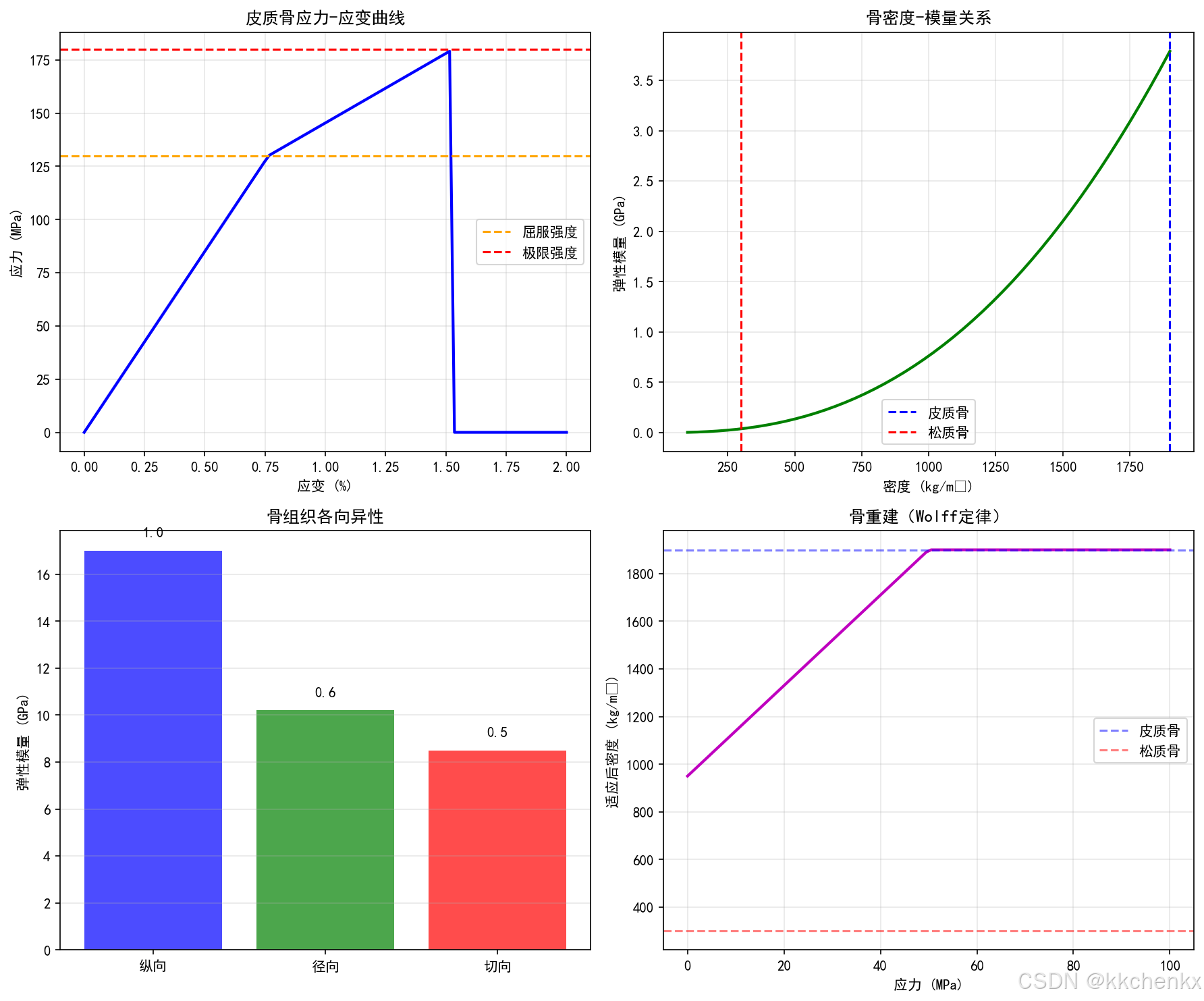
对于线性弹性生物材料,其本构关系遵循胡克定律:
σ=Eϵ \sigma = E \epsilon σ=Eϵ
对于各向异性生物材料(如骨组织),需要使用张量形式:
σij=Cijklϵkl \sigma_{ij} = C_{ijkl} \epsilon_{kl} σij=Cijklϵkl
3.2 粘弹性本构关系
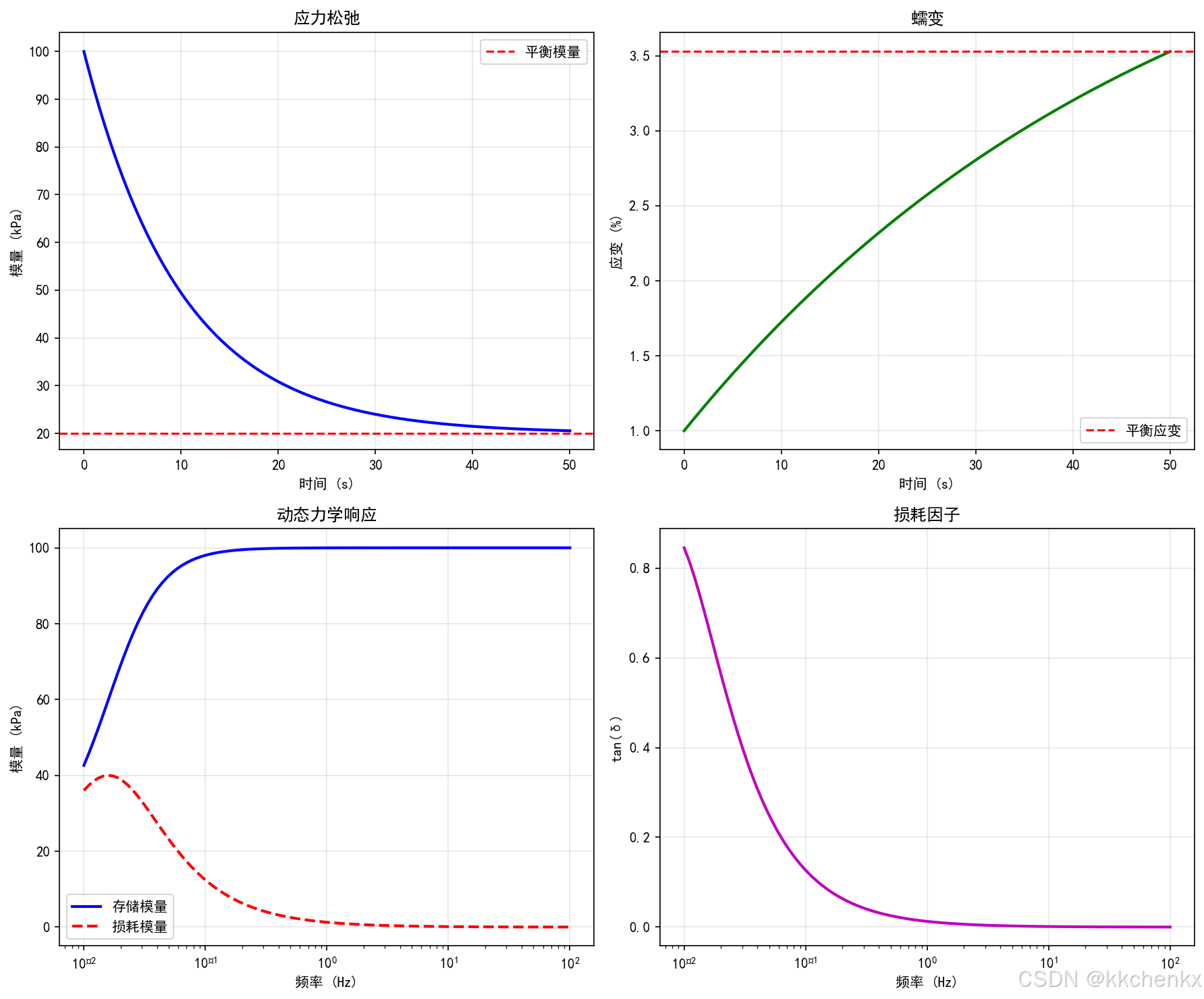
生物材料通常表现出粘弹性行为,需要考虑时间依赖性:
Maxwell模型:
σ˙+στ=Eϵ˙ \dot{\sigma} + \frac{\sigma}{\tau} = E \dot{\epsilon} σ˙+τσ=Eϵ˙
Kelvin-Voigt模型:
σ=Eϵ+ηϵ˙ \sigma = E \epsilon + \eta \dot{\epsilon} σ=Eϵ+ηϵ˙
标准线性固体模型:
σ+τσσ˙=E0ϵ+E1τϵϵ˙ \sigma + \tau_\sigma \dot{\sigma} = E_0 \epsilon + E_1 \tau_\epsilon \dot{\epsilon} σ+τσσ˙=E0ϵ+E1τϵϵ˙
3.3 超弹性本构关系
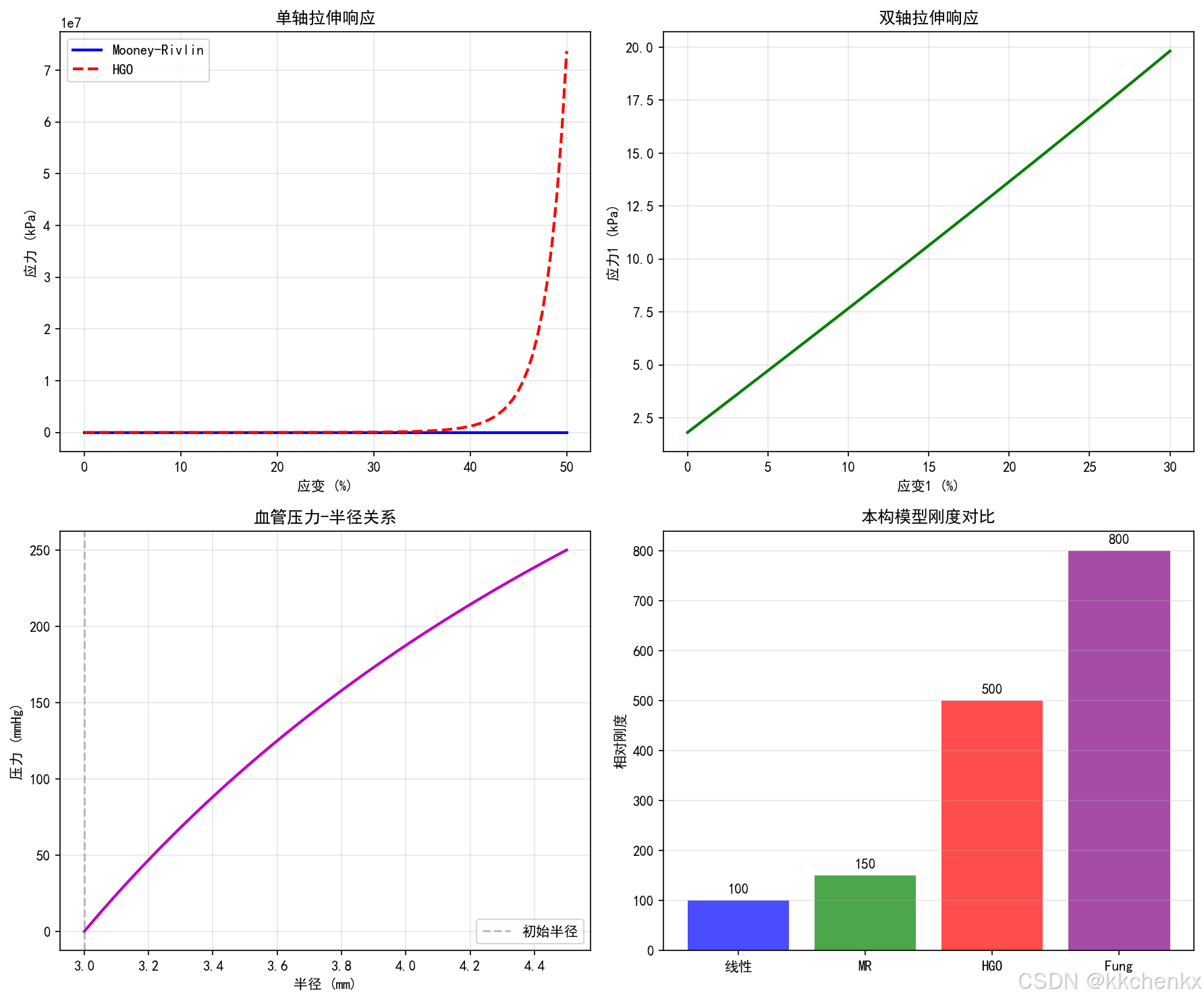
对于软组织和聚合物生物材料,常用超弹性模型:
Neo-Hookean模型:
W=μ2(I1−3) W = \frac{\mu}{2} (I_1 - 3) W=2μ(I1−3)
Mooney-Rivlin模型:
W=C10(I1−3)+C01(I2−3) W = C_{10} (I_1 - 3) + C_{01} (I_2 - 3) W=C10(I1−3)+C01(I2−3)
Ogden模型:
W=∑i=1Nμiαi2(λ1αi+λ2αi+λ3αi−3) W = \sum_{i=1}^N \frac{\mu_i}{\alpha_i^2} (\lambda_1^{\alpha_i} + \lambda_2^{\alpha_i} + \lambda_3^{\alpha_i} - 3) W=i=1∑Nαi2μi(λ1αi+λ2αi+λ3αi−3)
3.4 降解本构关系
对于可降解生物材料,其本构关系需要考虑降解引起的性能变化:
σ=E(t)ϵ \sigma = E(t) \epsilon σ=E(t)ϵ
其中,弹性模量随时间的变化可表示为:
E(t)=E0e−kt E(t) = E_0 e^{-kt} E(t)=E0e−kt
或更复杂的降解模型:
E(t)=E0(1−ttd)n E(t) = E_0 \left(1 - \frac{t}{t_d}\right)^n E(t)=E0(1−tdt)n
4. 生物材料仿真方法
4.1 有限元方法
class BiomaterialFEM:
    """生物材料有限元分析"""

    def __init__(self, mesh, material_properties):
        """初始化生物材料有限元模型"""
        self.mesh = mesh
        self.material_properties = material_properties
        self.n_nodes = mesh['n_nodes']
        self.n_elems = mesh['n_elems']
        self.coords = mesh['coords']
        self.elems = mesh['elems']

        # 计算自由度数量
        self.dofs = self.n_nodes * 3  # 三维问题,每个节点3个自由度

    def compute_stiffness_matrix(self, time=0):
        """计算刚度矩阵"""
        K = np.zeros((self.dofs, self.dofs))

        for i, elem in enumerate(self.elems):
            # 获取单元节点坐标
            node_coords = np.array([self.coords[n] for n in elem])

            # 计算单元刚度矩阵
            ke = self._compute_element_stiffness(node_coords, i, time)

            # 组装全局刚度矩阵
            dof_indices = []
            for node in elem:
                dof_indices.extend([3*node, 3*node+1, 3*node+2])

            for row in range(len(dof_indices)):
                for col in range(len(dof_indices)):
                    K[dof_indices[row], dof_indices[col]] += ke[row, col]

        return K

    def _compute_element_stiffness(self, node_coords, elem_id, time):
        """计算单元刚度矩阵"""
        # 简化的四面体单元刚度矩阵计算
        # 实际应用中应使用更精确的方法
        n_nodes = node_coords.shape[0]
        ke = np.zeros((3*n_nodes, 3*n_nodes))

        # 获取材料属性,考虑时间依赖性
        E = self._get_elastic_modulus(time)
        nu = self.material_properties.get('nu', 0.3)

        # 计算弹性矩阵
        D = self._compute_elastic_matrix(E, nu)

        # 简化实现,实际应计算B矩阵并积分
        volume = self._compute_element_volume(node_coords)
        ke = np.eye(3*n_nodes) * E * volume / 1000

        return ke

    def _get_elastic_modulus(self, time):
        """获取随时间变化的弹性模量"""
        E0 = self.material_properties.get('E', 1e9)
        degradation_rate = self.material_properties.get('degradation_rate', 0)

        # 考虑降解的弹性模量
        E = E0 * np.exp(-degradation_rate * time)
        return E

    def _compute_elastic_matrix(self, E, nu):
        """计算弹性矩阵"""
        D = np.zeros((6, 6))
        factor = E / ((1 + nu) * (1 - 2 * nu))

        D[0, 0] = D[1, 1] = D[2, 2] = factor * (1 - nu)
        D[0, 1] = D[0, 2] = D[1, 0] = D[1, 2] = D[2, 0] = D[2, 1] = factor * nu
        D[3, 3] = D[4, 4] = D[5, 5] = factor * (1 - 2 * nu) / 2

        return D

    def _compute_element_volume(self, node_coords):
        """计算单元体积"""
        # 四面体单元体积计算
        if node_coords.shape[0] == 4:
            v1 = node_coords[1] - node_coords[0]
            v2 = node_coords[2] - node_coords[0]
            v3 = node_coords[3] - node_coords[0]
            volume = np.abs(np.dot(v1, np.cross(v2, v3))) / 6
        else:
            volume = 1.0

        return volume

    def solve(self, F, bc, time=0):
        """求解有限元问题"""
        # 计算刚度矩阵
        K = self.compute_stiffness_matrix(time)

        # 应用边界条件
        free_dofs = np.array([dof for dof in range(self.dofs) if dof not in bc])
        K_reduced = K[np.ix_(free_dofs, free_dofs)]
        F_reduced = F[free_dofs]

        # 求解线性方程组
        u_reduced = np.linalg.solve(K_reduced, F_reduced)

        # 组装位移向量
        u = np.zeros(self.dofs)
        u[free_dofs] = u_reduced

        return u
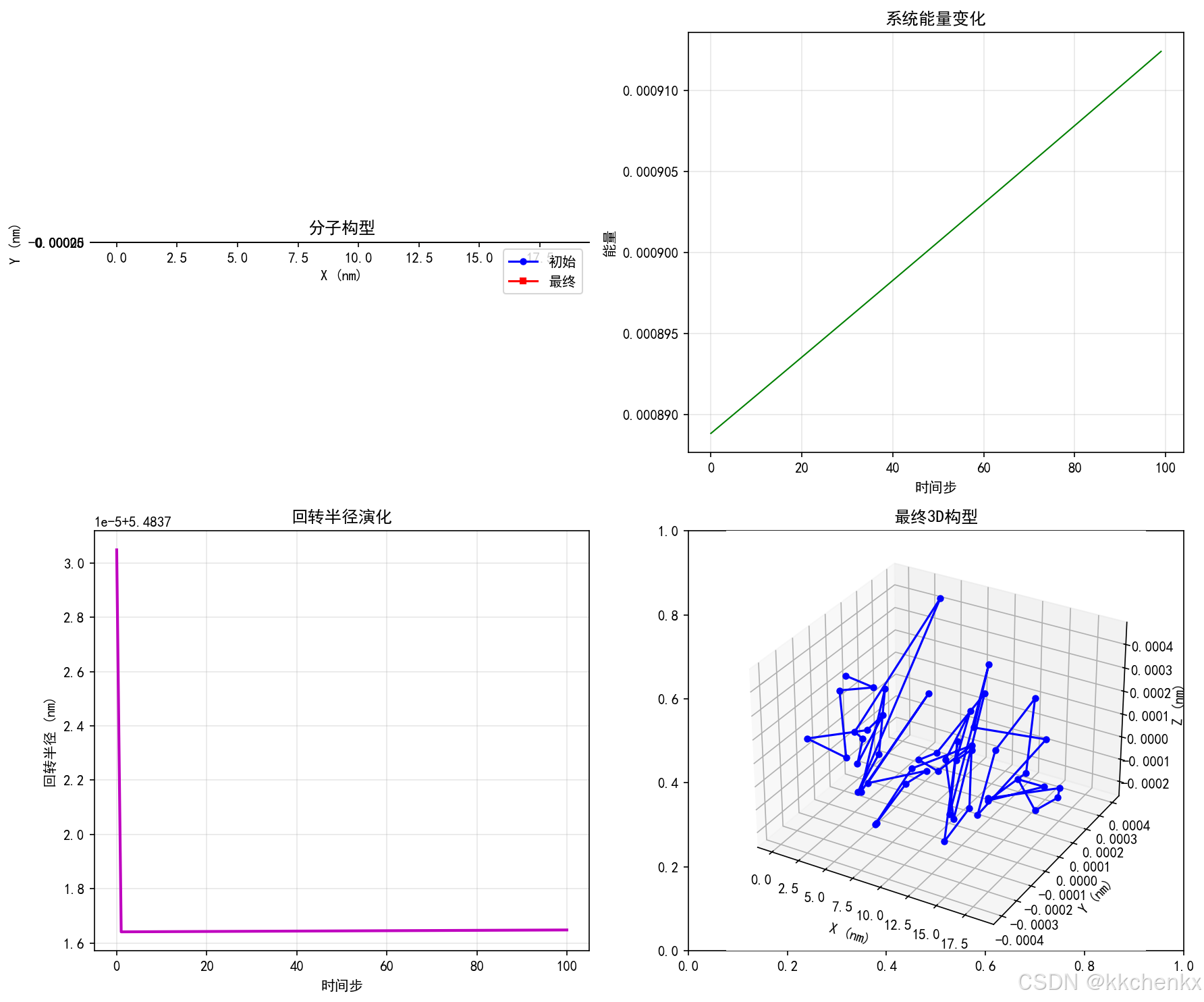
4.2 分子动力学模拟
class BiomoleculeMD:
    """生物分子动力学模拟"""

    def __init__(self, molecule_structure, force_field):
        """初始化生物分子动力学模型"""
        self.structure = molecule_structure
        self.force_field = force_field
        self.n_atoms = len(molecule_structure['atoms'])

    def run_simulation(self, temperature=300, time_step=1e-15, n_steps=100000):
        """运行分子动力学模拟"""
        # 初始化位置和速度
        positions = np.array([atom['position'] for atom in self.structure['atoms']])
        velocities = np.random.normal(0, np.sqrt(0.025), (self.n_atoms, 3))

        # 模拟结果
        trajectory = []
        energies = []

        for step in range(n_steps):
            # 计算力
            forces = self._compute_forces(positions)

            # 速度-Verlet积分
            velocities += 0.5 * forces * time_step
            positions += velocities * time_step
            forces = self._compute_forces(positions)
            velocities += 0.5 * forces * time_step

            # 温度控制
            velocities = self._control_temperature(velocities, temperature)

            # 记录结果
            if step % 100 == 0:
                trajectory.append(positions.copy())
                energy = self._compute_energy(positions, velocities)
                energies.append(energy)

                if step % 1000 == 0:
                    print(f"Step {step}: Energy = {energy:.4f}")

        return {
            'trajectory': trajectory,
            'energies': energies,
            'final_positions': positions,
            'final_velocities': velocities
        }

    def _compute_forces(self, positions):
        """计算原子间力"""
        forces = np.zeros((self.n_atoms, 3))

        # 计算键合力
        for bond in self.structure['bonds']:
            i, j = bond['atoms']
            r_ij = positions[j] - positions[i]
            r = np.linalg.norm(r_ij)
            k = bond.get('force_constant', 1000)
            r0 = bond.get('equilibrium_length', 0.1)

            force_magnitude = k * (r - r0)
            force_direction = r_ij / r if r > 0 else np.zeros(3)
            forces[i] += force_magnitude * force_direction
            forces[j] -= force_magnitude * force_direction

        # 计算非键合力(范德华力和静电力)
        for i in range(self.n_atoms):
            for j in range(i+1, self.n_atoms):
                r_ij = positions[j] - positions[i]
                r = np.linalg.norm(r_ij)

                if r > 0.5:  # 截断距离
                    continue

                # 范德华力(Lennard-Jones势)
                sigma = 0.34  # 范德华半径
                epsilon = 0.01  # 势阱深度
                lj_force = 24 * epsilon * ((2 * (sigma/r)**14) - (sigma/r)**8) * r_ij/r

                # 静电力
                q_i = self.structure['atoms'][i].get('charge', 0)
                q_j = self.structure['atoms'][j].get('charge', 0)
                coulomb_force = 138.935458 * q_i * q_j / r**2 * r_ij/r if r > 0 else np.zeros(3)

                total_force = lj_force + coulomb_force
                forces[i] += total_force
                forces[j] -= total_force

        return forces

    def _compute_energy(self, positions, velocities):
        """计算系统能量"""
        # 动能
        kinetic_energy = 0.5 * np.sum(np.linalg.norm(velocities, axis=1)**2)

        # 势能
        potential_energy = 0

        # 键合势能
        for bond in self.structure['bonds']:
            i, j = bond['atoms']
            r_ij = positions[j] - positions[i]
            r = np.linalg.norm(r_ij)
            k = bond.get('force_constant', 1000)
            r0 = bond.get('equilibrium_length', 0.1)
            potential_energy += 0.5 * k * (r - r0)**2

        # 非键合势能
        for i in range(self.n_atoms):
            for j in range(i+1, self.n_atoms):
                r_ij = positions[j] - positions[i]
                r = np.linalg.norm(r_ij)

                if r > 0.5:
                    continue

                # 范德华势能
                sigma = 0.34
                epsilon = 0.01
                lj_energy = 4 * epsilon * ((sigma/r)**12 - (sigma/r)**6)

                # 静电势能
                q_i = self.structure['atoms'][i].get('charge', 0)
                q_j = self.structure['atoms'][j].get('charge', 0)
                coulomb_energy = 138.935458 * q_i * q_j / r if r > 0 else 0

                potential_energy += lj_energy + coulomb_energy

        total_energy = kinetic_energy + potential_energy
        return total_energy

    def _control_temperature(self, velocities, target_temperature):
        """温度控制"""
        current_temperature = np.mean(np.linalg.norm(velocities, axis=1)**2) / 3
        scaling_factor = np.sqrt(target_temperature / current_temperature) if current_temperature > 0 else 1
        return velocities * scaling_factor
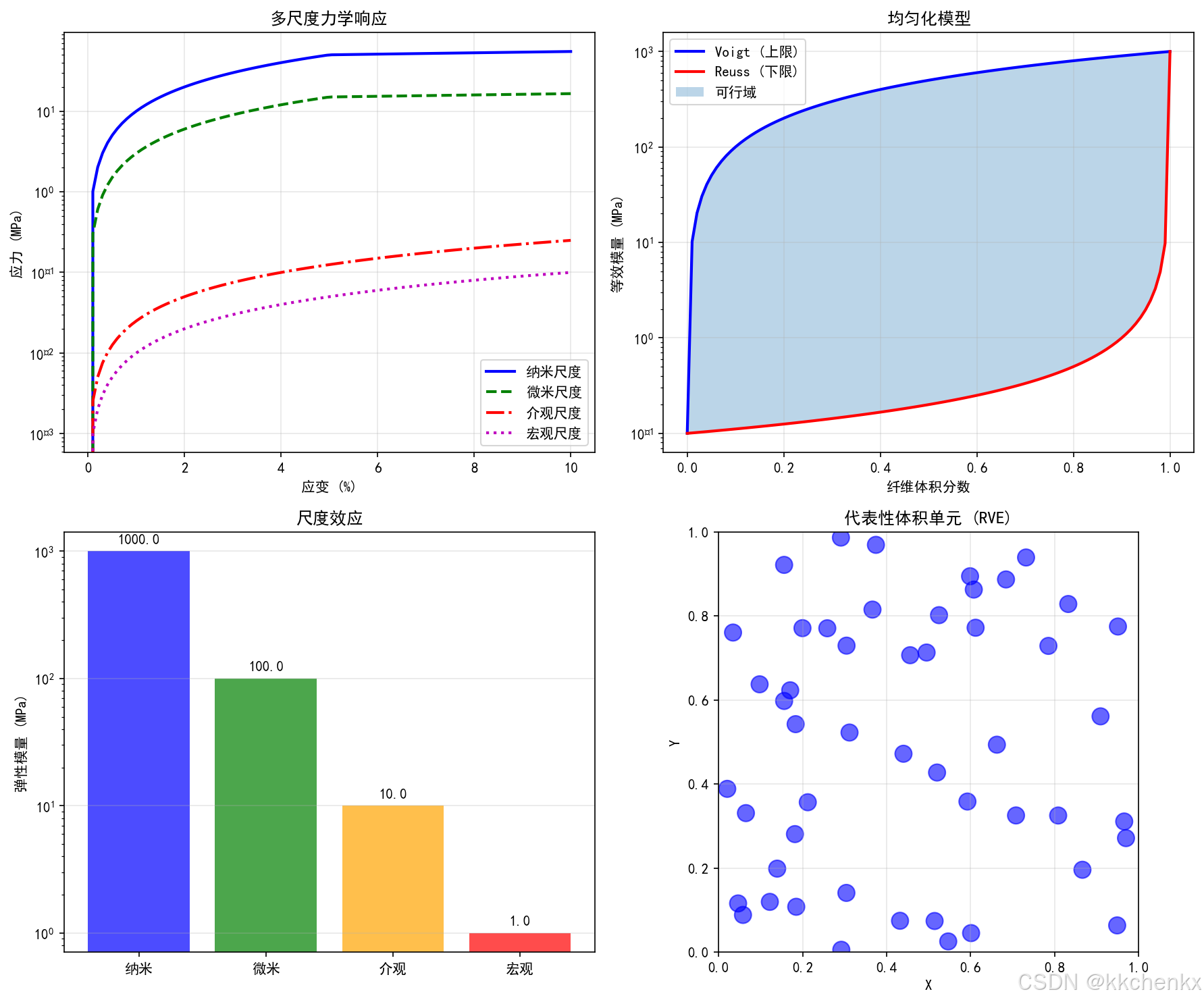
4.3 多尺度方法
class MultiscaleBiomaterialModel:
    """生物材料多尺度模型"""

    def __init__(self, macro_model, micro_model):
        """初始化多尺度模型"""
        self.macro_model = macro_model  # 宏观模型
        self.micro_model = micro_model  # 微观模型

    def solve(self, macro_load, macro_bc, time=0):
        """求解多尺度问题"""
        # 1. 宏观尺度分析
        macro_displacement = self.macro_model.solve(macro_load, macro_bc, time)

        # 2. 提取宏观应力和应变
        macro_strain = self._compute_macro_strain(macro_displacement)
        macro_stress = self._compute_macro_stress(macro_strain, time)

        # 3. 在关键区域进行微观尺度分析
        micro_results = []
        for region in self._identify_critical_regions(macro_stress):
            # 将宏观应变作为微观模型的边界条件
            micro_bc = self._map_macro_to_micro(macro_strain, region)
            micro_result = self.micro_model.solve(micro_bc, time)
            micro_results.append({
                'region': region,
                'result': micro_result
            })

        # 4. 将微观结果反馈到宏观模型
        updated_macro_model = self._update_macro_model(micro_results)

        # 5. 再次求解宏观模型
        final_macro_displacement = updated_macro_model.solve(macro_load, macro_bc, time)

        return {
            'macro_displacement': final_macro_displacement,
            'macro_strain': macro_strain,
            'macro_stress': macro_stress,
            'micro_results': micro_results
        }

    def _compute_macro_strain(self, displacement):
        """计算宏观应变"""
        # 简化实现
        return np.zeros_like(displacement)

    def _compute_macro_stress(self, strain, time):
        """计算宏观应力"""
        # 简化实现
        return np.zeros_like(strain)

    def _identify_critical_regions(self, stress):
        """识别关键区域"""
        # 简化实现
        return [{'center': [0, 0, 0], 'size': 0.1}]

    def _map_macro_to_micro(self, macro_strain, region):
        """将宏观应变映射到微观模型"""
        # 简化实现
        return []

    def _update_macro_model(self, micro_results):
        """根据微观结果更新宏观模型"""
        # 简化实现
        return self.macro_model
5. 生物材料的降解与吸收
5.1 降解模型
class DegradationModel:
    """生物材料降解模型"""

    def __init__(self, degradation_parameters):
        """初始化降解模型"""
        self.parameters = degradation_parameters

    def compute_degradation(self, time, temperature=37, pH=7.4):
        """计算降解程度"""
        # 获取降解参数
        k0 = self.parameters.get('k0', 1e-6)  # 降解速率常数
        Ea = self.parameters.get('Ea', 60000)  # 活化能
        n = self.parameters.get('n', 1)  # 反应级数

        # 温度对降解速率的影响(Arrhenius方程)
        R = 8.314  # 气体常数
        k = k0 * np.exp(-Ea / (R * (temperature + 273.15)))

        # pH值对降解速率的影响
        pH_effect = 1 + 0.1 * abs(pH - 7.4)
        k *= pH_effect

        # 计算降解程度
        degradation = k * time**n
        degradation = min(degradation, 1.0)  # 最大降解程度为1

        return degradation

    def compute_mass_loss(self, initial_mass, time, temperature=37, pH=7.4):
        """计算质量损失"""
        degradation = self.compute_degradation(time, temperature, pH)
        mass_loss = initial_mass * degradation
        remaining_mass = initial_mass - mass_loss

        return {
            'mass_loss': mass_loss,
            'remaining_mass': remaining_mass,
            'degradation': degradation
        }

    def compute_mechanical_property_degradation(self, initial_property, time, temperature=37, pH=7.4):
        """计算力学性能降解"""
        degradation = self.compute_degradation(time, temperature, pH)

        # 力学性能随降解的变化
        property_degradation_model = self.parameters.get('property_degradation_model', 'linear')

        if property_degradation_model == 'linear':
            degraded_property = initial_property * (1 - degradation)
        elif property_degradation_model == 'exponential':
            degraded_property = initial_property * np.exp(-5 * degradation)
        elif property_degradation_model == 'power_law':
            degraded_property = initial_property * (1 - degradation)**2
        else:
            degraded_property = initial_property * (1 - degradation)

        return degraded_property
5.2 降解产物扩散模型
class DiffusionModel:
    """降解产物扩散模型"""

    def __init__(self, diffusion_parameters):
        """初始化扩散模型"""
        self.parameters = diffusion_parameters

    def compute_concentration(self, time, geometry):
        """计算降解产物浓度分布"""
        # 获取扩散参数
        D = self.parameters.get('diffusion_coefficient', 1e-9)  # 扩散系数
        k = self.parameters.get('reaction_rate', 1e-5)  # 反应速率

        # 简化的一维扩散模型
        if geometry == 'sphere':
            radius = self.parameters.get('radius', 0.01)
            r = np.linspace(0, radius, 100)
            c = np.zeros_like(r)

            for i, ri in enumerate(r):
                if ri == 0:
                    c[i] = self._sphere_center_concentration(time, D, k, radius)
                else:
                    c[i] = self._sphere_radial_concentration(ri, time, D, k, radius)

        elif geometry == 'cylinder':
            radius = self.parameters.get('radius', 0.01)
            r = np.linspace(0, radius, 100)
            c = np.zeros_like(r)

            for i, ri in enumerate(r):
                c[i] = self._cylinder_radial_concentration(ri, time, D, k, radius)

        else:  # 平面
            thickness = self.parameters.get('thickness', 0.01)
            x = np.linspace(-thickness/2, thickness/2, 100)
            c = np.zeros_like(x)

            for i, xi in enumerate(x):
                c[i] = self._plane_concentration(xi, time, D, k, thickness)

        return {
            'position': r if geometry in ['sphere', 'cylinder'] else x,
            'concentration': c
        }

    def _sphere_center_concentration(self, t, D, k, R):
        """计算球体中心浓度"""
        # 简化的解析解
        return 1.0 * np.exp(-k*t) * np.erf(R/(2*np.sqrt(D*t)))

    def _sphere_radial_concentration(self, r, t, D, k, R):
        """计算球体径向浓度"""
        # 简化的解析解
        return 1.0 * np.exp(-k*t) * np.erf((R-r)/(2*np.sqrt(D*t)))

    def _cylinder_radial_concentration(self, r, t, D, k, R):
        """计算圆柱体径向浓度"""
        # 简化的解析解
        return 1.0 * np.exp(-k*t) * np.erf((R-r)/(2*np.sqrt(D*t)))

    def _plane_concentration(self, x, t, D, k, L):
        """计算平面浓度"""
        # 简化的解析解
        return 1.0 * np.exp(-k*t) * np.erf((L/2 - abs(x))/(2*np.sqrt(D*t)))
4. 工程应用案例
4.1 人工关节仿真
问题描述:设计一种基于钛合金的人工髋关节,评估其在生理载荷下的力学性能和磨损行为。
实现步骤:
- 建立人工髋关节的三维有限元模型
- 模拟生理载荷条件
- 分析应力分布和接触压力
- 预测磨损寿命
class ArtificialJointSimulation:
    """人工关节仿真"""

    def __init__(self, joint_geometry, material_properties):
        """初始化人工关节模型"""
        self.joint_geometry = joint_geometry
        self.material_properties = material_properties
        self.fem_model = BiomaterialFEM(joint_geometry, material_properties)

    def simulate_gait_cycle(self, gait_data):
        """模拟步态周期"""
        results = []

        for i, (time, load) in enumerate(gait_data):
            # 应用载荷和边界条件
            F = self._apply_gait_load(load)
            bc = self._apply_boundary_conditions()

            # 求解有限元问题
            displacement = self.fem_model.solve(F, bc, time)

            # 计算应力和应变
            stress = self._compute_stress(displacement, time)
            strain = self._compute_strain(displacement)

            # 计算接触压力
            contact_pressure = self._compute_contact_pressure(displacement)

            results.append({
                'time': time,
                'load': load,
                'displacement': displacement,
                'stress': stress,
                'strain': strain,
                'contact_pressure': contact_pressure
            })

            print(f"Gait cycle step {i+1}/{len(gait_data)}: Time = {time:.2f}s, Max stress = {np.max(stress):.2f}MPa")

        return results

    def predict_wear_life(self, gait_cycles=1e6):
        """预测磨损寿命"""
        # 简化的磨损预测模型
        # 基于Archard磨损定律:W = k * F * S / H

        k = self.material_properties.get('wear_coefficient', 1e-15)  # 磨损系数
        H = self.material_properties.get('hardness', 300)  # 硬度

        # 假设每个步态周期的滑动距离
        sliding_distance_per_cycle = 0.01  # 米

        # 计算总滑动距离
        total_sliding_distance = sliding_distance_per_cycle * gait_cycles

        # 假设平均接触力
        average_contact_force = 2000  # 牛顿

        # 计算磨损量
        wear_volume = k * average_contact_force * total_sliding_distance / H

        # 计算磨损深度
        contact_area = 0.001  # 平方米
        wear_depth = wear_volume / contact_area

        return {
            'wear_volume': wear_volume,
            'wear_depth': wear_depth,
            'predicted_life': gait_cycles
        }

    def _apply_gait_load(self, load):
        """应用步态载荷"""
        # 简化实现
        F = np.zeros(self.fem_model.dofs)
        # 在股骨头节点施加载荷
        for node in self.joint_geometry['femoral_head_nodes']:
            F[3*node] = load['x']
            F[3*node+1] = load['y']
            F[3*node+2] = load['z']
        return F

    def _apply_boundary_conditions(self):
        """应用边界条件"""
        # 固定髋臼杯
        bc = []
        for node in self.joint_geometry['acetabular_cup_nodes']:
            bc.extend([3*node, 3*node+1, 3*node+2])
        return bc

    def _compute_stress(self, displacement, time):
        """计算应力"""
        # 简化实现
        return np.zeros_like(displacement)

    def _compute_strain(self, displacement):
        """计算应变"""
        # 简化实现
        return np.zeros_like(displacement)

    def _compute_contact_pressure(self, displacement):
        """计算接触压力"""
        # 简化实现
        return 0.0
4.2 组织工程支架仿真
问题描述:设计一种基于聚乳酸(PLA)的组织工程支架,评估其在降解过程中的力学性能变化和细胞生长环境。
实现步骤:
- 建立支架的三维模型
- 模拟降解过程
- 分析力学性能演变
- 评估细胞生长环境
class TissueEngineeringScaffold:
    """组织工程支架仿真"""

    def __init__(self, scaffold_geometry, material_properties):
        """初始化组织工程支架模型"""
        self.scaffold_geometry = scaffold_geometry
        self.material_properties = material_properties
        self.degradation_model = DegradationModel(material_properties.get('degradation_parameters', {}))
        self.diffusion_model = DiffusionModel(material_properties.get('diffusion_parameters', {}))

    def simulate_degradation(self, time_points):
        """模拟降解过程"""
        results = []

        for time in time_points:
            # 计算降解程度
            degradation = self.degradation_model.compute_degradation(time)

            # 计算力学性能变化
            E_initial = self.material_properties.get('E', 3e9)
            E_degraded = self.degradation_model.compute_mechanical_property_degradation(E_initial, time)

            # 计算质量损失
            mass_initial = self._compute_initial_mass()
            mass_result = self.degradation_model.compute_mass_loss(mass_initial, time)

            # 计算降解产物浓度分布
            diffusion_result = self.diffusion_model.compute_concentration(time, geometry='sphere')

            # 评估细胞生长环境
            cell_viability = self._assess_cell_viability(degradation, diffusion_result['concentration'])

            results.append({
                'time': time,
                'degradation': degradation,
                'elastic_modulus': E_degraded,
                'mass_loss': mass_result['mass_loss'],
                'remaining_mass': mass_result['remaining_mass'],
                'concentration_profile': diffusion_result,
                'cell_viability': cell_viability
            })

            print(f"Time = {time:.1f} weeks: Degradation = {degradation:.2f}, E = {E_degraded/1e6:.2f}MPa, Cell viability = {cell_viability:.2f}")

        return results

    def optimize_scaffold_design(self, design_parameters):
        """优化支架设计"""
        best_design = None
        best_score = float('-inf')

        for params in design_parameters:
            # 更新支架参数
            porosity = params.get('porosity', 0.7)
            pore_size = params.get('pore_size', 0.05)

            # 计算支架性能
            mechanical_score = self._evaluate_mechanical_performance(porosity, pore_size)
            mass_transfer_score = self._evaluate_mass_transfer(porosity, pore_size)
            cell_attachment_score = self._evaluate_cell_attachment(porosity, pore_size)

            # 综合评分
            total_score = 0.4 * mechanical_score + 0.3 * mass_transfer_score + 0.3 * cell_attachment_score

            if total_score > best_score:
                best_score = total_score
                best_design = params
                best_design['score'] = total_score

        return best_design

    def _compute_initial_mass(self):
        """计算初始质量"""
        volume = self.scaffold_geometry.get('volume', 1e-6)  # 立方米
        density = self.material_properties.get('density', 1240)  # 千克/立方米
        return volume * density

    def _assess_cell_viability(self, degradation, concentration):
        """评估细胞活力"""
        # 简化的细胞活力评估
        max_concentration = np.max(concentration)
        if max_concentration > 0.5:
            return max(0, 1 - (max_concentration - 0.5) * 2)
        else:
            return 1.0

    def _evaluate_mechanical_performance(self, porosity, pore_size):
        """评估力学性能"""
        # 简化评估
        return (1 - porosity) * 0.8 + (1 - pore_size) * 0.2

    def _evaluate_mass_transfer(self, porosity, pore_size):
        """评估质量传输性能"""
        # 简化评估
        return porosity * 0.6 + pore_size * 0.4

    def _evaluate_cell_attachment(self, porosity, pore_size):
        """评估细胞附着性能"""
        # 简化评估
        return (1 - porosity) * 0.3 + (1 - pore_size) * 0.7
4.3 血管支架仿真
问题描述:设计一种基于不锈钢的血管支架,评估其在植入过程中的扩张行为和长期力学性能。
实现步骤:
- 建立血管支架的有限元模型
- 模拟支架扩张过程
- 分析支架与血管的相互作用
- 评估长期疲劳性能
class VascularStentSimulation:
    """血管支架仿真"""

    def __init__(self, stent_geometry, material_properties):
        """初始化血管支架模型"""
        self.stent_geometry = stent_geometry
        self.material_properties = material_properties
        self.fem_model = BiomaterialFEM(stent_geometry, material_properties)

    def simulate_expansion(self, balloon_pressure):
        """模拟支架扩张过程"""
        results = []

        # 逐步增加球囊压力
        pressure_steps = np.linspace(0, balloon_pressure, 20)

        for pressure in pressure_steps:
            # 应用球囊压力载荷
            F = self._apply_balloon_pressure(pressure)
            bc = self._apply_boundary_conditions()

            # 求解有限元问题
            displacement = self.fem_model.solve(F, bc)

            # 计算应力和应变
            stress = self._compute_stress(displacement)
            strain = self._compute_strain(displacement)

            # 计算支架直径
            diameter = self._compute_stent_diameter(displacement)

            results.append({
                'pressure': pressure,
                'displacement': displacement,
                'stress': stress,
                'strain': strain,
                'diameter': diameter
            })

            print(f"Pressure = {pressure:.2f} atm: Diameter = {diameter:.3f} mm, Max stress = {np.max(stress):.2f}MPa")

        return results

    def simulate_stent_vessel_interaction(self, vessel_geometry, vessel_properties):
        """模拟支架与血管的相互作用"""
        # 1. 支架扩张后的状态
        expansion_result = self.simulate_expansion(10)  # 10 atm球囊压力
        expanded_stent = expansion_result[-1]

        # 2. 建立血管模型
        vessel_model = BiomaterialFEM(vessel_geometry, vessel_properties)

        # 3. 模拟支架植入后的血管响应
        # 将支架作为血管的内边界
        vessel_bc = self._apply_vessel_boundary_conditions(expanded_stent['diameter'])

        # 应用血压载荷
        vessel_load = self._apply_blood_pressure(120/760)  # 120 mmHg血压

        # 求解血管模型
        vessel_displacement = vessel_model.solve(vessel_load, vessel_bc)
        vessel_stress = self._compute_stress(vessel_displacement)

        return {
            'expanded_stent': expanded_stent,
            'vessel_displacement': vessel_displacement,
            'vessel_stress': vessel_stress
        }

    def predict_fatigue_life(self, pulse_rate=75, years=10):
        """预测疲劳寿命"""
        # 计算总循环次数
        cycles = pulse_rate * 60 * 24 * 365 * years

        # 材料的疲劳极限
        fatigue_limit = self.material_properties.get('fatigue_limit', 200e6)  # 200 MPa

        # 假设支架中的平均应力
        mean_stress = 150e6  # 150 MPa

        # 简化的疲劳寿命预测
        if mean_stress < fatigue_limit:
            # 安全,不会发生疲劳失效
            safety_factor = fatigue_limit / mean_stress
            return {
                'fatigue_life': cycles,
                'safety_factor': safety_factor,
                'prediction': 'Safe'
            }
        else:
            # 计算疲劳寿命
            # 基于S-N曲线的简化模型
            exponent = self.material_properties.get('fatigue_exponent', -0.1)
            fatigue_life = (fatigue_limit / mean_stress) ** (1/abs(exponent))
            safety_factor = fatigue_life / cycles

            return {
                'fatigue_life': fatigue_life,
                'safety_factor': safety_factor,
                'prediction': 'Risk' if safety_factor < 1 else 'Safe'
            }

    def _apply_balloon_pressure(self, pressure):
        """应用球囊压力"""
        # 简化实现
        F = np.zeros(self.fem_model.dofs)
        # 在支架内表面节点施加压力载荷
        for node in self.stent_geometry['inner_surface_nodes']:
            # 假设压力方向向外
            F[3*node] = pressure * 101325 * 1e-6  # 转换为牛顿
            F[3*node+1] = pressure * 101325 * 1e-6
            F[3*node+2] = pressure * 101325 * 1e-6
        return F

    def _apply_boundary_conditions(self):
        """应用边界条件"""
        # 固定支架一端
        bc = []
        for node in self.stent_geometry['end_nodes']:
            bc.extend([3*node, 3*node+1, 3*node+2])
        return bc

    def _compute_stress(self, displacement):
        """计算应力"""
        # 简化实现
        return np.zeros_like(displacement)

    def _compute_strain(self, displacement):
        """计算应变"""
        # 简化实现
        return np.zeros_like(displacement)

    def _compute_stent_diameter(self, displacement):
        """计算支架直径"""
        # 简化实现
        return 4.0  # 假设4 mm直径

    def _apply_vessel_boundary_conditions(self, stent_diameter):
        """应用血管边界条件"""
        # 简化实现
        return []

    def _apply_blood_pressure(self, pressure):
        """应用血压载荷"""
        # 简化实现
        return np.zeros(100)  # 占位符
5. 生物材料力学仿真挑战与解决方案
5.1 挑战
- 复杂的生理环境:体液、酶、细胞等因素的影响
- 材料非线性:生物材料的超弹性、粘弹性行为
- 时间依赖性:降解、吸收、组织生长等过程
- 多尺度特性:从分子到组织的多尺度结构
- 生物-材料界面:材料与生物组织的相互作用
- 个性化需求:不同患者的解剖结构和生理条件差异
5.2 解决方案
- 多物理场耦合:发展考虑生物化学、力学、热学等多场耦合的模型
- 先进数值方法:使用自适应网格、并行计算等技术提高计算效率
- 实验-仿真结合:通过实验数据校准和验证仿真模型
- 机器学习辅助:利用机器学习预测材料性能和降解行为
- 个性化建模:基于医学影像构建个性化的生物材料模型
- 标准测试方法:建立生物材料力学性能的标准测试和评估方法
6. 代码优化与性能提升
6.1 计算效率优化
def optimize_biomaterial_simulation(simulation_config):
    """优化生物材料仿真计算效率"""
    # 1. 模型简化
    if simulation_config.get('model_simplification', True):
        print("应用模型简化技术")
        # 实现模型简化

    # 2. 并行计算
    if simulation_config.get('parallel_computing', True):
        print("启用并行计算")
        # 实现并行计算

    # 3. 自适应时间步长
    if simulation_config.get('adaptive_time_step', True):
        print("使用自适应时间步长")
        # 实现自适应时间步长

    # 4. 网格自适应
    if simulation_config.get('adaptive_meshing', True):
        print("启用自适应网格")
        # 实现自适应网格

    return simulation_config
6.2 内存优化
- 稀疏矩阵存储:对于大型有限元问题
- 数据压缩:减少中间结果存储
- 按需计算:避免一次性计算所有数据
- 模型降阶:使用模型降阶技术减少计算复杂度
7. 应用前景与发展趋势
7.1 技术发展趋势
- 个性化医疗:基于患者特定数据的定制化生物材料
- 再生医学:与干细胞技术结合的组织工程
- 智能生物材料:具有感知和响应能力的智能生物材料
- 4D打印:时间响应性生物材料打印
- 多尺度建模:从分子到器官的完整多尺度模型
- AI驱动设计:使用人工智能优化生物材料设计
7.2 应用领域扩展
- 骨科:人工关节、骨修复材料、脊柱植入物
- 心血管:血管支架、心脏瓣膜、人工血管
- 牙科: dental implants、fillings、orthodontic appliances
- 软组织:皮肤修复、神经修复、肌肉修复
- 药物递送:可控释放药物载体、靶向药物递送系统
- 诊断:生物传感器、成像对比剂
7.3 未来挑战
- 长期生物相容性:提高生物材料的长期稳定性和相容性
- 再生能力:开发能够完全再生组织和器官的生物材料
- 感染控制:防止生物材料相关感染
- 监管审批:简化生物材料的监管审批流程
- 成本降低:降低先进生物材料的制造成本
- 可持续发展:开发环境友好的生物材料
8. 总结
生物材料力学仿真是生物材料科学与力学交叉的重要领域,通过数值模拟方法研究生物材料的力学行为、降解过程以及与生物组织的相互作用。本教程介绍了生物材料的分类、力学特性、本构关系、仿真方法和工程应用案例,涵盖了人工关节、组织工程支架和血管支架等典型应用。
随着科学技术的不断发展,生物材料力学仿真将在个性化医疗、再生医学、智能生物材料等领域发挥越来越重要的作用。未来,我们需要进一步发展多物理场耦合模型、多尺度计算方法、机器学习辅助设计等技术,以推动生物材料科学的进步,为人类健康事业做出更大的贡献。
9. 扩展阅读与参考资料
- 张兴栋. 生物材料学[M]. 北京: 科学出版社, 2011.
- Ratner B D, Hoffman A S, Schoen F J, et al. Biomaterials Science: An Introduction to Materials in Medicine[M]. Academic Press, 2012.
- Gibson L J. Cellular Solid Structures[M]. Cambridge University Press, 2012.
- Biomaterials, https://www.journals.elsevier.com/biomaterials
- Journal of Biomedical Materials Research, https://onlinelibrary.wiley.com/journal/15493296
- 中国生物材料学会, http://www.csbm.org.cn/
10. 练习与思考
- 推导聚合物生物材料的粘弹性本构关系,并编写Python代码实现。
- 设计一种组织工程支架,优化其孔隙率和孔径以平衡力学性能和细胞生长环境。
- 模拟人工髋关节在步态周期中的应力分布,预测其磨损寿命。
- 分析血管支架在扩张过程中的力学行为,评估其与血管的相互作用。
- 探讨如何利用机器学习预测生物材料的降解行为和力学性能。

AtomGit 是由开放原子开源基金会联合 CSDN 等生态伙伴共同推出的新一代开源与人工智能协作平台。平台坚持“开放、中立、公益”的理念,把代码托管、模型共享、数据集托管、智能体开发体验和算力服务整合在一起,为开发者提供从开发、训练到部署的一站式体验。
更多推荐
 9
9 0
0- 0


 已为社区贡献5条内容

所有评论(0)