Rust专项——高级 Trait 与泛型进阶:GAT、HRTB、型变与设计模式
·
本节聚焦 Rust 高阶类型技巧与工程化模式:GAT(泛型关联类型)、HRTB(高阶 trait 约束)、型变/不变、PhantomData、新类型/密封 trait、以及一组可复用的 API 设计模式。
适合已有 6.1–6.5 基础、希望在大型项目中写出“强抽象、零成本”的你。
1. GAT:泛型关联类型(Generic Associated Types)
当关联类型本身需要再带一个泛型参数时,GAT 能避免层层泛型造成的签名爆炸。
// 定义 StreamingIter trait,使用 GAT 并约束 Item 的生命周期
trait StreamingIter {
    // 关键:约束 Item<'a> 的生命周期与 self 的生命周期 'a 绑定
    type Item<'a> where Self: 'a;
    fn next<'a>(&'a mut self) -> Option<Self::Item<'a>>;
}

// 实现按行迭代的结构体(持有源字符串的引用)
struct Lines<'a> {
    src: &'a str,  // 源字符串,生命周期 'a
    pos: usize,    // 当前迭代位置
}

impl<'a> StreamingIter for Lines<'a> {
    // 明确 Item<'b> 的生命周期 'b 必须 <= self 的生命周期 'a(因 src: &'a str)
    type Item<'b> = &'b str where 'a: 'b, Self: 'b;

    // next 方法的生命周期 'b 与 self 的可变引用绑定
    fn next<'b>(&'b mut self) -> Option<Self::Item<'b>> {
        if self.pos >= self.src.len() {
            return None;
        }

        let rest = &self.src[self.pos..];
        // 分割换行符,未找到则取剩余部分
        let (line, tail) = rest.split_once('\n').unwrap_or((rest, ""));
        // 更新位置(跳过当前行和换行符)
        self.pos += line.len() + if tail.is_empty() { 0 } else { 1 };

        Some(line)
    }
}

// 测试代码
fn main() {
    let text = "hello\nworld\nrust";
    let mut lines = Lines { src: text, pos: 0 };

    assert_eq!(lines.next(), Some("hello"));
    assert_eq!(lines.next(), Some("world"));
    assert_eq!(lines.next(), Some("rust"));
    assert_eq!(lines.next(), None);

    println!("测试通过!");
}
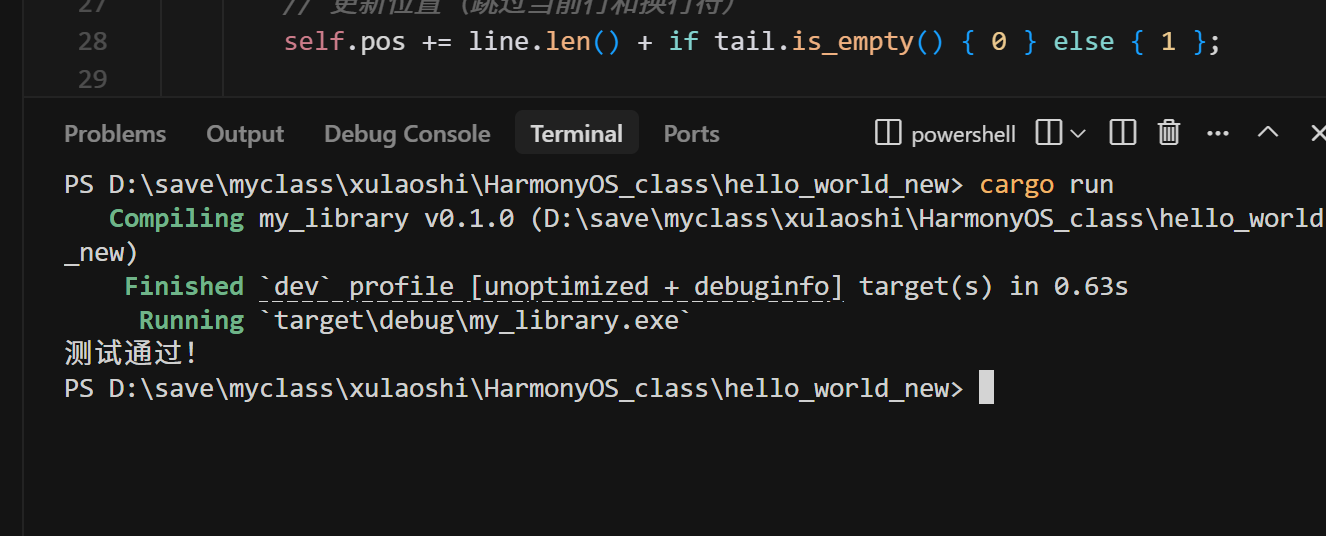
- 没有 GAT 时需要“返回 impl Iterator<Item=&str> + 'a”的构造,复杂且受限;GAT 让“与 self 同寿命的返回项”表达更自然。
2. HRTB:高阶 trait 约束(for<'a>)
表达“对所有生命周期都成立”的约束,典型用于函数式回调、借用闭包。
fn with_str<F>(s: &str, f: F)
where
    F: for<'a> Fn(&'a str) -> usize
{
    let _ = f(s);            // f 可以接受任意生命周期的 &str
}
for<'a>是“对所有'a”的量词;最常见在Fn(&'a T)的抽象上,否则会被推断为“某个具体'a”。
3. 型变(Variance)与 PhantomData
&'a T对'a协变(更长寿命可替换短寿命);&'a mut T不变;*const T协变;*mut T不变。- 使用
PhantomData为“零大小类型”声明所有权/生命周期关系,使编译器正确检查:
use std::marker::PhantomData;
struct RefWrap<'a, T> { ptr: *const T, _marker: PhantomData<&'a T> }
- 若不声明,编译器可能认为
RefWrap不携带'a的借用,导致逃逸或不安全。
4. 新类型(Newtype)与密封 Trait(Sealed)
- 新类型:
struct Bytes(Vec<u8>);用于隔离外部 trait/类型,满足孤儿规则并提供定制 API。 - 密封 trait:阻止外部 crate 实现某个 trait,以免破坏不变量:
mod sealed { pub trait Sealed {} }
pub trait Stable: sealed::Sealed { fn version(&self) -> u32; }

pub struct V1; impl sealed::Sealed for V1 {}
impl Stable for V1 { fn version(&self) -> u32 { 1 } }
5. API 设计模式速览
5.1 借用视图 + 拥有权版本
- 借用视图:
fn as_str(&self) -> &str/&[T]零拷贝; - 拥有权版本:
fn into_string(self) -> String;满足不同使用场景。
5.2 宽入窄出(AsRef/Into)
- 入参:
impl AsRef<Path>、impl Into<String>; - 出参:尽量返回具体类型(可预期、好推断)。
5.3 静态/动态双版本
- 热路径:
fn run<T: Trait>(t: &T); - 插件化:
fn run_dyn(t: &dyn Trait)。
5.4 结果与上下文
- 库:
thiserror;应用:anyhow::Result+.context()。
6. 组合范式:GAT × HRTB × 关联类型
trait View<'a> { type Out<'b> where Self: 'b; fn view<'b>(&'b self) -> Self::Out<'b>; }

struct Table { rows: Vec<String> }
impl<'a> View<'a> for Table {
    type Out<'b> = std::slice::Iter<'b, String> where Self: 'b;
    fn view<'b>(&'b self) -> Self::Out<'b> { self.rows.iter() }
}

fn consume_all<F>(f: F)
where
    F: for<'a> Fn(&'a str) -> ()
{ let _ = f("demo"); }
- GAT 让返回项随借用变化;HRTB 使回调对所有生命周期有效。
7. 常见坑与修复
- 把需要“对所有生命周期成立”的回调写成了“某个具体生命周期” → 补
for<'a>。 - 忘记在零大小持有者中声明
PhantomData→ 编译器不检查实际借用关系。 - GAT 中遗漏约束
where Self: 'a→ 无法保证返回引用与&self的关系。 - 过度动态分发导致性能退化 → 热路径尽量静态分发,必要时 bench。
8. 实战练习
- 为一个只读数据库 API 设计
trait Cursor,使用 GAT 让next()返回Item<'a>;实现内存表版本。 - 写一个
for<'a> Fn(&'a str) -> usize的统计器适配器,用于多处回调。 - 实现
struct Handle<'a, T>,用PhantomData<&'a T>表达借用;讨论何时需要PhantomPinned。
小结:GAT 与 HRTB 让“随借用变化”的抽象变得自然;配合型变、PhantomData 与密封/新类型模式,可以在大型工程中构建稳定、可演进、零成本的高级 API。

AtomGit 是由开放原子开源基金会联合 CSDN 等生态伙伴共同推出的新一代开源与人工智能协作平台。平台坚持“开放、中立、公益”的理念,把代码托管、模型共享、数据集托管、智能体开发体验和算力服务整合在一起,为开发者提供从开发、训练到部署的一站式体验。
更多推荐


 11
11 0
0- 0


 已为社区贡献48条内容

所有评论(0)