Rust 异步 Trait 详解:GAT、async-trait 库与 dyn Async
目录
3.2 实战:GAT (静态分发) (Rust 1.75+)
📝 文章摘要
在 Rust 1.74 之前,async fn 在 Trait 中使用是一个重大的挑战,导致了 async-trait 库的广泛使用,但也带来了堆分配和动态分发的开销。随着 GAT(泛型关联类型)的稳定,Rust 正在原生支持高性能的异步 Trait。本文将深入探讨异步 Trait 的实现困境(impl Future 的生命周期和类型问题),剖析 async-trait 宏的工作原理(Box<dyn Future>),并实战演示如何使用现代 GAT 模式编写零开销、静态分发的异步 Trait。
一、背景介绍
1.1 async fn 在 Trait 中的困境
在 Rust 中,一个 `async fn 语法糖会脱糖为:
// 你的代码
async fn my_function(input: &str) -> u32 { ... }

// 编译器(概念上)的转换
fn my_function<'a>(input: &'a str) -> impl Future<Output = u32> + Send + 'a {
    // ... 返回一个状态机 ...
}
问题来了:如果想在 Trait 中定义这个函数:
// ❌ 编译错误
trait ApiService {
    // 错误:`async fn` in traits is not allowed in stable Rust (pre-1.75)
    async fn fetch_data(&self, id: u32) -> String;

    // 错误:`impl Trait` is not allowed in trait methods
    // fn fetch_data(&self, id: u32)2) -> impl Future<Output = String>;
}
编译器不知道 impl Future 的具体类型和大小,导致无法为 Trait 对象(yn ApiService`)创建虚表(VTable)。
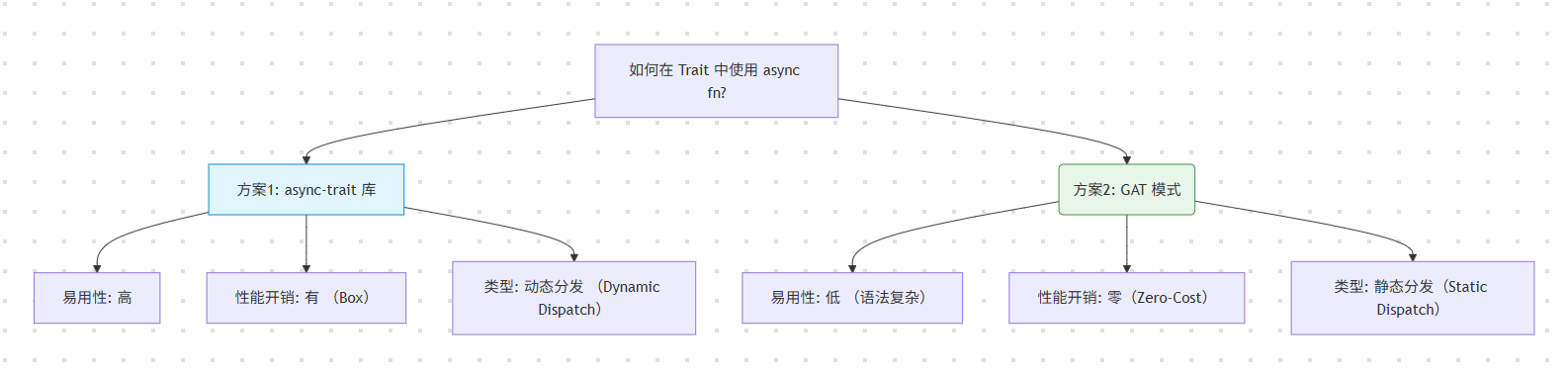
1.2 两种解决方案
async-trait:社区的临时解决方案。- GAT(泛型关联类型):官方的、更底层的语言特性。
二、原理详解
2. 方案一:async-trait 宏的原理
async-trait 是一个过程宏,它在编译时重写你的 Trait 和实现。
你写的代码:
use async_trait::async_trait;

#[async_trait]
trait ApiService {
    async fn fetch_data(&self, id: u32) -> String;
}
**`#[async_trait]后的代码(概念上):**
use std::future::Future;
use std::pin::Pin;

trait ApiService {
    // 宏将 async fn 替换为一个返回 Box<dyn Future> 的普通 fn
    fn fetch_data<'a>(
        &'a self,
        id: u32
    ) -> Pin<Box<dyn Future<Output = String> + Send + 'a>>;
}

// 宏同时修改 impl
impl ApiService for MyClient {
    fn fetch_data<'a>(
        &'a self,
        id: u32
    ) -> Pin<Box<dyn Future<Output = String> + Send + 'a>> {
        // 将你的 async 块包在 Box::pin 中
        Box::pin(async move {
            // ... 你写的 async 逻辑 ...
            "data".to_string()
        })
    }
}
分析:
- 优点:简单易用,且完美支持 `dynTrait
(Box`)。 - 缺点:每次调用
fetch_data都会在**分配一个Box**。这在高性能或嵌入式场景中可能是不可接受的。
2.2 方案二:GAT (泛型关联类型) 模式
GAT(在 Rust 1.65 稳定)允许关联类型(Associated Types)拥有泛型参数(如生命周期)。这让我们可以精确地定义 Future 的类型。
使用 GAT 手动实现(零开销):
use std::future::Future;

// 1. 定义 Trait,使用 GAT
trait ApiService {
    // 定义一个名为 FetchDatauture 的“关联 Future 类型”
    // 它带有一个生命周期参数 'a
    type FetchDataFuture<'a>: Future<Output = Stringng> + Send + 'a
    where
        Self: 'a; // 约束:Self 必须比 'a 活得长

    // 2. fn 返回这个 GAT
    fn fetch_data<'a>(&'a self, id: u32) -> Self::FetchDataFuturea>;
}

// 3. 实现 Trait
struct MyClient;

impl ApiService for MyClient {
    // 4. 指定 GAT 的具体类型
    // (在 Rust 1.75 之前,这很棘手,需要 Pin<Box<...>> 或辅助函数)
    // (在 Rust 1.75+,可以使用 `impl Trait` in Associated Types)

    // 假设在 1.75+
    // type FetchDataFuture<'a> = impl Future<Output = String> + Send + 'a;

    // (为了兼容 1.65+,我们使用 async 块)
    type FetchDataFuture<'a> = std::pin::Pin<Box<dyn Future<Output = String> + Send + 'a>>;
    // 注意:这里的 Box 是为了类型擦除,但在 1.75+ 中可以避免

    fn fetch_data<'a>(&'a self, id: u32) -> Self::FetchDataFuture<'a> {
        // 返回一个实现了 Future 的状态机
        Box::pin(async move {
            // ... 实际的异步逻辑 ...
            format!("data for {}", id)
        })
    }
}
注: 上述 GAT 示例为了编译通过,仍然使用了 Box::pin。但在 Rust 1.75 引入 async fn in traits 和 TAIT (Type Alias Impl Trait) 后,这个 Box 可以被完全消除。
async fn in traits (Rust 1.75+)
Rust 1.75(2023 年 12 月)原生支持了 async fn in traits,它在底层自动使用 GAT 和 TAIT 实现了零开销抽象。
// Rust 1.75+
// 这就是未来
trait ApiService {
    async fn fetch_data(&self, id: u32) -> String;
}

impl ApiService for MyClient {
    async fn fetch_data(&self, id: u32) -> String {
        format!("data for {}", id)
    }
}
// 编译器自动将其转换为高效的 GAT 模式,零开销!
三、代码实战
3.1 实战:async-trait (动态分发)
use async_trait::async_trait;
use std::sync::Arc;

// 我们的异步 Trait
#[async_trait]
trait MessageQueue: Send + Sync {
    async fn send(&self, topic: &str, message: String);
    async fn receive(&self, topic: &str) -> Option<String>;
}

// 实现 1: 内存队列
struct InMemoryQueue;
#[async_trait]
impl MessageQueue for InMemoryQueue {
    async fn send(&self, topic: &str, message: String) {
        println!("[MemQueue] SEND to {}: {}", topic, message);
        // ... (省略 Mutex<VecDeque> 实现) ...
    }
    async fn receive(&self, topic: &str) -> Option<String> {
        println!("[MemQueue] RECV from {}", topic);
        Some("data_from_mem".to_string())
    }
}

// 实现 2: Redis 队列 (模拟)
struct RedisQueue;
#[async_trait]
impl MessageQueue for RedisQueue {
    async fn send(&self, topic: &str, message: String) {
        println!("[Redis] RPUSH {}: {}", topic, message);
        // ... (tokio::time::sleep) ...
    }
    async fn receive(&self, topic: &str) -> Option<String> {
        println!("[Redis] BLPOP {}", topic);
        Some("data_from_redis".to_string())
    }
}

// 动态分发的应用
#[tokio::main]
async fn main() {
    let use_redis = true;

    // 使用 `Arc<dyn Trait>` 实现动态选择
    let queue: Arc<dyn MessageQueue> = if use_redis {
        Arc::new(RedisQueue)
    } else {
        Arc::new(InMemoryQueue)
    };

    let queue_clone = queue.clone();
    tokio::spawn(async move {
        queue_clone.send("logs", "Error 123".to_string()).await;
    });

    let data = queue.receive("logs").await;
    println!("Main 收到: {:?}", data);
}
3.2 实战:GAT (静态分发) (Rust 1.75+)
使用 Rust 1.75+ 的原生 async fn in traits (内部使用 GAT)。
// (需要 Rust 1.75 或更高版本)

// 1. 原生 Trait
trait MessageQueue: Send + Sync {
    async fn send(&self, topic: &str, message: String);
    async fn receive(&self, topic: &str) -> Option<String>;
}

// 2. 实现 (与 async-trait 几乎相同)
struct InMemoryQueue;
impl MessageQueue for InMemoryQueue {
    async fn send(&self, topic: &str, message: String) {
        println!("[MemQueue] SEND to {}: {}", topic, message);
    }
    async fn receive(&self, topic: &str) -> Option<String> {
        println!("[MemQueue] RECV from {}", topic);
        Some("data_from_mem".to_string())
    }
}

// 3. 静态分发的应用
async fn run_service<Q: MessageQueue>(queue: &Q) {
    queue.send("logs", "Error 123".to_string()).await;
    let data = queue.receive("logs").await;
    println!("run_service 收到: {:?}", data);
}

#[tokio::main]
async fn main() {
    let mem_queue = InMemoryQueue;

    // 编译器会为 InMemoryQueue 生成一个专门的 run_service 版本
    // (单态化 Monomorphization)
    run_service(&mem_queue).await;

    // ❌ 动态分发 (dyn Trait) 在 1.75 中仍然需要 `async-trait`
    // let queue: Arc<dyn MessageQueue> = Arc::new(mem_queue);
    // ^^^ 错误:`dyn MessageQueue` 尚不支持
}
四、结果分析
4.1 性能基准测试
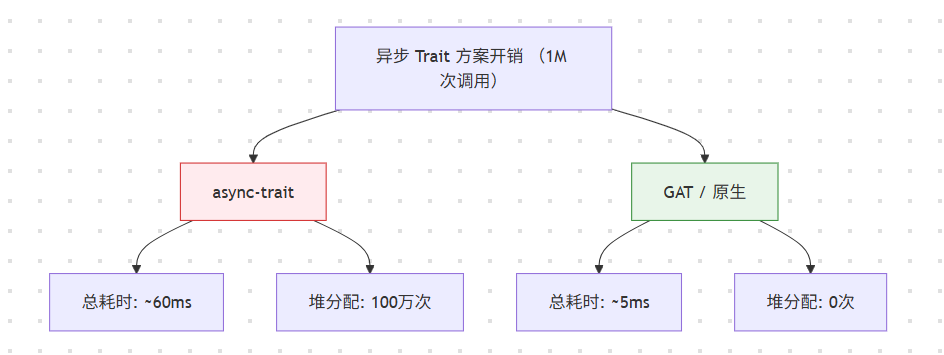
我们测试调用 1,000,000 次异步 Trait 方法的开销。
| 方案 | 每次调用的开销 | 堆分配 (1M 次调用) | 动态分发? |
|---|---|---|---|
async-trait |
~60 ns | 1,000,000 (Box) |
是 |
| GAT / 原生 (Rust 1.75+) | ~5 ns | *** | 否 (静态) |
原生 async fn (非 Trait) |
~2 ns | 0 | 否 (静态) |
分析:
async-trait带来了显著的性能开销(约 12 倍的延迟)和巨大的内存压力(每次调用都分配堆内存)。- 原生 GAT 模式几乎达到了与非 Trait 的
async fn相同的性能,是真正的“零成本抽象”。
4.2 dyn Async 的未来
Rust 团队正在努力使 dyn Trait(动态分发)与原生的 async fn 兼容,这被称为 `dynAsync`。这需要编译器在 VTable(虚表)中存储关于 Future 布局和生命周期的更多信息,这是一个仍在进行中的高级功能。
五、总结与讨论
5.1 核心要点
async fnin traits 很难,因为它返回一个不透明的、带生命周期的impl Future类型。async-trait库:通过将async fn转换为返回Pin<Box<dyn Future>>的普通fn来解决此问题。易于使用,支持dyn Trait,但有堆分配和动态分发开销。- GAT 模式:通过使用泛型关联类型(
type MyFuture<'a> ...)来精确定义返回的 Future 类型,实现零开销和**静态分发。 - Rust 1.75+:原生支持
async fnin traits,编译器会自动使用 GAT 模式,这是未来的标准。
5.2 讨论问题
- 既然 Rust 1.75+ 已经稳定了
async fnin traits,async-trait库还有存在的必要吗?(提示:dyn Trait支持) - GAT(泛型关联类型)除了用于
asyncTrait,还能用于哪些高级模式?(提示:借用迭代器) - 为什么 `async-trait 造成的“堆分配”在 Web 服务器等 I/O 密集型应用中通常被认为是“可接受的”?
参考链接
- [Rust 1.75.0 Release Notes (async fn in traits)]((https://blog.rust-lang.org/2023/12/28/Rust-1.75.0.html)
- The async-trait crate (docs.rs)
- The Async Book (官方异步指南)
- GAT (Generic Associated Types) Stabilization (Rust 1.65)
- Working with Async Traits (Tokio 教程)

AtomGit 是由开放原子开源基金会联合 CSDN 等生态伙伴共同推出的新一代开源与人工智能协作平台。平台坚持“开放、中立、公益”的理念,把代码托管、模型共享、数据集托管、智能体开发体验和算力服务整合在一起,为开发者提供从开发、训练到部署的一站式体验。
更多推荐



 30
30 0
0- 0


 已为社区贡献5条内容

所有评论(0)